
Epstein’s Echo: Will Andrew’s Trade Blunders Delay £19Billion UK Trade Deal With India?

Britain reels from the arrest of Andrew Mountbatten-Windsor, once Prince Andrew, on his 66th birthday over Epstein ties, questions swirl around New Delhi’s corridors. Could this royal mess cast a shadow on the freshly inked UK-India Free Trade Agreement (FTA), set to unlock £19 billion in UK exports to India?

With the pact eyeing rollout in April, Indian businesses eye massive gains, but trust in UK diplomacy hangs by a thread. Mountbatten-Windsor, nabbed Thursday on suspicion of misconduct in public office, allegedly funneled sensitive trade docs to Jeffrey Epstein during his 2001-2011 stint as UK’s trade envoy.

Emails from US Justice Department files show him sharing “confidential briefs” on investment opportunities and visit reports from Vietnam, Singapore, Hong Kong, and Shenzhen in 2010-2011. “Andrew forwarded Epstein reports about Vietnam, Singapore and other places,” notes a Reuters report, highlighting itinerary shares too.

These leaks, post-Epstein’s 2008 conviction, smack of betrayal. Thames Valley Police are probing if this breached the Official Secrets Act, with Buckingham Palace pledging support for any inquiry.

Andrew India visit / PIB

For India, the timing stings. The FTA, signed July 2025 after 15 negotiation rounds, promises tariff cuts on 99% of Indian exports entering UK duty-free, slashing UK duties by up to £400 million yearly, rising to £900 million in a decade. Bilateral trade hit £47.2 billion last year, up 15%, making India UK’s 10th top partner.

But Andrew’s Asia blunders raise red flags. His 2010 tour overlapped with UK’s push into emerging markets, including India. Sharing intel with a convicted felon could expose vulnerabilities in deals involving sensitive sectors like tech and defence, areas India guards closely amidst China tensions.

Andrew made several high-profile visits to India, most notably in 2006, 2010, May 2012 for Queen Elizabeth II’s Diamond Jubilee, visiting Chennai, Mumbai, and Nagaland to strengthen defense and trade ties. He visited again in 2015 for various diplomatic and business engagements, including the trade deal.

Though there is no direct India link in leaks or the scandal, its fresh fallout is turning wary. Post-Brexit, UK needs India for growth, but New Delhi, juggling FTAs with EU and US, might demand stricter safeguards now.

On X, chatter hints at unease. While global posts rage over Andrew’s arrest, Indian voices tie it to diplomacy: “UK’s royal rot could spoil our trade party,” tweets analyst @IndiaEconWatch, echoing fears of delayed gains.

Yet, optimism lingers. A commerce ministry official said the pact’s on track for mid-2026, with services provisions limited but goods flowing freer. For Indian firms eyeing UK markets, from autos to pharma, this Epstein echo is unlikely to affect trade ties for now.

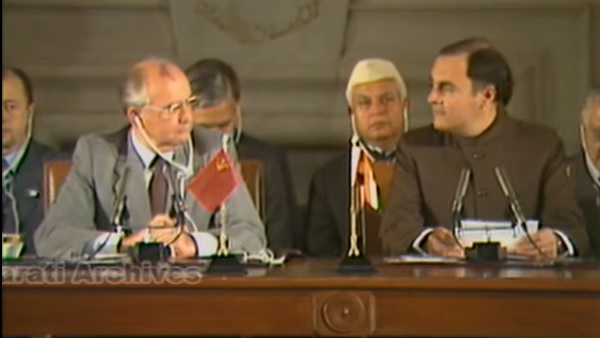
Gorbachev dies at 91; India connection, contribution

Mikhail Gorbachev, a friend of India who visited twice in the mid-1980s, died on Tuesday aged 91 after a prolonged illness. He was the last Soviet president who ended the Cold War without bloodshed though could not prevent the collapse of the Soviet Union.

“Mikhail Gorbachev passed away tonight after a serious and protracted disease,” said Russia’s Central Clinical Hospital. President Vladimir Putin expressed “his deepest condolences”, and World leaders paid tribute. European Commission chief Ursula von der Leyen said Gorbachev, who was awarded the Nobel Peace Prize in 1990, had opened the way for a free Europe.

U.S. President Joe Biden said he had believed in “glasnost and perestroika – openness and restructuring – not as mere slogans, but as the path forward for the people of the Soviet Union after so many years of isolation and deprivation.”

He will be buried in Moscow’s Novodevichy Cemetery next to his wife Raisa, who died in 1999.

On becoming general secretary of the Soviet Communist Party in 1985, aged just 54, he had set out to revitalize the system by introducing limited political and economic freedoms, but his reforms spun out of control.

“He was a good man – he was a decent man. I think his tragedy is in a sense that he was too decent for the country he was leading,” said Gorbachev biographer William Taubman, a professor emeritus at Amherst College in Massachusetts.

Gorbachev’s policy of “glasnost” allowed previously unthinkable criticism of the party and the state, but also emboldened nationalists who began to press for independence in the Baltic republics of Latvia, Lithuania, Estonia and elsewhere.

India Visits in 1986, 1988

Gorbachev, throughout his tenure championed for strong Soviet-India relations and visited India twice in 1986 and 1988. In 1986 he was received by then Indian Prime Minister Rajiv Gandhi.
“When friends come calling, our hearts light up. We are delighted to have you in our midst,” Rajiv Gandhi said during the press conference.

Gorbachev said India and Soviet Russia strive for lasting global peace and said Soviet Russia will always support India’s real interests. “We shall not take a single step in our foreign policy that could damage India’s real interests,” Gorbachev said. It was during this visit that Gorbachev and Gandhi also signed the Delhi Declaration which “called for the complete destruction of nuclear arsenals before the end of the century, and asserted the importance of solving problems in a non-violent way.”

Gorbachev’s India visit

Soviet Russia and India opened more avenues of cooperation in sectors of space, infrastructure development and defence during the visit. Russia committed to provide India with the latest military hardware and months after, India received advanced MiG29s from Soviet Russia.

When Rajiv Gandhi visited Moscow in 1987, Gorbachev held a private meeting with him lasting for six hours. He also dedicated a monument to his mother and former prime minister Indira Gandhi and named a Moscow square in her memory.