
Reaching a child in Darfur is ‘hard-won and fragile’, says UNICEF

Briefing journalists in Geneva on Friday, Eva Hinds, the UN child agency’s Chief of Communications, described a humanitarian response that is fragile, painstaking and essential, following her return from a 10-day mission to Darfur.

For nearly three years, rival militaries who were former allies have been battling for control of the shattered country, engaged in a brutal civil conflict that has destablised multiple countries bordering Sudan. 

In Darfur today, reaching a single child can take days of negotiation, security clearances, and travel across sand roads under shifting frontlines,” she said. “Nothing about this crisis is simple: every movement is hard-won, every delivery fragile.

City built from fear

Ms. Hinds had just returned from Tawila, in North Darfur, where she witnessed what she described as an entire city rebuilt from desperation. Hundreds of thousands of people have fled violence and erected makeshift shelters from sticks, hay and plastic sheeting.

“Over 500,000 to 600,000 people are sheltering there,” she reported. “But standing inside that vast expanse of makeshift shelters was overwhelming. It felt like an entire city uprooted and rebuilt out of necessity and fear.

Despite the insecurity and logistical hurdles, UNICEF and its partners are still reaching children.

Effective aid operation

In just two weeks, more than 140,000 children were vaccinated, thousands treated for illness and malnutrition, safe water restored to tens of thousands, and temporary classrooms opened.

“It is painstaking, precarious work – delivered one convoy, one clinic, one classroom at a time – but for children in Darfur, it is the thin line between being abandoned and being reached,” Ms Hinds said.

She described meeting Doha, a teenage girl newly arrived from Al Fasher, who dreams of returning to school and one day teaching English. “Her name refers to the soft light just after sunrise,” Ms Hinds said. “She embodies that image – hopeful and determined.”

‘The children are freezing’

At a nutrition site, she met Fatima, a young girl being treated for malnutrition after losing her mother to the conflict.

At a centre for women and girls, mothers spoke of having no food, blankets or warm clothes for their children. “The children are freezing,” one mother told her. “We have nothing to cover them with.”

“These personal stories reflect only a small part of a much wider situation,” Ms Hinds said, stressing that Sudan is now the world’s largest humanitarian emergency, yet one of the least visible.

What I witnessed is a humanitarian catastrophe unfolding on a massive scale,” she warned.

Sudan’s children urgently need international attention and decisive action. Without it, the horrors facing the country’s youngest and most vulnerable will only deepen.”

Source link

Gaza crisis deepens as UN warns children are ‘dying before reaching hospital’

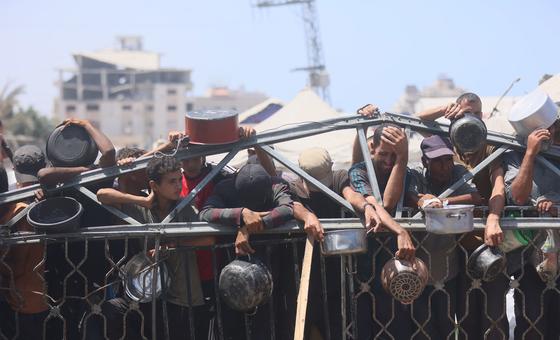
With 96 per cent of households lacking clean water, many malnourished children are not surviving long enough to receive hospital care.

James Elder, Spokesperson for the UN Children’s Fund (UNICEF), told at a news briefing in Geneva that it would be a mistake to assume the situation is improving.

There’s a sense through the world’s press that things are improving,” he said. “But unless there is sustained humanitarian aid…there will be horrific results.

He emphasised the scale of need: “When food comes in which supports 30,000 children, there are still 970,000 children not getting enough. It is a drop in the ocean.”

Aid still a trickle

The UN relief coordination office, OCHA, said that although unilateral pauses have allowed some aid into Gaza, the current trickle is vastly insufficient.

“There should be hundreds and hundreds of trucks entering Gaza every day, for months or years to come,” said Jens Laerke, OCHA spokesperson. “People are dying every day. This is a crisis, on the brink of famine.

Thousands of tons of pre-funded aid remain stuck just outside the enclave, he added, as bureaucratic delays and lack of safe access continue to block distribution.

Urgent scale-up needed

In New York, UN Deputy Spokesperson Farhan Haq also noted the impediments to bringing in and distributing sufficient aid.

“Massive food shortages continue to impact people’s chances for survival,” he said. “As malnutrition levels rise, children’s immune systems are weakened, hindering their development and growth far into the future.”

Last Thursday alone, 71 kitchens delivered over 270,000 hot meals across Gaza, including 10,000 to health facilities. But that figure falls far short of what’s needed to feed more than two million people.

We need an urgent scale-up of supplies, as well as an environment that allows humanitarians to reach people in need safely, rapidly and efficiently,” Mr. Haq added.

Health challenges continue

Some medicine has entered Gaza in recent days, but supplies remain limited. Health workers continue to operate under extreme pressure and shortages.

The World Health Organization (WHO) reported 46 cases of Guillain-Barré syndrome in July, including two deaths. The condition, which affects the nervous system, has been linked to compromised immunity, poor nutrition and hygiene-related infections.

The situation of pregnant women and nursing mothers is equally alarming. The UN reproductive health agency, UNFPA, said that 40 per cent of pregnant or breastfeeding women are suffering from severe malnutrition, with newborn deaths and stillbirths on the rise.

Meanwhile, three UN fuel tankers reached Gaza City on Monday. The fuel will power critical health, water and sanitation services, but OCHA stressed this only allows operations to run at “bare minimum” capacity.

Source link