
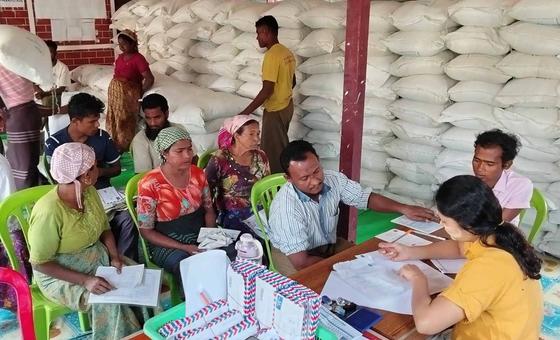
‘Wars, disasters, displacement, hunger’ continue to burden Myanmar

Four years after the military coup which deposed the democratically elected government, Myanmar’s civil conflict grinds on, leaving millions displaced and without a home.

The suffering of millions of people across Myanmar is immense,” said UNHCR chief Filippo Grandi. “With aerial bombardments, destruction of property, and forced recruitment, they live in daily fear for their lives.”

He added that “civilian men, women and children must be protected from violence, and solutions found so that they can choose to return home in safety and dignity.”

Many crises in need of response

A brutal civil war is not all Myanmar has to face.

In March, a 7.7 magnitude earthquake hit the country affecting multiple regions including the capital, Nay Pyi Taw. The UN relief chief Tom Fletcher said then on X that the humanitarian response “has been hampered by lack of funding.”

Mr. Grandi, who visited the affected communities earlier this year, urged wider humanitarian access and discussed solutions for the forcibly displaced.

“Millions of people forcibly displaced within the country and as refugees throughout the region, want nothing more than to be able to return home. They demand – and are entitled to – the safety and security that comes with peace.” Mr. Grandi said.

Homes destroyed

Thousands of people also had their homes destroyed after floods swept through many regions in July.

“Wars, disasters, displacement, hunger: the forgotten plight of so many people in Myanmar, like the Rohingya, never ends,” Mr. Grandi said in a post on X.

In the last year and a half, 150,000 Rohingya, a mainly Muslim minority in the majority Buddhist country, have fled to neighbouring Bangladesh. This marks the largest exodus to the country since 2017, when 750,000 Rohingya sought refuge from the violence in Rakhine state.

A call for solutions

UNHCR works with other UN agencies, NGO partners and communities in Myanmar to address the basic needs, physical safety and well-being of forcibly displaced and stateless people.

But many communities still suffer from lack of access to vital aid. This year’s UN response plan for Myanmar is currently only funded at 22 per cent.

Later this month in New York, Mr. Grandi will attend a high-level conference on the Rohingya and other minorities in Myanmar, calling for greater regional and international efforts to address the crisis.

All parties – with the support of the international community – must engage seriously to find solutions to their plight. This is particularly needed for the Rohingya, who have not only been attacked and displaced, but deprived of their basic rights for far too long,” the UNHCR chief said.

Source link

Why OROP Issue Was a Pre-poll Harakiri by BJP?

Modi promised to implement OROP in his 2nd Independence Day speech but war veterans are not ready to quit hunger strike. (PIB)

The One Rank One Pension (OROP) scheme that was hanging on the Finance Ministry for over five years, both the Congress-led UPA government and the BJP-led NDA government under Narendra Modi should own the responsibility for perpetuating it despite full knowledge that it was beyond mere political calculations involving a huge dent on the exchequer.

While the Congress relented just before the election year to benefit from the votes of these 30 lakh beneficiaries, BJP weaned them away promising its immediate implementation. Once in power, the staggering amount of Rs.8500 crore has forced Finance Minister Arun Jaitley to postpone the OROP beyond the second budget, forcing the ex-servicemen to hit the streets and now end up at the Jantar Mantar in hinger strikes.

For those new to the subject, implentation of OROP entails uniform pension benefits for the defence persons who retired in the same rank with the same service term, irrespective of their date of retirement. Current policy entails only those who retired after 1996 to draw more pension than those who retired before, though rank is the same.

With OROP, 22 lakh ex-servicemen and about 6 lakh war widows will get Rs.10,000 more on average. This has become imminent because the current policy entails those who retired after 1996 to draw more pension than those who retired before, though rank is the same.

“Modi has assured us that it will be implemented, but it has been one year,” said retired Colonel Anil Kaul, who is the media adviser to Indian Ex-Servicemen Movement (IESM) that is sprearheading the protest in New Delhi at Jantar Mantar. “The Prime Minister’s voice still echoes in our minds when he roared at the ex-servicemen rally on September 15, 2013, in Rewari and demanded a white paper on OROP from the UPA Government,” said ISEM earlier.

Now that the relay hunger strike entered 65 days, many war veterans who were in the forefront to die for the country are openly preparing themselves to die for the OROP implementation. Strange but no country would have upset its ex-servicemen given a chance.

In case of the Modi’s government too the question is bigger than mere rhetorics. Pumping in Rs.8,500 crore even if it is in incremental way, would mean a huge burden diverting funds from the developmental plans. Secondly, OROP would also undercut the cost of military expenditure on armaments but shows bigger than any other nation in the short run.

Finally, the government has no choice but to implement it. The question is from where will the finance minister draw the funds?