UN Assembly president defends multilateralism, UN Charter in Davos

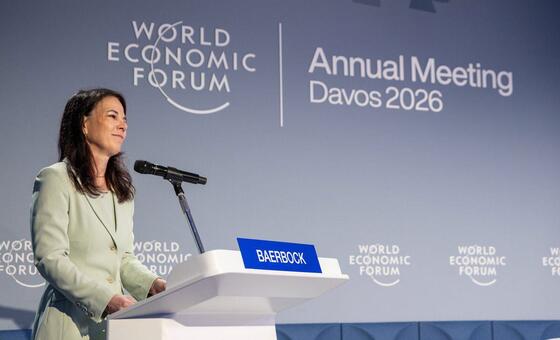
Speaking at the session Who Brokers Trust Now? at the World Economic Forum, Annalena Baerbock warned that multilateral institutions – long seen as the brokers of global trust – are under unprecedented strain as conflicts multiply and respect for international law erodes.

“Who brokers trust?” she asked. “In ordinary times, there would be a simple answer: multilateral institutions like the United Nations.” But, she added, these are “not ordinary times”.

Ms. Baerbock said the world is facing more conflicts than at any point in recent history. Since the start of 2026, she said, divisions have deepened further, leaving some Member States hesitant to act when circumstances demand principled conviction.

Voices that were once outspoken in their support for all the three pillars of the United Nations Charter – peace and security, sustainable development, and human rights – fall more and more silent in the face of their erosion,” she said.

The UN is not only under pressure but under outright attack.

Facts and truths not up for negotiation

Ms. Baerbock stressed that trust cannot exist without truth and shared facts – foundations she said are increasingly undermined by deliberate disinformation.

“Without facts, you can’t have truth. Without truth, you can’t have trust,” she said, quoting Nobel Peace Prize laureate Maria Ressa.

She cautioned that falsehoods are rarely accidental, but are often deployed to “weaponize mis- and disinformation”, while diplomatic silence in the face of obvious falsehoods only deepens mistrust.

We do not negotiate truths and facts,” Ms. Baerbock said. “We use them to negotiate, to broker trust.

She highlighted the risks posed by artificial intelligence, noting that while AI offers enormous benefits, it is also being used to blur the line between truth and lies. Deepfakes, she said, are “systematically attacking women”, citing figures showing that the overwhelming majority of such content is pornographic and targets women.

UN Charter – ‘world’s life insurance’

Ms. Baerbock also highlighted that trust is impossible without common rules, arguing that respect for international law is not naïve idealism but a matter of enlightened self-interest.

Trust is built on rules,” she said, likening the global system to competitive sports or markets where predictability and fairness are essential. “Why would you put your money into a business if the competition rules are totally unpredictable?

Recalling the founding of the United Nations 80 years ago, she said leaders at the time chose cooperation after witnessing the catastrophic consequences of a lawless international order.

The UN Charter, she added, remains “the world’s common life insurance”, just as a rules-based economic order underpins global business and investment.

A call for broad alliance

The General Assembly President concluded by calling for a broad alliance – spanning governments, businesses and regions – to stand up for the international order and defend shared principles, even when it is politically or economically costly.

“Trust is brokered by those who hold up the common rules and principles, even when it is hard,” she said. “By those who act when action is required…and by those who speak the truth, when silence or distortion would be easier.”

The challenge now, Ms. Baerbock emphasised, is whether today’s leaders can act with the same courage and conviction as those who built the post-war international system.

The founders of the United Nations understood that because they had seen what the alternative would mean, in a world where might makes right, there can be only one outcome: chaos and war.

Source link

Haiti crisis at breaking point as gangs tighten grip ahead of transition deadline

With the political transition set to expire on 7 February, officials cautioned that escalating violence, entrenched criminal networks and mounting humanitarian needs risk pushing Haiti further into instability unless security and political efforts are urgently sustained.

Carlos Ruiz-Massieu, the head of the UN Integrated Office in Haiti (BINUH), said the country had entered a “critical phase” in efforts to restore democratic institutions, calling on Haitian actors to contain political fragmentation and prioritise elections.

“Let us be clear: the country no longer has time to waste on prolonged internal struggles,” he said, stressing the need for continuity of governance arrangements beyond the February deadline and sustained coordination to bring the transition to a close.

Mr. Ruiz-Massieu said recent steps toward elections were encouraging, citing the adoption of an electoral decree on 1 December and the publication of an calendar for going to the polls later that month.  

New provisions on voter registration, overseas voter participation and women’s representation could boost inclusivity if effectively implemented, he added.

Security still fragile

But progress on the political front is unfolding against a deteriorating security landscape.

Gangs continue to mount coordinated attacks, control key economic corridors and agricultural regions, and force mass displacement – stretching police and humanitarian capacity to the limit.

The murder rate in 2025 rose by nearly 20 per cent compared with 2024, he said.

Some security gains have been made. Police operations, supported by the Security Council-authorised Gang Suppression Force, have reopened roads in parts of Port-au-Prince and the Artibonite Department, while state presence around the capital’s Champ de Mars has been gradually restored.

Mr. Ruiz-Massieu cautioned, however, that such gains remain fragile and risk reversal without sustained pressure and basic service delivery.

Read our explainer on the situation in Hait: Why the crisis is deepening, and what comes next

Gangs reorganising and restructuring

The evolving violence reflects a deeper transformation of Haiti’s criminal landscape, according to John Brandolino, Acting Executive Director of the UN Office on Drugs and Crime (UNODC).

Once-fragmented gangs have reorganised into structured criminal networks with defined leadership, territorial ambitions and diversified revenue streams.

Coalitions such as Viv Ansanm have coordinated large-scale attacks on police, prisons and economic infrastructure, he said, allowing gangs to consolidate control over Port-au-Prince and strategic corridors into Artibonite and Plateau Central.

Extortion has become a core revenue source, alongside trafficking in drugs, weapons and ammunition.

Implications for regional security

UNODC said the crisis is increasingly regional, driven by adaptive arms-trafficking routes, illicit financial flows and corruption. Despite enforcement efforts, traffickers continue to shift routes through weaker ports and offshore transfers to evade embargo controls.

Both officials underscored the importance of the transition of the Multinational Security Support Mission into the Gang Suppression Force and the establishment of the UN Support Office in Haiti, calling for predictable funding and continued international backing.

Beyond security, the humanitarian situation remains dire. Around 6.4 million people require assistance, with Haiti among the least-funded humanitarian responses globally.

Source link

At the edge of war: the Central African Republic’s uneasy border with Sudan

Since the beginning of the civil war in Sudan, tens of thousands of refugees have fled south to the area, carrying with them not only what they could salvage from their homes, but the woes of the world’s largest humanitarian crisis.

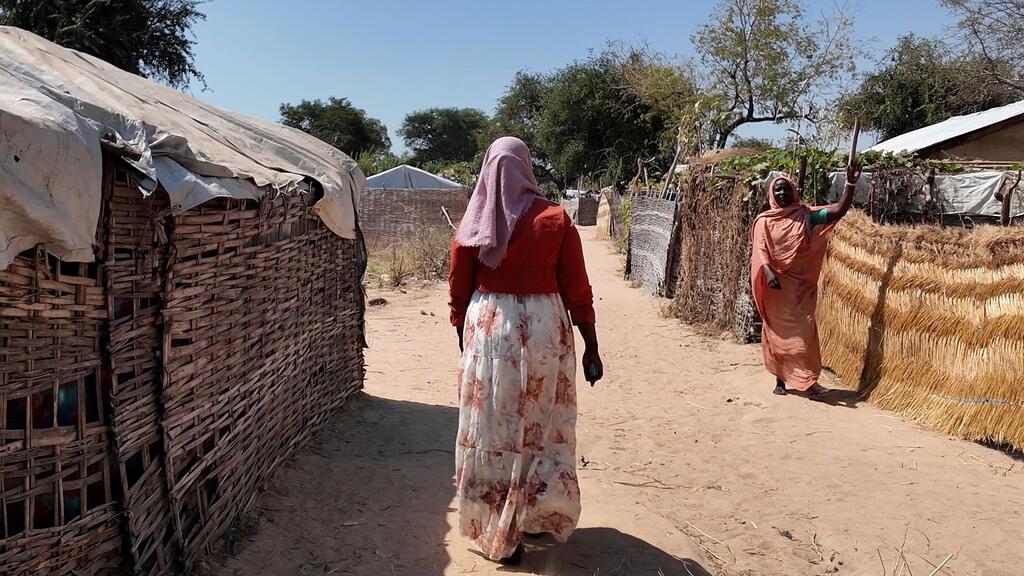
On a sweltering November day, at the start of the dry season, a tall woman was standing in the shade of a tree near a plastic tent, amid the thatched-roof houses of Korsi, a neighbourhood hastily built on the outskirts of Birao to absorb the tide of new arrivals. 

Nafeesa, as we’ll call her, said she came from a city outside Khartoum, the Sudanese capital, more than 700 miles away.

When the war broke out there, in April 2023, she and her family headed west to South Darfur, where her husband opened a small shop in a local market. One day, armed men burst into the store and threatened him. He managed to escape, but they followed him home.

UN News/Alban Mendes de Leon

Nafeesa (center, from behind), whose real name has been changed to protect her safety, said she came from a city outside Khartoum, the Sudanese capital, more than 700 miles away.

That same night, the men returned to finish the job. 

“They came to us at 1:30am,” Nafeesa, whose real name has been changed to protect her safety, recalled in Arabic. “He got out of bed, but they shot him three times.” 

About this article

This reported story was produced with the support of the UN peacekeeping mission in the Central African Republic (MINUSCA). It explores how the war in neighbouring Sudan is affecting communities in areas where the mission is tasked with protecting civilians. 

The mission at a glance

  • Deployed: 2014, following the outbreak of the Central African civil war 
  • Mandate: Protection of civilians; support to stabilization, the peace process, and the restoration of state authority
  • Personnel: 18,313 uniformed and civilian staff, including 13,307 troops 
  • In northern CAR: roughly 900 peacekeepers, including 600 in Birao

She and her nine-year-old son were tied up as her husband lay dying. “They took our money, our belongings, and our clothes.”

She spoke in a soft voice, her hands covered with dainty henna patterns, but her face was hardened by grief and exile.

After the killing, she decided to leave Sudan with the rest of her family.

The war spreads

The events that forever altered the course of Nafeesa’s life were put into motion by the rupture between Sudan’s army chief, general Abdel Fattah al-Burhan, and the paramilitary commander of the Rapid Support Forces (RSF), Mohamed Hamdan Daglo. 

Nearly three years later, what started as a power struggle in Khartoum metastasized into nationwide bloodshed. Roughly 30 million people have been pushed into humanitarian distress and more than 10 million have fled their homes, half of them children. Since the summer of 2024, famine has taken hold in various parts of the country.

In late October 2025, the war reached a new threshold. After more than 500 days of siege, the RSF seized the city of El Fasher, the last government stronghold in North Darfur. Hundreds of thousands were displaced. Reports emerged of ethnically targeted massacres against non-Arab communities, mass rape, and summary executions.

For many Darfuris, the violence felt chillingly familiar. The RSF trace their origins to the Janjaweed militias that fought alongside the Sudanese government during the Darfur war, more than two decades ago. 

That conflict pitted them against the region’s non-Arab communities – the Fur, the Masalit, and the Zaghawa. Just weeks before the fall of El Fasher, the International Criminal Court (ICC) convicted Ali Muhammad Ali Abd-Al Rahman – a former Janjaweed leader known as Ali Kushay – of war crimes and crimes against humanity committed in West Darfur in 2003 and 2004. Prosecutors warned that similar atrocities were again being committed today, often with rape used as a weapon of war.

Borders without barriers

Like Nafeesa, many people living in Darfur cross south into the Central African Republic, where they arrive in Am Dafock, a border town sitting on marshy ground two hours away from Birao.

They came to us at 1:30am…. He got out of bed, but they shot him three times.

There is no fence, no physical barrier marking the end of one country and the beginning of the other – just a dried-up riverbed spanning the invisible line drawn on maps.

People move back and forth freely – by foot, riding donkeys, or with cattle. Armed men cross, too. 

In the words of Ramadan Abdel Kader, the area’s deputy governor, the town’s recent history has been defined by fear. “The population was plunged into absolute distress,” he told us. Men suspected to be RSF fighters crossed the border to loot, kill, and terrorize villagers. 

At the height of the violence, he said, up to 11,500 people – a large chunk of the Am Dafock population – fled their homes. 

They found shelter near the local base of MINUSCA, the UN peacekeeping mission in the Central African Republic (CAR), which set up camp in the border town after the Sudanese crisis erupted. “Were it not for its presence here, this locality would have been overrun by armed elements from Sudan,” the official said.

UN News/Alban Mendes de Leon

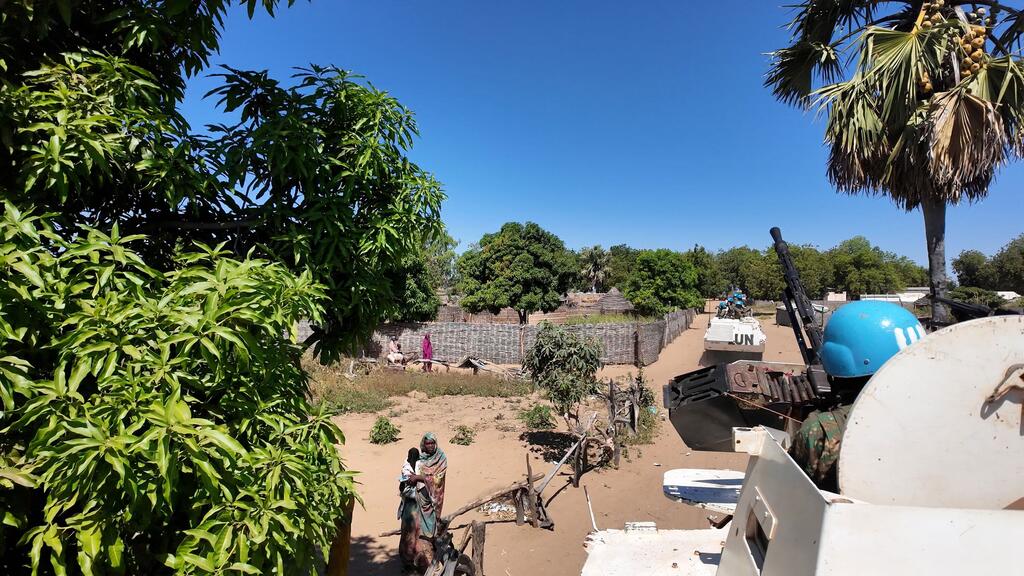
In the north of the Central African Republic, where seasonal flooding regularly cuts the region off from the rest of the country, MINUSCA forces patrol vast distances with limited infrastructure.

Born of another war

The reason for MINUSCA’s presence in the country has scarcely anything to do with its embattled neighbour. The mission was deployed in 2014 as the Central African Republic descended into chaos, following the seizure of power by the Séléka, a predominantly Muslim coalition that overthrew the president at the time, François Bozizé. What followed was a spiral of violence in which Séléka fighters and mostly Christian militias known as the anti-Balaka committed widespread abuses against civilians – killings, looting, sexual violence – plunging the country into cycles of communal bloodshed.

The violence pushed the country to the brink of collapse. Entire communities were displaced along religious lines. State authority evaporated outside the capital, Bangui. 

More than a decade later, the Séléka has disbanded, two presidential elections have been held, and a 2019 peace agreement brought 14 armed groups into a political process. Still, large swaths of the country remain unstable, and the UN mission maintains more than 13,000 troops across the landlocked nation.

We are operating in an environment where the state is still rebuilding itself

In the north, where seasonal flooding regularly cuts the region off from the rest of the country, MINUSCA forces patrol vast distances with limited infrastructure. “We are operating in an environment where the State is still rebuilding itself,” said Major Obed Mumba, the commander of the roughly 200 peacekeepers stationed in Am Dafock. “Our role here is first and foremost to protect civilians and to prevent any escalation that could destabilize the region further.”

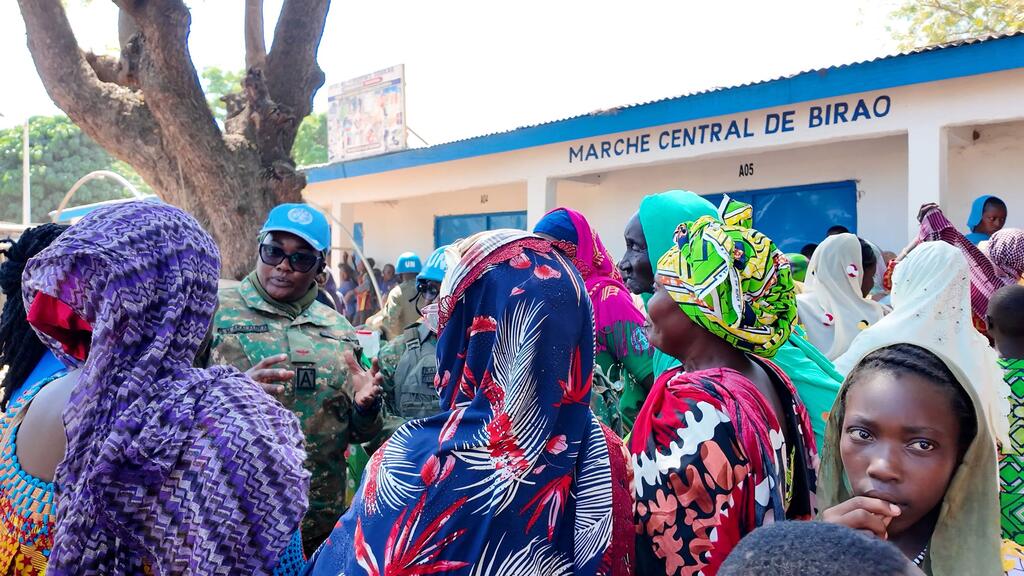
With the Sudanese war raging at its doorstep, the mission has taken on a renewed sense of urgency. For Major Sifamwelwa Akalaluka, who leads MINUSCA’s community engagement efforts in Birao, its work is inseparable from the human terrain. “We engage with the population every day,” she said. “We listen to women, to youth, to community leaders. This helps us understand where tensions are rising before they turn into violence.”

When land becomes contested

Those tensions, local officials and residents told us, were not driven solely by the presence of armed men crossing over from Sudan. They were also fuelled by competition over land and resources between Sudanese pastoralists, fleeing violence with their herds, and Central African farmers, whose fields lie along transhumance routes – traditional paths used to move livestock in search of pasture.

As Sudanese breeders have moved south with their cattle, crops were trampled, wells were strained, and disputes multiplied. 

What had once been seasonal friction hardened into confrontation, exacerbated by rumours, opportunistic traders, and the circulation of weapons in an already volatile border zone. Suspected RSF fighters and other armed elements exploited the chaos.

By September, according to Tamia Célestin, one of Am Dafock’s community leaders, the situation had reached a breaking point. “We recorded numerous cases of rape,” he said. “Young girls, some of them 12 or 13 years old, were attacked. People were afraid to go to their fields.” That month, local leaders registered six bodies shot dead and nearly 26 cases of sexual violence. 

UN News/Alban Mendes de Leon

Talking under the trees

In response, MINUSCA facilitated a cross-border dialogue, bringing together Central African and Sudanese communities who had been living face to face – and increasingly at odds. From October 27 to 30, 2025, more than a hundred delegates gathered in Am Dafock, sitting on benches and mats beneath trees, in the absence of any formal meeting hall.

Religious leaders, village chiefs, traders, members of transhumance committees, and nine women faced one another across the dusty clearing. “The dialogue was not easy,” Mr. Célestin, who took part in the three-day talks, recalled. “But people spoke.” Grievances were aired. Accusations exchanged. Boundaries redrawn – not on maps, but in words. “In the end, we agreed that the violence had to stop,” he said

A local agreement was signed just two weeks before our arrival. It banned the carrying of weapons, reaffirmed transhumance corridors for cattle, and committed both sides to resolving disputes through local committees rather than force. Since then, residents said, the gunfire had mostly quieted. The fields were being cultivated again. The border remained open – but calmer.

Am Dafock was buzzing with preparations for the upcoming general elections, as residents were preparing to choose an official mayor for the first time in decades – municipal polls had not been held in the country since 1988.

On December 28, Central Africans voted overwhelmingly for the incumbent president, Faustin-Archange Touadéra, securing him a third term. 

For many residents there, the ballot carried the promise of normalcy, or at least continuity, in a region long starved of both.

That promise, however, remains elusive.

UN News/Alban Mendes de Leon

Major Sifamwelwa Akalaluka, who leads MINUSCA’s community engagement efforts in Birao, talks to women at the town’s market.

Waiting for somewhere safe

Back in 2023, Nafeesa did not stay long in Am Dafock, where she’d arrived with her family after the murder of her husband. Like thousands of other Sudanese seeking distance from the war, the insecurity at the border pushed her onward to Birao. 

There, the UN refugee agency (UNHCR) worked with local authorities to register new arrivals and organize their survival. “They gave us blankets and mattresses for my children,” she said. “They gave me the house where I am staying now.”

Today, more than 27,000 Sudanese refugees live in and around Birao, an overwhelming number for a town that claims fewer than 18,000 residents of its own. “This is a rather unusual situation,” acknowledged Jofroy Fabrice Sanguebe-Nadji, a UNHCR staff member on the ground. 

“The arrival of a significant number of refugees has put a strain on resources that were already limited in the first place.” Water and basic services have been stretched thin. 

People entered at night and killed the boy. We couldn’t find him.

In Korsi, the refugee neighbourhood where Nafeesa now lives, humanitarian organisations have carved out a delicate ecosystem. “This is not a camp,” explained Mr. Sanguebe-Nadji. “It is an out-of-camp approach, where refugees live alongside the host community.” 

Still, most residents remain dependent on humanitarian aid – food assistance, shelter materials, access to healthcare, and schooling – even as financial support dwindles. “The main difficulty today,” the official added, “is the critical lack of funding.”

Nafeesa survives by selling whatever small goods she can find. “They gave me a small table for the market,” she said. “Thank God, life is okay.”

Safety, though, is still an issue. While the agreement signed in Am Dafock has eased intercommunal tensions along the border, violence still creeps in – including here, in Birao. “The other day, they killed a boy in the camp,” Nafeesa said. “People entered at night and killed the boy. We couldn’t find him.”

Returning to Sudan with her mother and children is out of the question, at least for now; the war has swallowed her past. But staying in Birao is not guaranteed either. Without lasting protection and steady work, displacement remains a temporary fix, not a long-term solution.

And so Nafeesa waits. Like the uneasy calm along the Sudanese border, her refuge endures – for now.


Humanitarian emergency

  • After nearly three years of war, humanitarian funding for Sudan has fallen sharply. The World Food Program has warned that food aid could run out in March.
  • In 2026, the UN is asking for $2.9 billion to provide lifesaving aid to 20 million people in Sudan, with another $500 million to help 2.6  million Sudanese refugees who have fled the country.
  • The UN is also asking for $264 million to help 1.3 million people in the Central African Republic.

Donate

Donations to these agencies help sustain food distributions, shelter, health services, and protection for civilians affected by the conflict:

Further reading

For more information, please consult our coverage on Sudan’s civil war, the Central African Republic, and peacekeeping operations, as well as the official websites of MINUSCA and UN peacekeeping


Source link

Haiti explained: why the crisis is deepening — and what comes next

Armed gangs control large swathes of territory and violence has spread well beyond the capital Port-au-Prince, weakening the State’s ability to govern and deliver basic services.

Presidential elections have not been held for a decade and humanitarian needs have reached unprecedented levels with millions struggling to meet their daily needs.

“Violence has intensified and expanded geographically, exacerbating food insecurity and instability, as transitional governance arrangements near expiry and overdue elections remain urgent,” according to the UN Secretary-General António Guterres in his latest report on the UN’s political mission in Haiti, BINUH.

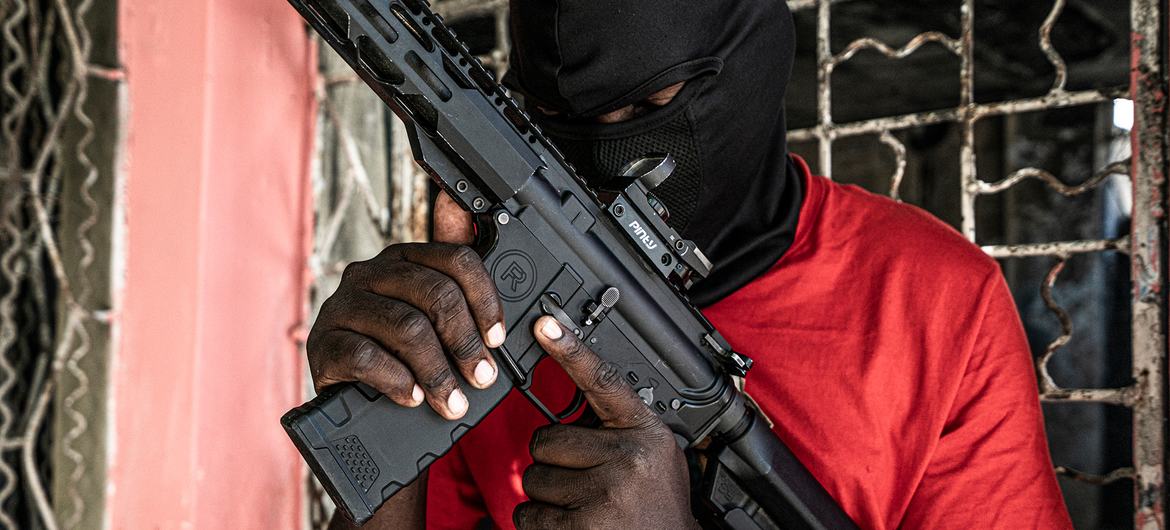
A gang member poses with a high-calibre rifle in the Delmas 3 neighbourhood of Port-au-Prince.

Why Haiti matters

The crisis in Haiti is multifaceted. Gang control of urban zones and transport routes and increased activity in rural areas, are disrupting livelihoods and humanitarian access nationwide. 

Extreme weather events, including hurricanes, floods and droughts as well as devastating earthquakes have worsened the humanitarian situation and complicated the ability of the country to recover and develop.

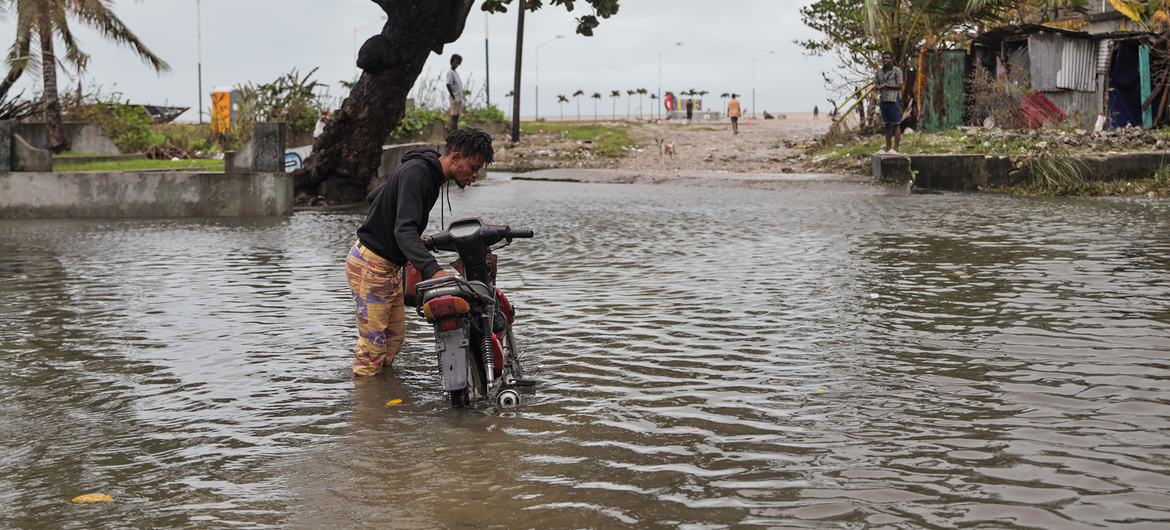
The southern city of Les Cayes is flooded due to Hurricane Melissa in October 2025.

With more than one in ten Haitians having fled their homes due to violence, the country risks prolonged instability.

The displacement of people – including through migration – could heighten pressures on neighbouring countries and undermine regional economic and security stability.

“Gang violence affects communities nationwide, with particularly devastating consequences for women, children and youth, undermining the country’s social fabric over the long term.” António Guterres.

Security: Gangs, violence and the suppression force

Armed violence intensified in the last three months of 2025 and remains the dominant force shaping the daily life of Haitians. 

Gangs with heavy weapons, use sexual violence and kidnappings for ransom to assert control, while police operations – sometimes supported by the UN Security Council-backed Gang Suppression Force – have pushed back in limited areas opening some key routes. 

Despite some tactical gains, killings remain widespread, especially outside the capital, and reprisals against civilians continue.

“More than 8,100 killings were documented nationwide between January and November 2025. …Reports also indicated an increase in the trafficking in children, with children continuing to be used by gangs in multiple roles, including in violent attacks.” António Guterres

Politics: a transition facing a deadline

Haiti’s political transition is approaching a critical deadline. An electoral decree and calendar now point to the hope that elections will take place which will see the installation of an elected President and Legislature in early 2027. 

“The immediate need is for national stakeholder groups to find common ground on ways to end the transition and accelerate preparations for elections.” António Guterres


People cast their vote in elections in Haiti’s capital Port au Prince, in October 2015. (file)

Some observers question whether elections are feasible without significant security improvements.

Humanitarian needs: a system stretched to breaking point

Humanitarian conditions continue to deteriorate in Haiti as funding shortfalls are limiting the reach of life-saving assistance.

  • Food insecurity affects 5.7 million people, with nearly two million at emergency levels.
  • Displacement has doubled to 1.4 million people in one year.
  • Many health facilities are barely functioning and cholera has remained a “major public health concern.”
  • In the 2024-25 school year1,600 schools closed due to violence with 1.5 million lacking access to education.

“The humanitarian response remains severely under-resourced, and humanitarian access is increasingly challenging.” António Guterres

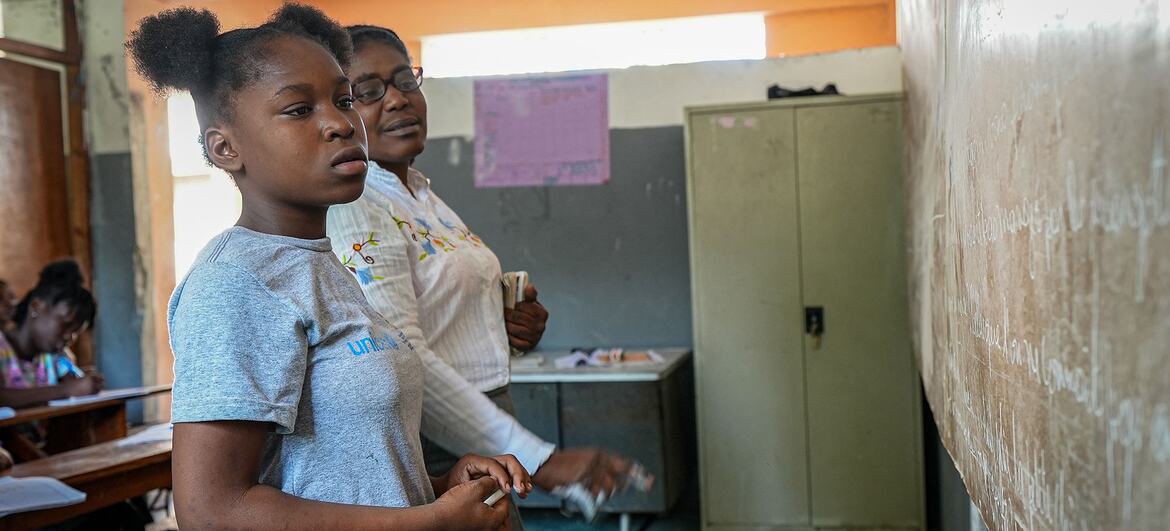
Many children in Haiti are struggling to maintain their studies.

Human rights: Women and girls at extreme risk

Women and girls are among the most affected by Haiti’s crisis. 

Gangs routinely use sexual violence, including collective rape, as a tool of intimidation and control. The reporting of incidents remains low due to fear and stigma, and access to survivor-centred services is limited, compounding trauma and impunity.

“I remain deeply concerned by the continued use of sexual violence by gangs, which terrorizes communities and systematically undermines the safety and dignity of women and girls.” António Guterres

What is the way forward?

The UN has continually emphasized that restoring security is essential, but it is not enough on its own. 

Without progress on governance, justice, accountability and social services, especially for youth, any security gains will be fragile. 

National consensus and sustained international support are critical to breaking the cycle of violence and instability.

“Security enforcement efforts alone will not be enough to address the broader governance problems that triggered the gang violence crisis.” António Guterres

How is the UN responding?

The United Nations is supporting Haiti in a number of ways. 

  • The political mission, BINUH provides human rights monitoring and electoral assistance and supports police development.
  • UN Humanitarian agencies deliver life-saving aid to the most vulnerable communities. The Humanitarian Response Plan for 2026 is seeking $880 million to assist 4.2 million people.
  • Preparations are under way for the recently-established United Nations Support Office in Haiti (UNSOH) to provide logistical and operational backing to the Gang Suppression Force.

Source link

World enters era of ‘global water bankruptcy’

For decades, scientists, policymakers and the media warned of a “global water crisis,” implying temporary shock – followed by recovery. 

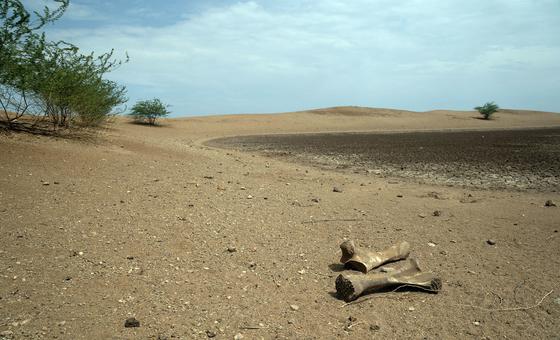
What is now emerging in many regions, however, is a persistent shortage whereby water systems can no longer realistically return to their historical baselines.

For much of the world, ‘normal’ is gone,” said Kaveh Madani, Director of the UN University Institute for Water, Environment and Health.

 “This is not to kill hope but to encourage action and an honest admission of failure today to protect and enable tomorrow,” he told a press briefing in New York on Tuesday.

Unequal burdens

Mr. Madani emphasised that the findings do not suggest worldwide failure – but there are enough bankrupt or near-bankrupt systems, interconnected through trade, migration and geopolitical dependencies, that the global risk landscape has been fundamentally altered.

The burdens fall disproportionately on smallholder farmers, Indigenous Peoples, low-income urban residents and women and youth, while the benefits of overuse often accrued to more powerful actors.

From crisis to recovery? 

The report introduces water bankruptcy as a condition defined by both insolvency and irreversibility.

Insolvency refers to withdrawing and polluting water beyond renewable inflows and safe depletion limits.

Irreversibility refers to the damage to key parts of water-related natural capital, such as wetlands and lakes, that makes restoration of the system to its initial conditions infeasible.

But all is not lost: comparing water action to finance, Mr. Madani said that bankruptcy is not the end of action. 

It is the start of a structured recovery plan: you stop the bleeding, protect essential services, restructure unsustainable claims, and invest in rebuilding,” he noted.

Costly tab

The world is rapidly depleting its natural “water savings accounts”, according to the study: more than half the world’s large lakes have declined since the early 1990’s, while around 35 per cent of natural wetlands have been lost since 1970, Mr. Madani said.

The human toll is already significant. Nearly three-quarters of the world’s population live in countries classified as water-insecure or critically water-insecure.

Around four billion people experience severe water scarcity for at least one month each year, while drought impacts cost an estimated $307 billion annually.

“If we continue to manage these failures as temporary ‘crises’ with short-term fixes, we will only deepen the ecological damage and fuel social conflict,” Mr. Madani warned.

Course corrections

The report calls for a transition from crisis response to bankruptcy management, grounded in honesty about the irreversibly of losses, protection of remaining water resources – and policies that match hydrological reality rather than past norms.

Source link

Rising hunger and displacement pose growing economic risk, UN tells Davos

The UN World Food Programme (WFP) has reported that an estimated 318 million people worldwide now face crisis levels of hunger or worse, with hundreds of thousands already experiencing famine-like conditions.

It cautioned that deep funding shortfalls are forcing it to cut rations and scale back assistance at a time of surging needs.

Current forecasts put WFP’s funding at just under half of its required $13 billion budget for 2026, leaving the agency able to reach about 110 million people – a third of those in need.

Combatting hunger yields dividends

“Hunger drives displacement, conflict, and instability and these not only threaten lives, but disrupt the very markets that businesses depend on,” said Rania Dagash-Kamara, WFP Assistant Executive Director for Partnerships and Innovation.

“The world cannot build stable markets on a foundation of 318 million hungry people.”

Ms. Dagash-Kamara, who is attending the forum, said the private sector has a direct stake in addressing food insecurity, calling on companies to invest in supply chains, technology and innovation that can help stabilize fragile markets and protect workforces.

WFP is urging business leaders in Davos to keep hunger and food security among their top priorities, invest in supply chain systems that strengthen fragile markets, and support food-related technologies that improve efficiency and resilience.

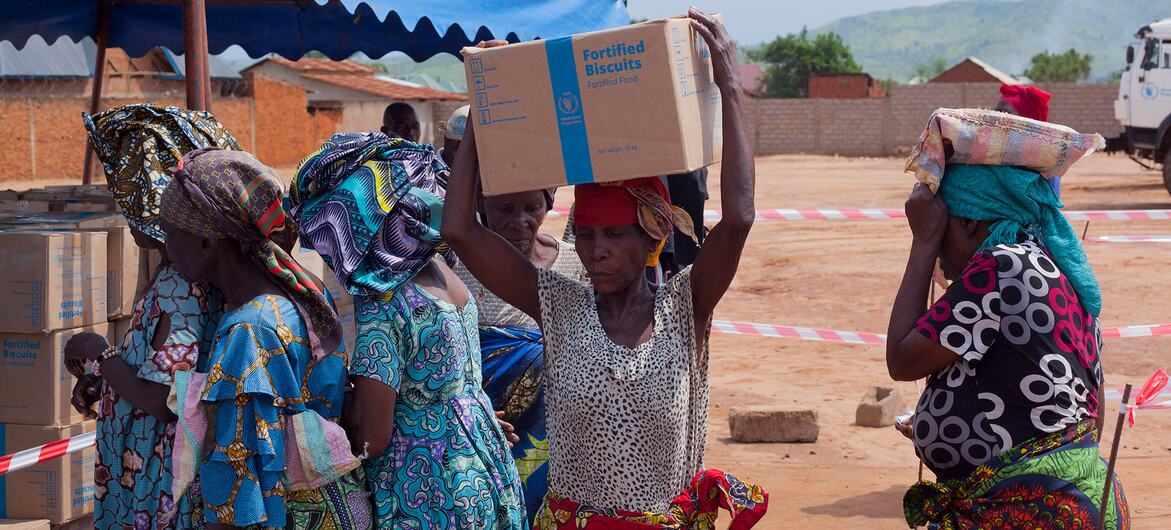
Displaced families in South Kivu, Democratic Republic of the Congo, receive food aid. (file photo)

Migration powers growth and development

The UN International Organization for Migration (IOM) is also taking its case to the annual forum in Switzerland, calling on political and business leaders to rethink migration as a driver of growth rather than a burden.

Migration is one of the most powerful drivers of development when managed responsibly,said IOM Director General Amy Pope.

“Mobility can unlock economic potential, help communities thrive independently, and provide lasting solutions to displacement, while respecting national sovereignty and human rights.”

Partnerships and innovation

IOM said partnerships with private companies and foundations are already helping realise that approach.  

This includes using artificial intelligence to improve health screening and labour market policies, and programmes that support vocational training, entrepreneurship and durable solutions for displaced people.

At Davos, the agency is also highlighting the role of diaspora communities as investors and innovators.

“By using remittances and diaspora capital to support business creation and digital financial access, IOM aims to open new markets and create jobs, while helping communities become more self-reliant,” the agency said.

Other senior UN officials attending the forum include President of the General Assembly Annalena Baerbock; WHO chief Tedros Adhanom Ghebreyesus; Alexander De Croo, Administrator of the UN Development Programme; UN High Commissioner for Refugees Barham Salih; and Rafael Mariano Grossi, Director-General of the International Atomic Energy Agency.

Source link

‘Alarming’ increase in use of death penalty last year, despite global trend towards abolition

The UN advocates for the universal abolition of the death penalty. The International Covenant on Civil and Political Rights, ratified by 175 countries, protects the right to life and stipulates that, for countries that have not abolished capital punishment, it be imposed only for the ‘most serious crimes’ in exceptional cases. 

OHCHR said the sharp increase in capital punishment last year was driven by executions for drug-related violations, for crimes people committed as children and for offences not meeting the ‘most serious crimes’.

The death penalty is not an effective crime-control tool, and it can lead to the execution of innocent people,” said Volker Türk, UN Commissioner for Human Rights. 

“In practice, the death penalty is also often applied arbitrarily and discriminatorily, in violation of fundamental principles of equality before the law.” 

Geography of death 

OHCHR’s monitoring reveals that no one region claimed the monopoly over capital punishment. 

In Iran, at least 1,500 individuals were reportedly executed in 2025, with at least 47 per cent relating to drug offences. 

In Israel, a series of legislative proposals is seeking to expand the use of the death penalty by introducing mandatory capital punishment provisions that would apply exclusively to Palestinians.

In Saudi Arabia, the reported number of executions exceeded the previous record of 2024, mounting to at least 356 people, where 78 per cent of cases were for drug-related offences. In Afghanistan, public executions continued, in breach of international law.

In the Americas, the United States saw the highest number of executions in 16 years – some 47 inmates who had been on death row.

Further south, at least 24 people were executed in Somalia and 17 in Singapore.

‘Encouraging steps’

However, OHCHR noted that several countries took ‘encouraging steps’ last year to limit capital punishment. 

Vietnam reduced the number of offences punishable by death. Pakistan also removed two non-lethal capital offences but still retained 29. 

Zimbabwe abolished on 31 December 2024 the death penalty for ordinary crimes, while Kenya initiated a legislative review of capital punishment. 

Malaysia’s resentencing process reduced the number of people at risk of execution by more than 1,000 and in Kyrgyzstan, the Constitutional Court reaffirmed the prohibition of the death penalty.

So far, 170 countries have abolished or introduced a moratorium on the death penalty either in law or in practice.

Source link

Prison breaks and renewed clashes raise alarm in northeast Syria

Secretary-General António Guterres is following the continuing violence “with great concern,” Deputy UN Spokesperson Farhan Haq said on Tuesday in New York. 

The Secretary-General called for full respect for international law and the protection of civilians while also stressing the importance of securing detention facilities. 

He urged the parties to continue dialogue, move forward in good faith, and work together to secure the implementation of all agreements. 

Fearing for families 

The UN human rights office, OHCHR, was “concerned about reports of renewed fighting between the Syrian Army and the SDF, despite the 18 January ceasefire agreement,” Spokesperson Ravina Shamdasani said earlier in Geneva. 

Rolando Gómez of the UN Information Service (UNIS) there described the overall situation as “worrying, in particular the damage to critical infrastructure.”   

He expressed concern for families unable to leave conflict areas and those who have been newly displaced.  

A fragile transition 

Syria remains on a fragile path to political transition following the fall of the Assad regime in December 2024 and nearly 14 years of civil war.   

The transitional government has been taking back territory in the northeast under Kurdish control and fighting has occurred in Aleppo, Raqqa, Deir-ez-Zor and Al Hassakeh governorates. 

Speaking in New York, Syria’s UN ambassador Ibrahim Olabi told journalists that the government and the SDF had reached “a common understanding” on several issues regarding the future of Al Hassakeh governorate. 

The SDF will be granted “a four-day period for internal consultations to develop a detailed plan for the practical mechanisms for integrating the area,” he said during a media stakeout at UN Headquarters. 

Syrian troops will not enter Al Hassakeh and Qamishli cities and will remain on their outskirts until a plan is finalised.

ISIL detention camps 

Northeast Syria is home to several prisons holding thousands of ISIL fighters. The terrorist group, also known as Daesh, once controlled large swaths of the country and neighbouring Iraq in its attempt to establish an Islamist caliphate, committing mass executions, rape, forced recruitment and other atrocities along the way. 

Tens of thousands of civilians with suspected ties to the militants, mainly women and children, are housed in separate detention camps such as notorious Al-Hol camp – home to over 30,000 people.   

Ceasefire and clashes 

The ceasefire announced on Sunday followed weeks of deadly fighting.  The truce calls for the authorities to take over SDF-controlled areas and for its forces to be integrated into the national army, among other points. 

Clashes resumed a day later during which roughly 120 ISIL fighters escaped from the prison in Al-Shaddadi city, according to media reports, though most have been captured. 

Ms. Shamdasani recalled that OHCHR has long stated that any integration of security forces into Syrian State institutions, particularly SDF forces, “must take place within a proper human rights-based vetting process to ensure that any individuals involved in human rights violations or abuses are not integrated.”   

Humanitarian support 

Meanwhile, humanitarians have been providing assistance in the four affected governorates, incluidng trauma care, water and hygiene support, and psychosocial support, the UN aid coordination office OCHA reported on Monday. 

Public services have been suspended in Deir-ez-Zor city and key transport routes temporarily closed, leaving civilians cut off from education and healthcare. 

Furthermore, damage to critical infrastructure in Raqqa city has curtailed access between neighbourhoods and disrupted the main water supply. 

OCHA noted that people continue to flee Raqqa and Tabqa cities, as well as Thawra town, and are heading towards Al Hassakeh and Qamishli governorates.  

Hundreds of families remain unable to leave Tabqa and are sheltering in public facilities. 

Assessments are underway to determine people’s needs as humanitarians continue to call for sustained, safe access to the population. 

Source link

Cold and dark: UN rights chief condemns Russian strikes on Ukraine’s power grid

Volker Türk said he was outraged by renewed overnight attacks that knocked out power and heating in major cities – including Kyiv and Odesa – as temperatures plunged well below zero and civilians bear the brunt of what he described as unlawful assaults on civilian infrastructure.

He said the Russian strikes “can only be described as cruel. They must stop. Targeting civilians and civilian infrastructure is a clear breach of the rules of warfare.

According to Ukrainian authorities, the latest long-range attacks triggered emergency power and heating outages across several regions.

In Kyiv alone, the city’s mayor reported that 5,635 multi-storey residential buildings were left without heating on Tuesday morning, nearly 80 per cent of which had only recently had heating restored after similar strikes earlier this month.

Since October last year, Russian armed forces have renewed systematic large-scale attacks against Ukraine’s energy infrastructure, with strikes recorded in at least 20 regions of the country.

Mr. Türk called on Russian authorities to immediately halt the attacks, warning that continued strikes on essential civilian infrastructure risk compounding human suffering.

Humanitarian consequences

“This means that hundreds of thousands of families are now without heating and several areas, including a significant part of Kyiv, are also without water,” Mr. Türk said, warning that the impact falls most heavily on children, older people and persons with disabilities.

The humanitarian toll was underscored by Matthias Schmale, the UN Humanitarian Coordinator for Ukraine, who said that over the past 48 hours tens of thousands of civilians once again woke to freezing homes and severe disruptions to basic services.

Parents cannot prepare hot meals for their children, and many older people have been left isolated in cold homes yet again,” he said. “The hideous strikes on energy that have such a huge negative impact on the lives of the civilian population violate international humanitarian law and should end immediately.”

Nuclear safety risks

The attacks have also raised fresh concerns over nuclear safety. The International Atomic Energy Agency (IAEA) said several electrical substations vital for nuclear safety were affected.

Chernobyl Nuclear Power Plant temporarily lost all off-site power, while power lines to other nuclear facilities were also impacted. “The IAEA is actively following developments in order to assess impact on nuclear safety,” Director General Rafael Grossi said.

Chernobyl was the site of the world’s worst nuclear accident in April 1986, when a reactor explosion released massive amounts of radioactive material across Ukraine, Europe and beyond.

Although the plant has long ceased power generation, it requires a stable electricity supply to maintain cooling systems, radiation monitoring and the safe management of nuclear waste, making uninterrupted power critical to preventing new safety risks.

Source link

Sudan: Atrocities ‘repeated town by town’, ICC prosecutor tells UN Security Council

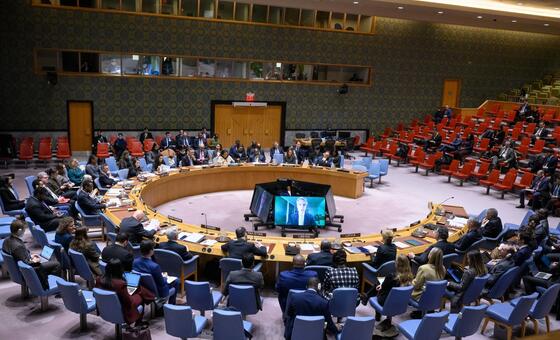
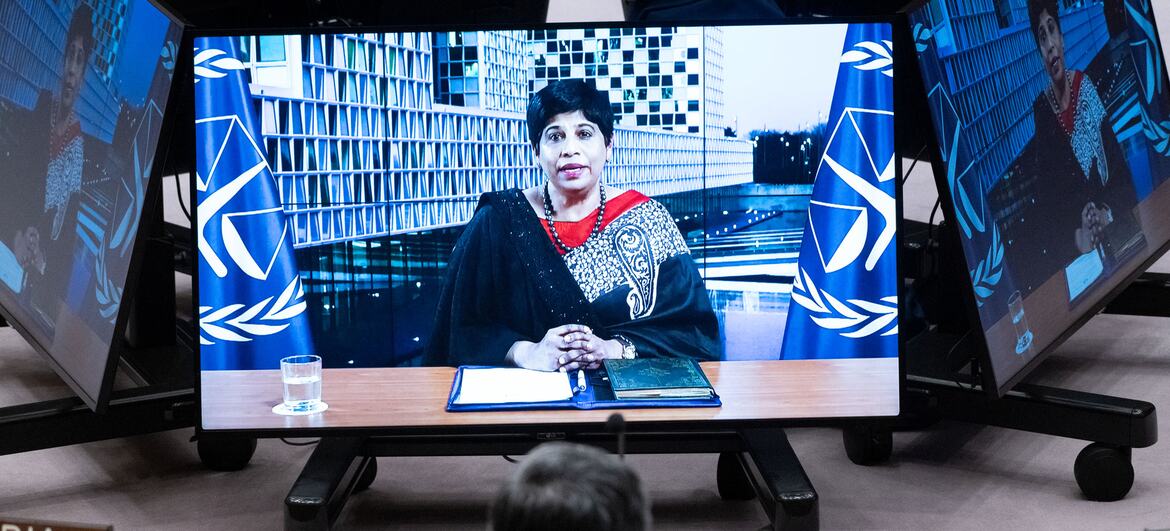
Briefing ambassadors, ICC Deputy Prosecutor Nazhat Shameem Khan said the situation in Darfur had “darkened even further,” with civilians subjected to what she described as collective torture amid a widening war between Sudan’s rival military forces.

The picture that is emerging is appalling: organised, widespread, mass criminality including mass executions,” Ms. Khan said. “Atrocities are used as a tool to assert control.

Epicentre of ‘profound suffering’

Sudan has been engulfed in conflict since April 2023, when fighting erupted between former allies the Sudanese Armed Forces (SAF) and Rapid Support Forces militia (RSF).

What began as a power struggle metastasised into conflicts across the country, most devastating in the Darfur region, which also saw longstanding ethnic tensions – which prompted allegations of genocide in the early 2000s – being reignited.

She said the fall of North Darfur’s regional capital El Fasher to the RSF had been followed by a “calculated campaign of the most profound suffering,” particularly targeting non-Arab communities.

The crimes, she said, include rape, arbitrary detention, executions and the creation of mass graves, often filmed and celebrated by perpetrators.

Nazhat Shameem Khan (on screen), Deputy Prosecutor of the International Criminal Court (ICC), briefs the Security Council.

Fighters ‘celebrating executions’

Based on video, audio and satellite evidence collected, the ICC Prosecutor has concluded that war crimes and crimes against humanity were committed in El Fasher, particularly in late October, following a prolonged RSF siege of the city. 

Ms. Khan said video footage showed patterns similar to those documented in earlier atrocities in Darfur, including the detention, mistreatment and killing of civilians from non-Arab tribes.

Members of the RSF are seen celebrating direct executions and subsequently desecrating corpses,” she said.

El Geneina investigations

The Office of the Prosecutor is also advancing investigations into crimes committed in El Geneina, where witnesses have provided accounts of attacks on displacement camps, looting, gender-based violence and crimes against children.

In 2023, El Geneina witnessed some of the worst violence of the war as RSF fighters and allied militias carried out massacres against the Massalit community, forcing hundreds of thousands to flee into neighbouring Chad.

UN officials and human rights investigators described the violence as ethnically motivated and warned of possible crimes against humanity.

Evidence now indicates that the patterns of atrocities seen in El Geneina have since been replicated in El Fasher, Ms. Khan said.

This criminality is being repeated in town after town in Darfur,” she warned. “It will continue until this conflict, and the sense of impunity that fuels it, are stopped.

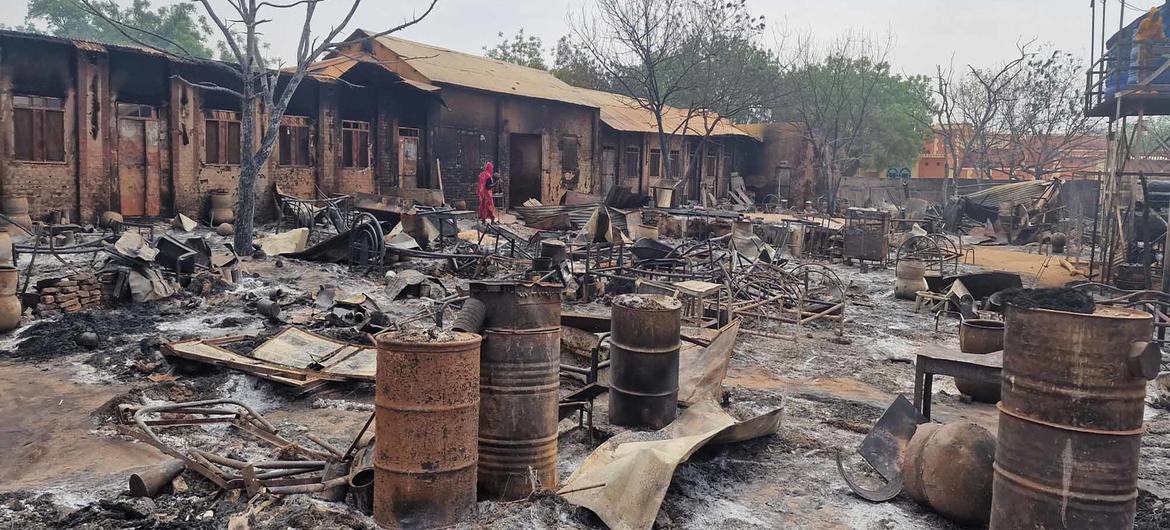
A school in El Geneina in West Darfur State, which had been serving as a displaced persons shelter, is burned to the ground. (file)

Rape as a weapon of war

Sexual violence, including rape, is being used as a weapon of war, Ms. Khan said, adding that gender-based crimes remain a priority for ICC investigations. She acknowledged cultural and security barriers that prevent survivors from reporting abuse, stressing the need for gender-sensitive and survivor-centred investigations.

While much of the briefing focused on RSF abuses, the Deputy Prosecutor said the ICC was also documenting allegations of crimes committed by the Sudanese Armed Forces (SAF), underscoring that all parties to the conflict are bound by international law to protect civilians.

Impunity overshadows progress

Ms. Khan cited the conviction last October of Ali Muhammad Ali Abd-Al-Rahman, known as Ali Kushayb – a former Janjaweed militia leader – as a landmark step toward accountability, but cautioned that the scale of ongoing atrocities far outweighed any sense of progress.

She closed with a pointed call on Sudanese authorities to act against senior suspects long sought by the Court, including former president Omar al-Bashir, former interior minister Ahmad Harun and former defence minister Abdel Raheem Muhammad Hussein.

“Action must now be taken,” she said, warning that justice for Darfur’s victims would remain hollow without arrests at the highest level.

Source link

Human trafficking depends on corruption at every step

A Chilean police officer stationed at the border collaborated on the scheme, enabling the crime.

Were it not for border guards, public officials and other entities who look the other way in exchange for money or sexual favours – or are themselves being extorted – human trafficking could not occur on a large scale, according to a new report from the UN Office on Drugs and Crime (UNODC) published on Monday. 

It analyses more than 120 cases involving almost 80 countries – based on consultations with policymakers, prosecutors, investigators and independent experts from more than 30 countries – to expose the ‘hidden links’ between human trafficking and corruption. 

Cloak of corruption

Human trafficking can include sexual exploitation, forced labour, forced begging, organ removal and even illegal adoption, among other forms of exploitation.

The report demonstrates how corruption permeates and facilitates every stage of human trafficking.

During recruitment and transport, corrupt officials provide documentation, overlook irregularities and collude with fraudulent recruitment agencies and organised criminal groups. 

At border crossings, bribes and papers obtained through corruption allow persons to be moved across jurisdictions.

Asking for help can appear difficult or impossible once a person is exploited. Corruption shields operations in industries such as agriculture, construction, fisheries and domestic work, and helps keep victims of trafficking in situations of forced labour, sexual exploitation and forced criminality. 

Finally, corruption obstructs anti-trafficking efforts, from police investigations and prosecutions to judicial decisions and assistance to victims.

Breaking the cycle

UNODC supports countries in breaking the cycle of corruption and human trafficking, including by ensuring national legislation applies stronger penalties when public officials are involved in trafficking and establishing safe reporting mechanisms for victims.

Other UN agencies are also supporting the effort. Backed by the International Organization for Migration (IOM), Moldova announced last week that it is strengthening its ability to identify and stop cross-border crimes, including human trafficking, through the new headquarters of its Passenger Information Unit (PIU).

The PIU is equipped with advanced UN software that improves passenger data collection, analysis and rapid response. Moldova is the seventh country to adopt this system, following in the footsteps of Norway, Luxembourg, Botswana, Georgia, the Philippines and Mongolia.

Source link

Mozambique floods heighten disease, malnutrition risks – UN agencies

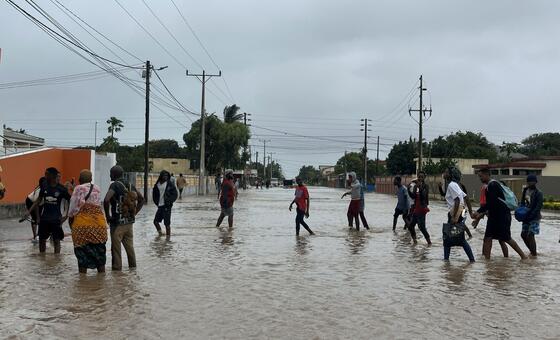
The head of aid coordination office, OCHA, in the country, Paola Emerson, told reporters in Geneva that more than half a million people have been impacted by the floods, triggered by heavy rains in the first weeks of the new year.

“The numbers keep rising as extensive flooding continues and dams keep releasing water to avoid bursting,” she said.

Mozambique’s Gaza province is most affected along with Maputo and Sofala provinces.

‘Melting’ houses

Speaking from Xai-Xai, Gaza’s capital city, Ms. Emerson stressed that 90 per cent of the country’s people live in adobe houses, which are earth-based structures “that basically melt after a few days’ rains”.

Health facilities, roads and critical infrastructure are also heavily impacted. Ms. Emerson said that some 5,000 kilometres of roads have been damaged across nine provinces, including the main road linking the capital Maputo to the rest of the country, which is currently inaccessible, resulting in major supply chain disruptions.

Meanwhile, dams continue to release water even as heavy rains subside.

“From just one dam, up to 10,000 cubic metres-worth of water were being discharged. That is approximately 25 times the amount of water that could be held in the press briefing room you are in today, every second,” Ms. Emerson told journalists, seated in a room with capacity for more than 100 people.

You cannot imagine the strength of this water and the impact it has on people and the infrastructure.

National emergency

The Government of Mozambique has declared a national emergency and has established an emergency operations centre in Gaza province. Xai-Xai, which is near the Limpopo River, has been inundated, prompting evacuations. Ms. Emerson said that authorities have issued alerts for downtown Xai-Xai, “including warnings of crocodile risks in flooded areas”.

“River levels are rising and are reaching urban areas or heavily populated areas,” she said. “The crocodiles that are in the Limpopo River…are able to get into urban or populated areas that are now submerged underwater.

Also speaking from Xai-Xai, the UN Children’s Fund (UNICEF)’s Chief of Communication in Mozambique, Guy Taylor, warned that flooding is “turning unsafe water, disease outbreaks and malnutrition into a deadly threat for children”.

Lethal combination

The combination of waterborne diseases and malnutrition “can often prove lethal,” he said, stressing that even before the floods, four out of every 10 children in Mozambique experienced chronic malnutrition.

“This renewed disruption to food supplies, to health services and to care practices threatens to push the most vulnerable children into a dangerous spiral,” he insisted.

Mr. Taylor added that Mozambique is now entering into its annual cyclone season, creating the risk of a double crisis. “We can prevent disease, deaths and irreversible losses to children, but we need to act fast,” he said.

The UNICEF spokesperson described Mozambique as “a country of children and young people”, with an average age of 17.

“When floods and cyclones strike, as they have repeatedly and with increasing frequency over recent years, it’s the youngest and children who are hit hardest,” he concluded.

Source link

World News in Brief: Food insecurity in Lebanon, Libya migrants freed, UNHCR tackles multiple emergencies – despite cuts

According to the latest UN-backed IPC Food Security Phase Classification report, around 874,000 people are facing crisis or emergency levels of acute food insecurity between November 2025 and March 2026. 

Certain districts and areas have been more severely affected, particularly parts of Baalbek and El Hermel, Akkar, Baabda, Zahle, Saida, Bint Jbeil, Marjayoun, El Nabatieh, Tyre, and refugee communities.

This is the first assessment to include people who arrived from Syria after December 2024, recognising shifting displacement patterns and new vulnerabilities. 

Assistance is essential 

Looking ahead, the situation is expected to worsen rapidly due to a combination of factors, including reduced food assistance, economic pressures, and rising living costs.

Between April and July 2026, food insecurity will rise to 961,000 people, nearly 18 per cent of the population, according to the IPC report. 

“People’s needs remain high, and predictable assistance will be essential to help people meet basic food needs and prevent further deterioration.” said Anne Valand, WFP representative and country director in Lebanon. 

Migrants freed from abusive detention sites in eastern Libya

The UN migration agency (IOM) has deployed emergency teams to eastern Libya to assist hundreds of migrants released from illegal detention sites where they were held in appalling conditions.

Libyan authorities last week closed an unlawful detention facility in Ajdabiya, leading to the release of 195 migrants and the recovery of 21 bodies from a nearby burial site. 

Initial investigations indicate the victims had been held captive and subjected to torture to extort ransom payments from their families.

Buried underground

In a separate operation in Kufra, security forces uncovered an underground detention site three metres below ground. 

A total of 221 migrants and refugees were freed, including women and children, among them a one-month-old baby. At least ten people were transferred to hospital for urgent treatment after being held for prolonged periods in grossly inhumane conditions.

“These shocking cases highlight the severe risks faced by migrants who fall prey to criminal networks operating along migration routes,” said Nicoletta Giordano, IOM’s Chief of Mission in Libya.

IOM teams are providing medical screenings, referring urgent cases to hospitals and distributing warm clothing to survivors. 

The agency welcomed efforts by Libyan authorities to rescue victims and launch investigations, while stressing the need to strengthen protection systems, dismantle trafficking networks and ensure accountability for perpetrators.

UNHCR responds to mounting crises despite funding shortfalls

Despite severe funding shortfalls, the UN refugee agency, UNHCR, responded to a surge of complex emergencies and deepening long-running crises last year, according to its newly released 2025 Impact Report: Response to New Emergencies and Protracted Crises.

Throughout 2025, agency teams provided protection and assistance in some of the world’s most volatile settings. 

They supported people fleeing renewed violence in eastern Democratic Republic of the Congo into Burundi and Uganda, assisted those escaping fresh fighting in and beyond South Sudan, and helped millions of Afghans returning or being forced back from Iran and Pakistan.

Protracted crises also worsened. Ongoing conflict in Sudan, intensified attacks on Ukraine and escalating violence in Colombia triggered repeated displacement, further eroding already fragile living conditions.

Positive response

“In 2025, displacement occurred amid protracted conflict, recurrent disasters, and new outbreaks of violence,” said Ayaki Ito, UNHCR’s Director of Emergency and Programme Support.

“In this environment, UNHCR teams continued to respond to the needs of people forced to flee, even as severe resource constraints limited our capacity.”

Emergency support included clean water for half a million people in Sudan, cash assistance for Afghan and Syrian returnees, and more than a million services for displaced people inside Ukraine and in neighbouring host countries.

UNHCR warned that humanitarian needs are set to rise further in 2026 as conflicts continue to drive displacement affecting nearly 52 million people.

You can find additional background on UNHCR’s emergency response work, here.
 

Source link

UNRWA headquarters bulldozed in East Jerusalem

Responding to the dramatic development, head of the UN agency for Palestine refugees Philippe Lazzarini described it as an “unprecedented attack” against the UN, whose premises are protected under international law.

The move represents “a new level of open and deliberate defiance of international law, including of the privileges and immunities of the United Nations, by the State of Israel”, the UNRWA Commissioner-General said on X.

The same thing could happen to any other organization or diplomatic mission “anywhere around the world”, Mr. Lazzarini warned. “This must be a wake-up call,” he stressed.   

Human rights chief’s ‘outrage’

Echoing those concerns, UN High Commissioner for Human Rights Volker Türk expressed his “outrage” at the incident, which marks a sharp escalation of tensions between the Israeli authorities and UNRWA.

“It compounds what we’ve been seeing for a while; attacking aid groups and UN actors who are trying to help,” said Ravina Shamdasani, spokesperson for the High Commissioner.

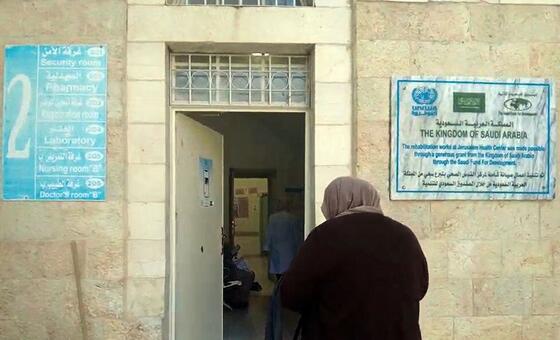
On 14 January, Israeli forces entered an UNRWA health centre in East Jerusalem and ordered it to close. At the time of the incident, the agency said its workers were “terrified”. In the coming weeks, water and power supplies to UNRWA facilities are scheduled to be cut, including to buildings used for health care and education.

“This is a direct result of legislation passed by the Israeli parliament in December, which stepped up existing anti-UNRWA laws adopted in 2024,” Mr. Lazzarini said.

Previously, UNRWA premises have been targeted by arsonists amid a “large-scale disinformation campaign” against it by Israel, the agency’s Commissioner-General maintained.

This was despite a ruling last October by the UN’s top court, the International Court of Justice, which restated that Israel was obliged “to facilitate UNRWA’s operations, not hinder or prevent them. The court also stressed that Israel has no jurisdiction over East Jerusalem,” Mr. Lazzarini noted.

“What happens today to UNRWA will happen tomorrow to any other international organisation or diplomatic mission, whether in the Occupied Palestinian Territory or anywhere around the world,” he continued. “International law has come under increasing attack for too long and is risking irrelevancy in the absence of response by Member States.”

Source link

Yemen: Children are dying and it’s going to get worse, warns aid veteran

“The simple narrative is, children are dying and it’s going to get worse,” said Julien Harneis, UN Resident and Humanitarian Coordinator in Yemen. “My fear is that we won’t hear about it until the mortality and the morbidity significantly increases in this next year.”

The alert follows an attempt by forces affiliated with the Southern Transitional Council (STC) to expand their presence in the resource-rich and strategically important eastern governorates of Hadramout and Al Mahra, a move reportedly reversed earlier this month by Government-aligned forces backed by Saudi Arabia.

The latest crisis comes after well over a decade of fighting between Houthi-led forces – who control the capital, Sana’a – and the internationally recognized government in Aden, backed by a Saudi-led military coalition. 

Complex operating environment

“It’s an extraordinarily complicated situation,” Mr. Harneis told journalists in Geneva. “Just in the last month in Aden, we went through a situation where you have the Government of Yemen in charge, then over 48 hours, the Southern Transitional [Council] situation took over the whole of the Government of Yemen areas, including areas they’ve never been in.”

Just four weeks later, however, a delegation from the STC released a statement while in Riyadh, Saudi Arabia, announcing that they had in fact “dissolved” their movement, allowing the Government in Yemen to retake the recently captured areas. “But at the same time, we’ve got demonstrations in Aden saying that, ‘No, we’re not [disbanded], we’re still there,’” Mr. Harneis explained.

Last week, UN Special Envoy for Yemen Hans Grundberg told the Security Council that this latest political and security upheaval underscored how quickly stability could unravel without a credible, inclusive political process to bring a negotiated end to the debilitating war.

Securing a peaceful future for the people of Yemen and providing lifesaving help has also been complicated by the ongoing detention of UN staff and diplomatic workers, among others, by Houthi rebels, who are backed by Iran and control Sana’a. 

Mr. Harneis described the torment for the families of the 69 staff members still being held: “It’s terrible for them; some families haven’t seen their loved ones in five years. They don’t know the conditions of their detention, they don’t know where they are, they don’t know if they’re going to be sentenced to death in the coming days.”

Millions going hungry

Latest UN data shows that more than 20 million Yemenis – about half the population – will face acute food insecurity next month, while tens of thousands could face famine-like conditions.

“We are expecting things to be much worse in 2026,” Mr. Harneis said.

A young boy is carried by his mother thorough a neighbourhood in Al Hawtah, Lahj Governate in Yemen.

The country’s health system is also collapsing. More than 450 facilities have already closed and thousands more are at risk of losing funding. Vaccination programmes are also under threat and only two-thirds of Yemen’s children are fully immunised, largely owing to a lack of access in the north.

“The way that economic and political decisions are playing out…food insecurity is only getting worse across all parts of the country”, the UN aid official maintained.

“We’re going to see a major change where the health system is not going to be supported in the way it has been in the past.”

Despite access restrictions, UN partners reached 3.4 million people with food assistance last year, along with emergency support during floods and disease outbreaks. 

The UN has been working in Yemen since the 1960s, helping to make development gains and protect the country’s most vulnerable people. “And then suddenly in the last couple of years this breakdown…inexplicably,” Mr. Harneis said. “That has a terrifying effect on the humanitarian workers.”

Source link

Secretary-General on UN at 80: Humanity strongest when we stand as one

Speaking at Methodist Central Hall, the very same venue where the first-ever UN General Assembly was held on 10 January 1946, Mr. Guterres called on delegates at the event to be “bold enough to change. Bold enough to find the courage of those who came to this Hall 80 years ago to forge a better world.” 

From bomb shelter to diplomatic gathering 

Organised by the United Nations Association-UK, Saturday’s anniversary event gathered over 1,000 delegates from across the world, with speakers including President of the General AssemblyAnnalena Baerbock, the UN Champion for Space Professor Brian Cox and the UN Refugee Agency’s Goodwill Ambassador Maya Ghazal. The event also marks the 80th anniversary of the first UN Security Council, which took place on 17 January 1946 at nearby Church House. 

During his keynote address, Mr. Guterres reflected on the symbolic location of the commemoration. The first General Assembly took place within the same walls four months after the end of the Second World War, in a heavily bombed London where tens of thousands had been killed, a powerful reminder as to why the UN had been created. 

“To reach this Hall, delegates had to pass through a city scarred by war. Buckingham Palace, Westminster Abbey, and the House of Commons had been shelled by the Luftwaffe. And as those bombs fell, terrified civilians huddled here, in the basement of the Methodist Central Hall — one of the largest public air-raid shelters in London,” said the Secretary-General.   

Throughout the Blitz, as many as 2,000 people gathered in the hall for protection, before the nations of the world assembled there in 1946 to ‘save succeeding generations from the scourge of war’.  

“In many ways, this Hall is a physical representation of what the United Nations is: a place people put their faith — for peace, for security, for a better life,” reflected Mr. Guterres. 

The world of 2026 is not the world of 1946 

In the 80 years since the first General Assembly, the UN has expanded from 51 members to 193. Mr. Guterres emphasised that the General Assembly, the UN’s chief deliberative, policymaking and representative body, is “the parliament of the family of nations. It is a forum for every voice to be heard, a crucible for consensus, and a beacon for cooperation.”

Whilst he acknowledged that the General Assembly’s work “may not always be straightforward or seamless,” he described it as a “a mirror of our world, its divisions and its hopes. And it is the stage on which our shared story plays out.”

Reflecting on the last decade, Mr. Guterres spoke of how “the conflicts in Gaza, Ukraine and Sudan have been vicious and cruel beyond measure; artificial intelligence has become ubiquitous almost overnight; and the pandemic poured accelerant on the fires of nationalism — stalling progress on development and climate action.”

Mr. Guterres emphasised how 2025 was a “profoundly challenging” year for international cooperation and the UN’s values.

Aid was slashed. Inequalities widened. Climate chaos accelerated. International law was trampled. Crackdowns on civil society intensified. Journalists were killed with impunity. And United Nations staff were repeatedly threatened — or killed — in the line of duty.”

The UN reported in 2025 that global military spending reached $2.7 trillion — over 200 times the UK’s current aid budget, or equivalent to over 70 per cent of Britain’s entire economy.

Fossil fuel profits have also continued to surge whilst the planet broke heat records, Mr. Guterres underlined.

“And in cyberspace, algorithms rewarded falsehoods, fuelled hatred, and provided authoritarians with powerful tools of control.”

Multilateralism over division

A “robust, responsive and well-resourced multilateral” system is needed to address the world’s interconnected challenges, Mr. Guterres urged, but the “values of multilateralism are being chipped away.”

The Secretary-General gave the example of a landmark international agreement to protect marine life in international waters and the seabed, which comes into force on Saturday, as a “model of modern diplomacy, led by science, with the participation not just of governments, but of civil society, Indigenous Peoples and local communities.”

“These quiet victories of international cooperation — the wars prevented, the famine averted, the vital treaties secured — do not always make the headlines. Yet they are real. And they matter. If we wish to secure more such victories, we must ensure the full respect of international law and defend multilateralism, strengthening it for our times.”

As he addressed the London audience, the Secretary-General expressed his “gratitude to the United Kingdom for its decisive role in creating the United Nations,” and for being “such a strong pillar of multilateralism and champion of the United Nations today.”

© United Nations/Shaun Ottway

UN Secretary-General António Guterres (right) met with UK Prime Minister Keir Starmer at 10 Downing Street in London on Friday.

High stakes for a better world 

Looking towards the future, the Secretary-General called for an international system that reflects the modern world, including reforming international financial systems and the Security Council.

“As global centres of power shift, we have the potential to build a future that is either more fair — or more unstable.”

The Secretary-General reminded delegates in London that when the UN first opened its doors, “many of its staff bore the visible wounds of war — a limp, a scar, a burn.”

“There is a persistent myth — now echoing louder each day — that peace is naïve. That the only ‘real’ politics is the politics of self-interest and force,” Mr. Guterres said.  

“But the founders of the United Nations were not untouched by reality. On the contrary, they had seen war, and they knew: Peace, justice and equality, are the most courageous, the most practical, the most necessary pursuits of all.” 

*Miranda Alexander-Webber is a communications officer with the United Nations Regional Information Centre for Western Europe (UNRIC).

Source link

UN rights chief bears witness to trauma and resilience in Sudan

Volker Türk briefed journalists in the Kenyan capital following a five-day mission to Sudan, where “a chronicle of cruelty is unfolding before our very eyes”.

He called on “all those who have any influence, including regional actors and notably those who supply the arms and benefit economically from this war” to act urgently to bring it to an end.

Mr. Türk last visited Sudan in November 2022.  Back then, he was deeply inspired by civil society—particularly the young people and women who spearheaded the 2018 revolution.

Salute to the people’s struggle for peace 

While the war between the Sudanese Armed Forces (SAF) and the Rapid Support Forces (RSF) “has plunged the country into an abyss of unfathomable proportions” – affecting the entire nation and all its people – “the spirit of the struggle for peace, justice and freedom…is not broken,” he affirmed.

“I bore witness in Sudan to the trauma of the unspeakable brutality that people have suffered – but also to the resilience and defiance of the human spirit.”

Mr. Türk met with various sectors of society, including young people who organise and deliver aid to their communities “often in the face of massive bureaucratic hurdles, risking detention and violence.”

As one volunteer told him, “The price of war is being paid by young people. Sudanese young people are at the frontlines of this war, serving those who are in need of humanitarian aid.”

End ‘intolerable attacks’ on infrastructure

The rights chief highlighted attacks on critical civilian infrastructure, such as the Merowe dam and hydroelectric power station which once supplied 70 per cent of electricity needs nationwide.  

It has been repeatedly hit by drones launched by the RSF, including in recent weeks. Such attacks are serious violations and can amount to war crimes.

He called for both warring parties to “cease intolerable attacks against civilian objects that are indispensable to the civilian population, including markets, health facilities, schools and shelters.”

Mr. Türk also met people displaced from the besieged city of El Fasher in North Darfur who are now living in the Al Afad camp some 1,200 kilometres away. Among them was a four-year-old who lost his hearing due to bombardment and a three-year-old who wouldn’t smile.

“One woman saw her husband and only son killed,” he said. “She is still bedridden from grief, trauma, and the bullet she took in her shoulder while trying – in vain – to shield her son.”

Women’s bodies ‘weaponized’

He shared the testimony of Aisha*, 20, who was fleeing El Fasher on a donkey cart in October when armed men on camels ordered the women to come down. Her brother tried to intervene but was shot, while her mother begged the men to take her instead of the children.

“They hit her, took me and told me to keep quiet or they will kill my mother. Then what happened…happened. My period has not come since then,” she told Mr. Türk.

In Sudan, “women and girls’ bodies have been weaponized,” he said. Sexual violence is being used as a weapon of war – also a war crime – and it is widespread and systematic.

The UN rights chief also heard accounts of widespread summary executions. He underlined that all parties to the conflict “have perpetrated gross violations and abuses of international human rights law and serious violations of international humanitarian law, notably when the fighting intensifies to control new areas.”

Concern for the Kordofan region

He expressed deep concern that atrocity crimes committed inf El Fasher are at risk of being repeated in the Kordofan region, where fighting has intensified since late October. This is happening amid famine conditions in the city of Kadugli and risk of famine elsewhere, including Dilling, he said in a stark warning.

He deplored the proliferation of advanced military equipment across Sudan, particularly drones, saying “it is despicable that large sums of money are being spent on procuring increasingly advanced weaponry – funds that should be used to alleviate the suffering of the population.”

Another concern is the increasing militarization of society by all parties to the conflict, including through the arming of civilians and recruitment and use of children. Civil society and journalists are also facing restrictions or being targeted through smear campaigns.

Focus on the Sudanese people

The UN rights chief concluded his remarks by calling on the warring parties to protect civilians and civilian infrastructure, guarantee safe passage for people to leave conflict areas, and ensure unimpeded access for the delivery of humanitarian aid.

“Measures, such as humane treatment of detainees, accounting for and establishing the fate of missing persons, and releasing civilians detained for alleged ‘collaboration’ with the opposing party are also priority areas,” he added.

Mr. Türk repeated the plea that he made when he last visited Sudan.

I urge all those involved to set aside entrenched positions, power games, and personal interests, and to focus on the common interests of the Sudanese people,” he said.

“Again, I leave with a plea that human rights be central to building confidence and bringing this war to an end, to resuming the difficult task of building a sustainable peace.”

This is difficult, he acknowledged, “but certainly not impossible, with the resilience and power of the Sudanese people.”

*Name changed for protection purposes.

Source link

Aid cuts push millions in West and Central Africa deeper into hunger

The UN World Food Programme (WFP) issued the warning on Friday, citing latest analysis from the food security framework Cadre Harmonisé, the regional equivalent of the Integrated Food Security Phase Classification (IPC) that uses a one to five scale – with five spelling catastrophe/famine – to inform response.

It projects that 13 million children are also expected to suffer from malnutrition this year while over three million people will face emergency levels of food insecurity – more than double the 1.5 million in 2020.

Nigeria, Chad, Cameroon, and Niger account for 77 per cent of the food insecurity figures, including 15,000 people in Nigeria’s Borno state at risk of catastrophic hunger for the first time in nearly a decade.

Although a combination of conflict, displacement, and economic turmoil has been driving hunger in West and Central Africa, the slashes to humanitarian funding are now pushing communities beyond their ability to cope.

“The reduced funding we saw in 2025 has deepened hunger and malnutrition across the region,” said Sarah Longford, WFP Deputy Regional Director.

“As needs outpace funding, so too does the risk of young people falling into desperation.”

Rations reduced, hunger soars

WFP urgently requires more than $453 million over the next six months to continue its humanitarian assistance across the region, where the impacts of the aid budget cuts are evident.

In Mali, when families received reduced food rations, areas experienced a nearly 65 per cent surge in acute hunger (IPC 3+) since 2023, compared with a 34 per cent decrease in communities that received full rations.

Continued insecurity has disrupted critical supply lines to major cities – including for food – and 1.5 million of the country’s most vulnerable people are on track to face crisis levels of hunger.

Malnutrition levels deteriorate

In Nigeria, funding shortfalls last year forced WFP to scale down nutrition programmes, affecting more than 300,000 children.  Since then, malnutrition levels in several northern states have deteriorated from “serious” to “critical.”

The UN agency will only be able to reach 72,000 people in Nigeria in February, down from the 1.3 million assisted during the 2025 lean season.

Meanwhile, more than half a million vulnerable people in Cameroon are at risk of being cut off from assistance in the coming weeks.

‘Paradigm shift’ needed

WFP underscored the importance of having adequate funding for its operations, which have helped to improve food security in the region.

For example, teams have worked with local communities in five countries to rehabilitate 300,000 hectares of farmland to support more than four million people in over 3,400 villages.

WFP programmes have also supported infrastructure development, school meals, nutrition, capacity building and seasonal aid to help families manage extreme weather and security risks, stabilise local economies and reduce dependency on aid.

“To break the cycle of hunger for future generations, we need a paradigm shift in 2026,” Ms. Longford said.

She urged governments and their partners to step up investment in preparedness, anticipatory action, and resilience-building to empower local communities.

Amid Sudan’s humanitarian crisis, Chad shows ‘act of solidarity’


That’s according to UN human rights chief Volker Türk, who had discussions with over 40 leaders of Sudanese civil society in Northern State’s capital, Dongola, this week.

“But these representatives have also found the solution,” Mr. Türk said in a video on X. “There needs to be an all-out effort, both within Sudan and by the international community to help them, to facilitate their work.”

The conflict in Sudan which erupted in 2023 between the Sudanese Armed Forces (SAF) and the armed group Rapid Support Forces (RSF) has uprooted some 9.3 million people and has brought about one of the world’s largest hunger crises.

Mr. Türk began his visit on Wednesday and is meeting with Sudanese authorities, civil society, humanitarian partners and people displaced by the conflict in Darfur and Kordofan. He will be holding two press conferences at the end of his visit on 18 January.

Chad shows ‘act of solidarity’ 

Since April 2023, more than 900,000 Sudanese refugees have arrived in eastern Chad, with new arrivals every day, the UN refugee agency (UNHCR) said on Friday.

The newly-appointed UN High Commissioner for Refugees Barham Salih visited Chad this week for the first time in this capacity, where he met with Sudanese refugee families and local authorities.

Many of the refugees he met had been displaced multiple times since the conflict began. They described years of violent attacks and human rights abuses.

“What is unfolding in Sudan is a humanitarian calamity of overwhelming scale. Chad’s generous welcome of refugees is a powerful act of solidarity,” Mr. Salih said.

From displacement to solutions 

Mr. Salih also acknowledged the host communities that have welcomed refugees despite economic hardship and environmental pressure.

He reiterated UNHCR’s readiness to work with the Government and others to facilitate economic opportunity and provide services for both refugees and the host communities.

The UN Refugees chief, Barham Salih (centre), speaks with Sudanese refugees at a women’s centre in Farchana, Chad.

“Visiting Chad and Kenya this last week, both countries clearly demonstrate how, with sustained international support, inclusive policies can move us from responding to displacement emergencies towards providing solutions,” Mr. Salih emphasised.

“When refugees are protected and included, they can rebuild their lives and contribute to the societies that host them. This is what I am seeing here, and this is the direction in which we must travel.”


Peacekeeping: Lacroix warns of rising threats to ‘blue helmets’ in Middle East

Briefing journalists by video link from Jeddah following an extensive visit to the region, Jean-Pierre Lacroix, said there has been an uptick in dangerous incidents involving peacekeepers and the fragile environment in which missions are operating.

He added that UN missions are continuing to deliver on their mandates despite increasingly challenging conditions on the ground.

“There is no pre-drawdown mandate,” Mr. Lacroix said of the UN Interim Force in Lebanon (UNIFIL), stressing that the mission will continue to operate under its current authorisation until the end of December 2026.

UNIFIL, he said, remains focused on supporting the Lebanese Armed Forces (LAF) and advancing implementation of Security Council resolution 1701, which brought an end to hostilities between Israeli forces and Hezbollah in 2006.

Mr. Lacroix said cooperation with Lebanese authorities and the LAF remained “excellent,” and welcomed recent statements by the Government regarding progress in establishing operational control in the south, while acknowledging that “a number of things remain to be done.”

Increasing danger

At the same time, he expressed grave concern over a growing number of hostile incidents affecting UN peacekeepers, particularly those involving the Israeli Defense Forces.

“The frequency of these incidents has been quite high – it has been increasing,” he said, warning that several encounters “could have had very tragic consequences” for peacekeepers.

He said he had raised the issue with Israeli counterparts, stressing that “it is in no one’s interest to put the lives of peacekeepers at risk,” and reminded all parties of their responsibility to ensure the safety and security of UN personnel.

Mr. Lacroix also described widespread devastation in southern Lebanon, where entire villages and civilians remain unable to return to their homes, undermining prospects for recovery and reconstruction.

Beyond security risks, Mr. Lacroix highlighted the impact of funding shortfalls on peacekeeping operations, noting that UNIFIL and other missions have had to implement savings plans due to delayed or incomplete contributions by some Member States.

He praised peacekeepers for adapting under pressure, saying they had “succeeded in mitigating the impact” of financial constraints through innovation and operational adjustments.

Syria and regional dynamics

Turning to Syria, Mr. Lacroix said the UN Disengagement Observer Force (UNDOF) continues to carry out its mandate with strong backing from both the Security Council and Syrian authorities.

However, he noted that conditions on the ground have changed significantly since Israeli forces established positions inside the area of separation defined by the 1974 disengagement agreement.

Established in May 1974, following the Yom Kippur War, UNDOF is mandated to maintain the ceasefire between Israel and Syria, and supervise the areas of separation as provided in the 1974 agreement.

What we would want is a return to the situation where UNDOF would be the only military presence in the area of separation,” Mr. Lacroix said, describing recent talks between Israel and Syria, mediated by the United States, as “positive.”

UN Photo/Wolfgang Grebien

UNDOF peacekeepers on patrol in the Golan Heights.

Mine action and wider needs

He also underscored the growing importance of UN mine action efforts in Lebanon, Syria, Gaza and the Occupied Palestinian Territory overall, saying needs were “huge” and urging greater donor support.

We are willing to do more,” Mr. Lacroix said, stressing that additional resources would be critical to protect civilians and support recovery in conflict-affected areas.