
UN rights chief bears witness to trauma and resilience in Sudan

Volker Türk briefed journalists in the Kenyan capital following a five-day mission to Sudan, where “a chronicle of cruelty is unfolding before our very eyes”.

He called on “all those who have any influence, including regional actors and notably those who supply the arms and benefit economically from this war” to act urgently to bring it to an end.

Mr. Türk last visited Sudan in November 2022.  Back then, he was deeply inspired by civil society—particularly the young people and women who spearheaded the 2018 revolution.

Salute to the people’s struggle for peace 

While the war between the Sudanese Armed Forces (SAF) and the Rapid Support Forces (RSF) “has plunged the country into an abyss of unfathomable proportions” – affecting the entire nation and all its people – “the spirit of the struggle for peace, justice and freedom…is not broken,” he affirmed.

“I bore witness in Sudan to the trauma of the unspeakable brutality that people have suffered – but also to the resilience and defiance of the human spirit.”

Mr. Türk met with various sectors of society, including young people who organise and deliver aid to their communities “often in the face of massive bureaucratic hurdles, risking detention and violence.”

As one volunteer told him, “The price of war is being paid by young people. Sudanese young people are at the frontlines of this war, serving those who are in need of humanitarian aid.”

End ‘intolerable attacks’ on infrastructure

The rights chief highlighted attacks on critical civilian infrastructure, such as the Merowe dam and hydroelectric power station which once supplied 70 per cent of electricity needs nationwide.  

It has been repeatedly hit by drones launched by the RSF, including in recent weeks. Such attacks are serious violations and can amount to war crimes.

He called for both warring parties to “cease intolerable attacks against civilian objects that are indispensable to the civilian population, including markets, health facilities, schools and shelters.”

Mr. Türk also met people displaced from the besieged city of El Fasher in North Darfur who are now living in the Al Afad camp some 1,200 kilometres away. Among them was a four-year-old who lost his hearing due to bombardment and a three-year-old who wouldn’t smile.

“One woman saw her husband and only son killed,” he said. “She is still bedridden from grief, trauma, and the bullet she took in her shoulder while trying – in vain – to shield her son.”

Women’s bodies ‘weaponized’

He shared the testimony of Aisha*, 20, who was fleeing El Fasher on a donkey cart in October when armed men on camels ordered the women to come down. Her brother tried to intervene but was shot, while her mother begged the men to take her instead of the children.

“They hit her, took me and told me to keep quiet or they will kill my mother. Then what happened…happened. My period has not come since then,” she told Mr. Türk.

In Sudan, “women and girls’ bodies have been weaponized,” he said. Sexual violence is being used as a weapon of war – also a war crime – and it is widespread and systematic.

The UN rights chief also heard accounts of widespread summary executions. He underlined that all parties to the conflict “have perpetrated gross violations and abuses of international human rights law and serious violations of international humanitarian law, notably when the fighting intensifies to control new areas.”

Concern for the Kordofan region

He expressed deep concern that atrocity crimes committed inf El Fasher are at risk of being repeated in the Kordofan region, where fighting has intensified since late October. This is happening amid famine conditions in the city of Kadugli and risk of famine elsewhere, including Dilling, he said in a stark warning.

He deplored the proliferation of advanced military equipment across Sudan, particularly drones, saying “it is despicable that large sums of money are being spent on procuring increasingly advanced weaponry – funds that should be used to alleviate the suffering of the population.”

Another concern is the increasing militarization of society by all parties to the conflict, including through the arming of civilians and recruitment and use of children. Civil society and journalists are also facing restrictions or being targeted through smear campaigns.

Focus on the Sudanese people

The UN rights chief concluded his remarks by calling on the warring parties to protect civilians and civilian infrastructure, guarantee safe passage for people to leave conflict areas, and ensure unimpeded access for the delivery of humanitarian aid.

“Measures, such as humane treatment of detainees, accounting for and establishing the fate of missing persons, and releasing civilians detained for alleged ‘collaboration’ with the opposing party are also priority areas,” he added.

Mr. Türk repeated the plea that he made when he last visited Sudan.

I urge all those involved to set aside entrenched positions, power games, and personal interests, and to focus on the common interests of the Sudanese people,” he said.

“Again, I leave with a plea that human rights be central to building confidence and bringing this war to an end, to resuming the difficult task of building a sustainable peace.”

This is difficult, he acknowledged, “but certainly not impossible, with the resilience and power of the Sudanese people.”

*Name changed for protection purposes.

Source link

Reporters in Gaza bear witness and suffer tragic consequences

Mr. Shahada lost his leg due to a severe injury he suffered in Nuseirat in central Gaza in April 2024, but he picked up his camera and returned to document the tragic events that have been unfolding in Gaza.

He will not let his disability stop him from working. “It is impossible for me to leave photojournalism, even if I face all these obstacles,” he said.

Ahead of World Press Freedom Day marked annually on 3 May which focuses on the role of media to highlight accountability, justice, equality, and human rights, our UN News correspondent in Gaza spoke with Palestinian journalists, documenting the risks and personal traumas they face reporting from the war-torn enclave.

© UNICEF/Mohammed Nateel

War has devastated Gaza.

Since the war began following the 7 October 2023 attack by Hamas on Israel an increasing number of journalists have been killed or injured in Gaza as a humanitarian crisis has engulfed the enclave.

Bearing witness

On one leg, leaning on crutches, Sami Shahada stands behind his camera, wearing his blue press jacket, working amongst the rubble of destruction with colleagues.

“I witnessed all the crimes that happened, and then the moment came when I was a witness to a crime that was perpetrated against me,” he told UN News.
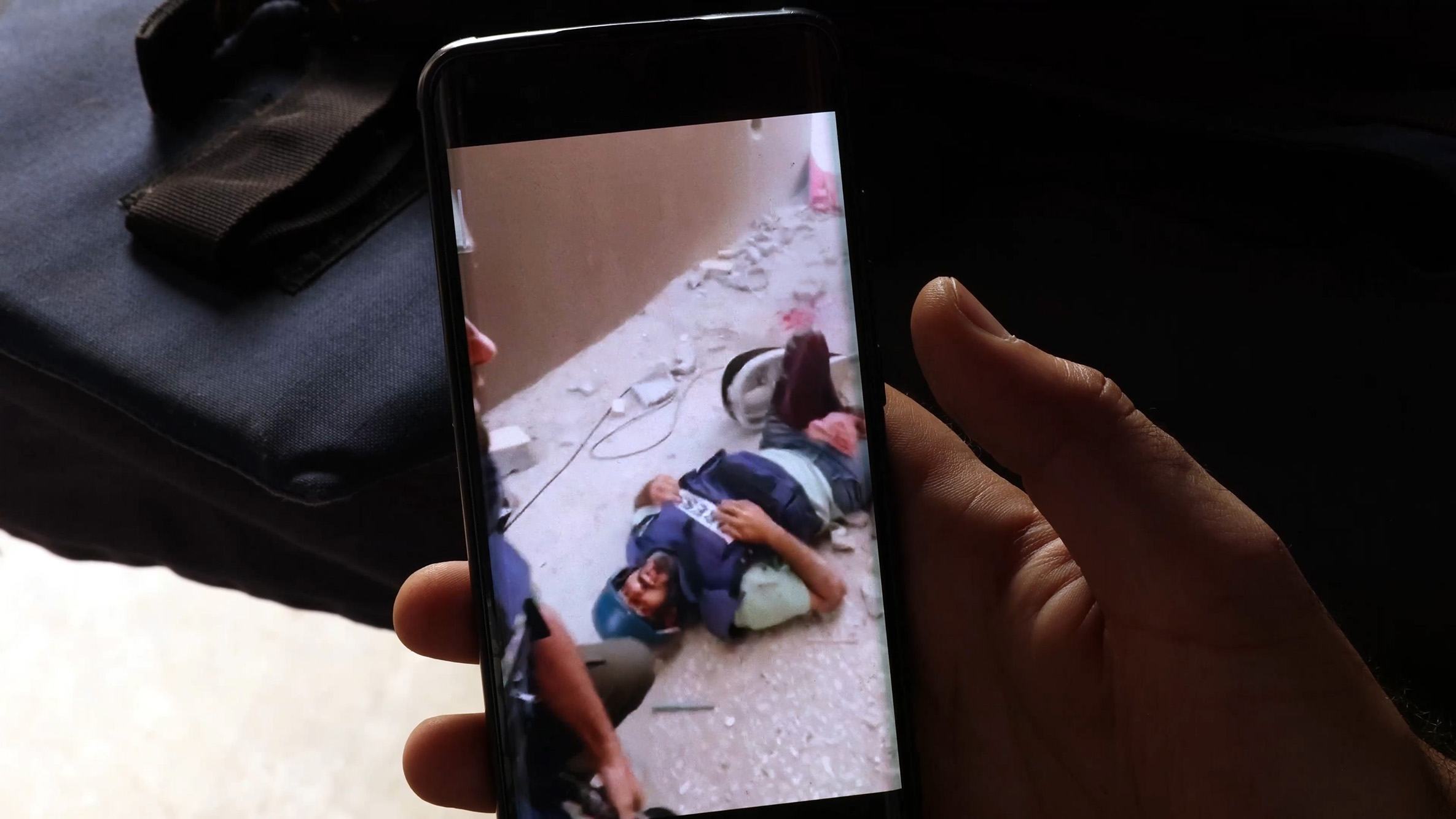
Sami Shehadeh looks at a video of the moment he was injured in Gaza in April 2024.

“I was a field journalist, carrying a camera in an open area and wearing a helmet and a jacket which identified me as a journalist, yet I was directly targeted.”

That incident marked a turning point in his life. “I did not need help from anyone before, now I need help,” adding that “I have the determination and persistence to overcome this new reality. This is how we journalists must work in Gaza.”

Working the streets

Journalist Mohammed Abu Namous is another of these journalists.

Filming with one of his colleagues in the rubble of a destroyed building in Gaza City he said: “While the world celebrates World Press Freedom Day, Palestinian journalists remember their workplaces which were destroyed in the war.”

“The minimum we need to carry out our journalistic work is electricity and the internet, but many do not have this, so we resort to commercial shops that provide the internet. The streets are now our offices.”

Palestinian journalist Mohammed Abu Namous and his colleague cover the impact of the war in Gaza.

He believes that Palestinian journalists have been targeted during the Israeli occupation of Gaza and said that media workers must be protected “whether they work in Palestine or elsewhere in the world.”

Voices not silenced by death of loved ones

Journalist Moamen Sharafi said he lost members of his family in an Israeli bombing in northern Gaza, but despite “the many negative impacts on a personal, social, and humanitarian level, professionally nothing has changed.”

He was determined to carry on working, he explained, as he was due to live broadcast from the streets of Gaza City.

Palestinian journalist, Moamen Sharafi (right,) lost several family members during the current war that started in October 2023.

“We have become more determined to continue our work and uphold our professional values and perform our mission with humanity to the world,” he continued, “in order to convey the reality of what is happening on the ground inside Gaza, specifically the humanitarian situation, and the impact on children, women and the elderly who suffer greatly.”

Source link

UFOs floating in shape over Shrewsbury, claims ex-army officer

An ex-army officer has claimed that he has captured a streak of UFOs floating over Shrewsbury, in Pontesbury Hill and the witness assured the viewers that it was not a military aircraft.

"Having served in the forces for over 30 years, I can bet my pension they are not known to the military. They moved slowly around the back of Pontesbury Hill and out towards Eastridge Woods," he said, reports Shropshire Star.

He said the unidentified flying objects did not make any sound and they moved in a controlled manner in the skies of Shrewsbury moving towards Stiperstones. They are certainly not the Chinese lanterns released during the festive season to float around in the sky along with the wind, he said.

“Did anyone else see these as I’m told that Shropshire is a hotspot for UFO sightings?" asked the witness, whose name has not been revealed.

The UFO sightings has increasingly been making it to the newsrooms and many former space scientists and astronauts have joined the row either claiming to have seen UFOs or denying the phenomenon as a hoax.

In addition, the time travellers have been hitting the Youtube or social media claiming that they had visited a particular year in the future and recollecting their experience. But none of them reveal their name or face or even their voice.

Since readership for anything UFO or time-travel is high, even major news outlets have repeatedly published such news. NASA, however, remains stuck to it stand that they are Internet Hoax.

But UFO buffs around the world claim that the governments are aware of alien existence and they even collaborate with them.