

“I hate earthquakes. Earthquakes took my mother and my aunt away,” five-year-old Khin Yadanar told the UN Children’s Fund (UNICEF), after both her mother and aunt were killed when a brick wall collapsed on them.
Around 6.5 million children were already in need of humanitarian assistance before the earthquake, which compounded existing vulnerabilities resulting from the brutal civil war between multiple armed opposition groups and the military junta which seized power in a February 2021 coup.
Families now face a further threat from flooding and landslides with the arrival of the monsoon season.
Midwives are lifelines
As health services collapsed after the earthquake, “women, especially pregnant mothers, were severely impacted,” said Yu Yu, a midwife in Mandalay, speaking to the UN’s reproductive health agency, UNFPA.
Amidst the chaos, midwives have emerged as frontline heroes. Undeterred by aftershocks and confronting both physical obstacles and emotional challenges, midwives provided hope and life-saving support.
Yu Yu notably recalls the case of one of her patients who suddenly became stranded, unable to reach any medical facilities as she went into labour following the quake.
Without hesitation, Yu Yu rushed to her side: “When I reached her, she was exhausted, overwhelmed by fear and financial insecurity following the earthquake,” she recalled.
On that day, Yu Yu saved both mother and child, as the baby’s umbilical cord had wrapped itself around the infant’s neck.
UNFPA has deployed mobile clinics to ensure that women and girls continue to receive essential healthcare and protection services.
A 10-year-old boy with his parrot on his shoulder at a temporary camp set up in the aftermath of devastating earthquake that struck Myanmar.
Deep trauma
“She cries in her sleep, and I worry something inside her has broken,” said Thida, mother of eight-year-old Thiri, speaking to UNICEF.
Beneath the visible devastation of the earthquake lies a deeper crisis: the profound psychological trauma that young survivors carry.
“I was so scared. My heart was beating so fast – and all I could think about was my parrots and cats at home,” said Thurein Oo, a ten-year-old boy who was praying at a mosque when the tremor struck.
Across earthquake-affected areas, parents are witnessing similar signs of distress in their children – sudden anxiety, emotional withdrawal, and sleepless nights, say UN aid workers.
In response to this growing mental health crisis, UNICEF and its partners have mobilised to provide critical psychological support to affected communities.
Setting up child-friendly spaces, UNICEF aims to promote psychosocial wellbeing, build resilience, and restore a sense of normalcy to children’s routines. Through various activities such as drawing, children learn to cope with their trauma.
“I coloured a picture of my mother,” said Khin, who lost her mother in the quake. “I feel better when I draw.”
Although the physical rebuilding of homes and infrastructure will likely take years, the emotional and psychological toll the earthquake has had on children cannot be left untreated.
“I like coming here,” said Thurein, referring to one of these spaces. “I feel safe, and I made a new friend who also lost his home,” he added.

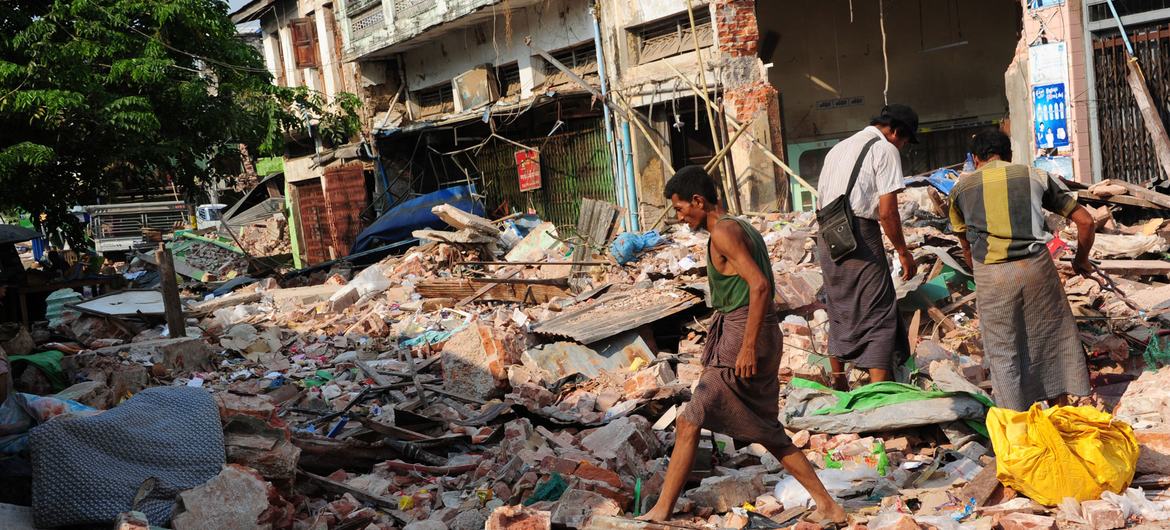
Earthquake survivors survey the ruins of their homes in Pyinmana, Myanmar following the earthquake there.
Proactive planning
While earthquakes are among the deadliest natural hazards, it is the collapse of buildings that causes the most devastating effects. As such, proactive disaster risk reduction – such as making structures earthquake-resistant – is essential to reducing deaths and economic losses.
Focusing on risk-sensitive urban development, UN-Habitat and the UN office for disaster risk reduction (UNDRR) are also working across Myanmar to mitigate the risks future earthquakes could pose.
While little can be done to prevent natural hazards such as earthquakes from occurring, much can be done to mitigate their effects.
As rebuilding efforts are underway, the UN is dedicated to “ensuring that each step we take makes the rebuilt areas stronger and more resilient than before,” said Anacláudia Rossbach, Executive Director of UN-Habitat.