Pakistan floods leave villages cut off as monsoon devastation continues

Aid agencies are continuing to work tirelessly to reach the hardest-hit areas.

The National Disaster Management Authority (NDMA) said nearly 800 people have died since late June – almost three times the toll during the same period last year.

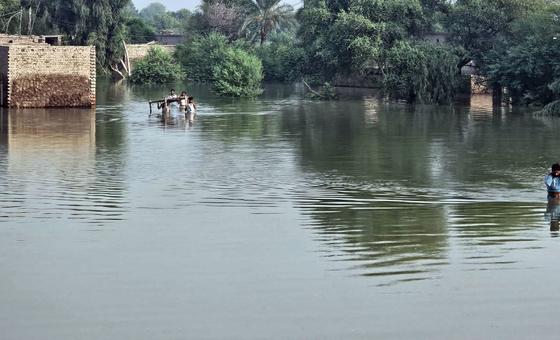
Khyber Pakhtunkhwa province has been hardest hit, where flash floods and landslides swept away homes and schools in mountainous districts, cutting off entire villages and communities.

Punjab – the country’s most populous province – is also on high alert as rising waters on the Sutlej, Ravi and Chenab rivers threaten downstream communities. Authorities fear that upstream water levels and near-full reservoirs could trigger further flooding in the coming days.

Glacier outbursts compound crisis

In Gilgit-Baltistan, so-called glacier lake outburst floods (GLOFs) have added another layer of devastation – destroying homes, water systems and power infrastructure in remote valleys.

These floods occur when heavy rains or rising temperatures cause glacial lakes to burst through natural barriers, suddenly releasing vast amounts of water and debris. With little warning, they are often catastrophic.

Experts warn that climate change is accelerating glacial melt in the Himalaya–Hindu Kush region, increasing the number and size of unstable lakes and heightening risks of such disasters.

Over a million affected

The humanitarian toll is widespread, with more than one million people affected nationwide.

Many families are sheltering with host communities rather than in relief camps, citing concerns over livestock and schooling. Health workers are reporting surges in malaria, fever and skin infections, stretching fragile health services.

Despite major efforts led by federal and provincial authorities, supported by the UN and humanitarian partners, critical gaps remain.

Communities cut off

The most acute needs are in remote mountain areas, where landslides block access and residents face worsening disease, hunger and water shortages, according to the UN aid coordination office, OCHA.

The UN Children’s Fund (UNICEF) said children face heightened risks, with schools damaged, safe water scarce and protection needs rising. The agency has dispatched hygiene kits and helped restore key water supplies.

The World Health Organization (WHO), for its part, is leading disease surveillance and control operations, in a bid to contain outbreaks.
Droughts are causing record devastation worldwide, UN-backed report reveals

This is according to a new report from the UN Convention to Combat Desertification (UNCCD), the U.S. National Drought Mitigation Center (NDMC) and the International Drought Resilience Alliance on the global impacts of droughts from 2023 to 2025.

“Drought is a silent killer. It creeps in, drains resources, and devastates lives in slow motion. Its scars run deep,” said UNCCD Executive Secretary Ibrahim Thiaw.

“This is not a dry spell,” stressed Dr. Mark Svoboda, report co-author and NDMC Director. “This is a slow-moving global catastrophe, the worst I’ve ever seen. This report underscores the need for systematic monitoring of how drought affects lives, livelihoods, and the health of the ecosystems that we all depend on.” 

Record devastation in Africa

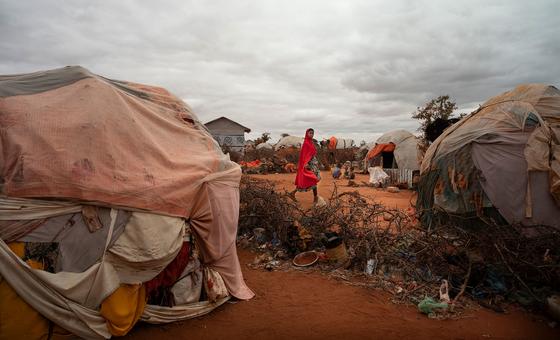
According to the report, as 90 million people face acute hunger across Eastern and Southern Africa, some areas in the region have been experiencing the worst drought ever recorded.

In Ethiopia, Zimbabwe, Zambia and Malawi, maize and wheat crops have suffered repeated failures. In Zimbabwe in particular, the 2024 corn crop was down 70 per cent year on year, maize prices doubled, and 9,000 cattle died of thirst and starvation.

Some 43,000 people in Somalia died in 2022 alone due to drought-linked hunger. The crisis continued through 2025, with a quarter of the population facing crisis-level food insecurity at the beginning of the year.

As a result of drought, Zambia is suffering one of the world’s worst energy crises: in April, the Zambezi River plummeted to 20 per cent of its long-term average, and the country’s largest hydroelectric plant, the Kariba Dam, fell to 7 per cent generation capacity, causing electricity blackouts of up to 21 hours a day. This has led to the shuttering of hospitals, bakeries, and factories, further compounding the devastation.

Worldwide impacts

But the effects of drought extend beyond Africa. For example, by September 2023 in Spain, two years of drought and record heat caused a 50 per cent drop in the olive crop, doubling olive oil prices nationwide.

In Türkiye, drought-accelerated groundwater depletion has triggered sinkholes, endangering communities and their infrastructure while reducing aquifer storage capacity.

In the Amazon Basin, record-low river levels in 2023 and 2024 led to mass deaths of fish and endangered dolphins, disrupted drinking water supplies and created transport challenges for hundreds of thousands. Ongoing deforestation and fires also threaten to shift the Amazon from a carbon sink to a carbon source.

Declining water levels in the Panama Canal slashed transit by more than one-third, leading to major global trade disruptions. Among the spillover effects were declines in American soybean exports and shortages and rising prices reported in UK grocery stores.

Call for cooperation and solutions

The report listed several recommendations to help combat this crisis, including stronger early warning systems, real-time drought and drought impact monitoring, and nature-based solutions such as watershed restoration and indigenous crop use.

It also called for more resilient infrastructure – including off-grid energy and alternative water supply systems – and global cooperation, particularly regarding transboundary river basins and trade routes. 

‘She cries in her sleep’: Deeper crisis looms beneath devastation from Myanmar quake

“I hate earthquakes. Earthquakes took my mother and my aunt away,” five-year-old Khin Yadanar told the UN Children’s Fund (UNICEF), after both her mother and aunt were killed when a brick wall collapsed on them.

Around 6.5 million children were already in need of humanitarian assistance before the earthquake, which compounded existing vulnerabilities resulting from the brutal civil war between multiple armed opposition groups and the military junta which seized power in a February 2021 coup.

Families now face a further threat from flooding and landslides with the arrival of the monsoon season.

Midwives are lifelines

As health services collapsed after the earthquake, “women, especially pregnant mothers, were severely impacted,” said Yu Yu, a midwife in Mandalay, speaking to the UN’s reproductive health agency, UNFPA.

Amidst the chaos, midwives have emerged as frontline heroes. Undeterred by aftershocks and confronting both physical obstacles and emotional challenges, midwives provided hope and life-saving support.

Yu Yu notably recalls the case of one of her patients who suddenly became stranded, unable to reach any medical facilities as she went into labour following the quake.

Without hesitation, Yu Yu rushed to her side: “When I reached her, she was exhausted, overwhelmed by fear and financial insecurity following the earthquake,” she recalled.

On that day, Yu Yu saved both mother and child, as the baby’s umbilical cord had wrapped itself around the infant’s neck.

UNFPA has deployed mobile clinics to ensure that women and girls continue to receive essential healthcare and protection services.

A 10-year-old boy with his parrot on his shoulder at a temporary camp set up in the aftermath of devastating earthquake that struck Myanmar.

Deep trauma

“She cries in her sleep, and I worry something inside her has broken,” said Thida, mother of eight-year-old Thiri, speaking to UNICEF.

Beneath the visible devastation of the earthquake lies a deeper crisis: the profound psychological trauma that young survivors carry.

“I was so scared. My heart was beating so fast – and all I could think about was my parrots and cats at home,” said Thurein Oo, a ten-year-old boy who was praying at a mosque when the tremor struck.

Across earthquake-affected areas, parents are witnessing similar signs of distress in their children – sudden anxiety, emotional withdrawal, and sleepless nights, say UN aid workers.

In response to this growing mental health crisis, UNICEF and its partners have mobilised to provide critical psychological support to affected communities.

Setting up child-friendly spaces, UNICEF aims to promote psychosocial wellbeing, build resilience, and restore a sense of normalcy to children’s routines. Through various activities such as drawing, children learn to cope with their trauma.

“I coloured a picture of my mother,” said Khin, who lost her mother in the quake. “I feel better when I draw.”

Although the physical rebuilding of homes and infrastructure will likely take years, the emotional and psychological toll the earthquake has had on children cannot be left untreated.

“I like coming here,” said Thurein, referring to one of these spaces. “I feel safe, and I made a new friend who also lost his home,” he added.

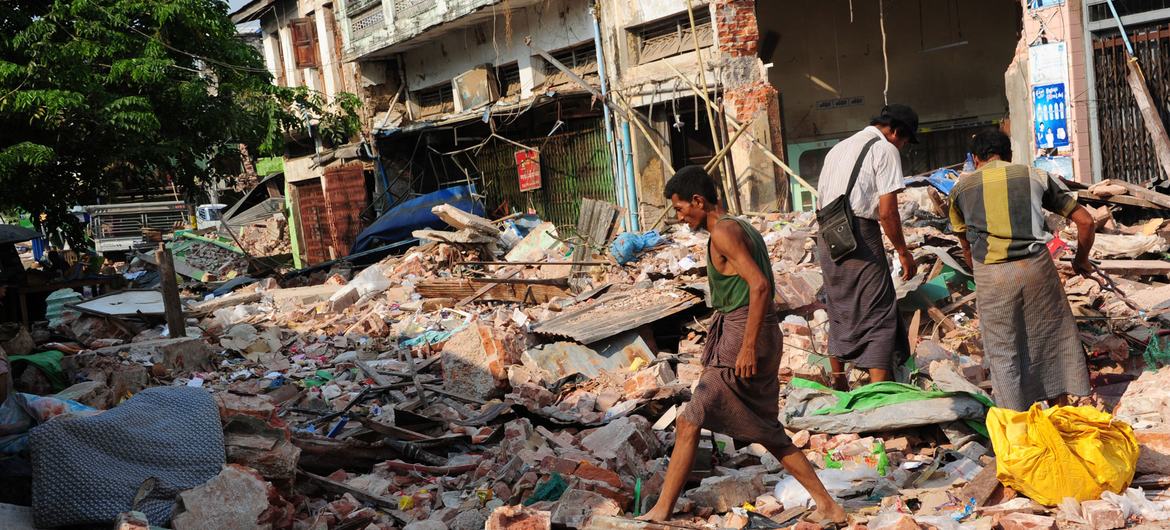
Earthquake survivors survey the ruins of their homes in Pyinmana, Myanmar following the earthquake there.

Proactive planning

While earthquakes are among the deadliest natural hazards, it is the collapse of buildings that causes the most devastating effects. As such, proactive disaster risk reduction – such as making structures earthquake-resistant – is essential to reducing deaths and economic losses.

Focusing on risk-sensitive urban development, UN-Habitat and the UN office for disaster risk reduction (UNDRR) are also working across Myanmar to mitigate the risks future earthquakes could pose.

While little can be done to prevent natural hazards such as earthquakes from occurring, much can be done to mitigate their effects.

As rebuilding efforts are underway, the UN is dedicated to “ensuring that each step we take makes the rebuilt areas stronger and more resilient than before,” said Anacláudia Rossbach, Executive Director of UN-Habitat.