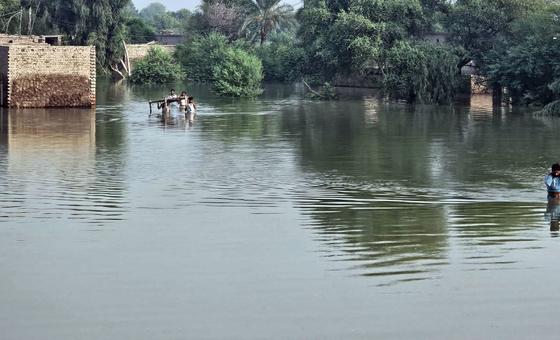
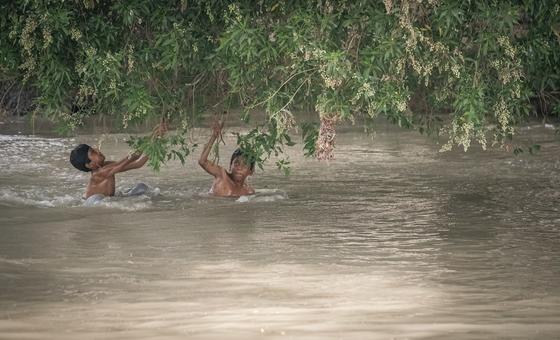
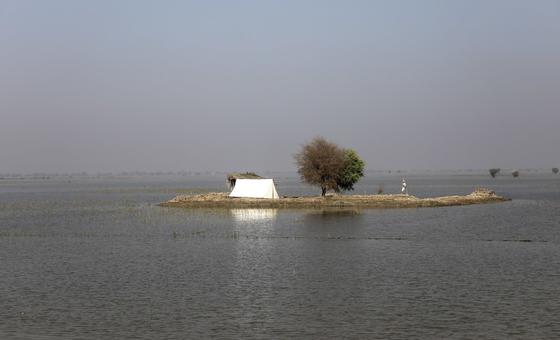
Pakistan floods leave villages cut off as monsoon devastation continues

Aid agencies are continuing to work tirelessly to reach the hardest-hit areas.

The National Disaster Management Authority (NDMA) said nearly 800 people have died since late June – almost three times the toll during the same period last year.

Khyber Pakhtunkhwa province has been hardest hit, where flash floods and landslides swept away homes and schools in mountainous districts, cutting off entire villages and communities.

Punjab – the country’s most populous province – is also on high alert as rising waters on the Sutlej, Ravi and Chenab rivers threaten downstream communities. Authorities fear that upstream water levels and near-full reservoirs could trigger further flooding in the coming days.

Glacier outbursts compound crisis

In Gilgit-Baltistan, so-called glacier lake outburst floods (GLOFs) have added another layer of devastation – destroying homes, water systems and power infrastructure in remote valleys.

These floods occur when heavy rains or rising temperatures cause glacial lakes to burst through natural barriers, suddenly releasing vast amounts of water and debris. With little warning, they are often catastrophic.

Experts warn that climate change is accelerating glacial melt in the Himalaya–Hindu Kush region, increasing the number and size of unstable lakes and heightening risks of such disasters.

Over a million affected

The humanitarian toll is widespread, with more than one million people affected nationwide.

Many families are sheltering with host communities rather than in relief camps, citing concerns over livestock and schooling. Health workers are reporting surges in malaria, fever and skin infections, stretching fragile health services.

Despite major efforts led by federal and provincial authorities, supported by the UN and humanitarian partners, critical gaps remain.

Communities cut off

The most acute needs are in remote mountain areas, where landslides block access and residents face worsening disease, hunger and water shortages, according to the UN aid coordination office, OCHA.

The UN Children’s Fund (UNICEF) said children face heightened risks, with schools damaged, safe water scarce and protection needs rising. The agency has dispatched hygiene kits and helped restore key water supplies.

The World Health Organization (WHO), for its part, is leading disease surveillance and control operations, in a bid to contain outbreaks.

Monsoon floods kill more than 700 in Pakistan, with heavy rains set to continue

The National Disaster Management Authority has also reported 978 injuries and the destruction or damage of more than 2,400 houses, while over 1,000 livestock have been lost as of Thursday, 21 August.

Severe weather is forecast to continue into early September, raising the risk of further flooding, landslides and crop losses, according to the UN Office for the Coordination of Humanitarian Affairs (OCHA).

Khyber Pakhtunkhwa hit hardest

The northwestern province of Khyber Pakhtunkhwa has borne the brunt of the disaster. 

Authorities declared a state of emergency in nine districts, including Buner, Shangla and Mansehra, after torrential rains between 15 and 19 August left 368 people dead, 182 injured and damaged more than 1,300 homes. Nearly 100 schools were also destroyed.

The international charity CARE said its teams found widespread devastation in Buner, where families reported homes and livelihoods swept away within minutes by torrents of floodwater carrying boulders and debris.

Children most affected

The toll on children has been particularly severe, with displacement, loss of schooling and limited access to safe water putting their health and well-being at grave risk. 

According to the UN Children’s Fund (UNJCEF), at least 21 children were among those killed in Khyber Pakhtunkhwa since 15 August.

Many schools have been destroyed or are now being used as temporary shelters, further restricting access to education and safe spaces.

Urban flooding in Karachi

In Sindh province, heavy rains on 19 August triggered urban flooding in Karachi – Pakistan’s largest city – where at least six people were killed in wall collapses and electrocutions. Rainfall reached up to 145 millimetres (about 5.75 inches) in parts of the city, inundating roads and leaving many neighbourhoods without power for hours.

The province of Punjab also suffered extensive flooding along the Indus and Chenab rivers, which has displaced more than 2,300 families and damaged cash crops across thousands of acres.

Scaling up support

Federal and provincial authorities are leading the response, having mobilized over 2,000 personnel for rescue and evacuation. In coordination with the UN and partners, they have dispatched key relief items, including food, tents and medical supplies to affected areas.

OCHA said it has deployed field coordinators to the hardest-hit districts and activated emergency mechanisms, including the release of funds from its regional humanitarian envelope for Pakistan – prioritising life-saving assistance in health, water, food security and shelter.

For its part, UNICEF has dispatched essential medicines and hygiene kits to affected districts. Each kit includes soap, water containers and other hygiene supplies to help prevent disease outbreaks.

Worrying trend

Pakistan has endured devastating monsoon seasons in recent years. In 2022, unprecedented floods killed more than 1,700 people, displaced millions, and caused an estimated $40 billion in economic losses.

Erratic and intensified rainfall patterns, amplified by climate change, are compounding the country’s vulnerability, threatening lives, livelihoods and long-term recovery across southern Asia. 

Source link

Pakistan reels under monsoon deluge as death toll climbs

Punjab, Pakistan’s most populous province, reported at least 63 casualties and 290 injuries in the past 24 hours, pushing the nationwide toll since the seasonal rains began on 26 June to over 120 fatalities, according to the National Disaster Management Authority.

The unfolding crisis – rising rivers, forecasts of further downpours, fragile rural homes collapsing and transport links severed – has revived stark memories of the catastrophic 2022 floods that submerged a third of the country and affected more than 33 million people.

More intense rainfall is forecast over parts of central and northern Pakistan in the next 72 hours. Weather forecasters have warned of “exceptional high” flood levels of up to 450,000 cusecs at some locations along the Jhelum River. One cusec equals one cubic foot of water – equivalent to 28.4 litres or 7.5 gallons – per second.

There are also fears of glacier lake outburst floods in the Khyber Pakhtunkhwa and Gilgit Baltistan regions.

Wider UN contingency – major stock gaps

Managed by the Office for the Coordination of Humanitarian Affairs (OCHA), the UN presence in Pakistan released an inter‑agency monsoon contingency plan earlier this month.

The plan lays out response triggers, sector roles and arrangements for floods, storms and landslides – under the leadership of the Government.

However, pre-positioned aid supplies remain far below projected need, with key sectors such as protection, nutrition, and shelter and non-food items, facing severe gaps.

These shortfalls underscore the urgency of pre‑positioning relief items and securing rapid financing if the rains intensify.

Building resilience

Amid the emergency, the UN World Food Programme (WFP) and the Government of Pakistan this week launched a climate-risk project in Khyber Pakhtunkhwa’s Buner and Shangla districts.

The initiative will establish early warning systems, train communities in safe evacuation and strengthen local capacity for disaster response.

Recurring climate shocks are a driver of hunger and malnutrition, threatening lives, livelihoods and entire food systems,” said WFP Country Director Coco Ushiyama.

“This project represents a multi-layered investment in early warning systems and action.”

Flashbacks of 2022 devastation

The escalating disaster once again reveals Pakistan’s vulnerability to climate shocks.

In 2022, unprecedented monsoon floods killed more than 1,700 people, displaced millions and devastated water systems, leaving millions more in desperate need. The disaster also inflicted immense economic damage estimated at nearly $40 billion, and reversed years of development efforts.

Experts warn that erratic monsoon patterns, amplified by climate change, are hitting the country – and others across the southern Asian – harder each year.

Source link

Rohingya Refugees and Locals Work Together to Prepare for Monsoon in Cox’s Bazar Camps

Rohingya refugees and local people in Teknaf, a southern sub-district of Cox’s Bazar, are racing to prepare for monsoon rains forecast to start as early as this week. IOM, the UN Migration Agency, has been supporting efforts to prepare the camps, which although smaller than the giant Ukhiya sub-district settlements of Kutupalong and Balukali, still house thousands of people, who face similar threats of flooding and landslides.

To date IOM has supported 24 quick impact projects in Teknaf under the umbrella of 20 Para Development Committees (PDCs) – community platforms, each comprised of six refugees and five locals. The projects include building bridges, access roads, steps, drains, and slope protection work that will enable communities to better weather the monsoon.

The projects are mainly located in the densely populated Unchiprang, Leda Makeshift Settlement, Nayapara and Shamlapur camps. Over 21,310 people live in Unchiprang, 9,320 in Leda, 24,790 in Nayapara and 22,700 in Shamlapur. In all, some 250,000 Rohingya refugees live outside the main Ukhiya camps.

“At present, the most critical issue for both the Rohingya refugees and local people is to be safe from the rains,” said Maulavi Shaker, 35, a Rohingya member of a Teknaf PDC. “We’ve been working towards that, building roads and bridges so that our area won’t get cut off if there is flooding,” he added.

“Most refugees in Teknaf are living in shelters built only with plastic sheets and thin bamboos, which are highly vulnerable in the monsoon,” said Mohammad Helal Uddin, 35, another Teknaf member.

IOM and partner agencies recognize the risks posed by the flimsy structures in high winds and rain and have been racing to upgrade the shelters. In Teknaf over 15,000 shelters – covering over 78,000 people – have been identified as in need of upgrades, including plastic sheets, poles and guy ropes. IOM itself is targeting 13,204 shelters housing 66,020 refugees.

“The PDCs are helping our teams to identify workers and organizing cash for work in order to ensure that households living in flood-prone and landslide-prone areas get back-filling to elevate their shelter plots. We’re also constructing drainage to protect the shelters from run-off water, building embankments to prevent tidal surges and doing a number of slope protection works,” said Rafael Abis, IOM’s site management area coordinator. “The PDCs will also help IOM in the event of an evacuation – particularly if it involves those who are unable to evacuate themselves,” he added.

IOM has also helped the PDCs to establish Youth Safety and Security sub-committees within each of PDC to cope with possible emergencies such as flash floods, landslides, fires or conflicts. The sub-committee members have been trained to build the response capacity of their respective communities.

“Despite all the challenges that the Rohingya influx has created in Cox’s Bazar, the refugee and local communities have maintained a harmonious relationship throughout the crisis,” said John McCue, IOM Senior Operations Coordinator in Cox’s Bazar. “Representatives of both communities have come together to identify shared needs and solutions. The roads and bridges that they have constructed to provide access, particularly during the rainy season, is a significant example of communal harmony in this disaster-prone area,” he added.