
“I stand in full solidarity with the people of Afghanistan after the devastating earthquake that hit the country earlier today,” the Secretary-General said in an online message. “I extend my deepest condolences to the families of the victims and wish a speedy recovery to those injured. The @UN team in Afghanistan is mobilized and will spare no effort to assist those in need in the affected areas.”
On the ground, several UN agencies reported devastation across four eastern provinces of Afghanistan including Nangarhar and Kunar, where staff and humanitarian partners are already supporting relief efforts.
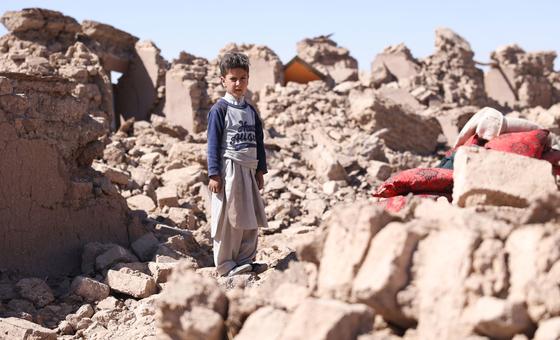
Hundreds of houses are believed to have collapsed in remote hillside communities, where many likely crumbled on top of others located on terraces further downhill.
“When an earthquake of this magnitude happens, the homes basically tumble on top of each other,” Salam Al-Jabani from the UN Children’s Fund (UNICEF) told UN News. “And because it was so late at night, families were at home sleeping and that’s why we see such big losses.”
The UN Humanitarian Air Service has scheduled additional flights connecting Kabul and Jalalabad for personnel and cargo to scale up the response.
Trapped inside
Witnesses reported that the earthquake happened at around midnight local time, heightening fears that many Afghans may still be trapped under the rubble of their homes. The UN Children’s Fund (UNICEF) reported that many youngsters had been killed, as first responders said that poor phone and signal quality was impacting rescue and assessment activities.
The tremor’s epicentre is estimated to have been only around eight kilometres (six miles) underground, causing buildings to shake in the Afghan capital, Kabul, and in Pakistan’s capital city, Islamabad, according to reports.
Among those providing assistance are the UN Assistance Mission in Afghanistan (UNAMA), the UN aid coordination office (OCHA) the UN World Health Organization (WHO) and many more.
“As reports of deaths and injuries from the #earthquake in eastern region of #Afghanistan continue to emerge, @WHOAfghanistan teams are on the ground in hospitals and health facilities, supporting the treatment of the wounded and assessing urgent health needs,” the UN health agency said.
“We are actively delivering essential medicines and supplies and deploying health teams to affected areas to help #SaveLives.”
How the UN helps
United Nations teams are on the ground in more than 160 countries, working with the authorities and partners on joint programmes in communities to promote climate action, food security, gender equality and safety of civilians.
The UN has been present in Afghanistan since 1949; the global body’s work there is driven by the Resident Coordinator, Indrika Ratwatte, as head of a country team which includes around 20 UN agencies and international organizations such as the World Bank and Asian Development Bank.
International appeal
Also on the ground to provide assistance, the UN refugee agency, UNHCR, noted that up more than 2,000 people have been likely injured in the province of Kunar alone. It is feared that the trading city of Jalalabad may have suffered a “very high death toll”, said UNHCR spokesperson Babar Baloch.
The UN agency is among those rushing lifesaving support to affected areas including medical equipment, shelter, clean water, tents and blankets. It underscored how the emergency has added “death and destruction” to Afghanistan’s many other existing human challenges that include drought and the return of millions of nationals from neighbouring countries.
Mr. Baloch insisted that the scale of this disaster “far exceeds the current capacity of local authorities and communities… We are appealing to the donor community globally to support urgently required relief efforts. Afghans need our support and assistance now, before it’s too late for many others.”
Aid teams will have to overcome challenging terrain to help some of the most remote communities who can only be reached on foot, OCHA noted.
It said that the de facto authorities have deployed heavy machinery to Nurgal and Chawkay districts to remove road blockages and that some sections have reportedly been reopened. Critically injured people have also been airlifted by helicopterto Jalalabad and Asadabad hospitals which are now the main referral points for victims in Nangarhar and Kunar provinces.
But “a number of isolated communities” can only be reached by foot with travel time currently up to three hours from the point of obstruction, OCHA noted, highlighting those in Dewagal Valley in Chawkay district and Mazar Valley in Nurgal district, Kunar province.
The earthquake is one of the worst to hit Afghanistan and comes less than two years since three deadly 6.3 magnitude quakes shook Herat on the other side of the country. They struck on 7, 11 and 15 October, killing 1,480 people and injuring 1,950 others across 382 villages, leaving widespread destruction.