WHO urges roll-out of first long-acting HIV prevention jab

Injectable lenacapavir – LEN, for short – is a highly effective, long-acting antiretroviral alternative to daily oral pills and other shorter-acting options, according to the World Health Organization (WHO).

“While an HIV vaccine remains elusive, lenacapavir is the next best thing: a long-acting antiretroviral shown in trials to prevent almost all HIV infections among those at risk,” said Tedros Adhanom Ghebreyesus, WHO Director-General.

Test kit advantage

WHO’s support for the injectable drug is significant because HIV prevention efforts are stagnating around the world.

To make it easier for people to receive the injection close to home, the UN agency also recommends the use of rapid testing kits for the disease, as opposed to “complex, costly procedures”.

According to the agency, 1.3 million people contracted HIV in 2024; people most impacted were sex workers, men who have sex with men, transgender people, people who inject drugs, people in prisons, and children and teens.

“WHO is committed to working with countries and partners to ensure this innovation reaches communities as quickly and safely as possible,” insisted Tedros, in comments during the 13th International AIDS Society Conference (IAS 2025) on HIV Science, in Kigali, Rwanda.

The recommendation for LEN is also in line with the US health authorities which approved it in June.

Call for implementation

Although access to the LEN injection remains limited outside clinical trials today, WHO urged governments, donors and partners to incorporate LEN “immediately” within national combination HIV-prevention programmes.

Other WHO-supported HIV-prevention options include daily oral tablets, injectable cabotegravir – which is injected once every two months – and the dapivirine vaginal ring, as part of a growing number of tools to end the HIV epidemic.

Funding dilemma

Amid massive funding cuts to the global effort to end HIV-AIDS – including the leading US Government programme launched in 2003, PEPFAR, focusing on combating the disease in Africa – WHO also issued new operational guidance on how to sustain priority HIV services.

“We have the tools and the knowledge to end AIDS…what we need now is bold implementation of these recommendations, grounded in equity and powered by communities,” said Dr Meg Doherty, Director of WHO’s Department of Global HIV, Hepatitis and STI Programmes and incoming Director of Science, Research, Evidence and Quality for Health.

HIV remains a major global public health issue.

By the end of 2024, an estimated 40.8 million people were living with HIV with an estimated 65 per cent in Africa. Approximately 630,000 people died from HIV-related causes globally, and an estimated 1.3 million people acquired HIV, including 120,000 children.

More positively, access to HIV drugs continues to expand, with 31.6 million people receiving treatment in 2024, up from 30.3 million a year earlier. Without anti-retroviral medication, the HIV virus attacks the body’s immune system, leading ultimately to the onset of AIDS.

Source link

Smurf your voice: Global campaign urges everyone to speak up for a better future

Launched in June, the eight-week digital campaign draws on the enduring popularity of the beloved Smurfs to encourage young people – along with their parents and caregivers – to raise their voices on issues that matter to them.

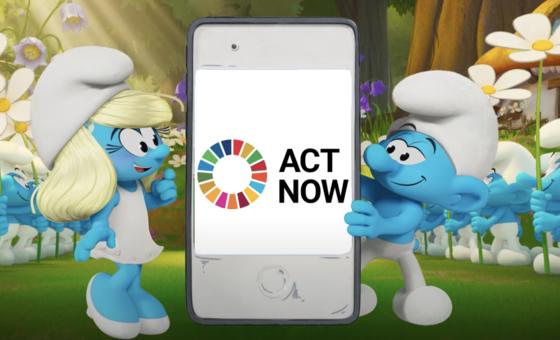
The initiative is part of the UN’s ActNow effort for the Sustainable Development Goals (SDGs) and aims to empower individuals, especially children, to speak out and take action in their communities.

Voices for change

Featuring Rihanna, Hannah Waddingham, Billie Lourd and Amy Sedaris – who voice various characters in an upcoming Smurfs film – the campaign includes vibrant public service announcements (PSAs) and colourful social media cards.

The Smurfs know the importance of speaking up and speaking out because everyone, every child, has the right to be heard,” said Hannah Waddingham, who voices Jezebeth in the movie.

The power to create change is already inside you. You just have to act,” added Billie Lourd (Worry Smurf).

Amy Sedaris (Jaunty) summed it up simply: “It’s easy if you follow the Smurfs’ blueprint. Small actions can add up to make a big difference.

The videos, produced in multiple formats, direct viewers to a dedicated “Speak Up with the Smurfs” section on the ActNow platform, which offers child-friendly tools and resources.

Join the Smurfs and speak up for a better world! | UN ActNow and UNICEF

Smurfing it up

To smurf things up a bit – campaign invites everyone to “smurf their voice” and help smurf a brighter future, one action at a time. Whether you’re five or fifty-five, there’s always a way to smurf positive change.

In Smurf-speak, “smurf” can mean just about anything – noun, verb, or adjective – but the message here is clear: smurf your voice, smurf your rights, smurf the future.

UNICEF’s involvement centres on ensuring the message reaches children everywhere – and that they are equipped to participate meaningfully in decisions affecting their lives.

Global rollout

The campaign is being promoted across Paramount Global’s platforms – including CBS, MTV, Nickelodeon, BET, Comedy Central, streaming services like Paramount+ and Pluto TV, and the free-to-air network Net 10 in Australia.

Smurf-themed content will also light up Times Square in New York City and appear in markets across Europe, Latin America and Asia.

Content is available in over a dozen languages, including Arabic, French, Spanish, Hindi, Kiswahili, and Japanese, to ensure broad accessibility.

About the Smurfs

First introduced in 1958, the Smurfs are small blue fictional characters known for their teamwork, mischief, and unique way of speaking.

Generations of children (like this author and his little ones) have followed their adventures, and their continued appeal has made them ideal messengers for values like cooperation, kindness and now, global citizenship.

By rallying a new generation to speak up – or smurf up – the campaign hopes to inspire meaningful, lasting change for children (and adults) everywhere.

Source link

UN-backed labour standards at risk as tariff uncertainty grows

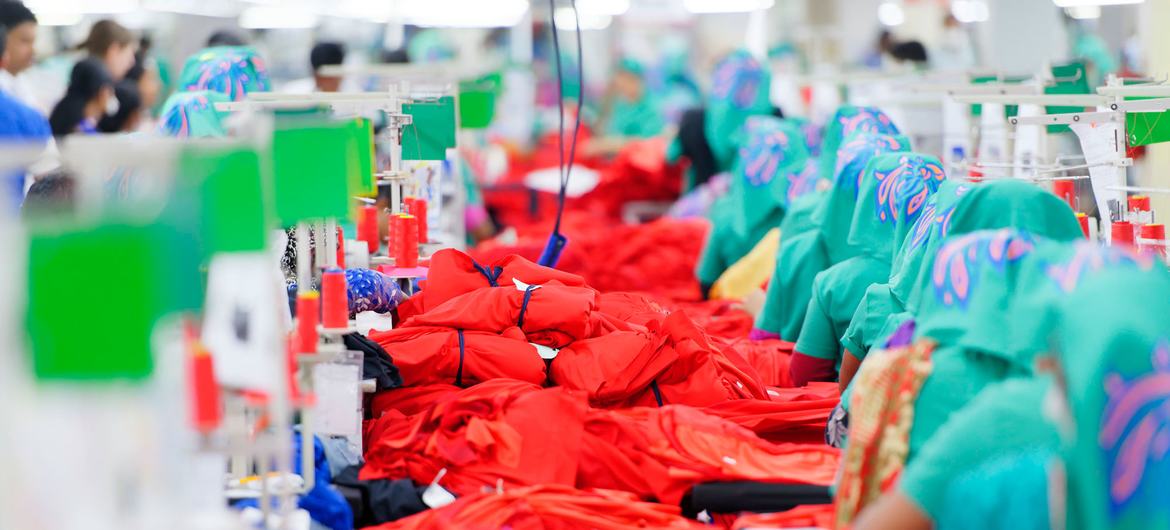
Threatened or actual tariff increases are largely focused on taxing imports into the United States and will make the products made by factories outside the country more expensive – a situation which may drive down demand.

The ILO’s Better Work programme, a partnership with the International Finance Corporation (IFC), has supported garment factories, many of which export their products to the United States.

The ILO’s Sara Park explained to UN News what could happen next.

Sara Park: Better Work currently operates in the garment, textile and footwear sector in 13 countries around the world.

It was set up 24 years ago in Cambodia to monitor the working conditions in garment factories and since then has focused on improvement and capacity building of factories and our constituencies in the sector, for example occupational safety and health.

There are other elements that support the sector to promote social dialogue, safe and decent work which includes fair wages and working hours. The programme has also helped build productivity in those sectors.

UN News: How is the ILO involved?

Sara Park: The ILO is a tripartite organization, so we work with governments, employers, the unions who represent workers, usually Ministries of Labour, but also with ministries of trade or commerce because the programme focuses on exports.

© Better Work/Aron Simeneh

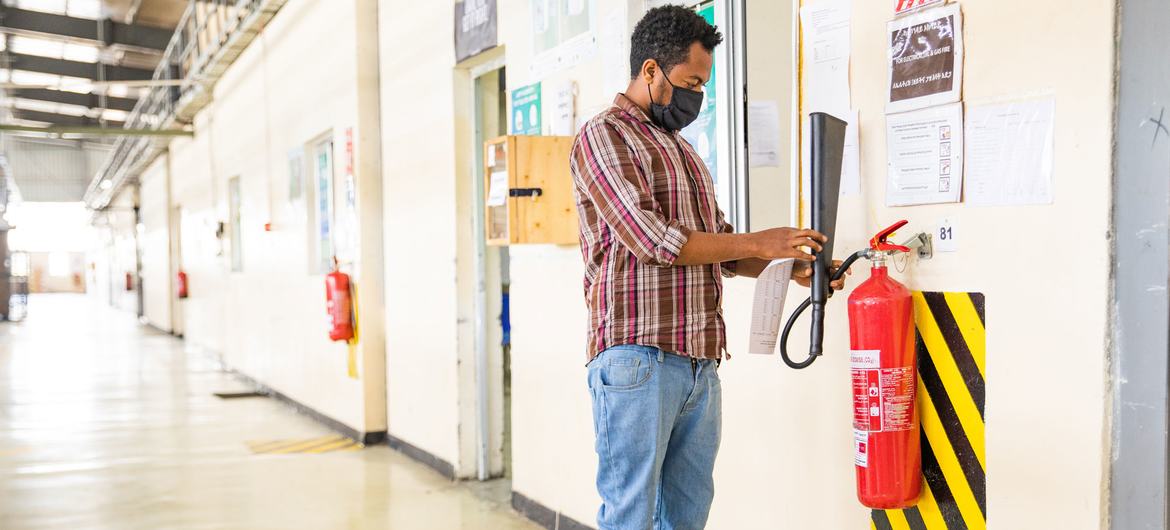
A worker at a factory in Ethiopia carries out an inspection on fire safety equipment.

But what maybe makes us different from other projects is that we have a very close collaboration with major brands from the US, UK, Europe and Japan to promote responsible business practices.

UN News: How successful has this programme been?

Sara Park: Our studies show that at the factory level we’ve made significant impact, for example by increasing wages and supporting gender-equality related issues, women’s empowerment and women getting more supervisory roles.

Over the quarter of a century of its existence, Better Work has lifted millions of people out of poverty and reduced the environmental impact of the apparel sector by creating decent work in sustainable enterprises.

It’s still hard for unions as freedom of association remains a big challenge.

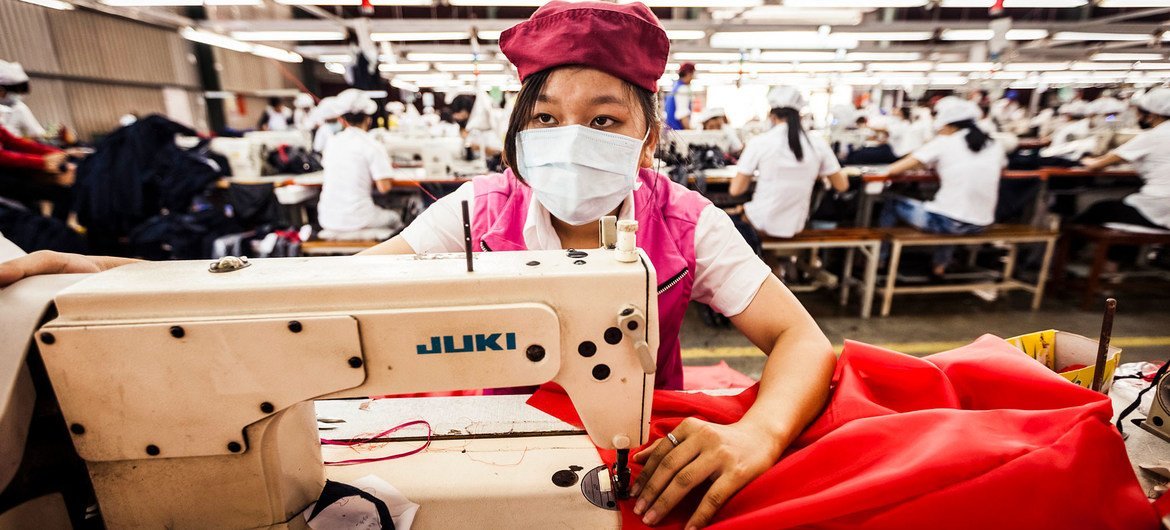
A woman works at a Better Work-affiliated factory in Viet Nam.

If you’re trying to develop a whole industry and make it competitive, it takes years if not decades; however, we have seen improvements in the factories where we work.

Better Work-enrolled factories have also reported an increase in orders from buyers.

UN News: So, this is good for business as well?

Sara Park: This is good for business, and productivity in individual factories. Governments also tell us that the programme supports confidence and thus growth of the industry as a whole in participating countries.

© Better Work/Marcel Crozet

Garment employees work on a production line of an exporting clothing plant in Jordan.

UN News: How has Better Work been affected by recent global changes in development funding?

Sara Park: As we know from recent developments, the US Government has cut funding and that has affected our programmes in Haiti and Jordan, which were almost fully funded by the US. The other countries have not been affected, as we are lucky to have very diverse funding.

UN News: Why is the ILO’s ongoing support needed once the relationship between factory and the buyer is set up?

Sara Park: The buyers, which are often well-known companies, require a sustainable way of monitoring working conditions to ensure they are in compliance with international labour standards; this is important to eliminate risk from the buyers’ perspective.

The Better Work programme supports improvements in factories, by conducting assessments, advisory and learning sessions and helps all parties to better understand compliance with the standards. It also works with governments, workers and employers to build capacity.

© Better Work/Feri Latief

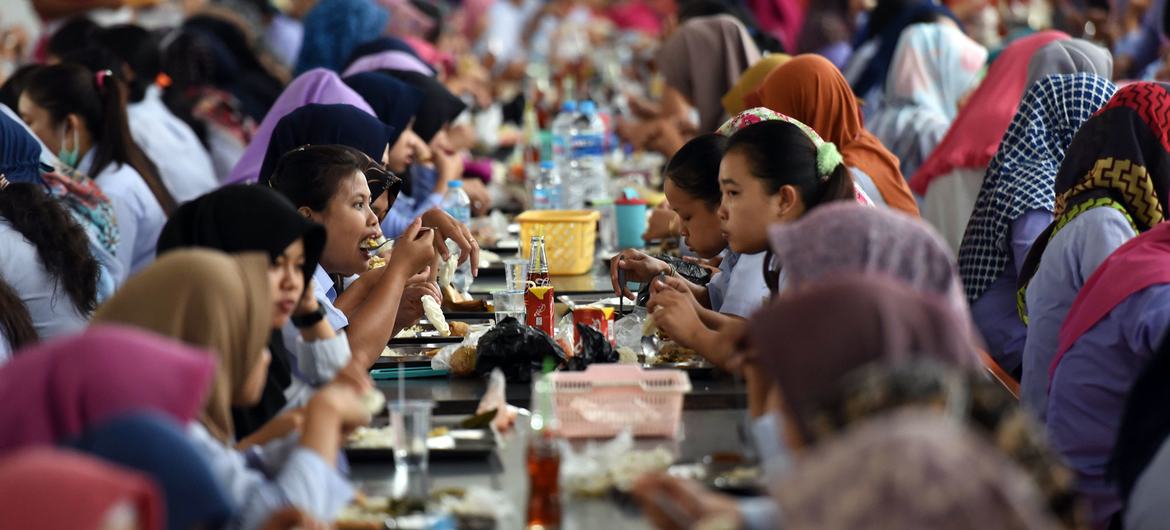
Workers take their lunch break at a garment factory in Indonesia.

UN News: Currently there is widespread uncertainty about tariffs, the taxing of imported goods particularly into the United States. How is the garment sector impacted?

Sara Park: At the moment, we don’t know what the impact will be. Governments are monitoring the situation. Employers and, of course, the unions are worried.

It is extremely challenging for factories as uncertainty means they cannot plan even for the short term, as they don’t know what orders they will have. They are also concerned about paying workers.

Better Work-enrolled factories are providing primarily jobs in the formal sector; if they close, then those jobs may move to the informal sector where workers have fewer protections.

In countries like Jordan for example, migrants make up the majority of the workforce in the garment industry, most of them come from South and Southeast Asia.

UN News: How is this uncertainty impacting investment in the global garment industry?

Sara Park: During periods of crisis or uncertainty, investment generally pauses. One concern is that factories stop investing in improving working conditions, which could affect occupational safety and health.

For example, heat stress is a serious issue. Recently, in Pakistan temperatures reached 50 degrees Celsius so action needs to be taken to protect workers. This may not happen if investment dries up.

UN News: What would you say to a garment worker who was worried about his or her job?

Sara Park: We understand this is a worry for many workers. Yet the work of the ILO is continuing to ensure that workers are protected and the ILO remains in those countries and is committed to improving conditions for all workers across different sectors.

We will continue to promote social dialogue because that’s how improvements can be made at factory, sectoral and national level.

Source link

UN forum to spotlight health, gender equality, oceans, in critical bid to meet development goals

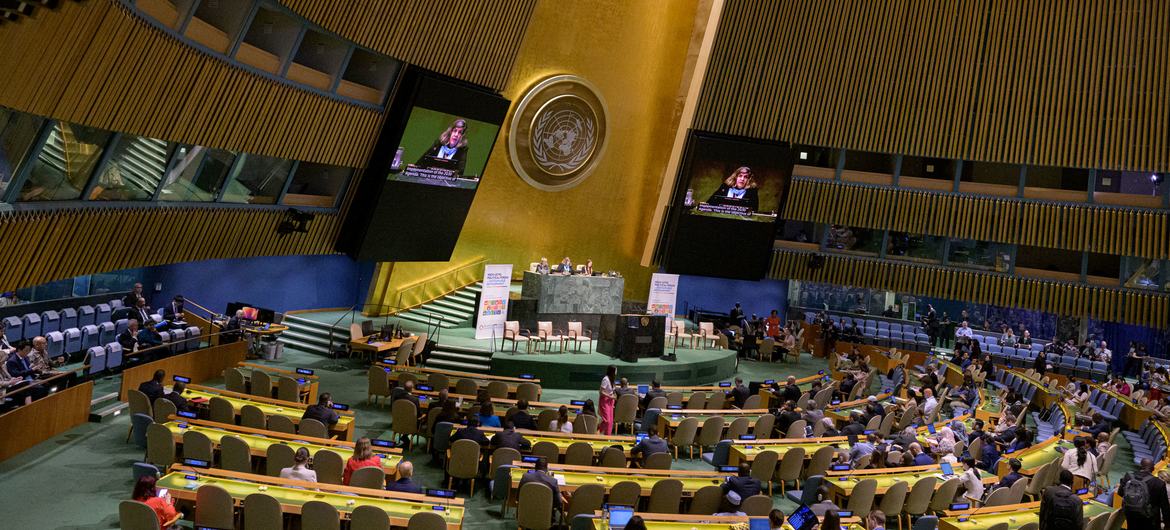
The 2025 High-Level Political Forum, or HLPF, follows two recent successful UN conferences focused on vital development issues: one in June in Nice, France, dedicated to ocean protection, and another held in Sevilla, Spain, centred on boosting financing for sustainable initiatives.

The Sevilla meeting ended with a strong call to action: to urgently address the massive $4 trillion annual shortfall in financing needed to achieve the SDGs. It also highlighted the pressing need for greater investment and deep reform of the global financial system.

Held under the auspices of the UN Economic and Social Council (ECOSOC), the forum will take place from 14 to 23 July at UN Headquarters in New York.

Here are five key things to know about this year’s forum:

1. It’s all about accelerating action

The HLPF is the United Nations’ main platform for tracking global progress on the Sustainable Development Goals. It meets each year to review countries’ efforts, share solutions, and push for faster action to meet the 2030 targets

The 2025 forum is convening under the theme:

Advancing sustainable, inclusive, science- and evidence-based solutions for the 2030 Agenda for Sustainable Development and its Sustainable Development Goals leaving no one behind.

This reflects a growing sense of urgency. With the 2030 deadline fast approaching, the forum will emphasise practical, data-driven strategies to close implementation gaps– particularly in the face of intersecting global crisis including climate change, inequality, and economic instability.

The 17 Sustainable Development Goals are all interconnected, for instance progress on SDG 2 to end hunger is closely tied to advances in health and education.

2. Five SDGs in the spotlight

Each year, the HLPF conducts in-depth reviews of selected Goals. In 2025, the focus will be on:

SDG 3: Good health and well-being

SDG 5: Gender equality

SDG 8: Decent work and economic growth

SDG 14: Life below water

SDG 17: Partnerships for the goals

These Goals span a wide range of issues – from public health and gender equity to economic resilience and marine conservation.

SDG 17, which is reviewed annually, highlights the importance of revitalising global partnerships and enhancing means of implementation – including financing, which nations committed to just last month in Sevilla.

© UNICEF/Lasse Bak Mejlvang

3. Countries will share their progress, voluntarily

A hallmark of the HLPF is the Voluntary National Reviews (VNRs) – self-assessments by Member States on their progress toward the SDGs. In 2025, dozens of countries are expected to present their VNRs, offering insights into both achievements and persistent challenges.

These reviews foster transparency, peer learning, and accountability. They also provide a platform for civil society and other stakeholders to engage directly with governments on development priorities.

VNR Labs – interactive sessions focused on national reviews – create space for dialogue, innovation, and collaboration

4. It’s not just governments

While the HLPF is a UN intergovernmental platform, it brings together a diverse range of voices, including youth groups, local authorities, indigenous peoples, NGOs, academics, the private sector, and UN system agencies.

A rich programme of side events, exhibitions, and roundtable-discussions. This inclusive approach reflects the spirit of the 2030 Agenda, which recognises sustainable development is a universal, shared endeavour.

A wide view of the opening of the 2023 High-Level Political Forum on Sustainable Development convened under the auspices of the Economic and Social Council (ECOSOC), held in the General Assembly Hall.

5 – 4 – 3 – 2 – 1 The Final Countdown

With only five years left to deliver on the 2030 Agenda, the 2025 HLPF marks a critical inflection point.

It is more than a yearly check-in. This year’s session comes at a time when science, solidarity, and urgent action must converge. It will help set the tone for the next Sustainable Development Goals Summit in 2027, where world leaders will take stock of collective progress and determine the final push toward 2030.

What happens now – at this two-thirds deadline moment – will shape whether the SDGs will realise a global promise or become a missed opportunity.

Source link

No fuel, no aid, no escape: UN agencies warn of looming collapse in Gaza

Fuel is the backbone of survival in Gaza,” said the statement. “Without fuel, these lifelines will vanish for 2.1 million people.”

UN humanitarian workers stressed that fuel powers everything from hospitals and water systems to bakeries and ambulances.

Without a steady supply, “maternity, neonatal and intensive care units are failing, and ambulances can no longer move.” The fuel shortage, they said, has left Gaza’s population – already facing severe food insecurity and the constant threat of violence – on the edge of catastrophe.

They warned that “without adequate fuel, UN agencies responding to this crisis will likely be forced to stop their operations entirely,” meaning “no health services, no clean water, and no capacity to deliver aid.”

Inadequate fuel injection

The agencies noted that for the first time in 130 days, a small quantity of fuel was allowed into Gaza this week. While welcome, the amount – just 75,000 litres over two days – is far from enough to meet the daily needs of the population and vital civilian aid operations.

Speaking at UN Headquarters in New York late Friday, UN Spokesperson Stéphane Dujarric described the overall situation as “dire and worsening by the day.”

Every day without a ceasefire brings more preventable deaths – children dying in pain, and hungry people shot while trying to reach the trickle of aid that is allowed in,” he said.

Life-threatening

Mr. Dujarric also expressed deep concern over continued Israeli restrictions on aid access. “Yesterday, our teams could provide hospitals with some of the fuel that came in – but only in the south. That’s because Israeli authorities denied our attempt to bring fuel to the north,” he said. “Such denials are life-threatening.”

He added that the fuel shortage also affects water treatment, ambulances and waste management. “All of these services are at risk of collapsing,” he said.

Out of 15 humanitarian missions that required coordination with Israeli authorities on Thursday, only six were fully facilitated. Five were denied outright, while four faced obstacles that delayed or prevented delivery.

One mission, to rescue injured people trapped under rubble in Gaza City, was only approved two days after the initial request – too late to save lives. “By the time the mission was finally allowed through yesterday, no one was found alive,” Dujarric said.

On top of this, essential items like tents and shelter materials have been blocked from entering Gaza for over four months, leaving thousands exposed to the elements.

Close call

Aid workers are also at risk. “Five strikes landed just a few hundred metres from where aid workers were operating this week, including UN staff,” Mr. Dujarric said. No injuries were reported, but several Red Crescent workers were shot while attempting to assist an injured colleague.

UN agencies are calling for the immediate and consistent delivery of fuel at scale, and for full, safe access to all parts of Gaza. “The urgency of this moment cannot be overstated,” they said. “Without fuel, Gaza faces a complete collapse of humanitarian efforts.”

Lifesaver: Study shows vaccine campaigns cut deaths by nearly 60 per cent

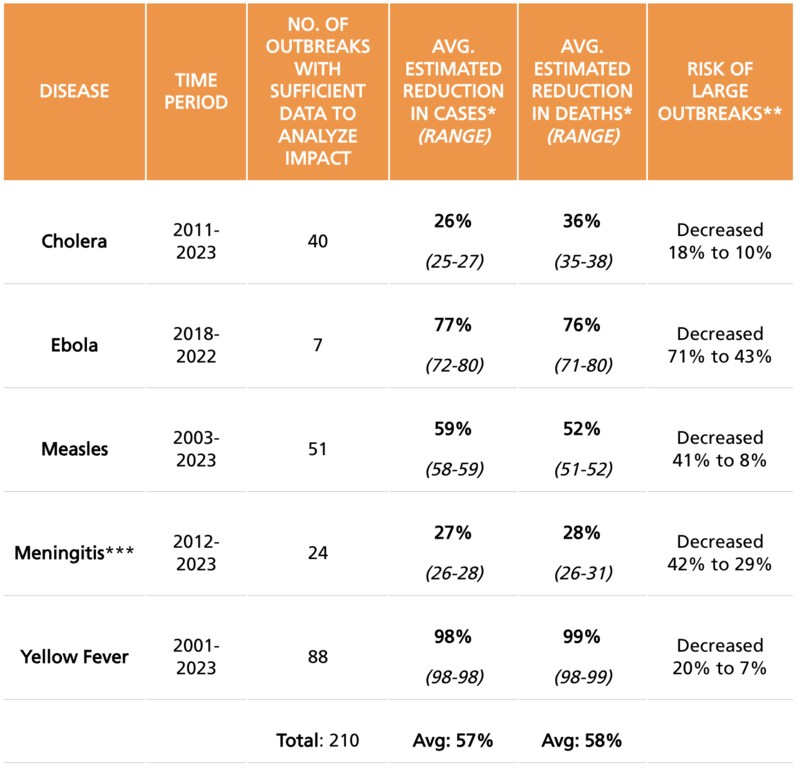
The study, conducted by Gavi, the Vaccine Alliance, in collaboration with Australia’s Burnet Institute, and published in the authoritative British Medical Journal (BMJ) Global Health, analyzed 210 outbreaks across 49 low-income countries over a 23-year period.

It found that rapid vaccine deployment during outbreaks of cholera, Ebola, measles, meningitis and yellow fever, had led to estimated reductions in illnesses and deaths of nearly 60 per cent on average.

For diseases like yellow fever and Ebola, the impact was even more dramatic: yellow fever deaths dropped by 99 per cent, while Ebola fatalities fell by 76 per cent.

The results highlight not only the effectiveness of emergency vaccination, but also the critical role of preparedness and speed in response to emerging threats.

“For the first time, we are able to comprehensively quantify the benefit, in human and economic terms, of deploying vaccines against outbreaks of some of the deadliest infectious diseases,” said Sania Nishtar, CEO of Gavi.

This study demonstrates clearly the power of vaccines as a cost-effective countermeasure to the increasing risk the world faces from outbreaks.

Gavi: A lifesaving partnership

Gavi, the Vaccine Alliance, is a unique global partnership that helps vaccinate nearly half the world’s children against deadly and debilitating diseases.

It brings together developing country and donor governments, the World Health Organization (WHO), UN Children’s Fund (UNICEF), the World Bank, the Bill & Melinda Gates Foundation and other key partners to expand access to immunisation.

Gavi also maintains global vaccine stockpiles for major diseases, managed in coordination with WHO, UNICEF, Médecins Sans Frontières (MSF), and the International Federation of Red Cross and Red Crescent Societies (IFRC).

Working in partnership with Gavi, governments and health authorities, UN agencies support vaccination campaigns in some of the most remote regions of the wrote. Pictured here, a child receives a vaccine in Solomon Islands in the Pacific.

Quantifying lives and costs saved

In addition to reducing deaths and disability-adjusted life years, emergency vaccination during the 210 outbreaks studied generated nearly $32 billion in economic benefits – from averting premature deaths and years of life lost to disability.

The study’s authors say this figure is likely a conservative estimate, as it does not include the broader social and macroeconomic impacts of major outbreaks.

For example, the 2014 Ebola outbreak in West Africa, which occurred before an approved vaccine was available, cost the region an estimated $53 billion. In contrast, later outbreaks responded to with emergency vaccines saw deaths reduced by three-quarters and the threat of regional spread dramatically lowered.

Source: Gavi/Burnet Institute study

Results by disease

Click here for details.

Disease-by-disease gains

The study provides a breakdown of vaccine effectiveness by disease.

Measles, one of the most infectious viruses known, saw cases drop by 59 per cent and deaths by 52 per cent thanks to outbreak response campaigns.

Yellow fever saw the biggest gains, with emergency vaccination nearly eliminating deaths – a 99 per cent drop.

Cholera and meningitis, which often strike communities with limited healthcare access and infrastructure, saw more modest but still meaningful reductions in cases and deaths.

Vaccinations helped reduce cholera cases and deaths by 28 per cent and 36 per cent, respectively, across 40 cholera outbreaks between 2011 and 2023. For meningitis, cases and deaths fell by 27 per cent and 28 per cent respectively, over 10 years.

Vaccines, COVID-19, and future threats

The coronavirus“>COVID-19 pandemic was a stark reminder of the value of vaccines, which saved an estimated 20 million lives globally in the first year of rollout alone, according to the respected and influential Lancet medical journal.

Yet the pandemic also disrupted routine immunisation, leading to dangerous backsliding in coverage rates for diseases like measles and polio. The Gavi study emphasizes that emergency vaccination must be paired with strong routine immunisation systems to prevent future outbreaks.

Looking ahead, Gavi’s 2026-2030 strategy includes expanding stockpiles, accelerating vaccine access for diseases like mpox and hepatitis E, and supporting preventive campaigns in high-risk regions.

Look back: COVID-19 pandemic disrupts vaccinations for children globally.

World Horse Day: Honoring humanity’s oldest and most loyal companion

UN News visited the farm to mark the first-ever World Horse Day, established this year by the UN General Assembly. By creating the Day, Member States sent a clear message: animals deserve to be treated with care and respect.

A faithful companion

From ancient battlefields to modern therapeutic programs, horses have been by humanity’s side for millennia—but in today’s high-tech world, few remember that legacy.

“Horses didn’t just help us survive,” says Marisa Striano. “They built America with us. They plowed the land, they carried people.”

Many cultures revere horses not only for their strength, but for their spiritual presence. In Mongolia—the country that introduced the resolution for World Horse Day—horses are sacred, central to national identity. Children there often learn to ride before they can walk, and folk songs celebrate the animals’ loyalty and nobility.

Fading from view

Once humanity’s primary mode of transportation, horses have largely been replaced by machines. Today, they are mostly found in sport, tourism, therapy, and entertainment. But this shift doesn’t mean they’ve lost their place in human life. “Horses haven’t lost their value – we’ve just stopped seeing it,” Striano says.

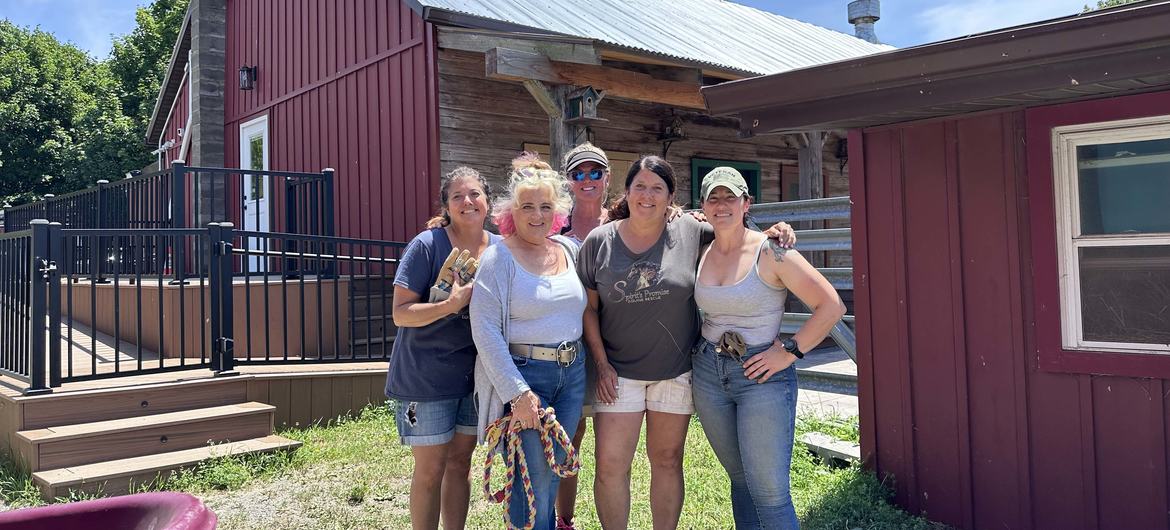
Located on Long Island New York’s scenic North Fork, Spirit’s Promise provides a sanctuary of healing for both animals and humans alike.

A second chance

Sick, aging, or retired racing horses are often shipped to slaughterhouses in Canada or Mexico.

“Imagine working 15 years, giving your all, and then being thrown away just because you got old,” Striano says. “Those are the horses we take in. We give them more time. A second chance.”

The farm is home to 19 rescued horses, including retired police horses, former breeding stallions, and even old Amish workhorses – each with their own story.

“One of them is Gus – he’s 107 in human years,” Striano says. “He used to be a therapy horse, but near the end he started throwing kids off. Now he’s retired and in love with his blind companion, Ramona. They’re inseparable. That’s the horse’s soul.”

Emotional congruency

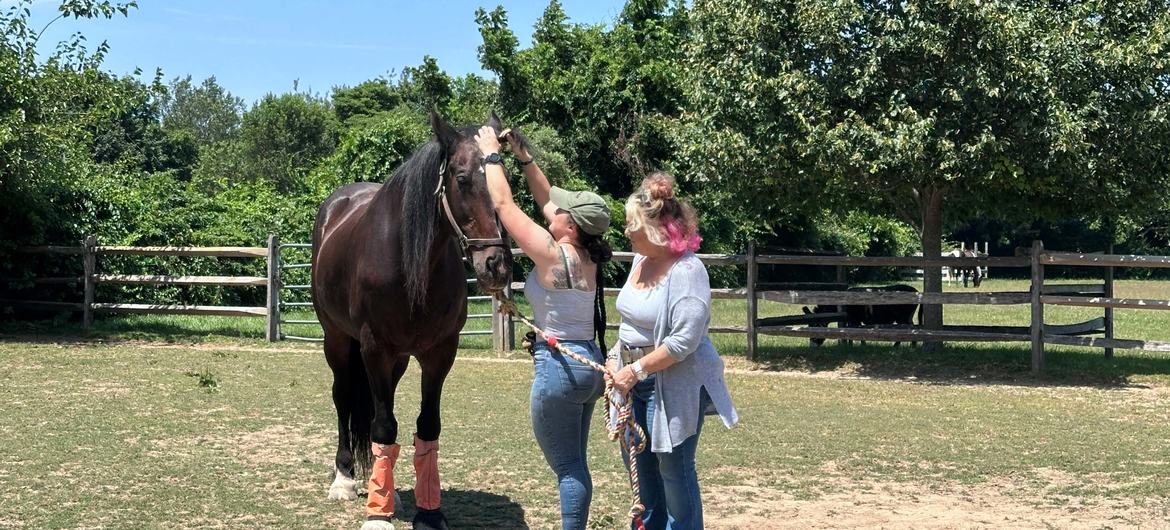
Horses aren’t just helpers – they’re deeply emotional, intuitive, and highly social beings. With near-360-degree vision and a heightened sensitivity to their surroundings, horses are naturally attuned to emotional states, Striano explains. This makes them ideal partners in therapeutic settings.

The Spirit’s Promise farm is run by a close-knit team of women.

At Spirit’s Promise, horses work with children with disabilities, survivors of abuse, and older adults with dementia. A horse can calm an anxious teenager or bring joy to someone who thought they had forgotten how to feel it.

They’re often called “mirrors of emotion”: horses instantly pick up on a person’s true inner state—even if the person isn’t aware of it themselves.

“Horses are 100 percent emotion. They don’t lie, and they can’t stand lies in others,” says Ms. Striano. “If you say you’re fine but inside you’re falling apart, they’ll sense it—and walk away. But if you’re honest—even if you’re sad or angry – they’ll stay with you.”

This sensitivity makes them remarkable companions for those experiencing grief, addiction, or trauma. One moment stands out vividly for her.

A young man came to the farm early in his recovery from drug addiction. Dressed in a hoodie with sleeves pulled low, he seemed constantly on guard. At the time, the farm had a horse named Heartbreaker. Though she has since passed, Striano recalls what happened next with awe.

“She walked right up to him and just… accepted him,” Ms. Striano says. “She looked at him like, ‘I see you’re broken. I am too. But that’s not the end. You can still love.’”

The two entered the paddock together. Heartbreaker lay down on the ground, and the man sat beside her, resting his face on her body. For half an hour, they just sat there in silence.

“It was complete peace,” Ms. Striano remembers. “Trust without words. Presence without conditions.” Then the young man’s mother approached. Heartbreaker, who had been calm and gentle, suddenly grew agitated — snorting, tossing her head, trying to break free.

“She acted like she wanted to protect him from his mother,” she says. “I rushed to lead Heartbreaker away. And the young man turned to me and whispered, ‘She hides behind her religion, but she hasn’t forgiven me. She’ll never say it – but the horse saw it.’”

For Ms. Striano, this confirmed something she’s seen again and again: horses don’t respond to appearances, only truth. “They don’t see the mask. They see the soul. And that’s their power. They see us for who we really are – and still choose to be with us.”

Between Care and Exploitation

Debates around horse exploitation are ongoing: from carriage horses to racing and show industries, where is the line between tradition and cruelty?

Located on Long Island New York’s scenic North Fork, Spirit’s Promise provides a sanctuary of healing for both animals and humans alike.

“I hate racing,” Ms. Striano says. “Maybe it had purpose once. Now it’s just about money. Horses get pumped with drugs, locked up, used up. Then slaughtered.”

At the same time, she acknowledges that ethical questions aren’t always clear-cut. “I don’t believe in sacrificing one soul for another,” she says when asked about the horses pulling carriages for tourists in New York’s Central Park. “Those horses feed entire families. We have to find a balance. But we must never forget: horses are not tools. They are living beings.”

To Forgive and Love Again

For Ms. Striano and the horses she cares for, the farm is a place where trust between species is rebuilt. She sees her work as a privilege—a daily chance to be with creatures that know how to forgive and love again, no matter what they’ve been through.

“When I walk into the paddock and they come up to me—I thank them. Every time,” she says. “Because a horse is pure. They’re not with you because you broke them—they’re with you because they chose to be. And that means everything.”

A Day to Say “Thank You”

According to  the UN Food and Agriculture Organization (FAO), there are around 60.8 million horses in the world. The United States has 2.41 million horses and ponies across 63,000 farms, while the European Union is home to about 7 million horses and 800,000 jobs in equestrian breeding, sport, and tourism. In Mongolia there are 3.4 million horses – nearly one for every person.

Beyond sport and industry, horses, donkeys, and mules are vital to rural life. According to research by the World Organisation for Animal Health and FAO, 112 million working equids support the livelihoods of some 600 million people in low- and middle-income countries, helping transport water, food, and much more.

On July 11, the first World Horse Day, the UN invites the world to say “thank you” to humanity’s loyal companion – for their labor, trust, and patience. For staying by our side – and helping us heal. “A horse is a gift,” Ms. Striano says. “And we have no right to lose it.”

Gazans dying in search of food, ‘starkest illustration’ of their desperation

The fact that people are now dying every day trying to get food, I think is the starkest illustration of how desperate the situation is,” said Carl Skau, Deputy Executive Director at the UN agency, briefing journalists on his fourth visit to the war-torn enclave.

Earlier this year, food security experts reported that starvation is spreading in Gaza. The entire population, some two million people, is acutely food insecure and half a million are on the brink.

“If anything, it’s much worse now,” said Mr. Skau, who was in Gaza City, Deir Al-Balah and Khan Younis last week. 

Children going hungry

Malnutrition is also surging.  Some 90,000 children are in urgent need of treatment, according to UN child rights agency UNICEF

Today, one in three people goes hungry for days. Mr. Skau said he met many families who told him there are days when their children do not eat at all.

“But the days when they are eating it’s often a hot soup they get from us with just a few lentils or a few pieces of pasta, so certainly not enough,” he said, adding that some mothers discourage their children from playing to conserve energy.

The top official also addressed the widespread displacement in Gaza. In the past he met families who had been forced to flee two or three times, but now “I meet families who have moved two or three times in the past 10 days,” and some who have been uprooted upwards of 20 times. 

Trickle of aid

Meanwhile, outside of the recent 80-day aid blockade, humanitarian response “has never been more constrained.” The amount of assistance humanitarians are able to bring into Gaza is “just a fraction of what’s needed,” at a time when a kilo of wheat flour costs $25.

He added that the operating environment “is just impossible.” Active military operations are occurring in roughly 85 per cent of Gaza’s territory and teams “get stuck waiting for clearances and at checkpoints, often spending between 15 to 20 hours straight in their armoured vehicles trying to escort our convoys.”

Other obstacles include lack of fuel, spare parts for vehicles, and basic communications equipment.  

Engagement with Israel

Mr. Skau said WFP have been actively engaging with the Israeli authorities over the past few weeks and “there were commitments” around issues such as volumes of aid, faster humanitarian movements, and not having the Israel Defense Forces (IDF) present when convoys are moving.

“Now, obviously, the proof is in the pudding,” he said. “We need now to see delivery and implementation on those commitments, and so far, we have not seen enough progress.”

He noted that WFP were allowed to deliver aid through the north on Friday for the first time in several days, which was “a key issue.”

“It’s not only about getting enough volumes, but it’s also to be able to get in through the north because in the north we are able to deliver in a more orderly way,” he said.

He told journalists that “there have been issues with armed elements interfering” in the region, which is unacceptable, but stressed the importance of being able to deliver there “because we think that is the way to also help bring down the levels of desperation and prices.”

Ceasefire now

Mr. Skau stated that the minor progress regarding commitments “is not going to be enough to turn the tide of hunger,” underlining the urgent need for a ceasefire in Gaza.

During the ceasefire earlier this year, WFP facilitated the entry of more than 8,000 trucks into the enclave, opened 25 bakeries and hundreds of soup kitchens, and delivered food packages to more than 1.5 million people.

The agency was also able to stock its warehouses, meaning operations could continue for roughly half of the 80-day blockade.

“We are ready to do that again,” said Mr. Skau.  “We have enough food on the borders to deliver to the entire population for some two months. But obviously we need that ceasefire, and we need conditions within that ceasefire.”

Here, he stressed the need for a humanitarian protocol with a provision that allows for multiple routes and entry points into and inside Gaza – as well as a secure environment for delivery.

Later, Mr. Skau was asked about the talks with Israel.

“I sense the recognition that conditions need to improve,” he said.  “It was also recognised that the UN has a key role to play,” he added. 

“It was very clear in my engagement that they want the UN to continue to be the main track in delivery. 

“And certainly should there be a ceasefire, the indications were that they would want us to be ready to scale up and do what we did last time when we on Day One were ready to bring 600 trucks into Gaza.” 

Source link

UN chief condemns latest Houthi attacks on Red Sea shipping

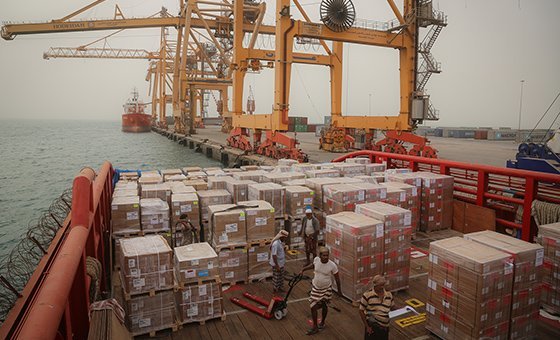
According to news reports, the Yemen-based rebel group – which has been battling the internationally-recognised Government for control of the country since the early 2010s – attacked the Liberian-flagged, Greek-operated Eternity C on Monday and again on Tuesday, causing it to sink on Wednesday morning.

Four crew members are reported to have died.

With 15 crew still missing as of Friday, the group also reportedly took an unspecified number of the seafarers to what rebels described as a “safe location.”

Weekend assault

This came after the Houthis launched missiles and drones at another Liberian-flagged, Greek-operated cargo ship in the Red Sea on Sunday, Magic Seas. The crew was forced to abandon ship, but all 22 members were rescued, according to reports.

Since the start of the war in Gaza in October 2023, the Houthis have targeted Israeli and commercial ships in the Red Sea deemed to be en route to Israel, in solidarity with Palestinians in the enclave.

In May, following US airstrikes on Houthi strongholds and missile infrastructure, the group agreed a deal with Washington to stop targeting US warships – however, they did not pledge to end attacks on other vessels allegedly linked to Israel.

Strong condemnation: Guterres

UN Spokesperson Stéphane Dujarric read a statement from Secretary-General António Guterres on Friday at UN Headquarters, saying the UN chief “strongly condemns the resumption of Houthi attacks on civilian vessels transiting the Red Sea, especially the attacks that took place over 6 to 8 July 2025.”

Mr. Guterres said the “unacceptable” attacks endangered the safety and security of crewmembers, violated freedom of navigation, disrupted maritime transport, and posed serious environmental, economic, and humanitarian risks.

Mr. Guterres also emphasised that international law must be respected by all parties, stressing that UN Security Council resolution 2768 related to Houthi attacks against merchant and commercial vessels must be fully respected.

The United Nations remains committed to continuing its efforts towards broader de-escalation in the region as well as continued engagement with Yemeni, regional and international actors to secure a sustainable and peaceful resolution to the conflict in Yemen,” he concluded.

Source link

Desperate Afghan refugees return to an unfamiliar home

The agency is calling for calm and cooperation to provide a dignified path forward for millions of displaced Afghans.

More than 1.6 million Afghans have returned from both neighbouring countries in 2024 alone, according to UNHCR – a figure that has already surpassed earlier forecasts for the entire year.

‘From Afghanistan – not of Afghanistan’

The scale and speed of these returns are placing enormous pressure on border provinces ill-equipped to absorb them, exacerbating poverty, insecurity and humanitarian need in a country still reeling from economic collapse and widespread human rights abuses.

Complicating the situation further is the fact that many returnees – especially women and children – are coming back to a country they barely know.

They are from Afghanistan [but] not of Afghanistan – often born abroad with better education and different cultural norms. Their outlook is different from and often at odds with present day Afghanistan,” says Arafat Jamal, UNHCR Representative in the country.

Women and girls in particular face a jarring shift: from relative autonomy in host countries to a context where their rights are severely restricted by edicts from Taliban authorities.

© UNICEF/Shehzad Noorani

Women’s rights in Afghanistan continue to face severe setbacks, with restrictions deepening across education, employment and public life

Disorientated and disorganised

He reported conditions that he had seen for himself recently in Islam Qala, a key border crossing with Iran.

Daily arrivals have surged to around 50,000 people, many of them disoriented and exhausted after arduous journeys. UN officials described scenes of desperation at reception centres.

Many of these returnees have been abruptly uprooted and have undergone arduous, exhausting and degrading journeys – they arrive tired, disoriented, brutalised and often in despair, and they sprawl throughout a crowded centre in often 40°C (104°F) heat,” Mr. Jamal said.

While some returns are voluntary, he added that many are occurring under duress or without proper protections in place. Those returning include both officially registered refugees and people in “refugee-like” situations who may face serious risks upon arrival.

Funding crisis

The UN and humanitarian partners have mounted a broad-based response along the borders, providing food, water, health services, protection and onward transportation.

However, funding shortfalls are critically hampering operations. UNHCR’s response is just 28 per cent funded as of July, forcing aid agencies to ration supplies and make painful choices.

“We are living on borrowed funds,” Mr. Jamal said. “Daily, we are asking ourselves – should we give one blanket instead of four? One meal instead of three? These are heartbreaking, soul-destroying decisions.

The situation is equally dire for other agencies: the wider, UN-led 2025 Humanitarian Needs and Response Plan for Afghanistan – which seeks $2.4 billion to assist nearly 17 million people across the country – is only 22 per cent funded.

Poverty and drought

Recent UN assessments have also warned of deteriorating conditions and deepening poverty within Afghanistan.

The UN Food and Agriculture Organization (FAO) issued alerts over worsening drought across much of the country, while the UN Development Programme (UNDP) reports that 70 per cent of Afghans already live at subsistence levels, as the collapse of public services and ongoing rights violations leaves millions in despair.

As returnees cross the border, often without notice or resources, local populations are being stretched to the limit.

Mr. Jamal noted that this “precarity layered upon poverty” risks fuelling frustration, competition over limited resources and new forms of social tension.

Afghanistan may be welcoming, but it is wholly unprepared to receive this volume of returnees,” he said. “The communities who are taking people in are doing so with great generosity, but they are themselves in crisis.”

Global attention

The growing emergency comes just days after the UN General Assembly overwhelmingly adopted a resolution expressing “deep concern” over deteriorating conditions facing Afghans.

The resolution, passed with 116 votes in favour and only two against, urged the Taliban to reverse repressive policies and called for renewed international cooperation to support Afghan civilians.

The resolution highlighted the need for “coherent approaches” that bridge humanitarian, development and political efforts. It also called on donor countries to maintain or increase support.

Source link

150,000 Rohingya flee to Bangladesh amid renewed Myanmar violence

As armed clashes intensify and conditions worsen inside Myanmar, thousands continue to cross the border seeking safety in the overcrowded camps of Cox’s Bazar, where nearly one million Rohingya refugees already live in densely populated camps.

This is the largest movement of Rohingya refugees into Bangladesh since 2017,” said Babar Baloch, spokesperson for the UN refugee agency, UNHCR, briefing journalists in Geneva on Friday.  

He clarified that unlike the mass influx in 2017, when some 750,000 Rohingya fled deadly violence in Rakhine state, this uptick in refugees has unfolded more gradually.

Advocating for asylum

UNHCR is working closely with local authorities to respond to urgent humanitarian needs.  

“As the conflict in Myanmar continues unabated, we are advocating with the Bangladeshi authorities to provide managed access to safety and asylum for civilians fleeing the conflict,” he said.

Bangladesh has long provided refuge to the Rohingya, a mostly Muslim minority community in Myanmar, which is mainly Buddhist. 

The country currently hosts nearly one million people in the refugee camps and the recent arrivals – many of them women and children – are placing further strain on resources. Many are relying heavily on local solidarity and sharing limited resources with those already living in the camps.

Appeal for support

By the end of June, nearly 121,000 newly arrived refugees had been biometrically registered, although many more are believed to be residing informally in the camps. Access to adequate shelter remains a major concern as facilities struggle to absorb the new population.

“These new arrivals join another nearly one million Rohingya refugees crammed into just 24 square kilometres,” said Mr. Baloch. “More humanitarian support is urgently required.”

Aid partners have been able to provide basic services including food, medical care, education, and essential relief items. However, the response is now under serious threat due to a lack of funding.

UNHCR warned that the 2024 humanitarian appeal for $255 million is only 35 per cent funded. Without immediate financial support, the entire operation could face systemic collapse.

Action needed now

Unless additional funds are secured, health services will be severely disrupted by September and essential cooking fuel — liquefied petroleum gas (LPG) – will run out by December. Food assistance will stop and education for some 230,000 Rohingya children, including 63,000 new arrivals, is in danger of being discontinued.

Despite a strictly controlled and officially closed border, the Government of Bangladesh has allowed new arrivals to access emergency services in the camps. The UN agency expressed deep appreciation for this humanitarian gesture under highly challenging conditions.

“We don’t have the resources to take care of the new arrivals and also those who were there before them,” said Mr. Baloch. “Everything will be impacted.”

As displacement from Rakhine state continues, UNHCR and its partners are urging the international community to act swiftly. Without immediate and sustained support, the already fragile humanitarian response in Cox’s Bazar could begin to unravel  – with devastating consequences for more than one million people who rely on it for survival. 

Source link

Malnutrition crisis deepens for Sudan’s children as war rages on

Across the five states that make up Darfur, UNICEF data revealed a 46 per cent increase in the number of children treated for SAM in January to May 2025 compared to the same period last year.

The rate of acute malnutrition has surpassed emergency levels set by the World Health Organization (WHO) in 9 of the 13 localities across Darfur.

In North Darfur alone, over 40,000 children were admitted for SAM treatment in the first five months of the year – double the number from the same period last year.

Besieged and starved

This malnutrition surge comes amid intensifying conflict in North Darfur since April. Entire neighborhoods have been besieged, hospitals targeted by airstrikes, roads rendered impassable while aid convoys have faced looting and violent attacks.

The situation is particularly catastrophic in El Fasher, where humanitarian access has been nearly completely severed since the RSF militia besieged the city – the last held by Government forces in the region – and cut off assistance in April of 2023.

UNICEF successfully delivered a batch of supplies to El Fasher earlier this year, but efforts to send additional aid have been blocked.

Children in Darfur are being starved by conflict and cut off from the very aid that could save them,” said Sheldon Yett, UNICEF Representative for Sudan. “This is a moment of truth; children’s lives depend on whether the world chooses to act or look away.”

The crisis has triggered mass displacement in the area: in April, nearly 400,000 people fled the Zamzam camp near El Fasher. Many walked up to 70 kilometres to reach Tawila, where more than 500,000 displaced people survive with little access to food, water, or adequate shelter.

Nationwide crisis

SAM is the deadliest form of malnutrition, and children suffering from it are highly vulnerable to life-threatening complications and face a high risk of death without proper treatment.

And the crisis isn’t limited to the Darfur states – SAM admissions rose by more than 70 per cent in North Kordofan, 174 per cent in Khartoum State and a staggering 683 per cent in Al Jazirah State.

However, the report noted that the rise in admissions in Al Jazirah and Khartoum is partially due to improved security and humanitarian access, enabling more families to reach health centres.

Compounding the crisis is Sudan’s lean season – a period of food scarcity between harvests – which is rapidly increasing the risk of mass child mortality, particularly in areas already nearing famine thresholds.

Cholera outbreaks, measles cases and collapsing health services are further aggravating the crisis, putting vulnerable children at even greater risk.

UNICEF response

UNICEF and its partners are saving lives by treating the wounded and malnourished, drilling wells and distributing food. But despite their best efforts, the violence is driving needs faster than they can be met.

UNICEF is calling on all parties to allow unimpeded humanitarian access to affected populations and urges renewed diplomatic pressure on all sides for a cessation of hostilities.

The agency is also appealing to the international community for more lifesaving funds. An additional $200 million is needed this year to sustain and expand essential nutrition services, including treatment for acute malnutrition.

Source link

Celebrating the potential and promise of the largest youth generation ever

Secretary-General António Guterres said empowering young people in a fair and hopeful world reaffirms the UN promise that every person has the right to make informed choices about their lives and futures.

While many young people face economic uncertainty, gender inequality, health challenges, the climate crisis and a spike in conflicts – they are still leading with courage, conscience and clarity, “calling for systems that uphold their rights and support their choices,” he said in his message.

“Let’s listen to what young people want and support them in exercising their rights, making their own choices and enjoying a hopeful future,” said Natalia Kanem, Director of the UN sexual and reproductive rights agency, formally known as the UN Population Fund (UNFPA).

An inclusive future

“Young people are not just thinking about their future children – they are thinking about the world those children will inherit,” one youth activist told UNFPA.

Mr. Guterres urged countries to invest in policies that will ensure young people have access to education, healthcare, and promoting the protection of reproductive rights.

Let us stand with young people and build a future where every person can shape their destiny in a world that is fair, peaceful and full of hope,” he said. 

2025 award winners

Each year, the Committee for the UN Population Award honours an individual and/or institution in recognition of outstanding contributions to population and reproductive health questions and to their solutions.

On this World Population Day, the 2025 recipients were recognised for their groundbreaking work in empowering women and addressing critical challenges facing demographic growth.

The winner in the individual category, Varshan Deshpande who founded Dalit Mahila Vikas Mandal, tirelessly works to empower women at the community level in India, by building vocational skills, connecting them to vital resources and services, and fostering financial independence.

The winner in the institutional category, the International Union for the Scientific Study of Population (IUSSP), has played a pivotal role in advancing population science and policy, notably by helping establish regional population associations in Asia, Africa, and Latin America.

Watch our interview with Natalia Kanem who is stepping down as UNFPA’s Director after more than eight years.

Source link

‘An unending horror story’: Gangs and human rights abuses expand in Haiti

Left vulnerable, communities then formed self-defence groups and Haitian security forces reinforced their operations and made small gains only to be rebuffed again by gangs.

And at all stages of this cycle, human rights violations are being committed against civilians, according to a report released on Friday by the UN office in Haiti (BINUH) and the UN human rights office (OHCHR).

“Caught in the middle of this unending horror story are the Haitian people, who are at the mercy of horrific violence by gangs and exposed to human rights violations from the security forces and abuses by the so-called ‘self-defence’ groups,” said Volker Türk, High Commissioner for Human Rights.

The report also warned about “early signs of criminal governance” in the Centre Department where gangs are beginning to consolidate their gains and act as a de facto governing authority.

Four years of horror

Since 2021 and the assassination of President Jovenel Moïse, gang violence has dominated the capital Port-au-Prince which is now 85 per cent controlled by gangs, says the UN.

Over 1.3 million Haitians have been displaced because of this violence, representing the largest displacement due to political upheaval in Haitian history.

Food insecurity among displaced Haitians is rampant, with Haiti one of five countries worldwide which is experiencing famine-like conditions.

As of March 2025, the violence has also expanded into previously untouched areas of the country, specifically the Artibonite and Centre Departments where 92,000 and 147,000 people have been displaced respectively.

The report also noted that recently, gangs have begun to expand beyond central Haiti towards the border of the Dominican Republic, with the apparent goal of controlling key roads through which much of the illegal weapons trafficking is happening.

“The expansion of gang territorial control poses a major risk of spreading violence and increasing transnational trafficking in arms and people,” said Ravina Shamdasani, a UNHCR spokesperson at a briefing in Geneva.

Human rights endangered

Between October 2024 and June 2025, 4,864 people in Haiti have been killed by gang violence. At least hundreds more have been injured, kidnapped, raped and trafficked.

“Human rights abuses outside Port-au-Prince are intensifying in areas of the country where the presence of the State is extremely limited,” said Ulrika Richardson, interim Head of BINUH and UN Resident Coordinator.

While many of these human rights violations – including the denial of the right to life and physical integrity, sexual violence and forced displacement — are being perpetrated by organized gangs, there are also documented human rights abuses at the hands of Haitian authorities.

Specifically, between October 2024 and June 2025, there were 19 extrajudicial executions by security forces in the Artibonite and Centre Departments – 17 of them in Artibonite.

Self-defence groups, which are increasingly prevalent as a result of inadequate State security, have also committed human rights violations, often in the form of lynchings of suspected gang members.

“The human rights violations and abuses that we have documented are further evidence of why Haiti and the international community urgently need to step up to end the violence,” Mr. Türk said.

At this point, there have been no documented human rights abuses committed by the Multinational Security Support (MSS) mission authorized by the United Nations and funded and staffed largely by Kenya.

No accountability

The Haitian National Police and MSS have launched multiple operations to regain territory lost to the gangs. While some have been briefly successful, the operations have been unable to maintain a lasting presence or protect local communities, according to the report.

In fact, the report suggests that in the Centre, the situation is trending in the opposite direction with gangs consolidating territorial gains outside the capital and beginning to institute forms of criminal governance.

As a result of this persistent insecurity, judicial operations are virtually at a standstill in the Centre and Artibonite Departments.

“The international community must strengthen its support to the authorities, who bear the primary responsibility for protecting the Haitian population,” said Ms. Richardson.

Source link

Gaza: ‘Unacceptable’ choice between getting shot or getting fed

UN Human Rights Office (OHCHR) spokesperson Ravina Shamdasani told reporters in Geneva on Friday that “we’ve raised concerns about atrocity crimes having been committed and the risk of further atrocity crimes, where people are lining up for essential supplies such as food and medicine and where they are being attacked, where again… they have a choice between being shot or being fed”.

Deadly lottery

This is unacceptable and it’s continuing,” she deplored.

Ms. Shamdasani said that her office is still looking into the incident in which at least 15 Palestinians including women and children were reportedly killed by a strike in front of a clinic in Deir al-Balah run by US-based aid group Project Hope, a partner organization of the UN Children’s Fund (UNICEF).  

In a statement on Thursday UNICEF chief Catherine Russell said that the killing of families trying to access life-saving aid is “unconscionable”.

The Israeli military reportedly said that it was targeting a Hamas member involved in the terror attacks in Israel on 7 October 2023.

Asked about the rationale of putting civilians, including children, in mortal danger when targeting one specific person, Ms. Shamdasani said that over the course of the conflict in Gaza OHCHR has had serious concerns about respect for essential international humanitarian law principles, including that of distinction and proportionality.

“We have seen that of the overall death toll in Gaza; a large proportion are women and children. And again, that raises serious questions about whether these principles are being respected,” she said.

Hungry people in Gaza run the risk being shot when picking up food aid.

Hundreds killed queuing for food

Killings of Gazans at or around aid distribution sites and near humanitarian convoys have become a regular occurrence in a context of restrictions on the entry of food, fuel and relief items into the Strip and particularly since the establishment of food distribution sites bypassing the UN operated by the Gaza Humanitarian Foundation (GHF).

Since late May, this militarised aid distribution model, backed by Israel and the United States, has sought to sideline the UN and its experienced humanitarian partners.  

OHCHR’s Ms. Shamdasani said that from 27 May, when the GHF started operations in Gaza, until 7 July, OHCHR recorded 798 killings “including 615 in the vicinity of the GHF sites and 183 presumably on the routes of aid convoys”.  

Gunshot injuries

The deaths of almost 800 people trying to access aid were “mostly due to… gunshot injuries”, Ms. Shamdasani said.

Joining her in condemning the killings, World Health Organization (WHO) spokesperson Christian Lindmeier said that he is “slowly lacking words to describe the scenario”.

“People being shot at distribution sites… scores of women and children and men and boys and girls being killed while either getting food or in what’s supposedly safe shelters or on the road to health clinics or inside health clinics – this is far beyond unacceptable.”

Fuel crisis

Asked to comment on a 75,000-litre fuel delivery into Gaza on Wednesday, the first such provision in over 130 days, Mr. Lindmeier said that “as good as it is that these this amount of fuel came finally in… we should not be relying on special news of special deliveries,” be it on fuel, food or other relief items.

“There should be a reoccurring delivery into Gaza to keep the lifelines open, to supply the ambulances, the hospitals, the water desalination plants, the bakeries… whatever is necessary to keep a little bit of lifeline open there, to run the incubators,” he said.  

The WHO spokesperson pointed out that 94 per cent of the hospitals in Gaza are now damaged or destroyed, while displacement continues and civilians are being pushed into ever smaller spaces.

Mr. Lindmeier also expressed his hope for a positive outcome of the ongoing ceasefire talks.

“Peace is the best medicine and opening the doors remains the only viable option,” he concluded.

Source link

UNICEF deplores ‘unconscionable’ killing of families lining up for aid in Gaza

Catherine Russell said she was appalled by the reported killing of 15 Palestinians, including nine children and four women, who were waiting in line for nutritional supplements provided by Project Hope, a UNICEF partner organization.

The incident occurred in Deir Al-Balah. An additional 30 people were injured, including 19 children. News reports indicate that it resulted from an Israel strike. 

‘Mothers seeking a lifeline’

“The killing of families trying to access life-saving aid is unconscionable,” she said in a statement.

These were mothers seeking a lifeline for their children after months of hunger and desperation.”

They included Donia, whose one-year-old son, Mohammed, was killed. She reported that the boy had spoken his first words to her just hours earlier.

“Donia now lies in a hospital bed, critically injured by the blast, clutching Mohammed’s tiny shoe,” said Ms. Russell.  “No parent should have to face such tragedy.”

A ‘cruel reality’

For the UNICEF chief, “this is the cruel reality confronting many in Gaza today after months of insufficient aid being allowed into the territory, and parties to the conflict failing to uphold basic responsibilities to protect civilians.”

She explained that “the lack of aid means children are facing starvation while the risk of famine grows,” warning that “the number of malnourished children will continue to rise until life-saving aid and services are resumed at full scale.”

“International law is clear: all parties to the conflict have an obligation to protect civilians and ensure the safe and unimpeded delivery of humanitarian assistance,” she said.

“We call on Israel to urgently review its rules of engagement to ensure full compliance with international humanitarian law, notably the protection of civilians including children, and to conduct a thorough and independent investigation of this incident and all allegations of violations.”

UN condemns killings

The UN yet again condemned the killing of civilians in Gaza, Spokesperson Stéphane Dujarric told journalists in New York.

Furthermore, the UN humanitarian affairs office OCHA “stresses that parties are bound by international humanitarian law to prevent such excessive death and injury of civilians in the midst of war,” he added.

OCHA reported that another strike on Thursday reportedly hit the office of a humanitarian partner in Gaza City. Three staff there were killed. 

Fuel running out

Mr. Dujarric also updated journalists on the dire fuel situation in Gaza, which impacts both the population and humanitarians.

A UN team managed to bring roughly 75,000 litres of fuel from Israel into the beleaguered enclave on Wednesday, marking the first such provision in 130 days.

He warned, however, that fuel is still running out and services will shut down if greater volumes do not enter immediately.

Water services at risk

We and our humanitarian partners need hundreds of thousands of litres of fuel each day to keep essential lifesaving and life-sustaining operations going, meaning the amount entered yesterday isn’t sufficient to cover even one day of energy requirements,” he said.

One aid partner reported that fuel shortages could soon cut off supplies of clean drinking water to about 44,000 children, he added, which would further increase the risk of cholera, diarrhoea, dysentery and other waterborne illnesses. 

Meanwhile, UN partners providing education services said that between October 2023 and this June, 626 temporary learning spaces have been established in Gaza, with 240,000 students enrolled, roughly half of them girls. 

However, only 299 spaces are currently operational due to the ongoing displacement orders, funding shortfalls and other challenges.

Aid workers also going hungry

Humanitarian partners in Gaza – who include first responders, health workers, and aid workers – “continue to deliver food and other assistance under intolerable conditions, and they themselves are facing hunger,” said Mr. Dujarric.

“A number of our own colleagues are also facing hunger. They also face water scarcity and threats to their personal safety, just like everyone else in Gaza,” he added.

The Spokesperson reiterated the UN’s long-standing message that “this catastrophic situation must end.”  He stressed that “a ceasefire is not only urgent, it is long overdue,” while also calling for the unconditional and immediate release of all hostages. 

Some Palestinians have been forced to flee their homes in the West Bank.

West Bank operations

Mr. Dujarric also addressed the situation in the West Bank, where humanitarians report and continue to warn of the intensification of Israeli operations in the northern areas.

These operations are causing massive destruction, driving further humanitarian needs and dampening hopes of thousands of displaced families that they will eventually be able to go back home,” he said.

“Meanwhile, attacks, harassment and intimidation by Israeli settlers against Palestinians have become a daily reality.”

He cited a settler attack on 3 July that led to the displacement of the Mu’arrajat East Bedouin community in the central West Bank. 

“This is the ninth community to be fully displaced in the Ramallah and Jericho areas since January 2023 following the recurrent attacks by Israeli settlers.” 

Source link

She fought for the girl the world left behind: Natalia Kanem’s UN legacy

She returns, over and over, to a single image: that of a ten-year-old girl – standing on the edge of adolescence, her future uncertain, and her rights still in grave doubt.

“Will she be able to stay in school, graduate, and make her way through the world?” Dr. Kanem wonders. “Or is she going to be derailed by things like child marriage, female genital mutilation, or abject poverty?”

That seismic question and that girl – not one child in particular, but an emblem of the millions worldwide whose future is at risk – have become the touchstone of Dr. Kanem’s nearly eight-year tenure as Executive Director of the UN’s sexual and reproductive health agency, formally known as the UN Population Fund (UNFPA).

From her early days working on the frontlines in East Africa to overseeing a $1.7 billion agency with operations in more than 150 countries, Dr. Kanem has shepherded UNFPA through global shifts, political headwinds, and ideological pushback.

Most of all, she has led a fierce revolution in the lives of millions of women and girls.

This month, she is stepping down from her post ahead of schedule. “It’s time to pass on the baton,” the 70-year-old told her staff – a 5,000-strong workforce – in a videotaped address earlier this year. “I have pledged to do everything in my capacity to keep positioning UNFPA to continue to do great things.”

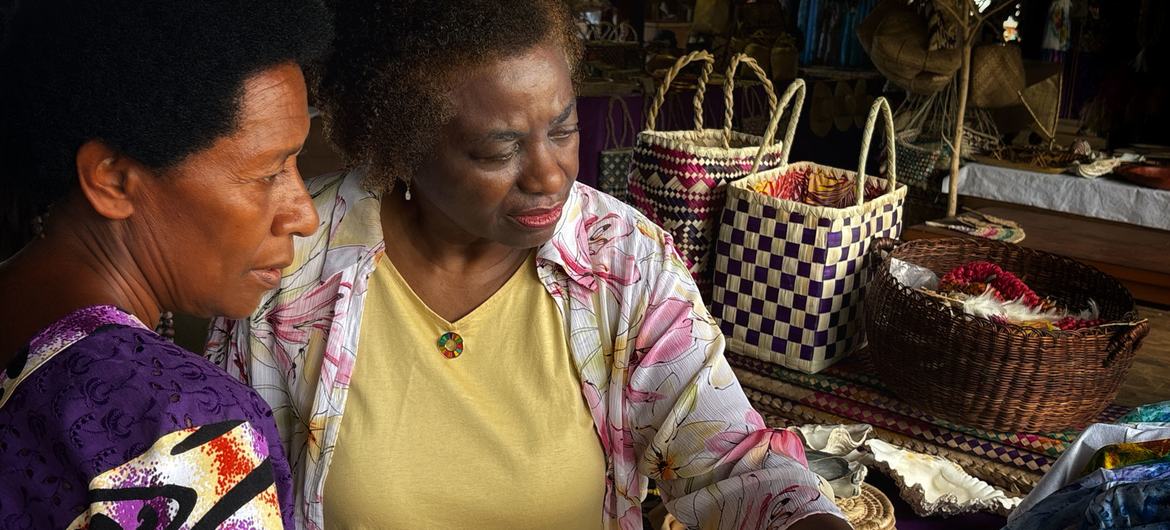
UNFPA Executive Director Natalia Kanem (centre) visits the Mamas Market in Port Vila, Vanuatu.

Roots and ascent

Born in Panama and trained as a medical doctor, Dr. Kanem joined UNFPA in 2014 after a career in philanthropy. Her decision to serve “the noble purpose of the United Nations” first led her to East Africa and Tanzania, where she was struck by the quiet heroism of field staff. “It’s really at the country level where we prove our worth,” she told UN News.

But the job was not easy. In 2017, when she took the reins of the agency, Dr. Kanem inherited an organization grappling with waning visibility, unstable funding, and persistent pushback from conservative viewpoints. Still, UNFPA grew – not just in budget, but in stature.

“When I came, the narrative was, ‘We’re a small organization, beleaguered, nobody understands what we do,’” she said. “Now, I think it’s clearer.”

That clarity came, in part, from what Dr. Kanem calls “thought leadership.”

Whether challenging misconceptions about fertility or confronting gender-based violence enabled by technology, she pushed UNFPA to the frontlines of global discourse. “We exist in a marketplace of ideas,” she explained. “And we have to tell the truth in a way that’s compelling enough so we can garner the allies this movement requires.”

Under her leadership, the agency trained hundreds of thousands of midwives, distributed billions of contraceptives, and expanded humanitarian operations to reach women and girls in the most fragile settings – from the Rohingya camps in Bangladesh’s Cox’s Bazar to war-scarred Ukraine and cholera-stricken Haiti.

UNFPA’s presence in crisis zones was not only logistical, but symbolic. In Sudan, Syria, and Gaza, a simple tent stocked with menstrual pads, a blanket, and a bar of soap could serve as sanctuary. “It represents the respite that a woman needs in a time of crisis,” she said. “You know, we call our kits ‘dignity kits’ for that reason.”

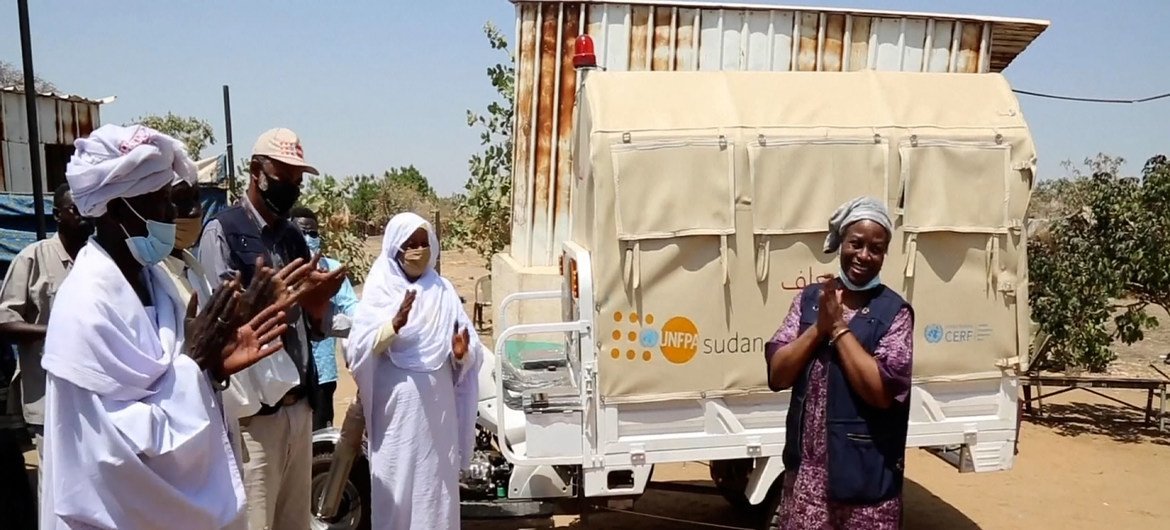
UNFPA Executive Director, Natalia Kanem (right), visits Sudan in March 2021.

Shifting the conversation

Beyond delivering services, Dr. Kanem elevated UNFPA’s role as a thought leader in a polarised world. She steered the agency into difficult public conversations – about teen pregnancy, climate anxiety, fertility rates, and online harassment – with an unflinching insistence on rights.

“The 10-year-old girl exists,” she said. “What her parents and her religious leaders and her community think is vital for her to be well prepared, for her to know what to do when she’s challenged by coercive practices.”

That leadership extended to data. Under Dr. Kanem, UNFPA invested heavily in supporting national censuses and building dashboards to help lawmakers shape reproductive health policy with real-time insight.

This year’s State of World Population report, the agency’s annual deep dive into demographic trends, reframed conventional narratives around so-called “population collapse” – noting that many women and men delay having children not out of ideology, but because they cannot afford to raise them.

Dr. Kanem praised the altruism of young people who say they’re choosing not to have children for fear of worsening the climate crisis. But that’s not what the data shows.

“The world replacement fertility rate is not endangering the planet,” she explained. “The facts really say: you can have as many children as you can afford.”

A rights-based compass in turbulent times

Dr. Kanem’s tenure coincided with mounting attacks on reproductive rights, rising nationalism, and growing scepticism of multilateral institutions. She faced years of US funding cuts – including under the current administration – even as demand for UNFPA’s services surged.

“UNFPA has more money than we’ve ever had,” she noted. “But it’s never going to be enough to stop the flow of need.”

Resources alone won’t secure the agency’s future – credibility and persistence are just as vital. “The multilateral system itself has come under question at a time when it is needed now more than ever,” she warned. “We do have to prove ourselves each and every day. And when we make mistakes, we’ve got to get up and rectify them and find partners who are going to be allies.”

One such partner has been the private sector. In 2023, UNFPA teamed up with tech firms to launch a development impact bond in Kenya, delivering mobile-based sexual health services to prevent teenage pregnancy and new HIV infections among adolescent girls.

Dr. Natalia Kanem, head of the United Nations Population Fund (left) talks to UN News and Media Deputy Director Mita Hosali.

Changing mindsets

UNFPA has long worked to end harmful practices such as female genital mutilation (FGM) and child marriage. Under Dr. Kanem, that work became as much about shifting mindsets as changing laws.

“Yes, absolutely,” she said when asked if progress was real. “It’s been very important to see religious leaders and traditional leaders standing against certain practices… and to work with school systems so that the girls themselves will understand the risks and be able to take better decisions about their options.”

The coronavirus“>COVID-19 pandemic, she admitted, was a setback. With schools closed, some communities increased the number of weddings and FGM ceremonies. But in many countries – including populous Indonesia – UNFPA has seen the practice decline, in part thanks to youth advocates speaking out from within their own communities.

New generation, next chapter

Looking ahead, Dr. Kanem didn’t dwell on uncertainty. She spoke instead of possibility. “We’ve transformed ourselves, modernized ourselves,” she said. “There’s just unlimited possibility for UNFPA.”

Her own future includes what she calls a “mini-sabbatical” – more time for music, her family, and, finally, herself. But she won’t stay silent for long. “I know that my passion for issues of women and girls is not going to recede,” she said. “It’s been a labour of love.”

Her parting thought? One final return to the girl at the centre of it all.

“When that 10-year-old girl succeeds, everyone succeeds,” she said. “It is a better world.”

Source link

UN warns of record civilian casualties in Ukraine

Russian forces launched an attack overnight focused on Kyiv, deploying 397 Shahed unmanned attack and decoy drones, along with 18 high-powered missiles, killing two and injuring at least 16, according to the UN Human Rights Monitoring Mission in Ukraine (HRMMU).

UN Spokesperson Stéphane Dujarric noted during his daily briefing in New York that four Kyiv districts were hit, damaging residential buildings, a clinic and a TV station, while an outpatient clinic was destroyed during the bombardment.

Mr. Dujarric also relayed reports from local authorities of recent attacks in other regions which left more than nine dead and at least ten civilians injured.

Grim June record

These attacks come after June saw the highest monthly civilian casualty count in Ukraine since the Russian invastion began in February 2022, with 232 people killed and 1,343 injured.

This data reflects a worsening trend: 6,754 civilians were killed or injured in the first half of 2025 – a sharp 54 per cent rise compared to the same period in 2024, when 4,381 civilian casualties were documented.

This breaks down to a 17 per cent increase in civilian deaths and a 64 per cent increase in injuries.

Russia’s increased use of long-range missiles and drones in urban areas – and their enhanced destructive power – were key drivers behind the spike in casualties.

The growing number of attacks also played a crucial role, as Russia launched ten times more missile and unmanned drone strikes in June 2025 than in June 2024.

Civilians across Ukraine are facing levels of suffering we have not seen in over three years,” said Danielle Bell, Head of HRMMU. “The surge in long-range missile and drone strikes across the country has brought even more death and destruction to civilians far from the frontline.”

Child suffering intensifies

Also on Thursday, the UN Children’s Fund (UNICEF) reported that an estimated 70 per cent of children in Ukraine (3.5 million) are experiencing “material deprivation” – up from 18 per cent in 2021.

Material deprivation refers to a lack of essential goods and services, including nutritious food, appropriate clothing, heating at home and access to education.

According to UNICEF’s report, one in three children in Ukraine lives in a home without a functioning water supply or sewage system, and nearly half lack access to a space to play.

This deprivation is driven by continued attacks on infrastructure – including water, sanitation, and energy systems – as well as on homes, schools, and healthcare facilities, along with rising poverty across the country.

Looking towards recovery

These warnings come as the fourth Ukraine Recovery Conference opened in Rome on Thursday. It aims to build global awareness and maintain momentum for international support and investment in Ukraine’s recovery, rebuilding, reform, and modernisation.

The Director General of the UN migration agency (IOM), Amy Pope, is among those attending. The agency plays a major role in Ukraine, where nearly four million people remain internally displaced, and another five million refugees reside across Europe.

“Displacement on this scale imposes numerous challenges for Ukraine and its people,” she said.

“Recovery must begin with a focus on the people in need – connecting them to services and restoring their livelihoods, so it becomes more than just returning home, but about regaining their place in society.”

Source link

Fight to end AIDS: ‘This is not just a funding gap – it’s a ticking time bomb’

The 2025 Global AIDS Update released on Thursday by UNAIDS – the global body’s agency fighting AIDS and HIV infection – warns that a historic funding crisis now threatens to unravel decades of hard-won gains unless countries radically rethink how they fund and deliver HIV services.

Yet even amid these challenges, many of the most-affected countries are stepping up. Of the 60 low and middle-income nations surveyed in the report, 25 have signaled plans to increase domestic HIV budgets in 2026 – a clear sign of growing national leadership and commitment to the response.

Although promising, such efforts are not sufficient to replace the scale of international funding in countries that are heavily reliant on global donors.  

Global emergency   

Despite marked progress in the HIV response in 2024, this year has seen many disruptions to HIV prevention programmes and treatment services, due to abrupt funding shortfalls in Washington and other major donor capitals.  

Even before the large-scale service disruptions, reported data for 2024 showed that 9.2 million people living with HIV still did not have access to life-saving treatments, contributing to 75,000 AIDS-related deaths among children in 2024.  

“This is not just a funding gap – it’s a ticking time bomb,” said Winnie Byanyima, UNAIDS Executive Director, as many AIDS-relief programmes are being defunded, pushing people out of critically needed care.  

If US-supported HIV treatment and prevention services collapse entirely, UNAIDS estimated that an additional six million new HIV infections, and four million additional AIDS-related deaths could occur between 2025 and 2029. 

Call for solidarity

Despite the grim landscape, “there is still time to transform this crisis into an opportunity,” said Ms. Byanyima, as countries and communities are stepping up to protect treatment gains.  

As of December 2024, seven countries in sub-Saharan Africa had achieved the 95-95-95 targets: 95 per cent of people living with HIV know their status, 95 per cent of those are on treatment, and 95 per cent of those on treatment are virally suppressed.  

While such successes must be maintained and further scaled up, the global HIV response cannot rely on domestic resources alone.  

In a time of crisis, the world must choose transformation over retreat,” said Ms. Byanyima.  

Together, we can still end AIDS as a public health threat by 2030 – if we act with urgency, unity and unwavering commitment,” she added.   

Overlooked and underestimated: Sand and dust storms wreak havoc across borders

That’s how much sand and dust enters the atmosphere on an annual basis according to the World Meteorological Organization (WMO)’s annual report on the storms which scatter such particles across borders worldwide.

The UN weather agency’s reports warns that while the amount of dust decreased marginally in 2024, the impact on humans and economies is increasing.

WMO estimates that over 330 million people across 150 countries are affected by sand and dust storms, leading to premature deaths and other health consequences in addition to steep economic costs.

More than just a dark sky 

Sand and dust storms do not just mean dirty windows and hazy skies. They harm the health and quality of life of millions of people and cost many millions of dollars,” said Celeste Saulo, the Secretary-General of WMO.

While the movement of sand and dust is a natural weather process, increased land degradation and water mismanagement have, in the past few decades, exacerbated the prevalence and geographic spread.

Dust and sand particles – 80 per cent of which come from North Africa and the Middle East – can be transported thousands of kilometres across borders and oceans.

“What begins in a storm in the Sahara, can darken skies in Europe. What is lifted in Central Asia, can alter air quality in China. The atmosphere does not recognize borders,” said Sara Basart, WMO Scientific Officer, at a briefing in Geneva.

And this is precisely what happened in 2024. Dust and sand from the Western Sahara travelled all the way to Spain’s Canary Islands. And fierce winds and drought in Mongolia brought dust to Beijing and northern China.

Fast-growing challenge

“These extreme weather events are not local anomalies. Sand and dust storms are fast becoming one of the most overlooked yet far-reaching global challenges of our time,” said a senior official on Thursday morning speaking on behalf of Philémon Yang, President of the General Assembly.

The storms can obscure sunlight, altering ecosystems on land and in the ocean. In addition to environmental impacts, these weather occurrences have profound impacts on humans and their economies.

“Once considered seasonal or localised, sand and dust storms have escalated into a persistent and intensifying global hazard,” said Rola Dashti, the co-chair of the UN Coalition on Combating Sand and Dust Storms.

Between 2018-2022, over 3.8 billion people were exposed to dust particles, with the worst-affected regions experiencing dust exposure 87 per cent of the time during that same period.

These particles exacerbate cardiovascular diseases and have other adverse health effects, leading to 7 million premature deaths each year especially among already vulnerable populations.

Mr. Yang referred to this as the “staggering human toll”: from an economic perspective, storms can lead to a 20 per cent reduction in crop production among rural communities, pushing them towards hunger and poverty.

In the Middle East and North Africa alone, economic losses in 2024 as a result of sand and dust storms accounted for 2.5 per cent of the regional GDP.

Can’t go it alone

WMO is calling on the international community to invest more in early warning systems and data tracking.

No country, no matter how prepared, can face this challenge alone. Sand and dust storms are a trans-boundary threat that demands coordinated, multisectoral and multilateral action,” said Ms. Dashti.

With 2025-2034 declared the Decade on Combating Sand and Dust Storms, Mr. Yang said this should prove a turning point. He urged Member States to move from awareness to action – and fragmentation to coordination. 

Source link