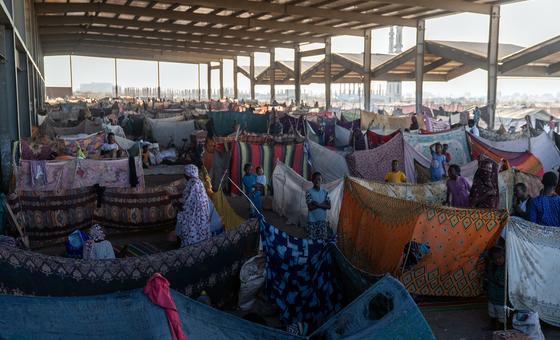
1.3 million Sudanese return home, offering fragile hope for recovery

“The thousands of people seeking to return home are driven by hope, resilience and an enduring connection to their country,” said Othman Belbeisi, regional director of the International Organization of Migration (IOM).  

While this development does offer hope, many of these people are returning to states and cities whose resources have been devastated by over two years of war.  

Since conflict broke out in April 2023, over 12 million Sudanese have been forcibly displaced, representing the largest displacement crisis in the world.

One-third of these displaced people have fled into neighbouring countries such as Chad and South Sudan, which are increasingly struggling to support the influx of refugees.  

“Not only do [the returnees] mark a hopeful but fragile shift, they also indicate already stretched host countries under increasing strain,” said Mamadou Dian Balde, the regional coordinator for the UN’s refugee agency, UNHCR.  

‘A race against time’

IOM emphasized that for these returns to accord with international law, they must be voluntary and dignified. Most of the 1.3 million Sudanese returnees are heading to Khartoum, Al Jazirah and Sennar states where the impact of the conflict is still very acute.  

In Khartoum specifically, many buildings — including the UNHCR office — are in ruins and public infrastructure, such as roads and power plants, has been compromised or destroyed.  

“Without urgent action, people will be coming back to cities that are in ruins. We are in a race against time to clear the rubble and provide water, power and healthcare,” said Abdallah Al Dardair, director of the Arab States for the UN Development Programme (UNDP).  

Additionally, Khartoum is already housing many internally displaced people and people who had formerly sought asylum in Sudan before the war broke out.  

Returnees also face danger from unexploded ordnance and high rates of gender-based and sexual violence against women and girls. To address the psychosocial and protection needs of these women and girls, safe spaces have been set up in Khartoum and Al Jazirah states.

Key to recovery 

In highlighting the hope that these returns signal, Mr. Belbeisi emphasized that returnees must be seen as active participants in the recovery of conflict-ridden Sudan.  

“Those heading home are not passive survivors, they are vital to Sudan’s recovery. Yes, the humanitarian situation is dire, but with the right support, returnees can revive local economies, restore community life, and foster hope where it’s needed most,” he said.

However, humanitarian work in and around Sudan is drastically underfunded — only 23 per cent of the estimated $4.2 billion dollars needed for the next year has been received, meaning that life-saving services may have to be scaled back.  

“More than evidence of people’s desire to return to their homeland, these returns are a desperate call for an end to the war so that people can come back and rebuild their lives,” Mr. Balde said.   

Source link

Home is where the heart is — and where development begins

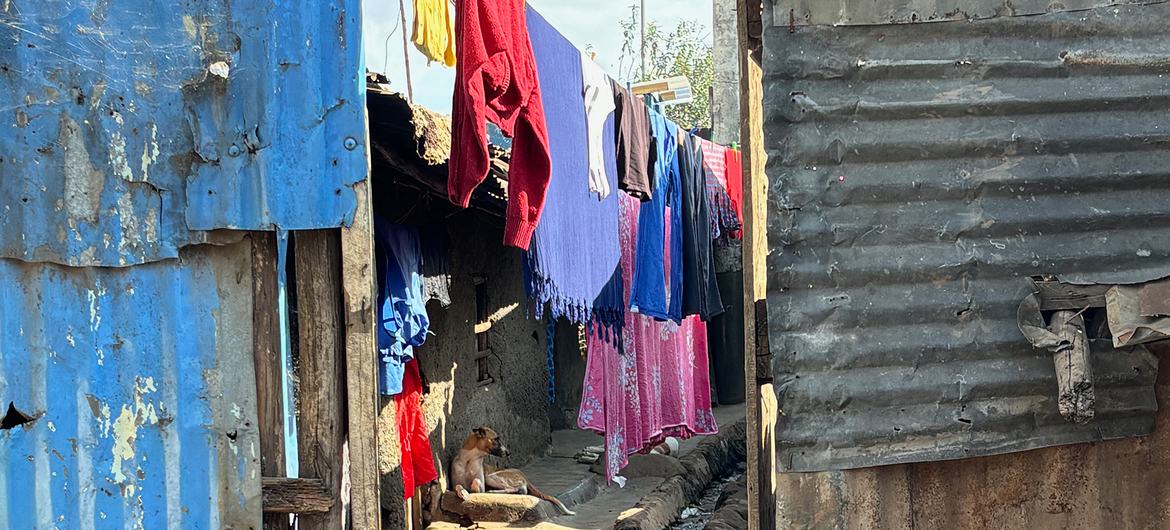
Mathare, one of the country’s largest slums, houses upwards of 500,000 people in five square kilometres, cramming them together and storing the human waste they produce in uncovered rivulets. But when he recounted the visit later to UN News, this was not the image that stuck with him the most.  

Without formal sewage systems, rivulets in the Mathare slum in Nairobi hold human waste.

What he remembered most clearly was a group of boys and girls, dressed in navy blue school uniforms — the girls in skirts and the boys in pants, both with miniature ties underneath their vests — surrounded by squawking chickens and human waste.  

There was no formal, or UNICEF-funded, school nearby. But the Mathare community had come together to create a school where their children might just have the chance to break an intergenerational cycle of poverty and invisibility.

“That was a message for me that development should be localized. There is something happening at the community [level],” said Mr. Jobin.

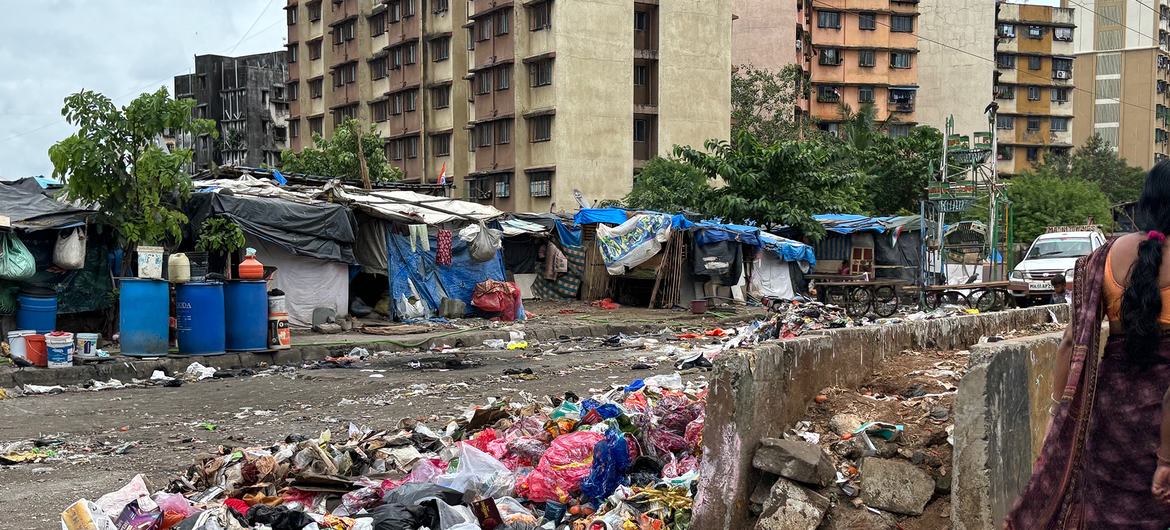
Globally, over one billion people live in overcrowded slums or informal settlements with inadequate housing, making this one of the largest development issues worldwide, but also one of the most underrecognized.  

“The first place where opportunity begins or is denied is not an office building or a school. It is in our homes,” UN Deputy Secretary-General Amina Mohammed told a high-level meeting of the Economic and Social Council (ECOSOC) on Tuesday.    

A litmus test

Mr. Jobin was one of the experts taking part in the High-Level Political Forum (HLPF) on Sustainable Development at UN Headquarters in New York this month to discuss progress – or lack thereof – towards the globally agreed 17 Sustainable Development Goals (SDGs).

One of the goals aspires to create sustainable cities and communities. However, with close to three billion people facing an affordable housing crisis, this goal remains unrealized.

“Housing has become a litmus test of our social contract and a powerful measure of whether development is genuinely reaching people or quietly bypassing them,” said Rola Dashti, Under-Secretary-General for the UN Economic and Social Commission for Western Asia (ESCWA).  

Housing as a mirror for inequalities

An apartment building at an informal settlement in Mumbai, India.

With over 300 million unhoused people worldwide, sometimes it is easy to forget about the one billion people who are housed but inadequately. These people, who populate informal settlements and slums, live in unstable dwellings and in communities where few services are provided.  

“Housing reflects the inequalities shaping people’s daily lives. It signals who has access to stability, security and opportunity and who does not,” said Ms. Dashti.

Children living in slums or informal settlements are up to three times more likely to die before their fifth birthday. They are also 45 per cent more stunted than their peers as a result of poor nutrition.  

Women and girls are more likely to experience gender-based violence. And human trafficking and child exploitation are also more prevalent.  

An intergenerational invisibility

People in informal settlements are often not a part of the national census, according to Mr. Jobin, meaning that they are not taken into consideration in policies, social programmes or budgets. Even if they were given social protections, these settlements rarely have addresses at which families could receive cash transfers.  

This is why experts often say that the people living in informal settlements and slums are invisible in official data and programmes.

“You’re born from an invisible family, so you become invisible,” Mr. Jobin said. “You don’t exist. You’re not reflected in policies or budgeting.”

This invisibility makes it almost impossible to escape poverty.  

“You become a prisoner of a vicious circle that entertains itself and then you reproduce yourself to your kid,” he said, referring to an inescapable cycle of deprivation.

The urban paradox

More and more people are migrating into urban centres, leading to the growth of these informal settlements. And with their growth, comes more urgency to address the issues.  

The World Bank estimates that 1.2 million people each week move to cities, often seeking the opportunities and resources that they offer. But millions of people are never able to benefit, instead becoming forgotten endnotes in an urban paradox that portrays urban wealth as a protection against poverty.  

By 2050, the number of people living in informal settlements is expected to triple to three billion, one-third of whom will be children. Over 90 per cent of this growth will occur in Asia and Africa.  

“These statistics are not just numbers — they represent families, they represent workers and entire communities being left behind,” said Anacláudia Rossbach, Under-Secretary-General of UN Habitat which is working to make cities more sustainable.  

The Mathare slum in Nairobi houses 500,000 people within 5 square kilometres.

Housing as a human right

It is not just national and local governments which struggle to contend with informal settlements — organizations like UNICEF are also “blind”, Mr. Jobin said, regarding the scope of problems in informal settlements.  

Development partners face twin issues in designing interventions — there is not enough national data and informal governance, or slum lords, can be more critical for coordinating programs than traditional governmental partners.

“We know the issue …  But somehow we have not really been able to intervene,” he said.

Ms. Mohammed emphasized that we need to begin to see adequate and affordable housing as more than just a result of development — it is the foundation upon which all other development must rest.  

“Housing is not simply about a roof over one’s head. It’s a fundamental human right and the foundation upon which peace and stability itself rests.” 

Desperate Afghan refugees return to an unfamiliar home

The agency is calling for calm and cooperation to provide a dignified path forward for millions of displaced Afghans.

More than 1.6 million Afghans have returned from both neighbouring countries in 2024 alone, according to UNHCR – a figure that has already surpassed earlier forecasts for the entire year.

‘From Afghanistan – not of Afghanistan’

The scale and speed of these returns are placing enormous pressure on border provinces ill-equipped to absorb them, exacerbating poverty, insecurity and humanitarian need in a country still reeling from economic collapse and widespread human rights abuses.

Complicating the situation further is the fact that many returnees – especially women and children – are coming back to a country they barely know.

They are from Afghanistan [but] not of Afghanistan – often born abroad with better education and different cultural norms. Their outlook is different from and often at odds with present day Afghanistan,” says Arafat Jamal, UNHCR Representative in the country.

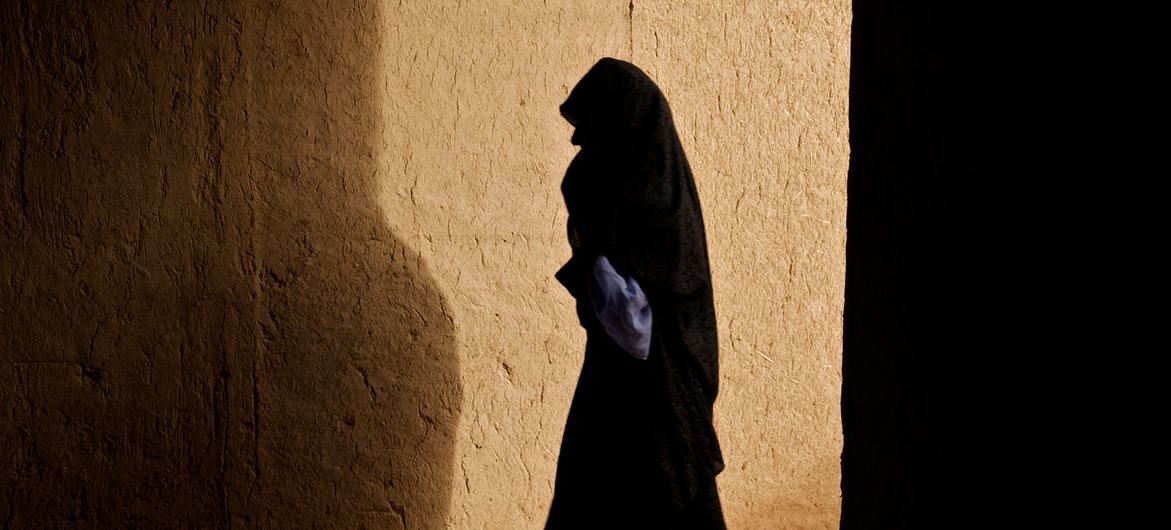
Women and girls in particular face a jarring shift: from relative autonomy in host countries to a context where their rights are severely restricted by edicts from Taliban authorities.

© UNICEF/Shehzad Noorani

Women’s rights in Afghanistan continue to face severe setbacks, with restrictions deepening across education, employment and public life

Disorientated and disorganised

He reported conditions that he had seen for himself recently in Islam Qala, a key border crossing with Iran.

Daily arrivals have surged to around 50,000 people, many of them disoriented and exhausted after arduous journeys. UN officials described scenes of desperation at reception centres.

Many of these returnees have been abruptly uprooted and have undergone arduous, exhausting and degrading journeys – they arrive tired, disoriented, brutalised and often in despair, and they sprawl throughout a crowded centre in often 40°C (104°F) heat,” Mr. Jamal said.

While some returns are voluntary, he added that many are occurring under duress or without proper protections in place. Those returning include both officially registered refugees and people in “refugee-like” situations who may face serious risks upon arrival.

Funding crisis

The UN and humanitarian partners have mounted a broad-based response along the borders, providing food, water, health services, protection and onward transportation.

However, funding shortfalls are critically hampering operations. UNHCR’s response is just 28 per cent funded as of July, forcing aid agencies to ration supplies and make painful choices.

“We are living on borrowed funds,” Mr. Jamal said. “Daily, we are asking ourselves – should we give one blanket instead of four? One meal instead of three? These are heartbreaking, soul-destroying decisions.

The situation is equally dire for other agencies: the wider, UN-led 2025 Humanitarian Needs and Response Plan for Afghanistan – which seeks $2.4 billion to assist nearly 17 million people across the country – is only 22 per cent funded.

Poverty and drought

Recent UN assessments have also warned of deteriorating conditions and deepening poverty within Afghanistan.

The UN Food and Agriculture Organization (FAO) issued alerts over worsening drought across much of the country, while the UN Development Programme (UNDP) reports that 70 per cent of Afghans already live at subsistence levels, as the collapse of public services and ongoing rights violations leaves millions in despair.

As returnees cross the border, often without notice or resources, local populations are being stretched to the limit.

Mr. Jamal noted that this “precarity layered upon poverty” risks fuelling frustration, competition over limited resources and new forms of social tension.

Afghanistan may be welcoming, but it is wholly unprepared to receive this volume of returnees,” he said. “The communities who are taking people in are doing so with great generosity, but they are themselves in crisis.”

Global attention

The growing emergency comes just days after the UN General Assembly overwhelmingly adopted a resolution expressing “deep concern” over deteriorating conditions facing Afghans.

The resolution, passed with 116 votes in favour and only two against, urged the Taliban to reverse repressive policies and called for renewed international cooperation to support Afghan civilians.

The resolution highlighted the need for “coherent approaches” that bridge humanitarian, development and political efforts. It also called on donor countries to maintain or increase support.

Source link

UN migration agency helping migrants in the US return home voluntarily

In a statement on Monday, the UN agency said it is supporting Assisted Voluntary Return (AVR) – not deportation – for those who decide to leave the US.

At the request of the US Government, IOM is helping people who register to go back to their countries of origin voluntarily.

AVR is a well-established, rights-based approach that helps migrants navigate complex global migration systems, regain control over their lives, and make informed choices,” the agency said.

Safe, dignified returns

“Our role is to ensure that those who lack the means to return on their own can do so in a safe, dignified, and informed way,” IOM added.

The agency made it clear that the US determines its own policies on migration. “IOM does not facilitate or implement deportations. Our involvement begins only after an individual gives informed consent to receive assistance.”

In these instances, “IOM ensures that people have access to accurate information and essential services, in line with international standards.”

The announcement comes as the US seeks to expand deportation of undocumented migrants in continuation of a policy President Donald Trump began nearly 10 years ago under his first administration.

He returned to office in January for a second term and has been cracking down on illegal immigration through raids, detentions and deportations. 

In a video posted to social media on Friday, President Trump said that he had signed an Executive Order “to launch the first-ever self-deportation programme for illegal aliens,” offering free flights from the US and payment of an “exit bonus.”

Support for a life-changing decision

IOM was established in 1951 and promotes humane and orderly migration.

For decades the agency has supported AVR programmes in more than 100 countries, “helping people without resources, legal options, or support return to their countries of origin safely and with dignity,” it said.

IOM noted that in the US, “many migrants face a challenging reality – navigating complex systems with limited options and resources,” and “this initiative provides support to those who choose to return, helping them make a life-changing decision with care and clarity.” 

Source link