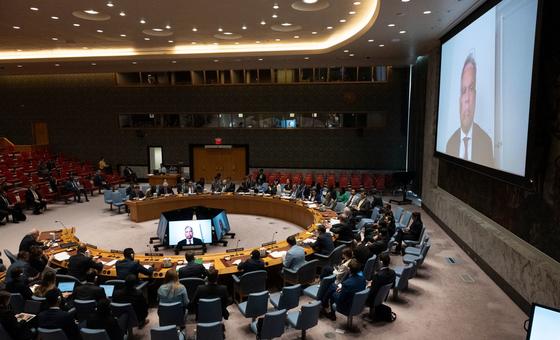
Daily malnutrition deaths continue as Israeli forces push further into Gaza City

Military activities continue in and around Gaza City, but also in the south, taking a heavy toll on civilians, including deaths, injuries and further displacement,” said UN Spokesperson Stéphane Dujarric at the daily press briefing in New York: “Our colleagues report that people continue to flee, mainly towards the coast.”

More than 76,000 people have been newly displaced since mid-August, with most occurring in the north, he said, citing the latest reports from UN agencies on the ground that are monitoring population movements. More than 23,000 people were displaced from northern Gaza.

Coastal areas are also crowded with tents, forcing many people to flee from Gaza City in the north towards central areas, according to the UN humanitarian coordination agency, OCHA.

Famine response: ‘We can do this again’

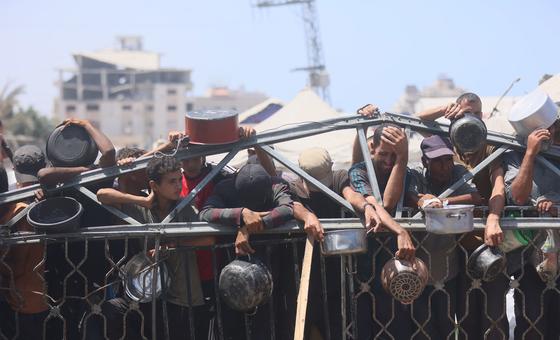
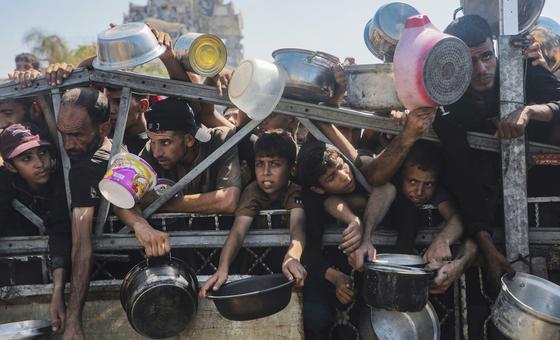
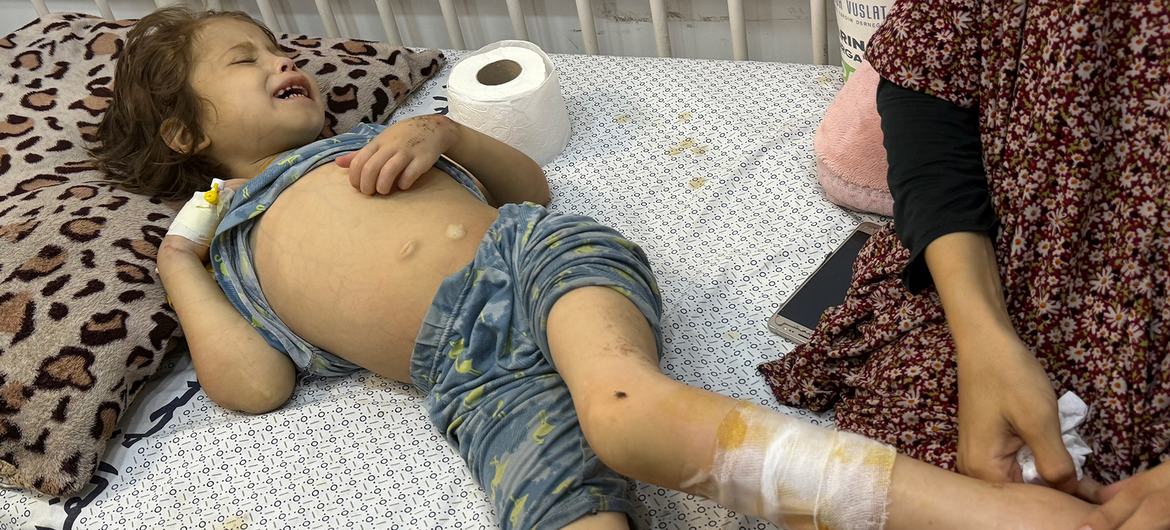
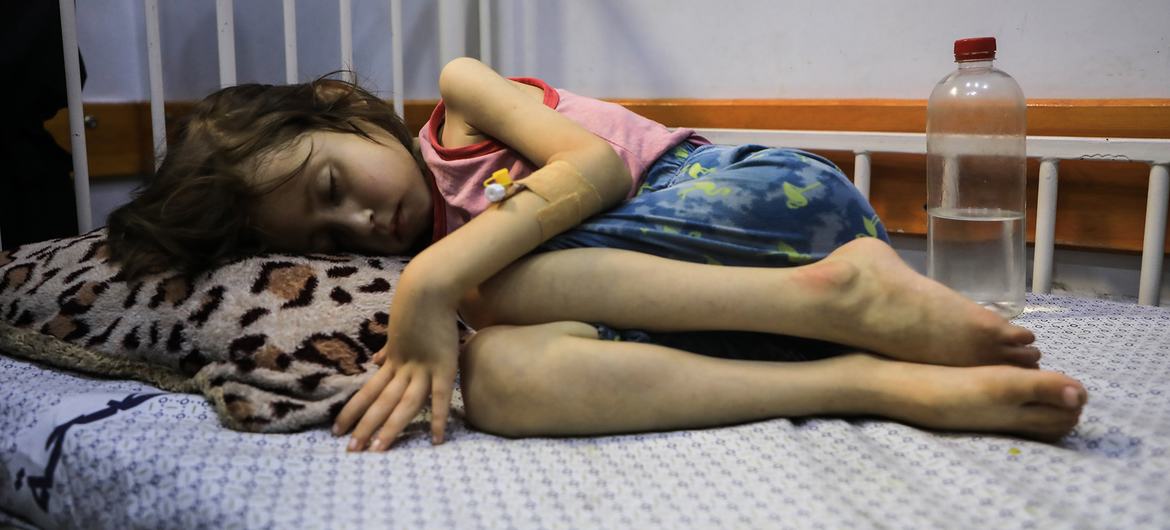
Daily reports of malnutrition deaths continue, the UN Spokesperson said. Since the start of the nearly two-year-long war, more than 300 people, including many children, have died of malnutrition in the Strip, according to local authorities.

The World Food Programme (WFP) reported that the situation “continues to deteriorate”, the UN Spokesperson added, adding that families without able-bodied members to fetch food are facing the highest risks.

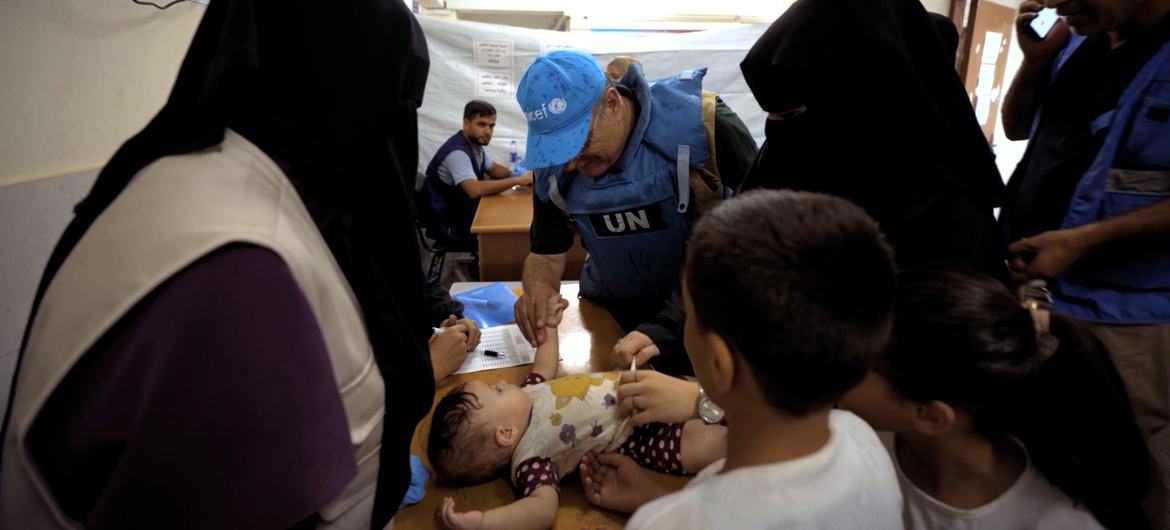
As such, the UN agency resumed last week its distribution system of digital vouchers, reaching 22,000 people, including vulnerable groups, following a five-month pause.

“We and our partners are continuing to transport aid and other medical supplies to and from the crossings [into Gaza], but the current situations on the ground have not yet allowed us to resume community-based distribution,” Mr. Dujarric said. “Only a ceasefire will ensure necessary conditions for a massive response to prevent famine from spreading further.”

During the previous ceasefire from January to March, he said “we reached nearly every single person in the Gaza Strip with lifesaving aid, and we can do this again.”

Obstacles delay urgent aid deliveries

WFP said obstacles include supply shortages and violent unrest around convoys which is making distributions “nearly impossible”.

According to the UN humanitarian agency, the movement of aid teams inside Gaza remains heavily restricted. OCHA also reported that about one in three planned missions were “impeded or outright denied by Israeli authorities” between Friday and Monday, the UN Spokesperson said.

As a result, many missions could not be completed, he said, also noting that strict Israeli inspections continue to significantly delay aid clearance at Ashdod Port.

Visas for top Palestinian officials blocked

News reports indicated that the United States announced last week that it would not issue visas to senior Palestinian leaders ahead of the high-level General Assembly meetings later this month at UN Headquarters in New York.

That includes a conference on 22 September where Heads of State and Government are expected to endorse a political declaration adopted by leaders attending an international conference in late July, endorsing the two-State solution.

Responding to a reporter’s question on the matter, Mr. Dujarric said “the participation of a senior Palestinian delegation to the conference is essential.”

UNRWA chief levels charge of ‘scholasticide’

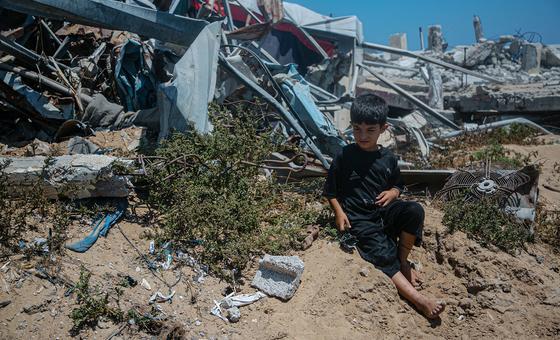
Philippe Lazzarini, Commissioner-General of the UN agency for Palestine refugees, UNRWA, raised alarms at what would have been the start to the school year for more than 600,000 children in Gaza.

Gaza is in ruins; so is its education system,” he said in a statement on Monday. “Instead of going back to school, like most children around the world, around 660,000 girls and boys in Gaza will be sifting through the rubble, desperate, hungry, traumatised and mostly bereaved.”

The longer they stay out of school with their trauma, the higher the risk they become “a lost generation, sowing the seeds for more hatred and violence”, the UNRWA chief warned.

“Ceasefire is the only way forward to reverse the famine and the ‘scholasticide’ hitting the children of Gaza,” he said.

Source link

The descent into ‘a massive famine’ in Gaza has begun, relief agencies warn

Although the private aid platform run by the US and Israeli-backed Gaza Humanitarian Foundation continues to receive its own supplies, “we are on a descent into a massive famine”, insisted Jens Laerke, spokesperson for the UN aid coordination office, OCHA, on Friday.

Referring to the latest catastrophic assessment of food insecurity in Gaza from the UN-backed IPC group of experts, Mr. Laerke noted that 500,000 people are in the worst possible situation today, with another 160,000 expected to be added to that number in the coming weeks.

Everyone lacks food

“They all need food,” he told journalists in Geneva. The entire Gaza Strip needs food. There would not have been declared famine had there been sufficient amounts of food.”

In a related development, the UN World Health Organization (WHO) highlighted the growing risk of communicable diseases in Gaza, with 94 suspected cases of Guillain-Barré Syndrome now reported.

The disease can cause paralysis and is treatable in hospital with intravenous immunoglobulin or plasma exchange, according to WHO. “But these two [treatments] are at zero stock, as are anti-inflammatories,” said WHO spokesperson Christian Lindmeier, referencing ongoing Israeli aid restrictions impacting humanitarian relief supplies entering Gaza. “These deliveries must be urgently expedited as much as surveillance and testing capabilities.”

Between 20 and 26 August, out of 89 attempts to coordinate relief missions with Israeli authorities across Gaza, 53 were facilitated, 23 were initially approved but then impeded on the ground, seven were denied and six had to be withdrawn by the organizers, OCHA said in an update.

More to come on this developing story…

Source link

Israel’s plan to take over Gaza City marks ‘new and dangerous phase’: Guterres

“Israel’s initial steps to militarily take over Gaza City signals a new and dangerous phase,” he told journalists in New York.

“Expanded military operations in Gaza City will have devastating consequences. Hundreds of thousands of civilians – already exhausted and traumatized – would be forced to flee yet again, plunging families into even deeper peril. This must stop.”

‘Endless catalogue of horrors’

Mr. Guterres was speaking ahead of a Security Council meeting on the situation in Haiti but stopped to brief reporters on the “unfolding tragedy that is Gaza”, where “yet more unconscionable Israeli strikes” have occurred.

Incidents include the two airstrikes on Nasser Hospital in Khan Younis earlier this week which killed civilians, including medical personnel and journalists, “all with the world watching”.

The Secretary-General said “these attacks are part of an endless catalogue of horrors” and called for accountability.  

“Gaza is piled with rubble, piled with bodies, and piled with examples of what may be serious violations of international law,” he said.

“Hostages taken by Hamas and other groups must be released and the atrocious treatment they have been forced to endure must stop. Civilians must be protected.”

© UNICEF/Mohammed Nateel

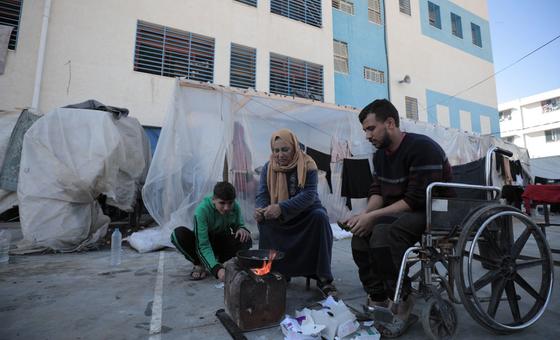
A displaced family sit outside their tent in Gaza.

Unparalleled destruction and famine

Mr. Guterres stressed that “the levels of death and destruction in Gaza are without parallel in recent times”.

He said that “famine is no longer a looming possibility – it is a present-day catastrophe.”

People are dying from hunger, yet Gaza’s food, water and healthcare systems have been systematically dismantled.

Israel’s obligations

“These are the facts on the ground. And they are the result of deliberate decisions that defy basic humanity,” he said. “Israel, as the occupying Power, has clear obligations.”

He said Israel must ensure the provision of food, water, medicine, and other essentials.  This is in addition to agreeing to and facilitating far greater humanitarian access to Gaza, and protecting civilians and civilian infrastructure.

Mr. Guterres said the International Court of Justice (ICJ) has given binding provisional measures which must be implemented in full and immediately.

They include the obligation to take all steps to ensure unfettered humanitarian and medical assistance to Palestinians throughout the Gaza Strip “without delay and in full cooperation with the United Nations.” 

UN staff killed, aid efforts blocked

Meanwhile, the UN and partners are doing all they can, he said.  This is often at great personal risk, as tragically 366 UN personnel have been killed. 

“Day after day, our efforts are being blocked, delayed, and denied,” he said. “This is unacceptable.”

Settlement expansion in the West Bank

Mr. Guterres also addressed the situation in the West Bank, describing it as “profoundly alarming”.

He said Israeli military operations, settler violence, demolitions, and discriminatory policies are driving displacement and deepening vulnerability. 

Furthermore, the relentless expansion of settlements is fracturing communities and cutting off access to vital resources.

The Israeli authorities recently approved of a plan for the construction of thousands of settlements in the E1 area. He said this would effectively separate the northern and southern West Bank, representing “an existential threat to the two-state solution” between Israelis and Palestinians. 

“I repeat: the Israeli settlements in the occupied West Bank including East Jerusalem have been established – and are being maintained — in violation of international law,” he stressed.   

“Israel must cease such actions and comply with its obligations.”

‘No more excuses’

The Secretary-General concluded his remarks by emphasizing that there is no military solution to the conflict.

“I appeal once again for an immediate and permanent ceasefire, unfettered humanitarian access across Gaza, and the immediate and unconditional release of all hostages,” he said.

“Starvation of the civilian population must never be used as a method of warfare. Civilians must be protected. Humanitarian access must be unimpeded,” he added, ending with a plea for “No more excuses.  No more obstacles.  No more lies.” 

UN calls for decisive steps to end conflict as Gaza and West Bank crises deepen

“Today the world looks on in horror as the situation in the Occupied Palestinian Territory continues to deteriorate to levels not seen in recent history,” said Ramiz Alakbarov, UN Deputy Special Coordinator for the Middle East Peace Process, speaking from Jerusalem.

He began by focusing on Gaza, which is “sinking deeper into disaster, marked by rapidly mounting civilian casualties, mass displacement, and, now, famine”, with no end in sight to the conflict.

Worst fears becoming reality

He said that “unthinkably, Gaza’s population is now facing yet another deadly escalation” following Israel’s announcement of its decision to take over Gaza City, which is ongoing.

“For a population already struggling to survive, Palestinians in Gaza are seeing their worst fears become reality in front of their eyes,” he said.

“Expanded military operations in Gaza City will have catastrophic consequences, including displacing hundreds of thousands.” 

Air strikes intensify

Mr. Alakbarov briefed the Council alongside Joyce Msuya, UN Assistant Secretary-General for Humanitarian Affairs, and two guests: Inger Ashing, Chief Executive Officer at Save the Children International, and Ilana Gritzewsky, an Israeli hostage who survived Hamas captivity in Gaza.

He reported that Israeli military strikes have intensified throughout the Strip, hitting tents housing displaced people, schools, hospitals, and residential buildings.  

Since 23 July, at least 2,553 Palestinians have been killed, according to the health authorities. Of this number, some 271 were reportedly killed attempting to collect aid, including in the vicinity of militarized distribution sites.  

Additionally, over 240 journalists have been killed since the war began on 7 October 2023 following deadly Hamas-led attacks on Israel. 

Although the UN and partners are working tirelessly to assist the people in Gaza, “the security risks are extremely high, and current mitigation measures are woefully insufficient,” he said.

“On my recent visit to Gaza, I was stunned at the scale of the destruction and suffering. I met humanitarian workers risking their lives to deliver aid, while themselves living in intolerable conditions,” he added.

Meeting with survivors and families of hostages

The UN official also visited affected communities in Israel and met survivors of the 7 October terror attacks and family members of some of the hostages. 

“I saw the shattered homes of Nir Oz, where one in four residents was either murdered or abducted on 7 October. I met survivors who carry unbearable loss and trauma,” he said.

Around 50 people, including one woman, are still being held by Hamas and other Palestinian armed groups in Gaza, and 28 are believed to be deceased. 

Videos released by Hamas and Palestinian Jihad depicting emaciated Israeli hostages were deeply disturbing, he said, stressing that ill-treatment and abuse of hostages constitute a blatant violation of international law.

Children in the Jenin refugee camp in the West Bank looking at the destroyed shelters following recent military operations. (file)

West Bank violence

Meanwhile, the situation in the occupied West Bank, including East Jerusalem, “continues to spiral dangerously downward” and “the territory envisioned for a future Palestinian State is shrinking, while a one-State reality of unlawful occupation and perpetual violence is rapidly advancing.”

Israeli security forces have continued operations in northern cities and refugee camps, displacing more than 32,000 people. Furthermore, security forces killed nine Palestinians, four of them children, during the three-month reporting period. 

Attacks by Israeli settlers also have continued, resulting in three Palestinians killed, damage to Palestinian property and displacement.  At the same time, attacks by Palestinians against Israelis have also continued, with no fatalities reported in the last month.

Settlement expansion 

Since the start of the war in Gaza, settler attacks have escalated in frequency and become more violent and deadly.  They have increasingly led to forced displacement, with settlers then moving in and establishing outposts. At the same time, Israel is “fast-tracking settlement expansion, including in the most highly strategic areas.”

Mr. Alakbarov recalled that the Israeli High Planning Committee recently approved a plan for the construction of more than 3,400 housing units in the E1 area.  

“If implemented, the move would effectively sever the connection between the northern and southern West Bank. As such, it would further undermine the possibility of a viable and contiguous Palestinian state,” he warned. 

Israeli authorities also continued to demolish Palestinian-owned structures, he added, and 175 Palestinians, including 70 children, have been displaced.

Regional tensions

Mr. Alakbarov noted that the developments in the Occupied Palestinian Territory are taking place amid a volatile regional context, with more exchanges of fire between Houthi rebels in Yemen and Israel forces occurring this week, along with continued Israeli strikes in Lebanon and an incursion in Syria.

Stressing the need for a ceasefire in Gaza and the release of all hostages, he said “what is needed now is bold action to resolve the conflict, end the occupation and re-establish a political horizon.”

In this regard, he welcomed the High-Level Conference on the Implementation of the Two-State Solution co-chaired by France and Saudi Arabia, held at UN Headquarters in June. 

Uphold the two-State solution

“The message from the international community is clear: the two-State solution remains the only viable path toward a just and lasting resolution of the Israeli-Palestinian conflict,” he said.

He urged the international community to work collectively to advance practical steps, including through engagements during the high-level week of the UN General Assembly in September.

“With Gaza immersed in a situation so horrendous that it defies basic humanity and with the West Bank facing genuine threats to its long-term existence, we can no longer wait,” he said. 

Gaza famine ‘a created catastrophe’

Ms. Msuya’s briefing centered around the recent Integrated Food Security Phase Classification (IPC) analysis confirming that famine is occurring in Gaza governorate – phase 5 conditions – and is expected to spread in the coming weeks.

She drew attention to some of the numbers, saying over half a million people currently face starvation, destitution and death, which could exceed 640,000 by the end of September.  

Approximately one million Gazans are in emergency phase 4 and over 390,000 face phase 3 crisis conditions, she continued.

At least 132,000 children under five are expected to suffer from acute malnutrition between now and the middle of next year, while the number of those who risk dying has tripled to over 43,000. 

Among pregnant and breastfeeding women, the number is predicted to rise from 17,000 to 55,000.

“Let us be clear: This famine is not a product of drought or some form of natural disaster,” she said. “It is a created catastrophe – the result of a conflict that has caused massive civilian death, injury, destruction and forced displacement.”

End this ‘human-made crisis’

Ms. Msuya urged the Council to ensure an immediate and sustained cessation of hostilities to save lives and stop famine from spreading.

She also called for the immediate and unconditional release of all hostages and for civilians and critical infrastructure to be protected.

Furthermore, safe, rapid and unimpeded humanitarian access through all entry points must occur, and aid – including food, medicine, water, fuel and shelter – has to be delivered to all people in need.

Her final request was for the restoration of commercial flows of essential goods at scale, market systems, essential services and local food production.

Ending this human-made crisis demands that we act as if it were our mother, our father, our child, our family trying to survive in Gaza today,” she said. 

A former hostage’s appeal

Ms. Gritzewsky recalled the moment her life was brutally changed on 7 October 2023.

She was grabbed by the hair, punched in the stomach, thrown against a wall, and “touched everywhere,” all while being filmed by the terrorists.  Taken to Gaza, she fainted at the time of her sexual assault.

“Nothing will be the same again,” she said, referring in particular to her broken jaw and pelvis.

Ms. Gritzewsky said she received no medication and did not see a doctor during the 55 days of captivity, even though she had raised concerns about her anaemia and colitis.

She is now fighting for the release of the hostages, particularly her partner, Matan, and made a passionate appeal to the Security Council to act for the release of all those still being held.  

Source link

Hunger and disease in Gaza will only worsen from ‘man-made’ famine: WHO

In an online alert, the UN agency said that disease and hunger will only increase, unless all Israeli impediments to aid delivery at scale are removed and access is allowed across the Strip.

The UN aid coordination office, OCHA, confirmed on Wednesday that some aid is allowed into the enclave every day, albeit far too little to meet the huge level of needs.

OCHA’s Olga Cherevko returned this week to a UN-supported community kitchen in Gaza City that she last visited in March, which had been struggling to stay open even then during the total blockade.

Community resilience

It had been forced to close – but managed to reopen again 10 days ago: “They’re now feeding 5,000 people a day, making meals hot meals for people in need in the neighbouring communities,” she said.

“Of course, the number of meals being cooked every day remains severely insufficient because the volume of supplies entering remains severely insufficient, and the only way for us to stop famine is by ensuring that more supplies are entering every day.”

The WHO appeal comes two days after at least 20 people were killed in a double strike on Nasser hospital in southern Gaza, with four health workers and five journalists among the victims.

Across the Gaza Strip today, WHO said that more than half a million people are trapped in famine, with destruction to food and health services, and to water and sanitation systems.

‘Act without delay’

The UN General Assembly-mandated Palestinian rights committee issued a statement on Wednesday reminding that the famine is projected to spread in the coming days, if Israel fails to allow in more food aid.

“This catastrophic man-made disaster comes on the heels of two years of near total Israeli destruction and blockade of Gaza and relentless military assaults that have decimated civilian infrastructure, including food production capacities and all other means of subsistence,” the committee said.

“This is a grave breach of international law. States must act without delay to fulfill their legal obligations towards bringing a rapid end to this catastrophe and illegal situation.”

More to follow…

Killing of journalists in Gaza hospital attack ‘should shock the world’: UN rights office

OHCHR Spokesperson Thameen Al-Kheetan said condemnation of the two strikes by Israeli forces on the Nasser Hospital in Khan Younis now needs to be channelled into a demand for accountability and justice for all those killed.

At least 20 died, including four health workers and five journalists, later named as Ahed Abu Aziz, Hussam al-Masri, Mariam Dagga, Mohammed Salama and Moaz Abu Taha. They worked for outlets including Middle East Eye, the Associated Press, Al Jazeera and Reuters.

Two strikes

Video taken at the scene shows a second strike apparently targeting rescuers who had arrived at the scene of the initial attack on southern Gaza’s largest medical facility on Monday.

“We know that one of the five journalists appears to have been killed in the first air strike while three others including the women journalist appear to have been killed in the second air strike. This is a shock and this is unacceptable,” said Mr. Al-Kheetan.

“At least 247 Palestinian journalists have been killed in Gaza since the 7th of October 2023,” he continued.

“These journalists are the eyes and the ears of the whole world and they must be protected…This raises many, many questions about the targeting of journalists and all of these incidents must absolutely be investigated and those responsible must be held accountable.

He added that OHCHR was continuing to corroborate the factual details of Monday’s strikes, adding that targeting journalists as well as hospitals is forbidden under international law.

The head of UN cultural agency, UNESCO – which advocates for press freedom and journalists’ safety – also condemned the killings, reiterating her call to respect UN Security Council resolution 2222, unanimously adopted in 2015 on the protection of journalists, media professionals and associated personnel as civilians in situations of conflict.

Audrey Azoulay said UNESCO is providing emergency assistance to journalists in the Gaza Strip, including psychosocial assistance, access to working equipment, and capacity-building

Investigations must ‘yield results’

Israeli Prime Minister Benjamin Netanyahu responded to the killings expressing regret, describing the incident as a “tragic mishap”. He said the Israeli military would carry out “a thorough investigation.”

The OHCHR spokesperson told journalists in Geneva that Israeli authorities had carried out investigations in the past, as the occupying power.

“But these investigations need to yield results. There needs to be justice. We haven’t seen results or accountability measures yet,” he said.

More to follow…

Source link

Gaza: UN calls for probe following deadly strikes on Nasser Hospital

At least 20 people were killed, including four health workers and five journalists, WHO Director-General Tedros Adhanom Gebreyesus said in a tweet.

Fifty other people were injured, including critically ill patients who were already receiving care.

Healthcare under attack

While people in Gaza are being starved, their already limited access to healthcare is being further crippled by repeated attacks,” Tedros remarked.

“We cannot say it loudly enough: STOP attacks on healthcare. Ceasefire now.”

He said the hospital’s main building, which houses the emergency department, inpatient ward, and surgical unit, was hit. 

The strikes also damaged the emergency staircase.

Global indifference and inaction

The head of UN Palestine refugee agency UNRWA also took to social media in the wake of the news.

Silencing the last remaining voices reporting about children dying silently and famine with the world’s indifference and inaction is shocking,” said Commissioner-General Philippe Lazzarini.

He called for compassion to prevail, saying “let us undo this manmade famine by opening the gates without restrictions, ⁠protecting journalists and humanitarian and health workers,” stressing the need for political will now.

The UN recently noted that more than 240 journalists have been killed in Gaza since the war began nearly two years ago following deadly Hamas-led attacks on Israel. 

Roughly 1,200 people were killed and 250 hostages were taken to the enclave, some of whom remain in captivity.

Guterres calls for investigation

UN Secretary-General António Guterres strongly condemned the deadly airstrikes and called for a prompt and impartial investigation.

These latest horrific killings highlight the extreme risks that medical personnel and journalists face as they carry out their vital work amid this brutal conflict,” UN Spokesman Stéphane Dujarric said in a statement. 

The UN Office for the Coordination of Humanitarian Affairs (OCHA) said that among the reporters killed was female journalist Mariam Abu Dagga who partnered with the agency last year on a photo essay depicting the dire situation in Gaza.

The Secretary-General reiterated that medical personnel and journalists must be able to perform their essential duties without interference, intimidation, or harm, in full accordance with international humanitarian law. 

He also renewed his call for an immediate and permanent ceasefire in Gaza, unfettered humanitarian access across the enclave, and the immediate and unconditional release of all hostages.

The Israeli Prime Minister’s office issued a statement later in the day saying the Government “deeply regrets the tragic mishap” which occurred at the Nasser Hospital. 

Famine spreading

The number of deaths in Gaza has surpassed 61,000, according to the local health authorities.

Last week, food security experts confirmed that famine has taken root in Gaza Governorate, projecting that it will spread. 

The Gaza Ministry of Health said on Tuesday that 11 people have died from malnutrition and starvation in the past 24 hours, bringing the overall total to 300.

Displacement deepens

Meanwhile, people across the enclave continue to be displaced while seeking safety and shelter.  

Humanitarians said that between 20 and 24 August, some 5,000 people are estimated to have been displaced from northern Gaza to Deir Al-Balah and Khan Younis. Roughly 8,000 more have been displaced to the west of Gaza City. 

Overall, new displacements have surpassed 800,000 since the end of the ceasefire in mid-March. 

Obstructions to aid delivery

At the same time, aid convoys in Gaza continue to face delays, movement obstructions and other challenges. 

On Sunday, only seven out of 15 humanitarian missions that required coordination with Israel were facilitated, including the collection of fuel from the Kerem Shalom border crossing for distribution to areas where it is needed most. 

“Four missions had to be either cancelled by the organisers or were denied outright by Israeli authorities,” OCHA said.

“The remaining ones were initially approved but then impeded on the ground and only partially accomplished, including the collection of food and vaccines from the crossings.”

Education on hold

As children around the world start heading back to school, their counterparts in Gaza continue to miss out on education.

Several education facilities that are being used as shelters for displaced people were attacked last week, according to aid partners.

“With local authorities announcing that final exams for over 35,000 high school students are due to be held in two weeks, the UN and its partners reiterate their call for the protection of education facilities in accordance with international law,” OCHA said. 

Source link

Driven by hunger in Gaza, amputees are part of the collateral damage

“I was going to buy falafel,” says Mohammed Hassan. “On the way home, I looked up and saw a rocket heading towards me. I tried to run, but it was too fast. I found myself pinned to the wall, and my foot had been blown off.”

Brought to Al-Shifa Hospital in Gaza City, the young boy looks down at his heavily bandaged left leg, and the stump where his foot used to be.

In another area of the hospital, a small child, Maryam Abu Alba, is crying in pain. “The neighbour’s house was bombed, and their home was hit,” says her grandmother. “One of her legs had to be amputated, and metal plates had to be inserted into the other one, which was fractured. She is in severe pain.”

Earlier this year, the UN humanitarian aid coordination agency OCHA estimated that 4,500 new amputees require prosthetics, in addition to the 2,000 existing cases requiring maintenance and follow-up care, while about 24,000 injured people required rehabilitation.

Health facilities are overwhelmed with many patients undergoing multiple surgeries without adequate medical supplies, including anaesthesia.

Palestinian child Mohammad Hassan sitting on a hospital bed in Gaza after his left leg was amputated by a strike.

Desperately seeking food

In May, as supply routes for UN humanitarian convoys were interrupted, the number of distribution points of aid dropped from 400 dotted across the Gaza strip to a handful of hubs operated by the Gaza Humanitarian Foundation.

Given the shortage of humanitarian aid and diminished capacity, thousands of Palestinians have been killed or injured since May while seeking food.  Among the wounded are children and parents who, despite losing limbs, continue to search for food and water.

This comes as a UN-backed food security report has just concluded that famine is confirmed in Gaza governorate, where half a million people are trapped in conditions of starvation, malnutrition and death.

Ibrahim Abdel Nabi was one of the many Palestinians who headed to the hubs in the hope of finding desperately needed provisions for their families.

In his tent at a displacement site in the coastal Al-Mawasi area of Khan Younis, Mr. Nabi, surrounded by his wife and children, explains how the journey ended in disaster and life-changing injuries.

“When I arrived at the Al-Alam area, west of Rafah, I was hit by an explosive bullet in my leg. I was bleeding for about an hour and a half, and no one came to help me. They were all trying to find food for their children.”

Eventually, a group of people came to his rescue and took him to the nearby Red Cross hospital.

“I stayed there for about a month and a half, undergoing about 12 operations. I became malnourished and lost a lot of blood. Infection spread, and more of my leg had to be amputated.”

Ibrahim Abdel Nabi, a Palestinian displaced in Gaza, sitting on a chair while his wife helps him wear the handmade prosthetic limb.

‘I made my prosthetic leg’

As Mr. Nabi was trying to recover, he was aware that his family were still in need of food. Despite the pain, he decided to make a simple prosthesis from materials he could find to allow him to get back on his feet and make fresh attempts to find food and water.

“The prosthesis injures my leg,” he said. “It causes inflammation and increases the pain. We don’t have medical care or supplies, but I will use it no matter how much it hurts.”

As he speaks, Mr. Nabi’s wife begins to cry. “God willing, we will live through this experience,” she says.

Mr. Nabi gets up on crutches and heads to a nearby tent, where his wife helps him to put on the crude prosthesis.

“Don’t strain yourself,” she repeats, over and over. “Take your time. Walk slowly.”

Source link

World News in Brief: Gaza humanitarian update, more killings in Sudan, ending impunity in Myanmar

Multiple strikes overnight into Friday were reported in the Jabalya Al Balad and An Nazla neighbourhoods, the UN Office for the Coordination of Humanitarian Affairs (OCHA) said in its latest update.

As a result, around 900 people reportedly fled towards the Sheikh Radwan neighbourhood and western Gaza City.

Safe passage, more aid

The UN and partners again reminded parties to the conflict of their obligation to protect civilians, in line with international law, including humanitarian workers and people who cannot or choose not to move. 

“Those fleeing must be allowed to do so safely. They must also be allowed to return if they wish to do so, as the situation allows,” OCHA said.

The agency underscored the need to ensure that people have access to aid and basic services, whether they leave or stay.

Supplies also must be allowed to enter the Gaza Strip through all available crossings and corridors, and humanitarians must have safe, predictable and sustained access to deliver aid at scale.

Hospitals under strain

Meanwhile, as strikes continue to intensify across the enclave, casualties are flooding hospital emergency departments.  

Humanitarians warned that the expansion of military operations would further cripple the collapsing healthcare system. 

Nearly half of all hospitals and field hospitals are located in Gaza City, accounting for some 40 per cent of bed capacity in the entire enclave.  Additionally, many medical facilities in the south are operating several times over their bedspace capacity.

Humanitarians stressed that access to healthcare must be immediately restored to avert more preventable deaths. 

Sudan: UN rights office horrified by recent killings in El Fasher 

Recent brutal attacks by the paramilitary Rapid Support Forces (RSF) in Sudan have left at least 89 people dead in North Darfur state, the UN human rights office, OHCHR, said on Friday

The RSF have been battling the Sudanese Armed Forces (SAF) for control of the country for more than two years.

OHCHR said RSF attacks on the besieged North Darfur capital El Fasher and the adjoining Abu Shouk camp for displaced people resulted in the killing of at least 89 civilians, though the actual number could be higher.

The attacks took place over a 10-day period ending on 20 August.

Apparent summary executions 

At least 32 civilians were killed in attacks between 16 and 20 August, while at least 57 were killed in previous attacks on 11 August.

OHCHR was particularly horrified that 16 of the most recent killings appear to have been summary executions, Spokesman Jeremy Laurence told journalists in Geneva.

“Most of the victims were killed in Abu Shouk camp and belonged to the African Zaghawa tribe, according to information gathered by our Office,” he said.

“In another case in the El Fasher area, a victim was asked which tribe he belonged to. He was killed after responding that he was from the African Berti tribe.” 

Meanwhile, the humanitarian situation in El Fasher has reached a critical stage after more than a year of siege, and there is growing risk of famine in the city and other areas of North Darfur.

OHCHR was appalled by two separate attacks on UN humanitarian convoys in North Darfur this month and in June, saying such attacks only worsen the human rights situation for civilians.

© UNICEF/Ilvy Njiokiktjien

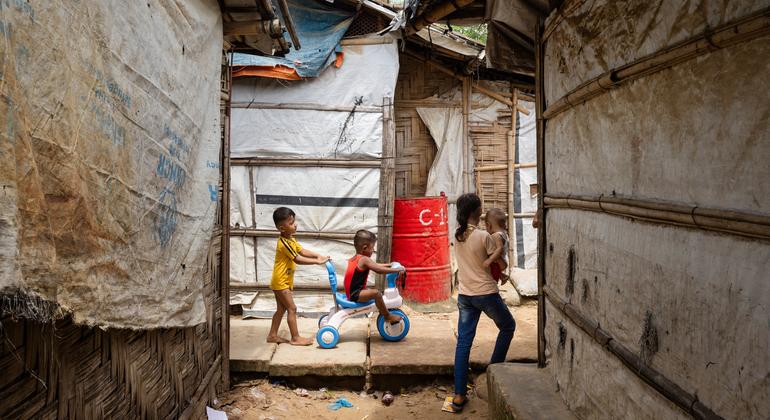
Ending impunity for violence critical for Rohingya in Myanmar

The UN human rights office has also called for ending impunity in the violence against the Rohingya people in Myanmar and ensuring their rights to security, citizenship and equality.

It said the Rohingya – a mostly Muslim minority community in predominantly Buddhist Myanmar – continue to suffer, eight years after a deadly crackdown by the military.

More than 700,000 fled to Bangladesh in the wake of the assault which began on 25 August 2017, joining others who had escaped earlier waves of attacks. 

Break the cycle

OHCHR said that ending impunity and ensuring the Rohingya’s rights to security, citizenship and equality, are essential for breaking the cycle of violence.

The Rohingya mainly live in Myanmar’s Rakhine state, and the office noted that the human rights and humanitarian situation there have sharply deteriorated since November 2023, further deepening the already life-threatening conditions they face.

OHCHR urged the international community to step up support for the Rohingya by increasing humanitarian funding to secure access to basic needs, essential services, and to ensure accountability. 

Source link

Famine in Gaza: ‘a failure of humanity itself,’ says UN chief

UN Secretary-General António Guterres said the results of the Integrated Food Security Phase Classification (IPC) analysis were no mystery: “It is a man-made disaster, a moral indictment – and a failure of humanity itself.

“Famine is not about food; it is the deliberate collapse of the systems needed for human survival.”

Famine conditions are projected to spread from Gaza Governorate to Deir Al Balah and Khan Younis Governorates in the coming weeks, the IPC estimates.

UN agencies have collectively and consistently highlighted the extreme urgency of delivering immediate and full-scale humanitarian aid given the escalating hunger-related deaths, rapidly worsening levels of acute malnutrition and plummeting levels of food consumption in Gaza – with hundreds of thousands going days without anything to eat.

Israel’s obligations

“As the occupying power, Israel has unequivocal obligations under international law – including the duty of ensuring food and medical supplies of the population,” said the UN chief, reacting to the famine declaration from the IPC, which is endorsed by dozens of governments, UN agencies and NGOs as the key evidence-based measure of food insecurity and malnutrition.

See our UN News explainer here.

Mr. Guterres said Israel’s denial of its duties could not be allowed to continue: “No more excuses. The time for action is not tomorrow – it is now.”

Silence the guns, release the hostages

UN agencies operating in Gaza joined the UN chief in calling for an immediate ceasefire to finally allow unimpeded, large-scale humanitarian response and the immediate release of all hostages taken by Hamas and other militants during the 7 October 2023 terror attacks.

Agencies also expressed grave concern over the threat of the intensified military offensive on Gaza City and any further escalation in the conflict, as it would have further devastating consequences for civilians where famine conditions already exist.

“Many people – especially sick and malnourished children, older people and people with disabilities – may be unable to evacuate,” they said in a joint statement.

Famine set to expand

By the end of September, more than 640,000 people will face ‘catastrophic’ levels of food insecurity – classified as IPC Phase 5 – across the Gaza Strip.

An additional 1.14 million people in the enclave will be in phase 4 with a further 396,000 people facing phase 3 ‘crisis’ conditions.

Conditions in North Gaza are estimated to be as severe – or worse – than in Gaza City. However, limited data prevented an IPC classification, highlighting the urgent need for access.

Classifying famine means that the most extreme category is triggered when three critical thresholds – extreme food deprivation, acute malnutrition and starvation-related deaths – have been breached. The latest analysis now affirms on the basis of reasonable evidence that these criteria have been met, UN agencies said.

Briefing journalists on Friday at UN headquarters in Geneva, the UN Emergency Relief Coordinator Tom Fletcher said it was a famine that could have been prevented “if we had been allowed.”

A young severely malnourished girl is helped into her clothes.

Famine in a fertile land

“Yet food stacks up at borders because of systematic obstruction by Israel. It is a famine within a few hundred metres of food, in a fertile land.

It is a famine that we repeatedly warned of – but that the international media has not been allowed in to cover, to bear witness,” he added.

“It is a famine in 2025. A 21st century famine watched over by drones and the most advanced military technology in history. It is a famine openly promoted by some Israeli leaders as a weapon of war.”

On a wider scale, Mr. Fletcher said it was “the world’s famine. It is a famine that asks ‘but what did you do?’ A famine that will and must haunt us all.”

Malnutrition among children in Gaza is accelerating “at a catastrophic pace”, said UN agencies, who note that in July alone, more than 12,000 children were identified as acutely malnourished – the highest monthly figure ever recorded and a six-fold increase since the start of the year.

First Middle East famine

Since the last IPC Analysis in May, the number of children expected to be at severe risk of death from malnutrition by the end of June 2026 has tripled from 14,100 to 43,400.

The new assessment reports the most severe deterioration since the IPC began analysing acute food insecurity and acute malnutrition in Gaza Strip, and it marks the first time a famine has been officially confirmed in the Middle East region.

Since July, food and aid supplies entering Gaza increased slightly but remained vastly insufficient, inconsistent and inaccessible compared to the need.

Meanwhile, approximately 98 percent of cropland in the territory is damaged or inaccessible – decimating the agriculture sector and local food production – and nine of ten people have been serially displaced from homes. 

Amid massive destruction of Gaza City, UN chief renews ceasefire call

“It is vital to reach immediately a ceasefire in Gaza,” the Secretary-General told reporters on the sidelines of the Ninth Tokyo International Conference on African Development (TICAD9), “and the unconditional release of all hostages and to avoid the massive death and destruction that a military operation against Gaza City would inevitably cause.

Around one million people still live in the city – Gaza’s largest – in the north of the war-torn enclave. The Israeli army has reportedly described it as a stronghold of Hamas, the terror group whose deadly attacks in Israel and hostage-taking sparked the war on 7 October 2023.

The UN chief also condemned the Israeli Government’s decision to approve a long-shelved settlement expansion project in the occupied West Bank.

The decision by the Israeli authorities to expand illegal settlement construction, which would divide the West Bank, must be reversed. All settlement construction is a violation of international law,” he insisted.

The settlement is believed to have permission for well over 3,000 houses, schools and a clinic, cutting off East Jerusalem from the occupied West Bank, which Israel captured during the 1967 Six-Day war after defeating Egypt, Jordan and Syria.

Urban destruction

Meanwhile in Gaza City, whole urban areas are being “totally destroyed”, the UN understands, with further destruction now underway in the south and southeast, as military manoeuvres continue.

Recent attacks have been particularly devastating in the Az Zaytoun neighbourhood of the city, the UN human rights office (OHCHRreported on Wednesday.

Highlighting more than 50 attacks on residential buildings and entire blocks in Gaza City since 8 August, OHCHR warned that its “systematic destruction” had begun.

Acute malnutrition soaring

Meanwhile, UN aid teams highlighted the catastrophic impact of the accelerating Israeli military operation, with acute malnourishment soaring among children in Gaza City to 28.5 per cent, or more than one in four youngsters.

“Children continue to die from man-made starvation,” UNRWA said in a statement, noting that it has screened more than 95,000 children aged six months to five years for malnutrition across the Gaza Strip since March 2025, after the ceasefire collapsed.

While the ceasefire still held in early March and relief supplies were allowed into Gaza in far greater quantities than today, malnutrition rates were six times lower in Gaza City, at 4.5 per cent, according to the UN agency for Palestinians, UNRWA. 

Across Gaza, acute malnutrition rose to nearly 16 per cent in mid-August, more than three times higher than the 5.2 per cent level recorded by the UN agency in March, it said.

Vital services in danger

Today, services provided by UNRWA in Gaza City are at “severe risk”, the agency warned, pointing to the tens of thousands of people who still live in its shelters and the “many more” who remain in surrounding areas.

There is particular concern for UNRWA’s Gaza Field Office compound – its largest logistics hub in northern Gaza – as the UN agency’s operations in the south have been “crippled” by displacement orders and bombardment.

As an indication of UNRWA’s key role in aid and relief provision across Gaza, it noted that last month alone, it provided more than 100,000 medical consultations and screened 3,500 children for malnutrition in Gaza City.

UNRWA also delivered drinking water to 220,000 people, domestic water to 250,000 and cleared hundreds of tons of waste.

Education and protection specialists from the UN agency reached thousands more in temporary learning spaces or by offering counselling, recreational activities and risk awareness training about the dangers of lethal unexploded weapons.

“While our colleagues, like the rest of the UN, are determined to stay and deliver, all of these services are now at risk as the military operations intensify,” UNRWA said.

Source link

Amid ongoing Israeli attacks, ‘the systematic destruction of Gaza City is already underway’: UN rights office

Recent attacks have been particularly devastating in the Az Zaytoun neighbourhood, where airstrikes, artillery shelling and gunfire are continuous and intense, causing a high number of civilian casualties and the large-scale destruction of residential buildings and public facilities, the UN human rights office, OHCHR, in the Occupied Palestinian Territory said in a statement.

Since 8 August, the office has recorded 54 attacks on residential buildings and entire blocks in Gaza City, killing 87 Palestinians, including at least 25 children and entire families.

It also recorded attacks on shelters for internally displaced people, including tents and schools, killing at least 14.

These casualty figures “indicate that the systematic destruction of Gaza City is already underway,” the statement said.

However, OHCHR stressed that these devastating figures are only a portion of the actual toll due to underreporting in such dire circumstances.

Impact of attacks

As a result of recent attacks, hundreds of families have been forced to flee, with nowhere safe to go amid dire humanitarian conditions across the Gaza Strip.

However, those who remain trapped are completely cut off from food, water and medical supplies.

OHCHR emphasised that “Israel’s reported decision to take full control of Gaza City and to forcibly displace its population will lead to mass killings of civilians and destruction of infrastructure vital to the survival of the population.”

The office is seeing the Israeli military repeat means of warfare that caused mass killings, serious injuries, forced displacement, arbitrary detention, starvation and extensive destruction in previous operations in North Gaza and Rafah.

To reportedly prepare for the offensive, the Israeli military has repeatedly called on Palestinians to move to Al Mawasi, west of Khan Younis.

However, Israel has repeatedly struck tents of the displaced in Al Mawasi, where people are struggling to survive with barely any access to food, water and other necessities.

Violations of international law

Under international law, Israel must not destroy civilian property unless it is rendered necessary by military operations. Yet, the widespread destruction of residential buildings in Gaza City is not seen as an imperative military necessity.

Additionally, by forcing the entire population of Gaza City and those remaining in North Gaza into displacement – with no shelter, food or medical provisions and no indication for allowing them to return to their homes in the future – OHCHR is concerned that these are grave breaches of the Fourth Geneva Convention.

Thus, the office is urging States party to the Geneva Conventions to follow their obligation “to exert maximum pressure on Israel to immediately halt this offensive, which risks triggering an unprecedented, life-threatening humanitarian crisis and permanently extinguishing the Palestinian presence in Gaza’s largest urban area.”

Worst-case famine

Meanwhile, the World Food Programme (WFP) welcomed Japan’s life-saving contribution of 500 million yen ($3.3 million) to provide emergency food and nutrition assistance to Palestinians as they face severe food insecurity.

Adding to the assistance, on 4 August, limited commercial truck entries resumed, containing mainly dry food items and a small amount of fresh produce, according to the UN aid coordination office, OCHA.

However, the risk of spoilage and infestation of food supplies has drastically increased due to being stranded for months, heat and impending expiration dates.

Furthermore, cooking gas has not entered Gaza for over five months, and firewood has become increasingly unaffordable, forcing many to use waste and scrap wood as alternative cooking sources, exacerbating health and environmental risks.

Due to such limited aid, WFP underscored that the latest Integrated Food Security Phase Classification report finds that the worst-case scenario of famine is currently occurring in the Gaza Strip.

“I meet families who have lost everything and don’t know where their next meal will come from.” said Antoine Renard, WFP Representative and Country Director in Palestine.

But thanks to this support from Japan, he continued, “WFP can continue procuring life-saving food assistance, but we urgently need a ceasefire and sustained access to reach those most at risk and prevent a full-scale famine.” 

Gaza: Looming offensive and restrictions on humanitarians

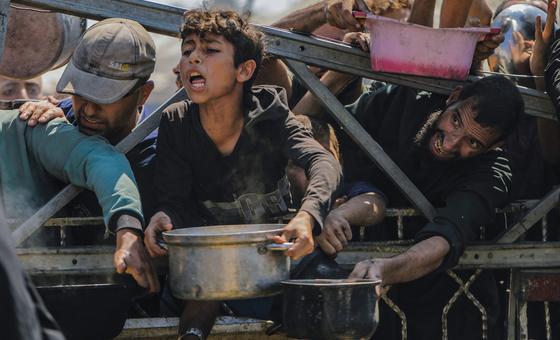
In the past 24 hours in Gaza, there have been more reports of casualties in shootings along aid convoy routes, where desperate crowds of civilians often wait to take supplies from the back of trucks.

Meanwhile, hostilities between Israeli forces and Palestinian armed groups are also escalating. In the past 24 hours, air strikes and shelling have occurred across five neighbourhoods in Gaza City, with reports of tanks and ground troops advancing.  

UN and partner officials in Gaza warned on Monday that the Israeli offensive would result in further mass displacement and “have a horrific impact on people already exhausted, malnourished, bereaved, displaced, and deprived of the basics needed for survival.”

Additionally, starvation persists in the enclave as supplies remain insufficient and inaccessible.  

Restrictions on international NGOs

OCHA also reported that the new requirements for international non-governmental organizations (NGOs) are preventing many humanitarian partners from bringing supplies into Gaza.  

To secure registration and bring in materials, international NGOs must share sensitive personal information about Palestinian employees, often contrary to their countries’ domestic legislation, which affects their ability to protect civilians.

Upcoming humanitarian work  

The UN and its NGO partners stressed that their teams will remain in Gaza City to provide life-saving support, reminding parties of their obligation to protect civilians, including humanitarian workers, and safeguard humanitarian infrastructure.

“Every day and every night, aid workers in Gaza courageously put themselves in harm’s way to keep others alive. At the same time, they also struggle to feed themselves and feed their own families,” said Spokesperson for the Secretary-General, Stéphane Dujarric, reporting on the situation in the context of World Humanitarian Day at Tuesday’s daily press briefing in New York.

“The world cannot look away while attacks on aid workers and on the very people they try to help have become routine.”

The humanitarian community welcomes the Israeli announcement that tents and shelter equipment will be allowed into Gaza, aiming to utilise this lifting of the ban to bring in tents, shelter materials and other items into the Gaza Strip. However, the UN and partners said it is deeply troubling that this lifting is in connection with a looming offensive.

They called for a significant scale-up of private sector operations and a full facilitation of deliveries from local and international humanitarian organizations, with supplies allowed to enter through all crossings. 

Gaza: Aid insufficient to avert ‘widespread starvation’ as Israeli military ramp-up forces more people to flee

“The risk of starvation is everywhere in Gaza,” UN Human Rights Office spokesperson Thameen Al-Kheetan told reporters in Geneva.

“This is a direct result of the Israeli government’s policy of blocking humanitarian aid,” he said.

Mr. Al-Kheetan insisted that in the past few weeks, Israeli authorities have only allowed aid to enter in quantities that remain “far below what would be required to avert widespread starvation”.

The UN said on Monday that hunger-related deaths continue to be reported in the Strip, including among children.

More people displaced

As the Israeli army intensified its attacks in the north of the enclave, it has continued to issue displacement orders for Palestinians, Mr. Al-Kheetan said.

He noted that Gazans have been told to move to the Al-Mawasi area, despite continuing airstrikes and disastrous conditions there.

“Hundreds of thousands of Palestinians displaced to Al-Mawasi have little or no access to essential services and supplies, including food, water, electricity and tents,” he warned.

Deadly pursuit of aid

The OHCHR spokesperson stressed that reaching humanitarian aid “can be a deadly pursuit” with latest data indicating that 1,857 Palestinians were killed while seeking food from 27 May, when the US and Israel-backed militarized aid distribution scheme known as the Gaza Humanitarian Foundation started its operations.

Out of that number, he said that 1,021 were killed in the vicinity of the Gaza Humanitarian Foundation sites and 836 on the routes of supply trucks.

“Most of these killings appear to have been committed by the Israeli military,” Mr. Al-Kheetan said.

Asked how the situation could get even worse, Jens Laerke, the spokesperson for the UN humanitarian affairs coordination office (OCHA), said that “it has already gotten worse”, insisting on the devastating effects of the Israeli ban on the entry of shelter materials into the enclave.

While the Israeli authorities recently announced that they would lift the ban on shelter supplies, Mr. Laerke said that “the United Nations and our partners have as of last night not been able to bring in shelter materials following the Israeli announcement.”

“There’s a set of impediments that still needs to be addressed, including Israeli customs clearance,” he added.

Need for shelter

The UN said on Monday that according to partners’ estimations at least 1.35 million people in Gaza need emergency shelter.

Aid agencies have warned that tents being used in Gaza are worn out from prolonged sun exposure and frequent displacement.

Asked about the reasons given for the ban on shelter items, Mr. Laerke explained that in a conflict, some shelter items such as tentpoles can fall under the “dual-use regime” as they could be used for both civilian and military purposes.

“Shelter has been banned entry for about five months and in that period over 700,000 people have been displaced or re-displaced,” he said.

People forced to flee time and again often have to leave behind the tents that they have been provided, Mr. Laerke explained, which creates a challenge for aid workers “trying to respond to people where they are”.

The looming expansion of Israel’s military activities in Gaza City is another major concern for UN humanitarians, as it would again push thousands of people into a severely overcrowded area in the south of the Strip.

Asked about the impact of Israel’s plans to occupy Gaza City, Mr. Al-Kheetan underscored a “huge risk” for civilians.

“There are risks of mass displacement… more killings and more misery that we have already seen in the Gaza Strip,” he warned. “Among those who will be affected are the most vulnerable, people with disabilities, the injured, the children, women”, he concluded.

Response to prison video

In other developments, the human rights spokesman said that video footage showing Israeli National Security Minister Itamar Ben-Gvir berating and taunting Palestinian leader Marwan Barghouthi inside an Israeli jail was “unacceptable.”

He said the minister’s behaviour and the publication of the images constitute an attack on Mr. Barghouthi’s dignity.

He added that international law requires that all detainees be treated humanely, with dignity, and that their human rights be respected and protected.

“Such conduct by the minister responsible for the Israeli Prison Service may encourage violence against Palestinian detainees, enabling human rights violations in Israeli detention facilities,” he said

Source link

World News in Brief: Gaza aid crisis latest, deadly floods in India and Pakistan, funding cuts exacerbate Somalia drought

In an alert from the World Food Programme (WFP), the agency said that half a million people “are on the brink of famine”, a claim backed up by multiple humanitarian agencies. The latest worrying data is showing widespread acute malnutrition.

A ceasefire is the only way to scale up aid deliveries, the UN agency insisted. It explained that although teams are doing everything they can to deliver food assistance, only 47 per cent of the daily target amount is getting in.

No meals, no bread

Unless the fighting stops, organized aid distributions and WFP-supported hot meals and bakeries can’t restart, the agency stated.

The UN relief agency for Palestine refugees, UNRWA, reported on Monday that instead of being able to prepare for the start of a new school year, children in Gaza are instead searching for water and queuing for food while their classrooms have “turned into crowded refuges”.

Three years of schooling has now been lost, the agency stressed in a tweet.

UN chief expresses ‘deep sorrow’ over deadly flash floods in India and Pakistan

UN Secretary-General António Guterres on Monday expressed his deep sorrow at the tragic loss of life due to flash floods in India and Pakistan in recent days, with many still missing and forecasts showing the possibility of further flooding and landslides ahead.

Indian rescue services responded to a deadly flood on Friday which reportedly killed at least 60 after it crashed through a village in the Himalayas while in remote villages of northwestern Pakistan, torrents of water killed more than 300, according to news reports.

Hundreds were also injured, Pakistani authorities reported. Buner district was the worst hit, with more than 200 deaths reported there, said the provincial disaster management authorities.

Standing in solidarity

“The Secretary-General offers his sincere condolences to the victims’ families and stands in solidarity with those affected by this disaster,” said the statement issued by his Spokesperson.

UN country teams in India and Pakistan have also been placed are at the disposal of authorities although no request for assistance has been made so far.

Impacts of Somalia drought made worse by funding cuts: OCHA

In Somalia, severe drought and funding cuts are undermining lifesaving assistance there, the UN aid coordination office, OCHAsaid on Monday.

Because of the reduction in the amount of support for aid work, food assistance has declined, health centres are closing and malnutrition is high, the UN agency warned.

OCHA said that 4.6 million people now face high levels of food insecurity while two million more are at risk from funding cuts.

Funding cuts mean ‘lives lost’

Without scaled-up support, “lives will be lost and progress reversed” across the east African nation, where cash shortfalls have left one million people without food assistance every month.

The global trend seeing less humanitarian assistance has curtailed vital support for healthcare across Somalia. So far this year, it has impacted at least 150 medical facilities and left hundreds of thousands of Somalis without the medical care they need.

OCHA noted that because of the cuts, the number of people being targeted for assistance in Somalia has had to be reduced by a staggering 72 per cent.

Source link

UN warns Gaza crisis could worsen without safe, unrestricted aid flow

In his regular daily briefing, UN Spokesperson Stéphane Dujarric highlighted that ongoing delays, bottlenecks at holding points and interference in the loading process at crossing platforms are undermining efforts to collect and distribute supplies to those in need.

It is imperative that the UN and its humanitarian partners are enabled to deliver aid at scale, using community-based mechanisms to reach the most vulnerable,” he said.

Injured trying to reach food

Recent figures illustrate the scale of the challenge. Between May 27 and August 8, the Red Cross Field Hospital in Rafah treated more than 4,500 wounded patients – most reporting injuries sustained while attempting to reach food distribution sites.  

Many were hurt in crowd crushes or subjected to theft or violence immediately after receiving critical food aid.

Of 12 aid missions requiring coordination with Israeli authorities on Thursday, five were facilitated without impediments. Four missions were cancelled by the organisers, and three others were impeded and only eventually fully accomplished – these included the collection of food aid from Zikim and Kerem Shalom/Karem Abu Salem crossings.

The UN Spokesperson also highlighted an ongoing starvation crisis, with increasing numbers of deaths, particularly among children.

Hospitals are struggling to cope with rising cases of malnutrition and many facilities have reportedly run out of bedspace to treat patients, he said.

No cooking fuel

Energy shortages are compounding the crisis, Mr. Dujarric said, noting that cooking gas has been unavailable in Gaza’s markets for five months, while firewood has become increasingly unaffordable.

More people are resorting to using waste and scrap wood as alternative fuel sources for cooking, which only makes worse health and protection risks, and causes environmental hazards,” he added.

Protect fleeing civilians

He also stressed that civilians must be protected in the event of expanded military operations in Gaza City.

Fleeing civilians must be protected and they must have their essential needs met, and they must be able to voluntarily return when the situation allows. And if they choose to stay, they should not be threatened or put at risk,” he said.

Mr. Dujarric also reiterated the UN’s long-standing call for the immediate and unconditional release of hostages held in the Strip.

Trapped in Gaza: Palestinians with disabilities cannot reach aid

But for an increasing number of Palestinians, including those who cannot hear the orders or whose mobility is impaired, following these orders may be impossible. Yet, failure to do so, could cost them their lives.  

“In a normal situation, people with disabilities suffer the most. And in wartime, of course, the situation is heightened further,” said Muhannad Salah Al-Azzeh, member of the UN Committee on the Rights of Persons with Disabilities at a public dialogue this week in Geneva.  

With the number of disabled people in Gaza increasing every day, Mr. Al-Azzeh said that the minimum level of safety for people with disabilities is not being upheld.  

No replacements for a broken hearing aid

Over 83 per cent of people with disabilities in Gaza do not have the assistive devices they need, including wheelchairs, hearing aids and other tools. And for those that do, the batteries which enable these devices to work are in very short supply.   

This makes it exponentially more difficult – if not impossible – for them to access healthcare and food.  

This shortage comes amidst an increasing number of people with disabilities. The UN Relief and Works Agency in Palestine (UNRWA) estimates that one in four Gazans has a new disability as a result of the war between Israeli forces and Hamas, which requires treatment and rehabilitation.

At least 35,000 people have “significant hearing damage” as a result of repeated explosions. And Ammar Dwaik, director-general of the Palestinian Independent Commission for Human rights, said that an average of 15 children are newly disabled each day. According to some rights groups, Gaza has the largest number of child amputees in modern history.  

But with over 134,000 people having sustained conflict-related injuries – 40,500 of whom are children – the besieged and under-resourced healthcare system cannot keep up.  

“Hospitals, ambulances, and medical and humanitarian personnel have been systematically targeted, with over 1,580 health workers and 467 humanitarian staff killed,” UNRWA noted.

Aid out of reach

Seeking life-saving aid has become a life-threatening prospect for even the healthiest in Gaza. But for people with disabilities, is almost impossible, according to Hector Sharp, a representative from UNRWA at the meeting in Geneva.  

“Reaching [the distribution points] and needing to physically compete for this aid is difficult for all Palestinians, but all the more so for people with disabilities to whom aid is being effectively placed out of reach,” Mr. Sharp said.  

The US and Israel-backed Gaza Humanitarian Fund, for example, has only a handful of distribution points throughout the Gaza Strip since it bypasses all established UN and NGO operations, forcing people to walk long distances in the hopes of receiving meagre amounts of food.  

If people with mobility impairments do not have families or friends willing to retrieve aid for them, they may simply be unable to reach it, according to Mr. Al-Azzeh.

Key infrastructure destroyed

Since 1962, UNRWA has operated a rehabilitation centre for the visually impaired in the Gaza Strip. It was the only one of its kind and served, at any given time, over 500 children.  

Today [the centre] lies in rubble,” Mr. Sharp said.  

The destruction of other civilian infrastructure throughout the Strip – including schools and hospitals – is impeding rehabilitation efforts for people with disabilities and further entrenching societal exclusion.  

The UNRWA representative in Geneva noted the impact that shuttered schools will have on children with disabilities.  

“For children with disabilities the loss of inclusive education deepens the systematic inequalities and places them at a heightened risk of lifelong social and economic exclusion,” he said.  

Peace, the only answer 

Despite the challenges, UNRWA has continued to provide services to people with disabilities, including over 53,000 sessions of physiotherapy and assistive devices or rehabilitation services to 8,500 people since the beginning of the year.  

Tedros Adhanom Ghebreyesus, Director-General of the World Health Organization (WHO), has called on the Israeli authorities to allow in more assistive devices and technology both for people with existing disabilities and those who are sustaining new ones amidst the ongoing conflict.  

He also called for medical evacuations to be expanded in order to allow people with disabilities to obtain vital, specialised care. But ultimately, he said, the only lasting solution is to end the conflict.  

“Peace is the only way to stop the suffering of Palestinians, including those with disabilities.” 

Source link

‘Humanitarian work, a moral obligation’: Retired doctor returns to face the ‘silent threat’ in Gaza

After a successful career that lasted 43 years, during which he worked in Saudi Arabia, for the Palestinian Ministry of Health and then the UN Children’s Fund (UNICEF), Dr. Awadallah decided to retire at the end of 2021.

But, that was short-lived. As the crisis in Gaza escalated and polio reappeared, he decided to return to the field. Doing so was not just a job assignment. As he describes it, it’s a “message of loyalty” to his profession, to the children of Gaza and to the institution that gave him so much.

Dr. Awadallah’s return was driven by a “deep inner sense of responsibility and belonging”.

“I felt that my long experience and field knowledge could make a difference in these critical times,” he told UN News.

‘The Silent Threat to Gaza’

Dr. Awadallah’s story was the focus of the film The Silent Threat to Gaza, produced by UNICEF in conjunction with World Humanitarian Day, observed annually on 19 August. The organization emphasises that the film is a powerful testament to the resilience of humanitarian workers who are facing the dangers of conflict.

Named in May on Time Magazine’s TIME100 Health List for leading “a heroic vaccination campaign” that reached 600,000 children in Gaza, Dr. Awadallah was one of the lead subjects of the 32-minute documentary. The film follows him and his colleague Fairuz Abu Warda, who, during short periods of last year’s ceasefire, delivered lifesaving vaccines to children across the Gaza Strip.

Watch the full document here:

UNICEF said their courage underscores a fundamental fact that when humanitarian principles are adhered to, workers are protected and given safe and timely access, lives can be saved even in the most fragile environments. The UN agency stressed that the courage of humanitarian workers, such as Dr. Awadallah and Ms. Warda, reinforces the urgent need for principled action and international accountability.

Dr. Awadallah told UN News how exhaustion, hunger and fear were part of their daily routine under constant bombardment from the air and sea.

However, their priority was to keep vaccinations effective and reach every child, he said, remembering the moments when he would see his colleagues collapse from exhaustion and then immediately return to work.

A living testimony to willpower

Dr. Awadallah points out that every scene in the vaccination campaign, from the smile of a child to the insistence of the teams to reach the farthest house despite the security difficulties and the danger of moving, reminded him that “humanitarian work cannot be retired.”

Children received the polio vaccine as part of a Gaza-wide campaign. (file)

“I provide humanitarian work, and even if I retire, it does not apply to humanitarian work,” he said.

“The Silent Threat to Gaza was not just a film or a depiction of events, but a living testimony to the strength of will and the power of hope.”

He believes that every shot in the film was “a message to the world that despite the wounds, despite the death and the difficulty of life, Gaza is able to rise up and protect its children”.

Despite the risks to their lives, Dr. Awadallah and his fellow humanitarian workers in Gaza continue their work under constant bombardment.

Protecting humanitarian workers is ‘not a luxury’

“Fear knows no way to their hearts,” he said. “We hear the explosion and then we go to do our work. We are moving towards our goal and we are used to it.”

He said more than 350 medical personnel have been killed, hundreds injured and more than 1,300 arrested.

He appealed to the world that the protection of those who lend a helping hand “is not a luxury, but a prerequisite for ensuring that life and hope reach those in need”, and that it is a “humanitarian duty” that is as important as the provision of assistance itself.

Dr. Younis Awadallah administers a polio vaccine in Gaza.

Spreading hope

After decades of experience, Dr. Awadallah said he has learned that human beings have an incredible resilience beyond imagination.

“Resilience is not the absence of pain and suffering, but the ability to persevere and rise despite tragedies,” he said. “I saw mothers smiling and laughing at their children despite the bleeding and pain. I saw patients facing the pain with a smile and hope.”

Their role as humanitarian workers goes beyond providing treatment and material assistance to include “promoting and instilling hope in people’s hearts, supporting them psychologically and maintaining their strength in the face of problems”, he said.

Not just a profession

On World Humanitarian Day, Dr. Awadallah pays tribute to all those who choose to walk towards danger rather than away from it.

I believe in this business

“We are throwing ourselves into perdition for the sake of others,” he said.

Humanitarian workers in Gaza and everywhere in the world – regardless of their specialties – “are witnesses that mercy knows no boundaries and that human solidarity can flourish even during wars or amid the rubble”, he added.

He said he hopes he would be able to reunite with his family soon.

“My message today is that humanitarian work is not just a profession, but a moral and humanitarian obligation. I left my family and haven’t seen them for two years because I believe in this business.”

Hunger and a heatwave plague the Gaza Strip

Recently, Israel has denied fewer humanitarian movements but approved missions “still take hours to complete and teams have been compelled to wait on roads that are often dangerous, congested or impassable,” the UN aid coordination office OCHA said in its latest update.

Between 6 and 12 August, humanitarians made 81 attempts to coordinate planned movements with the Israeli authorities, including to transfer fuel and personnel.

Challenges to aid delivery

Of this number, 35 were facilitated, 29 were initially approved but then impeded on the ground, 12 were denied and five had to be withdrawn by the organizers.

However, 14 of the missions that had faced obstructions eventually went ahead.

Nearly three years have passed since hostilities erupted in Gaza following the Hamas-led attacks on Israel which left roughly 1,200 people dead.  

Some 250 others – both Israelis and foreigners – were taken hostage.  It is believed that 50 people are still being held in Gaza, including some who have been declared dead. 

Desperate times, desperate measures

Starvation in the enclave is now at its highest level since the conflict began, according to the World Food Programme (WFP). 

The update cites the Gaza health authorities who have documented 235 malnutrition-related deaths, including 106 children, as of 13 August.

Despite hunger spreading, aid convoys are limited each day and dangers persist as the trucks travel through the war-ravaged enclave.

“Additionally, desperate crowds often offload food supplies from trucks to feed their families – while looting also prevents aid from reaching its intended destinations,” OCHA said.

Last month, WFP collected 1,012 trucks transporting nearly 13,000 metric tonnes of food from the Kerem Shalom and Zikim border crossings with Israel.  Only 10 arrived at warehouses and the rest were offloaded on the way.

Food aid risks spoiling

Although WFP and partners have enough food either in the region or headed there to feed all 2.1 million people in Gaza for at least three months, “the risk of spoilage and infestation of the stranded food supplies has significantly increased, and some of them are nearing their expiry dates.” 

Humanitarians continue to push for more aid and commercial goods to be allowed into Gaza. Although more food is entering, the quality and quantity remain insufficient to meet the immense needs.

As of 10 August, 81 community kitchens were preparing 324,000 individual meals daily – a “noticeable increase” over the 259,000 daily meals prepared two weeks ago but far below the more than one million daily meals distributed in April.

The heat is on

Meanwhile, a heatwave is making conditions much worse as Gaza is currently experiencing temperatures that surpass 40°C or 104°F.

UN Palestine refugee agency UNRWA warned that dehydration is increasing because of the very limited water available.

As part of its ongoing efforts to help the people of Gaza, UNRWA has provided emergency water, sanitation and hygiene services to about 1.7 million people since the start of the war. 

Malnutrition deaths mark ‘latest in the war on children’ in Gaza: UNRWA chief

These young deaths are “the latest in the war on children and childhood in Gaza,” Philippe Lazzarini, head of UN Palestine refugee agency UNRWA, said in a tweet on Wednesday.

The toll also includes some 40,00 boys and girls reported killed or injured due to bombardment and airstrikes, at least 17,000 unaccompanied and separated children, and one million deeply traumatised youngsters who are not getting an education. 

“Children are children,” he said.

 “No one should stay silent when children die, or are brutally deprived of a future, wherever these children are, including in Gaza.”

A sombre reunion

Thousands of sick children in Gaza need urgent medical evacuation, according to UN aid coordination office OCHA.

Olga Cherevko, a spokesperson for the agency, recalled the moment she recognized a young girl requiring treatment in a Gaza hospital after a year’s interval, once again suffering from malnourishment.

“I remembered her long eyelashes,” the veteran humanitarian told UN News, describing seven-year-old Janah, who she came across at Gaza City’s Patient Friendly Hospital on Tuesday.

“The first time I met her was in the IMC Field Hospital in southern Gaza in April 2024. Back then, she was severely malnourished and was getting treatment. And she gradually became better and was released eventually and went home.”

Seven-year-old Janah is treated at Gaza City’s Patient Friendly Hospital.

Evacuation saves lives

However, Janah was now back in hospital “because the malnutrition became aggravated and the condition that she has also is not properly diagnosed and cannot be properly diagnosed.” 

The girl is on a list of people to be medically evacuated for treatment outside Gaza.  The most recent evacuations took place last week when the World Health Organization (WHO) supported the transfer of 15 critically ill children to Jordan, but more than 14,800 people are still waiting.

Ms. Cherevko stressed the importance of ensuring that evacuations continue to save as many lives as possible.

More aid needed

She also pointed out that for children and adults with pre-existing conditions, their situation becomes worse with malnutrition.

“It wouldn’t be this way if they had proper nutrition, because these conditions existed before the starvation crisis and they weren’t getting as sick as they are now,” she said.

“This is why it’s imperative to make sure that we have proper conditions on the ground for adequate volumes of supplies to be entering – everything from food to medicine to nutrition to shelter,” she continued. 

“And these lifelines have to be really enabled for us to be able to deliver this aid to the people in need.” 

Source link