
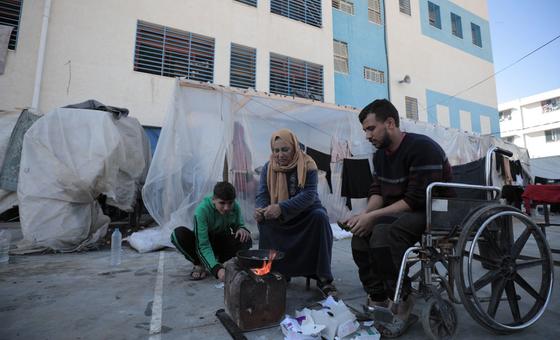
Trapped in Gaza: Palestinians with disabilities cannot reach aid

But for an increasing number of Palestinians, including those who cannot hear the orders or whose mobility is impaired, following these orders may be impossible. Yet, failure to do so, could cost them their lives.  

“In a normal situation, people with disabilities suffer the most. And in wartime, of course, the situation is heightened further,” said Muhannad Salah Al-Azzeh, member of the UN Committee on the Rights of Persons with Disabilities at a public dialogue this week in Geneva.  

With the number of disabled people in Gaza increasing every day, Mr. Al-Azzeh said that the minimum level of safety for people with disabilities is not being upheld.  

No replacements for a broken hearing aid

Over 83 per cent of people with disabilities in Gaza do not have the assistive devices they need, including wheelchairs, hearing aids and other tools. And for those that do, the batteries which enable these devices to work are in very short supply.   

This makes it exponentially more difficult – if not impossible – for them to access healthcare and food.  

This shortage comes amidst an increasing number of people with disabilities. The UN Relief and Works Agency in Palestine (UNRWA) estimates that one in four Gazans has a new disability as a result of the war between Israeli forces and Hamas, which requires treatment and rehabilitation.

At least 35,000 people have “significant hearing damage” as a result of repeated explosions. And Ammar Dwaik, director-general of the Palestinian Independent Commission for Human rights, said that an average of 15 children are newly disabled each day. According to some rights groups, Gaza has the largest number of child amputees in modern history.  

But with over 134,000 people having sustained conflict-related injuries – 40,500 of whom are children – the besieged and under-resourced healthcare system cannot keep up.  

“Hospitals, ambulances, and medical and humanitarian personnel have been systematically targeted, with over 1,580 health workers and 467 humanitarian staff killed,” UNRWA noted.

Aid out of reach

Seeking life-saving aid has become a life-threatening prospect for even the healthiest in Gaza. But for people with disabilities, is almost impossible, according to Hector Sharp, a representative from UNRWA at the meeting in Geneva.  

“Reaching [the distribution points] and needing to physically compete for this aid is difficult for all Palestinians, but all the more so for people with disabilities to whom aid is being effectively placed out of reach,” Mr. Sharp said.  

The US and Israel-backed Gaza Humanitarian Fund, for example, has only a handful of distribution points throughout the Gaza Strip since it bypasses all established UN and NGO operations, forcing people to walk long distances in the hopes of receiving meagre amounts of food.  

If people with mobility impairments do not have families or friends willing to retrieve aid for them, they may simply be unable to reach it, according to Mr. Al-Azzeh.

Key infrastructure destroyed

Since 1962, UNRWA has operated a rehabilitation centre for the visually impaired in the Gaza Strip. It was the only one of its kind and served, at any given time, over 500 children.  

Today [the centre] lies in rubble,” Mr. Sharp said.  

The destruction of other civilian infrastructure throughout the Strip – including schools and hospitals – is impeding rehabilitation efforts for people with disabilities and further entrenching societal exclusion.  

The UNRWA representative in Geneva noted the impact that shuttered schools will have on children with disabilities.  

“For children with disabilities the loss of inclusive education deepens the systematic inequalities and places them at a heightened risk of lifelong social and economic exclusion,” he said.  

Peace, the only answer 

Despite the challenges, UNRWA has continued to provide services to people with disabilities, including over 53,000 sessions of physiotherapy and assistive devices or rehabilitation services to 8,500 people since the beginning of the year.  

Tedros Adhanom Ghebreyesus, Director-General of the World Health Organization (WHO), has called on the Israeli authorities to allow in more assistive devices and technology both for people with existing disabilities and those who are sustaining new ones amidst the ongoing conflict.  

He also called for medical evacuations to be expanded in order to allow people with disabilities to obtain vital, specialised care. But ultimately, he said, the only lasting solution is to end the conflict.  

“Peace is the only way to stop the suffering of Palestinians, including those with disabilities.” 

Source link

Soon Railway Stations, Trains to be Disabled-Friendly

In order to provide better accessibility to Persons with Disabilities (Divyangjan), short term facilities, as detailed below, have been planned at all stations, beginning with ‘A-1’, ‘A’ and ‘B’ category stations:-
• Standard ramp for barrier free entry
• Earmarking at least two parking lots
• Non-slippery walk-way from parking lot to building
• Signages of appropriate visibility
• At least one toilet (on the ground floor)
• At least one drinking water tap suitable for use by Persons with Disabilities (Divyangjan)
• ‘May I help you’ Booth
In addition, long term facilities, as detailed below, have also been planned at ‘A-1’, ‘A’ and ‘B’ category stations:-
• Provision of facility for inter-platform transfer
• Engraving on edges of platform
In order to facilitate easy movement of elderly and Persons with Disabilities (Divyangjan), as per the existing guidelines, ‘A-1’ category stations qualify for provision of escalators/elevators while ‘A’ category, ‘C’ category and stations of tourist importance qualify for provision of escalators under ‘Desirable Amenities’. So far, 394 escalators at 167 stations and 219 lifts at 100 stations have been provided. Further, work is in progress for about 380 nos. of escalators at 133 stations and 427 nos. of lifts at 134 stations which shall be completed over a period of next two to three years.
Indian Railways have manufactured about 3450 SLRD/SRD coaches (SLRD-Second Class Cum Luggage Cum Guard Van & Disabled friendly compartment, SRD- Second Class Cum Guard Van & Disabled friendly compartment) which have a suitably designed compartment and toilet adapted to the needs of Persons with Disabilities (Divyangjan)/wheelchair borne passengers. In SLRD coaches, wider entrance door for wheelchair borne passengers, wider berths, wider compartments, space for provision of wheelchair, larger lavatory and lavatory doors have been provided. Inside the toilets, additional grab rails on the side walls for support, wash basin and mirror at lower height have been provided. It is endeavored to have at least one such coach in each Mail/Express train having ICF design coaches.
Further, the fully air conditioned Garib Rath trains have been provided with an Air conditioned Persons with Disabilities (Divyangjan) friendly compartment and toilets in the power cars.
For assistance to visually impaired travelers, Braille signages are now being provided in newly manufactured coaches.
Availability of Wheelchairs on Platforms: Instructions already exist for provision of Wheelchair at stations. This facility is provided, duly escorted by coolies (on payment) as per present practice. Zonal Railways have also been instructed to provide one wheelchair per platform and in case of island platforms one wheelchair per two platforms at all ‘A-1’ and ‘A’ category stations.
Battery Operated Cars (BOCs): Zonal Railways have been authorized to introduce Battery Operated Cars (BOCs) at major railway stations for Persons with Disabilities (Divyangjan), elderly and ailing passengers on ‘first come first served’ basis through sponsorship from individuals, NGOs, Trusts, Charitable institutions, Corporate and PSUs/Corporate Houses under their Corporate Social Responsibility free of charge to passenger or to the Railway. 70 BOCs have already been provided at 48 major railway stations. Further, instructions have also been issued to Zonal Railways to invite Expression of Interest for providing the facility of Battery Operated Car service on payment basis initially at all ‘A-1’ category stations keeping in view the financial sustainability of the service. This facility can be availed by passengers on ‘first come first served’ basis, however, preference shall be given to Senior Citizens, Persons with Disabilities (Divyangjan), pregnant women and medically sick passengers.
Yatri Mitra Sewa: ‘Yatri Mitra Sewa’ is being provided at major stations for enabling passengers to book wheelchair services cum Porter services etc. The responsibility of providing Yatri Mitra Sewa is entrusted to IRCTC who may provide this service ‘Free of cost’ through some NGOs, PSUs etc. under CSR or on payment basis. This service can be booked on IRCTC e-ticketing website and 139 (IVRS and SMS) or through a mobile.
Complaints on railway services are received from all walks of life through various channels viz.; Centralised Public Grievance Redress and Monitoring System (CPGRAMS) web portal, Complaints Management System Portal, Social media etc. which are forwarded to concerned Departments of Railways for necessary action. However, no separate data is maintained regarding complaints of railway services being Persons with Disabilities (Divyangjan) unfriendly.

This Press Release is based on the information given by the Minister of State for Railways Shri Rajen Gohain in a written reply to a question in Rajya Sabha on 11.08.2017 (Friday).