
Afghanistan quake: Aid teams still scrambling to reach survivors

The magnitude six quake has already left more than 800 dead and at least 2,000 injured, but the total impact could be in the “hundreds of thousands”, according to the UN’s top aid official in the country, Indrika Ratwatte.

Speaking from Kabul, Mr. Ratwatte said that mud and wooden roof structures were predominant in the affected mountainous provinces.

“When the walls collapse, the roof is what basically falls on individuals, kills them or suffocates them,” he said. “Since this happened in the night, everybody was sleeping,” the senior UN aid official explained, indicating that many more people may be trapped under the debris.

Massive loss of homes, livestock

Hundreds of thousands could be impacted, “as in houses destroyed, injured, casualties, livestock lost and any livelihood systems that they had”, Mr. Ratwatte explained.

In the first critical 24 hours after the earthquake hit, access was “very limited”, owing to landslides and rockfalls triggered by the tremors.

“This has posed a huge challenge to us as we deploy right now,” Mr. Ratwatte said, stressing that 20 emergency assessment teams have been mobilized alongside 15 mobile teams “which will enhance the humanitarian flights from Kabul to Jalalabad”, capital of the affected Nangarhar province.

The UN Humanitarian Air Service has scheduled additional flights connecting Kabul and Jalalabad for personnel and cargo to scale up the response.

The aid official also said that the UN and others are trying to set up or repair damaged mobile networks as there is “zero connectivity” with some affected communities, “and even to bring in helicopters and land,” another challenge for the de facto authorities.

“It’s not easy to get to these areas and keep shuttling injured individuals,” he said.

Disease danger

Mr. Ratwatte underscored the importance of protection work, “including psychosocial support for individuals who lost family and loved ones”. He also stressed that it was urgent to dispose of bodies and dead livestock to prevent waterborne diseases, “which can happen very, very fast”.

One of the first responders in the affected areas was the Afghan Red Crescent. Joy Singhal, Acting Head of Delegation for Afghanistan of the International Federation of Red Cross and Red Crescent Societies (IFRC), said that more people could have been saved if road access were easier.

“Our staff and volunteers sometimes have to [walk] for about four to five hours to reach some of those remote villages,” he said. Once they reach their destination “they have to walk back and bring those affected and wounded people into the city centre…the two hospitals there are overwhelmed.”

Disaster, time after time

Afghanistan has long faced what the UN’s Humanitarian Coordinator Mr. Ratwatte called “systemic humanitarian challenges”. Half of its population – or some 22.5 million people – need assistance, while food insecurity has been aggravated by recent drought. Sweeping funding cuts to humanitarian programmes since the beginning of the year have meant that “hundreds” of aid facilities have had to close.

“The earthquake comes at a time where vulnerable communities are going to be super-exposed to additional stresses,” Mr. Ratwatte said.

Another major challenge is the return in 2025 of 2.4 million Afghan refugees from Iran and Pakistan, whom communities in the country have been “struggling to integrate”, said UN refugee agency (UNHCR) spokesperson Babar Baloch.

“More than half of these are deportations, people who have been put on buses and other forms of transport and left at the borders to go home, and it has already put a further restraint on our ability to support,” Mr. Baloch said.

Deported regardless 

He also stressed that the majority of returnees are heading precisely to the earthquake-affected areas. In another “worrying” development, Sunday marked “the end of grace period for registered Afghan refugees in Pakistan” and UNHCR is preparing for “significantly more returns” in the coming days.

“These people already with very little resources are now returned to a disaster zone,” Mr. Baloch said.

“We are at breaking point in terms of response to the multiple humanitarian shocks in the country,” the UN’s Mr. Ratwatte insisted.

The $2.4 billion humanitarian response plan for Afghanistan for 2025 is only 28 per cent funded, “and here we have an emergency on top of the crisis situation”, he concluded.

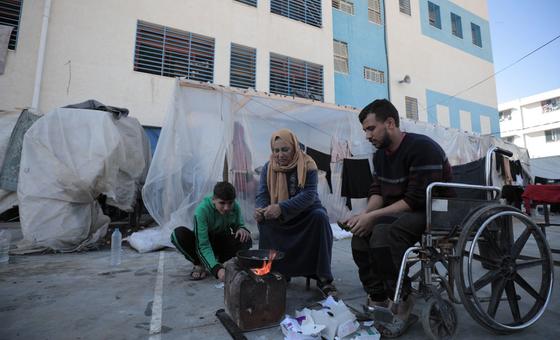
Trapped in Gaza: Palestinians with disabilities cannot reach aid

But for an increasing number of Palestinians, including those who cannot hear the orders or whose mobility is impaired, following these orders may be impossible. Yet, failure to do so, could cost them their lives.  

“In a normal situation, people with disabilities suffer the most. And in wartime, of course, the situation is heightened further,” said Muhannad Salah Al-Azzeh, member of the UN Committee on the Rights of Persons with Disabilities at a public dialogue this week in Geneva.  

With the number of disabled people in Gaza increasing every day, Mr. Al-Azzeh said that the minimum level of safety for people with disabilities is not being upheld.  

No replacements for a broken hearing aid

Over 83 per cent of people with disabilities in Gaza do not have the assistive devices they need, including wheelchairs, hearing aids and other tools. And for those that do, the batteries which enable these devices to work are in very short supply.   

This makes it exponentially more difficult – if not impossible – for them to access healthcare and food.  

This shortage comes amidst an increasing number of people with disabilities. The UN Relief and Works Agency in Palestine (UNRWA) estimates that one in four Gazans has a new disability as a result of the war between Israeli forces and Hamas, which requires treatment and rehabilitation.

At least 35,000 people have “significant hearing damage” as a result of repeated explosions. And Ammar Dwaik, director-general of the Palestinian Independent Commission for Human rights, said that an average of 15 children are newly disabled each day. According to some rights groups, Gaza has the largest number of child amputees in modern history.  

But with over 134,000 people having sustained conflict-related injuries – 40,500 of whom are children – the besieged and under-resourced healthcare system cannot keep up.  

“Hospitals, ambulances, and medical and humanitarian personnel have been systematically targeted, with over 1,580 health workers and 467 humanitarian staff killed,” UNRWA noted.

Aid out of reach

Seeking life-saving aid has become a life-threatening prospect for even the healthiest in Gaza. But for people with disabilities, is almost impossible, according to Hector Sharp, a representative from UNRWA at the meeting in Geneva.  

“Reaching [the distribution points] and needing to physically compete for this aid is difficult for all Palestinians, but all the more so for people with disabilities to whom aid is being effectively placed out of reach,” Mr. Sharp said.  

The US and Israel-backed Gaza Humanitarian Fund, for example, has only a handful of distribution points throughout the Gaza Strip since it bypasses all established UN and NGO operations, forcing people to walk long distances in the hopes of receiving meagre amounts of food.  

If people with mobility impairments do not have families or friends willing to retrieve aid for them, they may simply be unable to reach it, according to Mr. Al-Azzeh.

Key infrastructure destroyed

Since 1962, UNRWA has operated a rehabilitation centre for the visually impaired in the Gaza Strip. It was the only one of its kind and served, at any given time, over 500 children.  

Today [the centre] lies in rubble,” Mr. Sharp said.  

The destruction of other civilian infrastructure throughout the Strip – including schools and hospitals – is impeding rehabilitation efforts for people with disabilities and further entrenching societal exclusion.  

The UNRWA representative in Geneva noted the impact that shuttered schools will have on children with disabilities.  

“For children with disabilities the loss of inclusive education deepens the systematic inequalities and places them at a heightened risk of lifelong social and economic exclusion,” he said.  

Peace, the only answer 

Despite the challenges, UNRWA has continued to provide services to people with disabilities, including over 53,000 sessions of physiotherapy and assistive devices or rehabilitation services to 8,500 people since the beginning of the year.  

Tedros Adhanom Ghebreyesus, Director-General of the World Health Organization (WHO), has called on the Israeli authorities to allow in more assistive devices and technology both for people with existing disabilities and those who are sustaining new ones amidst the ongoing conflict.  

He also called for medical evacuations to be expanded in order to allow people with disabilities to obtain vital, specialised care. But ultimately, he said, the only lasting solution is to end the conflict.  

“Peace is the only way to stop the suffering of Palestinians, including those with disabilities.” 

Source link