
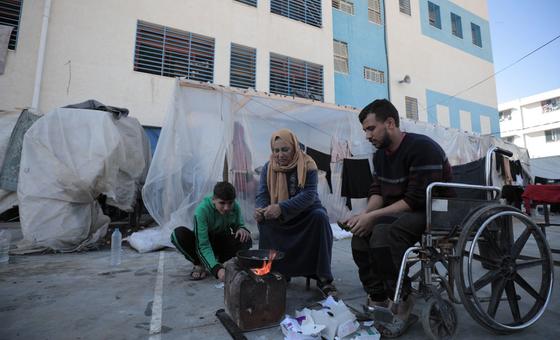
Trapped in Gaza: Palestinians with disabilities cannot reach aid

But for an increasing number of Palestinians, including those who cannot hear the orders or whose mobility is impaired, following these orders may be impossible. Yet, failure to do so, could cost them their lives.  

“In a normal situation, people with disabilities suffer the most. And in wartime, of course, the situation is heightened further,” said Muhannad Salah Al-Azzeh, member of the UN Committee on the Rights of Persons with Disabilities at a public dialogue this week in Geneva.  

With the number of disabled people in Gaza increasing every day, Mr. Al-Azzeh said that the minimum level of safety for people with disabilities is not being upheld.  

No replacements for a broken hearing aid

Over 83 per cent of people with disabilities in Gaza do not have the assistive devices they need, including wheelchairs, hearing aids and other tools. And for those that do, the batteries which enable these devices to work are in very short supply.   

This makes it exponentially more difficult – if not impossible – for them to access healthcare and food.  

This shortage comes amidst an increasing number of people with disabilities. The UN Relief and Works Agency in Palestine (UNRWA) estimates that one in four Gazans has a new disability as a result of the war between Israeli forces and Hamas, which requires treatment and rehabilitation.

At least 35,000 people have “significant hearing damage” as a result of repeated explosions. And Ammar Dwaik, director-general of the Palestinian Independent Commission for Human rights, said that an average of 15 children are newly disabled each day. According to some rights groups, Gaza has the largest number of child amputees in modern history.  

But with over 134,000 people having sustained conflict-related injuries – 40,500 of whom are children – the besieged and under-resourced healthcare system cannot keep up.  

“Hospitals, ambulances, and medical and humanitarian personnel have been systematically targeted, with over 1,580 health workers and 467 humanitarian staff killed,” UNRWA noted.

Aid out of reach

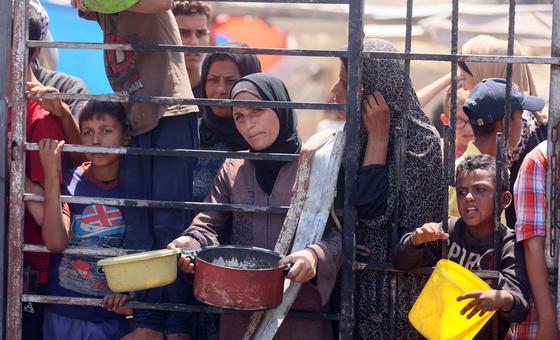
Seeking life-saving aid has become a life-threatening prospect for even the healthiest in Gaza. But for people with disabilities, is almost impossible, according to Hector Sharp, a representative from UNRWA at the meeting in Geneva.  

“Reaching [the distribution points] and needing to physically compete for this aid is difficult for all Palestinians, but all the more so for people with disabilities to whom aid is being effectively placed out of reach,” Mr. Sharp said.  

The US and Israel-backed Gaza Humanitarian Fund, for example, has only a handful of distribution points throughout the Gaza Strip since it bypasses all established UN and NGO operations, forcing people to walk long distances in the hopes of receiving meagre amounts of food.  

If people with mobility impairments do not have families or friends willing to retrieve aid for them, they may simply be unable to reach it, according to Mr. Al-Azzeh.

Key infrastructure destroyed

Since 1962, UNRWA has operated a rehabilitation centre for the visually impaired in the Gaza Strip. It was the only one of its kind and served, at any given time, over 500 children.  

Today [the centre] lies in rubble,” Mr. Sharp said.  

The destruction of other civilian infrastructure throughout the Strip – including schools and hospitals – is impeding rehabilitation efforts for people with disabilities and further entrenching societal exclusion.  

The UNRWA representative in Geneva noted the impact that shuttered schools will have on children with disabilities.  

“For children with disabilities the loss of inclusive education deepens the systematic inequalities and places them at a heightened risk of lifelong social and economic exclusion,” he said.  

Peace, the only answer 

Despite the challenges, UNRWA has continued to provide services to people with disabilities, including over 53,000 sessions of physiotherapy and assistive devices or rehabilitation services to 8,500 people since the beginning of the year.  

Tedros Adhanom Ghebreyesus, Director-General of the World Health Organization (WHO), has called on the Israeli authorities to allow in more assistive devices and technology both for people with existing disabilities and those who are sustaining new ones amidst the ongoing conflict.  

He also called for medical evacuations to be expanded in order to allow people with disabilities to obtain vital, specialised care. But ultimately, he said, the only lasting solution is to end the conflict.  

“Peace is the only way to stop the suffering of Palestinians, including those with disabilities.” 
Source link

Gaza: Nearly 1,400 Palestinians killed while seeking food, as UN warns airdrops are no solution

Between 30 and 31 July alone, 105 Palestinians were killed and at least 680 more injured along the convoy routes in the Zikim area in North Gaza, southern Khan Younis, and in the vicinity of the GHF sites in Middle Gaza and Rafah, the office (OHCHR) said in a press release issued on Friday

In total, since 27 May, at least 1,373 Palestinians have been killed while seeking food; 859 in the vicinity of the GHF sites and 514 along the routes of food convoys.

OHCHR noted that most of the killings were committed by the Israeli military, and that while it is aware of the presence of other armed elements in the same areas, it does not have information indicating their involvement in the killings.

“[The office] has no information that these Palestinians were directly participating in hostilities or posed any threat to Israeli security forces or other individuals. Each person killed or injured had been desperately struggling for survival, not only for themselves, but also for their families and dependents,” it said.

Uphold international law

The office emphasized that intentionally directing attacks against civilians not taking direct part in hostilities and intentionally using starvation of civilians as a method of warfare by depriving them of objects indispensable to their survival, including willfully impeding relief supplies, are war crimes.  

“If part of a systematic or widespread attack on the civilian population, these may also constitute crimes against humanity,” OHCHR added, noting that the cumulative impact of these incidents and humanitarian access restrictions.

“Each of these killings must be promptly and independently investigated, and those responsible held to account. Urgent measures must be put in place to prevent recurrence,” it said.

Airdrops not effective

Meanwhile, the UN Relief and Works Agency for Palestine Refugees (UNRWA), underscored the need to open road crossings to supply aid at scale across the Gaza Strip.

“Airdrops are at least 100 times more costly than trucks. Trucks carry twice as much aid as planes,” UNRWA Commissioner-General Philippe Lazzarini said on social media.  

“If there is political will to allow airdrops – which are highly costly, insufficient and inefficient, there should be similar political will to open the road crossings,” he stressed.

Mr. Lazzarini further noted that UNRWA has 6,000 trucks loaded with aid stuck outside Gaza waiting permission to enter.  

During the ceasefire earlier this year, UNRWA and other UN agencies were able to bring in 500 to 600 trucks of aid each day.  

“Aid reached the entire population of Gaza in safety and dignity. It succeeded to reverse the deepening starvation without any aid diversion,” the UNRWA head said.

“Let us go back to what works and let us do our job.” 

Source link

Gaza: Over 400 Palestinians killed around private aid hubs, UN rights office says

The alert comes nearly a month since the Israeli and US-backed Gaza Humanitarian Foundation (GHF) started operating on 27 May in select hubs, bypassing the UN and other established NGOs.

Its food distribution points have been associated frequently with confusion and shooting as desperate and hungry Gazans rush to fetch supplies, said UN human rights office spokesperson Thameen Al-Keetan.

“Israel’s militarized humanitarian assistance mechanism is in contradiction with international standards on aid distribution,” he insisted. “The weaponization of food for civilians, in addition to restricting or preventing their access to life-sustaining services, constitutes a war crime and, under certain circumstances, may constitute elements of other crimes under international law.”

In its latest update on the emergency, the UN aid coordination office, OCHA, reported that “scores of people of all ages are being killed and injured every day” in the shattered enclave.

“Humanitarian operations of sufficient scale are not facilitated, leaving unaddressed the critical needs of those who have so far survived,” it said.

Shelled or shot 

In Geneva, meanwhile, OHCHR’s Mr. Al-Keetan explained that private aid hub victims were either “shelled or shot” by the Israel Defense Forces. They have endangered civilians and contributed to the “catastrophic humanitarian situation in Gaza”, he maintained.

At least 93 people have also been reportedly killed by the Israeli army while attempting to approach the few remaining aid convoys of the UN and other aid partners still operating in Gaza.

In a previous alert, the UN human rights office has condemned the possible summary execution of Palestinian staff associated with the Gaza Humanitarian Foundation by armed men allegedly affiliated with Hamas.

“These killings must end immediately, and those responsible held to account,” the UN office said in a statement.

Most vulnerable miss out

The OHCHR spokesperson noted that women and children, along with older people and those with disabilities continue to face “multiple challenges” accessing food in Gaza today.

Looting of aid convoys is now commonplace in Gaza after more than 20 months of daily Israeli bombardment as a result of a near-total blockade on humanitarian supplies including food, fuel and medicine.

The result is that Gaza’s most vulnerable individuals are unable to access any of this diverted aid, the UN human rights office told UN News.

To date, at least 3,000 Palestinians have been injured in incidents associated with the non-UN aid hubs and looting.

“Desperate, hungry people in Gaza continue to face the inhumane choice of either starving to death or risk being killed while trying to get food,” the UN human rights office explained.

Ongoing aid obstacles

Although the UN and other aid providers still function in Gaza, they are reliant on the Israeli authorities to facilitate their missions. On Saturday and Sunday, only eight out of 16 requests for humanitarian operations were approved, aid teams reported.

“Half of [the missions] were denied outright, hindering the tracking of water and fuel, the provision of nutrition services and the retrieval of the bodies,” said Alessandra Vellucci, Director of the Information Service at UN Geneva.

Her comments followed a warning from the UN’s top aid official in Gaza on Sunday who described dire scenes and “carnage”.

“It is weaponized hunger. It is forced displacement. It’s a death sentence for people just trying to survive. All combined, it appears to be the erasure of Palestinian life from Gaza,” said OCHA’s Head of Office in the Occupied Palestinian Territory, Jonathan Whittall.

Telecommunications have now been restored across Gaza after damaged fibre cables were repaired at the weekend.

“For the first time in days, humanitarian teams have had more than 24 hours of relatively stable connectivity – something that is essential to coordinate emergency relief and save lives,” OCHA said in Monday evening’s update.

But without urgent fuel deliveries, telecommunications “will go down again very soon”, the UN aid wing warned.

Fuel crisis

“Fuel is also needed to keep emergency rooms running, power ambulances, and operate water desalination and pumping stations,” it explained.

“Right now, teams on the ground are rationing what little fuel remains and working to retrieve stocks stored inside Gaza, in areas that are hard to reach.”

Access to Nasser Medical Complex is also limited because there is not enough fuel for transportation “and health workers and patients fear for their safety”, OCHA continued.

“Last week, in Khan Younis, in-patient admissions at field hospitals increased threefold, largely due to access challenges at Nasser, which also saw an influx of trauma patients and has been overwhelmed since.”

Most of Gaza remains under displacement orders issued by the Israeli military, including another one on Monday for two neighbourhoods in Khan Younis city, reportedly following Palestinian rocket fire from these areas.

“These neighbourhoods were already subject to earlier displacement orders and include two hospitals – Al Amal and Nasser,” OCHA said. “While Israeli authorities have clarified that the hospitals are not required to evacuate, OCHA says the designation is nonetheless hindering access to those critical facilities for both patients and medical staff.”