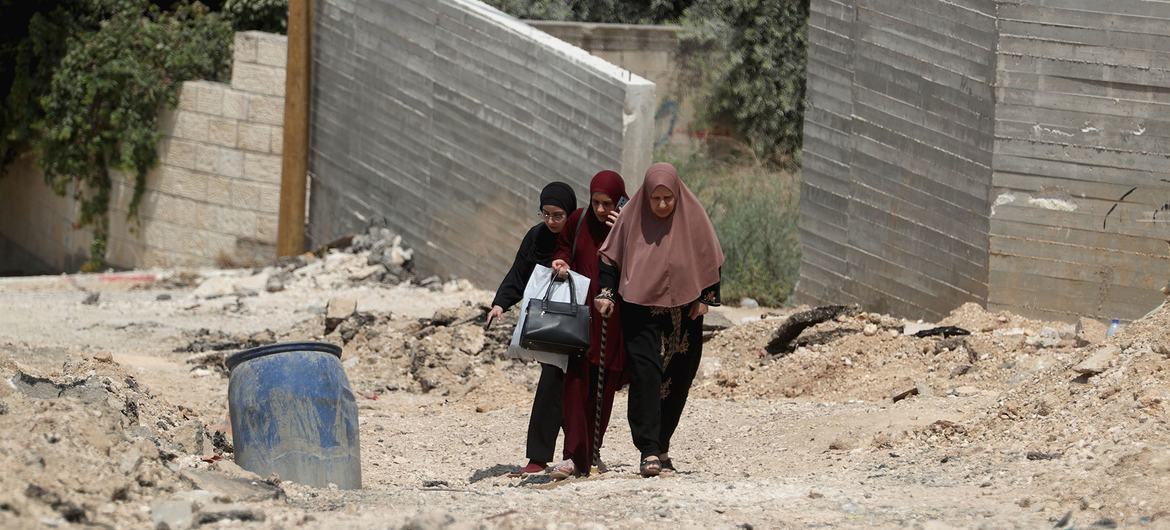
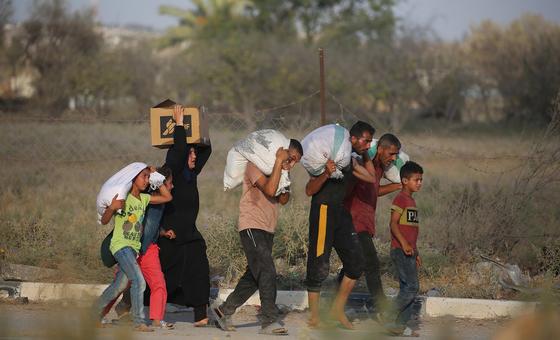
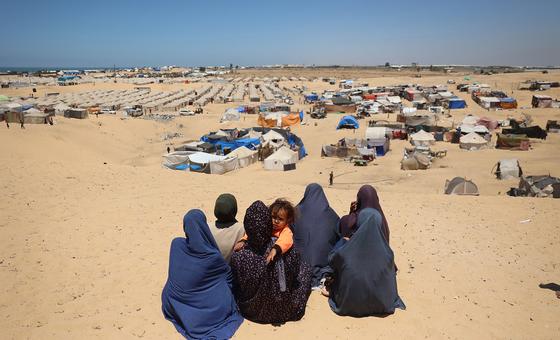
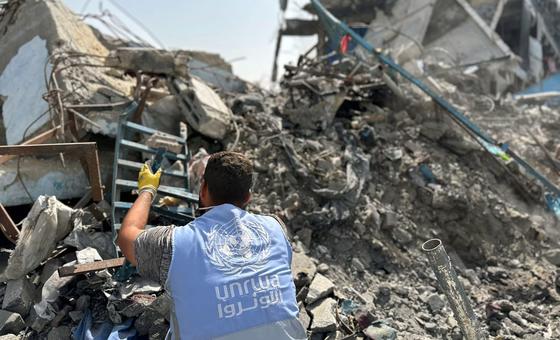
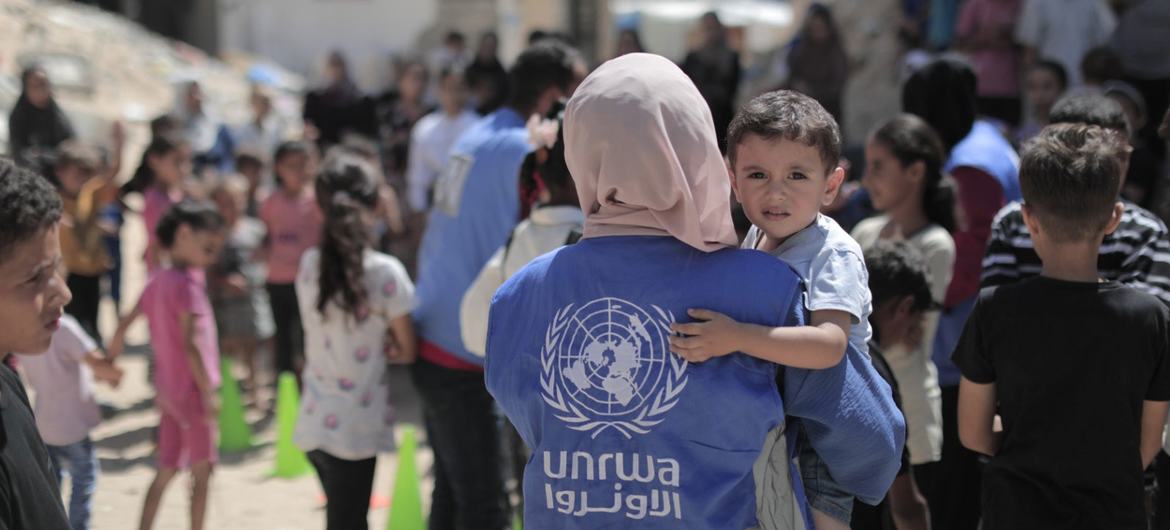
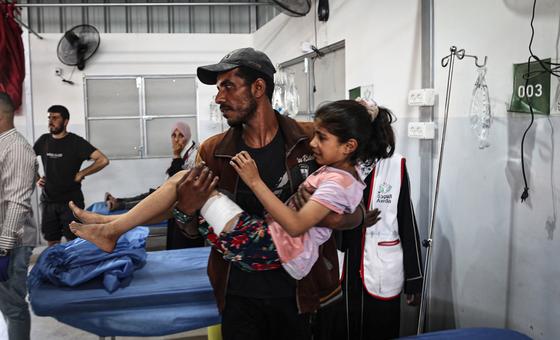
Humanitarians report more deaths, displacement and desperation in Gaza

“Every day brings more preventable deaths, displacement and desperation,” the agency said in a humanitarian update.

On Friday, Israeli authorities issued another displacement order, this time for parts of North Gaza.

OCHA said it continues to receive deeply troubling reports of malnourished children and adults being admitted to hospitals with insufficient resources available to treat them.

Fuel crisis deepens

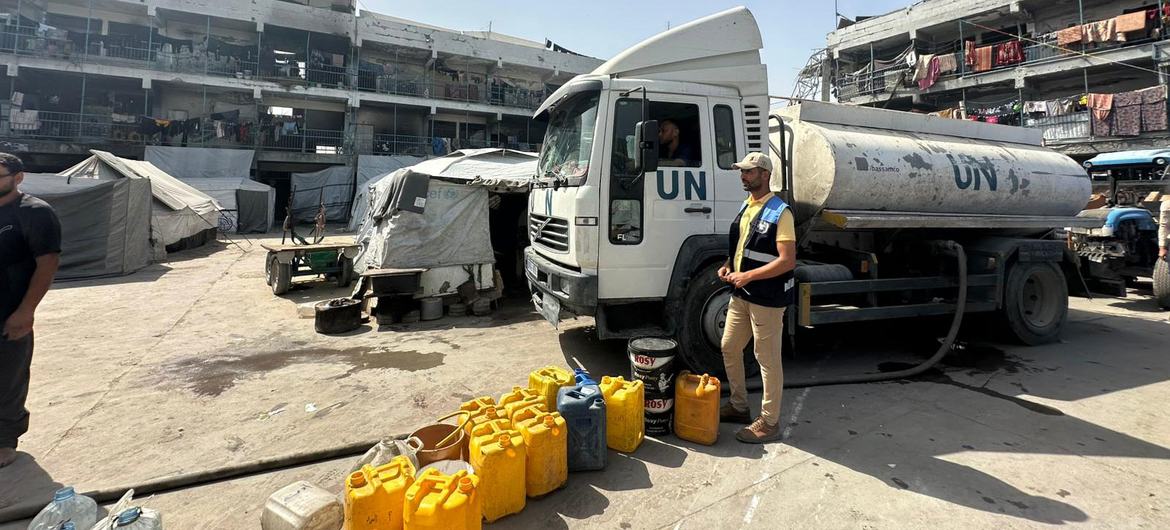
The energy crisis in Gaza is also deepening, despite the resumption of limited fuel imports as the quantities that are entering – while critical for continuity – “remain at lower levels than what we were previously able to extract from dwindling internal reserves, which have now been fully depleted”.

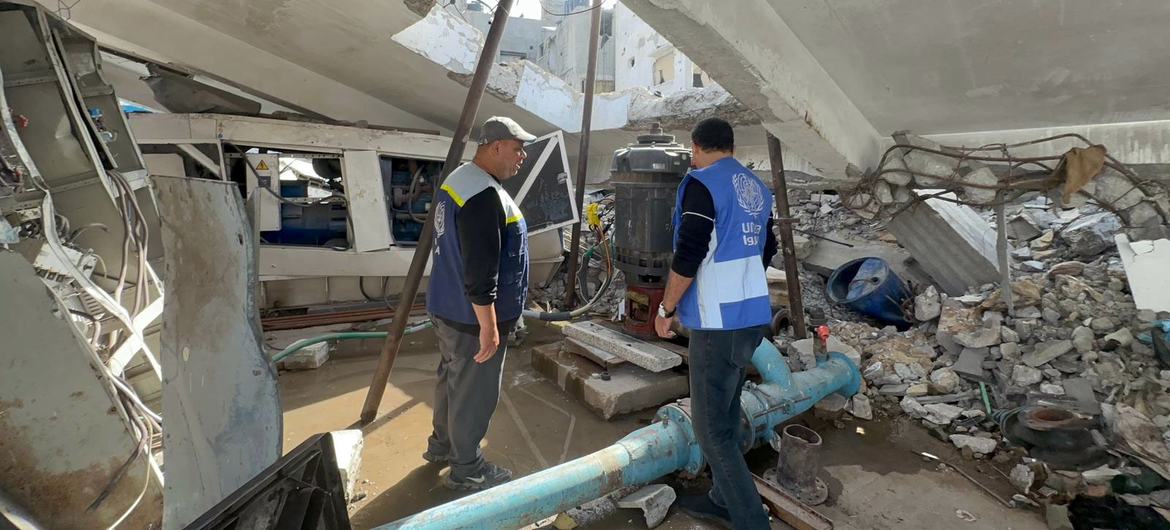
The situation has forced solid waste collection to be paused in recent days, and additional wells have had to shut down, particularly in Deir Al-Balah.

“While specific health services, including dialysis, have reduced or shut down, others could go on for a few more days before they too will have to go dark,” OCHA warned.

“With every day that passes, people have less clean water and healthcare and more sewage flooding ground floors.”

Since the limited entry of fuel entry supplies resumed on 9 July, the UN has managed to send just over 600,000 litres of diesel to Kerem Shalom. On Thursday,

it was able to send 35,000 litres of much-needed benzene for the first time.

OCHA said these volumes are limited because Israel has allowed only 14 trucks over the past week. 

The agency stressed that to maintain lifesaving operations, hundreds of thousands of litres of fuel are needed every day. The limited fuel currently entering is primarily allocated to health, water and communications services as well as to power vehicles.

Humanitarian movements curtailed

Humanitarian movements inside Gaza also continue to be restricted.

On Thursday, seven out of 13 attempts to coordinate the movement of aid workers and supplies with the Israeli authorities were facilitated.

Teams were able to retrieve some fuel, collect some water, relocate generators, provide supplies related to hygiene and sanitation and transfer much-needed medical supplies.

The six remaining attempts were either outright denied or approved initially, but then faced obstacles on the ground.

End international media ban

Meanwhile, the head of the UN Palestine refugee agency UNRWA called on Friday for the ban on international media entering Gaza to be lifted.

“650 days of atrocities against civilians with no international media allowed in,” Philippe Lazzarini wrote in social media post, adding that over 200 Palestinian journalists have been killed during this time.

“Media ban fuels dis-information campaigns questioning first-hand data and accounts from eyewitnesses and international humanitarian organizations,” he said.

Source link

On the road in war-torn Gaza

Moving around Gaza has become ever more difficult amid the ongoing 21-month-long war.

Mr. Saad, who was displaced from the town of Beit Lahia in the northern Gaza Strip, was waiting for the vehicle pulling the cart he was sitting in to move.

“Transportation is very difficult and unsafe,” he told UN News. “The roads are exhausting. We pray to God to grant us patience and to return home.”

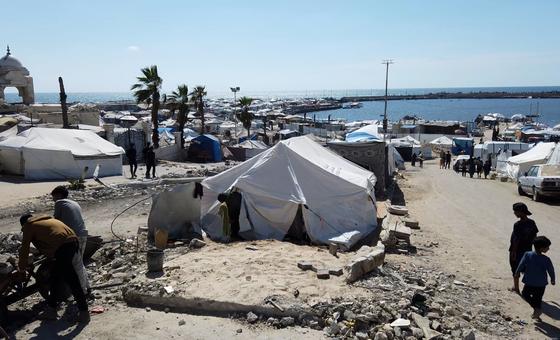
This was on Rashid Street, west of the city, which connects the north and south of the Strip. It is crowded with carts, cars and three-wheeled motorcycles that have also been converted into means of transportation.

The area is interspersed with tents of displaced people, all surrounded by the rubble of buildings destroyed by war on both sides of the road.

War and evacuation orders have left many in Gaza scrambling for transportation to safety.

A luxury not for everyone

“People can barely find enough to eat, so how will they pay for transportation?” Umm Haytham Al-Kulak asked while waiting in a passenger compartment attached behind a motorcycle,

“We walk mostly; we can’t take public transportation,” she said.

“May God help the drivers. Fuel prices are high, and all the people are exhausted and overwhelmed.”

In Gaza, many people have no choice but to use risky ways to get around during the ongoing war.

Sky high fuel costs

Drivers are paying skyrocketing prices for fuel, which is a heavy burden, Abdel Karim Abu Asi said as he waited for his car to be fully loaded with passengers.

“The price of a litre of diesel has reached 100 shekels [around $27],” he said. “What should we do? We’re trying to use locally produced fuel, but it causes significant damage to cars and a lot of problems.”

This isn’t the only problem facing drivers. Mr. Abu Asi said the prices of spare parts are very high. A part that used to cost around 100 shekels now sells for around 2,000 shekels, or around $560.

“We also suffer from the destruction of the streets, and no matter how hard the municipalities try to repair them, the problem is not solved because they require a large number of bulldozers to clear them,” he said.

“People must be helped with transportation costs and many other aspects.”

Fuel vendors sell their products at sharply inflated prices, with a litre of fuel reaching around 100 shekels.

Only option

Despite all the challenges, people there continue to go about their daily lives, even if it takes all day to get from one place to another. That’s what happened to Hussein Al-Hamarneh, who was waiting in a car to travel to the southern Gaza Strip.

Mr. Al-Hamarneh believes that most of these means of transportation are “uncomfortable, such as tuk-tuks [three-wheeled motorcycles] and carts pulled by cars, which are primarily designed to transport goods or animals, not people”.

“This is the only option for those who do not own cars,” he said.

Tayseer Abu Asr, who arranges for passengers to board a cart pulled by a car, stood on the section of the road.

“We’re trying to help people get around,” he said. “These carts have become our only means of transportation after the destruction of buses and taxis.”

On top of these challenges during the ongoing war, the Gaza Strip is facing a fuel crisis.

UN agencies warned earlier this week that the fuel shortage in Gaza has reached critical levels. They said if supplies run out, it will place an unbearable new burden on the population.

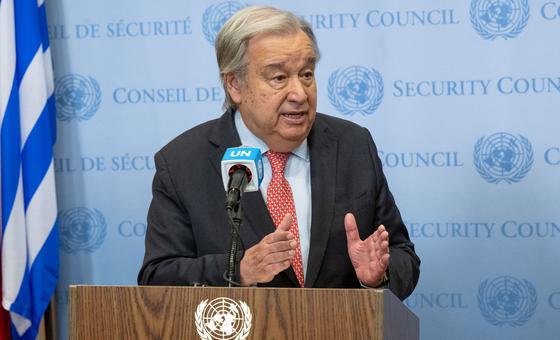
Guterres deplores Israeli strike on Gaza church

Three people were killed and at least 10 others were injured in the bombing of the Holy Family Church in Gaza City, according to media reports.

Stephanie Tremblay, a spokesperson for the Secretary-General, noted that the church was both a place of worship and a sanctuary for civilians.

“Attacks on places of worship are unacceptable. People seeking shelter must be respected and protected, not hit by strikes,” she said during the daily media briefing from New York.

“Too many lives have already been lost,” she added, before stressing the urgent need for an immediate ceasefire and the immediate and unconditional release of all hostages.

Strikes continue amid widespread displacement 

Meanwhile, Israeli strikes over the past 24 hours have hit sites hosting displaced Palestinians, some of whom were injured and killed.

The UN Office for the Coordination of Humanitarian Affairs (OCHA) reported that more than 11,500 people in Gaza were newly displaced between 8-15 July.

Overall, more than 737,000 people have been uprooted since the latest escalation of hostilities on 18 March, or roughly 35 per cent of the population

Furthermore, nearly everyone in Gaza has been displaced, in many cases multiple times, since the war began in October 2023.

Ms. Tremblay reminded journalists that most housing in Gaza is flattened or otherwise unhabitable and families are staying in the open because the UN has not been allowed to bring in tents and other shelter materials since early March.

Mediterranean swimming ban

She also highlighted a “worrying development” as humanitarians report that many displaced people are wary of bathing in the Mediterranean Sea after Israeli reinstated a ban prohibiting swimming and fishing.

“OCHA says that for many, the sea has been their only option to wash, as there is barely any functioning water infrastructure and almost no fuel to pump water, a much-needed outlet in the hot weather in Gaza,” she explained. 

More fuel needed

Humanitarians also continue to report that the amount of fuel Israel is allowing into Gaza is still nowhere enough to keep life-saving services operating and shutdowns are a real risk. 

Ms. Tremblay mentioned “a small but important step” that occurred on Thursday, as the UN was finally allowed to bring in some benzene – used to power ambulances and other critical services – for the first time in more than 135 days.

“That’s in addition to the limited amounts of diesel allowed over the past week. But it’s not enough,” she said.

“We are calling for more fuel – both benzene and diesel – to come in regularly. And the ban on shelter materials needs to be lifted immediately. Lives depend on both.” 

Source link

Gaza war: UN officials warn of unspeakable conditions as children bear the brunt

Tom Fletcher, the UN Emergency Relief Coordinator, said there was no “vocabulary” left to adequately describe conditions on the ground.

Food is running out. Those seeking it risk being shot. People are dying trying to feed their families. Field hospitals receive dead bodies, and medical workers hear stories firsthand from the injured – day after day after day,” he said.

Starvation rates among children reached their highest levels in June, with more than 5,800 girls and boys diagnosed as acutely malnourished.

“Last week, amid this hunger crisis, children and women were killed in a strike while waiting for the food supplements to keep them alive.”

UN Emergency Relief Coordinator Tom Fletcher briefs the Security Council

A classroom full of children, lost every day

UNICEF’s Executive Director Catherine Russell told ambassadors that an average of 28 children are killed in Gaza every day – “the equivalent of an entire classroom.”

Over the past 21 months, more than 17,000 children have been killed and 33,000 injured across Gaza.

Many of those children, she said, were struck “as they line up for lifesaving humanitarian aid – further proof that there is no safe place for civilians anywhere in Gaza.”

Children are not political actors. They do not start conflicts, and they are powerless to stop them. But they suffer greatly, and they wonder why the world has failed them,” she added.

“And make no mistake, we have failed them.”

Critical infrastructure collapse

Gaza’s health system “is shattered,” Mr. Fletcher reported – only 17 of 36 hospitals and 63 of 170 primary health centres are even partially functioning; shortages mean up to five babies share one incubator.

Seventy per cent of essential medicines are out of stock, half of all medical equipment is damaged, pregnant women are giving birth without care, women and girls manage their periods without basic supplies.

Meanwhile, water production capacity has plummeted leaving the entire enclave (95 per cent) facing water insecurity.

With clean water increasingly difficult to access, children have little choice but to drink contaminated water,” Ms. Russell said, noting that this is increasing the risk of disease outbreaks.

UNICEF Executive Director Catherine Russell briefs the Security Council

Aid impeded, fuel at trickle levels

Mr. Fletcher further described the scale of challenges to moving something as simple as a bag of flour into Gaza.

He noted multiple layers of approvals that Israel requires, scanning, re‑loading, multiple handoffs, damaged roads, delays at holding points, insecurity and desperate civilians grabbing supplies off trucks.

Last week – after almost 130 days – some fuel entered Gaza, as Israeli authorities agreed to allow two trucks in per day, five days a week. However, petrol – fuel for ambulances and other critical services – has not been permitted.

Between 19 May and 14 July, just 1,633 aid trucks – about 62 per cent of loads submitted for clearance – entered Gaza, far below the average of 630 daily truckloads moved during the previous ceasefire, Mr. Fletcher said.

Appeals to Israel, Hamas – and the Council

Both officials pressed for immediate, safe, sustained, demilitarised humanitarian access through all available crossings, consistent fuel flows, protection of civilians at distribution points, and restoration of the UN‑led aid pipeline that briefly functioned during earlier pauses in fighting.

They also reiterated the UN’s call for the immediate and unconditional release of all hostages held in Gaza and called on all parties – including Hamas and other armed groups – to respect international humanitarian law.

Mr. Fletcher asked the Security Council to assess whether Israel, as the occupying power, is meeting its obligations to ensure food and medical supplies reach civilians.

“We hold all parties to the standards of international law in this conflict. We don’t have to choose – and in fact, we must not choose – between demanding the end to the starvation of civilians in Gaza and demanding the unconditional release of all the hostages,” he said.

“We must reject antisemitism – we must fight it with every fibre of our DNA. But we must also hold Israel to the same principles and laws as all other States.”

Displacement, poverty and insecurity fueling violence against women in Gaza

In the past three months, a third of Gaza’s population (714,000 people) have been forced to move once again, separating families and dismantling local support systems.

Women and girls are bearing a heavy burden, fearing for their lives on the streets – at delivery points, and in overcrowded, makeshift shelters that lack privacy and security – as many sleep in the open.

“Women have experienced immense loss, including the death or imprisonment of relatives. Looking for water, living without any privacy, and constantly worrying – it’s exhausting,” one case worker told UNFPA.  

Many young girls are also being pushed into child labour and forced marriage in efforts to cope with devastating hunger.

Suhair who works at a safe space for women and girls in Gaza’s central Deir El-Balah Governorate.

Safe spaces in big demand

In response to this crisis, on Wednesday, UNFPA reported a sharp increase in victims seeking help at their safe spaces, which provide shelter and psychological support.

However, according to the women working there – many of whom are also displaced, conditions are extremely difficult, and there are far too few facilities for the number of women and children in need, making it difficult to reach those most at risk.

For instance, displacement orders have disrupted services and caused providers to lose essential equipment and files, forcing them to restart operations from scratch.  

Even as staff receive accounts of abuse, incidents remain vastly underreported due to stigma, fear of retaliation, and the collapse of health and justice systems.

“Despite all the difficulties, I continue to support abused women and girls,” said Asmaa, who works at a UNFPA-supported safe space in Gaza and has been displaced ten times since the war began.

Severe supply and fuel shortages

Fuel shortages are crippling critical infrastructure across Gaza. The UN has warned that humanitarian operations may collapse entirely, and an estimated 80 per cent of health facilities are expected to run out of fuel in the coming days.

As UNFPA attempts to shift to remote support, fuel shortages have triggered telecommunications blackouts, cut off survivor hotlines and made remote assistance largely inaccessible.

Since the blockade was imposed on 7 March, no agency supplies have entered Gaza, leaving essential items such as menstrual hygiene kits severely depleted.

Due to these shortages, three UNFPA safe spaces have closed, while the remaining 14 are functioning at severely limited capacity.

Despite the many challenges, the reproductive health agency and its case workers continue to try their best to help women and girls. “We feel the urgent needs of women and recognise the importance of supporting them. A small effort can make a big difference in their lives,” one caseworker stressed.

© UNFPA/Women’s Affairs Centre

Salma, left, is a mother of four and gender-based violence case manager in Khan Younis.


Source link

SECURITY COUNCIL LIVE: ‘Aid must go where needs are greatest’ in Gaza, urges UN relief chief

The UN Security Council is meeting on the escalating humanitarian crisis in Gaza, where fresh Israeli evacuation orders have uprooted tens of thousands amid relentless bombardment claiming hundreds of civilian lives in recent weeks – many of them children. “Food is running out. Those seeking it risk being shot. People are dying trying to feed their families,” UN relief chief Tom Fletcher has just told ambassadors. Follow our real-time updates and key moments through our live UN Meetings Coverage page. UN News App users can join here.

Source link

Gaza: More misery as new evacuation orders impact tens of thousands

Those impacted by the orders have been told to relocate to the “already overcrowded” coastal strip at Al Mawasi, according to the UN Office for the Coordination of Humanitarian Affairs (OCHA), late Tuesday.

Al Mawasi near Khan Younis lacks “the basics for survival”, the UN agency insisted. It has also seen nearly two dozen strikes on displaced Gazans sheltering in tents there between 18 March and 11 April, the UN human rights office said

As the war drags on well into its 21st month, Gaza’s most vulnerable people continue to struggle to survive.

Dialysis emergency

They include Musbah Zaqqout, 70, one of 230 patients receiving lifesaving dialysis at Al-Shifa Hospital in Gaza City. His treatment has been disrupted by persistent supply shortages that reduced sessions from three to two per week at the end of last month, the UN World Health Organization (WHO) warned on Tuesday.

“He suffered a lot when dialysis was not available,” said Mr. Zaqqout’s wife, Saadia. “He was suffocating and was frequently admitted to the hospital, to the point where he fell into a coma, lost focus and didn’t recognize anyone.”

With support from partner organization KS Relief, WHO delivered dialysis supplies and fuel for Al-Shifa Hospital, so that it could resume dialysis treatment and other lifesaving services.

“Thank God, after restarting dialysis, his condition improved,” Mrs. Zaqqout said, while the UN health agency reiterated its calls for sustained entry of food, fuel, and health aid at scale through all possible routes.

“Critical shortages of fuel and medical supplies persist across Gaza,” WHO warned. “Without urgent and sustained replenishment, health care services risk coming to a grinding halt.”

Child malnutrition tragedy

Echoing those concerns, the UN agency for Palestinians, UNRWA, warned on Wednesday that it is increasingly difficult to help Gazans. Already, one in 10 of the children brought to its clinics suffers from malnutrition. The condition was unheard of in the enclave before the war, but it more than doubled in children under five between March and June, amid the near-total Israeli siege.

“It’s becoming more and more difficult for us to continue providing services,” said UNRWA’s Louise Wateridge. “At least 188 UNRWA installations – over half of all our installations in the Gaza Strip – are located within the Israeli-militarized zone, under displacement orders, or where these overlap.”

In an update, Ms. Wateridge said that only six UNRWA health centres and 22 of the agency’s medical points remain operational today, in addition to 22 mobile medical points inside and outside shelters.

Nearly 60 per cent of essential medical supplies are now out of stock, according to the UN agency. “Children are dying before our eyes, because we do not have the medical supplies or sustained food to treat them,” it said.

Key medicines run out

As a direct result of the Israeli blockade on Gaza which began on 2 March, UNRWA said that it has “now run out of” medicines for high blood pressure, antiparasitic and antifungal medicine, medicine for eye infections and inflammation, all skin treatments and oral antibiotics for adults.

Providing clean water to the war-shattered enclave remains a massive challenge and only two UNRWA main water wells still function. Ten were operational before the war. Another 41 smaller wells are operational in UNRWA shelters.

For the past two months in north Gaza, UNRWA has been forced to stop providing water and sanitation services for around 25,000 displaced people in shelters, owing to displacement orders issued by Israeli forces.

“The restrictions on the entry of fuel continues placing life-saving services at a severe risk,” the UN agency said. “Critical water services are at risk of shutting down if sustained fuel supplies are not permitted entry.”

Source link

Gaza: 875 people now confirmed dead trying to source food in recent weeks

“As of 13 July, we have recorded 875 people killed in Gaza while trying to get food; 674 of them were killed in the vicinity of GHF sites,” said Thameen Al-Kheetan, OHCHR spokesperson.

The remaining 201 victims were killed while seeking food “on the routes of aid convoys or near aid convoys” run by the UN or UN-partners still operating in the war-shattered enclave, Mr. Al-Kheetan told journalists in Geneva.

Killings linked to the controversial US and Israeli-backed aid hubs began shortly after they started operating in southern Gaza on 27 May, bypassing the UN and other established NGOs.

The latest deadly incident happened at around 9am on Monday 14 July, when reports indicated that the Israeli military shelled and fired towards Palestinians seeking food at the GHF site in As Shakoush area, northwestern Rafah.

According to OHCHR, two Palestinians were killed and at least nine others were injured. Some of the casualties were transported to the International Committee of the Red Cross (ICRC) hospital in Rafah. On Saturday medics there received more than 130 patients, the “overwhelming majority” suffering from gunshot wounds and “all responsive individuals” reporting they were attempting to access food distribution sites.

Deadly hunger

The UN agency for Palestinian refugees, UNRWA, expressed deep concerns about the continuing killing of civilians trying to access food, while deadly malnutrition spreads among children.

“Our teams on the ground – UNRWA teams and other United Nations teams – have spoken to survivors of these killings, these starving children included, who were shot at while on their way to pick up very little food,” said Juliette Touma, UNRWA Director of Communications.

Speaking via video from Amman, Ms. Touma insisted that the near-total Israeli blockade of Gaza has led to babies dying of the effects of severe acute malnutrition.

“We’ve been banned from bringing in any humanitarian assistance into Gaza for more than four months now,” she said, before pointing to a “significant increase” in child malnutrition since the Israeli blockade began on 2 March.

Ms. Touma added: “We have 6,000 trucks waiting in places like Egypt, like Jordan; it’s from Jordan to the Gaza Strip it’s a three-hour drive, right?”

In addition to food supplies, these UN trucks contain other vital if basic supplies including bars of soap. “Medicine and food are going to soon expire if we’re not able to get those supplies to people in Gaza who need it most, among them one million children who are half of the population of the Gaza Strip,” Ms. Touma continued.

West Bank: ‘Silent war is surging’

Meanwhile in the occupied West Bank including East Jerusalem, Palestinians continue to be killed in violence allegedly linked to Israeli settlers and security forces, UN agencies said.

According to OHCHR, two-year-old Laila Khatib was shot in the head by Israeli security forces on 25 January while she was inside her house in Ash-Shuhada village, in Jenin.

On 3 July, 61-year-old Walid Badir was shot and killed by Israeli security forces, reportedly while he was cycling back home from prayers, passing through the outskirts of the Nur Shams camp, the UN rights office continued, pointing to intensifying “killings, attacks and harassment of Palestinians in past weeks.

“This includes the demolition of hundreds of homes and forced mass displacement of Palestinians,” OHCHR’s Mr. Al-Kheetan noted, with some 30,000 Palestinians forcibly displaced since the launch of Israel’s operation “Iron Wall” in the north of the occupied West Bank earlier this year.

“We should recall that international law is very clear about this in terms of the obligations of the occupying power,” he said. “Bringing about a permanent demographic change inside the occupied territory may amount to a war crime and is tantamount to ethnic cleansing.”

“We continue to have a silent war that is surging, where heavy restrictions on movement continue, where poverty is increasing as people are cut off from their livelihoods and unemployment soars,” said UNRWA’s Ms. Touma.

With its current focus on the northern occupied West Bank, the Israeli military operation has impacted the refugee camps of Jenin, Tulkarem and Nur Shams.

“It is causing the largest population displacement of the Palestinians in the West Bank since 1967,” Ms. Touma continued.

Gaza: UNICEF mourns seven children killed queuing for water

The incident occurred in central Gaza on Sunday, according to media reports, which said that four other people also lost their lives due to the Israeli airstrike. 

The Israeli military said it had been targeting a terrorist but a “technical error” saw the munition stray off course.

Uphold protection of children

UNICEF Executive Director Catherine Russell noted that the incident came just days after several women and children were killed while lining up for nutritional supplies.

The Israeli authorities must urgently review the rules of engagement and ensure full compliance with international humanitarian law, notably the protection of civilians, including children,” she wrote in a statement posted on X.

The UN has repeatedly deplored the killing of Palestinians seeking food aid amid the dire humanitarian situation in Gaza, where food security experts have warned that the entire population, some 2.1 million people, is not getting enough to eat.

The risk of famine remains, according to UNICEF. In June, more than 5,800 children were diagnosed with malnutrition, including more than 1,000 children with severe acute malnutrition, representing an increase for the fourth consecutive month. 

Stockpiles of food available

Meanwhile, “truckloads of food and medical supplies are waiting in warehouses” just outside the enclave, UN Palestine refugee agency UNRWA said in a tweet.

It included a quote from one of its health workers who said that “in the past, I only saw such cases of malnutrition in textbooks and documentaries.  Today, I am treating them face to face in the health centre.”

UNRWA appealed for starvation of civilians to stop and for the siege to be lifted.  

Let the UN, including UNRWA, do its lifesaving work,” the tweet said.

The small quantities of aid and critical supplies that have entered Gaza so far are nowhere near enough to meet the immense needs, the UN humanitarian affairs office, OCHA, said later on Monday. 

It called for Israel to allow the urgent entry of aid at scale through all possible routes and corridors.  

Healthcare under attack

OCHA said health teams continue to suffer some of the worst impacts of the hostilities, with the Ministry of Health reporting on Sunday that another doctor had been killed over the previous 24 hours. 

Although the health system has been decimated and is on the brink of collapse, hospitals continue to respond to mass casualty incidents as much as they can.

The Israeli authorities have continued to issue displacement orders amid the ongoing hostilities and destruction, the agency added.

On Friday, a displacement order was put out for the Rimal area of Gaza city where some 70,000 people were staying at a dozen displacement sites.

Today, more than 86 per cent of Gaza’s territory is either under displacement orders or located within the Israeli-militarized zone. 

West Bank annexation ‘well underway’

Separately, UNRWA also highlighted the situation of Palestinians in the occupied West Bank against the backdrop of the war in Gaza.

Agency chief Philippe Lazzarini told an international conference in Switzerland on Monday that “annexation is well underway.”

UNRWA said “this is not just destruction: it is part of systematic forced displacement, a violation of international law, and a form of collective punishment.”

In January, Israeli forces launched operations in Tulkarm and Jenin in the West Bank, which UNRWA has previously said are the most extensive in two decades.

Humanitarians reported last week that the operations are causing massive destruction and displacement while attacks by Israeli settlers have intensified.

The high levels of violence continue, with OCHA reporting that two Palestinian men, one of whom was a US national, were killed near Ramallah on Friday during a settler attack.

Overall, more than 700 settler attacks have been recorded in the West Bank during the first half of this year. Over 200 communities have been affected, primarily in Ramallah, Nablus and Hebron governorates

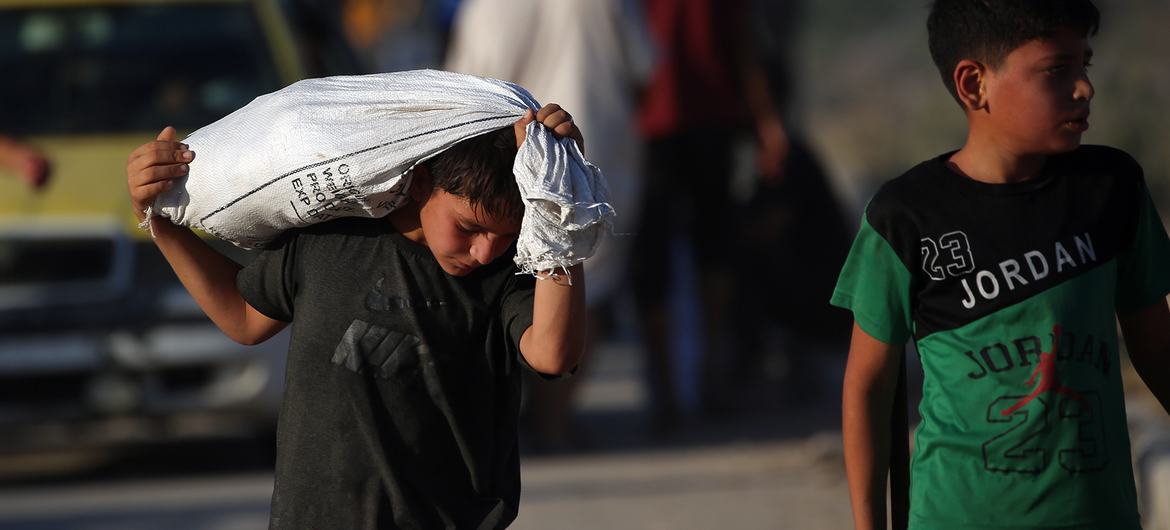
No fuel, no aid, no escape: UN agencies warn of looming collapse in Gaza

Fuel is the backbone of survival in Gaza,” said the statement. “Without fuel, these lifelines will vanish for 2.1 million people.”

UN humanitarian workers stressed that fuel powers everything from hospitals and water systems to bakeries and ambulances.

Without a steady supply, “maternity, neonatal and intensive care units are failing, and ambulances can no longer move.” The fuel shortage, they said, has left Gaza’s population – already facing severe food insecurity and the constant threat of violence – on the edge of catastrophe.

They warned that “without adequate fuel, UN agencies responding to this crisis will likely be forced to stop their operations entirely,” meaning “no health services, no clean water, and no capacity to deliver aid.”

Inadequate fuel injection

The agencies noted that for the first time in 130 days, a small quantity of fuel was allowed into Gaza this week. While welcome, the amount – just 75,000 litres over two days – is far from enough to meet the daily needs of the population and vital civilian aid operations.

Speaking at UN Headquarters in New York late Friday, UN Spokesperson Stéphane Dujarric described the overall situation as “dire and worsening by the day.”

Every day without a ceasefire brings more preventable deaths – children dying in pain, and hungry people shot while trying to reach the trickle of aid that is allowed in,” he said.

Life-threatening

Mr. Dujarric also expressed deep concern over continued Israeli restrictions on aid access. “Yesterday, our teams could provide hospitals with some of the fuel that came in – but only in the south. That’s because Israeli authorities denied our attempt to bring fuel to the north,” he said. “Such denials are life-threatening.”

He added that the fuel shortage also affects water treatment, ambulances and waste management. “All of these services are at risk of collapsing,” he said.

Out of 15 humanitarian missions that required coordination with Israeli authorities on Thursday, only six were fully facilitated. Five were denied outright, while four faced obstacles that delayed or prevented delivery.

One mission, to rescue injured people trapped under rubble in Gaza City, was only approved two days after the initial request – too late to save lives. “By the time the mission was finally allowed through yesterday, no one was found alive,” Dujarric said.

On top of this, essential items like tents and shelter materials have been blocked from entering Gaza for over four months, leaving thousands exposed to the elements.

Close call

Aid workers are also at risk. “Five strikes landed just a few hundred metres from where aid workers were operating this week, including UN staff,” Mr. Dujarric said. No injuries were reported, but several Red Crescent workers were shot while attempting to assist an injured colleague.

UN agencies are calling for the immediate and consistent delivery of fuel at scale, and for full, safe access to all parts of Gaza. “The urgency of this moment cannot be overstated,” they said. “Without fuel, Gaza faces a complete collapse of humanitarian efforts.”

Gaza: ‘Unacceptable’ choice between getting shot or getting fed

UN Human Rights Office (OHCHR) spokesperson Ravina Shamdasani told reporters in Geneva on Friday that “we’ve raised concerns about atrocity crimes having been committed and the risk of further atrocity crimes, where people are lining up for essential supplies such as food and medicine and where they are being attacked, where again… they have a choice between being shot or being fed”.

Deadly lottery

This is unacceptable and it’s continuing,” she deplored.

Ms. Shamdasani said that her office is still looking into the incident in which at least 15 Palestinians including women and children were reportedly killed by a strike in front of a clinic in Deir al-Balah run by US-based aid group Project Hope, a partner organization of the UN Children’s Fund (UNICEF).  

In a statement on Thursday UNICEF chief Catherine Russell said that the killing of families trying to access life-saving aid is “unconscionable”.

The Israeli military reportedly said that it was targeting a Hamas member involved in the terror attacks in Israel on 7 October 2023.

Asked about the rationale of putting civilians, including children, in mortal danger when targeting one specific person, Ms. Shamdasani said that over the course of the conflict in Gaza OHCHR has had serious concerns about respect for essential international humanitarian law principles, including that of distinction and proportionality.

“We have seen that of the overall death toll in Gaza; a large proportion are women and children. And again, that raises serious questions about whether these principles are being respected,” she said.

Hungry people in Gaza run the risk being shot when picking up food aid.

Hundreds killed queuing for food

Killings of Gazans at or around aid distribution sites and near humanitarian convoys have become a regular occurrence in a context of restrictions on the entry of food, fuel and relief items into the Strip and particularly since the establishment of food distribution sites bypassing the UN operated by the Gaza Humanitarian Foundation (GHF).

Since late May, this militarised aid distribution model, backed by Israel and the United States, has sought to sideline the UN and its experienced humanitarian partners.  

OHCHR’s Ms. Shamdasani said that from 27 May, when the GHF started operations in Gaza, until 7 July, OHCHR recorded 798 killings “including 615 in the vicinity of the GHF sites and 183 presumably on the routes of aid convoys”.  

Gunshot injuries

The deaths of almost 800 people trying to access aid were “mostly due to… gunshot injuries”, Ms. Shamdasani said.

Joining her in condemning the killings, World Health Organization (WHO) spokesperson Christian Lindmeier said that he is “slowly lacking words to describe the scenario”.

“People being shot at distribution sites… scores of women and children and men and boys and girls being killed while either getting food or in what’s supposedly safe shelters or on the road to health clinics or inside health clinics – this is far beyond unacceptable.”

Fuel crisis

Asked to comment on a 75,000-litre fuel delivery into Gaza on Wednesday, the first such provision in over 130 days, Mr. Lindmeier said that “as good as it is that these this amount of fuel came finally in… we should not be relying on special news of special deliveries,” be it on fuel, food or other relief items.

“There should be a reoccurring delivery into Gaza to keep the lifelines open, to supply the ambulances, the hospitals, the water desalination plants, the bakeries… whatever is necessary to keep a little bit of lifeline open there, to run the incubators,” he said.  

The WHO spokesperson pointed out that 94 per cent of the hospitals in Gaza are now damaged or destroyed, while displacement continues and civilians are being pushed into ever smaller spaces.

Mr. Lindmeier also expressed his hope for a positive outcome of the ongoing ceasefire talks.

“Peace is the best medicine and opening the doors remains the only viable option,” he concluded.

Source link

UNICEF deplores ‘unconscionable’ killing of families lining up for aid in Gaza

Catherine Russell said she was appalled by the reported killing of 15 Palestinians, including nine children and four women, who were waiting in line for nutritional supplements provided by Project Hope, a UNICEF partner organization.

The incident occurred in Deir Al-Balah. An additional 30 people were injured, including 19 children. News reports indicate that it resulted from an Israel strike. 

‘Mothers seeking a lifeline’

“The killing of families trying to access life-saving aid is unconscionable,” she said in a statement.

These were mothers seeking a lifeline for their children after months of hunger and desperation.”

They included Donia, whose one-year-old son, Mohammed, was killed. She reported that the boy had spoken his first words to her just hours earlier.

“Donia now lies in a hospital bed, critically injured by the blast, clutching Mohammed’s tiny shoe,” said Ms. Russell.  “No parent should have to face such tragedy.”

A ‘cruel reality’

For the UNICEF chief, “this is the cruel reality confronting many in Gaza today after months of insufficient aid being allowed into the territory, and parties to the conflict failing to uphold basic responsibilities to protect civilians.”

She explained that “the lack of aid means children are facing starvation while the risk of famine grows,” warning that “the number of malnourished children will continue to rise until life-saving aid and services are resumed at full scale.”

“International law is clear: all parties to the conflict have an obligation to protect civilians and ensure the safe and unimpeded delivery of humanitarian assistance,” she said.

“We call on Israel to urgently review its rules of engagement to ensure full compliance with international humanitarian law, notably the protection of civilians including children, and to conduct a thorough and independent investigation of this incident and all allegations of violations.”

UN condemns killings

The UN yet again condemned the killing of civilians in Gaza, Spokesperson Stéphane Dujarric told journalists in New York.

Furthermore, the UN humanitarian affairs office OCHA “stresses that parties are bound by international humanitarian law to prevent such excessive death and injury of civilians in the midst of war,” he added.

OCHA reported that another strike on Thursday reportedly hit the office of a humanitarian partner in Gaza City. Three staff there were killed. 

Fuel running out

Mr. Dujarric also updated journalists on the dire fuel situation in Gaza, which impacts both the population and humanitarians.

A UN team managed to bring roughly 75,000 litres of fuel from Israel into the beleaguered enclave on Wednesday, marking the first such provision in 130 days.

He warned, however, that fuel is still running out and services will shut down if greater volumes do not enter immediately.

Water services at risk

We and our humanitarian partners need hundreds of thousands of litres of fuel each day to keep essential lifesaving and life-sustaining operations going, meaning the amount entered yesterday isn’t sufficient to cover even one day of energy requirements,” he said.

One aid partner reported that fuel shortages could soon cut off supplies of clean drinking water to about 44,000 children, he added, which would further increase the risk of cholera, diarrhoea, dysentery and other waterborne illnesses. 

Meanwhile, UN partners providing education services said that between October 2023 and this June, 626 temporary learning spaces have been established in Gaza, with 240,000 students enrolled, roughly half of them girls. 

However, only 299 spaces are currently operational due to the ongoing displacement orders, funding shortfalls and other challenges.

Aid workers also going hungry

Humanitarian partners in Gaza – who include first responders, health workers, and aid workers – “continue to deliver food and other assistance under intolerable conditions, and they themselves are facing hunger,” said Mr. Dujarric.

“A number of our own colleagues are also facing hunger. They also face water scarcity and threats to their personal safety, just like everyone else in Gaza,” he added.

The Spokesperson reiterated the UN’s long-standing message that “this catastrophic situation must end.”  He stressed that “a ceasefire is not only urgent, it is long overdue,” while also calling for the unconditional and immediate release of all hostages. 

Some Palestinians have been forced to flee their homes in the West Bank.

West Bank operations

Mr. Dujarric also addressed the situation in the West Bank, where humanitarians report and continue to warn of the intensification of Israeli operations in the northern areas.

These operations are causing massive destruction, driving further humanitarian needs and dampening hopes of thousands of displaced families that they will eventually be able to go back home,” he said.

“Meanwhile, attacks, harassment and intimidation by Israeli settlers against Palestinians have become a daily reality.”

He cited a settler attack on 3 July that led to the displacement of the Mu’arrajat East Bedouin community in the central West Bank. 

“This is the ninth community to be fully displaced in the Ramallah and Jericho areas since January 2023 following the recurrent attacks by Israeli settlers.” 

Source link

UN warns of deepening health crisis in Gaza amid mass casualty incidents

Across the Gaza Strip, as people desperately search for food, mass casualty incidents are reported almost daily, UN Spokesperson Stéphane Dujarric, told reporters at his regular briefing in New York.

Hospitals, already under immense strain, are struggling to cope and lack of essential supplies – including fuel and medicines – is placing even greater pressure on overstretched teams.

The war has also had a devastating impact on health workers. According to Gazan health authorities, more than 1,500 medical staff have been killed in Gaza since October 2023.

Medical supplies arrive – but much more is needed

The World Health Organization (WHO) reported that 11 trucks carrying medical aid, including surgical supplies, assistive devices, orthopaedic instruments and other essential medical items, had entered the Strip on Tuesday.

These supplies are set to be distributed to various health facilities across Gaza.

“The health needs remain immense. Much more medical supplies are needed. We urgently call for the unimpeded entry of fuel, food, and health aid at scale into Gaza through all possible routes,” Tedros Adhanom Ghebreyesus, WHO General-Director, said in a post on social media.

Mr. Dujarric echoed that message, calling for the opening of all crossings and corridors “to ensure the consistent, frequent and large-scale distribution of aid to people in need, wherever they are.”

Disease risk rising

Against the backdrop of access challenges, the spectre of deadly disease outbreaks is also rising.

In northern Gaza, 10 water wells have stopped functioning due to lack of fuel, and another 25 are operating only partially and could soon shut down.

“Shorter pumping hours, reduced water production and limited solid waste collection provide fertile ground for diseases to spread – especially among vulnerable people including children, older people and pregnant women,” Mr. Dujarric said.

No hygiene items have entered Gaza since early March 2025, he noted, added that the ongoing shortage of cleaning and sanitation supplies is severely affecting health and impeding an effective medical response.

Source link

Gaza: Hospitals rationing critical supplies, ambulances stalling

What little fuel remains is powering essential operations, but it is running out fast, and there are virtually no additional accessible stocks left, UN Spokesperson Stéphane Dujarric said, citing reports from the UN relief coordination office, OCHA.  

“Hospitals are rationing. Ambulances are stalling. Water systems are on the brink. And the deaths this is likely to cause could soon rise sharply unless the Israeli authorities allow new fuel to get in,” said Mr. Dujarric.

“We need fuel urgently and we need it in large quantities to power the most essential parts, notably water desalination, hospitals and telecommunications,” he added, noting fuel has not entered the enclave in the last few months.

Khan Younis displacement

Meanwhile Israeli forces continue to attack civilian infrastructure in Gaza and issue new displacement orders.

On Tuesday, such orders were issued for parts of Khan Younis, specifically ordering those staying in tents to move, Mr. Dujarric reported.

The map published alongside the order indicates that some areas included had not been subject to displacement orders since before the March ceasefire, he said.

“The issuance of a displacement order does not relieve any party from the imperative to spare civilians, including those who are unable or unwilling to move.”  

Safeguard hospitals

Mr. Dujarric also reiterated the UN World Health Organization’s (WHO) call to protect the Nasser Medical Complex in Khan Younis, warning that the hospital is overwhelmed with trauma injuries at double its capacity.  

In a video message sent from the hospital on Monday, Rik Peeperkorn, WHO representative in the Occupied Palestinian Territory, said the facility is running critically low on trauma supplies, essential medicines, equipment and fuel, and that staff are exhausted.

Humanitarian movements

Meanwhile, OCHA reported that humanitarian movements inside Gaza remain heavily restricted: only four out of 12 attempts on Monday to coordinate movements with the Israeli security authorities were fully facilitated, and just one delivered supplies.

Four more attempts were rejected by Israeli authorities, halting efforts to evacuate patients, retrieve disabled trucks or clear debris.  

Although the remaining four were initially approved, ground-level impediments ultimately undermined the ability to carry out the missions.

Source link

UN Human Rights Council hears grim updates on Ukraine, Gaza and global racism

Escalating conflict in Ukraine

In an oral update, Ilze Brands Kehris, UN Assistant Secretary-General for Human Rights, reported a sharp escalation in hostilities in Ukraine.

Civilian casualties have surged, with April to June seeing nearly 50 per cent more deaths and injuries compared to the same period in 2024.

“More than 90 per cent of these casualties occurred in territory controlled by Ukraine,” she said, attributing the spike in part to intensified Russian drone and missile attacks.

Attacks using airburst warheads and repeated strikes on hospitals have instilled “terror and anxiety” among urban populations, she added. A June 16-17 nighttime attack in Kyiv killed more civilians than any other assault in the past year.

While ceasefire negotiations have produced some humanitarian gains – such as the exchange of prisoners of war and the return of deceased soldiers – Ms. Kehris underscored harrowing conditions in detention.

Over 117 former Ukrainian POWs interviewed by the UN rights office, OHCHR, reported torture, including sexual violence, in Russian captivity. Though less widespread, similar abuses have also been documented in unofficial Ukrainian detention facilities, prompting calls for transparent investigations.

The report also noted ongoing human rights violations in territories occupied by Russia, including restrictions on civic space and the exercise of freedom of expression.

“Peace is more imperative than ever,” Ms. Kehris said, reiterating calls for an immediate cessation of hostilities in line with international law.

Structural racism and intersectionality

Ashwini K.P., Special Rapporteur on contemporary forms of racism, delivered a thematic report focused on intersectionality as a tool for racial justice.

Drawing from experiences of Black feminists and expanded by studies focusing on Dalit, Indigenous, Muslim and Roma community members, the concept of intersectionality was presented as essential to dismantling systemic discrimination.

“Women of African descent, caste-oppressed communities, Roma, Arab and Muslim women, and other marginalized groups are disproportionately impacted due to overlapping forms of discrimination,” Ms. Ashwini said.

Her report detailed how states can integrate an intersectional approach, emphasising data disaggregation, participatory policymaking, legal recognition of multiple discrimination and historical accountability.

Ms. Ashwini highlighted the importance of reparatory justice for communities affected by colonialism and slavery and called on states – particularly those historically complicit – to implement bold reforms.

People search through the rubble of a destroyed building in the central Gaza Strip.

Deepening crisis in Gaza

Francesca Albanese, Special Rapporteur on the situation of human rights in the Palestinian territories occupied since 1967, also reported to the Council, with grim update on Gaza.

She described conditions as “apocalyptic” and reported over 200,000 people killed or injured since 7 October 2023, when Hamas and other Palestinian armed groups attacked Israeli communities – killing at least 1,200 people and taking more than 250 as hostages.

“In Gaza, Palestinians continue to endure suffering beyond imagination,” Ms. Albanese said, describing the Israeli-backed Gaza Humanitarian Foundation as a “death trap – engineered to kill or force the flight of a starved, bombarded, emaciated population marked for elimination.”

She also accused Israel of using the conflict as an opportunity to test new weapons and technology against the population of the enclave “without restraint”.

“The forever-occupation has provided an optimal testing ground for arms manufacturers and big tech with little oversight and zero accountability – while investors, and private and public institutions have profited handsomely,” she said.

“We must reverse the tide,” Ms. Albanese urged, calling on Member States to impose a full arms embargo on Israel, suspend all trade agreements and investment relation and enforce accountability, “ensuring that corporate entities face legal consequences for their involvement in serious violations of international law.”

Independent rights experts

Special Rapporteurs are independent human rights experts appointed and mandated by the Human Rights Council – the UN’s highest intergovernmental forum on human rights.

Forming a part of its Special Procedures, Special Rapporteurs and other independent experts are mandated to monitor and assess the rights situation in certain thematic or country situations.

They work in their individual capacity, are not UN staff and do not receive a salary. 

Source link

UN chief ‘appalled’ by worsening Gaza crisis as civilians face displacement, aid blockades

Multiple attacks in recent days have killed and injured scores of Palestinians at sites hosting displaced people and others attempting to access essential supplies, according to a statement from UN Spokesperson Stéphane Dujarric on Thursday.

“The Secretary-General strongly condemns the loss of civilian life,” Mr. Dujarric said.

On just one day this week, nearly 30,000 people were forced to flee under new Israeli relocation orders, with no safe place to go and clearly inadequate supplies of shelter, food, medicine or water, he added.

Critical systems shutting down

With no fuel having entered Gaza in over 17 weeks, the UN chief is also “gravely concerned that the last lifelines for survival are being cut off.”

“Without an urgent influx of fuel, incubators will shut down, ambulances will be unable to reach the injured and sick, and water cannot be purified,” Mr. Dujarric said.

“The delivery by the United Nations and partners of what little of our lifesaving humanitarian aid is left in Gaza will also grind to a halt.”

The Secretary-General reiterated his call for safe and sustained humanitarian access so aid can reach people in desperate need.

“The UN has a clear and proven plan, rooted in the humanitarian principles, to get vital assistance to civilians – safely and at scale, wherever they are,” Mr. Dujarric said.

The Secretary-General reiterated his call for an immediate and permanent ceasefire and the unconditional release of all hostages held by Hamas and other groups. He reminded all parties that international humanitarian law must be upheld.

Displacement continues

Displacement remains relentless. On Wednesday, Israeli authorities issued a new evacuation order in parts of Gaza City, affecting some 40,000 people and including a displacement site, a medical point and one of the few neighbourhoods that had remained untouched by such orders since before the March ceasefire.

Since that ceasefire collapsed, over 50 such orders have been issued, now covering 78 per cent of Gaza’s territory.

“Add the Israeli-militarized zones and that percentage jumps to 85 – leaving just 15 per cent where civilians can actually stay,” Mr. Dujarric said, briefing reporters at the UN Headquarters, in New York.

Those areas are overcrowded and severely lacking in services or proper infrastructure.

“Imagine having just over two million people in Manhattan – which is actually slightly bigger – but instead of buildings, the area is strewn with the rubble of demolished and bombed-out structures, without infrastructure or basic support,” the UN Spokesperson said.

“And in Gaza, these remaining areas are also fragmented and unsafe.”

Gaza: Access to key water facility in Khan Younis disrupted, UN reports

According to the UN Office for the Coordination of Humanitarian Affairs (OCHA), Israeli authorities issued displacement orders overnight for two neighbourhoods in Khan Younis, where up to 80,000 people had been living.

The Al Satar reservoir – a critical hub for distributing piped water from Israel – has become inaccessible as a result.

Grave warnings

“Any damage to the reservoir could lead to a collapse of the city’s main distribution of the water system, with grave humanitarian consequences,” UN spokesperson Stéphane Dujarric told reporters at a daily news briefing in New York.

Al Satar’s disruption comes as Gaza’s infrastructure buckles under relentless displacement, strained services and critical shortages of fuel and supplies.

Approximately 85 per cent of Gaza’s territory is currently either under displacement orders or located within military zones – severely hampering people’s access to essential aid and the ability of humanitarians to reach those in need, OCHA reported.

Displacement continues

Since the collapse of a temporary ceasefire in March, nearly 714,000 Palestinians have been displaced again, including 29,000 in the 24 hours between Sunday and Monday. Existing shelters are overwhelmed, and aid partners report deteriorating health conditions driven by insufficient water, sanitation and hygiene services.

Health teams report that rates of acute watery diarrhoea have reached 39 per cent among patients receiving health consultations. Khan Younis and Gaza governorates are hardest hit, with densely overcrowded shelters and little access to clean water exacerbating the spread of disease.

Adding to the crisis, no shelter materials have entered Gaza in over four months, despite the hundreds of thousands of newly displaced people. UN partners reported that in 97 per cent of surveyed sites, displaced families are sleeping in the open, exposed to heat, disease and trauma.

Fuel shortages

Meanwhile, fuel shortages are jeopardising the humanitarian response. A shipment of diesel intended for northern Gaza was denied on Wednesday by Israeli authorities, just a day after a successful but limited delivery to Al Shifa Hospital in Gaza City.

If the fuel crisis is not urgently addressed, Mr. Dujarric warned that relief efforts could grind to a halt.

“If the fuel crisis isn’t addressed soon, humanitarian responders could be left without the systems and the tools that are necessary to operate safely, manage logistics and distribute humanitarian assistance,” he said.

“This would obviously endanger aid workers and escalate an already dire humanitarian crisis.”

Gaza: Families deprived of the means for survival, humanitarians warn

“As humanitarian assistance and basic services dwindle, people in Gaza have been increasingly deprived of the means for their survival,” UN Spokesperson Stéphane Dujarric told reporters at the UN Headquarters in New York.

It has been 17 weeks since any fuel has entered Gaza, according to Mr. Dujarric – a critical shortage that forced the Al-Shifa Medical Complex to suspend its kidney dialysis services and restrict its intensive care unit services to just a few hours per day.

Other hospitals, including Al-Aqsa in Deir al-Balah, have also come under attack, with the World Health Organization (WHO) reporting a strike on a tent sheltering displaced civilians in its courtyard.

Over the past 48 hours, five school buildings sheltering displaced families  were also hit, reportedly causing deaths and injuries, while a new evacuation order issued on Sudan displaced 1,500 families from northern Gaza.  

Living in terror

Olga Cherevko, an official at the UN Office for the Coordination of Humanitarian Affairs (OCHA), described conditions for families in Gaza as “living in terror.”

“The only thing that is on their minds right now is a ceasefire and peace at last,” she said.  

Ms. Cherevko called for Israel to open all border crossings and allow a steady and sufficient flow humanitarian aid.

“The thing that needs to happen for us…to address the emergency on the ground, is to reopen additional crossings, to allow supplies to enter through multiple corridors and remove the constraints that are in place for us to deliver supplies to people in need,” she said.  

She warned that unless conditions change quickly, essential services will continue to shut down — and the broader humanitarian response could stall entirely.

“If the situation doesn’t change very, very urgently, more such services will continue shutting down,” Ms. Cherevko said.

“And if the situation doesn’t change going forward, the entire humanitarian operation could grind to a halt.” 

Source link

Gaza: UN urges Israel to allow fuel into Strip

“Amid ongoing Israeli military operations, scores of people have reportedly been killed and injured, including while waiting for food,” the UN Office for the Coordination of Humanitarian Affairs (OCHA) said.

“Over the weekend, there were numerous reports of attacks hitting homes, as well as schools hosting displaced people,” it added.

Catastrophic hunger

OCHA noted that amid the “heavy constraints” on bringing in supplies and carrying out humanitarian operations across Gaza, people are going hungry.

“The World Food Programme (WFP) reports that one in five people faces catastrophic hunger, and more than 90,000 women and children urgently require treatment for malnutrition,” it said.

WFP has about 130,000 metric tons of food positioned in the region, ready to serve people in Gaza if improved access is granted.

Call for access

OCHA reiterated calls on Israel to facilitate the access and entry of essential supplies into Gaza, through the available crossing points and corridors, to address people’s desperate needs. Fuel, in particular, is urgently needed.

The UN and its partners call on the Israeli authorities, with utmost urgency, to allow the entry of fuel into Gaza. This is critically needed for life-saving operations – including hospitals, water and sanitation equipment, telecommunications, moving cargo from crossings, and operating community kitchens,” it said.

Displacement continues

Mass displacement continues in the war-torn enclave.

On Sunday, the Israeli military issued new evacuation orders for parts of Jabalya and Gaza City, impacting around 150,000 people. Those forced to flee join thousands already crowded into shelters lacking water, sanitation, and medical care. Shelter materials such as tents and timber have not entered Gaza in 17 weeks.

Most of the territory remains under displacement orders, OCHA said, and Israel, as the occupying power, has a legal obligation to protect civilians.

Search for the missing

Meanwhile, in war-torn Gaza, thousands of families remain trapped in a spiral of anxiety and despair as they search for their missing loved ones.

Among them is Anwar Hawas, a young woman in her twenties, searching desperately for Hadi, her 17-year-old autistic brother who has been missing for weeks.

“Every day I go out in the morning and return in the evening, hoping to find him,” she told UN News.

The Palestinian Central Bureau of Statistics reports that more than 11,000 individuals are missing in Gaza since the war started on 7 October 2023, the majority among them women and children. 

Source link

Gaza: ‘Unbearable’ suffering continues, UN official tells Security Council

Briefing ambassadors in the Security Council, Assistant Secretary-General for the Middle East Khaled Khiari said more than 1,000 Palestinians had been killed since mid-June alone, many of them while seeking aid.

Citing figures from the Gazan health authorities, he reported that the total number of Palestinian fatalities since 7 October 2023 had surpassed 56,500.

The level of suffering and brutality in Gaza is unbearable,” Mr. Khiari said. “The continued collective punishment of the Palestinian people is unjustifiable.

Killed trying to access aid

Mr. Khiari cited multiple incidents involving the Israel Defense Forces (IDF) opening fire near food distribution points.

On 17 June, at least 50 people were killed and 200 injured in Khan Younis when an IDF tank opened fire on a crowd waiting for UN World Food Programme (WFP) aid trucks.

Once again a week later, IDF troops reportedly opened fire near Gaza Humanitarian Foundation sites, this time killing 49 Palestinians and injuring 197 others.

“We strongly condemn the loss of lives and injuries of Palestinians seeking aid in Gaza,” Mr. Khiari said. “We call for an immediate and independent investigation into these events and for perpetrators to be held accountable.”

He emphasised that the UN “will not participate in any aid delivery modality that does not comply with the fundamental humanitarian principles of humanity, impartiality, independence, and neutrality,” a sentiment which other UN officials have repeatedly said as well.

Strong condemnation

Mr. Khiari reiterated the UN’s strong condemnation of Hamas and other Palestinian armed groups for their attacks in Israel, which killed over 1,200 people and led to more than 250 being taken hostage. Fifty hostages, including one woman, remain in captivity.

Nothing can justify these acts of terror. We remain appalled that hostages may be subjected to ongoing ill-treatment and that the bodies of hostages continue to be withheld,” he said.

At the same time, he also condemned “the widespread killing and injury of civilians in Gaza, including children and women, and the destruction of homes, schools, hospitals and mosques.”

Rising violence in the West Bank

In the occupied West Bank, Israeli raids and settler violence have escalated.  

Mr. Khiari reported that a 15-year-old boy and an elderly woman were killed in separate incidents on 25 June. Armed settlers also killed several Palestinians during attacks in Surif and Kafr Malik.

The escalating violence in the occupied West Bank is alarming,” Khiari said, warning that military operations and settler expansion are leading to fatalities, displacement and destruction.

Iran-Israel ceasefire brings hope to the region

Mr. Khiari concluded his briefing with comments on the wider Middle East region, particularly the recent flare-up between Israel and Iran.

He welcomed the 24 June ceasefire agreement between the two countries, announced by US President Donald Trump, and credited US and Qatari mediation.

We hope that this ceasefire can be replicated in the other conflicts in the region – nowhere is this more needed than in Gaza,” he said.