Syria: UN chief urges de-escalation as Sweida violence escalates, Israel strikes Damascus

News reports estimate that the sectarian violence in the predominantly Druze city of Sweida, south of the capital, has killed more than 200.

Israel explained its attacks in the heart of the capital and on pro-government forces in Sweida as a defensive move in support of the Druze community, which has a significant presence within Israel and in the Israeli-occupied Golan.  

The strikes on the defence ministry in Damascus also hit an area near the presidential palace, according to news reports and Syrian authorities.

Pledging to protect the Druze minority but also following up on its threat to attack any Syrian military operations taking place south of the capital, Israel said it would intensify strikes if government forces did not withdraw from the region, according to news reports.

Syrians ‘robbed’ of opportunity for peace

“The Secretary-General is alarmed by the continued escalation of violence in Sweida” and “unequivocally condemns all violence against civilians,” said UN Spokesperson Stéphane Dujarric on Wednesday.  

It was the second day in a row that the UN chief has intervened to highlight the increasing civilian toll and “reports of arbitrary killings and acts that fan the flames of sectarian tensions and rob the people of Syria of their opportunity for peace.”  

Mr. Guterres further condemned Israel’s “escalatory airstrikes” on Sweida, Daraa and central Damascus, together with “reports of the IDF’s redeployment of forces in the Golan,” the highly-contested mountainous region along the border of the two countries. 

The UN also called on Israel to cease any violations of Syria’s sovereignty and respect for the 1974 Disengagement of Forces Agreement

The UN chief also reiterated the need to support “a credible, orderly and inclusive political transition in Syria in line with the key principles of Security Council Resolution 2254.”

Extending his condolences to the people of Syria, the Secretary-General reiterated his call for an immediate de-escalation of violence measures to facilitate humanitarian access.  

Civilians in peril

Mr. Dujarric said UN humanitarians were warning that “the deadly hostilities continue to put civilians at risk, with ongoing reports of significant displacement and damage to critical infrastructure, including water, electricity and telecommunications networks,” Mr. Dujarric said.  

Access to Sweida and the impacted areas remains severely constrained due to insecurity and road closures, and civilians are unable to reach shelters.  

The UN Humanitarian Coordinator in Syria, Adam Abdelmoula, said that the UN and its humanitarian partners plan to assess the needs and provide essential assistance in Sweida as soon as conditions allow.

Mr. Dujarric underscored that medical services in Sweida and the neighbouring Daraa Governorate are overstretched and hospitals are almost at capacity.  

While the World Health Organization (WHO) has dispatched emergency medical supplies to Daraa, deliveries to Sweida have yet to get through due to the fighting. 

UN urges de-escalation, protection of civilians as conflict roils Syria

On Sunday, violence erupted between Sunni Bedouin tribal fighters and Druze militias in Sweida, two days after a Druze merchant was abducted on the highway to Damascus.

The casualty figures are unclear according to local reports, but the death toll is at least 30, and hundreds have been injured.  

As violent unrest continued Monday, interim government security forces were deployed to restore order, which reportedly led to clashes with local armed militia.

On the same day, Israeli forces struck tanks under the control of Syrian forces in defence of the Druze, whom it considers a loyal minority at home and in the occupied Golan area, according to news reports.

Shortly after forces of the caretaker government in Damascus arrived in Sweida on Tuesday, Syria’s defence chief announced a ceasefire.

Tensions have historically been high between minority groups in the city since Islamist rebels toppled former president Bashar al-Assad’s regime in December and a new caretaker government was installed which is gaining increasing international recognition.

Guterres expresses concern

Spokesperson for the Secretary-General, Stéphane Dujarric, addressed the situation in Syria on behalf of Secretary-General António Guterres at Tuesday’s briefing in New York.

“The Secretary-General is deeply concerned over the continued violence we have seen in the Druze-majority area in Sweida governorate,” Mr. Dujarric said, adding that he is particularly alarmed by reports of arbitrary violence against civilians.

Mr. Guterres condemned “all violence against civilians, especially acts that risk enflaming sectarian tensions,” and urged de-escalation, protection of civilians and a transparent investigation into those responsible for the killings and injuries.

Israel urged to end violations within Syria

“The Secretary-General is also concerned by Israel’s airstrikes on Syria’s territory and calls on Israel to refrain from violations of Syria’s independence, its sovereignty and its territorial integrity,” Mr. Dujarric stressed.  

Mr. Guterres urged support for “a credible, orderly and inclusive political transition in Syria in line with the key principles of Security Council Resolution 2254.” 

Mr. Dujarric also relayed reports from UN humanitarian partners in Sweida, noting that medical services are overstretched and that markets and essential services – including water, electricity and education – have been disrupted.

While UN aid operations have been suspended in impacted areas due to blocked roads, the UN is mobilising to respond when conditions allow. 

Investigators raise alarm

Also on Tuesday, the UN Human Rights Council mandated Syria Commission of Inquiry released a statement expressing concern over the situation in Sweida and stressing the urgent need for de-escalation and the protection of human rights.

The statement cited reports from local residents of killings, abductions, property burnings, looting and a rise in hate speech both online and in person.

In addition to highlighting concern over sectarian violence and Israeli airstrikes, the Commission emphasized the interim government’s responsibility to uphold human rights and ensure safe passage and humanitarian aid access.

The independent human rights investigators said they had begun an investigation into alleged human rights abuses related to the killings in Sweida in recent days.  

UN reiterates call for urgent de-escalation amid Iran-Israel conflict, worsening Gaza crisis

In a joint call to de-escalate, UN agencies have warned that further conflict risks triggering new displacement in a region already strained by decades of war and instability.

The UN refugee agency (UNHCR) noted military strikes have led people in both Iran and Israel to flee their homes in search of safety from tit-for-tat missile strikes.

“Movements have been reported from Tehran and other parts of Iran, with some choosing to cross into neighbouring countries,” the agency stated. Meanwhile, “shelling has caused people in Israel to seek shelter elsewhere in the country and in some cases abroad.”

This region has already endured more than its share of war, loss, and displacement – we cannot allow another refugee crisis to take root,” said UN High Commissioner for Refugees Filippo Grandi. “The time to de-escalate is right now. Once people are forced to flee, there’s no quick way back – and all too often, the consequences last for generations.”

UNHCR urged countries in the region to respect the right to seek asylum and ensure humanitarian access to those affected, while calling on all parties to protect civilians and civilian infrastructure.

Nuclear risks rise as Iran facilities hit

The conflict escalated sharply following Israeli airstrikes on multiple Iranian nuclear-related sites in the past week, including a centrifuge manufacturing workshop in Esfahan, according to the UN’s International Atomic Energy Agency (IAEA).

“This is the third such facility that has been targeted over the past week,” Director General Rafael Mariano Grossi confirmed, noting that the facility had been under IAEA surveillance as part of the Joint Comprehensive Plan of Action (JCPOA) – the nuclear deal signed with Iran in 2015, which the United States pulled out of in 2017.

“We know this facility well. There was no nuclear material at this site and therefore the attack on it will have no radiological consequences,” he said. However, Mr. Grossi warned that continued strikes on nuclear infrastructure are severely undermining nuclear safety and security.

Though they have not so far led to a radiological release affecting the public, there is a danger this could occur.”

The IAEA has been tracking damage to sites in Esfahan, Arak, Karaj, Natanz and Tehran since the Israeli military campaign against Iran began on 13 June. T

he agency has been providing regular updates to the UN Security Council, which has yet to reach consensus on a response. On Friday, ambassadors debating the escalation heard during an emergency meeting in New York heard UN Secretary-General António Guterres warn that if fighting escalated it could “ignite a fire no one can control.”

Gaza in ruins, Palestinians face starvation

The mounting regional crisis is unfolding against the backdrop of the war in Gaza, where humanitarian conditions continue to deteriorate.

On Saturday, the head of the UN agency for Palestine refugees (UNRWA), Philippe Lazzarini, painted a grim picture of life in the enclave during an address to the Organisation of Islamic Cooperation in Istanbul.

In Gaza, two million people are being starved,” he said bluntly. “The newly created, so-called ‘aid mechanism’ is an abomination that humiliates and degrades desperate people. It is a death-trap, costing more lives than it saves.”

Lazzarini described a territory devastated by nearly two years of conflict, with more than 55,000 reported dead by local authorities in the Strip – the majority of them women and children.

Survivors, he said, “are shadows of their former selves; their lives forever changed by unspeakable trauma and profound loss.”

In the occupied West Bank, displacement and destruction of public infrastructure are altering the demography of Palestinian camps, he added, in what he described as an effort to erase the prospect of a Palestinian State under the UN-backed two-State solution and strip Palestinians of refugee status.

UNRWA in the crosshairs

UNRWA has become an objective of this war,” Mr. Lazzarini warned, citing the deaths of at least 318 of the agency’s staff in Gaza since the 7 October terror attacks on Israel by Hamas and other militants, the expulsion of international staff, and a campaign of disinformation aimed at crippling its funding.

Despite these pressures, UNRWA continues to provide lifesaving services, including over 15,000 health consultations per day, waste management and shelter support.

UNRWA’s financial situation is now “dire,” the agency chief said. “Without additional funding, I will soon have to take unprecedented decisions affecting our operations across the region.”

He appealed to Member States to act urgently: “The sudden loss or reduction of UNRWA’s services will only deepen suffering and despair across the occupied Palestinian territory. It might spark unrest in the neighbouring countries. This is something that the region cannot afford, especially now.”

Iran-Israel crisis: UN rights office appeals for urgent de-escalation

Israel began targeting nuclear and military sites across Iran last Friday, prompting a barrage of retaliatory strikes on Israeli cities.

“The UN human rights office urges de-escalation and urgent diplomatic negotiations to end these attacks and find a way forward,” said Ms. Al-Nashif. “We are following closely and are aware of reports that many thousands of residents are fleeing parts of the capital, Tehran, as a result of warnings covering broad areas.”

Latest reports from the region indicate that more than 200 people have been killed in Iran and 24 in Israel to date. The violence continued unabated overnight in both countries. 

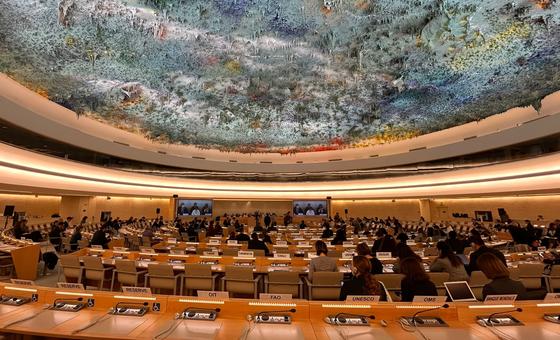
Addressing the Human Rights Council in Geneva at a scheduled meeting to discuss Iran’s rights record, the Deputy High Commissioner highlighted serious concerns that populated areas have been hit in the escalation.

“It is imperative that both sides fully respect international law, in particular by ensuring the protection of civilians in densely populated areas and of civilian objects,” she said. “We urge all those with influence to engage in negotiation as a matter of priority.”

Nuclear watchdog update

In a related development, the UN-backed nuclear watchdog said on Wednesday that two Iranian centrifuge production facilities had suffered major damage after being targeted.

“The TESA Karaj workshop and the Tehran Research Centre, were hit,” it said in an update. “At the Tehran site, one building was hit where advanced centrifuge rotors were manufactured and tested. 

At Karaj, two buildings were destroyed where different centrifuge components were manufactured,” said the International Atomic Energy Agency (IAEA).

Speaking at the Council after the Deputy High Commissioner, Iran’s Permanent Representative of Iran, Ambassador Ali Bahreini, condemned the Israeli strikes: 

“There has been no violation worse than [the] 13 June act of aggression against Iran,” he said, pointing to “continuous blind attacks on residential areas, bombardment of vital supplies, explosion of drinking water resources and reckless strikes on nuclear facilities are immediately impacting the civilians and people of Iran.”

Such “deliberate targeting” of his country’s nuclear facilities risked exposing local communities to a “possible hazardous leak”, the Iranian ambassador continued. “This is not an act of war against our country, it is war against humanity.”

In a short statement to the Council from which Israel announced its withdrawal earlier this year, Mr. Bahreini called for accountability and international condemnation of the Israeli attacks. 

“This impunity must come to [an] end,” he said. “Israel activities are not just against one or two countries. It is acting against all humanity and their actions target all human rights.”

Source link