
UN official reiterates call for Gaza ceasefire as ‘nightmare of historic proportions’ unfolds

Khaled Khiari, Assistant Secretary-General for the Middle East, told ministers and ambassadors that ongoing talks must lead to a permanent end to hostilities, the release of all hostages, unimpeded entry of humanitarian aid, and for recovery and reconstruction to begin.

He painted a grim picture of conditions on the ground, citing expanded Israeli military operations, particularly in Deir Al-Balah, which have led to further mass displacement.

UN premises were also struck, hampering humanitarian operations and exacerbating the already dire situation.

ASG Khiari briefs the Security Council.

Humanitarian toll deepens

At least 1,891 Palestinians have been killed in Gaza since 30 June, according to figures from Gazan health authorities, including 294 people reportedly killed while attempting to collect aid near militarised distribution points.  

Evacuation orders continue to force repeated displacement, while food insecurity and malnutrition are worsening despite a limited uptick in the entry of humanitarian supplies.

On the Israeli side, 13 soldiers have been killed in the same period. Palestinian armed groups have continued sporadic rocket attacks into Israel. According to Israeli sources, 50 hostages – including 28 believed to be dead – are still being held by Hamas and other groups.

The Secretary-General has repeatedly condemned the continued holding of hostages by Hamas and other armed groups,” Mr. Khiari stressed. “Hostages must be released immediately and unconditionally.

Places of worship struck

The briefing also highlighted growing concerns about civilian casualties and attacks on protected sites.  

Mr. Khiari condemned a 17 July strike on the Catholic Church of the Holy Family in Gaza City, which killed three and injured several others. The strike forced the evacuation of roughly 600 Palestinians, including children and persons with special needs, who had been sheltering there.

The Israeli Prime Minister’s Office expressed regret, describing the strike as the result of “stray ammunition,” and said an investigation was underway, Mr. Khiari reported.

© UN Women/Samar Abu Elouf

A woman and child walk through the heavily bombed town of Khuza’a in the Gaza Strip.

Dire fuel shortages

Since 9 July, Israel has allowed limited fuel deliveries through the Kerem Shalom/Karim Abu Salem crossing, after 130 days of a full blockade.

However, the amount is “a fraction of what is required to run essential life-saving services in Gaza, where nearly every aspect of life depends on fuel,” Mr. Khiari warned.

Occupied West Bank

Turning to the occupied West Bank, Mr. Khiari reported high levels of violence, including deadly Israeli military operations, attacks by settlers on Palestinians and retaliatory attacks by Palestinians against Israelis.

He noted that the Palestinian Authority (PA) is facing a severe fiscal crisis, with $2.7 billion in withheld clearance revenues, crippling its ability to pay salaries and provide basic services.

Unless urgently addressed, the deterioration of the PA’s fiscal and institutional situation could have catastrophic consequences, undermining the significant progress made over many years to build up Palestinian institutions,” he warned, urging immediate international support.

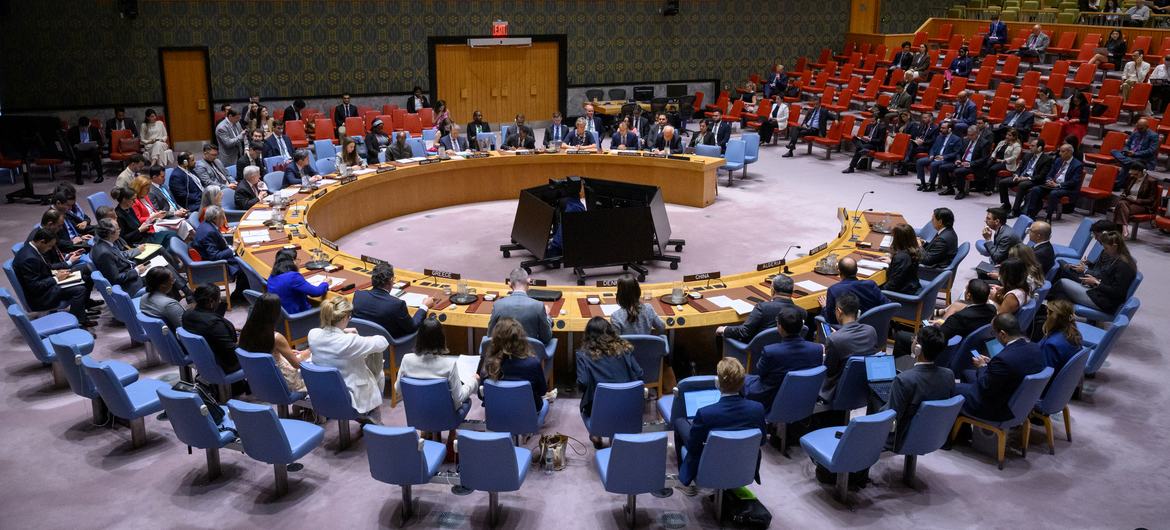
A wide view of the Security Council meeting on the situation in the Middle East, including the Palestinian question.

Tensions in the wider region

Mr. Khiari also highlighted continued tensions along the Blue Line between Lebanon and Israel, as well as renewed violence in Syria’s Sweida region and Israeli airstrikes on Syrian territory.

He urged both Israel and Syria to adhere to the 1974 Disengagement Agreement and to avoid any actions that risk escalating the conflict.

Call for a political horizon

Mr. Khiari concluded by reiterating that only a revived political process towards the two-State solution can deliver a sustainable solution.

Our goal is clear: realizing the vision of two States – Israel and a viable and sovereign Palestinian State of which Gaza is an integral part – living side by side in peace and security within secure and recognized borders, on the basis of the pre-1967 lines, with Jerusalem as the capital of both States,” he said.

UN reiterates call for urgent de-escalation amid Iran-Israel conflict, worsening Gaza crisis

In a joint call to de-escalate, UN agencies have warned that further conflict risks triggering new displacement in a region already strained by decades of war and instability.

The UN refugee agency (UNHCR) noted military strikes have led people in both Iran and Israel to flee their homes in search of safety from tit-for-tat missile strikes.

“Movements have been reported from Tehran and other parts of Iran, with some choosing to cross into neighbouring countries,” the agency stated. Meanwhile, “shelling has caused people in Israel to seek shelter elsewhere in the country and in some cases abroad.”

This region has already endured more than its share of war, loss, and displacement – we cannot allow another refugee crisis to take root,” said UN High Commissioner for Refugees Filippo Grandi. “The time to de-escalate is right now. Once people are forced to flee, there’s no quick way back – and all too often, the consequences last for generations.”

UNHCR urged countries in the region to respect the right to seek asylum and ensure humanitarian access to those affected, while calling on all parties to protect civilians and civilian infrastructure.

Nuclear risks rise as Iran facilities hit

The conflict escalated sharply following Israeli airstrikes on multiple Iranian nuclear-related sites in the past week, including a centrifuge manufacturing workshop in Esfahan, according to the UN’s International Atomic Energy Agency (IAEA).

“This is the third such facility that has been targeted over the past week,” Director General Rafael Mariano Grossi confirmed, noting that the facility had been under IAEA surveillance as part of the Joint Comprehensive Plan of Action (JCPOA) – the nuclear deal signed with Iran in 2015, which the United States pulled out of in 2017.

“We know this facility well. There was no nuclear material at this site and therefore the attack on it will have no radiological consequences,” he said. However, Mr. Grossi warned that continued strikes on nuclear infrastructure are severely undermining nuclear safety and security.

Though they have not so far led to a radiological release affecting the public, there is a danger this could occur.”

The IAEA has been tracking damage to sites in Esfahan, Arak, Karaj, Natanz and Tehran since the Israeli military campaign against Iran began on 13 June. T

he agency has been providing regular updates to the UN Security Council, which has yet to reach consensus on a response. On Friday, ambassadors debating the escalation heard during an emergency meeting in New York heard UN Secretary-General António Guterres warn that if fighting escalated it could “ignite a fire no one can control.”

Gaza in ruins, Palestinians face starvation

The mounting regional crisis is unfolding against the backdrop of the war in Gaza, where humanitarian conditions continue to deteriorate.

On Saturday, the head of the UN agency for Palestine refugees (UNRWA), Philippe Lazzarini, painted a grim picture of life in the enclave during an address to the Organisation of Islamic Cooperation in Istanbul.

In Gaza, two million people are being starved,” he said bluntly. “The newly created, so-called ‘aid mechanism’ is an abomination that humiliates and degrades desperate people. It is a death-trap, costing more lives than it saves.”

Lazzarini described a territory devastated by nearly two years of conflict, with more than 55,000 reported dead by local authorities in the Strip – the majority of them women and children.

Survivors, he said, “are shadows of their former selves; their lives forever changed by unspeakable trauma and profound loss.”

In the occupied West Bank, displacement and destruction of public infrastructure are altering the demography of Palestinian camps, he added, in what he described as an effort to erase the prospect of a Palestinian State under the UN-backed two-State solution and strip Palestinians of refugee status.

UNRWA in the crosshairs

UNRWA has become an objective of this war,” Mr. Lazzarini warned, citing the deaths of at least 318 of the agency’s staff in Gaza since the 7 October terror attacks on Israel by Hamas and other militants, the expulsion of international staff, and a campaign of disinformation aimed at crippling its funding.

Despite these pressures, UNRWA continues to provide lifesaving services, including over 15,000 health consultations per day, waste management and shelter support.

UNRWA’s financial situation is now “dire,” the agency chief said. “Without additional funding, I will soon have to take unprecedented decisions affecting our operations across the region.”

He appealed to Member States to act urgently: “The sudden loss or reduction of UNRWA’s services will only deepen suffering and despair across the occupied Palestinian territory. It might spark unrest in the neighbouring countries. This is something that the region cannot afford, especially now.”

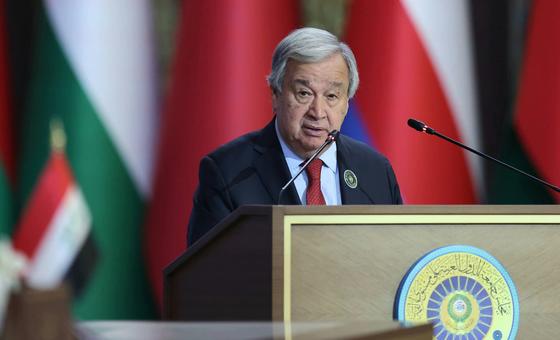
At Arab League Summit, Guterres reiterates call for Gaza ceasefire

António Guterres told leaders meeting in the Iraqi capital that “the region and the world face trials and tests on all fronts,” starting with the situation in Gaza.

He reiterated that neither the atrocious 7 October 2023 terror attacks by Hamas nor the collective punishment of the Palestinian people can be justified.

Permanent ceasefire now

“We need a permanent ceasefire, now. The unconditional release of all hostages, now. And the free flow of humanitarian aid ending the blockade, now,” he said.

The Secretary-General expressed alarm over reports that Israel plans to expand ground operations in Gaza and stressed that the UN “will not participate in any so-called aid operation that does not adhere to international law and the humanitarian principles of humanity, impartiality, independence and neutrality.”

He again called for full support for UN Palestine refugee agency UNRWA, including funding.  

Two-State solution at risk

The UN chief rejected the repeated displacement of the Gaza population, as well as any suggestion of forced displacement outside Gaza, and urged leaders to remain focused on the terrible situation in the occupied West Bank.

“Let’s be clear,” he said. “Annexation is illegal.  Settlements are illegal. Only a two-State solution can deliver sustainable peace.”

He said the high-level conference in June, co-chaired by France and Saudi Arabia, is an important opportunity.

“The world, the region – and, most of all, the people of Palestine and Israel – cannot afford to watch the two-State solution disappear before our eyes,” he said.

Respect Lebanese sovereignty

The Secretary-General addressed the situation in Lebanon.  He emphasized that the country’s sovereignty and territorial integrity must be respected, and the Government must have full control over the entire territory.

He was encouraged by continued progress on reforms as well as efforts to deploy the Lebanese Armed Forces to the south, with support from the UN Mission in the country, UNIFIL.

Mr. Guterres touched on Syria, saying sovereignty, independence, unity and territorial integrity are critical.  He urged strong support for an inclusive Syrian-led and Syrian-owned political process that safeguards the rights and participation of all the country’s people and ensures their protection.

Regarding Yemen, he noted that attacks by Houthi rebels in the Red Sea have caused significant damage to regional and local economies. He welcomed the cessation of hostilities between the Houthis and the United States, announced by Oman on 6 May.

The Secretary-General also called for the release of UN staff and other personnel in Yemen who have been arbitrarily arrested.

Engagement on Sudan

In Sudan, renewed and coordinated multilateral engagement is crucial to help stem appalling violence, famine, and mass displacement, he said, and thanked the Arab League and African Union (AU) for the excellent coordination meeting convened the previous day.  He also commended the Arab League’s efforts to strengthen multilateral coordination.

The Secretary-General turned next to Somalia, saying unity and inclusive dialogue are imperative. Furthermore, assistance from Somalia’s partners will be essential in the fight against Al-Shabaab militants and to strengthen peace and security.

For this reason, Mr. Guterres said he has put forward a recommendation to the UN Security Council to enable predictable and sustainable financing for the AU Support and Stabilization Mission in the country.

Meanwhile in Libya, the UN is also actively engaging in efforts to end the confrontation between armed groups, to preserve the independence of key oversight institutions, to address obstacles preventing national elections, and set the course for long-term stability and prosperity in line with the people’s needs and aspirations.

Lessons from Baghdad

The Secretary-General concluded his remarks by commending the progress Iraq has made over since the restoration of sovereignty in 2004, such as strengthening institutions, resolving outstanding disputes through dialogue, and promoting sustainable development as well as human rights.

He said the UN Assistance Mission in Iraq (UNAMI) has accompanied the country on this path and is working to ensure the successful delivery of its residual mandate and an orderly drawdown by the end of the year.

“Despite the enormous challenges, let us draw lessons and hope from here in Baghdad. Working in unity and solidarity, we can help resolve conflicts and build a future of peace and prosperity,” he said.

Gaza situation ‘beyond inhumane’

Speaking later to reporters, Mr. Guterres said the situation for Palestinians in Gaza “is beyond description, beyond atrocious and beyond inhumane.”

Since 2 March, Israel has banned the entry of cargo into the Strip, including aid and other life-saving supplies. UN agencies continue to warn that the entire population, 2.1 million people, is at risk of famine and one if five faces starvation.

“A policy of siege and starvation makes a mockery of international law,” he said, calling for the blockade to end immediately.

Source link