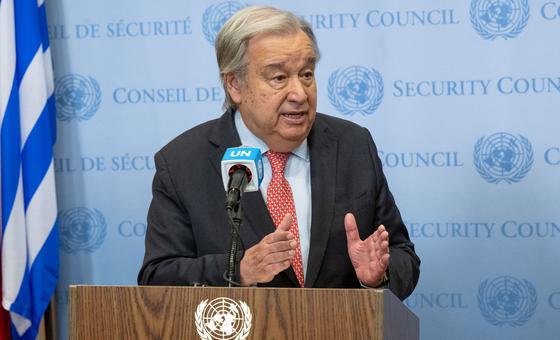
Khaled Khiari, Assistant Secretary-General for the Middle East, told ministers and ambassadors that ongoing talks must lead to a permanent end to hostilities, the release of all hostages, unimpeded entry of humanitarian aid, and for recovery and reconstruction to begin.
He painted a grim picture of conditions on the ground, citing expanded Israeli military operations, particularly in Deir Al-Balah, which have led to further mass displacement.
UN premises were also struck, hampering humanitarian operations and exacerbating the already dire situation.
Humanitarian toll deepens
At least 1,891 Palestinians have been killed in Gaza since 30 June, according to figures from Gazan health authorities, including 294 people reportedly killed while attempting to collect aid near militarised distribution points.
Evacuation orders continue to force repeated displacement, while food insecurity and malnutrition are worsening despite a limited uptick in the entry of humanitarian supplies.
On the Israeli side, 13 soldiers have been killed in the same period. Palestinian armed groups have continued sporadic rocket attacks into Israel. According to Israeli sources, 50 hostages – including 28 believed to be dead – are still being held by Hamas and other groups.
“The Secretary-General has repeatedly condemned the continued holding of hostages by Hamas and other armed groups,” Mr. Khiari stressed. “Hostages must be released immediately and unconditionally.”
Places of worship struck
The briefing also highlighted growing concerns about civilian casualties and attacks on protected sites.
Mr. Khiari condemned a 17 July strike on the Catholic Church of the Holy Family in Gaza City, which killed three and injured several others. The strike forced the evacuation of roughly 600 Palestinians, including children and persons with special needs, who had been sheltering there.
The Israeli Prime Minister’s Office expressed regret, describing the strike as the result of “stray ammunition,” and said an investigation was underway, Mr. Khiari reported.
A woman and child walk through the heavily bombed town of Khuza’a in the Gaza Strip.
Dire fuel shortages
Since 9 July, Israel has allowed limited fuel deliveries through the Kerem Shalom/Karim Abu Salem crossing, after 130 days of a full blockade.
However, the amount is “a fraction of what is required to run essential life-saving services in Gaza, where nearly every aspect of life depends on fuel,” Mr. Khiari warned.
Occupied West Bank
Turning to the occupied West Bank, Mr. Khiari reported high levels of violence, including deadly Israeli military operations, attacks by settlers on Palestinians and retaliatory attacks by Palestinians against Israelis.
He noted that the Palestinian Authority (PA) is facing a severe fiscal crisis, with $2.7 billion in withheld clearance revenues, crippling its ability to pay salaries and provide basic services.
“Unless urgently addressed, the deterioration of the PA’s fiscal and institutional situation could have catastrophic consequences, undermining the significant progress made over many years to build up Palestinian institutions,” he warned, urging immediate international support.

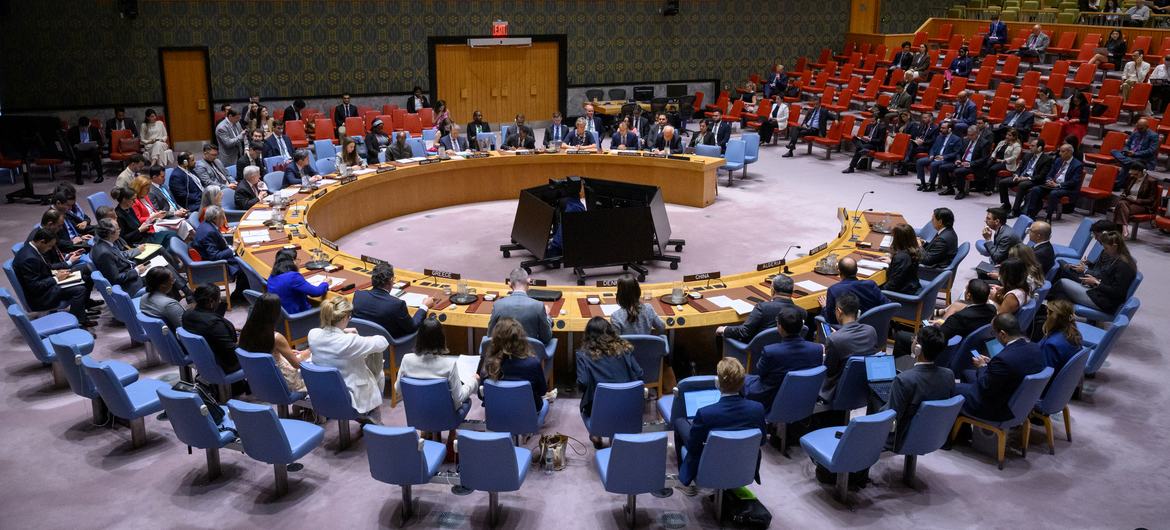
A wide view of the Security Council meeting on the situation in the Middle East, including the Palestinian question.
Tensions in the wider region
Mr. Khiari also highlighted continued tensions along the Blue Line between Lebanon and Israel, as well as renewed violence in Syria’s Sweida region and Israeli airstrikes on Syrian territory.
He urged both Israel and Syria to adhere to the 1974 Disengagement Agreement and to avoid any actions that risk escalating the conflict.
Call for a political horizon
Mr. Khiari concluded by reiterating that only a revived political process towards the two-State solution can deliver a sustainable solution.
“Our goal is clear: realizing the vision of two States – Israel and a viable and sovereign Palestinian State of which Gaza is an integral part – living side by side in peace and security within secure and recognized borders, on the basis of the pre-1967 lines, with Jerusalem as the capital of both States,” he said.