
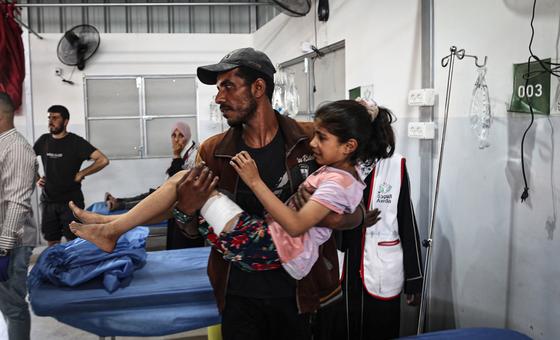
Gaza horrors continue as the weakest succumb to injuries and disease

“I met a little boy who was wounded by a tank shell at one of these sites on the final day of me leaving Gaza – I learnt that this little boy had since died of those injuries,” said UN Children’s Fund (UNICEF) spokesperson James Elder. “That speaks to both what is happening at these sites and what is not happening when it comes to medical evacuations.”

A recent online video featuring a dying 13-year-old Abed al-Rahman who Mr. Elder met while on mission in Gaza has been seen thousands of times since it was published on 6 June. In the clip, Abed explains that he has been asking for pain relief for his shrapnel wounds, but none is available.

Speaking to journalists from Amman, Mr. Elder explained that partly destroyed hospitals including Nasser Medical Complex in Khan Younis continue to treat wounded children, despite a shortage of medicine and medical supplies.

“Humanitarian aid is so much more than food in a box; it’s oxygen kits, it’s ventilators, it’s hygiene packs; it’s medicines, it’s incubators,” he explained. “It’s all those things the United Nations was doing just a couple of months ago.”

Mr. Elder added that parents whose children need oxygen have been leaving hospital “because of the fear that Nasser may come under attack again. As the doctors told me, if you have a child who needs oxygen and they leave without the oxygen, they will, over a matter of time, die in a tent.”

Desperation, starvation

The dire shortage of the most basic life-sustaining aid linked to Israeli restrictions continues to create desperation and starvation across Gaza.

“I spoke to a grandmother in tears saying, how am I possibly to get to these sites?” Mr. Elder explained. “I’ve met young men who’ve been seven times and never returned with anything. So, there’s a complete lack of equity. There’s a complete lack of sites. You cannot distribute aid in a militarised zone, in a combat zone, by one party to the conflict.”

Those most susceptible to the lack of fresh drinking water, food and fuel are the weakest Gazans: the young, pregnant women, the elderly and amputees, Mr. Elder said. 

It would be impossible for them to walk the long distances required to fetch scant supplies from controversial non-UN aid hubs.

Lethal choice

“You have half a million people facing starvation with a lethal choice of being forced into very small pockets where most people can’t access into what are officially known as combat sites,” the UNICEF spokesperson explained. “We know children [who have been] killed at these sites.”

Meanwhile, malnutrition and the impact of it on people’s weakened immune systems continues to take its toll, the UN World Health Organization (WHO) warned.

“The latest reports say 610 patients have been admitted due to severe malnutrition complications,” said WHO spokesperson Christian Lindmeier. “But what does that mean? That means these are the lucky ones who made it so far to get to a place. 

“This does not count the many who were too weak to reach any point, who are too weak, who cannot be transported because the roads are blocked, because there are no ambulances, or because the hospitals, some of the health emergency centres have been shelled and bombed and are being constantly shelled and bombed.”

Source link

Manuka Honey emerges miracle drug for lung infection if combined with widely used ‘amikacin’

A potential new treatment combining natural manuka honey with a widely used drug has been developed by scientists at Aston University to treat a potentially lethal lung infection and greatly reduce side effects of one of the current drugs used for its treatment.

Manuka honey can also be used to help treat wounds, injuries, improve oral health, soothe a sore throat and treat ulcers. The findings are published in the journal Microbiology.

The scientists in the Mycobacterial Research Group in the College of Health and Life Sciences at Aston University were able to combine manuka honey and the drug amikacin in a lab-based nebulisation formulation to treat the harmful bacterial lung infection Mycobacterium abscessus, said lead author and PhD researcher Victoria Nolan.

Manuka honey is long known to have wide ranging medicinal properties, but more recently has been identified for its broad spectrum antimicrobial activity. Now scientists have found that manuka honey has the potential to kill a number of drug resistant bacterial infections such as Mycobacterium abscessus – which usually affects patients with cystic fibrosis (CF) or bronchiectasis.

Manuka honey could help to clear deadly drug-resistant lung infection – research/Photo:Microbiology Society

According to the Cystic Fibrosis Trust, CF is a genetic condition affecting around 10,800 people – one in every 2,500 babies born in the UK – and there are more than 100,000 people with the condition worldwide. The NHS defines bronchiectasis  as a long-term condition where the airways of the lungs become widened, leading to a build-up of excess mucus that can make the lungs more vulnerable to infection..

In the study, the researchers used samples of the bacteria Mycobacterium abscessus taken from 16 infected CF patients. They then tested the antibiotic amikacin, combined with manuka honey, to discover what dosage was required to kill the bacteria.

Dr Jonathan Cox, senior lecturer in microbiology, Aston University said: “By combining a totally natural ingredient such as manuka honey with amikacin, one of the most important yet toxic drugs used for treating Mycobacterium abscessus, we have found a way to potentially kill off these bacteria with eight times less drug than before.”

As part of the study the team used a lab-based lung model and nebuliser – a device that produces a fine spray of liquid often used for inhaling a medicinal drug. By nebulising manuka honey and amikacin together, it was found they could improve bacterial clearance, even when using lower doses of amikacin, which would result in less life-changing side-effects to the patient.

In the UK, of the 10,800 people living with CF, Mycobacterium abscessus infects 13% of all patients with the condition. This new approach is advantageous not only because it has the potential to kill off a highly drug resistant infection, but because of the reduced side effects, benefitting quality of life and greatly improving survival chances for infected CF patients.

Mycobacterium abscessus is a bacterial pathogen from the same family that causes tuberculosis, but this bug differs by causing serious lung infections in people (particularly children) with pre-existing lung conditions, such as CF and bronchiectasis, as well as causing skin and soft tissue infections. The bacteria is also highly drug resistant.

Currently, patients are given a cocktail of antibiotics, consisting of 12 months or more of antimicrobial chemotherapy and often doesn’t result in a cure. The dosage of amikacin usually used on a patient to kill the infection is 16 micrograms per millilitre. But the researchers found that the new combination using manuka honey, required a dosage of just 2 micrograms per millitre of amikacin – resulting in a one eighth reduction in the dosage of the drug.

Until now Mycobacterium abscessus has been virtually impossible to eradicate in people with cystic fibrosis. It can also be deadly if the patient requires a lung transplant because they are not eligible for surgery if the infection is present.