Arun has been associated with India International Times since 2018 and he has been a key reporter in covering science and space related stories. He can be reached at arunKnn@indiainternationaltimes.com.
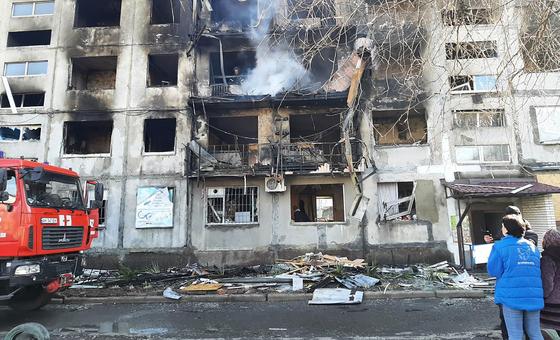
Donetsk, Kherson and Sumy regions sustained the most damage, with several civilians reportedly killed, and many displaced, UN Spokesperson Stéphane Dujarric told reporters at a regular news briefing on Thursday.
“Our humanitarian colleagues tell us that food insecurity remains a concern in front-line and border regions,” he added.
According to a recent assessment by the UN World Food Programme (WFP) and the Food and Agriculture Organization (FAO), the conflict has devastated livelihoods and quadrupled poverty levels, leaving the most vulnerable – particularly displaced people – at greatest risk.
Food insecurity on the front-line
WFP Executive Director Cindy McCain described the challenges.
“This frontline stretches 700 miles and countless towns and villages are still without the basics for survival,” she said.
This has made the work of humanitarians even more vital, with over 400,000 people in Donetsk and Kherson receiving food and agricultural support in addition to cash-based assistance.
In total, over 130 humanitarian organizations have distributed food and livelihood assistance to over 1.8 million people across the country.
Aid challenges
But with hostilities becoming increasingly deadly, humanitarian access remains limited. Since the start of the year, there has been a 50 per cent increase in civilian deaths when compared to the same period last year.
Authorities continue to urge the 10,000 people who remain in the front-line region to evacuate for their own safety.
“For those who stayed or those who came back, there are no jobs, no income and no opportunity,” Ms. McCain said.
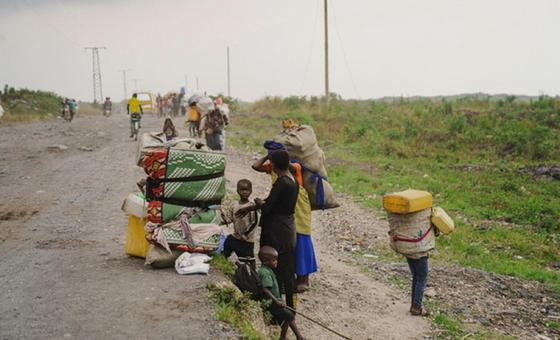
Speaking from the Goma region, whose main city was overrun by Rwanda-backed M23 rebels in January, UN Emergency Relief Coordinator Tom Fletcher explained that people had suffered “decades of trauma”.
The last few months have been “particularly horrific for so many”, he added, referring to the lawless fall-out from heavy fighting this year between the rebel fighters and the regular DRC army that has been linked to serious human rights abuses, including potential war crimes.
“Most striking today and yesterday has been the stories of sexual violence, and sitting with women who tell horrific stories which are too horrific for me to tell here and who are trying to find the courage to rebuild their lives,” the UN relief chief said.
“We’re there providing that support to them, trying to help them rebuild, but they have been through hell.”
Peace call
All those newly displaced by the M23 rebel advance are in addition to the five million people already living in displacement camps in eastern DRC. Today, more than 20 million people need relief assistance. “They are desperate for this conflict to end,” Mr. Fletcher continued.
A day after NATO Member States agreed to a five per cent increase in funding for their collective defence, investment in the humanitarian work of the UN and its partners is at rock bottom.
In DRC, a full 70 per cent of UN aid programmes was historically funded by the United States – “amazing generosity over decades” – Mr. Fletcher noted. But today “we’re seeing most of that disappearing”, he insisted, forcing the humanitarian community to make “brutal choices, life-and-death choices” about who receives help.
“For these women – the survivors of sexual violence, for the kids who told me they needed water, for the communities that told me they needed shelter, medicine, these cuts are real right now and people are dying because of the cuts,” the top UN official explained.
Aid teams haven’t stopped
Despite the difficulties linked to the protracted nature of the conflict in DRC and the massive needs, UN aid teams and their partners are “working hard to get access to those communities,” Mr. Fletcher insisted – “trying to get the airport back open, trying to get roads open, trying to unblock checkpoints that are impeding our aid from getting through”.
In an attempt to square the circle of the steadily diminishing amount of aid funding provided globally, Mr. Fletcher recently announced a “hyper-prioritized” plan to save 114 million lives this year. But that is dependent on receiving the necessary funding. “All we’re asking for to do that is one per cent of what the world spent on defence last year,” he continued.
After visiting and connecting with communities impacted time and again by the fighting, the top UN official insisted that they should not be forgotten. “They are the frontlines of the humanitarian effort,” he said.
Communities on front line
“I suppose the glimmer of hope in all of this is, yes, we can work in that more efficient and prioritized way and will do that; but also, the communities here who are – basically – they’ve come through so much and they are determined to support each other.”
And despite rising antipathy in some countries towards international cooperation including the work and peace-promoting efforts of the United Nations, Mr. Fletcher insisted that reasons for optimism remain.
“I really strongly believe there is a movement out there that will back this work, that will support this work,” he told UN News. “We’ve got to find them. We’ve got to enlist them, and we’ve got to show them that we can deliver for them.
“And, you know, I have not given up on human kindness and human solidarity. I have not given up on the UN Charter for a second. And this work is at the heart of it.”
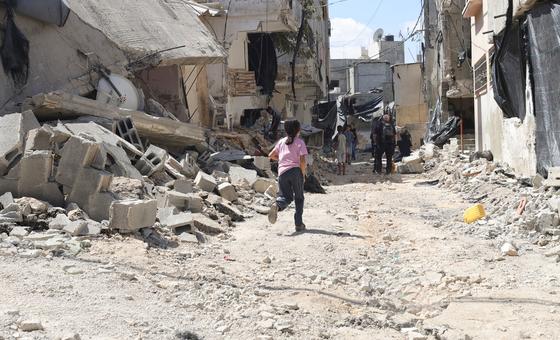
Israeli authorities have stepped up measures to transfer large numbers of people from long-standing Palestinian towns and communities, according to OHCHR’s office in the Occupied Palestinian Territory.
On 18 June, the High Planning Council in the Israeli Civil Administration issued a directive to reject all building and planning permits submitted by Palestinians in Masafer Yatta, South Hebron Hills, in the area referred by the Israeli authorities as Firing Zone 918.
The decision was based on the grounds that the Israeli army needs the area for “military training,” the rights office said.
Demolitions on the rise
In recent months, Israel has dramatically ramped up home demolitions, as well as the arbitrary arrest and ill-treatment of Palestinians and human rights defenders. This is happening alongside intensifying movement restrictions in and around Masafer Yatta, to force Palestinians out, the office noted.
At the same time, Israeli settlers from nearby outposts have carried out daily attacks and harassment of Palestinians, including older people, women and children, to force them to leave.
“The recent directive by the Israeli Civil Administration effectively paves the way for the Israeli army to demolish existing structures in the area and expel the approximately 1,200 Palestinians, who have been living there for decades,” OHCHR said.
“This would amount to forcible transfer, which is a war crime. It could also amount to a crime against humanity if committed as part of a widespread or systematic attack directed against any civilian population, with knowledge of the attack.”
Some 6,463 Palestinians have been forcibly displaced following the demolition of their homes by Israel between 7 October 2023 and 31 May 2025, according to the UN humanitarian affairs office, OCHA,
This figure does not include the approximately 40,000 Palestinians displaced from three refugee camps in Jenin and Tulkarem as a result of intensive Israeli operations in the northern West Bank since January.
During the same period, over 2,200 Palestinians were forcibly displaced by settler attacks and access restrictions.
More communities at risk
OHCHR added that countless other Palestinian communities face the same fate of forced displacement. It said that on 10 June, the Jerusalem municipality reportedly issued demolition notices for the entire village of An Nu’man, home to 150 people.
The village, which is located near Bethlehem, was cut off from the rest of the West Bank by the construction of the separation wall and incorporated into Israel’s unilaterally declared boundaries of the Jerusalem municipality. Most Palestinians were not provided with Jerusalem identification cards, effectively rendering them unable to access services in either East Jerusalem or the rest of the West Bank.
“These demolition notices appear to be another step by Israel to compound the coercive environment and forcibly transfer Palestinians from the village and consolidate the annexation of this land,” the office said.
Evictions in East Jerusalem
Meanwhile, Palestinians in occupied East Jerusalem also face the ongoing threat of forced eviction from their homes and lands.
OHCHR said that on 16 and 22 June, the Israeli Supreme Court endorsed the eviction of five Palestinian families, 37 people, from their homes in the Batn El Hawa neighbourhood of Silwan based on discriminatory laws that permit Jewish individuals to reclaim property lost in the 1948 war, while denying Palestinians the same rights.
Additionally, the Israel Land Authority issued eviction notices on 11 June for residencies in Umm Tuba. The 150 Palestinians affected were informed that the land was registered to the Jewish National Fund under the “settlement of land title”.
“These evictions form part of a concerted campaign by the Israeli State and settler organisations, which target Palestinian neighbourhoods to seize Palestinian homes and expand Jewish settlements,” OHCHR said.
The office stressed that these acts violate international law, which prohibits the confiscation of private property in occupied territory, as highlighted by the advisory opinion of the International Court of Justice (ICJ) last July.
December’s local, legislative and presidential elections “represent a crucial opportunity” to strengthen democratic governance, promote reconciliation and consolidate stability, Jean-Pierre Lacroix, Under-Secretary-General for Peace Operations told ambassadors in the Security Council.
The timely holding of presidential and legislative elections is a constitutional requirement, and the Government has consistently demonstrated its commitment to holding local elections, he added.
Although the final electoral roll is currently delayed due to technical difficulties, national authorities, supported by the UN peacekeeping mission, MINUSCA, have made significant efforts to advance the revision of the electoral register through nationwide registration.
“This process took place without major security incidents, reflecting effective collaboration between the Central African national defence forces and MINUSCA, as well as public interest in engaging with the political process,” said Mr. Lacroix.
Challenges remain
Although the 19 April agreement between the government and leaders of various opposition armed groups aimed to end hostilities in the country, violence – primarily perpetrated by armed groups and militias – continues to undermine stability.
“The security situation remains fragile in border regions,” said Mr. Lacroix, noting the spillover effects of the conflict in neighbouring Sudan.
Last week, a Zambian peacekeeper was killed when suspected Sudanese armed elements opened fire on a MINUSCA patrol responding to reports of an attack against civilians in the north-east of the country.
Mr. Lacroix also informed the Security Council of human rights and humanitarian concerns.
Though progress has been made in advancing judicial accountability, notably by the Special Criminal Court, a lack of funding is expected to jeopardise the Court’s operations by September.
In addition, as urgent needs continue to outpace available resources, “the humanitarian situation remains dire,” said Mr. Lacroix, calling for strong support for lifesaving humanitarian assistance.
The meals which families are able to obtain are nutritiously poor — thin broths, lentils or rice, one piece of bread or sometimes just a combination of herbs and olive oil known as duqqa.
Adults are routinely skipping meals in order to leave more for children, the elderly and the ill. And still, on average since January, 112 children have been admitted on a daily basis for acute malnutrition.
“[When my children wake up at night hungry] I tell them ‘Drink water and close your eyes.’ It breaks me. I do the same – drink water and pray for morning,” as one parent said.
Risking lives for food
Due to these extreme food shortages, people in Gaza are forced to risk their lives on a daily basis to access small amounts of food. Since 27 May, 549 Palestinians have been killed and 4,066 have been injured trying to access food, according to the Ministry of Health (MoH) in Gaza.
“The majority of casualties have been shot or shelled trying to reach US-Israeli distribution sites purposefully set up in militarized zones,” said Johnathan Whittall, head of office for the UN humanitarian affairs agency, OCHA, in the Occupied Palestinian Territories.
Since the end of May, the US-Israeli backed Gaza Humanitarian Foundation (GHF) has been distributing aid in Gaza, bypassing the UN and established NGOs.
The UN has said Palestinians who seek aid from the GHF face threats of gunfire, shelling and stampedes.
“We don’t want to be out there. But what choice do we have? Our kids cry for food. We don’t sleep at night. We walk, wait, and hope we come back,” one Palestinian told WFP.
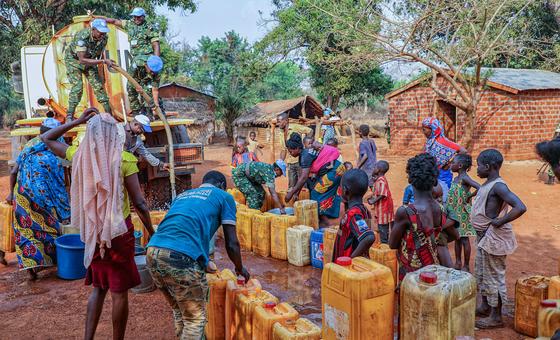
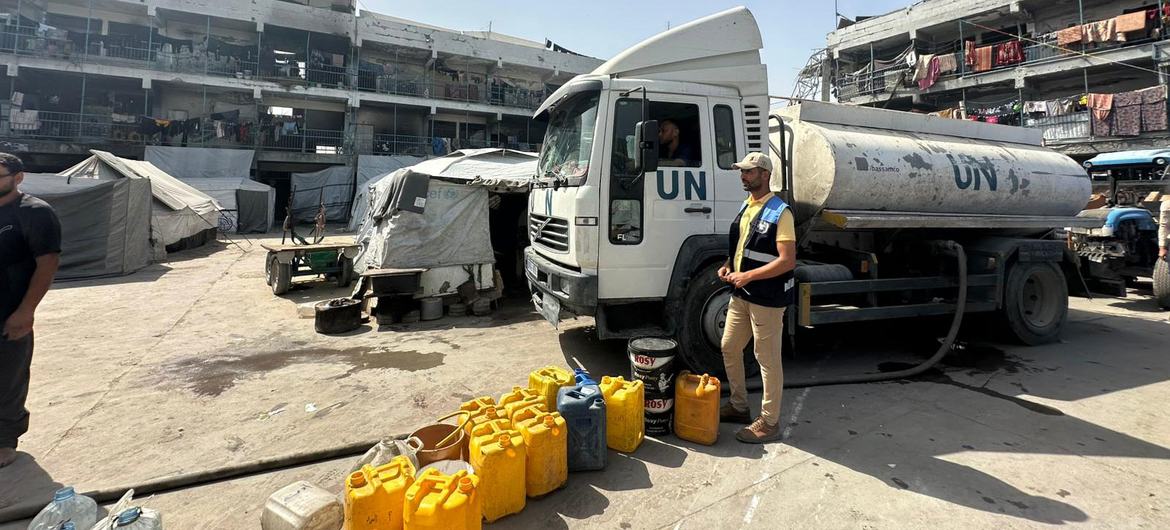
Water is delivered to Gazans sheltering at an UNRWA school.
Systems near collapse
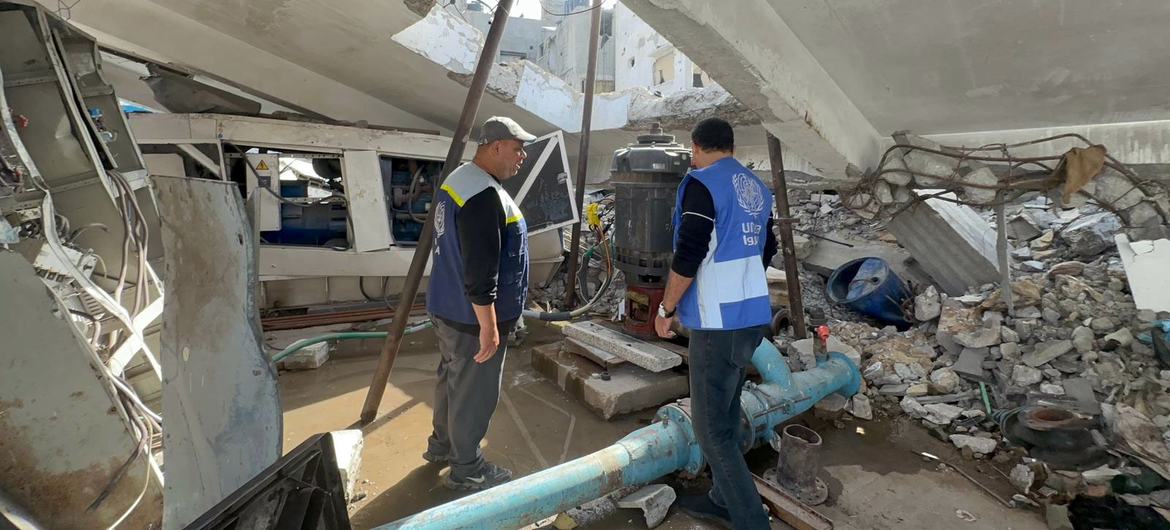
Protracted conflict and bombardment have pushed almost all service systems in Gaza to the brink.
As a result of fuel shortages, only 40 per cent of drinking water facilities are functional and 93 per cent of households face water insecurity.
The fuel shortage is also negatively affecting the provision of medical services with medical equipment and medicine storage reliant on electricity.
For the first time since the resumption of limited aid entry on 19 May, nine trucks containing medical items offloaded supplies on the Israeli side of the Kerem Shalom crossing on Wednesday.
Displaced, over and over again
Since the resumption of Israeli bombardment in Gaza on 18 March after a 42-day ceasefire, over 684,000 Palestinians have been displaced. And for almost all of them, this is not the first time.
With over 82 per cent of Gaza either designated as an Israeli militarized zone or under a displacement order, there are few places — much less safe places — that the newly displaced can go.
They have been forced to take shelter in overcrowded displacement camps, makeshift shelters, damaged buildings and sometimes just on open streets. Schools are no longer buildings of learning but of shelter.
An UNRWA member of staff inspects destroyed infrastructure.
“Schools have transformed into empty shelters, devoid of any elements of a safe learning environment,” said Kamla, a teacher with the UN Relief and Works Agency for Palestinian Refugees in the Near East (UNRWA) in Nuseirat.
All of these shelters are experiencing rapidly deteriorating conditions as a result of insufficient shelter materials, according to Stéphane Dujarric, spokesperson for the Secretary-General.
“No shelter materials have entered Gaza since 1 March, before the Israeli authorities imposed a full blockade on aid and any other supplies for nearly 80 days,” he said at a briefing on 19 June.
“While some commodities have subsequently been allowed in small quantities, tents, timber, tarpaulins and any other shelter items remain prohibited.”
The UN and its partners have 980,000 shelter items prepared to dispatch into Gaza once authorization is granted by the Israeli authorities.
‘Symbols of hope’
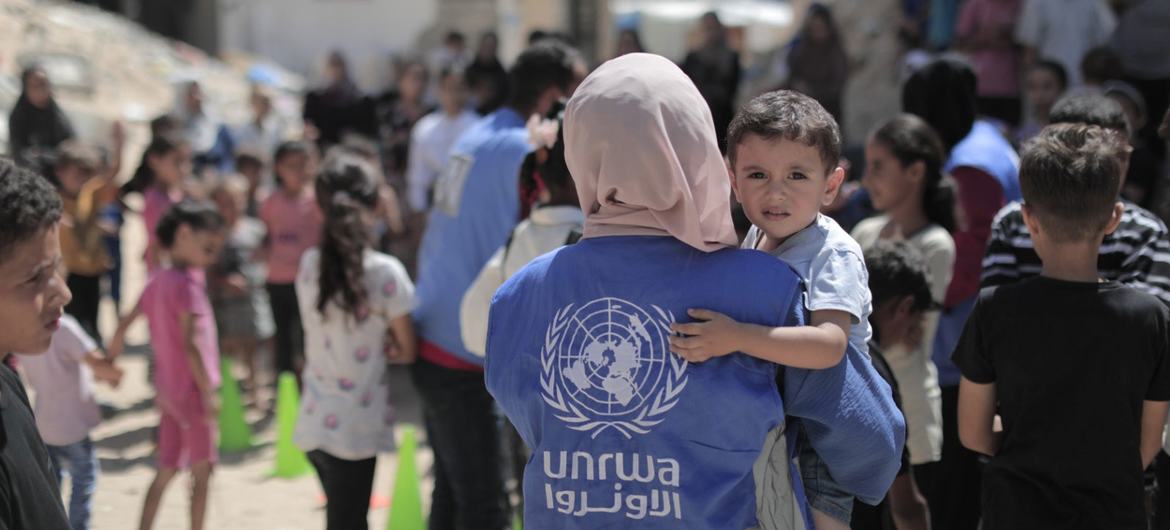
Since the beginning of the violence in Gaza, UNRWA has continued to work tirelessly to provide displaced and injured Palestinians with many types of support.
“Despite all this, the eyes and hopes of our community remain fixed on us. UNRWA staff are not merely service providers. In the eyes of people in Gaza, we are pillars of resilience, lifelines of stability and symbols of hope,” said Hussein, an UNRWA worker in Gaza City.
An UNRWA worker carries a young boy in Gaza.
But as fuel shortages continue and only small amounts of humanitarian aid — food, medicine, shelter materials — trickle through the Kerem Shalom border crossing, the job of UNRWA workers and other humanitarians in Gaza is increasingly untenable.
“We have lost all the tools needed to work, so we have had to adapt,” said Neven, a psychosocial UNRWA worker in Khan Younis.
Dspite their best efforts, the bombardment and devastation of Gaza continues with children going hungry and some even expressing suicidal thoughts.
“I told my daughter her deceased father is safe, eating and drinking with God,” one mother said. “Now, she cries every day and says, ‘I’m hungry and want to go to my father because he has food to feed us.’”
Under cooler skies after days of intense heat, the run ended where it all began, at the original UN Charter – the document that launched the Organization and reshaped the modern international order – now on display at UN Headquarters.
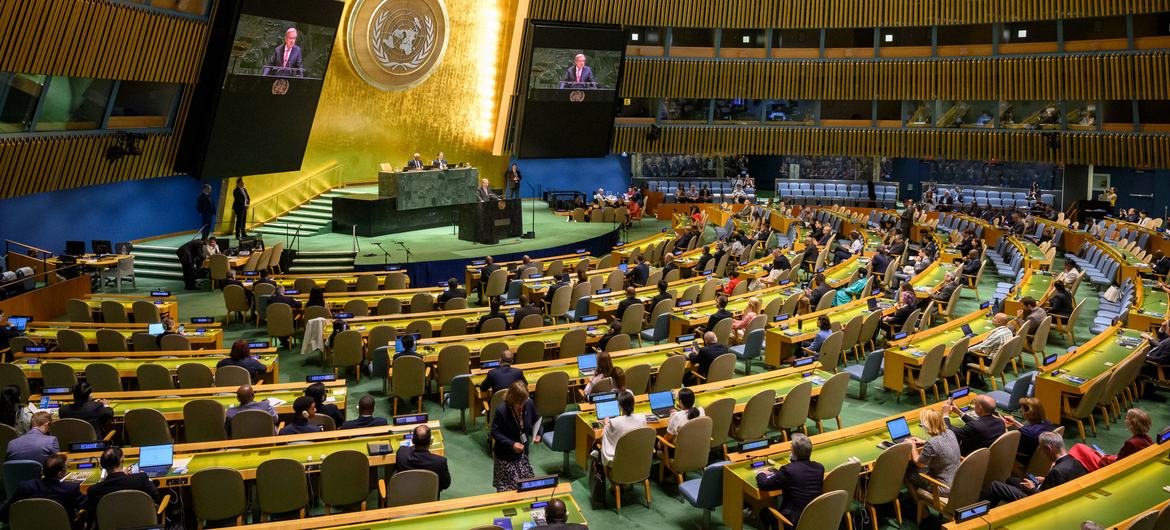
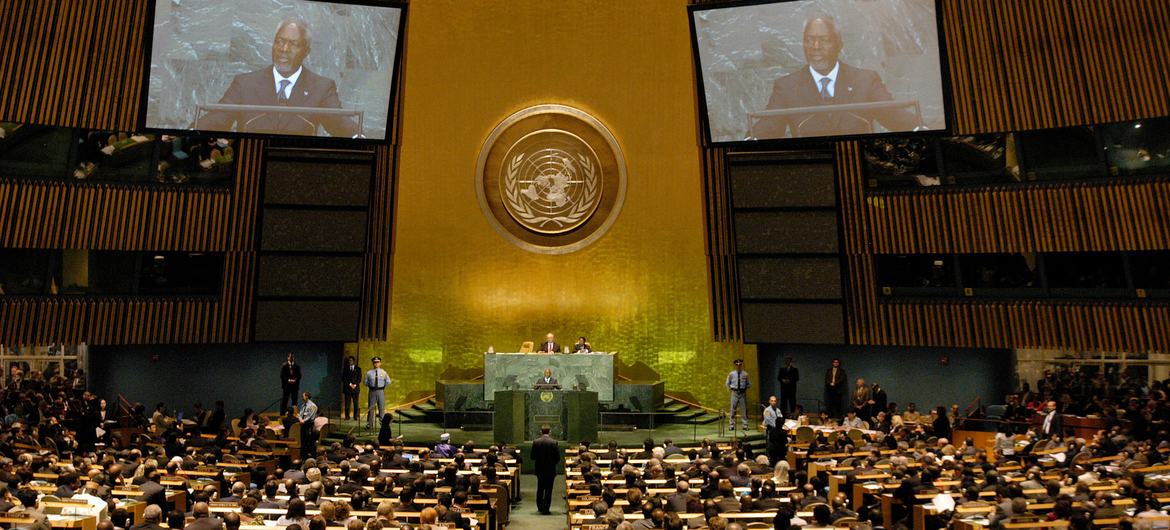
Inside the General Assembly Hall, delegates gathered to commemorate the 80th anniversary of its signing.
They reflected on the past eight decades in which the UN helped rebuild countries after the Second World War, supported former colonies’ independence, fostered peace, delivered aid, advanced human rights and development, and tackling emerging threats like climate change.
To save succeeding generations from the scourge of war
General Assembly President Philémon Yang described the moment as “symbolic” but somber, noting ongoing conflicts in Gaza, Ukraine and Sudan, and the growing challenges to multilateralism.
He urged nations to choose diplomacy over force and uphold the Charter’s vision of peace and human dignity: “We must seize the moment and choose dialogue and diplomacy instead of destructive wars.”
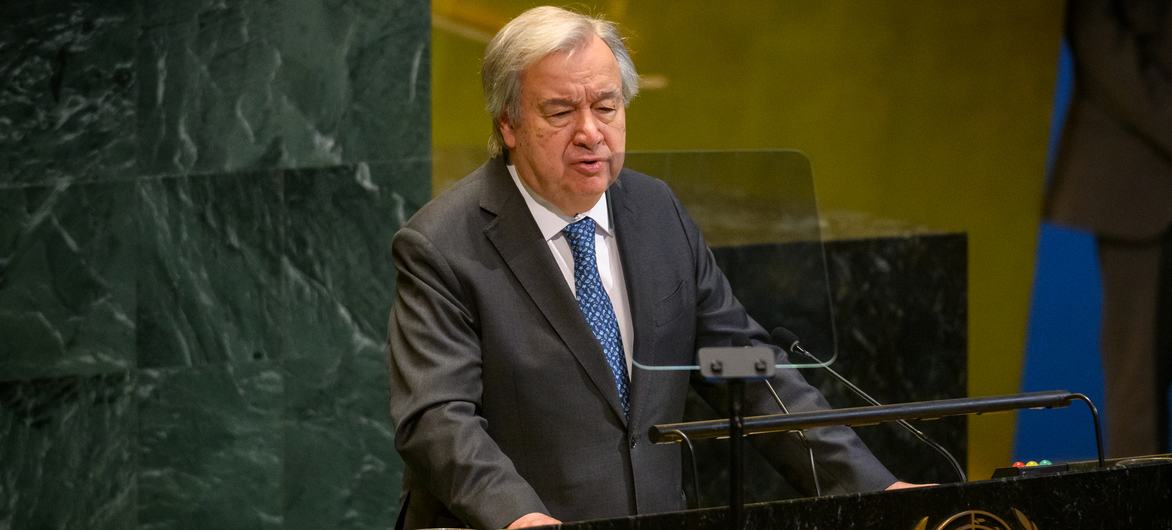
Secretary-General António Guterres echoed this call, warning that the Charter’s principles are increasingly under threat and must be defended as the bedrock of international relations.
“The Charter of the United Nations is not optional. It is not an à la carte menu. It is the bedrock of international relations,” he said, stressing the need to recommit to its promises “for peace, for justice, for progress, for we the peoples.”
Carolyn Rodrigues-Birkett, Security Council President for June, emphasized the urgency of renewed collective action to address emerging global threats.
“Let this 80th anniversary of the Charter be not just an occasion for reflection, but also a call to action,” she urged.
General Assembly commemorates 80th anniversary of the signing of UN Charter.
To unite our strength to maintain international peace and security
Eighty years ago, on 26 June 1945, delegates from 50 countries gathered in San Francisco to sign a document that would change the course of history.
Forged in the aftermath of the Second World War, by a generation scarred by the Great Depression and the Holocaust and having learnt the painful lessons of the League of Nations’ collapse, the Charter of the United Nations represented a new global pact.
Its preamble – “We the peoples of the United Nations” – echoed the determination to prevent future conflict, reaffirm faith in human rights, and promote peace and social progress.
That very document, preserved by the United States National Archives and Records Administration, has returned – for the first time in decades – to the heart of the institution it founded.
Now on public display at UN Headquarters through September, the original Charter stands as a powerful symbol: not just of a past promise, but of an enduring commitment to multilateralism, peace and shared purpose.
Video: UN Charter returns to UN Headquarters
To promote social progress and better standards of life
Bob Rae, ECOSOC President, drew an arc through human history to underscore the UN’s relative youth – just eight decades old in a global context of millennia.
“We currently have the advantage of being able to lucidly look at what we have accomplished, while also recognizing our successes and failures,” he said, holding up a copy of the Charter once used by his father.
“The United Nations is not a government and the Charter is not perfect,” he said, “but it was founded with great aspirations and hope.”
ICJ President Judge Yuji Iwasawa reflected on the progress since 1945 and the challenges still facing the global community.
“In the 80 years since the drafters of the Charter set down their pens, the international community has achieved remarkable progress. However, it also faces many challenges,” he said. “The vision of the Charter’s drafters to uphold the rule of law for the maintenance of international peace and security, remains not only relevant but indispensable today.”
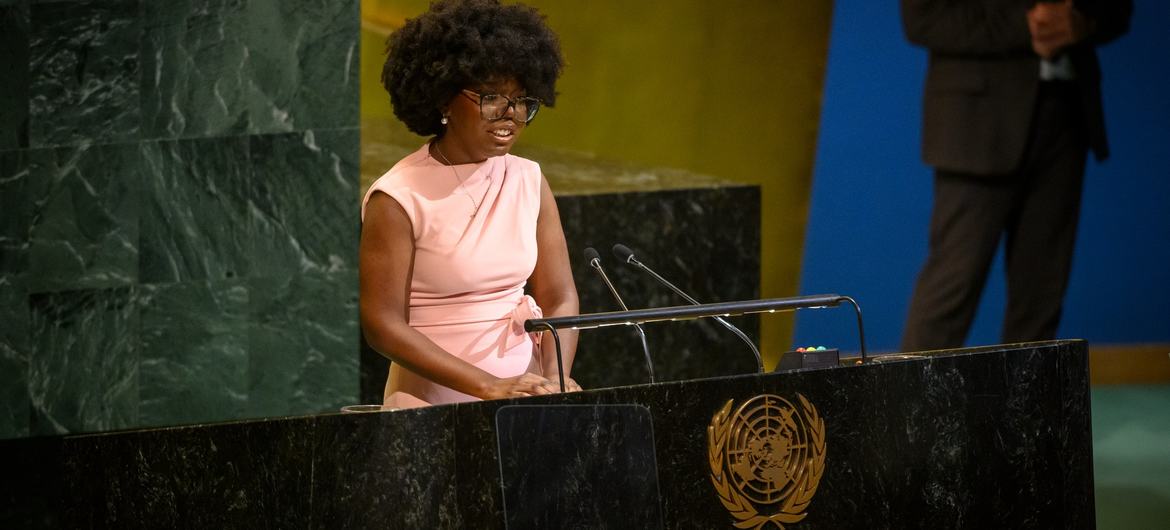
Jordan Sanchez, a young poet, speaks at the General Assembly during the commemoration of the 80th anniversary of the signing of the UN Charter.
To reaffirm faith in fundamental human rights
In a powerful reminder that the Charter speaks not only to the past but to future generations, Jordan Sanchez, a young poet took the stage.
Her spoken word piece, Let the Light Fall, evoked not declarations, but feelings of hope and vision for a better world.
“Let the light fall,” she began, “on fallen faces hidden in the shadow of scorn…where may the children run towards the light of your face, towards the warmth of your presence and the stillness of your peace.”
“There is no fear, only abundance, of safety, of security, of knowing there will always be enough light for me” she said, describing a dreamscape of Eden restored – not a paradise lost, but glimpsed in justice, fairness and shared humanity.
“Let us be bold enough to look down and take it, humble enough to kneel down and bathe in it, loving enough to collect and share it, and childish enough to truly, truly believe in it.”
The equal rights of men and women
As the world marks 80 years of the UN Charter, it’s worth remembering that its promise of equal rights for men and women was hard-won from the very start.
In 1945, just four women were among the 850 delegates who gathered in San Francisco to sign the document, and only 30 of the represented countries granted women the right to vote.
In a 2018 UN News podcast, researchers spotlighted these overlooked trailblazers – and asked why the women who helped shape the UN’s founding vision are so often left out of its story.
Listen to the podcast here.
Note: The subheads in this article are taken directly from the Preamble of the United Nations Charter, whose enduring language continues to guide the Organization’s mission.
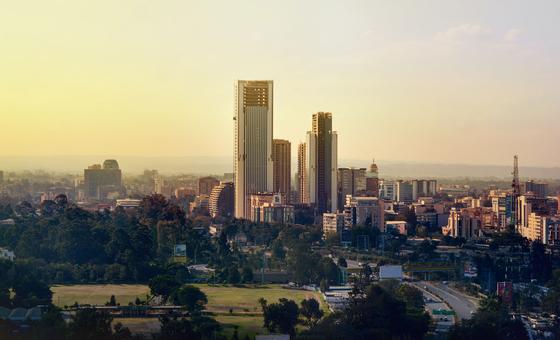
At least 400 people were injured, including police officers, according to media reports. The official death toll has not been confirmed, with estimates ranging from eight to 16.
The demonstrations marked the anniversary of last year’s anti-tax protests, when 60 people were reportedly killed and dozens abducted by police.
This year, anger intensified following the death of blogger Albert Ojwan, 31, who died in police custody earlier this month.
The demonstrators reportedly targeted government and police offices, chanted for the occupation of the presidential residence and attacked, looted and burned shops and businesses in Nairobi.
At a press conference, Kenyan Interior Minister Kipchumba Murkomen accused protestors of attempting to unconstitutionally enact “regime change.”
He also said nine police stations were attacked, dozens of vehicles destroyed, and five guns were stolen.
UN Human Rights response
On Thursday, as smoke still rose from torched buildings in Nairobi, the UN human rights office, OHCHR, released a statement expressing concern.
Alarmed by reports that protesters had been wounded or killed by gunfire, OHCHR stressed that under international human rights law, law enforcement should only use lethal force when strictly necessary to protect life or prevent serious injury from an imminent threat.
The office welcomed the announcement that Kenya’s Independent Policing Oversight Authority will investigate the incidents and underlined the need for “prompt, thorough, independent and transparent investigations to bring those responsible to justice” and prevent recurrence.
OHCHR also called for calm and restraint.
UN Spokesperson Stéphane Dujarric echoed these concerns at the daily press briefing in New York, saying: “We are obviously concerned about the violence we have seen in Kenya. We are closely monitoring the situation. We are very saddened by the loss of life.”
He also reiterated concerns over the reported gunshot wounds and welcomed plans for oversight investigations.
Despite the current government’s hostility to the trade, the country remains a hub for the production and distribution of the drug.
During the country’s long-running civil war, the Assad regime was hit by sanctions and diplomatic isolation, and the trade in Captagon is believed to have brought in billions of dollars for the dictator and his allies.
The country’s attitude towards the trade changed markedly after the fall of Assad in December 2024, and the rise to power of a transitional government led by members of the Islamist group HTS and comprising members of many of Syria’s ethnic groups. The current administration has pledged to disrupt the supply chain and has demonstrated this by publicly destroying large quantities of seized Captagon.
Thousands of people gathered in Damascus on Friday to celebrate the fall of the Assad regime.
However, the most recent edition of the World Drugs Report, released by the UN Office on Drugs and Crime (UNODC) on 26 June, warns that Syria remains a major hub for the drug, despite the crackdown.
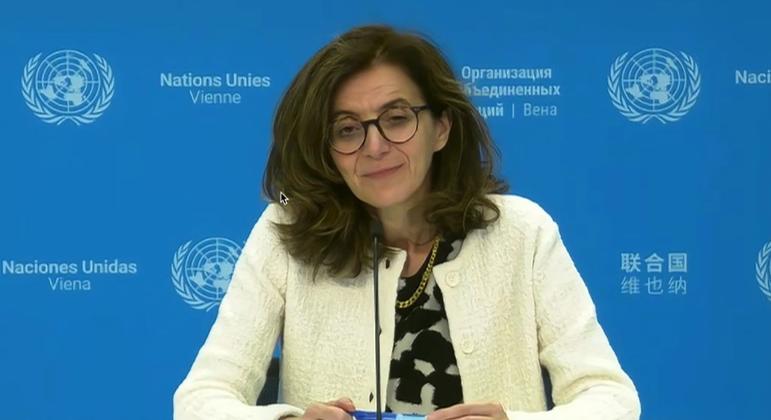
Ahead of the launch, Angela Me, the head of social affairs at UNODC, talked to UN News about the continued use of Captagon in the region,
Angela Me: Captagon is a stimulant, similar to methamphetamine, which is taken as a pill, and for many years it has been the main drug of concern in the Gulf state and parts of North Africa.
It was called the “Jihadi pill” after it was found that the perpetrators of some terrorist attacks had used it. On the battlefield it helps to maintain energy, which is one reason it is so widespread. But users quickly become dependent, and it causes physical and mental health problems.
UN News: The transitional government of Syria has indicated that they do not tolerate this trade, but your report shows that Syria is still a big hub for Captagon. Who is producing and selling?
Angela Me: There is a lot of uncertainty around that. We see a lot of large shipments going from Syria through, for example, Jordan. There are probably still stocks of the substance being shipped out, but we’re looking at where the production may be shifting to. We’re also seeing that the trafficking is expanding regionally, and we’ve discovered labs in Libya.
UN News: Given the large amounts of money generated by drugs, are there still groups in Syria that would like to carry on the trade in the parts of the country they control?
Angela Me: Definitely, and not only in Syria, but also in the wider region. These groups have been managing Captagon for a long time, and production is not going to stop in a matter of days or weeks.
We are helping countries to tackle the problem from an organised crime perspective, to understand the criminal groups involved, so that they can design responses and solutions: our research shows that there is not one single response to dismantle the groups.
We also help law enforcement to connect with their peers in the region, because this is not a national problem. It’s clearly a transnational problem which goes beyond the Middle East; we have been seeing Captagon traffic through Europe, for example.
Another way we can support is by addressing the health-related issues, sharing evidence-based treatment that can really help people to recover from their dependence on the drug.
Today, a $4 trillion financing gap is hindering progress toward achieving the Sustainable Development Goals (SDGs) by the end of this decade.
In response, the Fourth International Conference on Financing for Development (FFD4) will take place in Sevilla, Spain, beginning on 30 June, bringing together stakeholders to advance solutions to the financing challenges threatening sustainable development.
“We’ve seen mounting debt burdens and declining investment, and we’ve seen reduced aid and growing trade barriers. The current system is certainly not delivering for the people it was designed to support,” said Deputy Secretary-General Amina Mohammed at a briefing on Wednesday about the conference.
She was joined by Ambassador Héctor Gómez Hernández of Spain, and Ambassador Chola Milambo of Zambia.
Role of stakeholders
More than 70 heads of state and government will attend the Conference, along with leaders of international financial institutions, civil society, philanthropies and the private sector, including those from energy, food systems and digital industries.
“The collective presence alone, I believe, sends a good signal for multilateralism at a time when we’re facing quite a bit of pushback,” said Ms. Mohammed.
Ms. Mohammed stressed that the Commitment addresses the debt crisis in developing countries that are particularly vulnerable to financing shortfalls, as many spend more on debt interest than on essential services, straining the opportunity for sustainable development.
Ambassador Milambo explained that this will be done through greater transparency, a global debt registry, and amplifying the voices of debtor countries.
It also aims to catalyse investment by tripling Multilateral Development Bank (MDB) lending, doubling Official Development Assistance (ODA) to developing countries, leveraging private sector investment and ensuring the international financing system is more inclusive and effective.
“This is an agenda that world leaders can do something about. They do have the tools – and the political clout – to make it happen,” said Ms. Mohammed.
Test of multilateralism
Ambassador Hernández emphasised that the Conference comes at a critical time for multilateralism.
“This conference is an appeal to action, and we have the extraordinary opportunity to send a very strong message to defend the international community’s commitment to the multilateral system,” he said.
Ambassador Milambo later added that the consensus on the Seville Commitment “sends a real message of hope to the world that we can tackle the financing challenges that stand in the way of the SDGs and that multilateralism can still work.”
Despite the consensus, the United States recently announced it will not send a delegation to the Conference.
Speakers urged observers to keep the broader picture in mind: “It is regrettable, but it doesn’t stop us from continuing to engage with that Member State” and urge a change in the course of action, said Ms. Mohammed.
She concluded by noting that, especially given the recent agreement of the Commitment, the discussions the UN is having with other donors on how they are trying to use resources more efficiently will hopefully go a long way.
Addressing the General Assembly, António Guterres said that the world is witnessing more armed conflicts than at any time since the end of the Second World War.
“Too often, early warnings go unheeded, and alleged evidence of crimes committed by States and non-State actors are met with denial, indifference, or repression,” he told Member States on Wednesday.
“Responses are often too little, too late, inconsistent, or undermined by double standards. Civilians are paying the highest price.”
Known as the Responsibility to Protect, or R2P, the pledge affirmed that sovereignty carries not just rights, but responsibilities – foremost among them, the duty of every State to safeguard its own people.
When national authorities manifestly fail to do so, the international community has a duty to act – collectively, timely and decisively – in accordance with the UN Charter.
Secretary-General António Guterres addresses the UN General Assembly meeting on the responsibility to protect and the prevention of genocide, war crimes, ethnic cleansing, and crimes against humanity.
An unfulfilled promise
“Two decades on, the Responsibility to Protect remains both an urgent necessity, a moral imperative and an unfulfilled promise,” he said.
He cited worsening identity-based violence, deepening impunity, and the weaponization of new technologies as compounding threats to populations around the world.
“No society is immune from the risk of atrocity crimes,” Mr. Guterres continued.
A ray of hope
The Secretary-General also presented his latest report on the Responsibility to Protect, reflecting on two decades of progress and persistent challenges. It draws on a global survey showing that the principle still enjoys broad support – not only among Member States, but also among communities affected by violence.
“Communities see it [R2P] as a ray of hope,” he said, “but they also call for effective implementation at all levels.”
Mr. Guterres emphasised that prevention must begin at home: with inclusive leadership, the protection of human rights and the rule of law. And it must be supported worldwide through multilateral cooperation and principled diplomacy.
“No society is immune from the risk of atrocity crimes,” he said.
“[Prevention] must be supported globally – through multilateral cooperation, principled diplomacy, and early and decisive action to effectively protect populations.”
UN Photo/Paulo Filgueiras
In September 2005, heads of states and governments from around the world gathered at the UN Headquarters for the World Summit.
Flashback: 2005 World Summit and the birth of R2P
The Responsibility to Protect was adopted by consensus at the 2005 World Summit – at the time, the largest-ever gathering of heads of state and government. The Summit also established the Peacebuilding Commission to support post-conflict recovery and the Human Rights Council to uphold human rights.
The R2P principle is built on three pillars: the State’s responsibility to protect its population; the international community’s role in assisting States in this effort; and the duty to take collective action when States manifestly fail to protect their people.
Since its adoption, R2P has helped shape international responses to atrocity crimes, guided UN operations, and informed preventive efforts through national, regional, and multilateral mechanisms.
Keep the promise
Yet the gap between principle and practice remains a central concern – one the Secretary-General is urging the international community to close.
“Let us keep the promise,” Mr. Guterres said. “Let us move forward with resolve, unity, and the courage to act.”
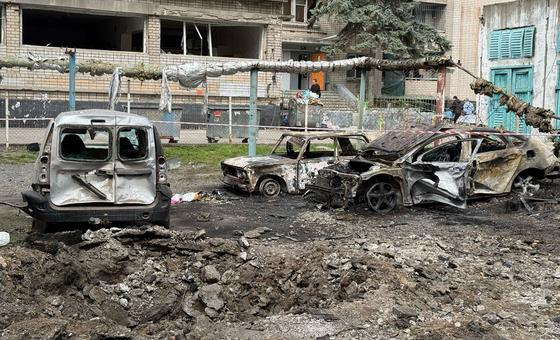
At least 24 people were reported killed and over 300 injured – including 32 children – when ballistic missiles struck Ukraine’s Dnipro and Odesa regions on Monday and Tuesday, the UN Human Rights Monitoring Mission in Ukraine (HRMMU) said on Wednesday.
The attacks destroyed homes, schools, hospitals, and other civilian infrastructure, and left hundreds wounded.
“The attacks struck during the day when civilians were at work, on trains, or at school,” said Danielle Bell, head of HRMMU.
“The timing alone made the high number of civilian casualties entirely foreseeable.”
On 23 June, two ballistic missiles launched by Russian forces hit Lyceum No. 1, a middle school in Bilhorod-Dnistrovskyi, Odesa region. Although the school year had ended, staff and students were present for administrative work. The strike killed three educators and injured 14 others, including two boys.
The school, which served over 700 students, sustained critical damage.
No military objective
HRMMU, which visited the attacks sites, reported no evidence of military presence at the school, and people confirmed that no military presence had been stationed there.
“The school in Bilhorod-Dnistrovskyi was not a military objective,” Ms. Bell said.
“Yet it was hit by two ballistic missiles, killing educators and injuring children.”
The following day, 24 June, missiles struck an industrial area of Dnipro city at around 11 AM local time. The blast shattered windows in nearby schools, hospitals and residential buildings.
HRMMU confirmed that two dormitories were hit, injuring numerous residents. A nearby passenger train was also impacted – windows blown out by the shockwave – injuring more than 20 travellers, according to a UN monitor onboard.
A troubling trend
These strikes followed a series of other attacks in June that have resulted in significant civilian harm, including in Kyiv city on 17 and 23 June, according to the human rights mission.
Civilian casualties in the first five months of 2025 were nearly 50 percent higher than during the same period last year, with increases typically seen during the summer months.
“Ballistic missiles, when used in densely populated areas, cause predictable and widespread harm to civilians, as demonstrated by these recent attacks,” Ms. Bell said.
“The rising civilian casualties reflect the severity of that risk.”
“Israeli authorities continue to restrict the delivery of fuel into and throughout the Gaza Strip, effectively choking off life-saving services for deprived and starving people,” UN Spokesperson Stéphane Dujarric said during his regular press briefing in New York.
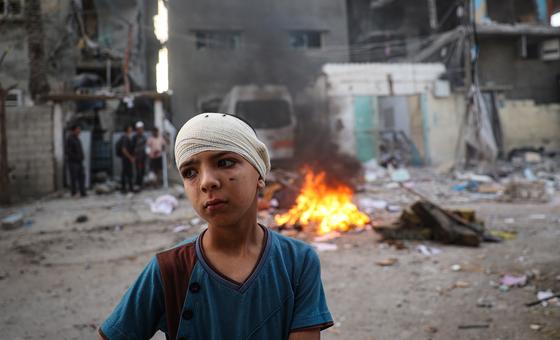
Conditions in the enclave remain bleak, as Israeli operations continue to have a devastating impact on civilians, with reports of the killing and injury of scores of people, many of whom were just seeking aid.
Pregnant women and babies at risk
Due to the fuel situation, the UN Population Fund (UNFPA) warned that 80 per cent of critical care units, including those used for childbirth, risk shutting down – at a time when 130 women are giving birth every day.
“As UNFPA stressed, fuel for Gaza is a matter of life and death,” said Mr. Dujarric.
He added that community kitchens were able to prepare more than 200,000 meals every day this week.
However, this represents an 80 per cent reduction compared with the more than one million meals distributed daily at the end of April, calling it “basically a trickle offered to people on the brink of famine.”
In the absence of fuel, cooking gas and electricity, people have resorted to burning plastic waste.
“When they do so in makeshift tents, you can imagine what happens with the poor ventilation and the tremendous risks that that poses,” he told journalists.
A young boy in Gaza with severe weight loss and malnutrition eats a nutritional supplement.
Allow in more aid
Furthermore, the UN relief coordination office, OCHA, also reminds that to meaningfully address the massive deprivation in Gaza, the Israeli authorities must allow in higher volumes of supplies and more varied types of food, as well as cooking gas, fuel and shelter items.
Mr. Dujarric stressed that to facilitate the orderly distribution of aid, supplies must be channelled daily through multiple crossings and land routes simultaneously. This would ensure people that the flow of essential support is steady, sufficient and reliable.
He said the UN and partners attempted to coordinate 15 humanitarian movements inside Gaza on Tuesday but only three were fully facilitated by the Israeli authorities, while seven were denied outright.
Four missions were initially approved but then halted on the ground, although one was ultimately accomplished on Wednesday and another was cancelled by the organizers.
“From that day on, our home became a travel bag and our path became that of displacement … My childhood was filled with fear and anxiety and people I was deprived of,” she said, speaking via videoconference from Syria.
Seema Sen Gupta, director of child protection and migration at UNICEF, briefs the Security Council.
The report documented a 25 per cent increase in grave violations against children in 2024, the largest number ever recorded in its 20-year history.
“This year’s report from the Secretary-General once again confirms what too many children already know — that the world is failing to protect them from the horrors of war,” said Sheema Sen Gupta, director of child protection at the UN Children’s Fund (UNICEF).
“Each violation against children in every country around the globe represents a moral failure.”
The real scale of the harm
The report presented to the Security Council is published annually to document grave violations against children affected by war. It relies entirely on data compiled and verified by the UN, meaning that the real numbers are likely much higher than reported.
In 2024, the report documented a record 41,370 grave violations — including killing and maiming, rape, abduction and the targeting of infrastructure such as schools which supports children.
“Each child struck by these attacks carries a story, a stolen life, a dream interrupted, a future obscured by senseless violence and protracted conflict,” said Virginia Gamba, the Secretary-General’s Special Representative for Children and Armed Conflict, whose office produced the report.
Virginia Gamba, the Secretary-General’s Special Representative for Children and Armed Conflict, briefs the Security Council.
While many of these violations occurred during times of conflict — especially as urban warfare is on the rise — grave violations can persist even after a conflict ends.
They persist in the unexploded ordinances which still pepper the ground.
“Every unexploded shell left in a field, schoolyard, or alley is a death sentence waiting to be triggered,” said Ms. Sen Gupta.
They persist in the spaces which remain destroyed, impeding children from accessing healthcare and education.
And they persist in the trauma and injuries which never fully leave a child.
Scars that never heal
Children who survive the grave violations do not escape unscathed — if they suffered violence, the injuries will stay with them for a lifetime. And even if they were not injured, the trauma remains.
“The physical and psychological scars borne by survivors last a lifetime, affecting families, communities and the very fabric of societies,” said Ms. Gamba.
This is why UNICEF and its partners have worked to provide reintegration programmes and psychosocial support for children who are victims of grave violations.
Sila said that the trauma of her childhood is still with her, and has pushed her to become an advocate for children in conflicts.
“From that moment on, nothing has felt normal in my life. I’ve developed a phobia of any sound that resembles a plane, of the dark, and even of silence,” she said.
‘This cannot be the new normal’
Ms. Gamba called for “unwavering condemnation and urgent action” from the international community in order to reverse the worrying trends which the report details.
“We cannot afford to return to the dark ages where children were invisible and voiceless victims of armed conflict… Please do not allow them to slip back into the shadows of despair,” she said.
Current funding cuts to humanitarian aid are impeding the work of UN agencies and partners to document and respond to grave violations against children.
In light of this, Ms. Sen Gupta’s call for the Security Council was simple: “Fund this agenda.”
She said that the international community cannot allow this to become “a new normal,” and reminded the members of the Security Council that children are not and should never be “collateral damage.”
Despite the devastation which the report detailed, there were “glimmers of hope” according to Ms. Sen Gupta. For example, the Syrian National Army signed an action plan which will prevent the recruitment, killing and maiming of children.
Sila also spoke of hope — she hopes that hers is the last generation to suffer these grave violations.
“I am from a generation that survived. Physically,” she said. “Our bodies survived but our hearts are still living in fear. Please help us replace the word displacement with return, the word rubble with home, the word war with life.”
Rafael Mariano Grossi was speaking to reporters in Austria following a briefing to the Government in Vienna.
Israel began launching air and missile strikes against Iranian military and nuclear sites nearly two weeks ago, and the United States carried out surprise bombing raids on three Iranian uranium enrichment facilities this past weekend.
A ceasefire between Iran and Israel, announced on social media by US President Donald Trump on Monday night, is fragile but holding.
However, the extent of damage to Iran’s enriched uranium stockpile remains unclear.
Iran says protective measures taken
Following the initial attacks, Iran informed the IAEA that it would take “special measures” to protect its nuclear materials and equipment.
Mr. Grossi told journalists that he has received a letter from the Iranian Foreign Minister which said protective measures have been taken.
“They did not get into details into what that meant, but clearly that was the implicit meaning of that. So, we can imagine that this material is there,” he said. To confirm this, and to evaluate the situation, “we need to return,” he added.
Inspections vital
On Wednesday, Iran’s parliament approved a bill to suspend cooperation with the IAEA, according to media reports, which has to be approved by the executive branch of the Government.
Mr. Grossi said he wrote to Foreign Minister Abbas Araghchi on Tuesday requesting that they meet “to analyze the modalities” for inspections to continue.
He stressed that the international community “cannot afford” for the inspection regime to be interrupted.
The IAEA chief was also asked about Iran’s plans to withdraw from the Non-Proliferation Treaty (NPT), a key international accord aimed at preventing the spread of nuclear weapons.
The move would be “very regrettable,” he said. “I hope this is not the case. I don’t think this would help anybody, starting with Iran. This would lead to isolation, all sorts of problems.”
While the rate of basic access to energy has increased since 2022, the current pace is insufficient to reach universal access by 2030, one of the UN’s Sustainable Development Goals (SDGs), according to a report published by the WHO and partners this Wednesday.
The report highlights the role of cost-effective distributed renewable energy — a combination of mini-grid and off-grid solar systems — in accelerating energy access, particularly as the populations who remain unconnected mostly live in remote, lower-income, and fragile areas.
Regional disparities
“Despite progress in some parts of the world, the expansion of electricity and clean cooking access remains disappointingly slow, especially in Africa,” said Fatih Birol, Executive Director of the International Energy Agency (IEA), as 85 per cent of the global population without electricity access reside in sub-Saharan Africa.
In the region, renewables deployment has rapidly expanded; however, on average, it remains limited to 40 watts of installed capacity per capita — only one eighth of the average in other developing countries.
Clean cooking
As regional disparities persist, an estimated 1.5 billion people residing in rural areas still lack access to clean cooking, while over two billion people remain dependent on polluting and hazardous fuels such as firewood and charcoal for their cooking needs.
Yet, the use of off-grid clean technologies, such as household biogas plants and mini-grids that enable electric cooking, can offer solutions that reduce the health impacts caused by household air pollution.
“The same pollutants that are poisoning our planet are also poisoning people, contributing to millions of deaths each year from cardiovascular and respiratory diseases, particularly among the most vulnerable, including women and children,” said Tedros Ghebreyesus, WHO Director-General.
Lack of financing
The report identified the lack of sufficient and affordable financing as a key reason for regional inequalities and slow progress.
While international public financial flows to developing countries in support of clean energy have increased since 2022, the developing world received significantly fewer flows in 2023 than in 2016.
“This year’s report shows that now is the time to come together to build on existing achievements and scale up our efforts,” said Stefan Schweinfest, Director of the UN Statistics Division, as the report called for strengthened international cooperation between the public and private sectors to scale up financial support for developing countries, especially in sub-Saharan Africa.
Every dollar invested in girls’ education yields an average return of $2.80 – translating into billions in additional GDP. Similarly, each dollar spent on water and sanitation saves $4.30 in healthcare costs.
Simple math, not miracles
These aren’t miracles – they’re measurable outcomes. Maths doesn’t recognize gender or infrastructure; it simply reflects the truth in numbers. And those numbers make a compelling case: helping countries with the least resources benefits everyone, including those with the most.
Even a single dollar, strategically invested, can make a profound difference.
For example, allocating just $1 per person annually to combat non-communicable diseases could prevent nearly seven million deaths by 2030. Likewise, every dollar spent on disaster risk reduction can save up to $15 in recovery costs.
Yet despite such compelling evidence, development aid is often misunderstood – seen by some as mere charity, and by others as a vehicle for profiteering.
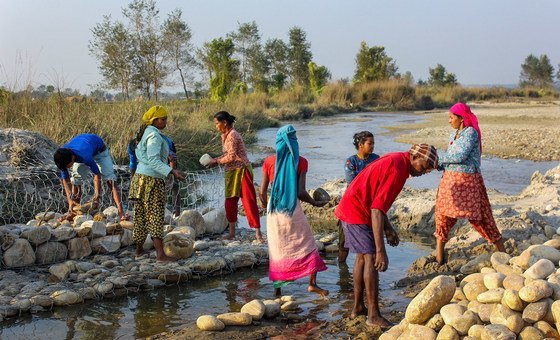
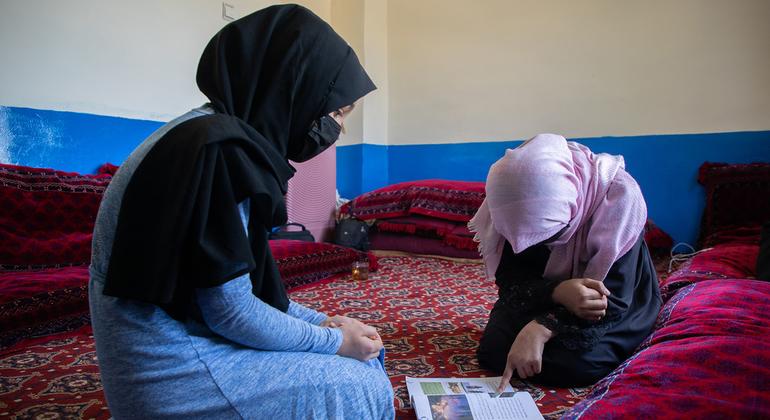
It highlights that these women are not seeking charity – they’re asking for a fair chance to succeed. Earning their own income gives them a measure of independence, which in turn strengthens the communities they live in.
Against all odds, they are generating income, creating jobs, and building fuller, more enriching lives.
Expanding access to public and private financing, guaranteeing loans, offering preferential terms in international markets, and reinforcing support networks can fuel business growth and foster a more prosperous future – whether in Afghanistan or Ecuador, or anywhere in between.
FFD4 faces strong headwinds
These examples – from education and health to entrepreneurship and disaster resilience – paint a clear, data-driven narrative: smart investments in development pay dividends for everyone.
That message should be front and center at the upcoming Fourth UN Conference on Financing for Development which will be held in the Spanish city of Sevilla, from 30 June to 3 July. But the summit, known by its clunky acronym FFD4, faces stiff headwinds.
Even as countries negotiating at UN Headquarters in New York agreed a week ago on a sweeping outcome document – set to be adopted at the close of the conference and intended to guide the future of global development aid – some nations are pulling back.
Notably, the United States has announced it will not send a delegation to Sevilla at all.
And even though there are some notable exceptions, including Spain, which has increased its development financing budget allocations by 12 per cent, the uncertain landscape ahead has led UN Secretary-General Antono Guterres to lament that “global collaboration is being actively questioned.”
This questioning is reflected in the $4 trillion annual deficit in development financing, as well as the abandonment of earlier commitments and delivery of aid by donors at what the Secretary-General has called “a historic speed and scale.”
Moreover, the Sustainable Development Goals, signed by all world leaders just 10 years ago, are a long way off track.
What is at stake in Seville?
Success in Sevilla “will require other countries to fill the global leadership vacuum and demonstrate credible commitment to multilateral cooperation, which is essential for our survival,” states Jayati Ghosh, professor of economics at the University of Massachusetts, Amherst.
Meaningful steps forward must include deep reforms of the international financial system. As it stands, it fails to meet the needs of developing countries while steadfastly protecting the interests of wealthier nations.
Consider this: developing countries face interest rates at least twice as high as those paid by developed nations. And today, the average rates charged by private creditors to these countries have reached their highest levels in 15 years.
What aid gives, debt takes away
Developing countries spent a record $1.4 trillion on external debt service in 2023, the highest in 20 years.
Meanwhile, in 2024, more than 1.1 billion people live in developing countries where external debt servicing accounts for more than 20 per cent of government revenue, and nearly 2.2 billion live in developing countries where the percentage is higher than 10 per cent.
Interest payment on this debt hinders development by preventing investment in health infrastructure and education services, to cite just two examples.
Debt restructuring is therefore essential, because much of the hope for development is lost in the give and take of aid and debt.
Promoting investment in what works
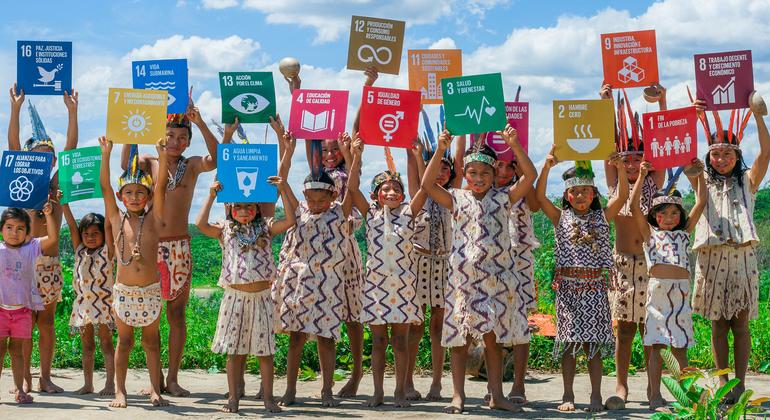
Eradicating hunger, advancing gender equality, protecting the environment, confronting climate change, and saving our oceans are not radical ideas.
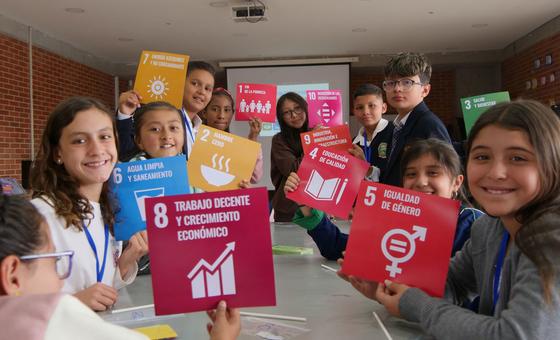
Despite claims from some highly ideological viewpoints that the Sustainable Development Goals represent an extremist agenda, they are, in fact, a shared baseline – an urgent set of priorities that humanity demands and that the leaders of 193 countries committed to in 2015.
Despite the noise made by those who oppose development aid and multilateralism, they are a minority, says Spain’s Secretary of State for International Cooperation.
Ana Granados Galindo sees Seville as “a beacon of global solidarity.”
Meanwhile, as the world gears up for FFD4, mathematics, statistics, and Afghan women continue to work their common sense ‘development magic’.
The informal meeting on the UN80 Initiative also provided a chance for ambassadors to share their views on the reform agenda, launched by Secretary-General António Guterres in March.
UN80 is centred around three workstreams focused on efficiencies and improvements, a mandate implementation review, and structural changes and programme realignments across the entire UN system.
Improving the UN
It also aims to reinforce the UN’s capacity to respond to global challenges such as conflict, displacement, and the climate crisis, while also managing external pressures effectively, such as shrinking budgets and growing political divisions.
“I think the UN80 Initiative is often characterised, but I think mischaracterised, simply as an exercise in downsizing in economy,” said Guy Ryder, Under-Secretary-General for Policy and chair of the Task Force overseeing the plan.
“But the Secretary-General has been rather clear in saying that whilst we have to respond to the resource situation, the overall intention of the Initiative is to strengthen and improve the workings of the UN system.”
Learn why UN80 matters to the world in our explainer here.
Widespread impact
Mr. Ryder alongside UN Controller Chandramouli Ramanathan (who prepares and oversees the budget and manages the Organization’s funds) presented updates on two workstreams during the morning session of the day-long meeting.
He set the scene with a slideshow outlining the background for UN80 and the circumstances confronting the UN today.
Over the years, it has adopted some 40,000 mandates delivered by “a fairly numerous and complex constellation of entities,” more than 140.
In 2023, the global body delivered some $69 billion in support and services worldwide, with “the lion’s share”, $31 billion or around 45 per cent, going to humanitarian action.
This was followed by development, $21 billion (30 per cent), peace and security, $9 billion (13 per cent), and human rights, $1 billion, or less than one per cent.
“We believe that the global population, in one manner or another…is connected to the global agenda of the United Nations,” he said. Additionally, some 440 million lives are directly impacted by its development work, and 140 million people in crisis situations receive support.
Reduction in resources
Mr. Ryder said the $69 billion mark two years ago represented “a peak” and it is estimated that the UN has some $50 billion in resources available today amid “a situation of significant uncertainty.”
This 30 per cent reduction means “we’re down to 380 million people who we’re able to reach directly in development work, and we’re down to 110 million as a reduction in emergency situations of our humanitarian spending.”
In light of this context, “maybe we can streamline the manner in which we implement the mandates that you hand down; maybe we can optimize the structures which form this archipelago of entities,” he suggested.
“The success of the UN80 Initiative depends on us being able to increase the impact that our work in the UN system has on the people who we are here to serve.”
Proposals to enhance efficiency
Mr. Ramanathan briefed delegates on workstream one. He said a working group was established to develop concrete proposals to enhance efficiency, reduce duplication, standardize services, and relocate functions to existing lower-cost duty stations where appropriate.
The “exhaustive list” includes measures such as consolidating existing human resources, finance and procurement services into unified support hubs. The process would start in New York and Geneva as they host the largest number of Secretariat entities and staff.
Another proposal involves having payroll operations centralized in three global processing centres, compared to 10 locations today.
The working group is finalising the proposals to be submitted to the Secretary-General and “if approved, they will be incorporated into the revised estimates for the 2026 proposed programme budget for the consideration of the General Assembly by 1 September,” said Mr. Ramanathan.
“Separately from the UN80 Initiative, we are reviewing the programme budget proposals for 2026 with a view to achieving between 15 and 20 per cent reductions for 2026, including a 20 per cent reduction in work force, post reduction, but with a focus on preserving capacity at entry levels and reducing senior posts where feasible,” he added.
A ‘universe of mandates’
Mr. Ryder returned to present workstream two, where the first step involved mapping out “the universe of mandates” that the UN implements, with initial focus on Secretariat departments and offices, peacekeeping operations, political missions, regional commissions and other bodies.
The overall “landscape” of mandates means that the Secretariat services some 400 intergovernmental organs and roughly 27,000 meetings each year and processes some 2,300 pages of documentation on average every day, amounting to around $360 million annually.
A mandate resource registry has been produced, and a report should be available by the end of July which will inform the way forward.
Concern over proposed budget cuts
During the session, several representatives expressed their views on UN80, such as Iraqi Ambassador Dr. Abbas Kadhom Obaid, who spoke on behalf of the Group of 77 and China.
He voiced concern over the proposed 15 to 20 per cent budget reductions, and the 20 per cent staff reduction, requesting more insight into how these figures were determined.
“This is important since we know that the departments, divisions, in the Organization’s funds, programmes and agencies vary greatly,” he said.
“We must also protect the geographical and gender balance in the context of any downsizing. As the Group has reiterated several times, the matters of transparency, accountability and inclusivity are paramount during this process.”
Fit for the future
The meeting took place just days before the 80th anniversary of the signing of the UN Charter on 26 June 1945, as General Assembly President Philémon Yang noted in his opening remarks.
He said it was a time to “reflect on the last 80 years and all that this Organization has achieved, and also a time to look to the future,” so the UN can remain fit for purpose – and ready for the next 80 years.
Amid this relative calm, the United Nations has renewed its call for a diplomatic solution to the Iran nuclear issue, warning that the objectives of the Joint Comprehensive Plan of Action (JCPOA) – and the resolution that endorsed it – remain unmet.
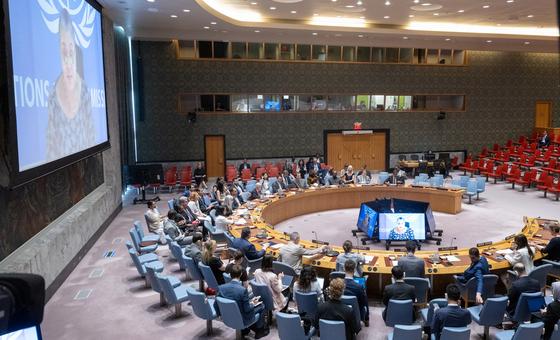
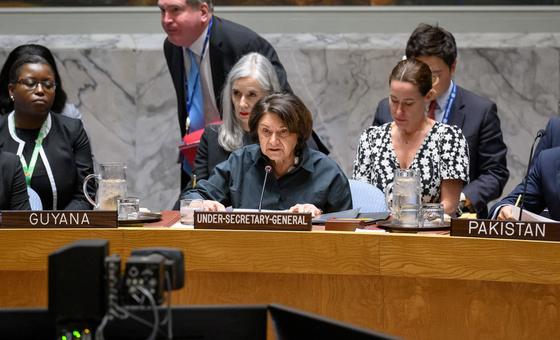
Addressing a planned Security Council meeting on Tuesday to try and revive the deal amid the dramatic military escalation of the past 12 days, UN political affairs chief Rosemary DiCarlo said the fragile ceasefire announced by Donald Trump overnight provided “an opportunity to avoid a catastrophic escalation and achieve a peaceful resolution of the Iran nuclear issue.”
The 2015 Iran nuclear deal – more formally known as the JCPOA and backed by the Security Council – offered Tehran sanctions relief in exchange for strict limits on uranium enrichment, stockpile levels and centrifuge use, alongside robust monitoring and verification by the International Atomic Energy Agency (IAEA).
But the accord has remained in limbo since the United States withdrew in 2018, followed by Iran’s rollbacks of its nuclear-related commitments.
With key provisions under resolution 2231 set to expire on 18 October – unless the Council decides otherwise – the UN’s top political official has warned that the window for reviving diplomacy is narrowing.
With less than four months before resolution’s remaining nuclear-related restrictions are set to expire on 18 October – unless extended by the Council – the UN’s top political official warned that the agreement’s key aims remain elusive.
Diplomacy kneecapped?
Ms. DiCarlo told ambassadors the recent surge in violence had significantly undermined diplomatic momentum.
“The military escalation between Israel and Iran since 13 June and United States air strikes on Iran’s nuclear facilities on 21 June complicated prospects for achieving full implementation of resolution 2231,” Ms. DiCarlo said.
“Iran’s strikes yesterday on a base in Qatar further exacerbated insecurity in an already tense region.”
Despite five rounds of bilateral talks between Iran and the US, facilitated by Oman in recent months, Ms. DiCarlo noted that efforts “did not produce a way forward” to restore full JCPOA implementation.
A sixth round of talks was called off due to the outbreak of hostilities.
Meanwhile, the toll from the recent conflict has been sobering. According to Iranian authorities, at least 606 people were killed and more than 5,300 injured since hostilities erupted on 13 June. Israeli officials reported 28 deaths and nearly 1,500 injuries.
Time running out
While divisions persist, Ms. DiCarlo said JCPOA participants – China, France, Germany, Iran, Russia, and the United Kingdom – had all reiterated their commitment to finding a diplomatic solution.
In a joint statement shared with the Secretary-General in March, China, Iran and Russia stressed the importance of resolution 2231’s provisions and timelines. China separately proposed a “step-by-step and reciprocal approach” to settle the nuclear issue.
“Diplomacy, dialogue and verification remain the best option to ensure the exclusively peaceful nature of Iran’s nuclear programme,” Ms. DiCarlo said.
EU Ambassador Stavros Lambrinidis briefs the Security Council as the Coordinator of the Joint Commission established by the JCPOA.
Deal, not force, key to resolution: European Union
Echoing UN appeals for dialogue, the European Union stressed that “a lasting solution to the Iranian nuclear issue can only be through a negotiated deal, not military action.”
Briefing the Council on behalf of EU High Representative Kaja Kallas, Ambassador Stavros Lambrinidis underscored the urgent need “to come back to a diplomatic solution.”
Ensuring that Iran does not acquire or develop a nuclear weapon remains a key security priority for the EU, he said.
He added that Iran’s accelerating nuclear activities and the absence of IAEA oversight – compounded by the economic fallout from US sanctions – have severely undermined the JCPOA, despite sustained EU efforts to preserve it through diplomacy.
Mr. Lambrinidis reaffirmed that diplomacy must prevail, with the IAEA remaining central to monitoring and verification efforts going forward.
US urges Iran to return to talks
Ambassador Dorothea Shea, Acting US Representative, said Iran’s increase in nuclear activity lacked “any credible civilian justification.”
Even after the IAEA Board of Governors found it noncompliant with nuclear safeguards, she noted, “it is regrettable that certain members of this Council have opted to turn a blind eye to, if not encourage, Iranian noncompliance.”
The US “will not turn a blind eye to Iran’s noncompliance and ongoing threat to regional stability,” she continued.
Ambassador Shea said the 21 June “precision operation effectively fulfilled our narrow objective – to degrade Iran’s capacity to produce a nuclear weapon,” after which President Trump coordinated a ceasefire between Iran and Israel.
“In this critical moment,” she concluded, “we must all urge Iran to seize this opportunity for peace and prosperity and abide by its international obligations.”
UK calls ceasefire a first step
UK Ambassador Barbara Woodward welcomed the ceasefire brokered by President Trump but warned that “the situation remains extremely fragile.”
Expressing that “now is the time for a return to diplomacy,” she urged Iran to engage in talks without delay, warning that its nuclear programme has exceeded “any credible civilian justification.”
She said all diplomatic levers will be deployed for a negotiated outcome and to “ensure Iran does not develop a nuclear weapon.”
Iran: Diplomacy can and must resolve differences
Iran’s Ambassador, Amir Saeid Iravani, said that his country “never initiated this war” and that “once the aggressors stopped their attacks, Iran stopped its lawful military response as well”.
Mr. Saeid also expressed his country’s strong commitment to diplomacy as the path through which differences can and should be resolved.
“Iran continues to believe that a diplomatic resolution to nuclear and sanction issues is possible,” Mr. Saeid said.
He called on the Security Council to condemn Israel’s and the United States’ attacks on Iran and their IAEA-protected nuclear facilities and work to ensure that they never happen again.
Ambassador Iravani added that Iran upheld Council resolution 2231 and the JCPOA, and that remedial measures were “fully consistent” with these two instruments.
Israel warns diplomacy with Iran has failed
Israeli Ambassador Danny Danon defended his country’s military operation against Iran, describing it as a necessary move to neutralise a “double existential threat” from Tehran’s nuclear and missile programmes.
He said Israel achieved complete air superiority and removed key regime targets, acting in coordination with the US.
Ambassador Danon accused Iran of deceiving the world for years, using diplomacy as cover to advance its nuclear weapons programme.
“There is still time,” he said, “to take meaningful and decisive action to ensure that the threat of a nuclear Iran does not return stronger than before.”
“We are often told that diplomacy must be given a chance – it was given every chance, every round, every channel, every deadline – but so far it has failed, the regime in Tehran never had any intention of complying.”
Nearly 15 years after Gaddafi’s fall, Libya remains split between the internationally recognised Government of National Unity in Tripoli, and the rival Government of National Stability in Benghazi.
Although a truce was reached on 14 May, the outbreak of fighting last month in the capital “temporarily disrupted UN development and humanitarian operations,” said top UN envoy Hanna Tetteh.
Fragile Truce
On 18 May, with support from the UN Support Mission in Libya (UNSMIL), the Presidential Council established a Truce Committee.
Composed of key security actors, the body has been mandated to monitor the upholding of the ceasefire, facilitate a permanent end to the fighting and ensure the protection of civilians.
As UNSMIL works to ease tensions and prevent further clashes, the Presidential Council has also set up a temporary Security and Military Arrangement Committee, tasked with sustaining peace and reorganising security forces in the capital.
“The truce, however, remains fragile, and the overall security situation unpredictable,” said Ms. Tetteh.
Alleged grave violations
The armed clashes that erupted in May resulted in civilian deaths and injuries, as well as damage to critical civilian infrastructure, underscoring the shortcomings of State security forces in adhering to international humanitarian and human rights law, she continued.
Ms. Tetteh expressed alarm over mass graves found in Abu Slim, citing emerging evidence of serious human rights violations – including extrajudicial killings, torture, and enforced disappearances – allegedly by State security forces.
“The presence of charred remains, unidentified bodies in morgues, and a suspected unofficial detention site at Abu Salim Zoo underscores the scale and gravity of these abuses,” she said.
Demand for change
“Many Libyans are deeply disillusioned with the prolonged transitional period and have lost confidence in the current institutions and leadership,” said Ms. Tetteh.
As civilians increasingly doubt the current leadership’s willingness to put national interests above their own, there is strong demand for a political process that allows public participation, enables elections, and delivers a democratic government with a clear mandate for real change.
UNSMIL intends to present a time-bound and politically pragmatic roadmap – with the goal of reaching the end of the transitional process – by the time of her next briefing, Ms. Tetteh told ambassadors.
“I urge all parties to engage in good faith and to be ready to forge consensus on this roadmap,” she said.
The Security Council is meeting over the future of the Joint Comprehensive Plan of Action put in place in 2015 to prevent Iran from weaponising its ambitious nuclear programme, which has been in effective limbo since the US withdrawal in 2018 and Iran’s rejection of parts of the deal. UN political affairs chief Rosemary DiCarlo described the US-brokered ceasefire overnight between Israel and Iran as a “significant achievement” and “an opportunity to avoid a catastrophic escalation and achieve a peaceful resolution of the Iran nuclear issue.” Follow our Meetings Coverage Section live coverage below and UN News app users can follow here.