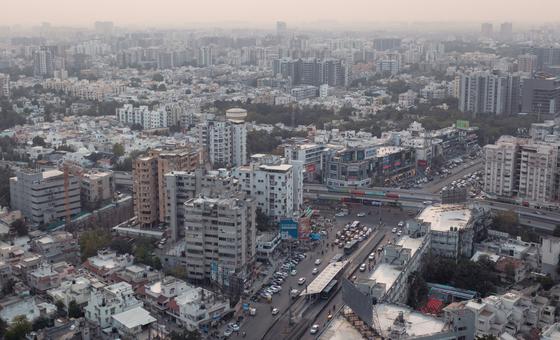
The plane – a Boeing 787-8 Dreamliner – crashed into a medical college about a mile from the city’s main airport reportedly killing five students and injuring around 50 who have been hospitalised.
The full extent of deaths and injuries on the ground has yet to be established but one British-Indian passenger on the plane miraculously survived the crash, reportedly telling journalists that there had been a loud noise around 30 seconds after take-off.
Heartfelt condolences
In a statement issued by his Spokesperson, Secretary-General António Guterres extended his heartfelt condolences to the families of the victims and to the people and Government of India, and to other countries who have lost citizens during the disaster.
He wished a swift and full recovery to all those injured as a result of the tragedy.
According to news reports, there were 169 Indian nationals, 53 Britons, seven from Portugal and one Canadian on the flight.
Officials at the crash site reported that the jet had continued to skid after crash landing, dragging along the ground before bursting into flames. Hundreds of police and emergency workers remain at the scene, combing through the wreckage for survivors.
President of the UN General Assembly Philémon Yang said in a social media post that his thoughts were with all the victims and those impacted by the disaster, adding, “may they find strength and solace during this difficult time.”
While the market is going agogue over the sudden crash of Sensex by 1100 point in intra-day trading on Monday, eroding about Rs.4 lakh crore from the pockets of shareholders, there is one reason for optimists to smile. BUY now!
Many TV show experts are suggesting the move to buy but foreign investors are driven by the ripple effect created by Yuan’s unrealistic devaluation that has all the potential to kick off another Asian Currency Crisis of the mid-1990s.
The ripple effect is seen in virtual shock and apathy in the trading session in the morning to make any trade decisions by buyers and brokers alike and even the Indian rupee hit a highest low of Rs.66.50, which is lowest since September 2013.
Monday’s market crash was the biggest after 2008 recession, as on October 24, 2008, it recorded a low of 1204.88 points. But Monday crash is different as it stems directly from the Yuan’s devaluation.
Speculations are high that the 2008 recession was driven by the US downturn while the 2015 would be the Year of China, with its extreme global reach. Another reason could be to bring the markets heed the global opinion on China’s political overtures, especially aimed at Japan.
Japan Prime Minister Shinzo Abe on Monday cancelled his state visit to China and the political fallout could be a trigger to anti-China sentiments bringing down Asian markets for now. The long-term impact will be known only in a couple of months when markets continue to be volatile.
While the Indian market reacted cautiously last week when China announced one of its worst devaluation of Yuan, the possible market reaction in India on the opening day of the week is abrupt and unexplainable.
The slowdown of the Chinese economy may recover from its devaluation but it is strange to see the Indian market reacting similarly as devaluation of the Indian rupee on par with its Chines counterpart is unadvisable for the long term market stabilization.
However, the market needed to correct itself from the buoyant artificial picture being projected by the industry in India following the BJP win last year. Though the Modi government is known for its pro-business and pro-industry policies, the undue delay in passage of bills and the bedlam in parliament have had enough reasons not to cheer about for the industry.
In fact, Indian recovery map was not as great as China or the US since 2008 crash as its macro economic indicators like current account deficit and forex reserves remained same, said Nirmal Jain, Chairman and Managing Director IIFL in a TV show on CNBC-TV18.
Another reason for the abrupt fall is that FIIs or foreign investors are quick to withdraw their investments in India after the Chinese market went down over the Yuan devaluation. Unless Indian investors repose their faith in the markets, Sensex is unlikely to stabilize in the next few days, but experts have advised buying for their clients now.
Meanwhile, European markets have responded taking the curve down as of now and in few hours when the US West Coast opens its stock exchanges, the bells will ring in the effect at least initially.