US strikes on Iran’s nuclear sites ‘marks perilous turn’: Diplomacy must prevail, says Guterres

After ten days of airstrikes initiated by Israel aimed at crippling Iran’s nuclear programme which have led to deadly daily exchanges of missile fire between Tehran and Tel Aviv, the UN chief said that diplomacy must now prevail.

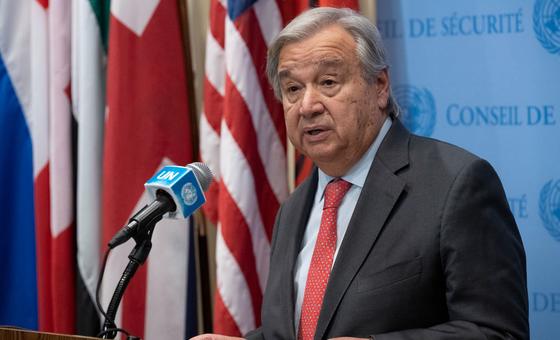
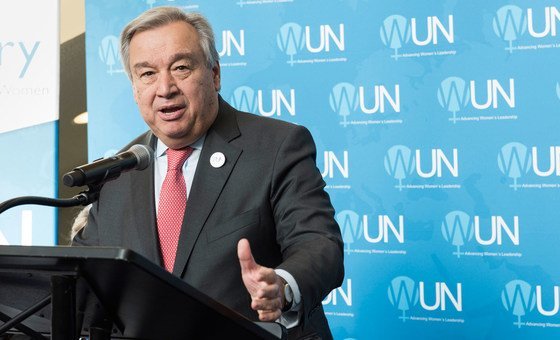
We now risk descending into a rathole of retaliation after retaliation,” he said, responding to the US intervention overnight in support of Israel’s military campaign, which targeted three facilities involved in uranium enrichment.

Return to serious negotiations essential

We must act – immediately and decisively – to halt the fighting and return to serious, sustained negotiations on the Iran nuclear programme,” Mr. Guterres added.

He told ambassadors the citizens of the wider Middle East region could not endure yet another cycle of destruction. Demanding a ceasefire, he also put Iran on notice that it must “fully respect” the Non-Proliferation Treaty on the development of nuclear weapons as a cornerstone of peace and security worldwide.

Iran has consistently denied the allegation from Israel and others that its ambitions are to become a nuclear armed State, versus developing atomic energy for purely peaceful purposes.

Israel, the US and Iran face a stark choice. “One path leads to a wider war,” the UN chief continued, “deeper human suffering and serious damage to the international order. The other leads to de-escalation, diplomacy and dialogue.”

Grossi warns of major risks following strikes

The head of the UN’s atomic energy watchdog, the IAEA, warned ambassadors the recent military strikes by Israel and now the US on nuclear sites in Iran have badly compromised safety and could pose serious risks if the situation worsens.

International Atomic Energy Agency Director General Rafael Grossi said the attacks had caused “a sharp degradation in nuclear safety and security”, even though there had been no radiation leaks which could potentially impact the public so far.

The IAEA chief warned ambassadors that if the short window of opportunity to return to dialogue closes then the destruction could be “unthinkable” while the global nuclear non-proliferation regime “as we know it could crumble and fall.”

Mr. Grossi confirmed that Iran’s main enrichment facility at Natanz had suffered major damage, including to key power infrastructure and underground halls containing uranium materials.

He said the main concern inside the site was now chemical contamination, which can be dangerous if inhaled or ingested.

Massive radiation leak still possible

He also listed damage at other nuclear-related sites across the country, including Esfahan, Arak and Tehran, adding that while radiation levels outside remained normal, the attacks had raised alarm over Iran’s operational nuclear plant at Bushehr.

Mr. Grossi warned that any strike on Bushehr could trigger a massive radiation release across the region. “The risk is real,” he said. “Military escalation threatens lives and delays the diplomacy that’s needed to resolve this crisis.”

He urged all sides to show restraint and said the IAEA stood ready to send experts back in to help monitor and protect damaged nuclear sites.

Senior political affairs official: ‘No military solution’

Assistant Secretary-General for Political Affairs Miroslav Jenča told ambassadors that the world is facing “a dangerous moment” following the US bombing mission, as Iran considers potential retaliation.

He warned the council that the region risks being “engulfed in further instability and volatility”, with “no military solution to this conflict”.

Mr. Jenča confirmed extensive damage at Iranian sites, citing open-source satellite imagery and Iranian reports that tunnels and buildings at the Fordow nuclear facility had been hit. He urged Tehran to grant IAEA inspectors access “as soon as safety conditions allow”.

Death toll mounting

Hostilities between Iran and Israel are now into their tenth day, and Mr. Jenča said the humanitarian toll is mounting. “Most [of the 430 killed in Iran] have been civilians,” he noted, while also citing Israeli reports of 25 dead and over 1,300 injured.

He also flagged growing threats from non-State armed groups, including the Houthis in Yemen, warning that their retaliation could widen the conflict. Iran’s parliament, meanwhile, has voiced support for closing the crucial trading route through the narrow Strait of Hormuz.

The world will not be spared from the ramifications of this dangerous conflict,” Mr. Jenča said, urging countries to act in line with international law and the UN Charter.

Source link

SECURITY COUNCIL LIVE: ‘Diplomacy must prevail’ over Iran following US military intervention, urges Guterres

The UN Secretary-General told the Security Council on Sunday that the bombing of Iran’s nuclear sites by the United States marks a “perilous turn”, warning that the region cannot endure yet another “cycle of destruction.” António Guterres said the must be an immediate ceasefire and returned to “serious, sustained negotiations.” We’ll have live updates from our Meetings Coverage team below and app users can follow here.

Source link

Guterres condemns deadly attack on peacekeepers in Central African Republic

The ambush took place on Friday along the Birao-Am Dafock axis in the volatile Vakaga Prefecture, in northeastern CAR, close to the border with conflict-hit Sudan.

According to the stabilization mission, MINUSCA, the patrol was targeted by “unidentified armed elements” in the locality of Am-Sissia.

Attack may be a war crime

In a statement released by his Spokesperson on Sunday, Secretary-General António Guterres extended his deepest condolences to the bereaved families, as well as to the Government and people of Zambia, and wished a swift recovery to the injured soldier.

He stressed that attacks against UN peacekeepers may constitute war crimes under international law and urged the Central African authorities “to spare no effort in identifying the perpetrators of this tragedy so that they can be brought to justice swiftly”.

This marks the third fatal attack against MINUSCA peacekeeping patrols since the start of 2025.

In March, a Kenyan peacekeeper was killed in the Haut-Mbomou prefecture, and a month earlier, a Tunisian ‘blue helmet’ lost his life in the north. Earlier this week, two Nepalese peacekeepers were injured during an assault in the southwest.

Valentine Rugwabiza, head of the UN mission, decried the “multiplication of attacks against peacekeepers” and echoed the call for justice, urging the authorities to act decisively against those responsible.

Since its deployment in 2014, MINUSCA has suffered significant losses, with around 150 peacekeepers paying the ultimate price.

The 17,000-strong force was established to help stabilise CAR, a country wracked by decades of political instability, armed conflict, and humanitarian crises.

According to a February report by the UN refugee agency (UNHCR), worsening insecurity across parts of the country has forced MINUSCA to step up patrols in several regions, including areas near the border with Sudan where violence and displacement have surged in recent months amid the brutal civil war between rival militaries there.

The Secretary-General reaffirmed the UN’s solidarity with the people and Government of CAR, underlining the world body’s continued commitment to peace and stability in the region.

Source link

Development is ‘the first line of defense against conflict,’ Guterres tells Security Council

Ambassadors met to debate how poverty, inequality, and underdevelopment are fuelling conflict and instability, at a time when hostilities are increasing and demand for humanitarian aid is rising as resources dwindle.  

Every dollar spent on prevention could save up to $103 in conflict-related costs, according to the International Monetary Fund (IMF). 

Sustainable development critical

Conflicts are proliferating and lasting longer, said Mr. Guterres. At the same time the global economy is slowing and trade tensions are rising, as aid budgets are being slashed while military spending soars. 

He warned that if current trends continue, two thirds of the world’s poor will live in conflict-affected or fragile countries by the end of this decade. 

“The message is clear,” he said.  “The farther a country is from sustainable and inclusive development, the closer it is to instability, and even conflict.”

Secretary-General António Guterres briefs the Security Council meeting on Poverty, Underdevelopment, and Conflict.

Give peace a (fighting) chance

The Secretary-General highlighted how the UN has worked to advance the three pillars of peace, development and human rights.  

These efforts began with its establishment 80 years ago and continue today, “guided by the simple principle that prevention is the best cure for instability and conflict, and there is no better preventive measure than investing in development,” he said.

“Development gives peace a fighting chance. It’s the first line of defence against conflict. But right now, we’re losing ground,” he said, noting that “the engine of development is sputtering.”

World falling short

Currently, two-thirds of the targets under the Sustainable Development Goals (SDGs) are lagging 10 years after adoption. 

“The world is falling short by over $4 trillion annually in the resources developing countries need to deliver on these promises by 2030,” he added.

Furthermore, “developing countries are being battered and bruised by limited fiscal space, crushing debt burdens and skyrocketing prices.”

Fix the ‘engine’

The Secretary-General pointed to the fourth Conference on Financing for Development, which begins next week in Spain, as an important moment “to fix and strengthen this essential engine.”

He called for renewed commitments towards securing public and private finance for the areas of greatest need, providing urgent relief for debt-laden countries, and reforming the outdated global financial architecture.

The Council debate “could not be more prescient,” said Kanni Wignaraja, the UN Development Programme’s (UNDP) Assistant Secretary-General and Regional Director for Asia and the Pacific.

Break the cycle

Global human development has stalled just as violent conflicts have surged to levels not seen in eight decades, she said, before presenting three priorities for investment to help break the cycle, including protecting household economies.

“In fragile settings, where peace and security have been shattered, development that goes directly to the local level becomes the first line of peoples’ defence and survival. And their hope for recovery,” she said.

“From these local economies – where livelihoods are restored, water and electricity can flow again, women’s businesses in particular reopen, farmers can trade food, and there is basic finance to allow markets to stay afloat – from this, comes the resources to build back broken capabilities and resilience.”

Address systemic imbalances

The Chairperson of the African Union (AU) Commission, Mahmoud Youssouf Ali, recalled how the continent loses billions of dollars annually to conflict, which could be channelled into schools, hospitals, infrastructure and innovation.

He said the international community must also acknowledge that poverty and underdevelopment “are not confined within national borders” but are global challenges that require global response.

“If we are to uphold international peace and security, we must address the systemic imbalances – economic, political, and institutional – that continue to fuel deprivation, exclusion, and instability across regions,” he said.

In this regard, the AU called for enhanced support to African-led peace operations, particularly those deployed in regions where poverty and underdevelopment are deeply entrenched. 

Critical juncture requires collective action

The debate was convened by Guyana, which holds the rotating Council presidency this month.

The country’s Foreign Minister, Hugh Todd, remarked that with the world “at a critical juncture where the interlinkages between peace, security and development have never been more pronounced,” collective and decisive action is required.

He cautioned against “prioritizing only political solutions in conflicts where poverty and underdevelopment feature prominently,” as creating conditions for socio-economic stability and well-being are also critical for peace.

Mr. Todd urged countries to address issues such as lack of access to education, unemployment, exclusion, and greater participation of women and youth.

“Currently, the global youth population is the highest in history, with most young people concentrated in developing countries,” he said.

“For us to harness their full potential, they must be given adequate economic opportunities and be involved in decision making on peace and security.” 

Source link

Guterres renews call for Israel-Iran ceasefire

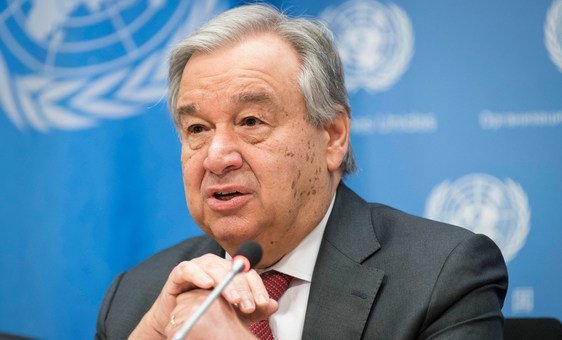
I reiterate my call for immediate de-escalation leading to a ceasefire,” Mr. Guterres said in a statement in which he strongly appealled against any further internationalization of the conflict. 

“Any additional military interventions could have enormous consequences, not only for those involved but for the whole region and for international peace and security at large,” he warned.

He condemned “the tragic and unnecessary loss of lives and injuries to civilians and damage to homes and critical civilian infrastructure.” 

Deadly escalation

The crisis erupted on Friday when Israel began targeting nuclear and military sites across Iran, prompting Tehran to launch retaliatory strikes on Israeli cities.

Since then, more than 250 people have been killed across both countries, according to media reports.

The International Atomic Energy Agency (IAEA), which has been monitoring Iran’s nuclear programme for decades, said that it had received information that two centrifuge production facilities were struck on Wednesday.

The TESA Karaj workshop and the Tehran Research Center were previously under its monitoring and verification as part of a 2015 international agreement known as the Joint Comprehensive Plan of Action (JCPOA).

“At the Tehran site, one building was hit where advanced centrifuge rotors were manufactured and tested,” the agency said in a tweet. “At Karaj, two buildings were destroyed where different centrifuge components were manufactured.”

Last week, the IAEA passed a resolution declaring that Iran was not complying  with its non-proliferation obligations.

The text noted Iran’s “many failures” to provide the agency with full and timely cooperation regarding undeclared nuclear material and activities at multiple undeclared locations in the country.

 Diplomacy reigns supreme

As the crisis in the Middle East deepens, the Secretary-General stressed that “diplomacy remains the best and only way to address concerns regarding Iran’s nuclear programme and regional security issues.”

 He underlined that “the UN Charter remains our shared framework to save people from the scourge of war,” urging all Member States to fully comply with the document and international law, including international humanitarian law. 

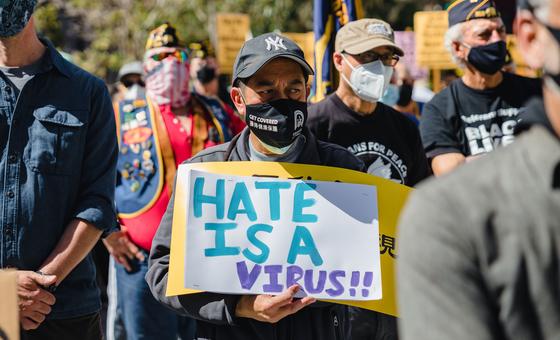
‘Hate speech is poison in the well of society,’ says Guterres

It is an alarm bell: the louder it rings, the greater the threat of genocide,” he warned.

As part of its core mission to combat hatred, discrimination, racism and inequality, the UN is stepping up efforts to challenge hate speech wherever it arises.

“Hate speech is poison in the well of society. It has paved the way for violence and atrocities during the darkest chapters of human history,” Mr. Guterres added.

Voices of hate

Hate speech often fuels violence and intolerance, with ethnic and religious minorities among the most frequent targets.

While the destructive power of hatred is nothing new, today it is being amplified by modern communication technologies.

Online hate speech has become one of the most prevalent means of spreading divisive narratives, posing a growing threat to peace and security around the world.

#NoToHate

Ahead of the international day, the UN has produced a series of videos aimed at countering hate speech – part of the #NoToHate campaign.

Ahmed Shaheed, Deputy Director of the Essex Human Rights Centre, speaks here about countering Islamophobia:

Rabbi Jill Jacobs, Executive Director of T’ruah: The Rabbinic Call for Human Rights, addresses rising antisemitism:

Artificial Intelligence

This year’s theme sheds light on the nexus between hate speech and artificial intelligence. Building coalitions is the main tool societies can use to reclaim inclusive and safe spaces free of hatred.

While AI tools offer myriad potential opportunities to make positive differences in situations of conflict and insecurity, biased algorithms and digital platforms are also spreading toxic content and creating new spaces for harassment and abuse.

Recognising these immense potential and risks, Member States have recommitted to countering hate speech online.

“Let us commit to using artificial intelligence, not as a tool of hatred, but as a force for good,” said Mr. Guterres.

Source link

Guterres to launch life-saving campaign strengthening mine action worldwide

António Guterres announced the move in a statement issued on Monday, in response to plans by several UN Member States to withdraw from the Anti-Personnel Mine Ban Convention.

The 1997 treaty, also known as the Ottawa Convention, prohibits the use, stockpiling, production and transfer of these weapons. 

Landmark global agreeement

Since then, it “has led to a virtual halt in global production of anti-personnel mines, and a drastic reduction in their deployment,” and “more than 40 million stockpiled mines have been destroyed,” according to the UN Office for Disarmament Affairs (UNODA).

To date, 165 States are party to the treaty and 133 have signed it.  

Five European countries – Estonia, Finland, Latvia, Lithuania and Poland – have recently announced that they intend to leave, or taken steps in this direction, reportedly due to security concerns related to Russia.

Weakening protection, undermining progress

Without naming countries, the Secretary-General expressed grave concern over the development.

“At a time when civilians face heightened risks from widening conflicts, it is imperative that we strengthen the frameworks that protect human life and dignity,” he said. 

“These announcements are particularly troubling, as it risks weakening civilian protection and undermining two decades of a normative framework that has saved countless lives.”

He urged all States “to adhere to humanitarian disarmament treaties and immediately halt any steps towards their withdrawal,” and appealed to the 32 States that have yet to join the treaty to do so without delay.

These countries include China, Iran, Israel, Russia, and the United States.

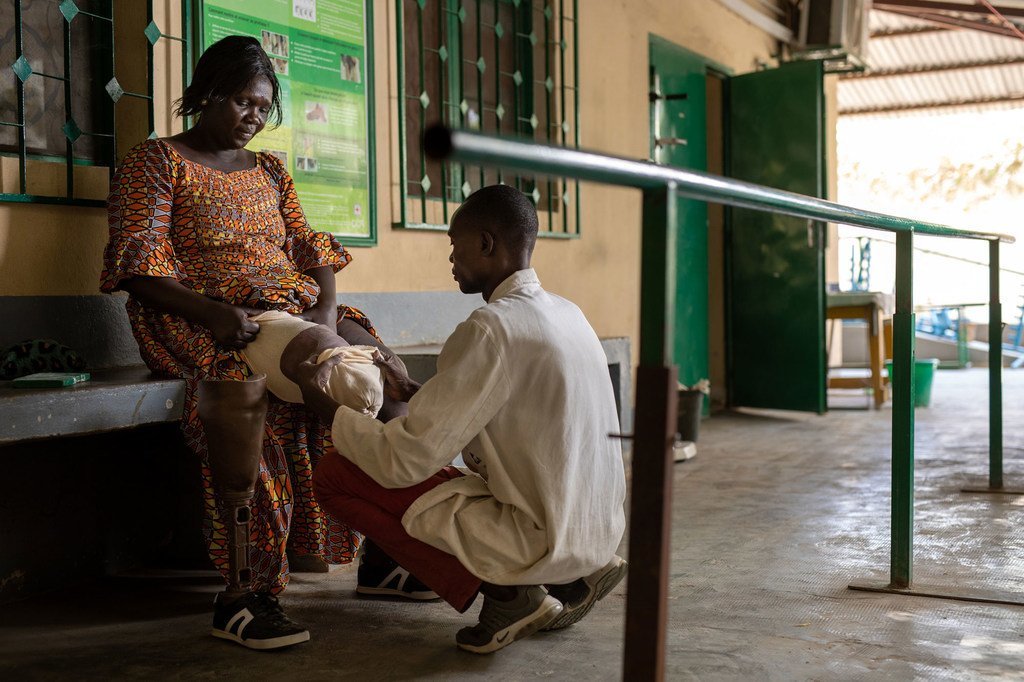
ICBL/Gwenn Dubourthoumieu

A 33-year old landmine survivor tries on a new prosthesis at the fitting and rehabilitation centre in Kabalaye, Chad. (file)

About the campaign

The Secretary-General’s campaign will centre around upholding the norms of humanitarian disarmament, accelerating mine action as an enabler of human rights and sustainable development, and driving forward the vision of a mine-free world.

“To achieve these aims, over the next six months this campaign will aim to re-energise public support for disarmament and will also facilitate concrete actions by States to uphold humanitarian norms and strengthen mine action,” he said.

He concluded by stressing that “the urgency of this matter cannot be overstated,” saying “the protection of innocent lives depends on our collective action and commitment.” 

Source link

Guterres calls for an end to ocean ‘plunder’ as UN summit opens in France

“The ocean is the ultimate shared resource,” he told delegates gathered at the port of Nice. “But we are failing it.”

Oceans, he warned, are absorbing 90 per cent of the excess heat from greenhouse gas emissions and buckling under the strain: overfishing, rising temperatures, plastic pollution, acidification. Coral reefs are dying. Fish stocks are collapsing. Rising seas, he said, could soon “submerge deltas, destroy crops, and swallow coastlines — threatening many islands’ survival.”

Port Lympia, Nice’s historic marina, now transformed into a secured diplomatic zone known as the Blue Zone for UNOC3.

Call for stewardship

More than 50 Heads of State and Government took part in the opening ceremony, including Brazilian President Luiz Inácio Lula da Silva and European Commission President Ursula von der Leyen — a show of political force underscoring the summit’s weight.

In total, over 120 countries are participating in the five-day gathering, signaling a growing recognition that ocean health is inseparable from climate stability, food security, and global equity.

French President Emmanuel Macron, whose country is co-hosting the summit alongside Costa Rica, followed with a forceful appeal for science, law, and multilateral resolve.

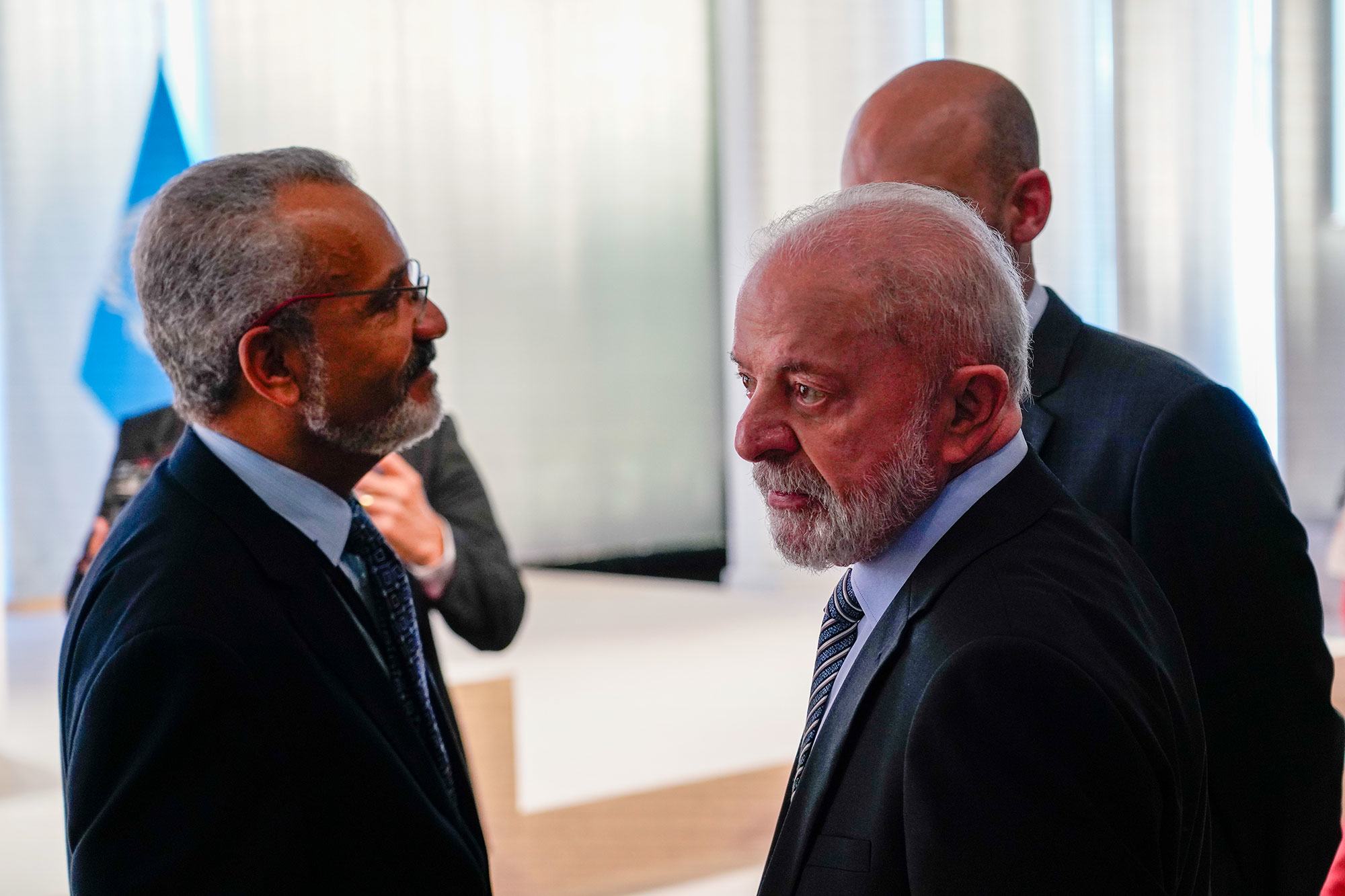
Brazilian President Luiz Inácio Lula da Silva, at the opening ceremony of UNOC3

“The abyss is not for sale, any more than Greenland is for sale, any more than Antarctica or the high seas are for sale,” he declared. “If the Earth is warming, the ocean is boiling.”

He insisted the fate of the seas could not be left to markets or opinion. “The first response is therefore multilateralism,” Mr. Macron said. “The climate, like biodiversity, is not a matter of opinion; it is a matter of scientifically established facts.”

Costa Rican President Rodrigo Chaves Robles took the podium next, thanking Mr. Guterres for elevating the ocean on the global agenda, then shifting to a stark warning.

“The ocean is speaking to us — with bleached coral reefs, with storms, with wounded mangroves,” he said. “There’s no time left for rhetoric. Now is the time to act.”

Condemning decades of treating the ocean as an “infinite pantry and global waste dump,” Mr. Chaves urged a shift from exploitation to stewardship.

“Costa Rica is a small country, but this change has started,” he said. “We are now declaring peace with the ocean.”

Most notably, the Costa Rican leader called for a moratorium on deep-sea mining in international waters until science can adequately assess the risks — a position already backed by 33 countries, he noted.

A treaty within reach

One of the summit’s core objectives is to help bring into force the landmark High Seas Treaty — known as the BBNJ accord — adopted in 2023 to safeguard life in international waters. Sixty ratifications are required for the treaty to become binding international law. Emmanuel Macron announced that this milestone is now within reach.

“In addition to the 50 or so ratifications already submitted here in the last few hours, 15 countries have formally committed to joining them,” he said. “This means that the political agreement has been reached, which allows us to say that this [Treaty] will be properly implemented.”

Whether the legal threshold is crossed this week or shortly after, the French President added, “it’s a win.”

The plenary hall of the third UN Ocean Conference (UNOC3) in Nice.

High-stakes negotiations in the ‘Blue Zone’

The tone set by the opening speeches made clear that Nice will be the stage for high-stakes negotiations — on finalizing a global treaty on plastic pollution, scaling up ocean finance, and navigating the controversy surrounding seabed mining.

Hundreds of new pledges are expected to be announced, building on more than 2,000 voluntary commitments made since the first UN Ocean Conference in 2017. The week-long talks will culminate in the adoption of a political declaration and the unveiling of the Nice Ocean Action Plan, a blueprint aligned with the landmark Kunming-Montreal Global Biodiversity Framework, a 2022 agreement to protect 30 per cent of marine and terrestrial ecosystems by 2030.

“The deep sea cannot become the Wild West,” António Guterres warned, urging that decisions be “grounded in science, guided by precaution, and in line with the rights and obligations enshrined in the UN Convention on the Law of the Sea.”

The summit is being held in a purpose-built venue overlooking Port Lympia, Nice’s historic marina, now transformed into the secured diplomatic ‘Blue Zone.’ On Sunday, a symbolic ceremony led by Li Junhua, head of the UN Department of Economic and Social Affairs and Secretary-General of the conference, saw the French and UN flags raised above the harbor.

“This ceremony marks not only the formal transfer of this historic port into the hands of the United Nations, but also the beginning of a week of shared commitment, responsibility, and hope,” said Mr. Li.

Ludovic Burns Tuki marked the start of the summit by blowing a pu, a traditional conch shell

Culture, science, and collective memory

Before the negotiations began in earnest, Monday’s opening turned to ritual and reflection. Polynesian climate activist Ludovic Burns Tuki marked the start of the summit by blowing a pu, a traditional conch shell.

“It’s a way to call everyone,” he told UN News after the ceremony. “I blow with the support of our ancestors.” In Polynesian navigation, the conch is sounded upon arrival at a new island to signal peaceful intent. Mr. Tuki, born in Tahiti to parents from the Tuamotu and Easter Islands, sees the ocean as both boundary and bond.

“We are not only countries,” he said. “We need to think like a collective system, because this is one ocean, one people, a future for all.”

The cultural segment also included a blessing by Tahitian historian Hinano Murphy, a martial arts performance by French taekwondo master Olivier Sicard, a scientific reflection by deep-sea explorer Antje Boetius, and a poetic testimony by Mauritanian filmmaker Abderrahmane Sissako, accompanied by kora musician Wassa Kouyaté.

What was lost can return

The goals of the conference are clear — but ambitious: to advance the ‘30 by 30’ pledge, promote sustainable fisheries, decarbonize maritime transport, and unlock new streams of “blue finance,” including ocean bonds and debt-for-nature swaps to support vulnerable coastal states.

In addition to plenary sessions, Monday will feature two high-level action panels: one on conserving and restoring marine ecosystems — including deep-sea habitats — and another on strengthening scientific cooperation, technology exchange, and education to bridge the gap between science and policy.

In his opening statement, António Guterres stressed that Sustainable Development Goal 14 , on ‘Life Below Water’, remains the least funded of the 17 UN’s global goals.

“This must change,” he said. “We need bold models to unlock private capital.”

“What was lost in a generation,” he concluded, “can return in a generation. The ocean of our ancestors — teeming with life and diversity — can be more than legend. It can be our legacy.”


Source link

Number of aid workers killed in Gaza conflict, highest in UN history: Guterres

Ahead of a memorial service at Headquarters in New York, Secretary-General António Guterres told journalists that the men and women being honoured “were not just names on a list” but “extraordinary individuals – each one a story of courage, compassion, and service.”

“They were driven by the pursuit of peace. By the urgency to ease human suffering. And by the conviction that every person, everywhere, deserves dignity and protection,” he said, speaking in front of the Security Council chamber.

He acknowledged that the past year has been especially devastating for UN humanitarian workers. 

“More than one in every 50 UNRWA staff in Gaza has been killed in this atrocious conflict. This is the highest staff death toll in United Nations history,” he said.

Some were killed delivering life-saving aid; others alongside their families; others while shielding the vulnerable.”

‘No room for impunity’

The Secretary-General said the sacrifice of all 168 fallen colleagues is a tragedy but also a reminder of the responsibility carried by every staff member every day.

It is important for the world to see this, he added, “because as we mourn those lost, we must also recognize the living.”

Mr. Guterres saluted staff members still serving in crisis zones across the globe for their courage and resilience.

“And to the world, I say: We will not grow numb to suffering. We will not accept the killing of UN personnel,” he stressed.

“We will not accept the killing of humanitarians, journalists, medical workers, or civilians as the new normal anywhere and under any circumstances. There must be no room for impunity.”

Remembering lives lost

Since 2011, the UN has held an annual service at Headquarters to honour personnel who have lost their lives in the line of duty during the previous year.

Those who paid the ultimate price in 2024 worked with UNRWA, the UN Secretariat, the UN refugee agency UNHCR, the UN Office for Project Services (UNOPS), and the World Food Programme (WFP).

They came from 31 countries and were teachers, engineers, doctors, administrators, humanitarians, peacekeepers, and more. Above all, they were sons and daughters, husbands and wives, fathers and mothers, and brothers and sisters.

Shortly after the press briefing, the Secretary-General joined some of their relatives, UN staff members and senior officials for the memorial service in the Trusteeship Council. Many others across the world followed the event online.

‘They were the best of us’

The Secretary-General noted that working for the UN “is far more than just a job” – it’s a calling. 

“All our fallen colleagues answered the call to serve humanity,” he said. “They did so in their own ways – without fanfare – and with determination.  They represented humanity in action.” 

He remarked that “at a time when some may question international cooperation or the very notion of multilateralism, we would all do well to remember these lives taken far too soon.”

“Let us take inspiration from how they lived,” he said. “And let us vow that the memory and mission of our fallen colleagues will endure. They were the best of us. Let them live on through our work.”

Legacy lives on

The president of the UN Staff Union in New York, Narda Cupidore, echoed this message.  She said they embodied the mission of the whole UN “and they paid the ultimate price.” 

“Let this honouring be more than a moment of silence,” she said. “Let it be a call for action. A call to protect those who serve. A call to ensure that anyone who serves under the blue flag does so with the full protection, support and respect.”

Ms. Cupidore said the legacy of the fallen colleagues “lives on in our work, in our advocacy and in our unshakeable belief that the world is worth striving for.” 

Source link

World News in Brief: Guterres condemns antisemitic attacks, ILO to debate pros and cons of working online, Sudan, Ukraine updates

A man was arrested in Boulder after reportedly using a flamethrower and Molotov cocktails to set people on fire at an event in support of Israeli hostages in Gaza on Sunday.

The suspect reportedly yelled “Free Palestine” during the attack and now faces federal hate crime charges along with multiple felonies.

The attack injured at least eight people, ranging in age from 52 to 88. The injuries have been described by local police as ranging from minor to “very serious”.

Holocaust memorial targeted

In a further antisemitic act in Paris, vandals targeted the Shoah Memorial, three synagogues and the Jewish restaurant Chez Marianne on Saturday morning, according to news reports.

Photos show green paint splashed on the Le Mur Des Justes wall, which lists names of French men and women who helped Jews during the World War II.

No suspects have been arrested so far and no group has claimed responsibility, news reports noted.

UN Spokesperson Stéphane Dujarric told correspondents at the Noon Briefing in New York that “The Secretary-General condemns these acts.”

“The United Nations firmly stands against all forms of antisemitism, as well as all other manifestations of extremism and any incitement to religious hatred and violence, and he calls for swift action to hold those responsible accountable,” 
Mr. Dujarric said.

UN labour agency sheds light on potential risks of online work

Governments, employers, and workers from the 187 UN ILO Member States are currently meeting in Geneva for the International Labour Organization’s annual conference.

The potential pitfalls of online platforms will be one key area for debate, as countries mull reforms to protect workers and promote development.

Digital platforms have grown rapidly in recent decades in line with the gig economy, boosting online education, tourism and transport, for example.

Lack of protections

But although businesses that use digital platforms offer flexibility for workers, there’s concern that they don’t offer enough social protection or decent conditions.

According to senior ILO official Angelika Muller many online workers lack protections as part of the informal economy.

As such, many face poor working conditions while many employers turn to  algorithms to evaluate worker performance.

Member States are also expected to agree on new ways to help countries transition from the informal to the formal economy and address the issue of health dangers from exposure to biological hazards at work.

Attacks on Sudanese civilians continue

On May 29, the World Food Programme’s facility in Al Fasher was repeatedly shelled, resulting in extensive damage, according to a report on Monday from UN aid coordination office, OCHA.

The next day, Eldaman International Hospital in Al Obeid was struck by a drone attack, killing at least six health workers and injuring more than 15 others.

Both attacks were reportedly carried out by the Rapid Support Forces (RSF) militia which has been fighting the Sudanese Armed Forces (SAF) for control of the country since April 2023.

Acting Resident and Humanitarian Coordinator for Sudan, Kristine Hambrouck, released a statement on Sunday calling the attacks a “blatant violation of international humanitarian law,” calling on all sides to protect civilian lives.

UN relief chief Tom Fletcher, also expressed concern over these attacks in a social media post Monday: “These attacks must stop.”

Continued cholera threats

Meanwhile, in Khartoum state, strikes on electricity infrastructure have aggravated water shortages, forcing many residents to rely on unsafe water sources and endangering over one million children with waterborne diseases, as cholera continues to spread across Sudan.

Thanks to the efforts of health workers and community volunteers, daily cholera cases in the capital region have fallen compared to previous weeks.

There have been more than 16,500 cases and over 340 reported deaths in Khartoum since the outbreak began.

Dozens of cases are also emerging in the South Darfur state, prompting officials to declare a health emergency and appeal for urgent support to contain the outbreak.

With UN support, local health authorities have established treatment centers and initiated surveillance and community health efforts. 

is urging the international community to act now to ensure that aid reaches those most in need, to halt the spread of cholera, and to protect the millions of civilians at risk.

Recent attacks on Ukrainian civilians 

The UN on Monday reported that attacks in Ukraine over the weekend and Monday left more than 20 civilians dead, including one child, and injured over 100 others.

Civilian infrastructure – including homes, medical and educational facilities and power and gas lines – was also affected.

Notably, the attacks occurred just hours before Ukrainian and Russian delegations met for a second round of preliminary peace talks in Türkiye on Monday.

Humanitarian response

Humanitarian organizations are providing critical support to affected families, including emergency repair materials, legal and psychological assistance, and evacuations from areas where heavy fighting is continuing.

On 30 May, an inter-agency convoy delivered essential aid – including solar lamps, charging stations, kitchen sets, diapers, food, hygiene items and first aid kits – to over 700 residents in the frontline Mylivska community of Kherson.

Source link

Gaza: Guterres urges probe into killings at food distribution sites

More than 30 people were killed and over 100 wounded while waiting in the early morning to get food from two sites in Rafah and Middle Gaza run by the newly established Gaza Humanitarian Foundation (GHF), according to media reports.

The organization is backed by Israel and the United States and uses private US security contractors supervised by the Israeli military. Aid distributions began at the end of May, bypassing the UN and other humanitarian agencies.

Risking their lives

UN chief António Guterres issued a statement on Monday saying he was “appalled” by the reports.

“It is unacceptable that Palestinians are risking their lives for food,” he said.

“I call for an immediate and independent investigation into these events and for perpetrators to be held accountable.”

He stressed that Israel has clear obligations under international humanitarian law to agree to and facilitate humanitarian aid. 

Allow UN operations

“The unimpeded entry of assistance at scale to meet the enormous needs in Gaza must be restored immediately,” he said.

The UN must be allowed to work in safety and security under conditions of full respect of humanitarian principles.

Meanwhile, the Secretary-General continues to call for an immediate permanent, sustainable ceasefire in Gaza and the immediate and unconditional release of all hostages.

“This is the only path to ensuring security for all. There is no military solution to the conflict,” he said.

More to follow… 

Source link

‘Justice is long overdue’: Guterres calls for reparations for enslavement and colonialism

“Africa is a continent of boundless energy and possibility. But for too long, the colossal injustices inflicted by enslavement, the transatlantic slave trade and colonialism have been left unacknowledged and unaddressed,” he said.

The United Nations has repeatedly said that slavery and the transatlantic slave trade constituted crimes against humanity, and the Secretary-General has repeatedly called for redress for these injustices.

Speaking to the Africa Dialogue Series — which is focused on the theme of justice through reparations — the Secretary-General noted that the movement for reparatory justice is gaining momentum around the world as reflected by the declaration of the Second Decade for People of African Descent, which runs through 2035. 

The last decade, which ended in 2024, yielded tangible results, with over 30 Member States revising laws to better tackle racial discrimination. However, the Secretary-General noted that much work remains.

“We point to the poisoned legacies of enslavement and colonialism, not to sow division but to heal them,” he said.

‘Long shadow of colonialism’

Mr. Guterres underlined the entrenched nature of racism and exploitative systems, saying that these systems have disadvantaged African countries and people of African descent beyond the end of colonialism and enslavement.

“Decolonization did not free African countries, or people of African descent, from the structures and prejudices that made those projects possible,” he said.

In fact, when the United Nations was founded and many of the global structures established, some African countries were still colonies.

“When African countries gained their independence, they inherited a system built to serve others — not them,” the Secretary-General said.

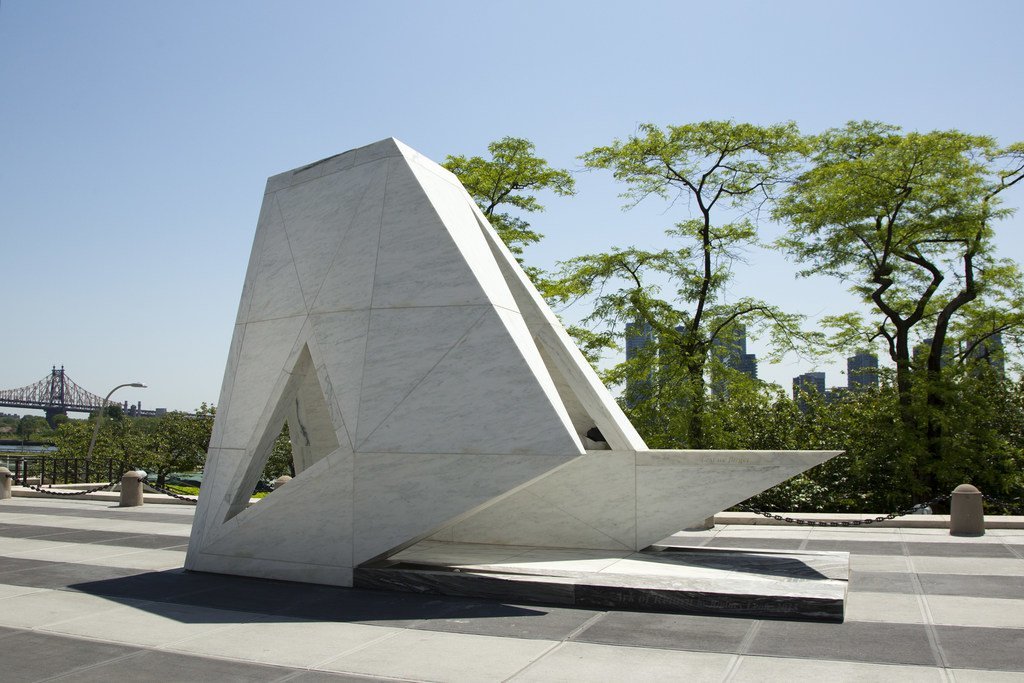
The President of the General Assembly, Philémon Yang, underlined the importance of teaching this history through national curricula and monuments such as The Ark of Return at UN Headquarters.

“Knowledge of our true history can serve as a powerful compass in our onward march towards progress,” he said.

The Ark of Return, the Permanent Memorial to Honour the Victims of Slavery and the Transatlantic Slave Trade, located at the Visitors’ Plaza of UN Headquarters in New York.

Transforming ‘poisoned legacies’

To address the inequities of this system, the Secretary-General called upon the global community to take action on international financial systems which are burdening developing economies in Africa and the Caribbean. Specifically, he emphasized the importance of restructuring debt systems which are “suffocating” these countries’ economies.

Previous UN reports have noted that some poor countries spend more on debt repayments than they do on health, education and infrastructure combined

Mr. Guterres also called for massive investments into clean energy infrastructure in Africa which has been deeply impacted by climate change.

“African countries did not cause the climate crisis. Yet the effects of our heating planet are wreaking havoc across the continent,” he said.

He also reiterated his call for the establishment of a permanent Security Council position for an African Member State.

Mr. Yang, the General Assembly President, underlined the urgency of the Secretary-General’s remarks, urging member states to act imminently.

“Now is the moment to turn recommendations into rights, apologies into action and aspirations into accountability.”  

Source link

Guterres calls on Israel to accept UN’s ‘detailed, principled’ aid plan for Gaza

Addressing reporters outside the Security Council, António Guterres called once again for a permanent ceasefire to end the fighting between Israeli forces and Hamas militants, the immediate and unconditional release of all hostages and full humanitarian access so aid can flow in following nearly 80 days of Israeli blockade.

‘Cruellest phase’

He said Palestinians in the enclave are now “enduring what may be the cruellest phase of this cruel conflict,” with families being “starved and denied the very basics,” as Israel intensifies its offensive and promotes a new privatised aid distribution network reportedly due to begin on Sunday which would bypass the UN and partner organizations’ aid operation.

Israel has clear obligations under international humanitarian law to treat civilians in Gaza humanely, Mr. Guterres added, and “must not forcibly transport, deport or displace the civilian population of an occupied territory.”

He noted that despite authorising a “trickle of aid” to enter in recent days, supplies from only 115 out of 400 trucks have been cleared for collection and distribution – while nothing has reached the besieged north.

UN ‘working round the clock’

“We are working around the clock to get whatever aid we can to people in need,” the UN chief said, but “needs are massive – and the obstacles are staggering.”

Israel is causing unnecessary delays, imposing quotas on distribution and barring essentials such as fuel, shelter, cooking gas, and water purification supplies – are prohibited.

Furthermore, the lives of UN and other humanitarian staffers are being placed at risk if they continue to be prevented from distributing food parcels and flour to those in desperate need, the UN chief continued.

He said absent rapid, reliable, safe and sustained aid access, more Gazans will die – with profound long-term consequences.

Without making direct reference to the US-backed Israeli plan to create new distribution sites overseen by private contractors in coordination with the military, Mr. Guterres said the UN had been clear: “We will not take part in any scheme that fails to respect international law and the humanitarian principles of humanity, impartiality, independence and neutrality.”

5-point aid plan

Instead, he said the UN and partners had “a detailed, principled, operationally-sound 5-stage plan” – supported by UN Member States.

  1. Ensure the delivery of aid to Gaza
  2. Inspect and scan aid at crossing points
  3. Transport aid from crossing points to humanitarian facilities
  4. Prepare aid for onward distribution
  5. And transport aid to people in need

“We have the personnel, the distribution networks, the systems and community relationships in place to act,” said the UN chief. “The supplies – 160,000 pallets, enough to fill nearly 9,000 trucks – are waiting.

“This is my appeal for life-saving aid for the long-suffering people of Gaza: Let’s do it right.  And let’s do it right away.”

Source link

Guterres strongly condemns killing of Israeli diplomats in US capital

The diplomats were gunned down on Wednesday night as they left an event at the Capital Jewish Museum in central Washington DC, where the American Jewish Committee was hosting a reception. 

They were identified as Yaron Lischinsky, 30, and Sarah Milgrim, 26, who were about to be engaged, according to officials and family members. A suspect was taken into custody.

Justice and sympathy

“The Secretary-General reiterates his consistent condemnation of attacks against diplomatic officials,” the statement said.

He called for the perpetrator to be brought to justice and extended his sympathies to the families and loved ones of the victims and to the Government of Israel.

The lone suspect, identified as Elias Rodriguez from Chicago, was apprehended shortly after the murders.  

He shouted pro-Palestinian slogans while in custody, according to media reports.

A ‘heinous antisemitic act’

The head of a UN platform that promotes intercultural dialogue and understanding also voiced his strong condemnation.

“This heinous antisemitic act is unacceptable and unjustifiable. My thoughts go to their families, their colleagues, and the State of Israel,” said Miguel Ángel Moratinos, High Representative for the United Nations Alliance of Civilizations (UNAOC).

Virginia Gamba, Acting UN Special Adviser on the Prevention of Genocide, called for an end to antisemitism saying “there is no place in the world where such a horrific antisemitic hate crime as the murders of Mr. Yaron Lischinsky and Miss Sarah Milgrim can be justified.” 

Senior politicians from across the world have also expressed their condemnation.

The killings occurred against the backdrop of the war in Gaza, which began on 7 October 2023 following Hamas-led attacks on Israel which left roughly 1,200 people dead while another 250 were taken hostage.  More than 53,000 Palestinians have been killed in Gaza, according to the health authorities.

Israeli foreign minister Gideon Sa’ar described the attack as “the direct consequence of the virulent and toxic antisemitic rhetoric against Israel and Jewish communities around the world that has been going on since October 7.”

‘An unbearable loss’

Mr. Lischinsky was a research assistant in the political department at the Israeli Embassy in Washington while Ms. Milgrim organized trips to Israel, according to media reports.

They were killed after attending the American Jewish Committee’s annual Young Diplomats reception which this year focused on response to humanitarian crises throughout the Middle East and North Africa.

The Spokesperson of the Israeli Embassy in Washington, Tal Naim, described their deaths as “an unbearable loss.”

She tweeted a photo of the couple below a message which said that “instead of walking you down the aisle, we are walking with you to your graves.” 

Source link

In Baghdad, Guterres affirms UN will never forget staff killed in Canal Hotel attack

António Guterres was speaking during a wreath-laying ceremony at a memorial in Baghdad to honour the victims of the 19 August 2003 Canal Hotel bombing – the worst terrorist attack in UN history.

Twenty-two people were killed, including the then UN Special Representative for Iraq, Sergio Vieira de Mello.  More than 100 others were injured, and several survivors attended the ceremony.

Families still mourning

Mr. Guterres told the audience that “22 years is a long time, but we will never forget the colleagues who were killed that day in the bombing at the Canal Hotel.”

These staff members “were sons, daughters, mothers, fathers and friends who are, to this day, mourned by those they knew and loved,” he said.

“We will always remember their leader, Sergio Vieira de Mello, who was also killed in the attack. We will stand with the survivors whose lives were changed forever,” he added.

“And we will remember the courageous colleagues and others who rushed to help on that terrible day, and in the days and weeks after — showing us the very best of the humanitarian spirit.”

A tribute and reminder

Mr. Guterres said the memorial stands as a tribute to their lives and their contributions to the people of Iraq.  It also serves as a reminder of how far the country has come since 2003.

He noted that the women and men of the United Nations have worked tirelessly together with the brave and resilient people of Iraq to support their quest for stability, development and peace.

He stressed that above all, the memorial is “a clear reminder of the vital work that our organization does around the world — and the dangers our people face in carrying out that work.”

Remembering humanitarians worldwide

Five years after the attack the UN General Assembly adopted a resolution designating 19 August as World Humanitarian Day.

This date “has been forever transformed from a day of unimaginable horror and tragedy here in Iraq into a global day of solemn remembrance for all humanitarians — inside and outside the organization,” Mr. Guterres said.

“Their bravery, dedication, and belief that a better future is possible will always inspire us. And like those whose lives were lost on 19 August 2003, their sacrifices and contributions to our world — and to our vital cause of peace — will never be forgotten.”

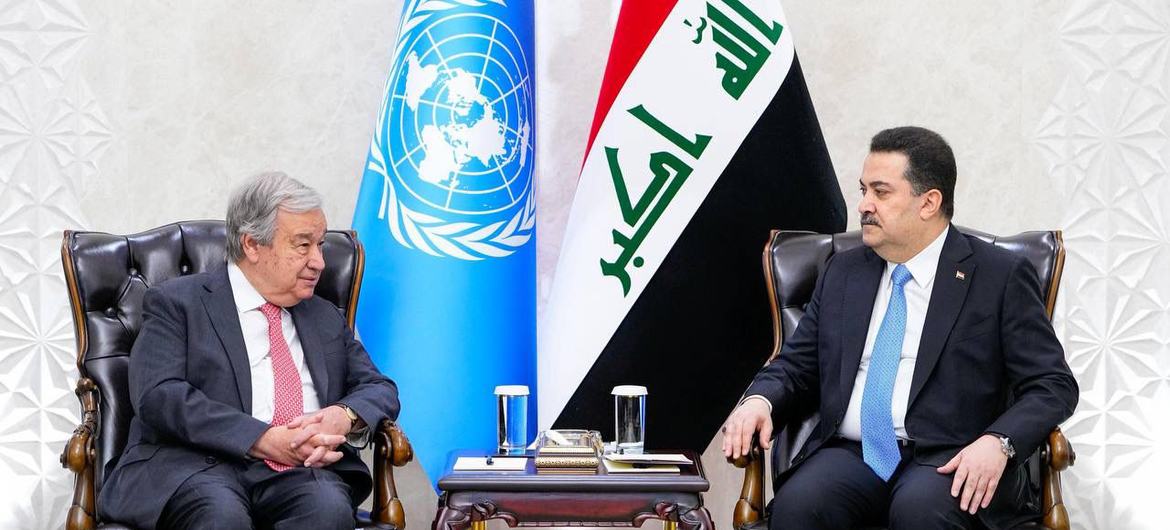
The UN Secretary-General meets with H.E. Mr. Mohammed Shia’ Al Sudani, Prime Minister of the Republic of Iraq.

Meeting with Iraqi Prime Minister

The Secretary-General was in Baghdad to attend the League of Arab States Summit. He also met with senior Iraqi officials, including Prime Minister Mohammed Shia Al-Sudani.

During talks on Sunday, they discussed developments in Iraq and the region, as well as the remaining period of the UN Assistance Mission for Iraq (UNAMI).

The Secretary-General reaffirmed that the UN remains fully committed to continuing to support the Government and people of Iraq following the mission’s departure.

UNAMI has been in the country since 2003 and is working to conclude its mandate by the end of the year.

Source link

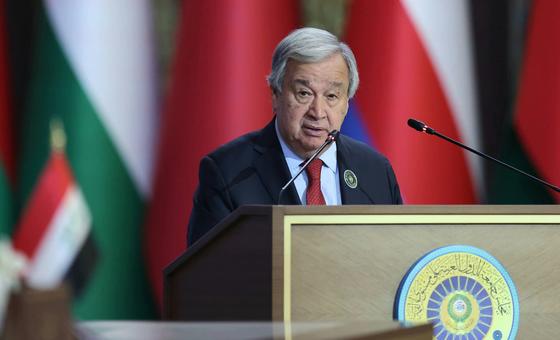
At Arab League Summit, Guterres reiterates call for Gaza ceasefire

António Guterres told leaders meeting in the Iraqi capital that “the region and the world face trials and tests on all fronts,” starting with the situation in Gaza.

He reiterated that neither the atrocious 7 October 2023 terror attacks by Hamas nor the collective punishment of the Palestinian people can be justified.

Permanent ceasefire now

“We need a permanent ceasefire, now. The unconditional release of all hostages, now. And the free flow of humanitarian aid ending the blockade, now,” he said.

The Secretary-General expressed alarm over reports that Israel plans to expand ground operations in Gaza and stressed that the UN “will not participate in any so-called aid operation that does not adhere to international law and the humanitarian principles of humanity, impartiality, independence and neutrality.”

He again called for full support for UN Palestine refugee agency UNRWA, including funding.  

Two-State solution at risk

The UN chief rejected the repeated displacement of the Gaza population, as well as any suggestion of forced displacement outside Gaza, and urged leaders to remain focused on the terrible situation in the occupied West Bank.

“Let’s be clear,” he said. “Annexation is illegal.  Settlements are illegal. Only a two-State solution can deliver sustainable peace.”

He said the high-level conference in June, co-chaired by France and Saudi Arabia, is an important opportunity.

“The world, the region – and, most of all, the people of Palestine and Israel – cannot afford to watch the two-State solution disappear before our eyes,” he said.

Respect Lebanese sovereignty

The Secretary-General addressed the situation in Lebanon.  He emphasized that the country’s sovereignty and territorial integrity must be respected, and the Government must have full control over the entire territory.

He was encouraged by continued progress on reforms as well as efforts to deploy the Lebanese Armed Forces to the south, with support from the UN Mission in the country, UNIFIL.

Mr. Guterres touched on Syria, saying sovereignty, independence, unity and territorial integrity are critical.  He urged strong support for an inclusive Syrian-led and Syrian-owned political process that safeguards the rights and participation of all the country’s people and ensures their protection.

Regarding Yemen, he noted that attacks by Houthi rebels in the Red Sea have caused significant damage to regional and local economies. He welcomed the cessation of hostilities between the Houthis and the United States, announced by Oman on 6 May.

The Secretary-General also called for the release of UN staff and other personnel in Yemen who have been arbitrarily arrested.

Engagement on Sudan

In Sudan, renewed and coordinated multilateral engagement is crucial to help stem appalling violence, famine, and mass displacement, he said, and thanked the Arab League and African Union (AU) for the excellent coordination meeting convened the previous day.  He also commended the Arab League’s efforts to strengthen multilateral coordination.

The Secretary-General turned next to Somalia, saying unity and inclusive dialogue are imperative. Furthermore, assistance from Somalia’s partners will be essential in the fight against Al-Shabaab militants and to strengthen peace and security.

For this reason, Mr. Guterres said he has put forward a recommendation to the UN Security Council to enable predictable and sustainable financing for the AU Support and Stabilization Mission in the country.

Meanwhile in Libya, the UN is also actively engaging in efforts to end the confrontation between armed groups, to preserve the independence of key oversight institutions, to address obstacles preventing national elections, and set the course for long-term stability and prosperity in line with the people’s needs and aspirations.

Lessons from Baghdad

The Secretary-General concluded his remarks by commending the progress Iraq has made over since the restoration of sovereignty in 2004, such as strengthening institutions, resolving outstanding disputes through dialogue, and promoting sustainable development as well as human rights.

He said the UN Assistance Mission in Iraq (UNAMI) has accompanied the country on this path and is working to ensure the successful delivery of its residual mandate and an orderly drawdown by the end of the year.

“Despite the enormous challenges, let us draw lessons and hope from here in Baghdad. Working in unity and solidarity, we can help resolve conflicts and build a future of peace and prosperity,” he said.

Gaza situation ‘beyond inhumane’

Speaking later to reporters, Mr. Guterres said the situation for Palestinians in Gaza “is beyond description, beyond atrocious and beyond inhumane.”

Since 2 March, Israel has banned the entry of cargo into the Strip, including aid and other life-saving supplies. UN agencies continue to warn that the entire population, 2.1 million people, is at risk of famine and one if five faces starvation.

“A policy of siege and starvation makes a mockery of international law,” he said, calling for the blockade to end immediately.

Source link

Gaza: Guterres hails hostage release, renews ceasefire call

Edan Alexander, a 21-year-old American-Israeli national and soldier with the Israel Defense Forces (IDF), had been held by Hamas since the brutal 7 October 2023 attacks on Israel in which roughly 1,200 people were killed and another 250 taken hostage.

He is believed to be the last living American held by militants in Gaza, according to media reports.

Free all remaining hostages

The Secretary-General “is profoundly relieved that Mr. Alexander has been freed and is now returning to his family and loved ones after this harrowing ordeal,” said UN Spokesperson Stéphane Dujarric in a statement.

The UN chief renewed his urgent call for an immediate, permanent ceasefire and the immediate and unconditional release of all remaining hostages, he added, stressing that hostages must be treated humanely and with dignity.

“He calls on all parties to immediately ensure rapid, unhindered, and safe humanitarian relief, including the delivery of critical services, for all civilians in need. Aid is not negotiable,” Mr. Dujarric said.

End the hostilities

The Secretary-General also commended the sustained mediation efforts of Egypt, Qatar, and the United States to bring an end to the fighting.  

He urged “all parties to build on today’s release to reach a comprehensive agreement that will ensure the release of all hostages, an end to the hostilities, the provision of humanitarian aid and the long-overdue alleviation of the human suffering in Gaza,” the statement concluded.

Food security experts warned on Monday that Gaza’s entire population, more than two million people, remains “at critical risk of famine” due to the war and Israel’s blockade on aid entry, effective since 2 March. 

Source link

Guterres welcomes India-Pakistan ceasefire | UN News

The UN chief’s statement, released on Saturday, came shortly after news broke of a decision by the two countries to de-escalate a situation that has caused widespread alarm in recent days.

Tensions had been steadily raising, after a group of gunmen fired on tourists visiting Jammu and Kashmir on 22 April, killing at least 26 and injuring scores more. India and Pakistan both administer parts of the Himalayan region but claim the territory in its entirety, and it has been a scene of unrest for decades.

In the past week, fears grew of an outright military confrontation, and the UN expressed deep concern over deteriorating relations between the two South Asian neighbours, with Mr. Guterres telling journalists that tensions were higher than they had been in years, and reiterating calls for maximum restraint.

There were reports of jubilation in both India and Pakistan at news of the ceasefire, which is believed to be the result of talks mediated by the US, and was announced by representatives of all three countries on social media platforms. However, there have since been reports of skirmishes, including drone attacks.

The Secretary-General welcomed the ceasefire agreement as a positive step toward ending current hostilities and easing tensions, and said that he hopes the agreement will “contribute to lasting peace and foster an environment conducive to addressing broader, longstanding issues between the two countries.”

Source link

Guterres welcomes election of Pope Leo ‘at a time of great global challenges’

His Holiness Pope Leo XIV – born Robert Francis Prevost – is the first person from the United States to lead the Catholic Church, although he also holds Peruvian citizenship after working in the Latin American country for many years.

He was selected by cardinals voting at the Vatican and later greeted thousands gathered in St. Peter’s Square with a message of peace.

Strong voices needed

Mr. Guterres extended heartfelt congratulations to the new pontiff and Roman Catholics everywhere. 

 “The election of a new Pope is a moment of profound spiritual significance for millions of faithful around the world, and it comes at a time of great global challenges,” he said.

 “Our world is in need of the strongest voices for peace, social justice, human dignity and compassion.”

Building on the legacy

 The Secretary-General said he looks forward to building on the long legacy of cooperation between the UN and the Holy See – nurtured most recently by the late Pope Francis – to advance solidarity, foster reconciliation, and build a just and sustainable world for all.

 “It is rooted in the first words of Pope Leo,” he noted.  “Despite the rich diversity of backgrounds and beliefs, people everywhere share a common goal: May peace be with all the world.”

© FAO/Giuseppe Carotenuto

António Guterres, UN Secretary-General (fourth from right) greets an official in front of St. Peter’s Basilica at the funeral of Pope Francis.

Pope Leo, 69, was born and grew up in the midwestern city of Chicago and spent years working as a missionary in Peru, before becoming a bishop and then rising to head the international Order of St. Augustine.

He became a cardinal in 2023 and went on to run the Vatican office that selects and manages Catholic bishops worldwide. 

He succeeds Pope Francis – the first Pope from Latin America – who died in April after serving for 12 years.

Following his death, the UN Secretary-General recalled that “Pope Francis was a transcendent voice for peace, human dignity and social justice” who “leaves behind a legacy of faith, service and compassion for all — especially those left on the margins of life or trapped by the horrors of conflict.” 

Source link

Guterres alarmed by Israeli plans to expand Gaza ground offensive

 “This will inevitably lead to countless more civilians killed and the further destruction of Gaza,” said UN Deputy Spokesperson Farhan Haq, responding to a journalist’s question during the regular media briefing in New York.

“What’s imperative now is an end to the violence, not more civilian deaths and destruction. Gaza is, and must remain, an integral part of a future Palestinian State.” 

The alert comes as the UN humanitarian team and other NGOs in the Occupied Palestinian Territory on Sunday condemned Israeli efforts to replace the aid delivery system with one where supplies would reportedly be funnelled through military hubs in the south.

This proposal would leave “large parts of Gaza…less mobile and (the) most vulnerable” without lifesaving supplies, aid chiefs insisted.

The Secretary-General continues to call for an immediate permanent ceasefire and the immediate and unconditional release of hostages in Gaza, said Mr. Haq.

Deadly attacks and looting

Meanwhile, airstrikes and other attacks continue across the Strip, where Israel has blocked the entry of aid and commercial supplies for more than two months.

Reports indicate that scores of people were killed and hundreds injured over the weekend, including children, the UN aid coordination office OCHA said on Monday.

OCHA noted that robbery and looting have become a daily reality in the Strip, especially in and around Gaza City, which is occurring in parallel with the depletion of supplies.

Businesses are being targeted, and there have also been attempts against UN warehouses.  In most cases the looters were stopped by guards, or the warehouses were already empty.

Water woes

Last week, OCHA reported that water pumping and sanitation systems in Beit Lahiya had gone down because fuel had run out. Services are still not back due to continuing shortages.

Furthermore, a major water line from Israel was damaged on Friday, cutting water supply to northern Gaza – including Gaza City – by half. Teams were only able to fix the problem on Sunday as the repair work required coordination with the Israeli authorities.

Also on Sunday, a UN team managed to retrieve some fuel from a station in Gaza City after the Israeli authorities facilitated their efforts to reach it. However, many reserves remain out of reach due to denial of access.

OCHA noted that in Rafah in southern Gaza, not a single attempt to retrieve fuel has been facilitated since 18 April.

The agency also reported that since Saturday, 19 out of 27 planned humanitarian movements within Gaza were denied outright.  Other attempts were initially given the go-ahead – but then impeded by forces on the ground. 

Source link