
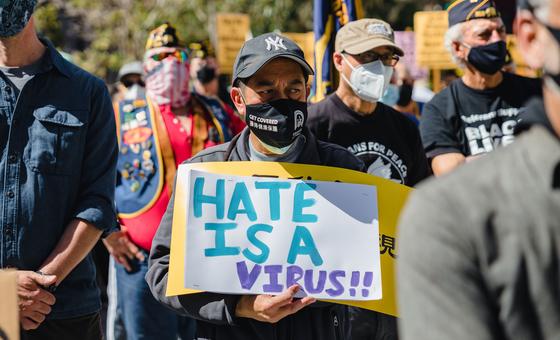
Remembering the Holocaust: ‘You are here because you choose hope over hate’

In his 10th Holocaust Remembrance Day address, Secretary-General António Guterres told survivors and their families gathered in the General Assembly Hall that honouring the dead “and the fight against the ancient poison of antisemitism – is not abstract, but personal”. 

Every year on the day the concentration camps were liberated in 1945, the world unites to honour the memory of the six million Jews – mothers, fathers, sons, daughters, grandparents – who perished at the hands of the Nazis and their collaborators.

Included in the commemoration are the Roma and Sinti communities, people with disabilities, LGBTIQ+ individuals, and all others who suffered from the systemic violence, torture, and genocide of the Nazi regime.

Mr. Guterres emphasised that the lessons of the Holocaust must never be forgotten.

“Remembrance is more than honouring the past. It is a duty and a promise – to defend dignity, to protect the vulnerable, and to keep faith with those whose names and stories we refuse to forget.”

Secretary-General António Guterres addresses the UN Holocaust Memorial Ceremony, held in observance of the international day of commemoration in memory of the victims.

Combat antisemitism 

Reiterating his condemnation of the horrific Hamas-led terror attacks on southern Israel of 7 October 2023, Mr. Guterres said although we are haunted by those horrors, coming together to commemorate the victims of the Holocaust brings hope. 

You are here because you choose hope over hate. You choose remembrance as a living force – a shield against prejudice, a spark for justice, a pledge to protect every human being,” he told the assembly. 

Reminding that the Holocaust began with words, not killing, the Secretary-General underscored that “this dark chapter of our common history reveals sobering truths”. 

When those with power fail to act, evil goes unpunished,” he added, calling for widespread condemnation of antisemitism and all forms of hatred, anywhere and everywhere. 

“Our duty is clear: to speak the truth. To educate new generations. To confront antisemitism, and all forms of hatred and discrimination. And to defend the dignity of every human being”, he concluded.

‘Never again’, etched into our DNA

The President of the UN General Assembly Annalena Baerbock recounted that ahead of the ceremony she had met death camp survivor, Blumenthal Lazan, who was deported to Bergen-Belsen as a child during World War Two.

Ms. Baerbock – former German foreign minister – said she had visited the notorious concentration camp as a young student, which left a powerful impression on her.

Reminding that the ‘Never Again’ promise is “etched into the very DNA of the United Nations, its Charter, and its Universal Declaration of Human Rights”, Ms. Baerbock said that it is “our duty to speak out, even louder than before, when signs of dehumanization emerge”.

Quoting Holocaust survivor Simon Wiesenthal, Ms. Baerbock added that “for evil to flourish, it only requires good men to do nothing”. 

She said that ‘Never Again’ had to represent more than a slogan: “It is a duty to speak up, to stand up, and to defend the dignity and human rights of every member of our human family, everywhere, every day”.

Remembering the lessons of the Holocaust

As part of ongoing efforts to combat hate speech, UN Holocaust commemorations worldwide highlight the importance of educating future generations.


Source link

‘Hate speech is poison in the well of society,’ says Guterres

It is an alarm bell: the louder it rings, the greater the threat of genocide,” he warned.

As part of its core mission to combat hatred, discrimination, racism and inequality, the UN is stepping up efforts to challenge hate speech wherever it arises.

“Hate speech is poison in the well of society. It has paved the way for violence and atrocities during the darkest chapters of human history,” Mr. Guterres added.

Voices of hate

Hate speech often fuels violence and intolerance, with ethnic and religious minorities among the most frequent targets.

While the destructive power of hatred is nothing new, today it is being amplified by modern communication technologies.

Online hate speech has become one of the most prevalent means of spreading divisive narratives, posing a growing threat to peace and security around the world.

#NoToHate

Ahead of the international day, the UN has produced a series of videos aimed at countering hate speech – part of the #NoToHate campaign.

Ahmed Shaheed, Deputy Director of the Essex Human Rights Centre, speaks here about countering Islamophobia:

Rabbi Jill Jacobs, Executive Director of T’ruah: The Rabbinic Call for Human Rights, addresses rising antisemitism:

Artificial Intelligence

This year’s theme sheds light on the nexus between hate speech and artificial intelligence. Building coalitions is the main tool societies can use to reclaim inclusive and safe spaces free of hatred.

While AI tools offer myriad potential opportunities to make positive differences in situations of conflict and insecurity, biased algorithms and digital platforms are also spreading toxic content and creating new spaces for harassment and abuse.

Recognising these immense potential and risks, Member States have recommitted to countering hate speech online.

“Let us commit to using artificial intelligence, not as a tool of hatred, but as a force for good,” said Mr. Guterres.

Source link

Should I stay or should I leave?

Knowing whether to stay in or leave a romantic relationship is often an agonizing experience and that ambivalence can have negative consequences for health and well-being.

Now a new study offers insights into what people are deliberating about and what makes the decision so difficult, which could help therapists working with couples and stimulate further research into the decision-making process.

The study, led by U psychology professor Samantha Joel, was published in Social Psychology and Personality Science. Co-authors were Geoff MacDonald and Elizabeth Page-Gould of the University of Toronto.

“Most of the research on breakups has been predictive, trying to predict whether a couple stays together or not, but we don’t know much about the decision process — what are the specific relationship pros and cons that people are weighing out,” Joel said.

In the first phase of the study, the researchers recruited three samples of people — including people who were in the midst of trying to decide whether to break up or not — to participate in an anonymous survey.

Participants were asked open-ended questions about their specific reasons for both wanting to stay and leave a relationship.

That yielded a list of 27 different reasons for wanting to stay in a relationship and 23 reasons for wanting to leave.

The stay/leave factors were then converted into a questionnaire that was given to another group of people who were trying to decide whether to end a dating relationship or marriage. Those dating had been together for two years on average, while married participants reported relationships that averaged nine years.

In both studies, general factors considered as the individuals deliberated what to do were similar.

At the top of the stay list: emotional intimacy, investment and a sense of obligation. At the top of the leave list: issues with a partner’s personality, breach of trust and partner withdrawal.

Individuals in both dating and married situations gave similar reasons for wanting to leave a relationship.

But the researchers found significant differences in stay reasoning between the two groups.

Participants who were in a dating relationship said they were considering staying based on more positive reasons such as aspects of their partner’s personality that they like, emotional intimacy and enjoyment of the relationship. Those who were married gave more constraint reasons for staying such as investment into the relationship, family responsibilities, fear of uncertainty and logistical barriers.

And about half of the participants said they had reasons to both stay and leave, indicating ambivalence about their relationships.

“What was most interesting to me was how ambivalent people felt about their relationships. They felt really torn,” Joel said. “Breaking up can be a really difficult decision. You can look at a relationship from outside and say ‘you have some really unsolvable problems, you should break up’ but from the inside that is a really difficult thing to do and the longer you’ve been in a relationship, the harder it seems to be.”

Most people, Joel said, have standards and deal breakers about the kind of person they want to date or marry but those often go out the window when they meet someone.

“Humans fall in love for a reason,” Joel said. “From an evolutionary perspective, for our ancestors finding a partner may have been more important than finding the right partner. It might be easier to get into relationships than to get back out of them.”