
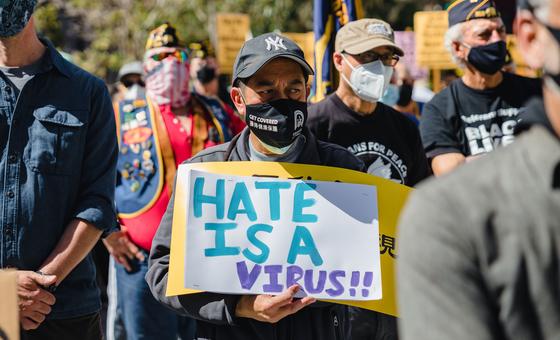
‘Hate speech is poison in the well of society,’ says Guterres

It is an alarm bell: the louder it rings, the greater the threat of genocide,” he warned.

As part of its core mission to combat hatred, discrimination, racism and inequality, the UN is stepping up efforts to challenge hate speech wherever it arises.

“Hate speech is poison in the well of society. It has paved the way for violence and atrocities during the darkest chapters of human history,” Mr. Guterres added.

Voices of hate

Hate speech often fuels violence and intolerance, with ethnic and religious minorities among the most frequent targets.

While the destructive power of hatred is nothing new, today it is being amplified by modern communication technologies.

Online hate speech has become one of the most prevalent means of spreading divisive narratives, posing a growing threat to peace and security around the world.

#NoToHate

Ahead of the international day, the UN has produced a series of videos aimed at countering hate speech – part of the #NoToHate campaign.

Ahmed Shaheed, Deputy Director of the Essex Human Rights Centre, speaks here about countering Islamophobia:

Rabbi Jill Jacobs, Executive Director of T’ruah: The Rabbinic Call for Human Rights, addresses rising antisemitism:

Artificial Intelligence

This year’s theme sheds light on the nexus between hate speech and artificial intelligence. Building coalitions is the main tool societies can use to reclaim inclusive and safe spaces free of hatred.

While AI tools offer myriad potential opportunities to make positive differences in situations of conflict and insecurity, biased algorithms and digital platforms are also spreading toxic content and creating new spaces for harassment and abuse.

Recognising these immense potential and risks, Member States have recommitted to countering hate speech online.

“Let us commit to using artificial intelligence, not as a tool of hatred, but as a force for good,” said Mr. Guterres.

Source link

What’s your poison? Alcohol linked to higher risk of pancreatic cancer

The research, led by the UN World Health Organization’s centre for cancer research, pooled data from nearly 2.5 million people across Asia, Australia, Europe, and North America.

It revealed a “modest but significant” association between alcohol consumption and the risk of developing pancreatic cancer, regardless of sex or smoking status.

Alcohol consumption is a known carcinogen, but until now, the evidence linking it specifically to pancreatic cancer has been considered inconclusive,” said Pietro Ferrari, senior author of the study at the international cancer research agency and Head of Nutrition and Metabolism Branch at the WHO International Agency for Research on Cancer (IARC).

The pancreas is a vital organ that produces enzymes for digestion and hormones that regulate blood sugar. Pancreatic cancer is among the most lethal cancers, largely due to late diagnosis.

All drinkers are at risk

The IARC study found that each additional 10 grams of alcohol consumed per day was associated with a 3 per cent increase in pancreatic cancer risk.

For women consuming 15 to 30 grams of alcohol daily – about one to two drinks – the risk rose by 12 per cent compared to light drinkers. Among men, those who drank 30 to 60 grams daily faced a 15 per cent increased risk, while men drinking more than 60 grams daily saw a 36 per cent higher risk.

“Alcohol is often consumed in combination with tobacco, which has led to questions about whether smoking might confound the relationship,” Mr. Ferrari said.

“However, our analysis showed that the association between alcohol and pancreatic cancer risk holds even for non-smokers, indicating that alcohol itself is an independent risk factor.”

Further research is needed, he added, to better understand the impact of lifetime alcohol consumption, including patterns such as binge drinking and early-life exposure.

A growing global challenge

Pancreatic cancer is the twelfth most common cancer globally, but it accounts for 5 per cent of cancer-related deaths due to its high fatality rate.

In 2022, incidence and mortality rates were up to five times higher in Europe, North America, Australia and New Zealand, and Eastern Asia than in other regions.