

As pollinators move between flowers, they are not only consuming sugar-rich nectar but also small amounts of alcohol. A new study by biologists at the University of California, Berkeley found detectable ethanol in the nectar of 26 out of 29 plant species tested.
The research, published in Royal Society Open Science, represents one of the first broad analyses of alcohol content in floral nectar. Scientists attribute the presence of ethanol to yeast fermentation of sugars within the nectar.
Most samples contained very low alcohol concentrations, though one reached 0.056 percent ethanol by weight. This level is roughly equivalent to one-tenth proof alcohol.
While the concentration may appear negligible, the cumulative intake for nectar-feeding animals can be significant due to their high consumption rates.
Hummingbirds may ingest alcohol equivalent to a daily human drink
Hummingbirds rely heavily on nectar for energy, consuming between 50 percent and 150 percent of their body weight in nectar each day. Based on this intake, researchers estimated that an Anna’s hummingbird could ingest about 0.2 grams of ethanol per kilogram of body weight daily.
This level is comparable to a human consuming roughly one standard alcoholic drink per day, based on metabolic scaling. Despite this, the birds show no visible signs of intoxication.
The study suggests that nectar-feeding animals ingest alcohol in small doses throughout the day rather than in concentrated amounts. This pattern may influence how their bodies process ethanol.
Researchers previously observed that hummingbirds tolerate sugar solutions containing up to 1 percent alcohol but reduce their intake when concentrations reach 2 percent. This behavior indicates some capacity to regulate consumption.
Metabolism and behavior show adaptation to ethanol intake
The research team found evidence that hummingbirds metabolize alcohol in ways similar to mammals. In a related experiment, scientists detected ethyl glucuronide, a metabolic byproduct of ethanol, in bird feathers.
This finding suggests that ethanol is not only consumed but also processed biologically. Researchers noted that the rapid metabolism of hummingbirds, which require constant energy intake, may prevent alcohol from accumulating in their systems.
“Hummingbirds are like little furnaces. They burn through everything really quick, so you don’t expect anything to accumulate in their bloodstream,” said Aleksey Maro, a doctoral student involved in the study.
At the same time, researchers said the behavioral effects of low-level alcohol exposure remain unclear. Ethanol could influence feeding patterns or signaling processes, even if it does not produce visible intoxication.
Robert Dudley, a professor of integrative biology at UC Berkeley, said the birds are unlikely to experience inebriation but may still exhibit subtle physiological or behavioral responses.
Nectar alcohol part of broader ecological and evolutionary pattern
The study places nectar-derived alcohol within a wider ecological context. Other compounds commonly found in nectar, including caffeine and nicotine, are known to affect pollinator behavior.
Researchers suggest ethanol may play a similar role, though further investigation is needed to determine its effects.
The team also compared alcohol intake across species. They found that nectar-feeding birds consume between 0.19 and 0.27 grams of ethanol per kilogram of body weight daily. In comparison, the pen-tailed tree shrew consumes higher levels, while the European honeybee consumes less.
Interestingly, the study found that hummingbirds may ingest more alcohol from artificial feeders than from natural nectar. Fermented sugar solutions in feeders could result in slightly higher ethanol exposure.
The findings contribute to a broader hypothesis that many animals, including primates, may have evolved tolerance to dietary alcohol over time.

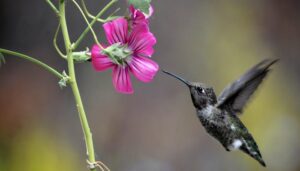
An Anna’s hummingbird (Calypte anna) feeding on flowers of an Island Mallow (Malva assurgentiflora), which was one of the plant species included in the study/Ammon Corl/UC Berkeley
Long-term exposure raises new research questions
The researchers say their findings highlight the need to better understand how animals process ethanol over long periods. Unlike occasional alcohol consumption in humans, nectar-feeding species are exposed to low levels of ethanol consistently throughout their lives.
“This is chronic through the course of the day, but that’s a lifetime exposure,” Dudley said, adding that the biological implications remain unclear.
The study was conducted as part of a five-year project funded by the National Science Foundation, which aims to examine genetic adaptations among hummingbirds and sunbirds.
Scientists involved in the project are exploring how these species have evolved to handle high-sugar diets, varying altitudes, and naturally occurring compounds in nectar.
The researchers said the widespread presence of ethanol in nectar suggests that tolerance to alcohol may be more common across the animal kingdom than previously understood. Further studies will be needed to determine how these adaptations developed and what they reveal about metabolism and evolution.
Also Read:
What’s your poison? Alcohol linked to higher risk of pancreatic cancer
Never mix energy drinks with alcohol, warns study