World News in Brief: Haiti funding cuts bite, civilian suffering intensifies in Myanmar, Belarus deaths in custody alert

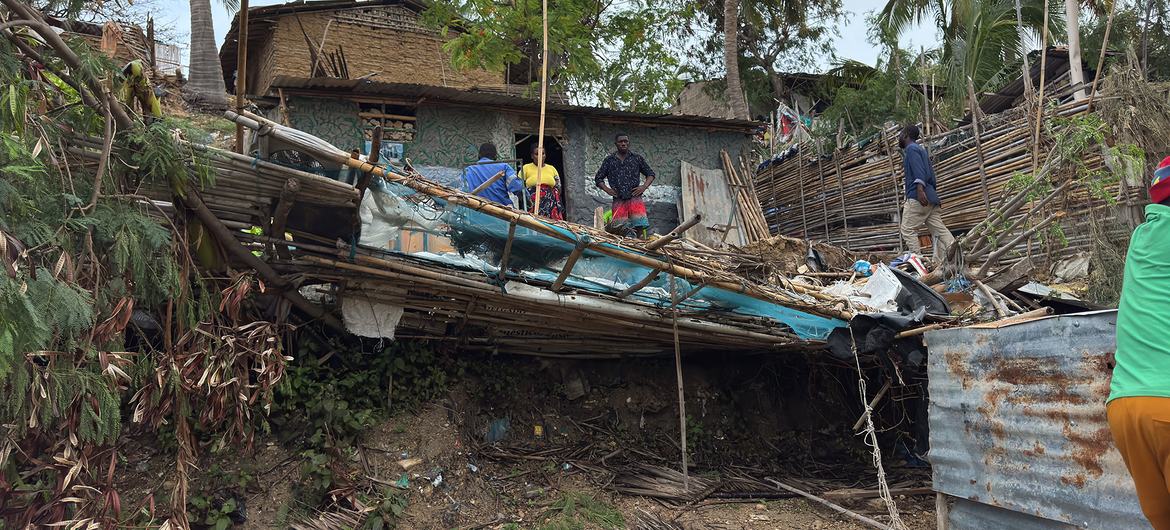
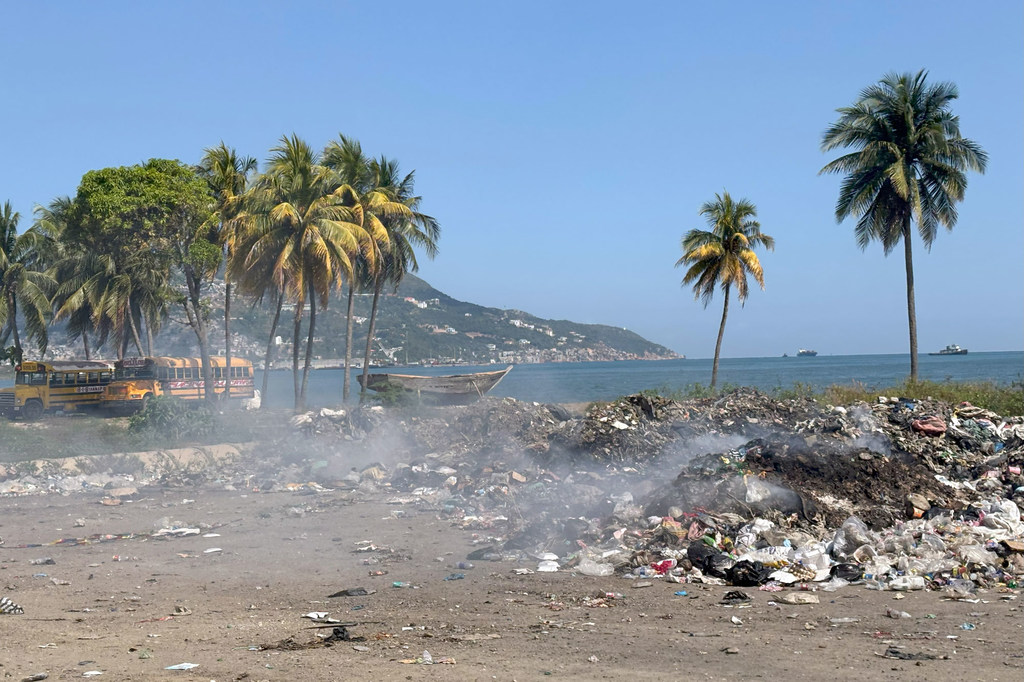
Ongoing violence is compounding the country’s food crisis, disrupting local food production in critical areas such as the commune of Kenscoff and the Artibonite department, often considered the breadbaskets of Haiti.

While the UN and its partners are responding “wherever and whenever possible,” UN Spokesperson Stéphane Dujarric said this Wednesday that humanitarians have only been able to reach 38 per cent of the population they aim to support.

Multiple roadblocks

“This is due to ongoing violence and insecurity, severe underfunding of the response, and the obvious access challenges,” he said.

Over halfway through the year, Haiti is the least-funded of the many humanitarian appeals that the UN coordinates – despite shortfalls for food security in the country being at extreme levels – with just over two per cent of the $425 million needed this year received to date.

Myanmar: Intensifying conflict impedes humanitarian aid

Almost four months after Myanmar’s devastating earthquake, the UN is deeply concerned over the plight of civilians caught up in the country’s devastating and continuing conflict between the military regime and opposition armed groups.

As fighting intensifies, civilians are particularly vulnerable, with increasing attacks on infrastructure.

According to reports, an air strike hit a monastery in Sagan Township in Sagaing Region on 11 July, killing 22 people and injuring at least 50 others. The monastery had been providing shelter to displaced people who had fled nearby villages.

A displacement camp in North Shan State was also reportedly hit by an airstrike over the weekend.

‘Broader pattern’

“These incidents are part of a broader pattern of attacks affecting people across Myanmar,” said Mr. Dujarric, with frequent reports of people being killed, injured or displaced by violence.

Such insecurity also impacts the ability of humanitarian teams to reach people in need: with one in three people now facing acute hunger, and the current monsoon season having caused flooding, “the UN urgently calls on all parties to respect human rights and international humanitarian law,” he said.

Belarus: Rights experts urge probe into deaths in custody of opposition activists

Top independent human rights experts called on Belarus on Wednesday to launch urgent investigations into the deaths of several people jailed for political dissent.

The experts – who are known as Special Rapporteurs – highlighted the case of 61-year-old businessman Valiantsin Shtermer. He died in May 2025 while serving his sentence in a so-called “Correctional Colony” in Šklou.

Mr. Shtermer had been jailed for making critical remarks about Russia’s full-scale invasion of Ukraine. Despite his serious medical condition, he was allegedly denied adequate care in prison.

Fifty-year-old opposition activist Vitold Ashurak meanwhile, also died shortly after being placed in an isolation in the same prison.

According to the Special Rapporteurs, Mr. Ashurak was a member of the Belarusian National Front who was jailed for violating public order during protests related to the disputed 2020 presidential elections.

We must not ignore these deaths

“These deaths must not be ignored,” said the experts, who added that there were strong grounds to believe that they resulted from abuse or neglect linked to the exercise of fundamental rights.

“It is of the utmost importance to thoroughly investigate the alleged instances of ill-treatment and neglect that resulted in the deaths of Shtermer, Ashurak, Puškin and other persons designated as political prisoners by human rights defenders,” the Human Rights Council appointed experts underscored.

“There are strong reasons to believe that these individuals lost their lives in retaliation for exercising their civil and political rights, including the rights to freedom of expression and peaceful assembly.”

The independent experts voiced concern that some opposition figures had been stigmatised and labelled as “extremists” or even “terrorists”.

Special Rapporteurs report regularly to the Human Rights Council. They are not UN staff and do not receive payment for their work.

Source link

First Person: How many more children must die before the world acts?

Juliette Touma, the director of communications for the UN agency for Palestine refugees, UNRWA, has visited Gaza several times during and before the war and has been reflecting on the children she has met there and in other conflict zones.

“Adam has been on my mind lately, more so than usual.

I met Adam years ago in the Yemeni port city of Hudaydah, back then under siege and heavy bombardment. In the very poor hospital ward, there lay Adam, 10 years old, weighing just over 10 kilogrammes. He could not speak, he could not cry. All he could do was make a hoarse sound of breathing. A few days later, Adam died from malnutrition.

A malnourished child inside a hospital in Sana’a, Yemen.

Deadly malnutrition

A couple of years before that, my colleague Hanaa calls from Syria late at night. She was in tears and could barely say a word. Hanaa eventually told me that Ali, a 16-year-old boy had died. In yet another town under siege, caught up in a war not of his making, he had also died from malnutrition.

The following morning, my supervisor, an epidemiologist, said “for a boy of 16 to die of malnutrition, that says a lot. He’s practically a man. It means there’s no food at all in that part of Syria.”

Back in Yemen in one of the few functioning children’s hospitals in the capital Sana’a, I was walking through the children’s ward during the peak of a cholera outbreak. Boys 15 and 16 years old, struggling to stay alive.

They were so weak and emaciated, they could barely turn around in their beds.

These images and stories haunted me over the years as they have for several among us who worked in severe hunger or famine-like situations.

The author plays with students enjoying the “summer fun weeks” games in an UNRWA school in the Gaza Strip in 2023. (file)

Fatal hunger grows in Gaza

In 2022, when I had the great pleasure of going in and out of Gaza, I would visit children in UNRWA schools. Immaculately dressed, healthy looking, smiling, eager to learn, jumping up and down in the school playground to the sound of music.

Back then, Gaza was already under a blockade for more than 15 years. Food was, however, available on the markets through imports via Israel and locally farmed produce. UNRWA was also giving food aid to over one million people.

Images of Adam and Ali were quickly pushed to the back of my memory until a few weeks ago when they suddenly reappeared.

A growing number of children are being screened for malnutrition in Gaza.

Babies can survive, but will they?

Our Gaza teams started sending alarming photos of emaciated babies. The rates of malnutrition are rapidly increasing, spreading across the Gaza Strip. According to the World Health Organization (WHO), more than 50 children died of malnutrition since the siege began on 2 March.

UNRWA has meanwhile screened over 242,000 children in the agency’s clinics and medical points across the war-torn Strip, covering over half the children under age five in Gaza.  One in 10 children screened is malnourished.

Ahlam is seven months old. Her family was displaced every month since the war began, in search of non-existing safety. Shocked and her body weakened, Ahlam is severely malnourished. Like many babies in Gaza, her immune system has been damaged by trauma, constant forced displacement, lack of clean water, poor hygiene and very little food.

Ahlam can survive, but will she?

Bombs and scarce supplies

There are very little therapeutic supplies to treat children with malnutrition as basics are scarce in Gaza. The Israeli authorities have imposed a tight siege blocking the entry of food, medicines, medical and nutritional supplies and hygiene material, including soap.

While the siege is sometimes eased, UNRWA (the largest humanitarian organisation in Gaza) has not been allowed to bring in humanitarian assistance since 2 March.

Last week, Salam, another malnourished baby, died. She was a few months old. When she finally reached the UNRWA clinic, it was too late.

Meanwhile, eight children queuing for therapeutic support against malnutrition were killed when the Israeli forces hit the clinic they were in. One of my colleagues who drove past the clinic a few minutes later told me she saw mothers looking out into the abyss, weeping in silence, just like Adam did.

How many more babies must die before the world takes action?

Why should babies die of malnutrition in the 21st century, especially when it’s totally preventable?

At UNRWA, we have over 6,000 trucks of food, hygiene supplies and medicines outside Gaza waiting for the green light to go in.

The aid will mainly help little girls like Ahlam. UNRWA also has more than 1,000 health workers who can provide boys and girls with specialised nutritional services.

Amid the daily livestream of horrors we get from Gaza on our screens, one cannot help but ask how many more Ahlam’s and Salam’s have to die before taking action?

How much longer until a ceasefire is reached so that bombs stop falling on emaciated and dying children?”

World News in Brief: Inter-ethnic violence in Syria, Indigenous Peoples’ rights, global information security

The violence erupted two days after a Druze merchant was abducted on the highway to Damascus.

The incident marks the latest episode of sectarian bloodshed in Syria, where fears among minority groups have surged since Islamist rebels toppled former dictator Bashar al-Assad in December and installed a new caretaker Government, which is gaining increasing international recognition.

Those targeted include the Druze sect, an offshoot of Shia Islam.  

UN voices ‘deep concern’

On Monday, UN Deputy Special Envoy for Syria, Najat Rochdi, expressed “deep concern” over these reports and urged authorities and stakeholders to “take immediate steps to protect civilians, restore calm and prevent incitement.”

She also underscored the need for inclusion, trust-building and meaningful dialogue to advance a credible and inclusive political transition in Syria.

UN human rights chief says ‘wisdom’ of Indigenous Peoples needed in climate change, digital policy upgrades

The UN human rights chief spoke at a high-level political forum on the rights of Indigenous Peoples on Monday.

Underscoring how crucial such forums are to advancing the rights of Indigenous Peoples, Volker Türk highlighted developments in Colombia, Finland and Guatemala that have given them more self-determination.

But despite these advances, violations against Indigenous Peoples’ rights continue.

Many still lack formal land recognition, while mining activity, deforestation and large-scale agricultural development often cause environmental destruction.

Indigenous Peoples also experience immense discrimination and face the brunt of climate chaos, Mr. Türk stressed.

Toll on activists

Furthermore, data from the human rights office reveals that 26 per cent of rights activists killed in 2023 and 2024 were Indigenous, largely in the Americas.

Additionally, states are using AI in ways that harm Indigenous Peoples through surveillance, data exploitation and exclusion from decision-making. Türk thus called for human rights-based approaches that uphold Indigenous data sovereignty and self-determination.

The High Commissioner also called for future policies on climate, digital technologies and other areas to “reflect the wisdom and experience of Indigenous Peoples.”

“This is not only essential to respect and fulfil the human rights of Indigenous Peoples,” he concluded. “There is growing recognition that the ideas and approaches of Indigenous Peoples hold important lessons for all of us.”

Guterres welcomes step forward in securing digital technology worldwide

The UN chief Antonio Guterres on Monday, welcomed the adoption by consensus of the UN Open Ended Working Group on Information and Communication Technologies.

It was established in 2020 with a five-year mandate to promote regular institutional dialogue and initiatives focused on keeping digital technologies safe and secure.  

The Secretary-General welcomed the Final Report of 10 July, which summed up the past five years of negotiations, said a statement issued by his Spokesperson.  

It reflects shared views on current and emerging threats, responsible government policies, international law, norms and efforts such as confidence-building and capacity development.  

Call for cooperation

It also establishes a permanent mechanism to continue discussions about responsible State behaviour in the use of information and communications technologies, which the Secretary General particularly appreciated.  

“The Secretary-General now calls upon all States to work together through the Global Mechanism to tackle digital risks and ensure these technologies are leveraged for good,” the statement said.  

The Secretary General congratulated the group on its accomplishments, saying the consensus adoption “demonstrates that even in the most challenging international security environment, collective action is still possible.” 

Source link

World Horse Day: Honoring humanity’s oldest and most loyal companion

UN News visited the farm to mark the first-ever World Horse Day, established this year by the UN General Assembly. By creating the Day, Member States sent a clear message: animals deserve to be treated with care and respect.

A faithful companion

From ancient battlefields to modern therapeutic programs, horses have been by humanity’s side for millennia—but in today’s high-tech world, few remember that legacy.

“Horses didn’t just help us survive,” says Marisa Striano. “They built America with us. They plowed the land, they carried people.”

Many cultures revere horses not only for their strength, but for their spiritual presence. In Mongolia—the country that introduced the resolution for World Horse Day—horses are sacred, central to national identity. Children there often learn to ride before they can walk, and folk songs celebrate the animals’ loyalty and nobility.

Fading from view

Once humanity’s primary mode of transportation, horses have largely been replaced by machines. Today, they are mostly found in sport, tourism, therapy, and entertainment. But this shift doesn’t mean they’ve lost their place in human life. “Horses haven’t lost their value – we’ve just stopped seeing it,” Striano says.

Located on Long Island New York’s scenic North Fork, Spirit’s Promise provides a sanctuary of healing for both animals and humans alike.

A second chance

Sick, aging, or retired racing horses are often shipped to slaughterhouses in Canada or Mexico.

“Imagine working 15 years, giving your all, and then being thrown away just because you got old,” Striano says. “Those are the horses we take in. We give them more time. A second chance.”

The farm is home to 19 rescued horses, including retired police horses, former breeding stallions, and even old Amish workhorses – each with their own story.

“One of them is Gus – he’s 107 in human years,” Striano says. “He used to be a therapy horse, but near the end he started throwing kids off. Now he’s retired and in love with his blind companion, Ramona. They’re inseparable. That’s the horse’s soul.”

Emotional congruency

Horses aren’t just helpers – they’re deeply emotional, intuitive, and highly social beings. With near-360-degree vision and a heightened sensitivity to their surroundings, horses are naturally attuned to emotional states, Striano explains. This makes them ideal partners in therapeutic settings.

The Spirit’s Promise farm is run by a close-knit team of women.

At Spirit’s Promise, horses work with children with disabilities, survivors of abuse, and older adults with dementia. A horse can calm an anxious teenager or bring joy to someone who thought they had forgotten how to feel it.

They’re often called “mirrors of emotion”: horses instantly pick up on a person’s true inner state—even if the person isn’t aware of it themselves.

“Horses are 100 percent emotion. They don’t lie, and they can’t stand lies in others,” says Ms. Striano. “If you say you’re fine but inside you’re falling apart, they’ll sense it—and walk away. But if you’re honest—even if you’re sad or angry – they’ll stay with you.”

This sensitivity makes them remarkable companions for those experiencing grief, addiction, or trauma. One moment stands out vividly for her.

A young man came to the farm early in his recovery from drug addiction. Dressed in a hoodie with sleeves pulled low, he seemed constantly on guard. At the time, the farm had a horse named Heartbreaker. Though she has since passed, Striano recalls what happened next with awe.

“She walked right up to him and just… accepted him,” Ms. Striano says. “She looked at him like, ‘I see you’re broken. I am too. But that’s not the end. You can still love.’”

The two entered the paddock together. Heartbreaker lay down on the ground, and the man sat beside her, resting his face on her body. For half an hour, they just sat there in silence.

“It was complete peace,” Ms. Striano remembers. “Trust without words. Presence without conditions.” Then the young man’s mother approached. Heartbreaker, who had been calm and gentle, suddenly grew agitated — snorting, tossing her head, trying to break free.

“She acted like she wanted to protect him from his mother,” she says. “I rushed to lead Heartbreaker away. And the young man turned to me and whispered, ‘She hides behind her religion, but she hasn’t forgiven me. She’ll never say it – but the horse saw it.’”

For Ms. Striano, this confirmed something she’s seen again and again: horses don’t respond to appearances, only truth. “They don’t see the mask. They see the soul. And that’s their power. They see us for who we really are – and still choose to be with us.”

Between Care and Exploitation

Debates around horse exploitation are ongoing: from carriage horses to racing and show industries, where is the line between tradition and cruelty?

Located on Long Island New York’s scenic North Fork, Spirit’s Promise provides a sanctuary of healing for both animals and humans alike.

“I hate racing,” Ms. Striano says. “Maybe it had purpose once. Now it’s just about money. Horses get pumped with drugs, locked up, used up. Then slaughtered.”

At the same time, she acknowledges that ethical questions aren’t always clear-cut. “I don’t believe in sacrificing one soul for another,” she says when asked about the horses pulling carriages for tourists in New York’s Central Park. “Those horses feed entire families. We have to find a balance. But we must never forget: horses are not tools. They are living beings.”

To Forgive and Love Again

For Ms. Striano and the horses she cares for, the farm is a place where trust between species is rebuilt. She sees her work as a privilege—a daily chance to be with creatures that know how to forgive and love again, no matter what they’ve been through.

“When I walk into the paddock and they come up to me—I thank them. Every time,” she says. “Because a horse is pure. They’re not with you because you broke them—they’re with you because they chose to be. And that means everything.”

A Day to Say “Thank You”

According to  the UN Food and Agriculture Organization (FAO), there are around 60.8 million horses in the world. The United States has 2.41 million horses and ponies across 63,000 farms, while the European Union is home to about 7 million horses and 800,000 jobs in equestrian breeding, sport, and tourism. In Mongolia there are 3.4 million horses – nearly one for every person.

Beyond sport and industry, horses, donkeys, and mules are vital to rural life. According to research by the World Organisation for Animal Health and FAO, 112 million working equids support the livelihoods of some 600 million people in low- and middle-income countries, helping transport water, food, and much more.

On July 11, the first World Horse Day, the UN invites the world to say “thank you” to humanity’s loyal companion – for their labor, trust, and patience. For staying by our side – and helping us heal. “A horse is a gift,” Ms. Striano says. “And we have no right to lose it.”

She fought for the girl the world left behind: Natalia Kanem’s UN legacy

She returns, over and over, to a single image: that of a ten-year-old girl – standing on the edge of adolescence, her future uncertain, and her rights still in grave doubt.

“Will she be able to stay in school, graduate, and make her way through the world?” Dr. Kanem wonders. “Or is she going to be derailed by things like child marriage, female genital mutilation, or abject poverty?”

That seismic question and that girl – not one child in particular, but an emblem of the millions worldwide whose future is at risk – have become the touchstone of Dr. Kanem’s nearly eight-year tenure as Executive Director of the UN’s sexual and reproductive health agency, formally known as the UN Population Fund (UNFPA).

From her early days working on the frontlines in East Africa to overseeing a $1.7 billion agency with operations in more than 150 countries, Dr. Kanem has shepherded UNFPA through global shifts, political headwinds, and ideological pushback.

Most of all, she has led a fierce revolution in the lives of millions of women and girls.

This month, she is stepping down from her post ahead of schedule. “It’s time to pass on the baton,” the 70-year-old told her staff – a 5,000-strong workforce – in a videotaped address earlier this year. “I have pledged to do everything in my capacity to keep positioning UNFPA to continue to do great things.”

UNFPA Executive Director Natalia Kanem (centre) visits the Mamas Market in Port Vila, Vanuatu.

Roots and ascent

Born in Panama and trained as a medical doctor, Dr. Kanem joined UNFPA in 2014 after a career in philanthropy. Her decision to serve “the noble purpose of the United Nations” first led her to East Africa and Tanzania, where she was struck by the quiet heroism of field staff. “It’s really at the country level where we prove our worth,” she told UN News.

But the job was not easy. In 2017, when she took the reins of the agency, Dr. Kanem inherited an organization grappling with waning visibility, unstable funding, and persistent pushback from conservative viewpoints. Still, UNFPA grew – not just in budget, but in stature.

“When I came, the narrative was, ‘We’re a small organization, beleaguered, nobody understands what we do,’” she said. “Now, I think it’s clearer.”

That clarity came, in part, from what Dr. Kanem calls “thought leadership.”

Whether challenging misconceptions about fertility or confronting gender-based violence enabled by technology, she pushed UNFPA to the frontlines of global discourse. “We exist in a marketplace of ideas,” she explained. “And we have to tell the truth in a way that’s compelling enough so we can garner the allies this movement requires.”

Under her leadership, the agency trained hundreds of thousands of midwives, distributed billions of contraceptives, and expanded humanitarian operations to reach women and girls in the most fragile settings – from the Rohingya camps in Bangladesh’s Cox’s Bazar to war-scarred Ukraine and cholera-stricken Haiti.

UNFPA’s presence in crisis zones was not only logistical, but symbolic. In Sudan, Syria, and Gaza, a simple tent stocked with menstrual pads, a blanket, and a bar of soap could serve as sanctuary. “It represents the respite that a woman needs in a time of crisis,” she said. “You know, we call our kits ‘dignity kits’ for that reason.”

UNFPA Executive Director, Natalia Kanem (right), visits Sudan in March 2021.

Shifting the conversation

Beyond delivering services, Dr. Kanem elevated UNFPA’s role as a thought leader in a polarised world. She steered the agency into difficult public conversations – about teen pregnancy, climate anxiety, fertility rates, and online harassment – with an unflinching insistence on rights.

“The 10-year-old girl exists,” she said. “What her parents and her religious leaders and her community think is vital for her to be well prepared, for her to know what to do when she’s challenged by coercive practices.”

That leadership extended to data. Under Dr. Kanem, UNFPA invested heavily in supporting national censuses and building dashboards to help lawmakers shape reproductive health policy with real-time insight.

This year’s State of World Population report, the agency’s annual deep dive into demographic trends, reframed conventional narratives around so-called “population collapse” – noting that many women and men delay having children not out of ideology, but because they cannot afford to raise them.

Dr. Kanem praised the altruism of young people who say they’re choosing not to have children for fear of worsening the climate crisis. But that’s not what the data shows.

“The world replacement fertility rate is not endangering the planet,” she explained. “The facts really say: you can have as many children as you can afford.”

A rights-based compass in turbulent times

Dr. Kanem’s tenure coincided with mounting attacks on reproductive rights, rising nationalism, and growing scepticism of multilateral institutions. She faced years of US funding cuts – including under the current administration – even as demand for UNFPA’s services surged.

“UNFPA has more money than we’ve ever had,” she noted. “But it’s never going to be enough to stop the flow of need.”

Resources alone won’t secure the agency’s future – credibility and persistence are just as vital. “The multilateral system itself has come under question at a time when it is needed now more than ever,” she warned. “We do have to prove ourselves each and every day. And when we make mistakes, we’ve got to get up and rectify them and find partners who are going to be allies.”

One such partner has been the private sector. In 2023, UNFPA teamed up with tech firms to launch a development impact bond in Kenya, delivering mobile-based sexual health services to prevent teenage pregnancy and new HIV infections among adolescent girls.

Dr. Natalia Kanem, head of the United Nations Population Fund (left) talks to UN News and Media Deputy Director Mita Hosali.

Changing mindsets

UNFPA has long worked to end harmful practices such as female genital mutilation (FGM) and child marriage. Under Dr. Kanem, that work became as much about shifting mindsets as changing laws.

“Yes, absolutely,” she said when asked if progress was real. “It’s been very important to see religious leaders and traditional leaders standing against certain practices… and to work with school systems so that the girls themselves will understand the risks and be able to take better decisions about their options.”

The coronavirus“>COVID-19 pandemic, she admitted, was a setback. With schools closed, some communities increased the number of weddings and FGM ceremonies. But in many countries – including populous Indonesia – UNFPA has seen the practice decline, in part thanks to youth advocates speaking out from within their own communities.

New generation, next chapter

Looking ahead, Dr. Kanem didn’t dwell on uncertainty. She spoke instead of possibility. “We’ve transformed ourselves, modernized ourselves,” she said. “There’s just unlimited possibility for UNFPA.”

Her own future includes what she calls a “mini-sabbatical” – more time for music, her family, and, finally, herself. But she won’t stay silent for long. “I know that my passion for issues of women and girls is not going to recede,” she said. “It’s been a labour of love.”

Her parting thought? One final return to the girl at the centre of it all.

“When that 10-year-old girl succeeds, everyone succeeds,” she said. “It is a better world.”

Source link

It’s time to finance our future and ‘change course’, Guterres tells world leaders in Sevilla

António Guterres issued his clarion call noting that sustainable development powered by international cooperation, is now facing “massive headwinds.”

Addressing the opening session of the 4th Financing for Development Conference (FFD4) in baking hot Sevilla, Spain – basking in record high June temperatures – the Secretary-General noted multilateralism itself is also feeling the heat, while trust between nations and institutions fray.

The world is on fire, shaken by inequalities, climate chaos and raging conflicts: “Financing is the engine of development and right now, this engine is sputtering,” he told the conference, attended by more than 50 world leaders, over 150 nations and around 15,000 delegates.

“As we meet, the 2030 Agenda for Sustainable Development – our global promise to transform our world for a better, fairer future – is in danger.”

Some two-thirds of the ambitious Sustainable Development Goals (SDGs) targets agreed in 2015 are significantly off track – hence the staggering $4 trillion investment needed to turn it around.

“We are here in Sevilla to change course. To repair and rev up the engine of development to accelerate investment at the scale and speed required,” said Mr. Guterres.

He described the outcome known as the Sevilla Commitment adopted on Monday – without the United States which pulled out of the process earlier this month – as a “global promise” to low-income nations to lift them up the development ladder.

The UN chief outlined three key action areas:

  • First, get resources flowing fast at home to spur sustainable growth, and for richer countries to honour their pledge under the accord to double aid to poorer countries to boost development. This includes tripling the lending capacity of Multilateral Development Banks and innovative solutions to unlock private cash.
  • Second, fix the “unsustainable, unfair and unaffordable” global debt system. Right now, poorer countries are spending around $1.4 trillion just servicing their vast debts in the form of interest payments. Among the innovations, a new borrowers’ forum will ensure fairer debt resolution and action.
  • Third, reform the global financial architecture, with major shareholders playing their part, so that it empowers every country. “We need a fairer global tax system shaped by all, not just a few.”

The current crisis of affordability and stalled development is “a crisis of people,” he continued, which leaves families hungry, children unvaccinated, and girls left out of education.

“This conference is not about charity. It’s about restoring justice and to facilitate the ability of all people to live in dignity,” said Mr. Guterres.

This conference is not about money – it’s about investments in the future we wish to build together.”

A tangible and actionable’ roadmap

King Felipe of Spain spoke just ahead of the official opening, telling delegates the multicultural city of Sevilla welcomes the world “with open arms”.

He said a new roadmap would emerge that is based on what is “concrete and tangible and actionable”.

The conference must be a success, because cooperation is one of our fundamental pillars of the multilateral world and “the ultimate embodiment of the values that sustain it – especially at this particular point in history where many certainties are melting away and many fears and uncertainties are taking shape.”

‘Our time is now’

Spain’s President Pedro Sánchez told delegates “our time is now and our place is here.” Millions of lives will depend on the choices made in Sevilla and going forward.

We must choose “ambition over paralysis, solidarity over indifference and courage over convenience,” he continued, adding that the eyes of world are on this hall, to see what we are ready to do together and in the face of this historic challenge we must prove our worth.”

Sevilla was “the New York of the 16th century” in diplomatic terms he told delegates – and a cradle of globalism – we must all do that legacy justice today.

‘Sevilla is not an end point’

Secretary-General of the conference, Li Junhua – who’s in charge of the Department of Economic and Social Affairs (DESA) – said the week in Sevilla is key moment to mobilise the resources necessary to build a just, inclusive and sustainable future.

The UN effort to finance development has been anchored in multilateralism and solidarity – but today, the whole framework is under “profound stress.”

He said never has sustainable development been so tested but the pact made in Sevilla puts people back at the centre.

Sevilla is not an end point, it is a launch pad for a new era of implementation, accountability and solidarity.” UNDESA is ready to support all nations to translate the commitment into international action, he underscored.

President of the UN General Assembly Philémon Yang told delegates above all, “we need leadership to guide the world forward into a brighter more prosperous future for everyone, everywhere.”

He said the Sevilla framework will renew global partnership for the decade ahead and provide a focus on a debt burden which is crippling the developing world.

President of the UN Economic and Social Council Bob Rae said trust between countries had to be strengthened, because its absence “creates chaos.”

“Most of all I want to congratulate states for bringing forward the ambition, deepening engagement between financial institutions.”

The week represents a real commitment to action, he said.

Ajay Banga, President of the World Bank Group, told delegates ending poverty remains his key mission and the surge in population underway in developing countries requires resources “at an unprecedented scale and pace.”

He said everyone knew that governments, philanthropies and institutions are unable to meet every projection or promise – which is why the private sector is essential to the Sevilla Agreement so that capital can flow.

Mr. Banga added that the bank’s reforms of recent years are about being a better partner to the private sector and government clients.

Improving response time, boosting capital and systems of growth are key – but much more is needed to deliver for the next generation.

Exempt least-developed from punishing tariffs: WTO

Ngozi Okonjo-Iweala, Director-General of World Trade Organization said the conference was gathering at a time of unprecedented difficulty.

After decades of positive contributions, the global trading system has now been “severely disrupted” leaving exports so hampered by unilateral tariff measures and policy uncertainty that the WTO has sharply downgraded growth forecasts.

Further tariff barriers on 9 July – the deadline set by the US administration – will only make the contraction in global trade worse.

She reminded that the WTO has argued for the least developed nations and Africa overall to be exempted from the tariffs, “so we can better integrate them into the world trading system, not further exclude them.”

She said the Sevilla Agreement rightly recognises international trade as an engine of development.

“We therefore need to bolster stability and predictability in global trade,” through action at many levels that can grow national resources through exports, she told delegates.

IMF calls for broader tax base

Nigel Clarke, Deputy Managing Director of the International Monetary Fund (IMF), called for broadening the tax base, building strong financial management systems, coordinating support and addressing debt more sustainably.

“Many countries continue to struggle with high interest costs,” he said, calling on the international community to improve debt restructuring processes.  

Through its capacity development, the Fund is equipping members to chart their own paths and is also providing financial support when they need it most, he added.

Source link

LIVE: World leaders in Sevilla launch ambitious push to finance the future

From rising debt and shrinking investment, to the aid funding crisis and struggles to meet ambitious development goals, the global financial system is failing the people it’s supposed to serve: that’s the challenge facing world leaders gathered in Spain’s sweltering southern jewel of Sevilla this week, as the  UN’s 4th International Conference on Financing for Development gets underway. Follow our live Meetings Coverage below; app users can catch all the action from the opening day here and you’ll find all related stories on our special dedicated page right here.

Source link

UN80 Initiative: What it is – and why it matters to the world

“This is a good time to take a look at ourselves and see how fit for purpose we are in a set of circumstances which, let’s be honest, are quite challenging for multilateralism and for the UN,” says Guy Ryder, Under-Secretary-General for Policy and chair of the UN80 Task Force.

Known as the UN80 Initiative, this process seeks not only to improve efficiency, but also to reassert the value of multilateralism at a time when trust is low and needs are high. It aims to reinforce the UN’s capacity to respond to today’s global challenges – ranging from conflict, displacement, and inequality to climate shocks and rapid technological change – while also responding to external pressures such as shrinking budgets and growing political divisions in the multilateral space.

“We will come out of this with a stronger, fit-for-purpose UN, ready for the challenges the future will undoubtedly bring us,” explains Mr. Ryder.

View of the UNHQ building from Roosevelt Island, New York

Three tracks of reform

At the heart of UN80 are three major workstreams. The first is focused on improving internal efficiency and effectiveness, cutting red tape, and optimizing the UN’s global footprint by relocating some functions to lower-cost duty stations. Mr. Ryder notes that burdensome administrative procedures and duplications are being targeted.

“We want to see what we can do better. We want to look at those areas where we think we can improve efficiencies and strip out unnecessary bureaucratic processes,” he outlines.

The second workstream is a mandate implementation review, which involves examining nearly 4,000 mandate documents underpinning the UN Secretariat’s work. A mandate refers to a task or responsibility assigned to the organisation by the Member States, usually through resolutions adopted by UN organs such as the General Assembly or the Security Council.

These mandates guide what the UN does – from peacekeeping operations and humanitarian aid to human rights and environmental action.  Over the decades, at least 40,000 mandates have accumulated, sometimes overlapping or becoming outdated, which is why reviewing them is a key part of the UN80 initiative .

“Let’s take a look at them,” Mr. Ryder says. “Let’s see where there may be duplication, where we can prioritise and de-prioritise, and find redundancies.”

But reviewing this mountain of mandates is not new. “We’ve tried this exercise before. We had a look at these bulky mandates back in 2006. It didn’t work very well.” Mr. Ryder reflects.

This time, however, the process is favoured by one key factor. “This time, we’ve got the data and analytical capacities. We’re applying artificial intelligence techniques to provide much more and better organised information to Member States – a more compelling case that could drive, I think, a productive process.”

He emphasises that the responsibility for deciding what to retain, revise, or discontinue rests squarely with the Member States.

“These mandates belong to Member States. They created them, and only they can evaluate them. We can look at the evidence, we can put that to Member States, but eventually they are the decision-makers on mandates and on very much else that the UN80 initiative brings.”

The third stream explores whether structural changes and programme realignment are needed across the UN System. “Eventually, we might want to look at the architecture of the United Nations system, which has become quite elaborate and complicated,” Mr. Ryder adds. Proposals are also likely to emerge from the mandate implementation review.

Guy Ryder, Under Secretary-General for Policy and Chair of the UN80 taskforce

A task force and a system-wide lens

To tackle reform across such a complex system, the Secretary-General established seven thematic clusters under the UN80 Task Force; each coordinated by senior UN leaders from across the system. These cover peace and security, humanitarian action, development (Secretariat and UN system), human rights, training and research, and specialised agencies.

“It’s important to say that at a moment when the system is under pressure, the system is responding as a system,” the UN80 Taskforce chair notes. “This is not just New York, not just the Secretariat. It is system-wide.”

Each cluster is expected to produce proposals to improve coordination, reduce fragmentation, and realign functions where needed. Several clusters have already submitted initial ideas. A broader set of proposals will follow in July.

UNFICYP/Katarina Zahorska

The United Nations works to prevent conflict, support peace processes, and protect civilians—upholding its core mandate to maintain international peace and security.

Reform, not retrenchment

Attention around the UN80 Initiative has largely focused on proposed budget cuts and staff reductions, raising concerns that it is mainly a cost-saving exercise. Mr. Ryder underscores that this view misses the bigger picture.

“Yes, we do face financial challenges. No need to avert our eyes from that. But this is not a cost-cutting, downsizing exercise. We want to make the UN stronger,” he says.

Still, the financial pressures across the system are undeniable. A revised programme budget for 2026, due in September, is expected to include significant reductions in funding and posts for Secretariat entities — a consequence of persistent cash flow constraints linked to delayed and incomplete contributions from Member States.

“The UN80 Initiative wants to improve the impact and effect of multilateralism and the UN,” Mr. Ryder explained. “Now, that does not mean – we wish it were otherwise – that we do not have to take a look at our budget and our resources in different parts of the system.”

“Organisations have faced some wrenching decisions, and this is happening every day. That’s the reality of our circumstances,” he adds.

Mr. Ryder contends that financial sustainability and mission impact are not mutually exclusive – but must be pursued in tandem. “We have to reconcile the two objectives of making ourselves financially sustainable in the difficult circumstances we find ourselves in, but also be attentive, as always, to the impact that we have in delivering on our responsibilities under the Charter,” he said.

Children in Haiti eat a meal provided as part of WFP’s school feeding programme.

Why UN80 matters to people everywhere

Rather than mere bureaucratic reform, UN80 is ultimately about people, those who rely on the UN’s support during crisis, conflict, or development challenges.

“If the UN is able to transform itself, to make improvements, sometimes through difficult decisions, that can mean those life-saving interventions reach the people we serve more effectively,” Ryder says.

The UN remains the essential, one-of-a-kind meeting ground to advance peace, sustainable development and human rights for all.

“This is the United Nations taking seriously its responsibilities to the people we serve”, Mr. Ryder says.

Right now, the UN assists over 130 million displaced people, provides food to more than 120 million, supplies vaccines to nearly half the world’s children, and supports peacekeeping, human rights, elections, and climate action across the globe. The UN’s development work has helped build peaceful, stable societies.

UNICEF-supported vaccination in remote Shan State village, Myanmar

What happens next

The UN80 Task Force will present its proposals to the Secretary-General, who has already indicated the first areas where outcomes are expected. A working group on efficiencies in the UN Secretariat, led by Under-Secretary-General Catherine Pollard, is expected to deliver initial proposals by the end of June. A report on the mandate implementation review will follow at the end of July.

This work under the first two workstreams will help inform broader thinking around structural changes and programme realignment across the UN system. Proposals under the third workstream will be put forward to Member States in the coming months and into next year.

Although the work is just beginning, Mr. Ryder believes the UN has the right tools – and a clear sense of ambition and urgency.

“We’re progressing well. There’s a lot of homework being done now,” he said. “As the weeks go by, this will be shifting more and more to the Member States’ space, and that’s when we’ll see results.”

Eventually, Member States will need to decide how to act on the findings. “They’re going to have to decide what they want to do. Will they wish to set up an intergovernmental process? The Secretary-General has mentioned this as a possibility already.”

UN Secretary-General António Guterres briefs the media about the UN80 Initiative.

Defining success

So, what does success look like?

“A UN system which is able to deliver more effectively, to strengthen and consolidate trust in multilateral action,” Mr. Ryder says. “A system which can convey to public opinion and political decision-makers that this is an organisation worth investing in. That this should be your preferred option when it comes to meeting the challenges of the future.”

For the UN80 Task Force chair, it comes down to credibility, capability, and public trust – and ensuring the UN remains not just relevant, but essential.

“We should all care about this,” he says. “If we take the view that multilateralism is the best instrument we have for meeting global challenges, then we need to make sure we renovate, refresh, and make that machinery as effective and as fit for purpose as it can possibly be.”

Source link

Asia is warming twice as fast as the rest of the world

While there are records which exist to be broken – Olympic ones, for example -these monthly temperature extremes are not medal worthy. And yet, China was not the only Asian country to set a flurry of new highs in 2024.

The continent is warming twice as fast as the global average, according to a report released Monday by the World Meteorological Organization (WMO). This rate of warming – which shows no signs of stopping – is leading to devastating consequences for lives and livelihoods across the region, and no country is exempt from the consequences.

Extreme weather is already exacting an unacceptably high toll,” said WMO Secretary-General Celeste Saulo on Monday.

Large landmass, warmer temperatures

The WMO report said that Asia is warming twice as fast as global averages because of its large landmass, explaining that temperatures over land increase more quickly than those over sea.

Variations in surface temperature have a large impact on natural systems and on human beings,” the report said.

The oceans around Asia are also experiencing temperature increases with surface temperatures in the Indian and Pacific Oceans reaching record levels in 2024.

Moreover, prolonged heat waves, both on land and sea, wreaked havoc across the region, leading to melting glaciers and rising sea levels. 

Too much and too little water

Some countries and communities in Asia were ravaged by record rainfall. Northern Kerala in India, for example, experienced a fatal landslide which killed over 350 people.

Record rainfall coupled with snow melt in Kazakhstan, which is home to thousands of glaciers, led to the worst flooding in 70 years.

Others were ravaged by the exact opposite problem – not enough rainfall. A summer long drought in China, for example, affected over 4.76 million people and damaged hundreds of thousands of hectares of crops.

WMO emphasized in the report that the only way to adapt to these increasingly polar weather patterns is to install more comprehensive early warning systems which are coupled with capacity building measures that enable communities to be more resilient.

Nepal: A case study in preparedness

The WMO report lauded the success that Nepal has had in installing early warning systems which monitor flooding risks, among other things, even as it said that more comprehensive action was necessary.

Between 26 and 28 September 2024, Nepal experienced extreme rainfall which created landslides and flooding across large swaths of the country. 246 people were killed, 178 injured and over 200 missing in the wake of the climate emergency.

While the impact of the crisis was extreme, early flood warning systems enabled communities to prepare for evacuation in addition to crisis responders to reach the worst hit regions quickly.

This is the first time in 65 years that the flooding was this bad. We had zero casualties thanks to preparedness and rescue measures, but the damage was extensive,” said Ramesh karki, Mayor of Barahakshetra, an affected municipality in Eastern Nepal.

Moreover, comprehensive national protocols on emergency funding ensured that funding for humanitarian and rebuilding needs was quickly dispersed throughout the country.

WMO said that they are working with the Nepalese government and other partners to continue improving upon these systems.

“The work of National Meteorological and Hydrological Services and their partners is more important than ever to save lives and livelihoods,” Ms. Saulo said. 

Source link

‘One Earth, One Health’: Yoga Day provides respite in a tumultuous world

This powerful message of International Yoga Day, observed annually on 21 June, reverberated through UN Headquarters in New York on Friday as hundreds gathered to embrace the ancient, holistic practice.

A familiar tradition now each year, the North Lawn once again transformed into an open-air yoga studio overlooking the East River.  Following a stretch of rainy, gray days, the sky had finally cleared, making it a bright, warm day.

And yoga enthusiasts, including diplomats, UN officials and staff, took full advantage of it, rolling out their mats – flexing bodies and minds.

Peter Rogina, founder of Project Peace Lights, was delighted to return to the headquarters and fondly recalled the 2019 event, which was moved indoors to the General Assembly Hall due to rain.

“I love the opportunity to practice with such a large group of people, the energy is just amplified…And I also have my son with me, so to introduce him to this experience, I am also very excited.”

Lama Aria Drolma is a Buddhist teacher and meditation expert.

A Buddhist monastic Lama Aria Drolma comes to the UN every year to participate in the event. Her path has taken her from the world of corporate modeling to a more reflective place of inner peace and meditation.

“When I was a young child growing up in India, I used to practice yoga. It touches not only the body but also the soul. It’s very meditative as well. I find yoga to be one of the healthiest things we all can do to take care of our health.”

‘One family’

The emphasis on personal wellness also highlighted the benefits of yoga going beyond individuals to encompass the health of the entire planet.

Organized by the Permanent Mission of India to the UN in collaboration with the UN Secretariat, the theme of this year’s event was, Yoga for One Earth, One Health.

India’s Permanent Representative Ambassador P. Harish noted how it underscores a vital truth: personal well-being and planetary health are deeply interconnected.

“In caring for ourselves, we begin to care for Earth, reflecting the enduring Indian ethos of Vasudhaiva Kutumbakam, or the whole world is one family.”

“The 11th edition of the Yoga Day offers us an opportunity to reflect on how yoga has grown into a global force for well-being, touching people across age-groups, geographies and walks of life,” he added.

Echoing that, Didi Ananda Radhika Acharya from Ananda Marga Women’s Welfare Center pointed out that more than just an exercise, yoga is  a way to discover the sense of oneness with yourself, the world and nature.

“On the outside, we are our bodies, within that lies our mind. Deep further inside, there is something that is always witnessing us, observing us. That is our soul. Through Yoga, we can reach that inner space. When we delve into the depths of our mind through yoga, we realize how deeply connected we all are.”

A symbol of hope

Participants on the lawn ranged from experienced practitioners to curious first timers, engaged in basic yoga asanas (poses), breathing techniques and stretching exercises.

Permanent Mission of India to the UN

Marking International Day of Yoga at UN Headquarters in New York City. (20 June 2025)

The key highlight of the programme was a guided meditation session by the renowned physician and a leading figure on integrative well-being, Dr. Deepak Chopra.

Marta Shedletsky from Sivananda Yoga Vedanta Center in New York attended the session seeking a sense of community, trust – and hope. The venue held a special meaning for her.

“What’s going on in the world these days, with all the turmoil and all the wars that are going on, this place feels like a symbol of hope for a better future and the possibility of peace.”

World News in Brief: Global investment plunges, hurricane season in Haiti, rising cholera and hunger in South Sudan

Their latest data shows that the outlook for international investment this year “is negative”, a sharp course correction from January, when “modest” growth seemed possible.

The reasons for this range from trade tensions and tariffs whose main effect has been a “dramatic increase in investor uncertainty”, said UNCTAD Secretary-General Rebeca Grynspan.

She said that investment in renewable energy, water and sanitation fell by some 30 per cent and that agriculture saw a 19 per cent drop in investor confidence.

Only the health sector saw an increase of nearly 20 per cent, Ms. Grynspan said, although that only accounts for “less than $15 billion globally”.

‘Very real consequences’

“Behind those numbers are very real consequences. Jobs not created,” she said. “Infrastructure not built, sustainable development delayed. What we see here is not just a downturn. It is a pattern.”

Ms. Grynspan also cited “growing geopolitical tensions” in addition to rising trade barriers around the world as reasons for the fall in global investment for development.

In critical sectors as hi-tech industries and rare earth minerals, governments are also tightening screening measures on proposed foreign investment, the UN agency noted.

Supplies to limit hurricane impact in Haiti critically low

The Humanitarian Country Team in Haiti warned Wednesday that funding and pre-positioned contingency supplies are critically low ahead of what is forecast to be an above-average hurricane season.

Haiti is highly vulnerable to extreme weather, with 96 per cent of the population at risk. Forecasts project 12 to 19 tropical storms and up to five major hurricanes this year.

The alert comes as the fragile island nation grapples with a worsening humanitarian crisis. Armed gangs control much of the country, the collapse of essential services and growing displacement have left 5.7 million people food insecure, 1.3 million displaced and 230,000 living in makeshift shelters ill-equipped to withstand severe weather.

Limited preparations  

Humanitarian actors have pre-positioned limited stocks of essential items, but they are at a record low for a hurricane season posing such high risk.  

For the first time, Haiti will begin the hurricane season without pre-positioned food supplies or the financial resources necessary to initiate a rapid response.  

Meanwhile, UN Humanitarian Office (OCHA) is coordinating missions with UN agencies and partners to assess how to safely resume aid operations in high-need areas, following their suspension on 26 May due to insecurity.

“I am deeply concerned for communities, families, and vulnerable groups who have already been affected by violence and are living in precarious conditions,” said Ulrika Richardson, Humanitarian Coordinator in Haiti, calling for immediate support.

As of mid-June, the $908 million Humanitarian Response Plan for Haiti is just 8 per cent funded.

Worsening cholera and hunger in South Sudan

OCHA raised the alarm on Thursday over rising malnutrition and cholera cases in war-torn South Sudan.

An estimated 2.3 million children under five urgently need treatment for acute malnutrition, a 10 per cent increase since last July.

This crisis is unfolding amid the world’s most severe cholera outbreak this year, with almost 74,000 cases and at least 1,362 deaths reported as of 16 June.  

The start of the rainy season and waning immunity risk a significant surge in infections.

UN response

The 2025 Humanitarian Needs and Response Plan for South Sudan is only 20 per cent funded.

Despite limited resources and many challenges, the UN and partners have scaled up efforts, delivering vaccines and life-saving aid to contain the disease and protect the most vulnerable.

“This dire situation is a stark reminder that we need funding urgently to expand food assistance, to expand nutrition and expand health services to those who need it the most,” said UN Spokesperson Stéphane Dujarric at the daily briefing in New York. 

Source link

World Refugee Day: telling their stories

While hotspots include Sudan, Syria, Afghanistan, Ukraine and Palestine, displacement affects every region of the world.

In the lead-up to World Refugee Day, Friday, the UN is spotlighting the importance of solidarity with refugees through support, solutions, and the power of storytelling.

Zahra Nader: Reporting from exile

Ahead of World Refugee Day, UN News spoke with Zahra Nader, a refugee, journalist and women’s rights activist from Afghanistan.

At age six, Nader and her family fled to Iran after the Taliban first took power, where she was denied access to education and faced racism.

Returning to Afghanistan years later, the stark contrast between life in exile and the opportunity to attend school ignited her passion for journalism and advocacy.

In August 2021, while she was pursuing a PhD in Canada, the Taliban regained control, shattering her dreams of returning home to teach and conduct fieldwork.

I felt as a journalist who grew up in Kabul, who became a journalist there, I have a right and responsibility to tell these stories of women in Afghanistan,” she said. “This is really inhuman, for half of the population of a country to be stripped of their basic human rights because they were born female.”

Channeling that pain into action, she founded Zan Times, an Afghan women-led newsroom in exile documenting human rights abuses in Afghanistan, particularly those affecting women.  

Despite limited funding and growing risks to her reporters, Nader continues her work to ensure that Afghan women are seen and heard.

She described the situation in Afghanistan as “the most severe women’s rights crisis of our time”, calling international action insufficient and warning that inaction emboldens the Taliban and its misogynistic ideologies.  

Despite her trauma and current inability to return, Nader remains optimistic and urges young Afghan women to resist through learning and preparing for a better future.

“I am hopeful, and I want to be also part of that change, to envision a better future for Afghanistan, and do my part to make that future happen.”  

Barthelemy Mwanza: From survival to leadership

On Thursday, UN Video featured the story of Barthelemy Mwanza, a refugee from the Democratic Republic of the Congo (DRC) who is now a youth leader and advocate.

At 18, Mwanza was caught between pressure to join an armed tribal group involved in nationwide conflict and his father’s plea to stay out of the fight, a decision that could have cost him his life.

To survive, he fled to the Tongogara refugee camp in Zimbabwe.

Emotionally overwhelmed from being displaced from his home country, “It really made me cry to say ‘Where am I?’” Mwanza said. “Later on, I was like, ‘Till when will I continue to cry? Shouldn’t I look at the future?’”

He began volunteering with UNHCR, leading more than 5,000 young refugees through initiatives tackling gender-based violence, youth protection, and climate action.

Now resettled in Ohio, United States, Mwanza continues to collaborate with UNHCR to elevate refugee voices, inspire climate action and share his story.

Empowering and advocating for refugees on a global stage “was one of my dreams, and now I can really see that it’s coming to life,” he concluded.  

© UNHCR/Nicolo Filippo Rosso

Barthelemy Mwanza Ngane is a refugee from the Democratic Republic of the Congo and is currently living in Akron, Ohio, US.

Source link

Shaping a better world at Expo 2025 in Japan

The UN is taking part alongside more than 150 countries and organizations at the global gathering, which carries the forward-looking theme: Designing Future Society for Our Lives.

The UN Pavilion is divided into four areas; a timeline in the first area explains the history of the UN and its agencies, whilst the second – the so-called orb room – outlines the organization’s diverse range of work through a series of everyday objects displayed on the walls.

An immersive video in the third area offers a glimpse into what a future world could look like if development takes place in a sustainable way, while the fourth is a rotating exhibition which highlights specific agencies.

Here’s what some visitors to the UN Pavilion thought about their experience.

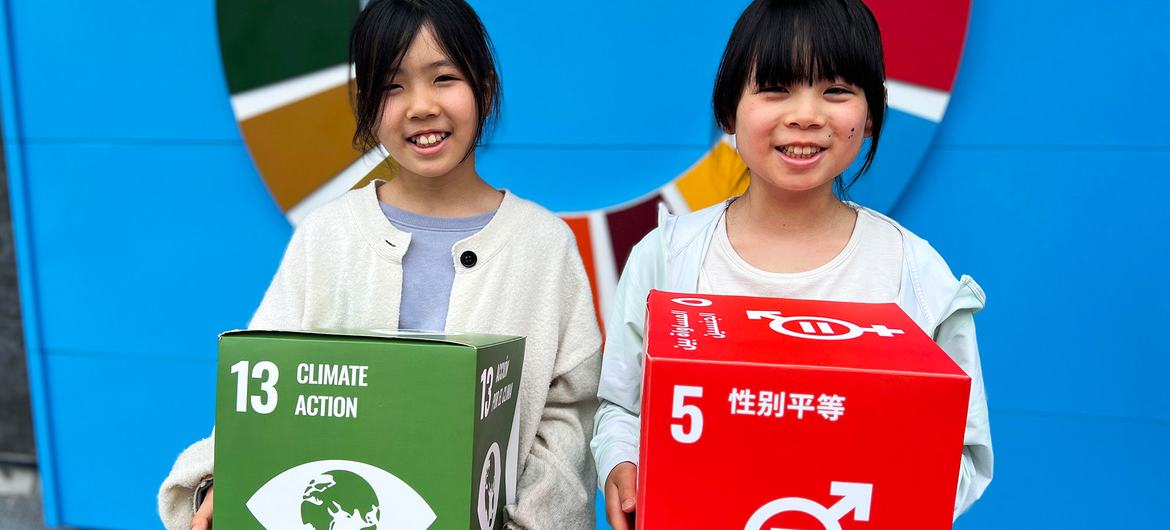
Kaneko Sayaka (left) and her sister hold up displays promoting the SDGs.

Kaneko Sayaka: I liked the video as I felt I was in a forest surrounded by trees and animals. It showed me that protecting the environment is very important.

Mikako Takeuchi: I was sucked into the immersive experience of the video presentation. It was really engaging and, although it explained the problems the world faces, it also presented the solutions and provided hope.

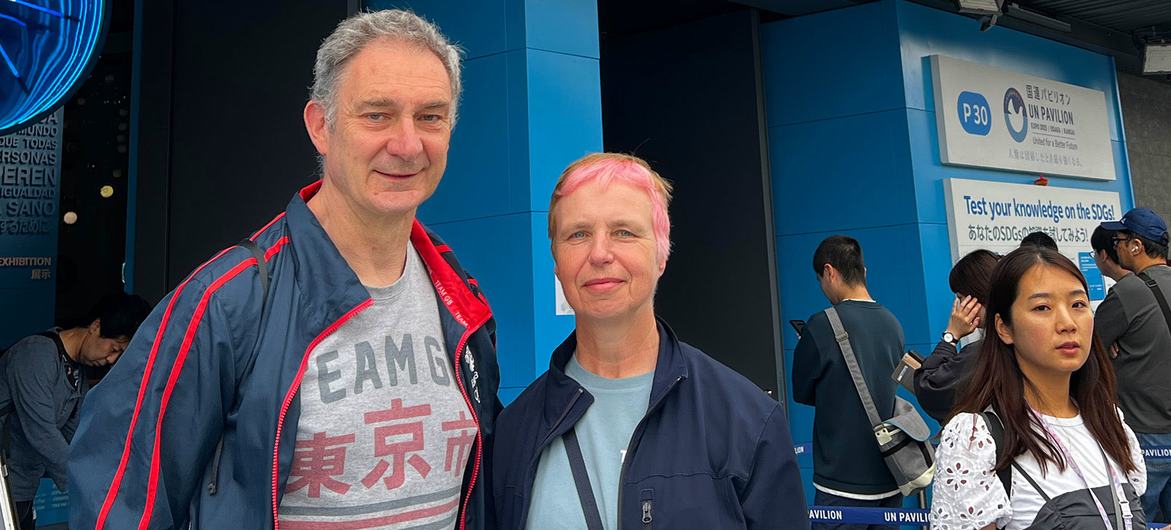
Phil Malone (left) and his companion visit the UN Pavilion.

Phil Malone: The message of the immersive video about sustainability and people’s rights and responsibilities towards the environment was clear and easily understandable by both young and older audiences.

It is difficult to explain the Sustainable Development Goals (SDGs) in a short video, although I think a Japanese audience is generally knowledgeable about the goals. The SDGs are highlighted by institutions across Japan, and I have only ever seen this level of promotion in certain African countries where I have worked for an agriculture-focused development organization.

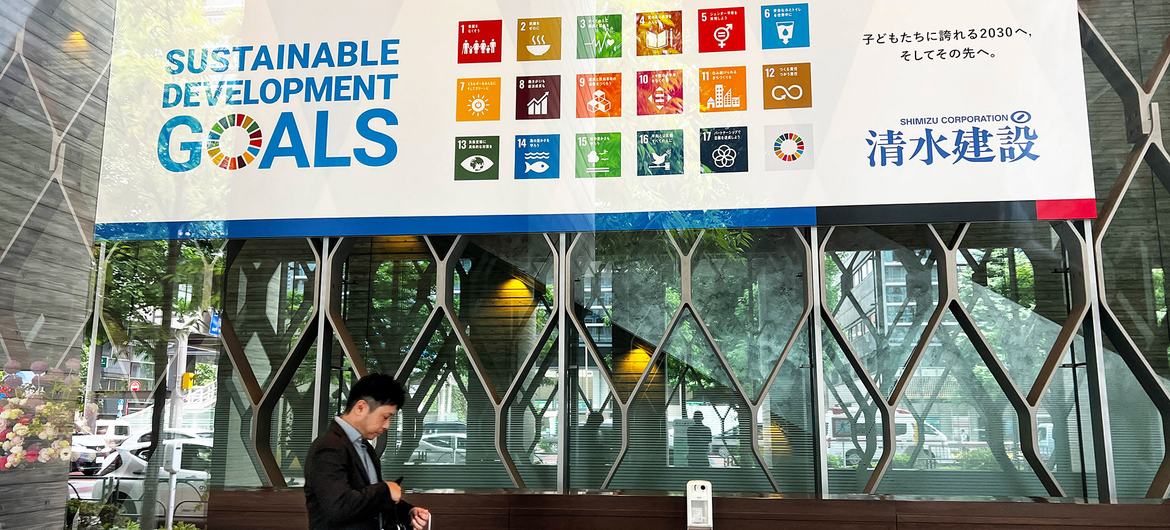
The SDGs are frequently promoted by the private sector in Japan, in this case in Tokyo. the capital city.

Tomoyuki Kadokura: I learnt a lot about the SDGs from the interactive quiz while I was queuing to get into the pavilion. In Japan, we concentrate more on the goals which focus on the environment and sustainable consumption, so I was keen to learn more about the other goals, for example poverty and human rights, which do not get a lot of attention here.

I was also surprised by the number of UN agencies that are working on the SDGs.

Agaka Sato (left) and Takato Ishida explore the orb room in the UN Pavilion.

Takato Ishida: At school we learn about the SDGs, so many Japanese people are interested in the goals, but I didn’t realize that progress towards them was so slow in many parts of the world.

I enjoyed the special projects section which highlighted the role that UN volunteers are playing across the world in supporting sustainable development.

Agaka Sato: I did not know there were so many different UN agencies and learnt a lot about them through the interactive display of objects in the orb room.

The touch screen which explains the role of these agencies is linked to the objects lining the wall of the room. I think it is fun for young children to make the link between objects like telephones, guns and health kits and the work of the UN.

Masako Yukita: The UN Pavilion made me consider what changes people need to make to contribute to the SDGs and world peace. When I get home, I will think about what more I can do as an individual. 

Source link

World News in Brief: Rights abuses in Haiti, Sudan war sees exodus to Chad, food trade optimism

Between 1 January and 30 May, at least 2,680 people – including 54 children – were killed, 957 injured, 316 kidnapped for ransom, and many more subjected to sexual violence and child gang recruitment.

“Alarming as they are, numbers cannot express the horrors Haitians are being forced to endure daily,” said Mr. Türk.

Conflicts on all sides

In recent months, gangs have attacked Mirebalais in the centre of the country, looting police stations, destroying property and freeing over 500 inmates from the local prison.

Meanwhile, so-called self-defence groups have targeted individuals they suspect of gang affiliation. On 20 May, at least 25 people were killed and 10 injured by a group accusing them of supporting gangs.

Law enforcement has ramped up operations against them. Since January, police have killed at least 1,448 people, including 65 during extrajudicial executions.

Mr. Türk called on the international community to take decisive action to end the violence, including renewed support for the Security Council-backed Multinational Security Support (MSS) mission and full enforcement of the council’s arms embargo.

He also reiterated his call for States to not forcibly return anyone to Haiti.  

“The coming months will be crucial and will test the international community’s ability to take stronger, more coordinated action – action that will help determine the future stability of Haiti and the wider region,” Mr. Türk added.

Outlook for food trade ‘relatively optimistic’, FAO says

The Food and Agriculture Organization (FAO) released their annual Food Outlook report Thursday which provides a “relatively optimistic” look at international food markets.  

According to the report, production is expected to increase across almost all categories, with grain production expected to reach record levels. And while prices do remain higher this year than last, between April and May there was an overall decrease of almost one per cent. 

The report noted, however, that global trends — including rising geopolitical tensions, climate shocks and trade uncertainties — may still negatively impact production.  

“While agricultural production trends appear solid, drivers that could negatively impact global food security are increasing,” said FAO Chief Economist Máximo Torero.

Fowl, fish fraud and fertilizer flows

The report noted that outbreaks of avian influenza have become more persistent and constitute “one of the most significant biological threats to the global poultry sector.” Nevertheless, poultry exports have largely remained largely resilient so far.  

The issue of fish fraud – the misrepresentation of the location or manner of the catch – was also discussed, with FAO warning that risks are growing.  

Additionally, the report examined fertilizer flows, noting Russia’s growing exports and the decrease in fertilizer prices since the COVID pandemic.  

Overall, the report noted, the cost of imports worldwide has increased by 3.6 percent or nearly $2.1 trillion.  

Eastern Chad ‘reaching a breaking point’ as Sudan war refugees continue to arrive  

Aid teams in eastern Chad warn on Friday that host communities are reaching breaking point because of climate shocks and the pressure of hosting war refugees from neighbouring Sudan.

In an alert, the UN’s top aid official in Chad, François Batalingaya, warned that a humanitarian catastrophe is unfolding almost unnoticed by the world’s media.

“Right now, nearly 300,000 people are stranded at the border, waiting to be relocated inland,” he noted.  

“Tens of thousands, mostly women and children, are sleeping in the open without shelter, clean water and health care. These are survivors of war. They arrive traumatized, hungry, and with nothing. They recount stories of mass killings, sexual violence and entire communities destroyed.” 

Major exodus

Since the outbreak of war in Sudan in April 2023, more than 850,000 Sudanese refugees have crossed into Chad. They’ve joined the 400,000 existing Sudanese refugees who have arrived over the last 15 years.

The UN aid official explained that even before the latest Sudanese arrivals, nearly one million people in eastern Chad were in urgent need of help.  

Today, “they are sharing what little they have – food, water, and space – with those fleeing the war,” Mr. Batalingaya said.

In an appeal for international assistance, he warned that clinics are overwhelmed, malnutrition is rising and basic services are buckling.  

World News in Brief: ‘Indifference and impunity’ in Sudan, ICC judges speak out against sanctions, respiratory diseases overlooked in Europe

Tom Fletcher noted that over 30 million people require humanitarian assistance. Moreover, with famine declared in multiple places and over 14.6 million people displaced, Sudan represents the largest humanitarian crisis in the world.

“Again and again, the international community has said that we will protect the people of Sudan. The people of Sudan should ask us if, when and how we will start to deliver on that promise,” the relief chief said.

When will the international community fully fund aid efforts in Sudan?

When will accountability for the violence in Sudan happen?

He called on the international community to stop acting with ‘indifference and impunity’ towards Sudan,

Health system ‘smashed to pieces’

Since the conflict in Sudan broke out in April 2022, civilian infrastructure across the country has been damaged or destroyed, including health facilities and water and sanitation systems. 

The health system in particular has been “smashed to pieces,” according to Mr. Fletcher, leading to increasingly dire measles and cholera outbreaks.

The cholera outbreak, which began in July 2024 and is now confirmed in 13 of Sudan’s 18 states, has infected more than 74,000 people in total and killed 1,826.

“I have seen first-hand the devastation caused by the cholera outbreak in Khartoum, where the health system has been devastated by conflict and is struggling to cope with the tremendous demand on health facilities,” Dr. Shible Sahbni, WHO representative in Sudan.

The World Health Organization (WHO), in partnership with the Sudanese Ministry of Health, is launching a 10-day cholera vaccination campaign in Khartoum State.

The campaign will aim to reach 2.6 million people in an effort to contain the cholera outbreak in the state.

“The vaccines will help stop cholera in its tracks as we strengthen other response interventions,” said Dr. Sahbni.


ICC judges express support for colleagues sanctioned by US

Judges at the International Criminal Court (ICC) expressed solidarity with their colleagues who have recently been sanctioned by the United States Government, describing the move as “coercive measures aimed at undermining the independence of the judiciary.”

“The Judges stand united and will continue to exercise their functions independently, impartially and conscientiously, fulfilling the demands of the rule of law,” they said in a statement on Thursday.

The US announced sanctions on 6 June against four judges from Benin, Peru, Slovenia and Uganda. The justices are currently overseeing a 2020 case which alleges war crimes in Afghanistan committed by the US and Afghan armies and the 2024 ICC arrest warrants issued for sitting Israeli Prime Minister Benjamin Netanyahu and former Defence Minister Yoav Gallant.

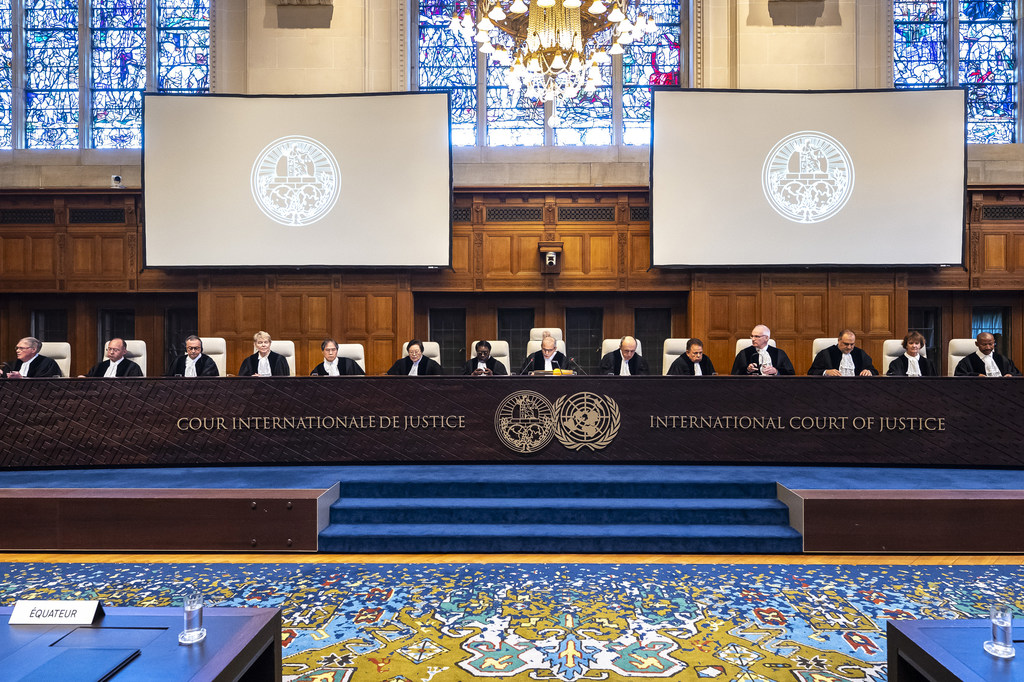
The International Court of Justice

The UN Human Rights Chief Volter Türk previously said that he was “deeply disturbed” by these sanctions, arguing that they corroded international governance and justice.

No improper influence

The ICC is an independent judicial body established under the Rome Statute, adopted in 1998. Although not part of the United Nations, the ICC works closely with it under a cooperative framework.

In the statement, the Judges said that they decide, and will continue to decide, cases based on facts and without regard to threats, restrictions or improper influence issued “from any quarter or for any reason.”

“The Judges reaffirm that they are equal in the performance of their functions and that they will always uphold the principle of equality before the law.”

Over 80 Million Europeans suffering from overlooked chronic respiratory diseases

Chronic respiratory diseases such as asthma are vastly underestimated, underdiagnosed and poorly managed in Europe – affecting 80 million people and costing $21 billion a year, the UN World Health Organization (WHO) said on Thursday.

A new report by WHO Europe and the European Respiratory Society highlights how smoking and air pollution are driving the growing crisis.

“We take 22,000 breaths a day, yet respiratory health remains one of the most neglected areas in global health,” said Professor Silke Ryan, President of the European Respiratory Society.

6th leading cause of death

Data analysis shows that chronic respiratory illnesses are the sixth leading cause of death in Europe. They are often misdiagnosed owing to weak diagnostic systems, limited training and inadequate health data.

Although effective treatments are available, asthma-related deaths remain high among young people, while chronic obstructive pulmonary disease is responsible for eight in 10 respiratory disease deaths.

As preparations begin for the 2025 UN High-Level Meeting on non-communicable diseases, WHO Europe urged governments to prioritize chronic respiratory disease, set measurable targets and tackle root causes like tobacco and air pollution.

Source link

The world pledged to end child labour by 2025: So why are 138 million kids still working?

There are 10,000 children in Madagascar who, like Tenasoa, work in the largely unregulated mica industry. The silicate is used in paints, car parts, and cosmetics – to add a “shimmer” effect. 

Alongside parents and grandparents, these children toil in dangerous conditions, inhaling harmful dust particles and entering structurally unsound tunnels. Many of them have dropped out of school – if they ever went at all. 

If we don’t work, we don’t eat,” Soja, Tenasoa’s grandfather, said. “It’s very simple. Men, women and children must all work to survive.”

In 2015, the United Nations set a goal to end child labour worldwide by 2025 but progress has been slow and halting, according to the Child Labour Report released on Wednesday by the International Labour Organization (ILO) and the UN Children’s Fund (UNICEF).

The report estimates that 138 million children – a 12 million decrease from 2020 – are still engaged in child labour, leading both ILO and UNICEF to call for the rapid acceleration of progress.

The findings of our report offer hope and show that progress is possible … But we must not be blindsided by the fact that we still have a long way to go,” ILO Director-General Gilbert F. Houngbo said.

Hazardous work

Since 2000, the number of children in child labour has been reduced by over 100 million, a promising decrease which proves that the world has a “blueprint” to end child labour. Much work remains, however.

“Far too many children continue to toil in mines, factories or fields, often doing hazardous work to survive,” said Catherine Russell, Executive Director of UNICEF.

Child labour does not refer to all work done by children. Rather, it is work which deprives children of their childhood and is often dangerous to their health and development.

It is important to understand that [child labour] is not household chores, it is not children helping their parents around the house…We are talking about work that is oftentimes hazardous,” Benajamin Smith, an ILO child labour expert told UN News.

Of the 138 million children in child labour, 54 million work in hazardous conditions, including mines.

Honorine, aged 13, is one of these children. She works from 10am to 5pm every day in a gravel quarry in Benin. Paid by the number of buckets of gravel she collects, she is saving her wages, hoping to train to be a hairdresser one day.

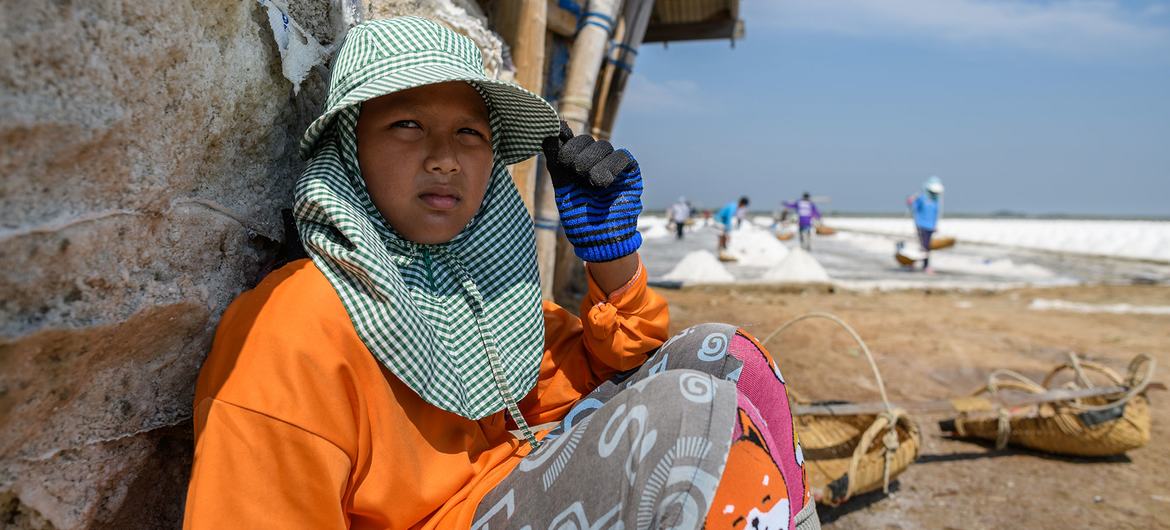
A young boy in Thailand takes a break while working in intense heat as a labourer.

Behind the statistics

The report notes that child labour is intergenerational. Children in child labour systems often struggle to access education, something which in turn compromises their future opportunities and creates a cycle of poverty and deprivation.

Federico Blanco, ILO expert and lead author of the Child Labour Report, noted that it is important to think of child labour as not just statistical.

“Behind every number, let’s remind ourselves that there is a child whose right to education, protection and decent future is being denied,” Mr Blanco said.

Nur, a 13-year-old Rohingya refugee in Bangladesh, was pulled out of school by his parents in order to help support his family financially. A case worker at a nearby UNICEF-funded centre identified Nur and convinced his family to put him back into school.

“I once dreamt of becoming a teacher. I thought I would never be able to become one. But now I feel that I can learn and become a teacher like I always wanted to,” Nur said.

‘A holistic approach’

In the report, UNICEF and ILO called for integrated policy solutions which work across governmental sectors, addressing the problem from an educational, economic and social perspective.

The report also highlighted that ending child labour cannot be accomplished without also thinking about the conditions that drive families to send their children to work – namely, poverty.

Upholding parents’ rights – including the right to collectively bargain, the right to safe work – is also key for ending child labour.

“The ILO looks at [child labour] in quite a holistic way because it is just as important [for] tackling child labour to make sure that the adults have good working conditions because poverty is really at the heart of child labour,” Mr Smith said.

Taking a country-driven approach is especially important due to regional disparities in child labour – the report noted that while all regions saw decreased numbers, Sub-Saharan Africa accounts for two-thirds of child labour worldwide.

Childhood dreams – underfunded and unfulfilled

Attempts to end child labour face significant headwinds as a result of funding shortages.

“Global funding cuts threaten to roll back hard-earned gains. We must recommit to ensuring that children are in classrooms and playgrounds, not at work,” Ms. Russell said.

Adwara, aged 10, dreams of being in class. He attended school for a few years and tried to balance work and school but with eight siblings, helping support his family was non-negotiable. Eventually, his teacher told him not to return – he was missing too much school.

Now, he works in a gold mine in Ethiopia, earning approximately $35 per day: “I’d like to go to school,” he said. “I’d like to become someone.”

Source link

World News in Brief: Global growth slows, deadly Ukraine attacks, Haiti hurricane hunger risk, legal migration for refugees

Growth is projected to weaken to 2.3 per cent, or nearly half a percentage point lower than expected at the start of the year, according to the Global Economic Prospects report.

“The global outlook is predicated on tariff rates close to those of late May prevailing,” it said.

“Accordingly, pauses to previously announced tariff hikes between the United States and its trading partners are assumed to persist.”

Although a global recession is not expected, average global growth is on track to be the slowest of any decade since the 1960s.

Poor countries suffer

Growth forecasts are being slashed in nearly 70 per cent of all economies, with the poorest countries most affected.

In most developing countries, nearly 60 per cent, growth should average 3.8 per cent in 2025 before reaching an average 3.9 per cent in the following two years – more than a percentage lower than the average in the 2010s.

The slowdown will impact efforts by developing countries in areas such as job creation, poverty reduction and closing income gaps with richer economies.

“The world economy today is once more running into turbulence. Without a swift course correction, the harm to living standards could be deep,” said Indermit Gill, Senior Vice President and Chief Economist.

The report calls for rebuilding trade relations as “economic cooperation is better than any of the alternatives – for all parties,” he said.

Countries are also urged to improve business climates and to promote employment by ensuring workers are equipped with necessary skills.

At least three dead in new Russian drone assault on Ukrainian cities 

A massive new wave of Russian drone attacks has killed at least three civilians and left Kyiv, Odesa and Zaporizhzhia engulfed in clouds of thick smoke, aid teams said on Tuesday. 

The attack was reportedly one of the largest since Russia’s full-scale invasion more than three years ago.

In an online update, the UN aid coordinating office, OCHA, said that a maternity ward in Odesa had come under fire, causing injuries and widespread damage to homes. 

Another terrible night

The UN Children’s Fund, UNICEF, underscored the impact of the violence on civilians, citing 16-year-old Sonya from Kyiv in an online post. “It was a terrible night,” she said. “The sounds were so frightening – a buzzing sound that was getting closer and explosions every five minutes.”

Russia has intensified its airstrikes on Ukraine in recent days. 

According to Moscow, it stepped up its bombing campaign in retaliation for Ukraine’s suprise drone attacks deep inside Russian territory last week codenamed operation spiderweb.

Amid the ongoing conflict, UN humanitarian teams and partners continue to work to help civilians in cities across Ukraine.

They provide first aid, protection services, food, construction materials and other support including counselling and legal advice.

Haiti: Hurricane season is here, but there are no food supplies

The World Food Programme (WFP) has reported that for the first time ever, it has no prepositioned food supplies in Haiti for the hurricane season, which lasts from June to November. 

WFP also said staffers do not have the financial resources to respond quickly to an emergency weather event in the country. 

Other UN agencies have prepositioned water and sanitation kits for 100,000 and health supplies for 20,000 people. However, these are not sufficient, especially in the absence of food, to meet needs during an emergency. 

“The current lack of contingency stocks and operational funds leaves Haiti’s most at-risk communities dangerously unprotected at a time of heightened vulnerability,” Deputy Spokesperson Farhan Haq said in a briefing Tuesday. 

Famine-like conditions

Food insecurity and malnutrition are already rampant, with over half the population facing acute hunger. Haiti is one of five countries worldwide which is experiencing famine-like conditions. 

Continuing armed violence by gangs in the capital and in other regions has displaced over one million people, compounding the hunger crisis and limiting access to other basic services such as clean water and health care. 

UN agencies in the country estimate that they will need $908 million to continue providing life-saving resources in Haiti, but currently, they have only received $78 million in emergency support. 

Refugees find hope through legal migration

Nearly one million refugees from eight countries with high asylum recognition rates were granted entry permits to 38 destination countries between 2019 and 2023, according to a new report from UN refugee agency, UNHCR, and the Organisation for Economic Co-operation and Development (OECD), Safe Pathways for Refugees

These permits were issued through existing systems for work, study, or family reunification.

“Refugees are using the same legal channels that millions rely on every day,” said Ruven Menikdiwela, UNHCR’s Assistant High Commissioner for Protection. 

“We don’t need new systems – just safer access to the ones already in place.”

In 2023 alone, nearly 255,000 permits were issued, marking a 14 per cent increase from 2022 and the highest number recorded since tracking began in 2010. 

Countries such as Germany, Canada, the United States, the United Kingdom and Sweden have played a leading role. 

UNHCR is urging States to remove obstacles for refugees and integrate them into regular migration systems. It also calls for stronger partnerships to expand access to legal pathways amid growing displacement and strained asylum systems. 

Source link

Green gold beneath the waves: How seaweed – and one man’s obsession – could save the world

Lesconil, a salt-bitten fishing port tucked into the coast of Brittany, in northern France, stirs slowly under the pale Atlantic dawn. Tide pools shimmer, breathing with the sea — undisturbed but for the cries of seabirds and a lone figure in yellow waders, knee-deep in a forest of seaweed. The man, Vincent Doumeizel, gently lifts a strand of Saccharina latissima from the brine, waving it above the waterline like a revolutionary banner.

“It’s not slimy,” he says of the olive-brown frond glistening in his fingers. “It’s magnificent.”

For Doumeizel, seaweed is more than a marine curiosity. This diverse family of green, red, and brown algae is a cornerstone of his life’s work – a vehicle for feeding the planet, restoring oceans, fighting climate change, and even replacing plastic.

It is, as he likes to say, “not just a superfood, but a super solution.”

A senior adviser to the UN Global Compact, a platform advocating for sustainable corporate practices, the 49-year-old Frenchman has become one of the faces of the so-called “seaweed revolution.”

In 2020, he co-authored The Seaweed Manifesto, a collaborative document involving the Food and Agriculture Organization (FAO), the World Bank and other partners. Its premise is bold: harness the humblest of marine organisms to tackle some of the planet’s most complex problems.

Algae, the manifesto argues, can help solve a quartet of crises – climate, environmental, food, and social. Doumeizel’s personal conviction borders on the messianic. “Undoubtedly,” he wrote in a 2023 book outlining his vision, seaweed is “the world’s greatest untapped resource.”

© Courtesy of Vincent Doumeizel

Vincent Doumeizel sometimes speaks of “sea forests” rather than “seaweed” – a linguistic sleight of hand designed to counter the Western bias that sees seaweed as stinky pollution waste.

Algae against apocalypse

Long before trees shaded Pangaea and dinosaurs thundered across its land, seaweed was already swaying in the sunlit shallows of ancient oceans – a silent architect of Earth’s transformation. Born more than a billion years ago, marine algae were among the first complex organisms to harness sunlight through photosynthesis, oxygenating the atmosphere and shaping the conditions for multicellular life.

But Doumeizel is neither a marine biologist nor an agronomist. His background is in food policy.

“I came across world hunger during an early deployment to Africa,” he told UN News. “It left a strong mark.”

Seaweed first sparked Doumeizel’s interest on a subsequent trip to the Japanese island of Okinawa, whose residents have exceptionally long lifespans. He noticed that people there ate a lot of seaweed.

“It was delicious,” he recalled. “And visibly healthy.”

From the northeast Atlantic “sea spaghetti” (Himanthalia elongata), to the Indo-Pacific “green caviar” (Caulerpa lentillifera), and the ubiquitous “sea lettuce” (Ulva lactuca), algae are rich in vitamins, omega-3 fatty acids, fibers, and even proteins.

Humble and often overlooked, these marine vegetables may be one of our most underappreciated sources of nutrition. Despite covering more than 70 per cent of the planet, the ocean contributes only a sliver to the global food supply in terms of calories – a gap that seaweed could help close.

And while agriculture contributes to roughly a quarter of global greenhouse gas emissions, in part due to deforestation for pastures and crops, seaweed cultivation does not require any land, fertilizers or freshwater.

Recent research even suggests that feeding red seaweed to cows could reduce their methane emissions by up to 90 per cent – a potential game-changer in the fight against climate change.

The implications go far beyond the barnyard. The ocean has generated more than half the oxygen we breathe, and it absorbs about a third of all man-made emissions. Seaweed plays a part in this process, capturing more carbon per acre than land vegetation. Some species, like “giant kelp” (Macrocystis pyrifera), can grow at an astonishing rate of two feet per day, making them powerful carbon sinks.

Seaweed can also be extracted and transformed into bioplastics, biofuels, textiles, and even pharmaceuticals.

“We can change the paradigm by encouraging seaweed cultivation,” Doumeizel said.

© Courtesy of Vincent Doumeizel

Algolesko, off the coast of Lesconil, in Brittany, is one of the largest seaweed farms in continental Europe, with 150 hectares of organic Laminaria culture.

A growing, yet under-regulated industry

When we met Doumeizel in Nice ahead UNOC3, the shorthand by which the third UN Ocean Conference is known, he was coming from the launch, two days earlier, of his comic book. The Seaweed Revolution is a 128-page dive into the life of an algae enthusiast also named Vincent “involved with the UN Ocean Forum.”

In real life, Doumeizel is as passionate and buoyant as on his TED Talk videos or keynote addresses.

“I could eat those,” he says, holding up a pair of sunglasses — sleek, black, and entirely made from plankton. Perched on a sunlit ledge above the Mediterranean, Doumeizel becomes part showman, part prophet, as he unpacks a series of seaweed-born wonders: a biodegradable garbage bag that looks indistinguishable from plastic, a soft green T-shirt spun from algae fibers, and, with a grin, an edible copy of his own book, The Seaweed Revolution. “All of this,” he says, gesturing to the strange little tableau at his feet, “could be made of seaweed.”

While the world’s salty waters are home to 12,000 different known species of seaweed, so far humans are only able to actively cultivate less than a couple dozen of them – a practice known as kelp farming.

Algolesko, in Brittany, is one of the largest seaweed farms in continental Europe. The morning when Doumeizel could be seen lifting a brown algae from the Atlantic Ocean, he was doing so from the farm’s 150 hectares of organic culture.

As co-head of the Global Seaweed Coalition, which is roughly 2,000-members strong and hosted by the UN Global Compact, Doumeizel travels around the world for speaking engagements, from Patagonia to Tunisia, Madagascar, and Australia. Each stop is also an opportunity to explore local seaweed production.

According to a concept paper written by the UN ahead of Nice’s Ocean Conference, the seaweed industry is on the rise. Production of marine algae more than tripled since 2000, up to 39 million tonnes a year, the overwhelming majority of which comes from aquaculture. It has become a $17 billion market, and current investments in bio stimulants, bioplastics, animal and pet foods, fabrics, and methane reducing additives could add another $12 billion annually by 2030.

Yet the path forward is not simple. “There is generally a lack of legislation and guidance,” notes the UN document. “There are currently no Codex Alimentarius standards establishing any food safety criteria for seaweed or other algae.”

Doumeizel agrees. The global seaweed industry, he said, is still fragmented and largely dominated by Asia, where the production of nori, the kind of seaweed used in sushi, was already a hugely profitable business. But, he added, so much more could be done with the resource.

© Courtesy of Vincent Doumeizel

On the island of Zanzibar, the seaweed boom began with a surge in demand for food texturizers made of algae. Widows and single women quickly stepped up.

Reducing gender inequality

Beyond its environmental promise and nutritional punch, seaweed is quietly driving a feminist transformation. According to the concept paper, about 40 per cent of seaweed start-ups worldwide are led by women.

“In Tanzania, a largely patriarchal society, the seaweed trade has changed lives,” said Doumeizel. The boom began with a surge in demand for food texturizers made of algae. Widows and single women quickly stepped up. On the island of Zanzibar, seaweed is now the third-largest resource, and women retain nearly 80 per cent of the profits.

“They built schools. They sent their daughters to those schools. They fought for a place in the markets to sell their harvests,” Doumeizel said. “They even bought motorcycles.”

The ripple effects have reached the highest levels of power: the current President of Tanzania is a woman from Zanzibar.

But climate change is pushing the industry into deeper waters – quite literally. As sea temperatures rise, the algae can no longer be cultivated close to shore. “Now, women have to venture farther out,” Doumeizel explained. “But most don’t know how to swim or steer a boat.”

To help preserve both livelihoods, the Global Seaweed Coalition is funding a new initiative to teach women maritime skills – swimming, boating, navigation. “We have to make sure this revolution leaves no one behind,” the Frenchman said.

The threat of climate change

If seaweed offers a promising solution to climate change, it is also one of its quietest victims. As atmospheric carbon dioxide climbs, the ocean grows warmer and more acidic – conditions that are already eroding marine ecosystems and triggering the widespread loss of seaweed habitats.

In places like California, Norway, and Tasmania, more than 80 per cent of kelp expanses have vanished in recent years, driven not only by climate change, but also pollution, and overfishing.

In interviews, Doumeizel sometimes speaks of “sea forests” rather than “seaweed” – a linguistic sleight of hand designed to counter the Western bias that sees seaweed as stinky pollution waste rather than threatened organisms.

“Preserving them is just as necessary to life on Earth as saving the forests of the Amazon,” he wrote in his book.

At UNOC3, which opens on Monday, Doumeizel will unveil a new initiative: the creation of a UN Seaweed Task Force. Designed to consolidate global efforts around regulation, research, and development, the task force would bring together six UN agencies – the Food and Agriculture Organization (FAO), the Global Compact, the UN Environment Programme (UNEP), the UN trade and development body (UNCTAD), the United Nations Educational, Scientific and Cultural Organization (UNESCO), and the UN Industrial Development Organization (UNIDO).

Its aim is ambitious: to give seaweed the institutional muscle it has long lacked. By centralizing expertise and setting global standards, the task force could help scale up the industry responsibly – and sustainably.

The proposal already has the backing of several countries, including Madagascar, Indonesia, South Korea, and France. Together, they plan to introduce a draft resolution at the UN General Assembly this fall, with a vote expected in 2026.

© Courtesy of Vincent Doumeizel

On the island of Zanzibar, seaweed is now the third-largest resource.

From bloom to boom

Sometimes, the revolution doesn’t arrive in neat rows of aquafarms. It comes in 6,000-mile-wide blobs.

In the spring of 2025, a vast bloom of sargassum – a free-floating brown algae known for its sprawling mats – blanketed the Atlantic, clogging beaches from the Gulf of Mexico to the shores of West Africa. Florida’s shore became inundated with the plant, whose pungent smell was deterring tourists. Coastal communities scrambled to manage the deluge.

Yet, Vincent Doumeizel saw not just crisis but opportunity. “These massive blooms are caused by pollution and climate change,” he noted. “But if we manage and understand them properly, they could become a sustainable resource, turned into fertilizers, bricks, even textiles.”

The vision is part redemption, part alchemy. Turning oceanic overgrowth into solutions may seem far-fetched. But then again, so does the idea that seaweed could replace beef – or plastic.

Roughly 12,000 years ago in the Middle East, Homo sapiens ceased to be hunter-gatherers. “We became farmers cultivating plants to feed our animals and our families,” Doumeizel wrote in his book. “Meanwhile, at sea, we are still Stone Age hunter-gatherers.”

But what if we could farm the ocean – not to exploit it, but to heal it? It’s not just a rhetorical question. It’s an invitation. And perhaps, a final warning.


Source link

‘Jerusalem is not for sale’ Palestinian President Abbas tells world leaders at UN Assembly

President Abbas underscored his commitment to peace and the two-state solution, as well as the path of negotiation to achieve them, reiterating that peace in the Middle East cannot be realized without an independent Palestinian state, with East Jerusalem as its capital.

“We have always fully and positively engaged with the various initiatives of the international community aimed at achieving a peaceful solution between us and the Israelis, including the Arab Peace Initiative,” he told world leaders gathered for the Assembly’s annual debate, noting that he also engaged with United States President Donald Trump and his administration from the start of his tenure.

However, the US administration’s decision to close office of the Palestine Liberation Organization (PLO) in Washington D.C., the proclamation of Jerusalem as the capital of Israel, and transferring of the US embassy from Tel Aviv to Jerusalem, not only violate UN resolutions, they have also undermined the two-state solution, added President Abbas.

Those decisions, have also caused the US administration to lose its eligibility as the mediator in the Middle East peace process, he said.

“The path to peace is enshrined in your [the UN] resolutions, including resolution 67/19 of 29 November 2012, which was adopted by an overwhelming majority and refers to the State of Palestine on the basis of the 1967 borders,” he stressed.

Mr. Abbas also highlighted what he called “racist” laws enacted recently in Israel, which not only discriminate against the Palestinian-Arab citizens, but, will also lead to the “inevitable” nullification of the two-state solution.

Palestinian people and the territory of the state of Palestine are in urgent need of international protection, he said, and while he welcomed economic and humanitarian support in the West Bank and the Gaza Strip but added that such support cannot be a substitute to a political solution to bring an end to the Israeli occupation.

President Abbas also highlighted the importance of the work of the UN Relief and Works Agency for Palestine Refugees in the Near East (UNRWA) and urged all countries as well as the General Assembly to support the agency.

Full statement available here.


Both radio and sports can help people achieve their potential, says UN on World Radio Day


In an era of dramatic advances in communications, radio retains its power to entertain, educate, inform and inspire, United Nations Secretary-General António Guterres said, marking World Radio Day with a call to celebrate both radio and sports as ways of helping people achieve their potential.

Source link