SECURITY COUNCIL LIVE: US vetoes new resolution calling for immediate Gaza ceasefire, unconditional release of hostages


The United States has vetoed a new draft resolution on Gaza, standing as the lone vote against the text which called for an immediate, unconditional and permanent ceasefire, the unconditional release of hostages held by Hamas and others and the immediate lifting of all aid restrictions. Follow live coverage from our Meetings Coverage Section and UN News app users can follow here.

Source link

Gaza: UN relief chief welcomes growing support for aid teams to resume vital work

We value the support of more and more Member States who are joining our call: Let us work,” Mr. Fletcher said, his comments coinciding with the announcement that the US and Israeli-backed aid hub in southern Gaza operating independently of the UN had been suspended on Wednesday.

“The world is watching, day after day, horrifying scenes of Palestinians being shot, wounded or killed in Gaza while simply trying to eat,” Mr. Fletcher said.

New Security Council resolution

The development comes ahead of a Security Council meeting on Gaza on Wednesday seeking agreement on a draft resolution calling for an immediate ceasefire and the release of all remaining hostages taken during Hamas-led terror attacks in Israel on 7 October 2023.

The resolution push is the result of lobbying by the body’s 10 non-permanent Members. It remains to be seen if it will garner the support of the US and the four other countries that hold just five permanent seats on the 15-Member body: China, France, the UK and Russia. Any one of them could veto it.

Meanwhile in Gaza, local authorities on Wednesday claimed that at least 12 people including children had been killed in an Israeli strike on a school-turned-shelter in the southern city of Khan Younis.

In his appeal, Mr. Fletcher noted that medical teams had confirmed treating “hundreds of trauma cases” in recent days after footage showed chaotic scenes of Palestinians rushing to take food from the US and Israeli-run aid hubs in southern Gaza.

Yesterday alone, dozens were declared dead at hospitals after Israeli forces said they had opened fire,” Mr. Fletcher continued.

He insisted: “Open the crossings – all of them. Let in lifesaving aid at scale, from all directions. Lift the restrictions on what and how much aid we can bring in. Ensure our convoys aren’t held up by delays and denials.”

Gaza: UN rights chief condemns new killings around private aid hub

Attacks directed against civilians constitute a grave breach of international law and a war crime,” the High Commissioner said in a statement, issued after Palestinians were reportedly killed seeking assistance for a third day running.

Mr. Türk also urged Israel to respect “binding orders” issued by the International Court of Justice to fully cooperate with the UN and ensure that aid reaches the people of Gaza “without delay” and “at scale”.

“There is no justification for failing to comply with these obligations,” he said.

Access calls denied

The controversial new aid initiative run by the Gaza Humanitarian Foundation bypasses the work of UN aid agencies which have repeatedly appealed for unimpeded access to Gaza in order to bring in thousands of tonnes of supplies. To date, the little aid that has been allowed into the enclave has fallen far short of what is needed.

In an update, the UN World Health Organization (WHO) insisted that it still had “teams on the ground” in Gaza ready to distribute supplies where they are needed across the war-torn enclave, if only they could be allowed to move.

“We have right now 51 trucks waiting loaded with medical supplies to go to those few hospitals that are still functional,” said WHO spokesperson Tarik Jasarevic. “We need access so that we can bring in supplies within Gaza to health facilities so they can function. Unfortunately, what is happening is just the opposite. There is no hospital in north Gaza functional anymore.”

On Monday, Mr. Jasarevic said that a WHO team went to the Indonesian Hospital in northern Gaza “and basically evacuated all remaining patients and medical staff…now that hospital is completely empty”. In Jabalia, also in northern Gaza, three Israeli soldiers were reportedly killed on Monday when their vehicle struck an explosive device.

Most vulnerable miss out

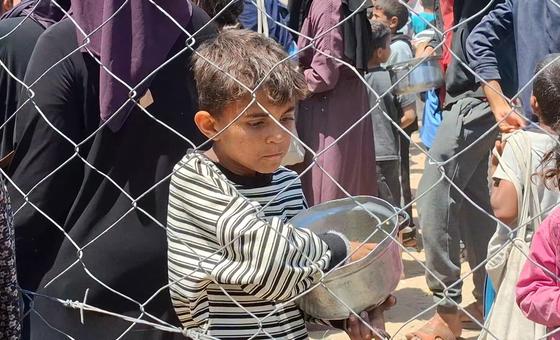
Critics of the US-Israeli scheme – which include the UN – have warned that it prevents children, the elderly and those with disabilities from receiving aid, since recipients often have to walk long distances to retrieve boxes of supplies distributed on a first-come, first-serve basis.

“The wilful impediment of access to food and other life-sustaining relief supplies for civilians may constitute a war crime,” Mr. Türk said.

His lengthy statement also condemned “the threat of starvation” faced by Gazans today, the “20 months of killing of civilians and destruction on a massive scale”.

Gazans have also been repeatedly displaced by evacuation orders from the Israeli military and faced “intolerable, dehumanizing rhetoric and threats by Israel’s leadership to empty the Strip”, the UN rights chief noted. All of these facts constitute elements of the most serious crimes under international law, he insisted.

‘Am I going to get shot?’

Jeremy Laurence, spokesperson for the UN human rights office, OHCHR, highlighted the High Commissioner’s call for a prompt, independent investigation into the dozens of reported killings in Gaza since the new aid hub opened on 27 May.

“I think there’s so much which has happened in the past three days apart from the tragic circumstances of human beings trying to gather food to survive and then being killed in the process,” he told journalists in Geneva. “[Gazans] are being forced to walk to these centres and now they’re terrified. Probably they go there and they’re thinking, ‘Am I going to get food or am I going to get shot?’”

Mr. Laurence noted multiple media reports on killings around the southern Gaza aid hub in recent days indicating engagement by helicopters, naval vessels, tanks and ground troops.

“We are aware of those reports,” he said, noting that the Israel Defense Forces (IDF) had also published an account on X of what had happened on Tuesday.

“My colleagues who are working on the ground have conducted interviews with witnesses and they do report fire from the IDF on those trying to access the food distribution centres. We’ve received reports from other organizations on the ground to a similar effect.”

He added: “We’ve gathered our own information; we’ve spoken to witnesses on the ground who have shared what they have seen, heard and felt themselves.”

Asked to explain what the High Commissioner meant when he expressed concerns that the “most serious crimes under international law” may have been committed, Mr. Laurence explained that this referred to war crimes, crimes against humanity and genocide.

Source link

Lifting of Israeli blockade ‘the only way to avert mass starvation’ in Gaza: UNRWA chief

Philippe Lazzarini posted on social media saying that aid distribution “has become a death trap,” citing reports from international medical staff on the ground and local health authorities who reported at least 31 deaths and more than 150 injured as civilians were lining up to receive aid from the Israel and United States-backed Gaza Humanitarian Foundation – which bypasses existing aid agencies.

‘Humiliating system’

“A distribution point by the Israeli-American plan was put far south in Rafah,” Mr. Lazzarini said on X.

This humiliating system has forced thousands of hungry and desperate people to walk for tens of miles to an area that’s all but pulverized due to heavy bombardment by the Israeli army.”

He said aid delivery and distribution “must be at scale and safe. In Gaza, this can be done only through the United Nations including UNRWA.”

Gaza’s defence agency said Israeli forces had been responsible for the gunfire. The Gaza Humanitarian Foundation – which uses private contractors and involves Israel Defense Forces (IDF) to secure its sites – has strongly denied that civilians were fired on, accusing Hamas militants of misinformation.

Disputed events

The IDF said on social media that reports of them firing towards residents receiving aid from the foundation were false: “Findings from an initial inquiry indicate that the IDF did not fire at civilians while they were near or within the humanitarian aid distribution site.”

The IDF posted video which it said showed gunmen shooting at civilians collecting aid, adding that “Hamas is doing everything in its power to prevent the successful distribution of food in Gaza.”

Medical staff at Nasser hospital in nearby Khan Younis told media outlets that around 79 people were admitted on Sunday, mostly with gunshot wounds, along with the bodies of some of those killed. Journalists on the scene posted video footage of bodies being carried on carts along with wounded arrivals.

‘Lift the siege’

UNRWA chief Lazzarini called on Israel to lift the three-month old aid blockade and allow safe and unhindered access. “This is the only way to avert mass starvation including among one million children.”

Highlighting the difficulties of clearly establishing facts on the ground due to Israel’s ban on international media from entering the Gaza Strip, the UNRWA chief said that amid competing narratives and “disinformation campaigns in full gear,” the ban on eyewitness reporting must be lifted immediately.

Gaza: Guterres urges probe into killings at food distribution sites

More than 30 people were killed and over 100 wounded while waiting in the early morning to get food from two sites in Rafah and Middle Gaza run by the newly established Gaza Humanitarian Foundation (GHF), according to media reports.

The organization is backed by Israel and the United States and uses private US security contractors supervised by the Israeli military. Aid distributions began at the end of May, bypassing the UN and other humanitarian agencies.

Risking their lives

UN chief António Guterres issued a statement on Monday saying he was “appalled” by the reports.

“It is unacceptable that Palestinians are risking their lives for food,” he said.

“I call for an immediate and independent investigation into these events and for perpetrators to be held accountable.”

He stressed that Israel has clear obligations under international humanitarian law to agree to and facilitate humanitarian aid. 

Allow UN operations

“The unimpeded entry of assistance at scale to meet the enormous needs in Gaza must be restored immediately,” he said.

The UN must be allowed to work in safety and security under conditions of full respect of humanitarian principles.

Meanwhile, the Secretary-General continues to call for an immediate permanent, sustainable ceasefire in Gaza and the immediate and unconditional release of all hostages.

“This is the only path to ensuring security for all. There is no military solution to the conflict,” he said.

More to follow… 

Source link

Helpless in the face of hunger: Gaza families pray for deliverance – or death

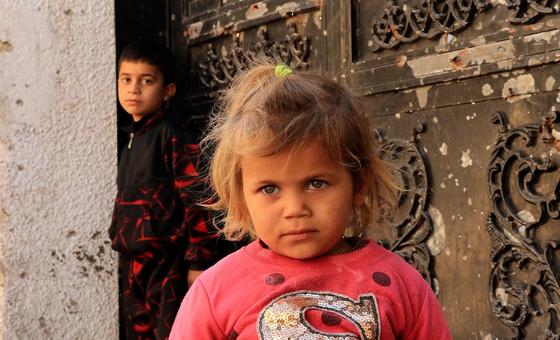
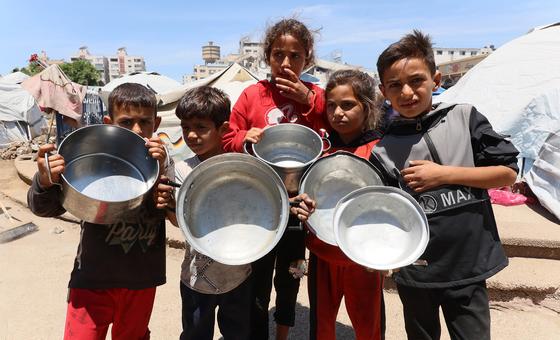
Zeenat and her husband, Moamen Abu Asr, live with their children in a flimsy canvas tent, one of thousands that now line Gaza’s coastline. 

Once a place of rest and leisure, the beach has become a last refuge for Palestinians displaced by relentless Israeli bombardment and military operations.

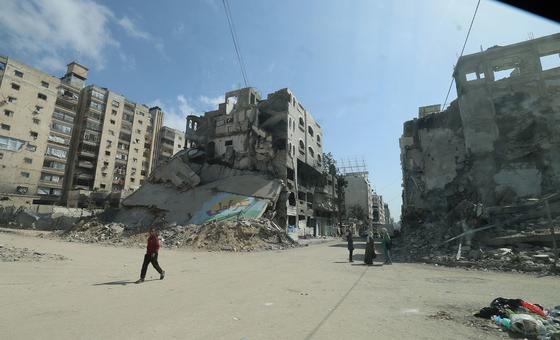
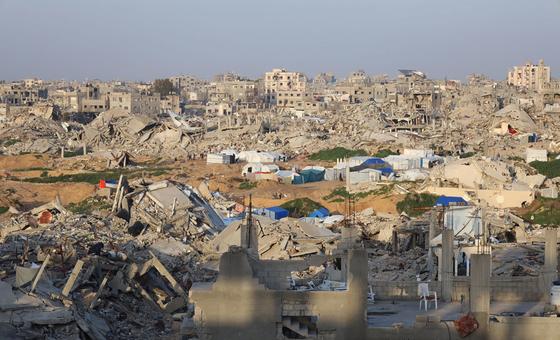
As displacement orders push people into ever smaller pockets of land, the strip of coast around Gaza’s seaport has turned into a makeshift camp. Its frayed tents and overcrowded conditions reflect the gravity of a humanitarian crisis that has plunged to unprecedented depths after more than 600 days of conflict between Israeli forces and Hamas.

The seaport, once a centre of Gaza’s fishing economy, is now a wasteland. All the boats have been destroyed, and in their place stands a sprawling encampment – a harsh and barren environment with almost none of the basic necessities for survival.

Moamen Abu Asr fixing a water tank by his tent.

A family with nothing left

Moamen and his family have been living in the camp for around two months, surviving in a tent cobbled together from salvaged mats and broken utensils recovered from nearby rubble.

He sits outside with his children, scrolling through pictures on his phone – fragments of a past life left behind in Shujaiya, east of Gaza City, when residents were ordered to evacuate without warning.

“There have been times when we’ve been displaced once every two months,” he told UN News. “Every day is suffering for us. We came to Gaza port with no food, no water – not even our iron tent.”

“There is nothing of life’s basics for us,” he said. To feed his family, Moamen repairs small water tanks for five shekels – about $1.43 – barely enough for anything in a place where prices have soared. “One kilo of flour is a hundred shekels [around $28.60],” he explained. “Our situation is very difficult, and we do not know what to do. By God, this is not life. We would rather die.”

Flies hover over one of the Abu Asr family’s sleeping children in their tent in Gaza.

‘We live on water’

The humanitarian situation has worsened since March, when Israeli authorities imposed a complete blockade on aid. Though this was slightly eased in recent weeks, the limited trickle of supplies cannot meet the overwhelming demand. Desperate civilians, starving and fearful, have resorted to looting whatever aid does arrive.

In their tent, Zeenat washes a few cooking utensils – all she could find in the communal makeshift kitchen. Most days, there is no food to prepare.

“Yesterday I cried a lot about my son,” she said. “He told me, ‘Mum, I want to eat.’ I stood helpless, not knowing what to do. The food didn’t come from the charity kitchen. We now live on fresh water. I recommend it to my children to help fill their stomachs. Today, thank God, we got a plate of food and ate it.”

Zeinat Abu Asr describes the hardship her family is facing in Gaza.

‘Enough is enough’

Conditions in the tent are dire. Flies swarm everywhere, and stray dogs – thin and hungry – prowl nearby. “Yesterday, a dog came into the tent and was pulling on a tarpaulin while my son was sleeping. I thought it was pulling my baby. I screamed and my husband kicked the dog out.”

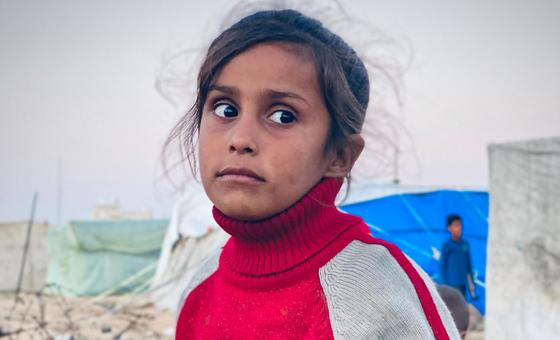
“We don’t know where to go or what to do. They uprooted us. Our hearts are extinguished. We can’t be patient anymore. Our patience has run out.”

The tents scattered along Gaza’s coastline are a stark symbol of the deepening humanitarian tragedy. The cries of hunger are louder than any voice of hope. There is no shelter left – only the sea remains.

Nothing encapsulates the despair more than Zeenat’s final plea: “Let the war end. Give us a break. Otherwise, let all countries come together and drop a nuclear bomb on us and end our misery, because we are tired of this life. Enough is enough.”

Gaza ‘hungriest place on earth’, as Israel continues stranglehold on aid

“Gaza is the hungriest place on Earth,” OCHA spokesperson Jens Laerke told reporters in Geneva, stressing that it is the only defined territory in the world where the entire population is at risk of famine.

The aid operation that we have ready to roll is being put in an operational straitjacket that makes it one of the most obstructed aid operations, not only in the world today, but in recent history,” he said.

Mr. Laerke explained that out of nearly 900 aid trucks that were approved to enter from the Israeli side since the reopening of the Kerem Shalom border crossing between Israel and the war-torn enclave ten days ago, less than 600 have been offloaded on the Gaza side.

An even lower number has been picked up for distribution in Gaza, he said, pointing to the “congested, insecure” routes which humanitarians are assigned to use by the Israeli authorities, as well as “significant delays” in the approvals.

Drip-feed of desperation

The OCHA spokesperson stressed that the limited number of truckloads coming in is a “trickle”.

It is drip-feeding food into an area on the verge of catastrophic hunger,” he insisted.

Mr. Laerke added that many of the trucks were “swarmed by desperate people” on the way.

“It’s a survival reaction by desperate people who want to feed their families,” he said, adding that the aid on the trucks “had been paid for by the donors to go to those people”.

“I don’t blame them one second for taking the aid that essentially is already theirs, but it’s not distributed in a way we wanted,” he explained.

On Wednesday, hungry crowds overran a UN World Food Programme (WFP) warehouse in Deir Al-Balah in central Gaza, where limited stocks of wheat flour had been pre-positioned for use by the few bakeries able to resume operations.

The incident reportedly left two people dead. In a statement WFP reiterated warnings over “the risks imposed by limiting humanitarian aid to hungry people in desperate need of assistance”.

‘Paid for’ aid must be delivered

OCHA’s Mr. Laerke insisted once again on the fact that the UN and partners have “tens of thousands of pallets of food and other life-saving assistance” ready to enter Gaza to relieve the suffering.

The aid has been paid for by the world’s donors, who expect us on their behalf to deliver it. It is cleared for customs, it is approved and it’s ready to move,” he said.

A new US and Israeli-backed aid distribution scheme run by a private entity called the Gaza Humanitarian Foundation started operating independently of the UN this week in the Strip.

On Tuesday at least 47 Palestinians were reportedly shot and injured trying to collect aid from its distribution facility in the south, according to information received by UN human rights office, OHCHR.

Aid scheme to bypass UN ‘not working’

In reaction to the incident OCHA head in the Occupied Palestinian Territory Jonathan Whittall warned on Wednesday that the US-Israeli distribution scheme was “engineered scarcity: four distribution hubs located in central and southern Gaza, secured by private US security contractors, where those Palestinians who can reach them will receive rations.”

Mr. Laerke told reporters that this “alternative modality” is “not working” as it does not meet people’s needs.

He added that it constitutes a “violation of basic principle of impartiality”, and that criteria for getting aid have to be based on need, and not the ability to walk for kilometres to a distribution point.

It creates chaos, and it creates a situation that is extremely dangerous for people,” Mr. Laerke said. “Even if you enter one of those distribution points, pick up a package, the minute you’re out of it… Are you a target for looters again? Yes, you are.”

The OCHA spokesperson reiterated calls by the humanitarian community for the reopening of all crossing points into Gaza, to enable delivery from all corridors, including from Jordan and Egypt.

“We need to be able to deliver food directly to families where they are,” as has been the case in the past, he said.

Highlighting the challenges for humanitarian access, Mr. Laerke said that over 80 per cent of the Gaza Strip is currently within Israeli militarized zones or under displacement orders. Since the ceasefire between Israel and Hamas collapsed on 18 March nearly 635,000 people in the enclave have been displaced yet again.

Source link

Desperate hunger drives crowd to storm UN food warehouse in Gaza

UN agencies warn that the decimated enclave is teetering on the brink of further chaos after months of war and the collapse of all essential services.

The incident took place at WFP’s Al-Ghafari facility in Deir Al-Balah, where limited stocks of wheat flour had been pre-positioned for use by the few bakeries which have been able to resume operations.

Tragic consequences

Corinne Fleischer, WFP’s Regional Director for the Middle East, described it as a “tragedy [that] should never have happened”.

She called for immediate and steady flow of aid to avoid further scenes desperation.

When people know food is coming, desperation turns to calm,” she said.

The storming of the warehouse is the latest sign of a hunger crisis spiralling out of control after 80 days of near-total blockade on aid into Gaza. While limited supplies of aid have resumed, “it is a drop in the ocean of what is urgently needed,” UN officials have said.

In a statement, WFP said it has consistently warned of alarming and deteriorating conditions on the ground, and the risks of limiting humanitarian aid – despite the looming threat of famine.

The agency reiterated its call for safe, unimpeded humanitarian access to enable orderly food distributions across Gaza immediately.

Collapse of fishing sector

The UN-led Protection Cluster – a coalition of UN entities and NGOs working on protecting civil rights during crisis – warned on Thursday of a collapse of Gaza’s fishing sector.

The sector was a vital source of food and livelihoods before the conflict erupted on 7 October 2023, when Hamas and other Palestinian armed groups attacked Israeli communities.

Monitoring from the UN human rights office, OHCHR, “found a consistent pattern” of Israeli military attacks on fishers in Gaza.

This included firing on vessels at sea by Israeli Naval Forces, as well as drone attacks at sea and on land.

According to the UN Food and Agriculture Organization (FAO), Gaza’s fishing industry is now operating at just 7.3 per cent of its pre-October 2023 capacity, with the fleet all but decimated.

Around 94 per cent of trawlers, 100 per cent of large fishing vessels and 70 per cent of smaller boats have been destroyed.

This dramatic decline is having a devastating impact on food security, income generation, and community resilience across Gaza, triggering negative coping strategies and risks to fishers,” the Protection Cluster said in a report.

Darkest point

Meanwhile, the UN Humanitarian Country Team (HCT) warned that the humanitarian situation in Gaza, six hundred days into the crisis, is at its darkest point yet.

As relentless, deadly bombardment and mass displacement intensify, families are being starved and denied the basic means of survival,” the team said in statement on Wednesday, adding that conditions for humanitarians to deliver aid safely and at scale are absent.

The HCT noted that over the past days, it had submitted 900 truckloads for Israeli approval – about 800 were cleared and just over 500 were cleared for offloading on the Israeli side of Kerem Shalom.

However, humanitarians have been able to collect only about 200 on the Palestinian side of the crossing due to insecurity and restricted access.

“While letting us bring in some nutrition and medical supplies, as well as flour, Israeli authorities have banned most other items, including fuel, cooking gas, shelter and hygiene products,” the HCT said.

Let us work

The UN and partners underscored Israel’s obligations under international humanitarian law, and urged it to treat civilians humanely, with respect for their inherent dignity, refrain from forcible transfer and facilitate the aid that is needed.

“We echo the Secretary-General’s calls: a permanent ceasefire, the immediate and unconditional release of all hostages, and full humanitarian access,” it said, adding:

We are ready to save lives. Let us work. The window to prevent famine is closing fast.

Source link

Gaza: Top UN envoy calls on Israel to end devastating strikes, starvation of civilians

Sigrid Kaag, interim UN Special Coordinator for the Middle East Peace Process, said that the man-made crisis unfolding in Gaza has plunged civilians into “an abyss.”

“Since the collapse of the ceasefire in March, civilians have constantly come under fire, confined to ever-shrinking spaces, and deprived of lifesaving relief,” she said.

Israel must halt its devastating strikes on civilian life and infrastructure.

Risk of famine

With families cut off from aid for weeks on end, and only a fraction of the needed relief now entering the enclave, starvation looms.

The entire population of Gaza is facing the risk of famine,” Ms. Kaag warned, adding that the limited aid permitted into the enclave is “comparable to a lifeboat after the ship has sunk.”

“Ms. Kaag emphasized that humanitarian aid must not depend on political negotiations, noting that the UN aid operation is prepared to deliver assistance immediately, in accordance with international law.

“Aid cannot be negotiable,” she said.

Full aid access imperative

Ms. Kaag called on Israel to halt its devastating strikes and allow full access for humanitarian aid and commercial goods.

At the same time, she stressed that Israel has the right to live in peace and security.

“This was undeniably shaken by the horrific terror attacks and taking of hostages on 7 October by Hamas and other Palestinian armed groups,” she said, reiterating the call on Hamas and other armed groups to stop rocket attacks against Israel and release all hostages unconditionally.

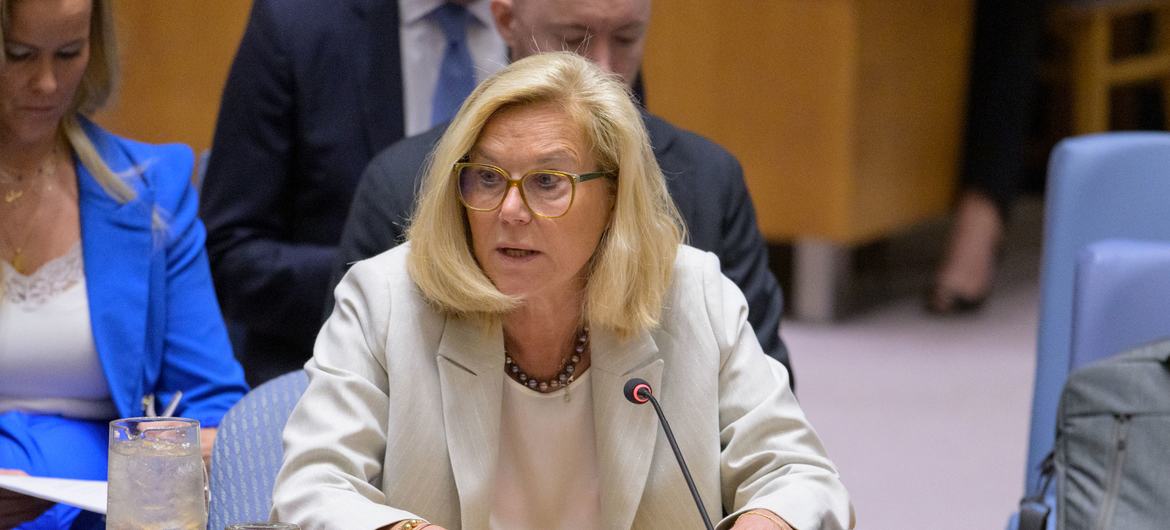
Sigrid Kaag, UN Special Coordinator for the Middle East Peace Process Ad Interim, briefs the Security Council on the situation in the Middle East.

Two-State solution

Ms. Kaag emphasised that durable security “cannot be achieved solely through force”, it must be built on mutual recognition, justice, and rights for all.

“A better path exists that resolves this conflict, de-escalates regional tensions and achieves a shared vision for peace,” she said.

The upcoming high-level international conference in June, co-chaired by France and Saudi Arabia, presents a critical opportunity to relaunch a path toward ending the occupation and realising the two-State solution based on international law, UN resolutions and previous agreements.

It must not be another rhetorical exercise,” she said.

“We need to pivot ourselves from declarations to decisions. We need to implement rather than adopt new texts.”

‘See you in heaven’

In her briefing, Ms. Kaag described the deep despair of civilians in Gaza, where families now bid farewell not with a “goodbye, see you tomorrow”, but with the words “see you in heaven.”

“Death is their companion. It’s not life, it’s not hope,” she continued, stressing that Gazans deserve more than survival – they deserve a future.

Urging bold political action, she called for adherence to international law, and support for a reformed Palestinian Government that can govern both Gaza and the West Bank.

Statehood is a right, not a reward,” Ms. Kaag said.

“Let us not be remembered as the generation that let the two-State solution disappear. Let us be the generation that chose courage over caution, justice over inertia and peace over politics. Let us be part of a generation that can make this happen.”

Special Coordinator a.i. Kaag’s briefing to the Security Council.

US ‘fully stands’ with Israel

Speaking for the United States, John Kelley, Political Coordinator at the US Mission to the UN, said that his country has been working tirelessly to free the hostages and bring the war to an end – “one that Hamas brutally started”.

“Hamas continues to reject proposals from the US, Qatar and Egypt that would release the 58 remaining hostages, who have now been cruelly held for 600 days, and bring calm to Gaza,” he said.

“Every day Hamas demonstrates its lack of regard for the Palestinians it claims to represent, all while it violently suppresses protests against its barbaric rule and diverts aid meant for civilians.”

He underscored that the US “fully stands” behind Israel and its right to defend itself, stating that to move forward, “Hamas must be defeated.”

“As Secretary [Marco] Rubio has said – if an ember survives, it will spark again into a fire. There can no peaceful and prosperous Gaza as long as Hamas governs it by force,” Mr. Kelley said.

The horrors must end: Algeria

Algerian Ambassador Amar Bendjama described the deadly impact of the ongoing war in Gaza on children, citing the specific case of the nine children of a Gazan doctor, all killed in an airstrike, while her sole remaining child and husband remain in a critical condition.

“They were not members of a centre for command and control of Hamas,” he said, adding, “the Israeli army killed them, they killed them deliberately.”

He noted that today, no one in Gaza is spared – and three decades after the optimism surrounding the Oslo peace accords between Israel and Palestinian leadership, “the dream of a Palestinian state is vanishing under the boots of the Israeli occupation and the silence of the international community.”

Stating that the “time for indecision” was over, he called for action – “not words of condemnation”.

“These horrors must end,” he said.

Gaza needs a ceasefire, not more bloodshed: United Kingdom

James Kariuki, Deputy Permanent Representative of the UK, said his country has “always supported” Israel’s right to defend itself but cautioned that it “strongly opposes” Israel’s escalating military action in Gaza, “which is wholly disproportionate.”

“An immediate ceasefire, not more bloodshed is the way to secure the release of the hostages and stop the end cycle of violence,” he said.

The level of human suffering in Gaza is intolerable, he continued, stating that the United Nations had warned of the risks of the Israeli Government’s aid delivery plan.

“In Rafah yesterday, we saw this warning become a reality. The Gaza Humanitarian Foundation lost control of its distribution centre, with multiple casualties reported and great distress for those desperately seeking aid,” he said.

“In contrast, the UN has a clear plan to deliver lifesaving aid at scale. It contains robust mitigations against aid diversion. Brave humanitarians stand ready to do their jobs,” he added. “Let aid in and enable the UN to operate now.”
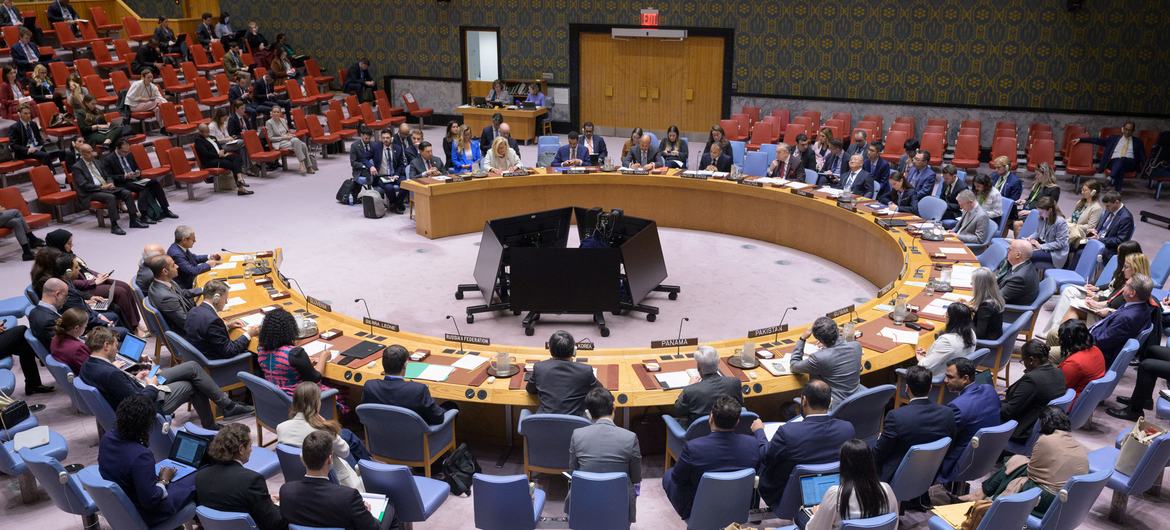
A wide view of the UN Security Council meeting on the situation in the Middle East.

Images of hungry, desperate people ‘gut-wrenching’: Palestine

Riyad Mansour, Permanent Observer of the State of Palestine, said the images of hungry and desperate people trying to get aid supplies in are “gut-wrenching” and “heart breaking.”

“These are people, human beings, deprived of water, food, medicine for so long and hanging to life by a thread,” he said, adding that this is “outraging the Palestinian people – all of them, including me.”

“It is outrageous to see this situation, and still you are not acting,” he said, pointing to Security Council members: “how much more do you want?”

He added that the UN plan for aid, with its proven capacity on the ground remains the only viable plan to deliver relief supplies and it has all necessary safeguards – “if that is the true concern.”

“But the true concern is how to get rid of the Palestinians by killing them, starving them, and destroying Gaza so they have no choice but to leave if they want to live,” Mr. Mansour said.

Israel is facilitating aid into Gaza: Ambassador

Israeli Ambassador Danny Danon said that while the UN “spreads panic and makes declarations detached from reality, the State of Israel is steadily facilitating the entry of aid into Gaza.”

This, he said, is being done via two methods.

“First, under the old framework, via trucks and, second, under the new distribution mechanism developed in coordination with the US and key international partners,” he continued, noting that both mechanisms are “working simultaneously” and will continue to do so for the immediate future.

“We are not only allowing aid in, but we are ensuring that it reaches the people who need it most,” he added.

Aid is already being distributed in Gaza, Ambassador Danon said, despite efforts by Hamas to obstruct people from reaching it by setting up checkpoints and roadblocks.

“Because Hamas knows if it loses control over the aid, it loses control over the people of Gaza,” he said.

Source link

Gaza: UN agencies calls for aid ‘surge’ as Israeli distribution plan begins

After nearly three months of complete blockade by Israel, a “vastly insufficient” amount of aid was finally allowed into the war-ravaged enclave in the last week, insisted Jens Laerke, spokesperson for the UN aid coordination office, OCHA.

“We have not stopped operating,” he said, referring to staff still inside Gaza, who are tasked with liaising with the Israeli authorities to retrieve supplies allowed into Gaza from Israel, via the Kerem Shalom crossing.

Mr. Laerke insisted that the UN is not participating in the Israeli aid plan known as the Gaza Humanitarian Fund: “It is a distraction from what is actually needed, which is a reopening of all the crossings into Gaza, a secure environment within Gaza and faster facilitation of permissions and final approvals of all the emergency supplies that we have just outside the border; [aid] needs to get in.”

The veteran humanitarian stressed the ongoing dangers and obstacles that have prevented aid teams from picking up and dispatching lifesaving supplies via the UN’s existing delivery network in Gaza.

“We are not always able to collect what is being dropped off on the other side because of the insecure routes that are being assigned to us by the Israeli authorities to use,” he told journalists in Geneva.

‘Cherry-picking’ warning

All types of aid must be allowed through and not “cherry-picked”, Mr. Laerke stressed: “The bottom line again is that we are talking about a vastly insufficient amount of aid that eventually enters Gaza at the moment. That’s why we need [the] opening of more crossings, we need all types of aid – not that aid that is cherry-picked by the Israeli side that we are allowed to get in.”

In an update, the UN World Food Programme (WFP) said that as of Monday, 294 trucks have reached Kerem Shalom from Port Ashdod. On Tuesday, media reports indicated that protesters attempted to block lorries loaded with aid from leaving the Israeli port.

“While desperately needed aid is finally trickling into Gaza, the pace is far too slow to meet the overwhelming needs,” WFP said. “Gaza families are at a breaking point, amid intensified fighting, waves of evacuation orders and population displacement.”

Crossing the line

The UN agency noted that it has “more than 130,000 metric tonnes of food in the pipeline as well as a functioning delivery network ready to provide assistance. An immediate surge in daily aid trucks and unrestricted access to safely collect and distribute food inside Gaza are critical before it is too late.”

The UN agency for Palestinian refugees, UNRWA, meanwhile, explained that “no supplies whatsoever” prepared by the agency have reached Gaza since the Israeli siege began on 2 March.

This is despite UNRWA having readied more than 3,000 trucks carrying food and medicines in Jordan and Egypt which will perish soon.

“We have clinics, we have pharmacies that the agency runs and there we normally would distribute medicines against chronic diseases…but also basic medicines, things like paracetamol and then childhood diseases and these are the medicines that we’re running out of,” said Juliette Touma, UNRWA Director of Communications.

Evidence call to Israel

The development comes as UNRWA Commissioner-General Philippe Lazzarini urged the Israeli Government to provide proof to back up its unsubstantiated allegations that the UN agency’s staff were involved in the Hamas-led terror attacks in Israel that sparked the war in October 2023.

Investigations carried out internally by the UN last year found sufficient evidence that nine active UNRWA staff had been involved.

A separate independent probe commissioned by the UN Secretary-General found that the agency’s rules, mechanisms and procedures were the most “elaborate” within the UN, reflecting the complex and sensitive demands associated with working in the Occupied Palestinian Territories.

“It’s been over 20 months of these claims coming our way, harming the agency’s reputation of course, but more importantly, putting the lives of our staff, especially those working in the Occupied Palestinian Territory, at risk,” said Ms. Touma.

Despite numerous requests by UNRWA to the Israeli Government for evidence to substantiate “numerous accusations”, no evidence has been shared to back up the claims against the agency and its personnel, Ms. Touma continued.

Source link

Guterres calls on Israel to accept UN’s ‘detailed, principled’ aid plan for Gaza

Addressing reporters outside the Security Council, António Guterres called once again for a permanent ceasefire to end the fighting between Israeli forces and Hamas militants, the immediate and unconditional release of all hostages and full humanitarian access so aid can flow in following nearly 80 days of Israeli blockade.

‘Cruellest phase’

He said Palestinians in the enclave are now “enduring what may be the cruellest phase of this cruel conflict,” with families being “starved and denied the very basics,” as Israel intensifies its offensive and promotes a new privatised aid distribution network reportedly due to begin on Sunday which would bypass the UN and partner organizations’ aid operation.

Israel has clear obligations under international humanitarian law to treat civilians in Gaza humanely, Mr. Guterres added, and “must not forcibly transport, deport or displace the civilian population of an occupied territory.”

He noted that despite authorising a “trickle of aid” to enter in recent days, supplies from only 115 out of 400 trucks have been cleared for collection and distribution – while nothing has reached the besieged north.

UN ‘working round the clock’

“We are working around the clock to get whatever aid we can to people in need,” the UN chief said, but “needs are massive – and the obstacles are staggering.”

Israel is causing unnecessary delays, imposing quotas on distribution and barring essentials such as fuel, shelter, cooking gas, and water purification supplies – are prohibited.

Furthermore, the lives of UN and other humanitarian staffers are being placed at risk if they continue to be prevented from distributing food parcels and flour to those in desperate need, the UN chief continued.

He said absent rapid, reliable, safe and sustained aid access, more Gazans will die – with profound long-term consequences.

Without making direct reference to the US-backed Israeli plan to create new distribution sites overseen by private contractors in coordination with the military, Mr. Guterres said the UN had been clear: “We will not take part in any scheme that fails to respect international law and the humanitarian principles of humanity, impartiality, independence and neutrality.”

5-point aid plan

Instead, he said the UN and partners had “a detailed, principled, operationally-sound 5-stage plan” – supported by UN Member States.

  1. Ensure the delivery of aid to Gaza
  2. Inspect and scan aid at crossing points
  3. Transport aid from crossing points to humanitarian facilities
  4. Prepare aid for onward distribution
  5. And transport aid to people in need

“We have the personnel, the distribution networks, the systems and community relationships in place to act,” said the UN chief. “The supplies – 160,000 pallets, enough to fill nearly 9,000 trucks – are waiting.

“This is my appeal for life-saving aid for the long-suffering people of Gaza: Let’s do it right.  And let’s do it right away.”

Source link

Aid teams highlight growing anxiety in Gaza after food is looted

“Fifteen World Food Programme trucks were looted late last night in Southern Gaza, while en route to WFP-supported bakeries,” the UN agency said. “These trucks were transporting critical food supplies for hungry populations waiting anxiously for assistance.”

The development is a blow to continuing efforts to help Gaza’s most vulnerable people after Israel allowed a limited number of aid trucks into Gaza earlier this week, following an 11-week total blockade.

Today, Gazans face “hunger, desperation and anxiety over whether more food aid is coming”, WFP said, noting that the uncertainty “is contributing to rising insecurity”.

“We need support from the Israeli authorities to get far greater volumes of food assistance into Gaza faster, more consistently and transported along safer routes, as was done during the ceasefire,” it insisted.

More to come on this developing story…

Gaza: Strikes on houses and tents responsible for over half of deaths this week

629 Palestinians were reportedly killed over the past week, according to OHCHR in the Occupied Palestinian Territory.  

At least 358 were killed because of attacks targeting houses and tents for displaced people, with children and women accounting for at least 148 of the victims.

“The high number of strikes on shelters, in the context of the existing destruction of infrastructure in Gaza, raises grave concerns that not all strikes were targeting military objectives,” OHCHR said.

Journalists under fire

Furthermore, nine Palestinian journalists were killed last week, making it one of the deadliest for the profession since the conflict began in October 2023.

Although journalists have a deep sense of duty to their work, “they, too, are displaced, tired and hungry like the rest of the population of Gaza,” OHCHR said.

“However, it appears that in many instances, these journalists may have been deliberately targeted with the intention of limiting the flow of information on what is happening in Gaza and the scale of the impact that this war is having on civilians.”

The office said international journalists must be allowed into Gaza and their safety ensured.

Aid on the move

Meanwhile, lifesaving aid is making its way across the enclave following a nearly 80-day blockade.

UN aid coordination office OCHA confirmed that 90 trucks carrying nutrition supplies, flour, medicines and other critical stocks left the Kerem Shalom border crossing on Wednesday for multiple destinations inside Gaza.

Among the supplies were more than 500 pallets containing items such as ready-to-use therapeutic food and nutritional supplements which were offloaded at a warehouse in Deir Al-Balah belonging to the UN Children’s Fund (UNICEF).

The contents are being unpacked and repackaged into smaller loads for onward transportation to distribution points.

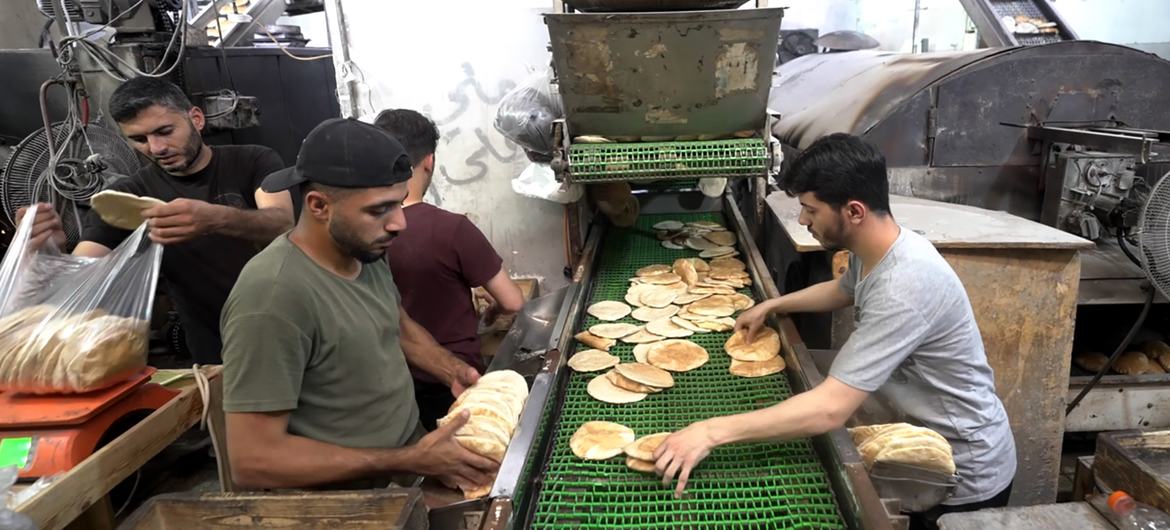
Workers pack freshly baked bread into bags for distribution at Al-Banna Bakery in Deir al-Balah, Gaza.

Famine risk persists

A handful of bakeries in south and central Gaza, supported by the UN World Food Programme (WFP), are also now operational and are back to baking bread, which is being distributed via community kitchens.

“However, after nearly 80 days of a total blockade of humanitarian assistance, families still face a high risk of famine, and far more aid is urgently needed into the Gaza Strip,” said Mr. Dujarric.

Food security experts recently warned that Gaza’s entire population, over two million people, are at risk of famine, with nearly half a million facing starvation.

Humanitarians underlined the critical need for Israel to facilitate the movement of aid convoys, including from southern Gaza into the north, so that all supplies can reach people in need wherever they are. 

“We also need to ensure the use of secure routes from Kerem Shalom onward into Gaza, as we did last night,” the Spokesperson said.

Strikes and shelling continue

Meanwhile, military operations continue across Gaza, with reports of strikes, shelling and fresh ground incursions.

The Al Awda hospital in North Gaza caught fire on Thursday, reportedly after being attacked. The medicine warehouse was heavily damaged, according to initial reports.

“Through coordination with Israeli authorities, OCHA facilitated the access of the Palestinian Civil Defense to the area, where they spent hours working to extinguish the fire,” said Mr. Dujarric.

He added that water wells in some areas of Gaza are shutting down as no fuel has been allowed in since the blockade.

“OCHA reports that Israeli authorities continue to deny our attempts to deliver fuel from areas where coordination is required,” he said. 

Healthcare under attack

The World Health Organization (WHO) warned that Israel’s intensified military operations continue to threaten Gaza’s already weakened health system. 

Four major hospitals have had to suspend medical services in the past week due to their proximity to hostilities or evacuation zones, and attacks. 

Only 19 out of 36 hospitals remain operational. Twelve provide a variety of health services, while the rest are only able to provide basic emergency care. 

WHO has recorded 28 attacks on healthcare in Gaza over the past week, and 697 attacks since October 2023. 

Source link

All eyes on Gaza as aid teams retrieve first lifesaving relief in months

“Today will be crucial. Truckloads of lifesaving aid finally on move again,” said top UN aid relief coordinator Tom Fletcher.

Hours earlier and in a major development, 198 trucks entered Gaza via the Kerem Shalom crossing in the south of the enclave, carrying nutrition supplies, medicines and wheat flour.

Announcing the news online, Mr. Fletcher reported that humanitarian organizations then retrieved “about 90 truckloads of goods” in a nighttime operation to prepare them for distribution.

But significant challenges remain “in loading and dispatching goods” Mr. Fletcher continued, citing security and looting concerns, “delays in coordination approvals and inappropriate routes being provided by Israeli forces that are not viable for the movement of cargo”.

No commercial or humanitarian supplies have been allowed into Gaza since 2 March, deepening an already catastrophic hunger crisis and sparking widespread condemnation from the international community.

According to the UN World Health Organization (WHO) at least 57 children have reportedly died from the effects of malnutrition, according to the local health authorities. The number is likely an underestimate and is expected to increase if the aid blockade continues.  

In their latest report, respected and UN-partnered food insecurity experts warned that nearly 71 000 children under the age of five are expected to be acutely malnourished over the next 11 months unless Gazans can access sufficient food and healthcare support.

Working through the night

Video footage published online Thursday by the UN World Food Programme (WFP) showed aid crews hurrying to offload sacks of flour from trucks at a floodlit warehouse.

Elsewhere in the storage hangar, other images showed large quantities of dough being made in an industrial mixer.

“Our teams are working non-stop to get bakeries running again,” the agency said, referring to the 25 facilities it had to close on 31 March when wheat flour and fuel ran out. 

“But it’s nowhere near enough to support everyone in need. We need more trucks, more food, in now,” the UN agency warned.

After 19 months of constant Israeli bombardment which continues today, one in five Gazans faces starvation, food insecurity experts have warned.

And reiterating the urgent need for more lifesaving supplies to enter the shattered enclave, the UN aid coordination office, OCHA, stressed that much more aid will be needed to avert a humanitarian catastrophe.

No fuel allowed in

No hygiene products or fuel have been allowed into the enclave by the Israeli authorities, the UN agency noted.

“The UN and its partners have been engaging with the Israeli authorities to identify the best possible route from Kerem Shalom onward into Gaza to ensure the flow of aid is not disrupted or suspended,” OCHA explained in its latest update. “Partners are in touch with community leaders in Gaza to mitigate the risk of looting and ensure that the supplies entering Gaza reach the people who rely on them.”

Meanwhile, Gazans continue to contend with daily bombardment and shelling across the Strip, with dozens reported killed on Tuesday.

A day later, OCHA noted that the health authorities on an urgent request for blood donors to treat the sick and injured.

“Amid the hostilities, large numbers of people continue to be displaced – once again fleeing for their lives amid intense bombing of their communities and with no safe place to seek shelter or supplies,” the UN agency said.

It reported that a full 80 per cent of Gaza is either subject to displacement orders or located in Israeli-militarized zones which require aid teams to coordinate their movements with the Israeli authorities.

“Partners report that over the past few days, almost half of people newly displaced have fled with none of their belongings,” OCHA said. “The ongoing displacement of Gaza’s population is putting immense pressure on humanitarian teams, especially when there is no food or other basic supplies to offer.” 

More to come on this developing story…

Source link

Gaza: Aid trucks still waiting for Israeli green light inside enclave

Existing supplies of basic necessities have been running dangerously low and on Wednesday the UN Children’s Fund, UNICEFsaid that its nutrition stocks to prevent increasing malnutrition “are almost gone”.

Humanitarian assistance is being weaponised to serve and support political and military objectives,” said Philippe Lazzarini, head of the UN agency for Palestinian refugees, UNRWA.

Speaking at the European Humanitarian Forum, Mr. Lazzarini insisted that significant stocks of aid remain blocked at the enclave’s borders.

“UNRWA is a lifeline for people in face of immense needs,” he said, noting that the whole humanitarian community in Gaza remains ready to scale up the delivery of critical supplies and services.

The development comes a day after UN humanitarians said that they had been allowed to send “around 100” more aid trucks loaded with supplies into Gaza.

Too little, too late

While such a move would be welcome in light of the desperate humanitarian emergency created by Israel’s total blockade, relief teams have pointed out that this would be a fraction of the 500 trucks that entered the enclave every day before the war erupted in Gaza in October 2023.

Today, one in five Gazans faces starvation, according to respected food security experts from the UN-backed Integrated Food Security Phase Classification platform – or IPC.

UN agencies have repeatedly stressed that they have stockpiles of relief supplies ready to enter Gaza.

Economic ‘paralysis’

Inside Gaza, the daily struggle to find food and water continues because of the Israeli blockade of all commercial and humanitarian access.

According to the UN World Food Programme (WFP), markets are “severely paralyzed”, supply chains have collapsed and prices have spiked.

“The population is now facing extreme levels of poor dietary diversity, with most people unable to access even the most basic food groups,” the UN agency warned in its latest update on Gaza.

“Several essential food items, including eggs and frozen meat, have disappeared from the market,” it said. “Wheat flour has reached exorbitant prices, with increases of over 3,000 per cent compared to pre-conflict levels and more than 4,000 per cent” compared to the ceasefire period from January to March.

While the Gazan economy is now in “near-total paralysis”, the West Bank is also staring down a deep recession, with combined overall output shrunk by 27 per cent.

Given that this is the deepest contraction in the Occupied Palestinian Territory in over a generation, WFP cited projections that Gaza will require 13 years to recover to pre-crisis levels and the West Bank three years.

West Bank demolitions crisis

In the occupied West Bank, meanwhile, further demolitions of Palestinian buildings were reported on Monday and Tuesday, in Beit Sahur, Shu’fat and Nahhalin.

Since the start of the year, Israeli settlers have damaged water infrastructure in the West Bank more than 60 times, according to OCHA. It noted that herding communities have been impacted most severely.

More to come…

Source link

UN life-saving aid allowed to trickle into Gaza as needs mount

He stressed that the assistance must be delivered swiftly and directly to those most in need.

He told journalists in New York that UN humanitarians were sending flour, medicines, nutrition supplies and other basic items through the Palestinian side of the Kerem Shalom crossing – a day after they managed to bring in baby formula and other nutrition supplies.  

The first trucks of vital baby food are now inside Gaza after 11 weeks of total blockade, and it is urgent that we get that assistance distributed. We need much, much more to cross,” he said, speaking from New York.

Complex aid operation

 In the face of mounting international objections over the total blockade imposed on 2 March – and  condemnation over the risk of widespread famine – Israel started to allow a handful of aid trucks to enter Gaza on Monday, while simultaneously intensifying its military offensive. 

The aid blockade has pushed the entire population, more than two million people, to the brink of famine, amid ongoing bombardment and recurrent displacement orders.

The UN humanitarian affairs office OCHA said Israel cleared nine aid trucks to cross the Kerem Shalom border on Monday, but only five were allowed in.

Mr. Dujarric said Israel requires supplies to be offloaded on the Palestinian side of Kerem Shalom. Items are then reloaded separately once the authorities secure humanitarian teams’ access from inside Gaza.

Only then are we able to bring any supplies closer to where people in need are sheltering,” he said.

On Tuesday, one of the UN teams waited for several hours before being given the green light.

“So, just to make it clear, while more supplies have come into the Gaza Strip, we have not been able to secure the arrival of those supplies into our warehouses and delivery points,” he said.

UN humanitarianshave received permissionfrom Israel for “around 100” more aid trucks to cross into the Strip, but they said the scale of relief efforts allowed remains entirely insufficient.

Ready and waiting

“Not enough. Five trucks, nowhere near. Not enough,” said Louise Wateridge, a spokesperson for the UN Palestine refugee agency UNRWA, in reference to Monday’s trickle of aid.  

She was speaking to journalists in Geneva from a warehouse full of ready-to-be-delivered supplies in Amman, Jordan, with enough food to feed 200,000 Palestinian civilians for an entire month. 

Everything around me is aid that is supposed to be in the Gaza Strip right now,” she explained, as warehouses and distribution centres lay empty in Gaza. 

Look at what the UN could do,” she continued. “We’ve done it: the ceasefire, the bombs stopped, the supplies went in. We reached every area of the Gaza Strip. We reached people who needed it most. We reached children. We reached the elderly. The supplies went everywhere.

Scarcity fuels looting

As aid is scarce, desperation is on the rise in Gaza, with “several predictable effects,” according to OCHA Spokesperson Jens Laerke.

 “One is that the insufficient supplies are at greater risk of being looted,” he told journalists in Geneva.

He said looted products end up being sold at exorbitant prices on the black market, and opening access for large quantities of aid would automatically ease the situation. 

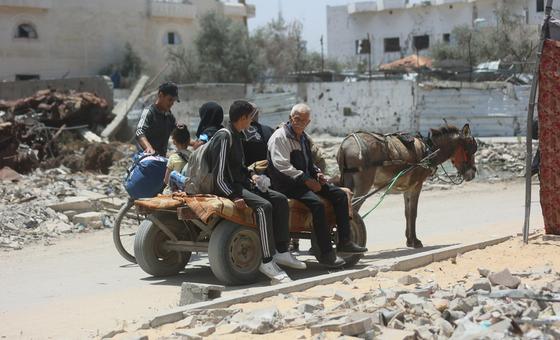
A displaced family travels on a donkey-pulled cart carrying their belongings.

Deadly attacks and displacement

Meanwhile, hundreds have been killed in attacks in recent days, according to the Gaza health authorities. 

They also report that the Indonesian Hospital was attacked on Monday, damaging electrical generators and forcing the facility to suspend services. 

Fifty-five people were there as of that day, including patients and medical staff, with critical shortages of water and food.

Furthermore, an Israeli airstrike reportedly hit a school in An Nuseirat area on Monday, killing seven people and injuring others. Two UNRWA staff members were among those killed. Their deaths push the total number of agency personnel killed during the war to over 300.

In other developments: Israel issued another displacement order on Tuesday, affecting 26 neighbourhoods in northern Gaza. Overall, some 80 per cent of the Gaza Strip is now either subject to displacement orders or located in Israeli-militarized zones.

UN partners estimate that more than 41,000 people were displaced following the evacuation order on Tuesday. They further estimate that since 15 May, more than 57,000 people were displaced in southern Gaza and more than 81,000 were displaced in the north due to intensified hostilities and recurrent displacement orders.

Israeli military operations in Gaza were triggered after the Hamas-led attack of 7 October 2023. Militants killed some 1,200 people in Israel and took 250 hostages to Gaza. Fifty-eight hostages are still being held captive; 23 are believed to still be alive.  

UN relief chief welcomes limited Gaza aid resumption – but it’s a ‘drop in the ocean’

Tom Fletcher said in a statement on Monday that nine UN trucks were cleared to enter the southern Kerem Shalom crossing earlier in the day.

“But it is a drop in the ocean of what is urgently needed…We have been reassured that our work will be facilitated through existing, proven mechanisms. I am grateful for that reassurance, and Israel’s agreement to humanitarian notification measures that reduce the immense security threats of the operation.”

Alarm over Israeli bombardment: UN chief

The UN Secretary-General on Monday expressed his alarm over the intensifying air strikes and ground operations in Gaza “which have resulted in the killing of hundreds of Palestinian civilians in recent days, including many women and children, and, of course, large-scale evacuation orders.”

António Guterres reiterated his call for the rapid, safe, and unimpeded delivery of humanitarian assistance at scale directly to civilians, in order to avert famine, alleviate widespread suffering, and prevent further loss of life.

Briefing reporters on Monday, UN Spokesperson Stéphane Dujarric said Mr. Guterres “welcomes the ongoing efforts by the mediators to reach a deal in Gaza. He has repeatedly warned that the continued violence and the destruction will only compound civilian suffering and heighten the risk of a broader regional conflict.”

He added that the Secretary-General “firmly rejects any forced displacement of the Palestinian population.”

Minimise risk of aid theft

Relief chief Fletcher said in his statement that he was determined to ensure UN aid reaches those in greatest need and make sure that any risk of theft by Hamas or other militants battling Israeli forces in the Strip amid a new offensive, would be minimised.

He said the UN aid coordination office, OCHA, had realistic expectations: “Given ongoing bombardment and acute hunger levels, the risks of looting and insecurity are significant.”

UN aid workers are committed to doing their jobs, “even against these odds,” he said, thanking humanitarian colleagues for their courage and determination.

Practical plan

“The limited quantities of aid now being allowed into Gaza are of course no substitute for unimpeded access to civilians in such dire need,” Mr. Fletcher continued.

The UN has a clear, principled and practical plan to save lives at scale, as I set out last week.”

He called on Israeli authorities to:

  • Open at least two crossings into Gaza, in the north and south
  • Simplify and expedite procedures together with removing quotas limiting aid
  • Lift access impediments and cease military operations when and where aid is being delivered
  • Allow UN teams to cover the whole range of needs – food, water, hygiene, shelter, health, fuel and gas for cooking

Ready to respond

Mr. Fletcher said to reduce looting, there must be a regular flow of aid, and humanitarians must be permitted to use multiple routes.

“We are ready and determined to scale up our life-saving operation Gaza and respond to the needs of people, wherever they are,” he stressed – calling again for the protection of civilians, a resumption of the ceasefire and the immediate and unconditional release of all hostages.

He concluded saying the operation would be tough – “but the humanitarian community will take any opening we have.”

Source link

Gaza: Israel ‘approaches UN’ to resume limited aid deliveries, says aid agency

“We have been approached by Israeli authorities to resume limited aid delivery, and we are in discussions with them now on how this would take place given the conditions on the ground,” OCHA said in a statement.

It is now 11 weeks since the Israeli authorities closed off all food, fuel and medicines to Gaza.

The decision has been widely condemned by the international community – including the UN Secretary-General – who on Sunday insisted that Israel’s “siege and starvation” of Gazans “makes a mockery of international law”.

According to news reports the Israel Government has taken the decision to resume “basic” levels of aid delivery to ensure against starvation, on the recommendation of the Israeli Defense Forces and in support of a renewed Gaza offensive.

“The situation for Palestinians in Gaza is beyond description, beyond atrocious and beyond inhumane,” António Guterres wrote online. “The blockade against humanitarian aid must end immediately.”

The aid blockade has created life-threatening hunger across Gaza – something that humanitarians have pointed out did not exist before the war started on 7 October 2023, sparked by Hamas-led terror attacks on Israel.

Basic principles

“I emphasize that the United Nations will not participate in any operation that does not adhere to international law and humanitarian principles of humanity, impartiality, independence and neutrality,” Mr. Guterres insisted, before underlining his “full support” for UNRWA, the largest aid agency in Gaza.

In an update on Monday, UNRWA reported that more than nine in 10 homes in Gaza have been damaged or destroyed. On Sunday the agency’s Commissioner-General, Philippe Lazzarini announced that more than 300 staff have been killed in the Gaza war. “The vast majority of staff were killed by the Israeli army with their children and loved ones: whole families wiped out,” he noted.

“Several were killed in the line of duty while serving their communities. Those killed were mostly UN health workers and teachers, supporting their communities.”

Ahead of unconfirmed reports on Monday that 20 aid trucks were expected to enter Gaza on Monday, UN agencies OCHA and the World Health Organization (WHO) warned that hungry and sick Gazans continue to live in terror because of ongoing bombardment.

In a new call to lift the blockade, both agencies rejected allegations of aid diversion to Hamas and highlighted the humanitarian nature of the goods being denied entry into Gaza, everything from children’s shoes to eggs, pasta, baby formula and tents.

How much war can you wage with this? asked OCHA spokesperson Jens Laerke.

Briefing Member States in Geneva, WHO Director-General Tedros Adhanom Ghebreyesus warned on Monday that the risk of famine “is increasing” as aid continues to be withheld deliberately by Israel.

Health system destroyed

The enclave’s health system is “already on its knees”, he insisted.

“Two million people are starving, while 116 000 tonnes of food is blocked at the border just minutes away,” he told the World Health Assembly.

In response to a resurgence of polio in Gaza, WHO negotiated a humanitarian pause for a vaccination campaign that reached more than 560,000 children, Tedros continued.

“We stopped polio, but the people of Gaza continue to face multiple other threats,” he said. “People are dying from preventable diseases as medicines wait at the border, while attacks on hospitals deny people care, and deter them from seeking it.”

At the same time, the WHO chief called out “increasing hostilities, evacuation orders, [the] shrinking humanitarian space and the aid blockade [that] are driving an influx of casualties”.

Tedros’s comments come as UN aid teams who remain committed to helping all Gazans confirmed intensifying bombing across the devastated Strip. “It has increased, of course,” said one worker, who wished to remain anonymous. They added that in the last 72 hours around 63,000 people have been uprooted.

Source link

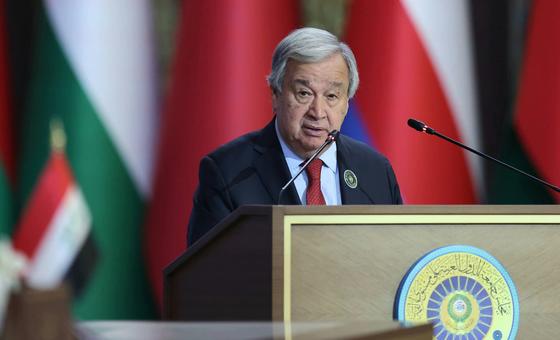
At Arab League Summit, Guterres reiterates call for Gaza ceasefire

António Guterres told leaders meeting in the Iraqi capital that “the region and the world face trials and tests on all fronts,” starting with the situation in Gaza.

He reiterated that neither the atrocious 7 October 2023 terror attacks by Hamas nor the collective punishment of the Palestinian people can be justified.

Permanent ceasefire now

“We need a permanent ceasefire, now. The unconditional release of all hostages, now. And the free flow of humanitarian aid ending the blockade, now,” he said.

The Secretary-General expressed alarm over reports that Israel plans to expand ground operations in Gaza and stressed that the UN “will not participate in any so-called aid operation that does not adhere to international law and the humanitarian principles of humanity, impartiality, independence and neutrality.”

He again called for full support for UN Palestine refugee agency UNRWA, including funding.  

Two-State solution at risk

The UN chief rejected the repeated displacement of the Gaza population, as well as any suggestion of forced displacement outside Gaza, and urged leaders to remain focused on the terrible situation in the occupied West Bank.

“Let’s be clear,” he said. “Annexation is illegal.  Settlements are illegal. Only a two-State solution can deliver sustainable peace.”

He said the high-level conference in June, co-chaired by France and Saudi Arabia, is an important opportunity.

“The world, the region – and, most of all, the people of Palestine and Israel – cannot afford to watch the two-State solution disappear before our eyes,” he said.

Respect Lebanese sovereignty

The Secretary-General addressed the situation in Lebanon.  He emphasized that the country’s sovereignty and territorial integrity must be respected, and the Government must have full control over the entire territory.

He was encouraged by continued progress on reforms as well as efforts to deploy the Lebanese Armed Forces to the south, with support from the UN Mission in the country, UNIFIL.

Mr. Guterres touched on Syria, saying sovereignty, independence, unity and territorial integrity are critical.  He urged strong support for an inclusive Syrian-led and Syrian-owned political process that safeguards the rights and participation of all the country’s people and ensures their protection.

Regarding Yemen, he noted that attacks by Houthi rebels in the Red Sea have caused significant damage to regional and local economies. He welcomed the cessation of hostilities between the Houthis and the United States, announced by Oman on 6 May.

The Secretary-General also called for the release of UN staff and other personnel in Yemen who have been arbitrarily arrested.

Engagement on Sudan

In Sudan, renewed and coordinated multilateral engagement is crucial to help stem appalling violence, famine, and mass displacement, he said, and thanked the Arab League and African Union (AU) for the excellent coordination meeting convened the previous day.  He also commended the Arab League’s efforts to strengthen multilateral coordination.

The Secretary-General turned next to Somalia, saying unity and inclusive dialogue are imperative. Furthermore, assistance from Somalia’s partners will be essential in the fight against Al-Shabaab militants and to strengthen peace and security.

For this reason, Mr. Guterres said he has put forward a recommendation to the UN Security Council to enable predictable and sustainable financing for the AU Support and Stabilization Mission in the country.

Meanwhile in Libya, the UN is also actively engaging in efforts to end the confrontation between armed groups, to preserve the independence of key oversight institutions, to address obstacles preventing national elections, and set the course for long-term stability and prosperity in line with the people’s needs and aspirations.

Lessons from Baghdad

The Secretary-General concluded his remarks by commending the progress Iraq has made over since the restoration of sovereignty in 2004, such as strengthening institutions, resolving outstanding disputes through dialogue, and promoting sustainable development as well as human rights.

He said the UN Assistance Mission in Iraq (UNAMI) has accompanied the country on this path and is working to ensure the successful delivery of its residual mandate and an orderly drawdown by the end of the year.

“Despite the enormous challenges, let us draw lessons and hope from here in Baghdad. Working in unity and solidarity, we can help resolve conflicts and build a future of peace and prosperity,” he said.

Gaza situation ‘beyond inhumane’

Speaking later to reporters, Mr. Guterres said the situation for Palestinians in Gaza “is beyond description, beyond atrocious and beyond inhumane.”

Since 2 March, Israel has banned the entry of cargo into the Strip, including aid and other life-saving supplies. UN agencies continue to warn that the entire population, 2.1 million people, is at risk of famine and one if five faces starvation.

“A policy of siege and starvation makes a mockery of international law,” he said, calling for the blockade to end immediately.

Source link

UN humanitarian chief demands resumption of aid in Gaza

No aid has entered the enclave since Israel implemented a ban on 2 March and the entire population, more than two million people, is at risk of famine.

“As we demonstrated during the ceasefire this year – and every time we’ve been granted access – the United Nations and our humanitarian partners have the expertise, resolve and moral clarity to deliver aid at the scale necessary to save lives across Gaza,” said Mr. Fletcher.

Ready to move

Those proposing an alternative modality for aid distribution should not waste time, he added, as a plan already exists.

The document is “rooted in the non-negotiable principles of humanity, impartiality, neutrality and independence.” Furthermore, it is backed by a coalition of donors, as well as most of the international community, and ready to be activated if humanitarians are allowed to do their jobs.

“We have the people. We have the distribution networks. We have the trust of the communities on the ground. And we have the aid itself – 160,000 pallets of it – ready to move. Now,” he said.

‘Let us work’

Mr. Fletcher reiterated that the humanitarian community has done this before and can do it again.

“We know how to get our aid supplies registered, scanned, inspected, loaded, offloaded, inspected again, loaded again, transported, stored, protected from looting, tracked, trucked, monitored and delivered – without diversion, without delay, and with dignity. We know how to reach civilians in desperate need and stave off famine.”

He concluded the statement by saying “Enough. We demand rapid, safe, and unimpeded aid delivery for civilians in need. Let us work.”