

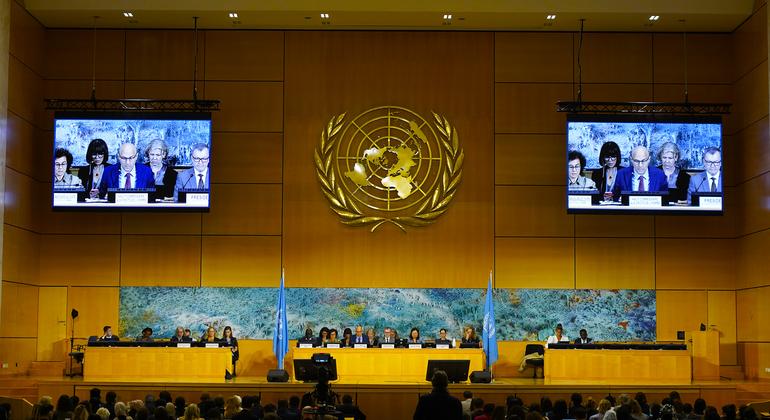
“No one is safe when human rights are under attack,” Mr. Türk told the Human Rights Council, warning that the rules of war “are being shredded”.
“Some States are becoming an extension of their ruler’s personal power,” he insisted.
In his customary address to the UN’s top rights forum at the beginning of a new session in Geneva, the High Commissioner for Human Rights decried that “pro-war propaganda is everywhere”, from military parades to “ramped-up rhetoric” from leaders.
“Sadly, there are no peace parades or ministries of peace, he stressed, while calling for countries to stand firm against the growing “erosion” of international law.
The High Commissioner also defended the importance of standing behind multilateral accords as “the foundation of peace, our global order and our daily lives, from trade rules to the global internet, to our fundamental rights”.
World order at risk
Today, governments “are disregarding, disrespecting and disengaging” the existing rules-based world order that was established after 1945 to prevent another world war, the UN rights chief insisted, in a call for accountability.
The danger is that when States ignore violations of the law, “they become normalised,” Mr. Türk said. “When States apply the law inconsistently, they undermine the legal order everywhere. It is time for States to wake up and to act.”
Condemning the continued illegal detention of United Nations staff in Yemen as a “direct attack on the UN system”, Mr. Türk also called the United States’ withdrawal “from the Paris Agreement and from global bodies, including this Council…deeply regrettable”, noting that other States were following suit.
The High Commissioner also warned of the negative consequences of the decision by Estonia, Finland, Latvia, Lithuania and Poland to leave the Ottowa Treaty on land mines, while identifying the “new trend of disparaging” the 2030 Agenda for Sustainable Development, which all countries had agreed to a decade ago.
An A to Z of rights concerns
As is usual at the start of Council sessions, the High Commissioner highlighted situations of concern around the world, from Afghanistan – where the “erasure” of women and girls from public life “is almost complete” – to Haiti which is “plunging deeper into lawlessness; Nigeria, which is seeing a resurgence of Boko Haram extremism; and Syria – whose transition to peace remains “fragile”.
In Ukraine, following the largest drone assault of the conflict, Russia’s full-scale invasion “has turned even more deadly”.
In Sudan, besieged El Fasher is under constant bombardment and the risk of further atrocities remains, Mr. Türk said, while in Myanmar, four years since the military coup, people remain caught up in “a harrowing human rights calamity”.
Turning to the eastern Democratic Republic of the Congo, “damning evidence” indicates continued “grave violations and abuses” by all parties to the conflict, the High Commissioner continued, while Gaza is now a “graveyard”, amid Israel’s “mass killing” of Palestinian civilians.
Where are steps to stop Gaza genocide?
“We are failing the people of Gaza…Where are the decisive steps to prevent genocide?” he asked. “Why are countries not doing more to avert atrocity crimes? They must stop the flow to Israel of arms that risk violating the laws of war.”

Continuing his tour d’horizon of country situations of concern in addition to thematic issues, Mr. Türk maintained that progress sought by his office, OHCHR, to protect the rights of Uyghur and other Muslim minorities in China has “yet to materialise”.
In West Africa, meanwhile, restrictions on LGBTQ+ people are growing in some countries considering criminalising consensual same-sex relations, the High Commissioner said, just as the rights of migrants and refugees are being increasingly violated.
Asylum alert
“Iran and Pakistan have forcibly returned millions of Afghans to their country and India has also deported groups of Rohingya Muslims by land and sea,” he insisted.
Similarly, Germany, Greece, Hungary, and other European countries “have also sought to limit the right to seek asylum”, Mr. Türk insisted. He took note of concerns about the United States’ reported agreement with El Salvador, South Sudan, Eswatini, Rwanda and others, to deport third country nationals, and underlined Kuwait’s decision to revoke citizenship for thousands of people in recent years, “leaving many stateless”.
Poll appeal
On imminent national elections across Africa, Mr. Türk also cited serious concerns over polling preparations in Cameroon, Côte d’Ivoire, Guinea, Guinea Bissau, Malawi, Tanzania and Uganda.
“In many of these countries, the authorities are resorting to harassment, exclusion or detention of opposition leaders; restrictions on media freedom; bans on peaceful protest; and crackdowns on human rights defenders,” he said.
The UN rights chief also urged the Ethiopian authorities to ensure conditions for free, fair and inclusive elections, amid concerns about arbitrary detentions of journalists.
As part of the UN’s efforts to improve and promote human rights everywhere, Mr. Türk urged all countries to do more so that “every child – whether a future farmer, digital worker, doctor or shopkeeper” understands that human rights “are our birthright”.
He added: “The vast majority of people around the world are crying out for human rights and freedoms…No one is safe when human rights are under attack. Abuses committed against one group are always part of a broader pattern of oppression and lead to the wider erosion of fundamental freedoms”.