
UN chief warns ‘law of the jungle’ is replacing rule of law

António Guterres was addressing a high-level open debate of the UN Security Council convened by Somalia, which holds the Council presidency for January.

The discussion comes as conflicts multiply, global tensions rise, and confidence in international institutions and rules is fading – even as the UN marks 80 years since the adoption of its founding Charter, which set out principles meant to prevent wars and reduce suffering.

The rule of law is a cornerstone of global peace and security,” Mr. Guterres said, calling it “the beating heart” of the UN Charter.

For eight decades, he said, the Charter, alongside the Universal Declaration of Human Rights, the Geneva Conventions and other core legal instruments, has helped humanity avoid another world war and limit the toll of countless conflicts.

Secretary-General Guterres addresses the Security Council.

Flagrant violations

But the Secretary-General warned that commitments to international law are increasingly being ignored.

Around the world, the rule of law is being replaced by the law of the jungle,” he said, pointing to what he described as flagrant violations of the UN Charter and international law, including the illegal use of force, attacks on civilian infrastructure, human rights abuses and the denial of life-saving humanitarian aid.

From Gaza to Ukraine and beyond, he said, the rule of law is being treated as “an à la carte menu,” with States choosing which rules to follow. Such violations, he warned, set dangerous precedents, encourage impunity and erode trust among nations.

A lifeline and a guardrail

For smaller and less-powerful countries, particularly those affected by historical inequities and the legacies of colonialism, international law is “a lifeline promising equal treatment, sovereignty, dignity and justice,” Mr. Guterres said.

“For powerful countries, it is a guardrail defining what is acceptable – and what is not, in times of disagreement, division and outright conflict,” he added.

He underscored the unique responsibility of the Security Council, the only body with Charter-mandated authority to adopt decisions binding on all Member States and to authorize the use of force under international law.

“Its responsibility is singular. Its obligation is universal,” he said.

Priorities for action

Looking ahead, the UN chief outlined three priority areas for action.

First, he urged countries to honour the commitments they made under the Charter, including settling disputes peacefully, safeguarding human rights and respecting the sovereign equality of States.

Second, he called for the use of peaceful tools to settle disputes – negotiation, mediation and judicial settlement, alongside stronger partnerships with regional organizations – and more investment in development to address the root causes of inequality and exclusion.

Third, he stressed the need for fair, independent judicial proceedings. He encouraged greater reliance on independent courts and tribunals, including the International Court of Justice (ICJ) and stronger support for international criminal justice.

“There can be no sustainable or just peace without accountability,” Mr. Guterres said. “The rule of law must prevail.”

Source link

UN rights chief denounces ‘glorification of violence’ and attack on rule of law

“No one is safe when human rights are under attack,” Mr. Türk told the Human Rights Council, warning that the rules of war “are being shredded”.

“Some States are becoming an extension of their ruler’s personal power,” he insisted.

In his customary address to the UN’s top rights forum at the beginning of a new session in Geneva, the High Commissioner for Human Rights decried that “pro-war propaganda is everywhere”, from military parades to “ramped-up rhetoric” from leaders.

“Sadly, there are no peace parades or ministries of peace, he stressed, while calling for countries to stand firm against the growing “erosion” of international law.

The High Commissioner also defended the importance of standing behind multilateral accords as “the foundation of peace, our global order and our daily lives, from trade rules to the global internet, to our fundamental rights”.

World order at risk

Today, governments “are disregarding, disrespecting and disengaging” the existing rules-based world order that was established after 1945 to prevent another world war, the UN rights chief insisted, in a call for accountability.

The danger is that when States ignore violations of the law, “they become normalised,” Mr. Türk said. “When States apply the law inconsistently, they undermine the legal order everywhere. It is time for States to wake up and to act.”

Condemning the continued illegal detention of United Nations staff in Yemen as a “direct attack on the UN system”, Mr. Türk also called the United States’ withdrawal “from the Paris Agreement and from global bodies, including this Council…deeply regrettable”, noting that other States were following suit.

The High Commissioner also warned of the negative consequences of the decision by Estonia, Finland, Latvia, Lithuania and Poland to leave the Ottowa Treaty on land mines, while identifying the “new trend of disparaging” the 2030 Agenda for Sustainable Development, which all countries had agreed to a decade ago.

An A to Z of rights concerns

As is usual at the start of Council sessions, the High Commissioner highlighted situations of concern around the world, from Afghanistan – where the “erasure” of women and girls from public life “is almost complete” – to Haiti which is “plunging deeper into lawlessness; Nigeria, which is seeing a resurgence of Boko Haram extremism; and Syria – whose transition to peace remains “fragile”.

In Ukraine, following the largest drone assault of the conflict, Russia’s full-scale invasion “has turned even more deadly”.

In Sudan, besieged El Fasher is under constant bombardment and the risk of further atrocities remains, Mr. Türk said, while in Myanmar, four years since the military coup, people remain caught up in “a harrowing human rights calamity”.

Turning to the eastern Democratic Republic of the Congo, “damning evidence” indicates continued “grave violations and abuses” by all parties to the conflict, the High Commissioner continued, while Gaza is now a “graveyard”, amid Israel’s “mass killing” of Palestinian civilians.

Where are steps to stop Gaza genocide?

We are failing the people of Gaza…Where are the decisive steps to prevent genocide?” he asked. “Why are countries not doing more to avert atrocity crimes? They must stop the flow to Israel of arms that risk violating the laws of war.”

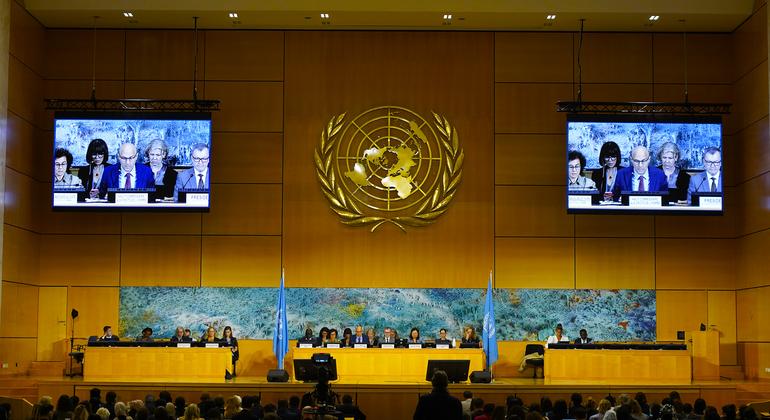
The Human Rights Council meets in three scheduled sessions every year at UN Geneva. 

Continuing his tour d’horizon of country situations of concern in addition to thematic issues, Mr. Türk maintained that progress sought by his office, OHCHR, to protect the rights of Uyghur and other Muslim minorities in China has “yet to materialise”.

In West Africa, meanwhile, restrictions on LGBTQ+ people are growing in some countries considering criminalising consensual same-sex relations, the High Commissioner said, just as the rights of migrants and refugees are being increasingly violated.

Asylum alert

“Iran and Pakistan have forcibly returned millions of Afghans to their country and India has also deported groups of Rohingya Muslims by land and sea,” he insisted.

Similarly, Germany, Greece, Hungary, and other European countries “have also sought to limit the right to seek asylum”, Mr. Türk insisted. He took note of concerns about the United States’ reported agreement with El Salvador, South Sudan, Eswatini, Rwanda and others, to deport third country nationals, and underlined Kuwait’s decision to revoke citizenship for thousands of people in recent years, “leaving many stateless”. 

Poll appeal

On imminent national elections across Africa, Mr. Türk also cited serious concerns over polling preparations in Cameroon, Côte d’Ivoire, Guinea, Guinea Bissau, Malawi, Tanzania and Uganda.

“In many of these countries, the authorities are resorting to harassment, exclusion or detention of opposition leaders; restrictions on media freedom; bans on peaceful protest; and crackdowns on human rights defenders,” he said.

The UN rights chief also urged the Ethiopian authorities to ensure conditions for free, fair and inclusive elections, amid concerns about arbitrary detentions of journalists.

As part of the UN’s efforts to improve and promote human rights everywhere, Mr. Türk urged all countries to do more so that “every child – whether a future farmer, digital worker, doctor or shopkeeper” understands that human rights “are our birthright”.

He added: “The vast majority of people around the world are crying out for human rights and freedoms…No one is safe when human rights are under attack. Abuses committed against one group are always part of a broader pattern of oppression and lead to the wider erosion of fundamental freedoms”.

Source link

‘You have to be able to rule your life’: The care revolution in Latin America

The workers we don’t pay or see are grandmothers, mothers, daughters — the women who take care of children, look after ill family members, and give dignity to the elderly. 

To do this vital care work, they give up formal employment with pay cheques. 

“Our system is designed as if women didn’t do care work. And that forces us to choose between raising children or working,” said Meredith Cortés Bravo, a founder of a grassroots organization in Chile that supports these women.

But in Latin America, this is slowly changing — a care revolution is underway that is asking governments and employers to consider what it would mean to recognize, protect and fund care work. 

“Care is essential for every family and for every community. The revolution is to make it visible, to make it valuable and to invest,” María Noel Vaeza, UN Women’s regional director for Latin America and the Caribbean, told UN News.

The most off-track goal

The High-Level Political Forum (HLPF) on Sustainable Development is convening at UN Headquarters in New York in order to discuss progress – or lack thereof – towards the globally agreed Sustainable Development Goals (SDGs).

While 18 per cent of the Goals are on track for 2030, achieving gender equality remains the Goal that is most off-track. Discriminatory laws and gender-based norms persist worldwide, with women dedicating approximately twice as many hours to unpaid care work as men.   

“Gender equality is not a side issue. It is central to peace, it is central to justice, and it is central to sustainable development and the credibility of the multilateral system itself,” Sima Bahous, Executive Director of UN Women said at an HLPF session this week.

The revolution is underway

Before the revolution began, Latin America faced a care crisis during the COVID-19 pandemic, according to Ms. Vaeza.  There was not enough care available outside of the home for sick people, forcing society to recognize that taking care of others is work. 

“Unpaid care work is what keeps the economy running, but it’s unfair because it’s invisible, undervalued and underfunded. We must recognize it,” Ms. Vaeza said. 

In Latin America, 17 are countries actively working to redesign their care economies, ensuring more protections and income for the women and men who provide this work. 

“The biggest shift has been putting care at the centre of public policy, not just academic debates,” said Virginia Gontijo, UN Women programme lead in Brazil.

This work is already bearing fruit. 

In Chile, one of the region’s most ambitious care systems is already delivering in 151 municipalities, with the ultimate goal of reaching 75,000 people in the next few years.  

UN Women is working with State governments and civil society groups to ensure that these new systems, policies and laws are shaped by and for caregivers.

A care system in Brazil worked closely with a care activist network to train caregivers in labour rights and promote long-term professional development.  

“I never felt my work was valued. But after this project, I feel better prepared to take part in political discussions and make our voices heard,” said Lucileide Mafra Reis, a domestic worker activist in Brazil.

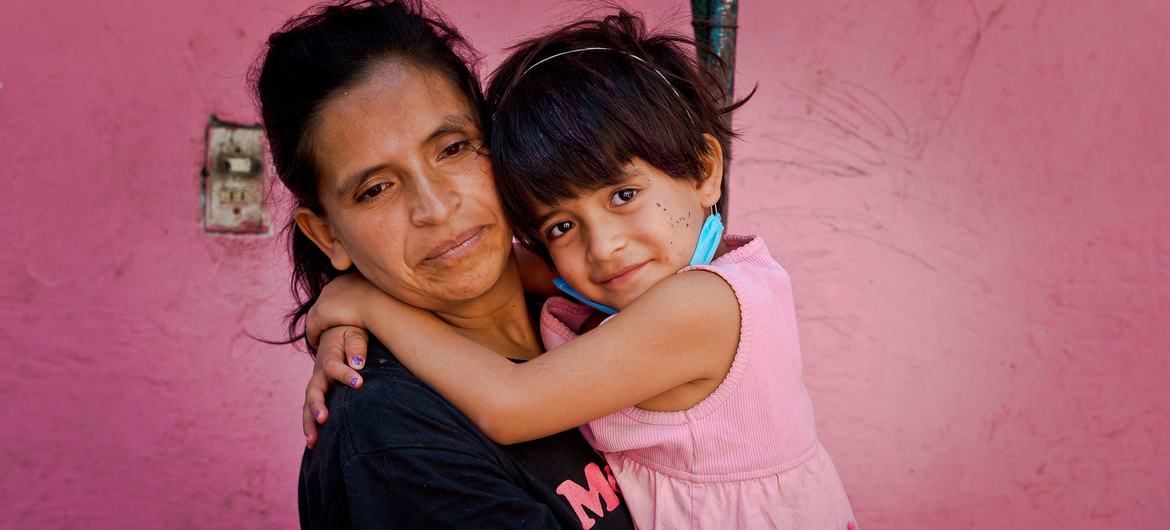
A woman and young girl in Mexico.

Care is a human right

Mexico and Peru have taken a more rights-based approach to care, codifying it as a basic human right. 

While the international community has yet to make a similar guarantee, Ms. Vaeza said that the human rights framework is an exceptionally effective one — it restores dignity and recognizes that care is a fundamental part of human life trajectories, from birth to death.

“If you say that care is a human right, it means that the government and the state have to provide support,” she Ms. Vaeza.  

For Aideé Zamorano González — a mother who founded Mama Godin, an organization in Mexico which evaluates the impact of care policies on women — it is equally as important that employers protect women’s right to do care work. 

This means ensuring that workplaces have policies that are supportive of mothers as workers, such as schedules that allow them to drop their children off at school.

For her, these sorts of policies are crucial for women’s rights and particularly for their freedom and autonomy.

“You have to be able to rule your life,” Ms. Zamorano González told UN News

Beyond just autonomy, however, it is also about safety. If a woman can make her own money — and therefore, her own decisions — she can leave abusive relationships and avoid economic exploitation. 

“Every other type of violence depends on the economic power that you have. If you have the ability to make your own decisions and own money, you are safer,” said Ms. Zamorano González. 

An economic investment

Changes to legal classifications and governmental support for care work not only benefit the caregivers but also promote economic growth across societies. 

“[Care] is an investment, a strategic investment for social justice, for gender equality and for sustainable development,” Ms. Vaeza said.

She noted that dedicating government funds to paying caregivers will return the investment threefold — both by increasing caregivers’ purchasing power and by generating tax revenue. 

In Chile and Colombia, new care systems are estimated to contribute 25.6 per cent and 19.6 percent respectively to their national GDPs, according to UN Women.

“When you invest in a women’s organization, you strengthen a living network, a tree with many branches that reaches places no office or institutional programme ever could,” Ms. Bravo said. 

Export the revolution

Latin America’s progress on care is a model for other regions around the world, Ms. Vaeza said, and demonstrates the importance of changing legal frameworks for women and girls. 

“It’s extremely important that this revolution be exported. It’s an investment, a strategic investment for social justice, for gender equality and for sustainable development,” she said. 

But while the revolution is ongoing, Ms. Zamorano González underlined the importance of economic empowerment for women as a means to protect their own rights even when laws and policies fall short. 

“We are under capitalism, so while we change the system, let’s play the game. Let’s get our own means to have freedom,” she said. 

Source link