Gaza: New displacement orders force thousands to flee as famine looms

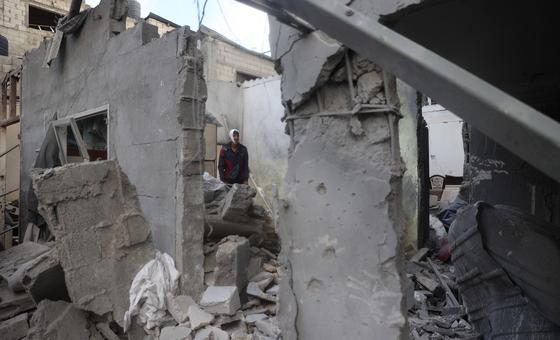
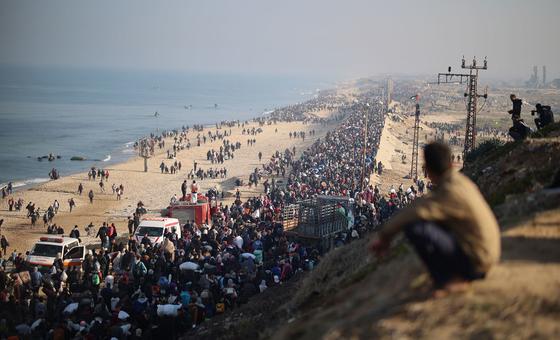
In addition to ongoing bombardment, Israel issued another three displacement orders over the past two days, covering seven per cent of the total area of the territory. 

Overall, some 71 per cent of the Gaza Strip is under displacement orders or in Israeli-militarized zones, where the Israeli authorities require humanitarian teams to coordinate their movements. 

These displacement orders come as populations across Gaza are at risk of famine and one in every five people faces starvation,” the agency said.

Thousands uprooted

Evacuation orders announced on Thursday have impacted thousands of residents in 10 neighbourhoods in Deir Al-Balah and Khan Younis, OCHA reported.

Initial assessment indicates that the affected area includes eight wells, five reservoirs, seven humanitarian warehouses, three health clinics and other critical facilities. 

Furthermore, displacement orders issued on Wednesday for six neighbourhoods in North Gaza governorate overlap with parts of zones covered under orders issued the previous day.

“According to preliminary estimates, the newly impacted area is home to approximately 100,000 people,” OCHA said. 

Some 30 sites for internally displaced people, six temporary learning spaces serving approximately 700 students, and several water and sanitation facilities have been affected.

Fleeing families return

Humanitarian partners report that several hundred families fled parts of the designated areas on Wednesday, however dozens have since returned due to lack of space and shelter.  

Another displacement order was also issued that same day for parts of the Rimal area of Gaza City.

OCHA further reported that Israeli forces hit another school-turned-shelter run by the UN agency that assists Palestine refugees, UNRWA, in the Nuseirat area of Deir Al-Balah on Wednesday.  No injuries were reported.

Humanitarians committed to deliver

Meanwhile, the UN and partners on the ground are committed to stay and deliver in the Gaza Strip despite the mounting challenges. 

On Wednesday, the World Health Organization (WHO) evacuated 284 patients and their companions from the European Gaza Hospital in Khan Younis to Europe and the United Arab Emirates. Israeli forces hit the hospital premises twice one day prior to the scheduled evacuation. 

European Gaza Hospital is no longer functional following the attack, WHO Director-General Tedros Adhanom Ghebreyesus said in a tweet on Thursday.

“The hospital’s closure has cut off vital services including neurosurgery, cardiac care, and cancer treatment—all unavailable elsewhere in Gaza,” he said.

He added that another strike near the Indonesian Hospital “spread fear, disrupted access, and raised the risk of closure.” 

Tedros underlined that “hospitals must be protected”, saying “they must never be militarized or targeted.”

Time is of the essence

More than two months have passed since Israel implemented a full blanket ban on the entry of cargo into the Gaza Strip, including aid and other life-saving supplies, which continues to drive hunger and deprivation.  

UN teams report that the number of hot meals provided by community kitchens has fallen from one million to just 249,000 a day.

OCHA Spokesperson Olga Cherevko told UN News that the situation will continue to worsen as supplies run down, forcing more kitchens to close.

People are terrified and are telling me every day that they don’t know how they will survive,” she said.

“I have passed several kitchens in the past few days where crowds of people were standing with empty pots and despair in their faces, and these people were being told to go home because all the food had run out for that day.”

The UN and partners have 9,000 truckloads of vital supplies ready to move into Gaza, including food assistance to feed millions for months. Thousands more trucks full of aid are on standby.

OCHA reiterated that as long as the full blockade is not immediately lifted, the already limited assistance available will shrink even further, warning “time is of essence to prevent further death.” 

Source link

UN aid office denounces attacks on Gaza hospital

OCHA reported that hostilities intensified overnight, with an attack by Israeli forces on the European Gaza Hospital in Khan Younis which killed and injured several people. 

A team from the World Health Organization (WHO) was also inside the hospital at the time.

The hospital premises were hit again on Wednesday morning, reportedly leading to additional casualties.

A ‘decimated’ health system

“These attacks not only further degrade Gaza’s already decimated healthcare system, but also further traumatize patients and medical staff at these facilities,” OCHA said.

The UN Office has documented at least 686 attacks impacting healthcare in the Gaza Strip since war erupted in October 2023, following the deadly Hamas-led attacks on Israel.

OCHA said escalating military activities and increasing explosive ordnance contamination are heightening safety risks for civilians, including aid workers, before stressing once again that civilians and healthcare facilities must always be protected.

First responders in northern Gaza reported that at least 80 people had been killed in the past day following Israeli strikes, including around 50 who died when homes were struck in northern Jabalia.

More displacement orders

Meanwhile, Israel has issued two new displacement orders in North Gaza since Tuesday night, following Palestinian rocket fire.  

Eight neighbourhoods have been affected and humanitarians have already observed some fleeing in search of relative safety.

More than 436,000 people are estimated to have been displaced to various areas of Gaza since 18 March.

Whether they leave or stay, civilians must be able to access the essentials for their survival,” OCHA said.

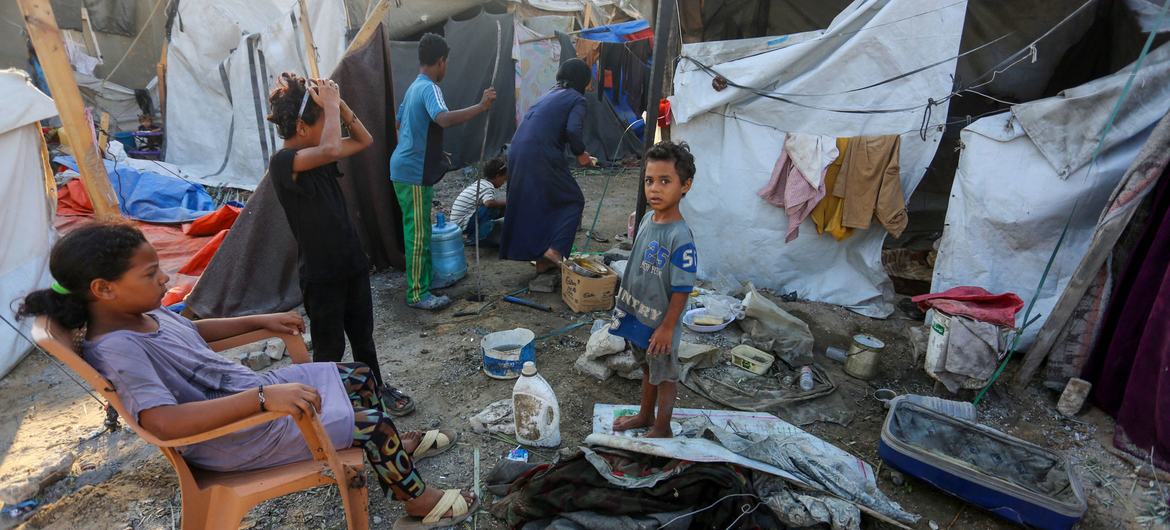
© UNICEF/Mohammed Nateel

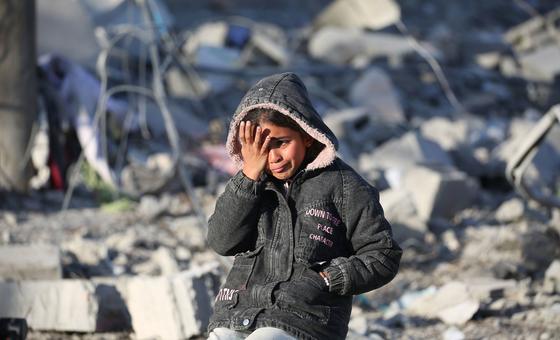
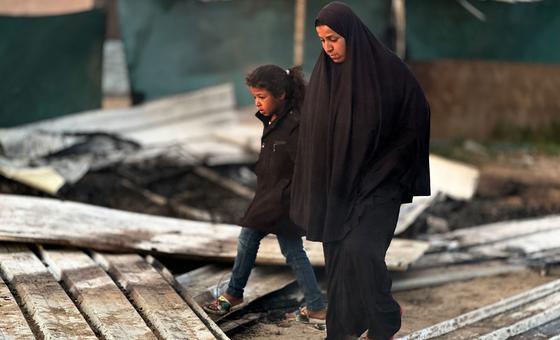
Displaced child in Gaza City

End aid blockade

The agency also continues to call for the immediate lifting of the blockade of Gaza. No cargo, including aid, has entered for more than 70 days.

The humanitarian situation is deteriorating, which has led to dwindling stocks in local markets and rising prices of the few supplies that remain available.

For example, during the first week of May, a single 25-kilogramme bag of wheat flour was being sold in Gaza City for the equivalent of more than $415 – a more than 3,000 per cent increase when compared with the last week of February.

“The blockade is also hampering the provision of hot meals in Gaza, with only about 250,000 individual meals now being provided each day through some 65 community kitchens,” OCHA said.

“This is compared to 25 April – less than three weeks ago – when 180 community kitchens were producing nearly 1.1 million meals on a daily basis.” 

Humanitarian partners have more than 171,000 metric tonnes of food in the region, ready for whenever the blockade is lifted.

This is enough to sustain Gaza’s entire population, roughly 2.1 million people, for up to four months.  

‘Stop the 21st century atrocity’ in Gaza, Fletcher urges UN Security Council

Mr. Fletcher began his remarks by asking the international community to reflect on what it will tell future generations about action taken “to stop the 21st century atrocity to which we bear daily witness in Gaza.”

He wondered, for example, if “we will use those empty words: ‘We did all we could,’” and urged the Council to act decisively to prevent genocide from happening.

Shrinking spaces, overwhelmed hospitals

In addition to the aid blockade, civilians in Gaza have again been forcibly displaced and confined into ever-shrinking spaces, he said, as 70 per cent of the territory is either within Israeli-militarized zones or under displacement orders. 

Furthermore, the few remaining hospitals are overwhelmed, and medics cannot stem the trauma and the spread of disease.

I can tell you from having visited what’s left of Gaza’s medical system that death on this scale has a sound and a smell that does not leave you,” he said.

“As one hospital worker described it, ‘children scream as we peel burnt fabric from their skin.’”

We can save lives

Mr. Fletcher stressed that the UN and partners are desperate to resume humanitarian aid across Gaza, and the recent ceasefire showed that they can deliver.  Meanwhile, lifesaving supplies are waiting to enter the enclave.

“We can save hundreds of thousands of survivors. We have rigorous mechanisms to ensure our aid gets to civilians, and not to Hamas,” he insisted.

“But Israel denies us access, placing the objective of depopulating Gaza before the lives of civilians,” he said. 

“It is bad enough that the blockade continues.  How do you react when Israeli Ministers boast about it? Or when attacks on humanitarian workers and violations of the UN’s privileges and immunities continue, along with restrictions on international and non-governmental organizations.”

Reject ‘cynical’ US-Israeli aid alternative 

Mr. Fletcher recalled that Israel has clear obligations under international humanitarian law, and as the occupying power must agree to aid and facilitate it.  

“For anyone still pretending to be in any doubt, the Israeli-designed distribution modality is not the answer,” he stated, noting that among other things, the plan “makes starvation a bargaining chip.”

It is cynical sideshow. A deliberate distraction. A fig leaf for further violence and displacement,” he told ambassadors.  “If any of that still matters, have no part in it.”

He also addressed the increasing violence in the West Bank, where the situation is the worst in decades, with entire communities destroyed and refugee camps depopulated.

Insist on accountability

Mr. Fletcher noted that international humanitarian workers have been the only international civilian presence in Gaza over the past 19 months, and they have briefed the Council on what they witness daily.

We have described the deliberate obstruction of aid operations and the systematic dismantling of Palestinian life, and that which sustains it, in Gaza,” he said.

The International Court of Justice (ICJ) is now considering whether a genocide is taking place there and “will weigh the testimony we have shared. But it will be too late,” he warned.

He said the ICJ has recognized the urgency and indicated clear provisional measures that should have been acted on – but Israel has failed to do so. 

Moreover, previous reviews of the UN’s conduct in cases of large-scale violations of international human rights and humanitarian law have pointed to the collective failure to speak to the scale of violations while they were being committed.

“For those killed and those whose voices are silenced: what more evidence do you need now?” he asked.  “Will you act – decisively – to prevent genocide and to ensure respect for international humanitarian law? Or will you say instead, ‘we did all we could?’”.

He told the Council that the degradation of international law is corrosive and infectious, and it is undermining decades of progress on civilian protection.

Humanity, the law, and reason must prevail,” he said.  “This Council must prevail. Demand this ends. Stop arming it. Insist on accountability.”

Fear future judgement

Mr. Fletcher called for Israel to stop killing and injuring civilians, and to lift the brutal blockade so that humanitarians can save lives.

He urged Hamas and other Palestinian armed groups to release all hostages immediately and unconditionally, and to stop putting civilians at risk during military operations. 

“And for those who will not survive what we fear is coming – in plain sight – it will be no consolation to know that future generations will hold us in this chamber to account. But they will,” he said.   

“And, if we have not seriously done “all we could’, we should fear that judgement.” 

Source link

GAZA LIVE: Security Council to meet on aid crisis amid ‘critical risk of famine’ due to Israeli blockade

The Security Council is set to meet this afternoon at 3 PM in New York to discuss the deepening crisis in Gaza, where humanitarians warn of “a critical risk of famine” and aid shipments have been blocked for over 70 days. UN relief chief Tom Fletcher is expected to brief ambassadors. Follow live for key updates from UN Headquarters and reports from the region. App users can follow coverage here.

Gaza: 57 children reported dead from malnutrition, says WHO

Since the aid blockade began on 2 March, 57 children have reportedly died from the effects of malnutrition, according to the Ministry of Health.

If the situation persists, nearly 71,000 children under the age of five are expected to be acutely malnourished over the next 11 months.

Briefing journalists in Geneva, WHO’s representative in the Occupied Palestinian Territory Dr. Rik Peeperkorn said that that Israel’s complete aid embargo has left only enough WHO supplies to treat 500 children with acute malnutrition – “a fraction of the urgent need”

“People are trapped in this cycle where a lack of diversified food, malnutrition and disease fuel each other,” he warned.

Dr. Peeperkorn’s comments follow the publication on Monday of a new analysis by the UN-backed food security alert scale known as the IPC showing that one in five people in Gaza – 500,000 – faces starvation, while the entire 2.1 million population of the Strip is subjected to prolonged food shortages. WHO is a member of the IPC.

An escalating hunger crisis

“This is one of the world’s worst hunger crises, unfolding in real time,” Dr. Peeperkorn said.

The UN health agency representative spoke of his recent visit to Kamal Adwan hospital in north Gaza, where each day more than 300 children are screened at a WHO-supported nutrition centre. During the visit, the hospital reported more than 11 per cent of cases with global acute malnutrition.

Describing the affected children, he said, “I’ve seen them [in the] wards… A child of five years old, and I thought he’s two and a half”.

WHO supports 16 outpatient and three inpatient malnutrition treatment centres in the enclave with lifesaving supplies, but the stopping of aid by Israel and shrinking humanitarian access are threatening its ability to sustain these operations.
Dr. Peeperkorn insisted on the long-term damage from malnutrition which “can last a lifetime”, with impacts including stunted growth, impaired cognitive development and health.

“Without enough nutritious food, clean water, access to health care, an entire generation will be permanently affected,” he warned.

The WHO official stressed that the agency was “constantly” raising with Israeli authorities the need to get supplies into the Strip. Some 31 WHO aid trucks are at a standstill in Al-Arish in Egypt just a few dozen kilometres away from the Rafah border crossing with Gaza and more supplies are positioned in the West Bank, ready to move “any day when this is allowed”.

‘Health care is not a target’

Turning to attacks on health care, Dr. Peeperkorn said that the burn unit of Nasser Medical Complex in the southern town of Khan Younis was reportedly hit by an Israeli airstrike on Tuesday, killing two and injuring 12. The attack has resulted in the loss of 18 hospital beds in the surgical department including eight “critical” intensive care beds.

Media reported that a Palestinian journalist was killed in the attack during treatment for injuries sustained in a previous airstrike.

“Health care is not a target,” Dr. Peeperkorn concluded. He reiterated calls for the protection of health facilities, an immediate end to the aid blockade, the release of all hostages held by Palestinian armed groups and for a ceasefire “which leads to lasting peace”. 

Gaza: Guterres hails hostage release, renews ceasefire call

Edan Alexander, a 21-year-old American-Israeli national and soldier with the Israel Defense Forces (IDF), had been held by Hamas since the brutal 7 October 2023 attacks on Israel in which roughly 1,200 people were killed and another 250 taken hostage.

He is believed to be the last living American held by militants in Gaza, according to media reports.

Free all remaining hostages

The Secretary-General “is profoundly relieved that Mr. Alexander has been freed and is now returning to his family and loved ones after this harrowing ordeal,” said UN Spokesperson Stéphane Dujarric in a statement.

The UN chief renewed his urgent call for an immediate, permanent ceasefire and the immediate and unconditional release of all remaining hostages, he added, stressing that hostages must be treated humanely and with dignity.

“He calls on all parties to immediately ensure rapid, unhindered, and safe humanitarian relief, including the delivery of critical services, for all civilians in need. Aid is not negotiable,” Mr. Dujarric said.

End the hostilities

The Secretary-General also commended the sustained mediation efforts of Egypt, Qatar, and the United States to bring an end to the fighting.  

He urged “all parties to build on today’s release to reach a comprehensive agreement that will ensure the release of all hostages, an end to the hostilities, the provision of humanitarian aid and the long-overdue alleviation of the human suffering in Gaza,” the statement concluded.

Food security experts warned on Monday that Gaza’s entire population, more than two million people, remains “at critical risk of famine” due to the war and Israel’s blockade on aid entry, effective since 2 March. 

Source link

Gaza: Starvation looms for one in five people, say food security experts

“Goods indispensable for people’s survival are either depleted or expected to run out in the coming weeks…The entire population is facing high levels of acute food insecurity,” said the Integrated Food Security Phase Classification (IPC) platform.

In its latest update, the IPC estimated that one in five people in Gaza – 500,000 – faces starvation.

Prices have soared for basics such as a 25 kilogramme sack of wheat flour, which now costs between $235 and $520, representing a 3,000 per cent price spike since February.

“In a scenario of a protracted and large-scale military operation and continuation of the humanitarian and commercial blockade, there would be a critical lack of access to supplies and services that are essential to survival,” the IPC said.

New strikes on UN shelters

The development comes amid continuing reports of Israeli bombardment across Gaza on Monday. 

On Saturday, another school run by the UN agency for Palestine refugees, UNRWA was hit, this time in Gaza City at around 6.30pm, reportedly killing two people and injuring an unknown number.

A day earlier, four more people were reportedly killed when another UNRWA facility was bombed in Jabalia camp, north Gaza. The agency’s office was “completely destroyed” and three surrounding buildings sustained severe damage, including a distribution centre. There were no supplies in the distribution centre when it was hit, owing to the continuing Israeli blockade, UNRWA said, noting that it ran out of food for Gaza “more than two weeks ago”. 

Echoing the wider aid community’s rejection of the Israeli plan to manage deliveries of food and non-food items across Gaza’s governorates, the IPC deemed it “highly insufficient to meet the population’s essential needs for food, water, shelter and medicine”.

IPC’s assessments help aid agencies decide where needs are greatest around the world. Food insecurity is measured on a scale of one to five, with IPC1 indicating no hunger and IPC5 denoting famine conditions.

According to the latest data, 15 per cent of people in the governorates of Rafah, North Gaza and Gaza are classified as IPC5. Most of the remainder are little better off.

Israel plan scepticism

Amid this disastrous and deteriorating situation, Israel’s proposed distribution plan will likely create “significant access barriers [to aid] for large segments of the population”, the IPC said.

And pointing to Israel’s recently announced large-scale military operation across the Gaza Strip and persistent obstacles impeding the work of aid agencies, it warned that there was “a high risk that ‘Famine (IPC Phase 5)’ will occur” between now and 30 September.

With hunger everywhere, a high number of households have reported having to resort to “extreme coping strategies” such as collecting rubbish to sell for food. But one in four of this number say that “no valuable garbage remains”, while social order “is breaking down” the IPC reported.


Source link

Gaza: UN agencies reject Israeli plan to use aid as ‘bait’

UN Children’s Fund (UNICEF) spokesperson James Elder insisted that the Israeli proposal to create a handful of aid hubs exclusively in the south of the Strip would create an “impossible choice between displacement and death”.

The plan “contravenes basic humanitarian principles” and appears designed to “reinforce control over life-sustaining items as a pressure tactic”, he told journalists in Geneva. “It’s dangerous to ask civilians to go into militarized zones to collect rations…humanitarian aid should never be used as a bargaining chip”.

The Gaza Strip has been under a complete aid blockade for more than two months and humanitarians have warned repeatedly that food, water, medicines and fuel have been running out.

Kids and elderly at risk

If the Israeli plan were to happen, Gaza’s most vulnerable individuals – the elderly, children with disabilities, the sick and the wounded who cannot travel to designated distribution zones – would face “horrendous challenges” retrieving aid, the UNICEF spokesperson maintained.

The Israeli aid distribution blueprint presented to UN humanitarians envisages only 60 aid trucks per day entering Gaza – “one-tenth of what was being delivered during the ceasefire” between Israel and Hamas which held from 19 January to 18 March.

“It’s not nearly enough to meet the needs of 1.1 million children, 2.1 million people,” Mr. Elder insisted. “There is a simple alternative: lift the blockade, let humanitarian aid in, save lives.”

Thousands of trucks in limbo

Stressing the success of the UN-led aid scale up during the ceasefire, humanitarian affairs coordination office spokesperson Jens Laerke urged the Israeli authorities to “facilitate the aid that we and our partners have available just a few kilometres away” just outside Gaza.

UNRWA, the largest aid provider in the Strip, said that the UN agency has “over 3,000 trucks of aid” that are stuck outside Gaza.

Juliette Touma, Director of Communications, deplored the fact that such a “big dollar figure” was going to waste, when the food could be reaching hungry children and when medicine could be used to treat people with chronic diseases.

“The clock is ticking. The gates must reopen, the siege must be lifted as soon as possible,” she insisted, while calling for the release of Israeli hostages and a return to a standard flow of humanitarian supplies.

Inside Gaza, aid teams warn that the situation is desperate. “Even those [food] lines are now gone because food is running out,” said UNRWA’s Ms. Touma.

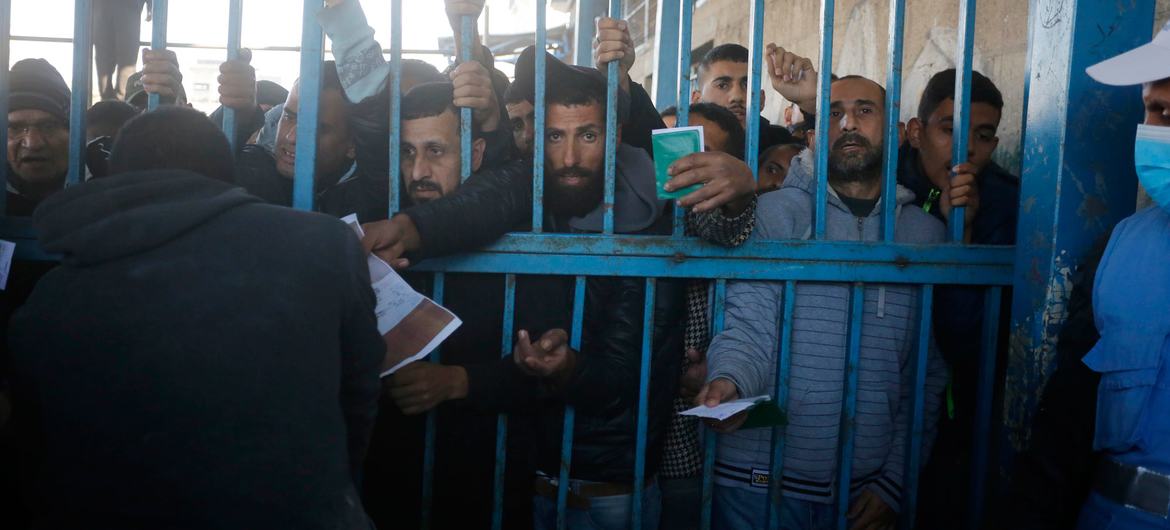
Nothing left to queue for

In an update on Thursday, OCHA said that more than 80 community kitchens have been forced to shut since late April, owing to the lack of supplies. This number is rising “by the day”, fuelling “widespread” hunger in Gaza, the UN aid coordination office said.

Rebutting Israeli allegations that aid reaching Gaza has been diverted by militant groups, both Ms. Touma and UN World Health Organization (WHO) spokesperson Dr. Margaret Harris described “end-to-end” systems put in place to counter this risk.

“Our supplies are reaching the health facilities they’re meant to serve,” said Dr. Harris, adding that the UN health agency had not witnessed any aid diversion within the health care system.

“It is not about failure of aid delivery within Gaza. It is about not being allowed to bring it in,” Dr. Harris concluded.

In a further note of caution about the Israeli plan, UNICEF’s Mr. Elder insisted that the proposed use of facial recognition as a precondition to access aid ran against all humanitarian principles to “screen and monitor beneficiaries for intelligence and military purposes”.

He recalled that the ceasefire earlier this year had resulted in a “huge” improvement in children’s nutrition.

“It meant food in the markets, repaired water systems…It meant people could access health care safely. It meant health care facilitators had medicines that they need.”

‘Boastful’ denials of aid

Fast forward to today and food, water, medicines – “everything for a child to survive” – is being blocked, Mr. Elder said — “and in many ways, boastfully blocked”.

The UNICEF spokesperson also expressed concern that the Israeli plan risks separating family members “while they move back and forth to try and get aid” from the designated locations in a territory that “lacks any safety” amid ongoing bombardments.

Source link

Absent faces, destroyed homes – young students paint the pain of Gaza

Their paintings and drawings range from a portrait of an esteemed Palestinian poet and family members killed in conflict, to a sky blackened by thick smoke – and a child crying in front of his mother’s corpse.

The poignant images are currently on display at UNRWA’s Remal School in Gaza City, which has been transformed into a shelter.

Remembrance and loss

The exhibition provides an opportunity for the children and young people to express and discuss their feelings after nearly 18 months of war.

Fatima al-Za’anin, who was displaced from Beit Hanoun in northern Gaza, cried as she spoke about her artwork. “I painted the Palestinian poet Mahmoud Darwish, I drew mama, baba, my sister and my grandfather,” she said.

Fatima stopped talking to cry once more and turned to a small pencil drawing peppered with red spots. “I drew martyrs’ bodies that were torn to pieces,” she explained.

She pointed to another drawing of a boy called Mohammed “who wished he had one person left in his family, but there was no one left,” she said. “I painted a child who lamented his mother, whom he had lost.”

A specialist from the UNRWA Psychological Support Centre stood beside Fatima and praised her courage in expressing her feelings.

17 year-old Na’emat Haboob, the sole survivor of her family and displaced from Jabalia Camp, stands beside her artwork—a moving tribute to her mother, who was killed in the war.

Praying for comfort

Na’emat Haboob, a 17-year-old student, touched one of her paintings as she spoke about it. The image is of the face of her mother, who was killed in the war. 

“This is mama’s painting.  Thank God I could draw it while I’m trying to get over losing her.  I hope everyone will pray for her.” 

Na’emat continued to run her fingers over the painting as if she wanted to touch her mother’s face and said: “May God grant me comfort for losing her and my siblings.”

May God grant me comfort for losing her and my siblings

She credited the mental health team at the Remal shelter for their support, saying it gave her the strength to turn her pain into art. 

Her grief welled up again and she was unable to go on. Comforted by a hug from the counsellor, she was able to continue, saying the psychological support she receives at the shelter enables her to keep studying. 

“I seek to develop my talents after what I’ve been through during the war,” she said. “I want to try hard to be what my mother wished for me.”

Malak Fayad, a displaced from Beit Hanoun (Gaza) shares the meaning behind her artwork with fellow displaced visitors, using art as a way to express her experiences, resilience, and hope amid the devastation of war.

Lives transformed, hopes destroyed

Another student, Malak Fayyad, stood in front of her colourful paintings. One depicts the clear blue sky and sea of Gaza, showing birds, trees and landscapes. It is a copy of a work she had previously painted which hung proudly on a wall in her family’s home. 

But the house was destroyed along with all their belongings, including the painting.

“I painted it again to remember Gaza as it was, and next to it another painting clouded by black smoke from weapons,” Malak said, before highlighting other works she created, including one which “shows how our lives have been transformed after the destruction and bombing.”

Another of her paintings depicts a Palestinian man who appears to be carrying a bag in the form of a house. She said it “shows that the Palestinian always carries with him the Palestinian cause, even when he is displaced and forced to leave his home.”

The war in Gaza has destroyed hopes of a better future, according to another young artist, Malak Abu Odeh.  

“Not only displacement and destruction, but the war has taken away from us our dearest people, our relatives and loved ones,” she said.

“We’re not well, but I would like to thank the mental health team who are trying to entertain us, help us and support us.”

Commitment to deliver

UNRWA continues to provide psychosocial support services across the Gaza Strip. The agency said its teams responded to around 3,000 cases between 21 and 27 April. 

This support included individual counselling, awareness-raising sessions and response to gender-based violence cases in its health centres, medical points and shelters. 

Source link

New horror in Gaza as double strike on school shelter kills 30

The UN agency for Palestine refugees, UNRWA, maintained that Israeli forces hit the school in Al Bureij, Middle Gaza, at around 6pm on Tuesday and again at 10.20pm.

The school sustained severe damage and a fire broke out in the shelter, making it difficult to evacuate the casualties. Residents had to open a hole in the wall to evacuate the dead and wounded,” UNRWA told UN News.

Since the start of the war between Hamas and Israel on 7 October 2023, more than 400 schools have received a direct hit, according to satellite imagery analyzed by the UN.

Deadly aftermath

Footage from the scene provided by the UN agency showed walls and floors blown out in the main school building.

In the courtyard, hundreds of people can be seen standing amid crumpled metal sheeting on the morning after the attack, with rubble and wooden planks strewn around where their shelters had been standing just hours earlier.

“Our colleagues are reporting that surviving parents and children are trying to salvage their belongings among the blood and body parts of their relatives and neighbours,” UNRWA said.

The agency noted that fatalities included women and children, while search and rescue operations are ongoing for several people still missing.

Many of those living at the school when it was hit have been displaced “countless times” by the war, which began on 7 October 2023, following Hamas-led terror attacks on Israel, UNRWA stressed.

The attack also sparked a fire in an adjacent school where more tents and temporary shelters were burned and damaged.

Education destroyed

According to the UN Satellite Service, UNOSAT, 95.4 per cent of schools in Gaza have sustained damage since the start of the war.

Of the enclave’s 564 schools, 501 will either need full reconstruction or major rehabilitation work to be functional again.

“There is no humanity left in Gaza, and no humanity left as the world continues to watch day after day as families are bombed, burned alive and starved,” UNRWA said after the latest attack.

Failed strategy won’t work: Türk

In a related development, the UN human rights chief Volker Türk on Wednesday condemned Israel’s reported plans to forcibly transfer Gaza’s population to a small area in the south of the Strip.

The move fuels concern that Israel’s intention is to make life for Palestinians “increasingly incompatible with their continued existence in Gaza”, he said in a statement.

Surviving parents and children are trying to salvage their belongings among the blood and body parts of their relatives and neighbours – UNRWA

“There is no reason to believe that doubling down on military strategies, which, for a year and eight months, have not led to a durable resolution, including the release of all hostages, will now succeed,” insisted the UN High Commissioner for Human Rights.

Expanding the offensive on Gaza “will almost certainly cause further mass displacement, more deaths and injuries of innocent civilians, and the destruction of Gaza’s little remaining infrastructure”, he continued.

Rights experts warn of irreversible consequences

Escalating atrocities in Gaza mark a critical moral turning point and demand urgent international action, UN-appointed independent human rights experts said in a statement.

While States debate terminology – is it or is it not genocide? – Israel continues its relentless destruction of life in Gaza,” they warned, citing attacks by land, air and sea, and a soaring civilian death toll.

“No one is spared – not children, persons with disabilities, nursing mothers, journalists, health professionals, aid workers, or hostages,” they said, noting that on 18 March alone, 600 Palestinians were reportedly killed, 400 of them children. The independent experts are appointed by the Human Rights Council, are not UN staff members and receive no salary for their work.

Occupied West Bank update

In the occupied West Bank, meanwhile, UN aid teams warned of worsening conditions for Palestinian communities because of “violence by Israeli forces and settlers”.

The alert comes after Israeli forces on Monday demolished more than 30 structures in Khallet Athaba, a hamlet in Hebron governorate, displacing nearly a dozen families – or around 50 people.

“This constitutes most of the structures in the community and marks the third and largest demolition there since February,” said UN aid coordination office, OCHA. It noted that the area is designated by Israel as a military training zone.

In addition, Israeli forces also began demolishing six homes in Nur Shams refugee camp in Tulkarm on Monday, impacting 17 families. They are among more than 100 buildings slated for demolition, following an Israeli notice issued at the start of the month.

Forcible transfer fears

OCHA described how dozens of families in the camp were given little time on Monday to collect their belongings before their homes were demolished.

The agency highlighted the “strong push” to uproot Palestinians living in the area “once again raising concerns about the risks of forcible transfer of the population”.

Under international law, Israel as the occupying power, has the responsibility to protect Palestinians in the West Bank and ensure their safety and dignity, OCHA insisted.

Humanitarian partners are mobilizing assistance, but urgent international engagement is needed to stop these coercive measures and protect vulnerable communities, the UN aid office said.

Source link

Gaza: UN aid teams reject Israel’s ‘deliberate attempt to weaponize aid’

It appears to be a deliberate attempt to weaponize the aid and we have warned against that for a very long time. Aid should be provided based on humanitarian need to whomever needs it,” said Jens Laerke, spokesperson for UN aid coordination office, OCHA.

Speaking in Geneva, Mr. Laerke referred to a verbal brief delivered by Israeli authorities on Monday, in which they offered to deliver supplies through Israeli hubs under conditions set by the military, once the Government reopens crossings into Gaza.

The proposal came as part of Israel’s plans to expand its military offensive against Hamas, including the “capture” of the Gaza Strip and a reported comment by Israeli Finance Minister Bezalel Smotrich that Palestinian territory will be “entirely destroyed”.

Attempted ‘shut down’ of UN aid system

Israeli officials have sought to shut down the existing aid system run by 15 UN agencies and 200 NGOs and partners,” Mr. Laerke maintained.

The Israeli cabinet’s vow to escalate the war will force Gaza’s more than two million people to move to the south of the Strip once again.

After 19 months of conflict, the entire enclave has suffered the impact of the months-long border blockade.

The Israeli decision to cut off the entry of humanitarian supplies to the enclave is reportedly to pressure Hamas to release the remaining hostages taken in Hamas-led terror attacks on 7 October 2023 that sparked the war.

Humanitarians have condemned the border closures stating the policy violates international law and risks fuelling famine.

Today in Gaza, UN partners working in the food sectors have distributed all they had and have no more to give. Mr. Laerke reported testimonies of colleagues on the ground who observed “people rummaging through garbage, trying to find something edible. That is the harsh, brutal, inhuman reality of the situation.”

Grave health impact

Since the beginning of 2025, nearly 10,000 children with global acute malnutrition have been admitted for outpatient and inpatient treatment, according to the UN World Health Organization (WHO). That number includes 1,397 with severe acute malnutrition.

Once you get to that stage, without treatment, you will die,” warned Dr. Margaret Harris, spokesperson for the UN health agency.

The WHO official noted that fewer children are being treated in partially functioning hospitals than expected, most probably because they cannot access care.

According to WHO data, one in five children does not complete their treatment because of the displacement and chaotic situation they face.

The lack of water and sewage infrastructure is also causing a worrying spike in acute watery diarrhoea. Skin diseases are also on the rise because people simply do not have enough water to wash themselves.

Meanwhile, Mr. Laerke continued to call on all combatants and those involved in mediation to continue pushing for a permanent ceasefire and the immediate and unconditional release of hostages.

“It is a horrible crime of war to take hostages and use them as some kind of bargaining chip,” he said. “On the other hand, you [cannot also] withhold aid to civilians as a bargaining chip on the other side of the board game.”

Guterres alarmed by Israeli plans to expand Gaza ground offensive

 “This will inevitably lead to countless more civilians killed and the further destruction of Gaza,” said UN Deputy Spokesperson Farhan Haq, responding to a journalist’s question during the regular media briefing in New York.

“What’s imperative now is an end to the violence, not more civilian deaths and destruction. Gaza is, and must remain, an integral part of a future Palestinian State.” 

The alert comes as the UN humanitarian team and other NGOs in the Occupied Palestinian Territory on Sunday condemned Israeli efforts to replace the aid delivery system with one where supplies would reportedly be funnelled through military hubs in the south.

This proposal would leave “large parts of Gaza…less mobile and (the) most vulnerable” without lifesaving supplies, aid chiefs insisted.

The Secretary-General continues to call for an immediate permanent ceasefire and the immediate and unconditional release of hostages in Gaza, said Mr. Haq.

Deadly attacks and looting

Meanwhile, airstrikes and other attacks continue across the Strip, where Israel has blocked the entry of aid and commercial supplies for more than two months.

Reports indicate that scores of people were killed and hundreds injured over the weekend, including children, the UN aid coordination office OCHA said on Monday.

OCHA noted that robbery and looting have become a daily reality in the Strip, especially in and around Gaza City, which is occurring in parallel with the depletion of supplies.

Businesses are being targeted, and there have also been attempts against UN warehouses.  In most cases the looters were stopped by guards, or the warehouses were already empty.

Water woes

Last week, OCHA reported that water pumping and sanitation systems in Beit Lahiya had gone down because fuel had run out. Services are still not back due to continuing shortages.

Furthermore, a major water line from Israel was damaged on Friday, cutting water supply to northern Gaza – including Gaza City – by half. Teams were only able to fix the problem on Sunday as the repair work required coordination with the Israeli authorities.

Also on Sunday, a UN team managed to retrieve some fuel from a station in Gaza City after the Israeli authorities facilitated their efforts to reach it. However, many reserves remain out of reach due to denial of access.

OCHA noted that in Rafah in southern Gaza, not a single attempt to retrieve fuel has been facilitated since 18 April.

The agency also reported that since Saturday, 19 out of 27 planned humanitarian movements within Gaza were denied outright.  Other attempts were initially given the go-ahead – but then impeded by forces on the ground. 

Source link

UN warns of growing humanitarian catastrophe in Gaza

In a statement released by the UN Humanitarian Country Team – which leads coordinated relief efforts across the Occupied Palestinian Territory – officials condemned Israeli efforts to dismantle the current aid system.

The team led by the UN’s top aid official in the region representing UN and non-governmental organizations (NGOs) both international and Palestinian, said Israeli plans would “contravene fundamental humanitarian principles” and deepen the suffering of civilians already enduring severe shortages of food, water, and medical care.

“Bakeries have shut. Community kitchens have closed. Warehouses stand empty. Children have gone hungry,” the statement said, describing the dire conditions facing the population.

The UN said Israeli authorities were attempting to impose a new aid distribution system that would funnel humanitarian supplies through military-controlled hubs, rather than allowing UN agencies and NGOs to operate independently.

‘Dangerous’ Israeli proposal

The proposal, the UN said, would leave “large parts of Gaza, including the less mobile and most vulnerable people,” without aid and would force civilians to enter militarised areas to access basic necessities.

This is dangerous, driving civilians into militarised zones to collect rations, threatening lives, including those of humanitarian workers,” the UN said, warning it would also exacerbate forced displacement across the strip.

According to news reports, the Israeli government has defended the policy as a security measure. At the same time, Israeli forces are planning to ramp up operations in central and southern Gaza.

On Saturday, call up notices were reportedly issued to thousands of Israeli military reservists, indicating a likely escalation of the offensive inside the Strip.

Guiding principles

The UN statement reaffirmed that aid operations must remain guided by the principles of “humanity, impartiality, independence and neutrality” and said all 16 UN entities and major humanitarian partners working in Gaza had endorsed this unified position.

“Humanitarian action responds to people’s needs, wherever they are,” the team said.

UN teams remain on the ground, “ready to again scale up the delivery of critical supplies and services” once the blockade is lifted. They urged global leaders to intervene and pressure Israel to reopen border crossings immediately.

“The time is now,” the UN said.

In a social media post on Sunday, the UN aid agency for Palestine refugees, UNRWA, pointed out that nearly a third of essential supplies for civilians in the Gaza Strip are out of stock while another third are projected to run out in under two months.

Source link

Reporters in Gaza bear witness and suffer tragic consequences

Mr. Shahada lost his leg due to a severe injury he suffered in Nuseirat in central Gaza in April 2024, but he picked up his camera and returned to document the tragic events that have been unfolding in Gaza.

He will not let his disability stop him from working. “It is impossible for me to leave photojournalism, even if I face all these obstacles,” he said.

Ahead of World Press Freedom Day marked annually on 3 May which focuses on the role of media to highlight accountability, justice, equality, and human rights, our UN News correspondent in Gaza spoke with Palestinian journalists, documenting the risks and personal traumas they face reporting from the war-torn enclave.

© UNICEF/Mohammed Nateel

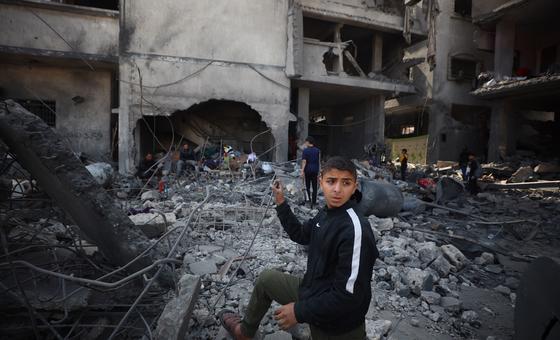
War has devastated Gaza.

Since the war began following the 7 October 2023 attack by Hamas on Israel an increasing number of journalists have been killed or injured in Gaza as a humanitarian crisis has engulfed the enclave.

Bearing witness

On one leg, leaning on crutches, Sami Shahada stands behind his camera, wearing his blue press jacket, working amongst the rubble of destruction with colleagues.

“I witnessed all the crimes that happened, and then the moment came when I was a witness to a crime that was perpetrated against me,” he told UN News.

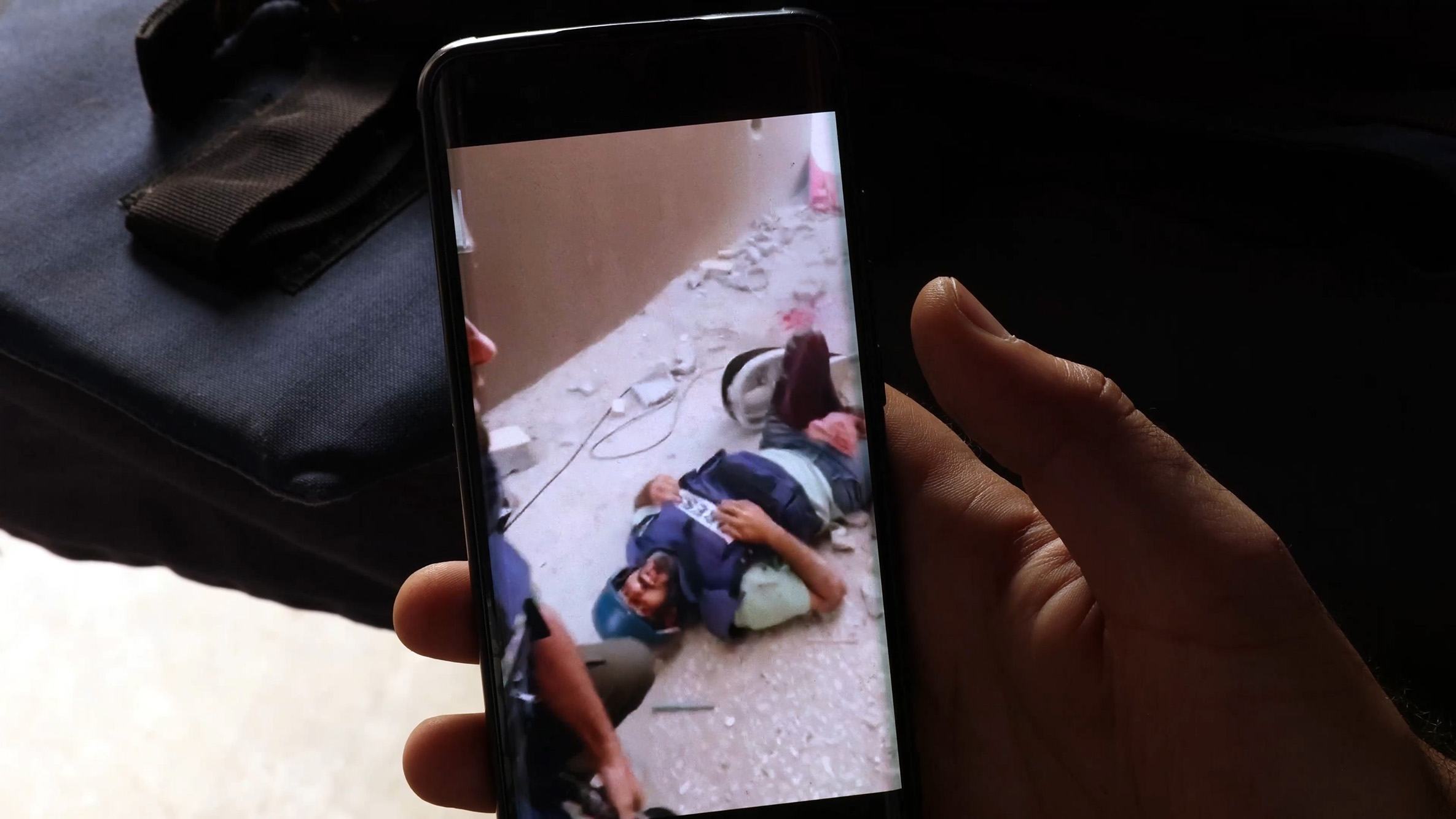
Sami Shehadeh looks at a video of the moment he was injured in Gaza in April 2024.

“I was a field journalist, carrying a camera in an open area and wearing a helmet and a jacket which identified me as a journalist, yet I was directly targeted.”

That incident marked a turning point in his life. “I did not need help from anyone before, now I need help,” adding that “I have the determination and persistence to overcome this new reality. This is how we journalists must work in Gaza.”

Working the streets

Journalist Mohammed Abu Namous is another of these journalists.

Filming with one of his colleagues in the rubble of a destroyed building in Gaza City he said: “While the world celebrates World Press Freedom Day, Palestinian journalists remember their workplaces which were destroyed in the war.”

“The minimum we need to carry out our journalistic work is electricity and the internet, but many do not have this, so we resort to commercial shops that provide the internet. The streets are now our offices.”

Palestinian journalist Mohammed Abu Namous and his colleague cover the impact of the war in Gaza.

He believes that Palestinian journalists have been targeted during the Israeli occupation of Gaza and said that media workers must be protected “whether they work in Palestine or elsewhere in the world.”

Voices not silenced by death of loved ones

Journalist Moamen Sharafi said he lost members of his family in an Israeli bombing in northern Gaza, but despite “the many negative impacts on a personal, social, and humanitarian level, professionally nothing has changed.”

He was determined to carry on working, he explained, as he was due to live broadcast from the streets of Gaza City.

Palestinian journalist, Moamen Sharafi (right,) lost several family members during the current war that started in October 2023.

“We have become more determined to continue our work and uphold our professional values and perform our mission with humanity to the world,” he continued, “in order to convey the reality of what is happening on the ground inside Gaza, specifically the humanitarian situation, and the impact on children, women and the elderly who suffer greatly.”

Source link

Gaza: ‘Worst-case scenario’ unfolds as brutal aid blockade threatens mass starvation

Speaking from Gaza City OCHA spokesperson Olga Cherevko told journalists in Geneva that a friend of hers “saw people burning a few days ago from the explosions – and there was no water to save them.”

Since all entry points into the war-torn enclave were “sealed by the Israeli authorities for the entry of cargo” in March, the “worst-case scenario” was triggered, Ms. Cherevko said: supplies are depleting while the conflict rages on.

Food stocks have now mainly run out, water access has become impossible,” she told journalists in Geneva.

As the veteran aid worker spoke, she noted that a “very violent fight” for access to water was taking place downstairs from her, with people throwing rocks and firing shots at a water truck which was pulling away.

No childhood

The OCHA spokesperson said that every day she was seeing children “who have been deprived of their childhood for many months,” and elderly people “rummaging through piles of trash” in search of food and combustible material for cooking, in the absence of fuel.

During a visit on Thursday to Patient Friends Hospital, a paediatric hospital in Gaza City which had been attacked several times during the war, she heard reports of rising malnutrition rates.

Hospitals report running out of blood units, as mass casualties continue to arrive,” Ms. Cherevko stressed, while precious fuel is being rationed.

Malnutrition cases among children in Gaza are increasing due to a lack of food.

Running on empty

“Gaza is inching closer to running on empty,” she added.

Ms. Cherevko said that UN humanitarians are “in constant contact” with the Israeli authorities and are advocating for border crossings to reopen. “We have mechanisms that mitigate diversion [and] ensure that aid reaches the people it’s intended to reach,” she said.

“We are ready to resume delivery at scale as soon as the crossings reopen, Ms. Cherevko insisted. “We stand by our pledge to remain principled and continue relieving people’s suffering, wherever they may be.”

In an appeal to the Israeli authorities on Thursday, the UN’s top humanitarian official and OCHA chief Tom Fletcher said, “Lift this brutal blockade. Let humanitarians save lives”.

Mr. Fletcher reaffirmed the urgent need for the release of hostages taken by Hamas on 7 October 2023, who “should never have been taken from their families” and stressed that “aid, and the civilian lives it saves, should never be a bargaining chip”.

Gazans queue for food in January 2025 when it was more widely available in the enclave.

Generational horror

Ms. Cherevko said that over the past one and a half months, 420,000 people have been “once again forced to flee, many of them with only the clothes on their backs, shot at along the way, arriving in overcrowded shelters, as tents and other facilities where people seek safety, are being bombed”.

“I worry that five, 10, 20 years from now, we will look at our children and grandchildren in shame and we will not be able to explain to them why we could not stop this horror,” she concluded.

How much more blood must be spilled before enough becomes enough?”

Source link

Israel must end ‘cruel collective punishment’ in Gaza, urges UN relief chief

In a powerful statement on Thursday, Tom Fletcher, the UN Emergency Relief Coordinator, condemned Israel’s decision to halt humanitarian assistance as a “cruel collective punishment” of the Palestinian population.

“Two months ago, the Israeli authorities took a deliberate decision to block all aid to Gaza and halt our efforts to save survivors of their military offensive,” said Mr Fletcher. “They have been bracingly honest that this policy is to pressurise Hamas.”

‘Blocking aid kills’

While reaffirming the urgent need for the release of hostages taken by Hamas on 7 October 2023 – who “should never have been taken from their families,” – the UN relief chief stressed that “international law is unequivocal: As the occupying power, Israel must allow humanitarian support in.”

Aid, and the civilian lives it saves, should never be a bargaining chip,” he added. “Blocking aid kills.”

Mr Fletcher warned that the aid blockade “starves civilians”, denies them basic medical services, and “strips them of dignity and hope.”

He underscored the neutrality and impartiality of humanitarian efforts, adding: “We believe that all civilians are equally worthy of protection. We remain ready to save as many lives as we can, despite the risks.”

Let us save lives

However, the latest delivery mechanism proposed by Israel, he said, “does not meet the minimum bar for principled humanitarian support.”

“To the Israeli authorities, and those who can still reason with them, we say again: lift this brutal blockade. Let humanitarians save lives,” he pleaded.

Addressing civilians in Gaza, Mr Fletcher said: “No apology can suffice… But I am truly sorry that we are unable to move the international community to prevent this injustice. We won’t give up.”

More to follow…

MIDDLE EAST LIVE: Security Council meets on Gaza crisis as starvation threat grows

The Security Council will meet on Tuesday to discuss the situation in the Middle East, with French Foreign Minister Jean-Noël Barrot presiding. The UN Secretary-General is expected to brief ambassadors as the humanitarian crisis in Gaza deepens, with reports from the UN Palestine refugee relief agency (UNRWA) this morning that children are “going to bed starving” amid the two-month Israeli aid blockade and continuing bombardment. App users can follow coverage here.

Source link

Children in Gaza ‘going to bed starving’ amid blockade

“The siege on Gaza is the silent killer of children, of older people,” said Juliette Touma, spokesperson for the UN agency for Palestine refugees, UNRWA.

“Families – whole families, seven or eight people – are resorting to sharing one can of beans or peas,” she told journalists in Geneva. “Imagine not having anything to feed your children. Children in Gaza are going to bed starving.

Today, thousands of trucks carrying relief supplies continue to be denied entry to Gaza. “We have just over 5,000 trucks in several parts of the region with lifesaving supplies that are ready to come in,”Ms. Touma continued.

“This decision is crippling the humanitarian efforts…and threatening the lives and survival of civilians in Gaza, who are also going through heavy bombardment day in, day out.”

Rafah levelled

Destruction to the southern city of Rafah has left it “obliterated”, UNRWA said. Formerly the largest entry point for aid into the enclave via Egypt, aerial videos purportedly of Rafah show buildings levelled as far as the eye can see.

“Rafah is nothing like the city it used to be…In every direction there is only destruction,” the UN agency said.

Forced displacement orders have been in place for 97 per cent of the city, uprooting around 150,000 people.

Almost 12 months ago, the Israeli military moved in displacing 1.4 million people, leaving homes, health facilities and shelters damaged or destroyed.

Starting from scratch

Across Gaza, more than 90 per cent of the population have been displaced “not once, not twice, some people have been displaced 12 times or 13 times…so they have to start from scratch.”

Before the war erupted in October 2023, Gazans relied on 500 trucks a day to deliver the food and other basic goods that they needed. But no humanitarian or commercial supplies have entered since 2 March.

This is by far the longest ban on aid moving into the Strip since the start of the war in October 2023, following deadly Hamas-led terror attacks on Israel that killed some 1,250 people and left more than 250 taken hostage.

The blockade has emptied warehouses of food, medical supplies, shelter materials and safe water – fuelling a black market “where prices have increased from 10 to 20, sometimes 40 times…You cannot give anything to your children and you’re seeing your children starving”, Ms. Touma said.

According to the UN World Food Programme (WFP) food prices rose 1,400 per cent increase in recent weeks compared to the ceasefire period from 19 January to 18 March 2025.

Last Friday, the UN agency delivered its last remaining stocks to community kitchens that provide hot meals of lentil soup and rice. The kitchens are expected to fully run out of food within days while another 16 closed over the weekend. In addition, all 25 WFP-supported bakeries have now closed.

“We’re likely to see more community kitchens closing down for the simple reason that they need supplies,” Ms. Touma explained.

Daily challenges for Gazans include finding food and fuel to cook, because of a lack of cooking gas. “Families are resorting to burning plastic to cook their meals,” UNRWA’s Ms. Touma said. 

Source link

Israel’s restrictions on UN agencies in Gaza in spotlight at world court

The ICJ, which sits in The Hague and is the UN’s top court, is expected to hear from 40 States and four international organizations in proceedings slated to last all week.

Representing Secretary-General António Guterres, UN Legal Counsel Elinor Hammarskjöld reiterated his many calls for a ceasefire, for humanitarian aid to reach all people in need and for all hostages to be freed.

A total of 13 UN entities are present in Gaza, Ms. Hammarskjöld noted, adding that 295 UN personnel have died in Gaza since the war began on 7 October 2023, following Hamas-led terror attacks in Israel.

Legal opinion

The UN legal counsel insisted on the special protections and immunities of UN agencies and personnel which it needs to implement its mandated activities all over the world, including in the OPT.

These protections also apply during armed conflict, Ms. Hammarskjöld said, before highlighting Israel’s obligations as the occupying power under international law.

“The overarching obligation [is] to administer the territory for the benefit of the local population and “to agree to and facilitate relief schemes”, she said “In the specific context of the current situation in the OPT, these obligations entail allowing and facilitating all relevant UN entities to carry out those activities for the benefit of the local population.”

The purpose of the hearings at the ICJ all this week is to establish what’s known as an “advisory opinion” on Israel’s obligations as the occupying power in Gaza and the wider OPT, in accordance with the UN Charter.

It follows a vote at the UN General Assembly in December where Member States voted 137 to 12 to seek the view of the ICJ’s 15 judges, amid ongoing Israeli bombardment and dramatic aid shortages across Gaza.

Although the ICJ judges’ advisory opinion is not binding – as opposed to the legal disputes between countries on which it rules (so-called “contentious cases”) – it provides clarity on legal questions.

Once the court has issued its opinion, the General Assembly would be open to pick up the matter again and decide on further action.

UNRWA shut out

Welcoming the hearings, the head of the UN agency for Palestine refugees, (UNRWA) Philippe Lazzarini, insisted that aid agencies were working “to address overwhelming needs”.

The UNRWA Commissioner-General explained that the Israeli Parliament’s widely condemned “no-contact” policy banning any coordination with UNRWA official have obstructed the delivery of essential relief services and aid.

The move is particularly significant because UNRWA is the largest aid agency in Gaza, where it has provided health, education and other vital public services for decades.

But since these restrictions came into effect at the end of January, UNRWA international staff have not received visas to enter Israel, Mr. Lazzarini said.

Inside Gaza, meanwhile, ordinary Gazans continue to face desperate food shortages linked to the 2 March decision by Israel to seal the enclave’s borders.

“Today people are not surviving in Gaza, those that aren’t being killed with bombs and bullets are slowly dying,” said Jonathan Whittall, local Head of Office for the UN aid coordination wing, OCHA. He insisted that humanitarian agencies are unable to meet soaring needs following Israel’s decision to cut all commercial and relief supplies.

“People here are being suffocated,” he maintained. “What we see around us is endless suffering under a total and complete blockade. A total closure that’s now lasted for almost two months while airstrikes, ground operations are intensifying and displacement orders that are pushing people out of their homes are increasing.”

Witness statements

The following Gaza testimonies have been provided by UNRWA:

Mona, a grandmother living in an UNRWA shelter in Gaza City:

“We only eat one meal a day, I go to sleep thinking about what we will eat tomorrow and how we will provide…I have enough flour for several days. I try to preserve it by making small loaves so that it lasts for a few more days. When children get hungry, I give them my loaf. I no longer take medicine, even if it is available, because treatment requires good food, and that is not available now.”

Wafaa, whose oldest child is seven and whose youngest is three, speaking from an UNRWA school in Gaza City:

“I have two cans of beans, some cans of peas, two cans of chickpeas, some duqqa (a spice mix), and a few kilos of flour that will only last for four days…The flour is mouldy and smells bad, but I can’t complain. When will this nightmare end?”

Source link

Gaza: UN official warns of ‘assault on dignity’ as blockade cripples humanitarian response

Speaking to journalists in Gaza City, Jonathan Whittall, OCHA‘s local Head of Office, painted a dire picture of life under what he called a “total and complete blockade” now approaching its third month.

“The coming days in Gaza are going to be critical. Today people are not surviving in Gaza, those that aren’t being killed with bombs and bullets are slowly dying,” he said.

Whittall stressed that humanitarian agencies are unable to meet the soaring needs of civilians due to the collapse of supply lines. Hospitals are overwhelmed, but medicines and equipment are running out. People are going hungry, but food warehouses are empty and bakeries are closing. Clean water is desperately needed, but water wells are inaccessible.

He noted that solid waste is piling up in the streets with no equipment to remove it, and that rescue efforts after airstrikes are impossible without fuel and machinery. Displaced families are forced to live in rubble without shelter materials, and fishermen are being shot at sea, while humanitarian organisations lack the resources to assist them. “Nowhere in Gaza today is safe”, he said.

He added that children need to learn, but schools have been destroyed or are inaccessible, and that education supplies are not available. Prices of the remaining goods in Gaza continue to rise, but there is no cash available. There is no cooking gas or fuel, forcing families to burn trash to generate some energy.

“This is not only about humanitarian needs, but it’s about dignity. There is an assault on people’s dignity in Gaza today,” he warned.

“We also know that humanitarian workers, first responders, you as journalists, should be protected, like all civilians, but we’re being killed in a war that appears to be fought without any limits,” he added.

Whittall emphasised that the situation in Gaza does not even resemble a war. “People in Gaza are telling me that they feel like it’s the deliberate dismantling of Palestinian life in plain sight, for all to see, documented every day by you as journalists,” he said.

He described the devastation witnessed daily — including children’s bodies thrown by explosions, families burnt alive, and colleagues killed — as part of what he termed “everyday atrocities.”

“As humanitarians we can see that aid is being weaponised through its denial,” he warned. “There’s no justification for the denial of humanitarian assistance. And humanitarian aid should never be weaponised.”

Despite the catastrophic conditions, he stressed that humanitarian organisations are continuing to operate where possible, but “we have less and less and less supplies and less and less capacity to be able to meet the growing and growing needs that are intensifying across Gaza.”

“Lives depend on the blockade being lifted, on aid being allowed to enter into Gaza, on the ceasefire being reinstated,” he said, calling for real accountability rather than waiting for history to judge the international community’s response.

Hunger and malnutrition surging

In a separate statement, OCHA warned of a “severe decline” in food availability across Gaza, as malnutrition rates escalate rapidly, particularly among children.

A UN partner organisation recently screened around 1,300 children in northern Gaza and identified over 80 cases of acute malnutrition, representing more than double the rate recorded in previous weeks.

“Nutrition partners report a critical shortage of supplies due to the obstruction of aid entry and challenges in transporting essential materials within Gaza,” OCHA said. Access to key facilities, including UNICEF’s main warehouse in Rafah, remains heavily restricted.

Journalists who visited the United Nations Relief and Works Agency for Palestine Refugees (UNRWA) main warehouses this week found them largely empty of food supplies, including flour.

Call for accountability and action

“Nothing can justify the collective punishment of the Palestinian people,” UNRWA said in a separate statement, stressing that international law prohibits indiscriminate attacks, the obstruction of humanitarian assistance, and the destruction of vital civilian infrastructure.

The agency reiterated its call for a renewed ceasefire, the dignified release of all hostages, and the immediate, unhindered flow of humanitarian aid and commercial goods into Gaza.

Source link