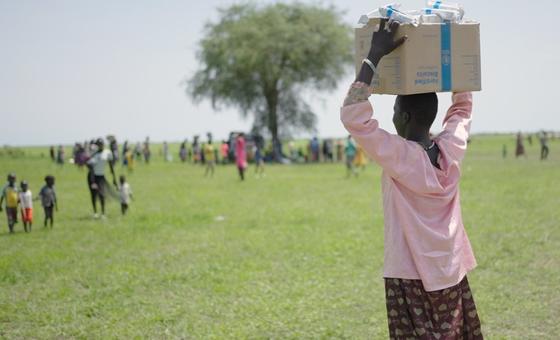
Reaching a child in Darfur is ‘hard-won and fragile’, says UNICEF

Briefing journalists in Geneva on Friday, Eva Hinds, the UN child agency’s Chief of Communications, described a humanitarian response that is fragile, painstaking and essential, following her return from a 10-day mission to Darfur.

For nearly three years, rival militaries who were former allies have been battling for control of the shattered country, engaged in a brutal civil conflict that has destablised multiple countries bordering Sudan. 

In Darfur today, reaching a single child can take days of negotiation, security clearances, and travel across sand roads under shifting frontlines,” she said. “Nothing about this crisis is simple: every movement is hard-won, every delivery fragile.

City built from fear

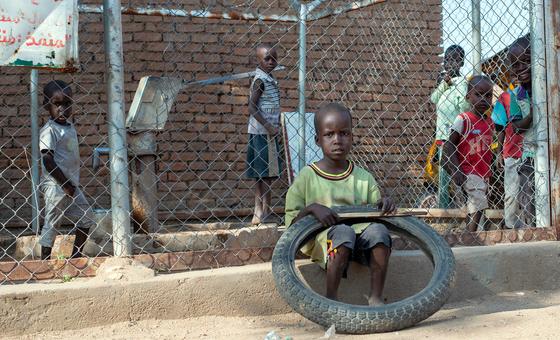
Ms. Hinds had just returned from Tawila, in North Darfur, where she witnessed what she described as an entire city rebuilt from desperation. Hundreds of thousands of people have fled violence and erected makeshift shelters from sticks, hay and plastic sheeting.

“Over 500,000 to 600,000 people are sheltering there,” she reported. “But standing inside that vast expanse of makeshift shelters was overwhelming. It felt like an entire city uprooted and rebuilt out of necessity and fear.

Despite the insecurity and logistical hurdles, UNICEF and its partners are still reaching children.

Effective aid operation

In just two weeks, more than 140,000 children were vaccinated, thousands treated for illness and malnutrition, safe water restored to tens of thousands, and temporary classrooms opened.

“It is painstaking, precarious work – delivered one convoy, one clinic, one classroom at a time – but for children in Darfur, it is the thin line between being abandoned and being reached,” Ms Hinds said.

She described meeting Doha, a teenage girl newly arrived from Al Fasher, who dreams of returning to school and one day teaching English. “Her name refers to the soft light just after sunrise,” Ms Hinds said. “She embodies that image – hopeful and determined.”

‘The children are freezing’

At a nutrition site, she met Fatima, a young girl being treated for malnutrition after losing her mother to the conflict.

At a centre for women and girls, mothers spoke of having no food, blankets or warm clothes for their children. “The children are freezing,” one mother told her. “We have nothing to cover them with.”

“These personal stories reflect only a small part of a much wider situation,” Ms Hinds said, stressing that Sudan is now the world’s largest humanitarian emergency, yet one of the least visible.

What I witnessed is a humanitarian catastrophe unfolding on a massive scale,” she warned.

Sudan’s children urgently need international attention and decisive action. Without it, the horrors facing the country’s youngest and most vulnerable will only deepen.”

Source link

Potential turning point for Gaza as peace plan enters second phase: UN envoy

Ramiz Alakbarov warned that risks of violence escalating again remain high, while the situation in the occupied West Bank continues to deteriorate.

The Deputy Special Coordinator for the Middle East Peace Process said he was addressing ambassadors “at a moment of both profound opportunity and considerable risk,” pointing to cautious diplomatic progress on Gaza alongside deepening instability elsewhere.

“In front of us we see a potential turning point for Gaza, a genuine chance for a better future,” Mr. Alakbarov said. “But many uncertainties remain.”

He heralded the second phase of President Donald Trump’s 20-point Comprehensive Plan as “a critical step in consolidating the ceasefire in Gaza,” alongside the establishment of new transitional bodies, including the National Committee for the Administration of Gaza and the Office of the High Representative for Gaza.

Deputy Special Coordinator Alakbarov briefs the Security Council members via video link.

Monumental task ahead

Mr. Alakbarov said he had just returned from Cairo, where he met members of the National Committee to discuss how the UN could support efforts to restore essential public services, facilitate humanitarian aid and begin planning for reconstruction, in line with Security Council resolution 2803.

He cautioned that the task ahead is “monumental” and will require close coordination among all stakeholders, considering existing systems and capacities.

The UN envoy welcomed the recovery of the remains of the last hostage held in Gaza, expressing condolences to the family of Ran Gvili and said he hoped that with all hostages returned, “the process of healing for the families and all those affected may begin.”

He also said Israel’s announcement that the Rafah crossing would open for pedestrian movement in both directions was encouraging, while stressing that demilitarisation of the Gaza Strip and effective security arrangements remain essential for the next phase to succeed.

Mr. Gvili was among more than 250 Israeli and foreign nationals abducted by Hamas and other Palestinian armed groups during their 7 October 2023 attack on southern Israel, in which more than 1,250 people were also killed.

The ensuing Israeli military offensive in Gaza resulted in widespread devastation and a massive loss of Palestinian life, with tens of thousands reported killed and countless others wounded, many suffering life-long injuries.

Gazans want a better, stable future

Despite continued hardship, Mr. Alakbarov said his recent visit to Gaza underscored the determination of its people.

The people in Gaza are ready and eager to lead the way to a better, more stable future,” he told the Council, describing students taking exams under extreme conditions, farmers finding ways to plant despite shortages, and small business owners adapting to a devastated market.

At the same time, he emphasised that humanitarian needs remain severe. Nearly the entire population of Gaza still requires assistance, with more than 1.5 million displaced people exposed to winter rains and cold temperatures.

Mr. Alakbarov warned that humanitarian operations are still unable to function at scale, citing insecurity, access restrictions and delays at crossings.

Occupied West Bank unravelling

Turning to the occupied West Bank, the senior UN official said the situation is “unravelling,” marked by ongoing violence, settlement expansion, demolitions and displacement.

These trends, he warned, are undermining prospects for peace and could jeopardise progress on implementing the second phase of the ceasefire plan.

The implementation of the second phase of the Gaza ceasefire plan is critical,” Mr. Alakbarov said, urging the Council to act collectively.

He reaffirmed the UN’s commitment to supporting Palestinians and Israelis in advancing toward a two-State solution, in line with international law and UN resolutions.

Click here for in-depth coverage of this meeting, including national and regional positions.

Source link

World News in Brief: IOM warning for Sudan returnees, Nipah virus alert for India, food security in Afghanistan

They did so despite extensive damage to housing, basic services, vital infrastructure, and an uncertain future. 

The highest number of returns were recorded in Khartoum State, where more than 1.3 million people have made the journey home, followed by nearby Aj Jazirah State, according to IOM’s latest data.

Pockets of security

IOM says the number of returnees is rising, signaling pockets of perceived relative security in parts of the country. 

Overall, 83 per cent of returnees had been internally displaced, while 17 per cent returned from neighbouring countries, including Egypt, South Sudan, and Libya, as well as from the Gulf States. 

However, across areas in Darfur and Kordofan where violence continues to escalate, increased displacement has been recorded.

IOM warns that without adequate resources and renewed efforts toward peace, millions of families will remain trapped in protracted displacement and instability.

WHO: India on alert with two cases of Nipah virus in January

India has confirmed two cases of the sometimes-fatal Nipah virus this month in the eastern state of West Bengal, according to an update by the World Health Organization (WHO). 

This is the seventh documented Nipah outbreak in India and the third in West Bengal, following outbreaks in 2001 and 2007.

The infected individuals are a male and a female nurse working at the same private hospital. As of last week, the male patient is recovering, while the female patient remains in critical condition.

Nipah is a virus transmitted mainly from bats to humans, sometimes through contaminated food or close contact. It can also spread from animals such as pigs to humans, and in some cases between people.

Nipah virus infection can range from asymptomatic illness to severe respiratory disease and fatal encephalitis.

Low transmission risk

 Historically, Nipah outbreaks in the WHO Southeast Asia Region have been limited to Bangladesh and India, occurring sporadically or in small clusters. There have been no known instances of international spread through travel.

WHO says India has demonstrated its capacity to manage previous outbreaks well and public health measures are currently being implemented.

As of 27 January, no additional cases have been detected. The national government has deployed an outbreak response team to West Bengal to work closely with state authorities.

For Nipah, no licensed vaccine or treatment is currently available, making early detection and prevention essential.

$100 Million initiative launched to strengthen food security in Afghanistan

In Afghanistan, the UN food agency (FAO) and the Asian Development Bank (ADB) are implementing a $100 million initiative to bolster food and nutrition security and restore agricultural livelihoods for more than one million vulnerable people over the next two years.

Backbone of the economy

Although agriculture remains the backbone of Afghanistan’s rural economy, it continues to face challenges such as low productivity, restricted market opportunities, and repeated natural disasters. 

The project will reach over 151,000 households – that’s just over a million people – including returnees, host communities, and disaster-affected families. 

With millions of Afghans already facing mounting pressures and at risk of slipping into deeper acute food insecurity and malnutrition, there is an urgent need for sustained investment that goes beyond emergency response to strengthen long-term resilience.

In 2026, 17.4 million people are projected to face acute food insecurity, including 4.7 million classified as being in the emergency phase – just one away from famine conditions. 

FAO has supported about 5.6 million people since 2022. 

Through its partnership with ADB, millions more rural households will gain the tools and resources needed to produce food, safeguard livestock, and secure their families’ nutrition.

Source link

Choose peace over chaos, Guterres urges as he sets out final-year priorities

2026 “is already shaping up to be a year of constant surprises and chaos,” he told journalists in New York.

Mr. Guterres – who trained as a physicist before entering public life – said that during times of profound flux, he returns to fixed principles that explain how forces act.

Broadcast of the press conference.

Generating ‘positive reactions’

Among them is Newton’s Third Law of Motion which states that for every action, there is an equal and opposite reaction.

“As we begin this year, we are determined to choose actions that generate concrete and positive reactions,” he said.

“Reactions of peace, of justice, of responsibility, and of progress in our troubled times.”

Chain reaction

Today, impunity is driving conflicts – fueling escalation, widening mistrust, and allowing powerful spoilers to enter from every direction.

“Meanwhile, the slashing of humanitarian aid is generating its own chain reactions of despair, displacement, and death,” as inequalities deepen.

He highlighted climate change – “the most literal and devastating illustration of Newton’s principle” – as actions that heat the planet trigger storms, wildfires, hurricanes, drought and rising seas.

Power shift

The world is also witnessing “perhaps the greatest transfer of power of our times”, namely from governments to private tech companies.

“When technologies that shape behaviour, elections, markets, and even conflicts operate without guardrails, the reaction is not innovation, it is instability,” he warned.

Secretary-General’s opening remarks at the press conference (click here to download from SoundCloud).

Hegemony is not the answer

These challenges are happening as systems for global problem-solving continue to reflect economic and power structures of 80 years ago and this must change.

“Our structures and institutions must reflect the complexity – and the opportunity – of these new times and realities,” he said.

Global problems will not be solved by one power calling the shots. Nor will they be solved by two powers carving the world into rival spheres of influence.”

He stressed the importance of accelerating multipolarity – “one that is networked, inclusive by design, and capable of creating balance through partnerships” – but it alone does not guarantee stability or peace.

“For multipolarity to generate equilibrium, prosperity and peace, we need strong multilateral institutions where legitimacy is rooted in shared responsibility and shared values,” he said.

Shared values

Additionally, in the pursuit of reform, “structures may be out of date – but values are not,” he said.

In this regard, the people who wrote the UN Charter “understood that the values enshrined in our founding documents were not lofty abstractions or idealistic hopes” but “the sine qua non of lasting peace and enduring justice.”

He said that “despite all the hurdles, the United Nations is acting to give life to our shared values” and will not give up.

Peace, reform and development

“We are pushing for peace – just and sustainable peace rooted in international law. Peace that addresses root causes. Peace that endures beyond the signing of an agreement.”

The UN is also pressing to reform and strengthen the Security Council – “the one and only body with the Charter-mandated authority to act on peace and security on behalf of every country.”

Stating that there is no lasting peace without development, he highlighted action to speed up progress to achieve the Sustainable Development Goals (SDGs) and reform the global financial architecture,

“That includes ending the crushing cycle of debt, tripling the lending capacity of multilateral development banks, and ensuring developing countries just participation and real influence in global financial institutions,” he said.

Climate support

On climate action, he stressed the need for deep emissions cuts this decade along with a just and equitable transition from fossil fuels to renewable energy sources.

We are demanding far greater support for countries already confronting climate catastrophe, expanded early warning systems, opportunities for nations rich in critical minerals to climb global value chains,” he said.

The UN is also working urgently towards a framework for technology governance, including through global dialogue, capacity support for developing countries and the new International Scientific Panel on Artificial Intelligence (AI).

The names of 40 proposed panel members will be submitted to the General Assembly soon.

AI for the developing world

Mr. Guterres has also called for the creation of a Global Fund on AI Capacity Development for developing countries, with a target of $3 billion.

“As we begin this year, we are determined to choose actions that generate concrete and positive reactions,” he said.

“Reactions of peace, of justice, of responsibility, and of progress in our troubled times.”

Source link

World News in Brief: UN Support Office in Haiti, Goodwill Ambassador Theo James in Syria, urgent appeal for millions in DR Congo

The office established through a resolution in September, will provide support to the new Gang Suppression Force and the UN political mission in the country (BINUH).

The Spokesperson’s updates included that Stephen McOwan has been selected as interim director of the office and he joined some 37 staff members already up and running in Port-au-Prince over the weekend. 

Furthermore, a second office was established in Santo Domingo, capital of the neighbouring Dominican Republic last week, to provide resources, finance and travel services.

The country will also serve as a designated medical evacuation destination should the organization need it. 

Mr. Dujarric added that the first air asset to be delivered, a helicopter, is now in Port-au-Prince, while more equipment is coming from the UN Logistics Base in Brindisi and from the UN’s now closed mission in Iraq (UNAMI).

Goodwill Ambassador Theo James ‘hopeful’ after visit to Syria 

Walking through Damascus, the Syrian capital currently being rebuilt after years of conflict, British actor Theo James contemplated his own grandfather’s journey years ago, who was welcomed in Syria after escaping war in Greece. 

“It’s a reminder that we all have the choice to provide safety to those fleeing conflict and persecution,” said the Hollywood star and UN refugee agency (UNHCR) Goodwill Ambassador. 

Renewed clashes over the past weeks in northeast Syria have forced thousands to flee their homes, a year after the fall of the Bashar al-Assad regime. 

Mr. James visited the country this week in his capacity as a top advocate for UNHCR’s work, which is on the ground providing assistance to Syrian families. He visited Damascus, Zabadani and Eastern Ghouta, meeting families who have recently returned home.

Optimism despite crisis 

“I am hopeful for the future after meeting with Syrians who chose to return to their homes – though for many people, not much is left,” said Mr. James. 

However, almost 90 per cent of the population needs humanitarian assistance, according to UNHCR.

Mr. James added that much of the infrastructure is destroyed and access to basic services remains limited, among other struggles. 

“That’s why UNHCR’s work in Syria is critical to ensure that those who return receive support,” he said.

New funding appeal for DR Congo 

The Democratic Republic of Congo (DRC) and the humanitarian community have launched an urgent appeal for $1.4 billion to support millions in the country this year, the UN aid coordination (OCHA) agency announced on Wednesday. 

In what OCHA characterised as one of the ‘most neglected humanitarian crises’, nearly 15 million people are in need of aid. Due to limited funding, however emphasis is on reaching the 7.3 million most vulnerable, down from 11 million last year.

Impossible choices

The UN Humanitarian Coordinator in the DRC, Bruno Lemarquis, said “the combination of immense needs and limited resources, forces us to make extremely difficult, sometimes impossible, choices.” 

The funding appeal focuses exclusively on areas affected by three major shocks: conflict, climate hazards, and recurrent epidemics. It covers 228 health zones, compared to 332 in 2025.  

This drastic reduction comes in a humanitarian context that is already deeply disrupted, particularly in the east where the situation has continued to deteriorate since January 2025 following an offensive by M23 rebels.

Source link

‘We children saw things that no one should ever have to see’ Holocaust survivor tells the UN

Speaking in the General Assembly Hall alongside one of her great grandchildren, Mrs Lazan described her family’s journey from a ‘comfortable’ life in Hoya, northwest Germany, to a detention camp in the Netherlands – and in January 1944, internment in Bergen Belsen concentration camp.

Mrs Lazan’s indomitable spirit in the face of the most inhumane and extreme conditions, echoed the words of Viktor Frankl, author and Holocaust survivor, who famously said “everything can be taken away from people but one thing: the last of the human freedoms – to choose one’s attitude in any given circumstances, to choose one’s own way.” 

Addressing the world today, Mrs. Lazan said “how we treat, behave, and reach out to one another – that is entirely up to us.” 

Marion Blumenthal Lazan (4th right) with Secretary-General António Guterres (centre) and other attendees at the UN Observance of International Day of Commemoration in Memory of Victims of Holocaust.

Here’s her moving address in full:

In the early 1930’s my grandparents, parents, brother and I lived comfortably in Hoya, a small town in northwest Germany.

In 1935, when I was one year old, the Nuremberg laws were formulated, drastically restricting the rights of Jews. Our lives changed dramatically, and my parents decided to leave the country.

On 9 November, 1938, Kristallnacht took place. Our apartment was ransacked, but worst of all, my father was forcibly taken to the concentration camp Buchenwald in Germany. My father was released after three weeks, only because our papers were in order for our emigration to America.

Trapped in the Netherlands

In January of 1939, we left for Holland from where we were to sail to the US. In December, we were deported to the Dutch detention camp of Westerbork to await our departure to America. Under Dutch control, Camp Westerbork was tolerable. 

However, in May of 1940, the Germans invaded Holland, and we were trapped.

The Nazi SS took over the command of Westerbork, we were surrounded by the ever-present, terrifying 12 ft-high, barbed wire. Then, in 1942, the dreadful transports to the concentration and extermination camps in eastern Europe began. 

Every Monday night, lists of those to be deported were posted, causing incredible anxiety, anguish and fear. Then on Tuesday mornings, every Tuesday morning, men, women and little ones were marched to the nearby railroad platform from where they were transported. This area became known as Boulevard. de misère.

Of the total of 120,000 men, women and children that departed Westerbork, 102,000 were doomed, never to return.

In January of 1944, it was our turn to be shipped out. I remember that it was a bitter cold, pitch black, rainy night when we arrived at our destination, Concentration Camp Bergen-Belsen in Germany. 

A lifetime of fear

We were dragged out of the cattle cars and greeted by the German guards, who were shouting at us and threatening us with their weapons and with the most vicious attack dogs by their sides. I was a very frightened nine-year-old, and to this day, I still feel a certain sense of fear whenever I see a German Shepard.

Six hundred of our people were crammed into each of the crude, wooden, heatless barracks, meant for 100 when originally built. There were triple decker bunk-beds with two people sharing each bunk. German winters were bitter cold and very long. We were given only one thin blanket per bunk, and a straw-filled mattress, and this bunk was our only living quarters and that for two people.

I remember seeing a wagon filled with what I thought was firewood, I soon realised that what was in the wagon were dead, naked bodies thrown one on top of the other.

Toilets consisted of long wooden benches with holes cut into them, one next to the other. There was no privacy, there was no toilet paper, there was no soap and hardly any water with which to wash. And in the almost year and a half that we were in Bergen-Belsen, never once were we able to brush our teeth.

Every morning, we were ordered to line up on a huge field, it was called an appellplatz, five in a row as we were counted. We would have to stand there until each and everyone one of us was accounted for, often from early morning to late at night without food, without water.

Urine for warmth

No matter what the weather, without protective clothing. Frostbite was common. We would treat our affected toes and fingers with the warmth of our own urine.

Our diet consisted of a slice of bread a day and some hot watery soup. The bread was later cut back and given to us just once a week and only if our quarters were neat and in order. 

Once a month we were marched to an area to shower, and there, under the watchful eyes of the guards, we were ordered to undress. I was so frightened, not knowing what would come out of the faucets – water or gas. Yes, we were always hungry, we were thirsty, and we were in pain, but for me, fear was the worst emotion to deal with.

The dark, crowded quarters often caused us to trip over the dead; bodies could not be taken away fast enough! We as children saw things that no one, no matter what the age, should ever have to see.

Indescribable horror

You have read books, you’ve seen movies, true documentaries, but the constant foul odour, the filth, continuous horror, and fear, surrounded by death is indescribable. There is no way this can be put accurately into words and pictures.

Our bodies, hair and clothes were infested with lice, we learnt there was a distinct difference between head lice and clothes lice, squashing them between my thumb nails became my primary pastime.

Much of my time was taken up with make-believe games. One game, a game based on superstition, became very important to me: I decided that if I were to find four pebbles of about the same size and shape, that would mean that the four members of my family would all survive. It was a very difficult game to play, but I was sure that I would always find my four pebbles. I made it my business to find those four pebbles.

Maternal strength

My mother was a remarkable, extraordinary lady with tremendous inner strength and fortitude. Mum passed away six weeks short of 105, and when she was still with us, we were five generations of women, and I refer to that as survival and continuity. 

I have no doubt that it was because of my mother that I survived. I am fortunate, very fortunate, that i was never separated from my mother during those difficult years.

One day, my mother was able to smuggle some salt and potatoes from the kitchen where she worked, and somehow managed to cook the soup in secret. This was done on our bunk. I was on the bunk with her trying to hide and shield what she was doing. The soup was simmering, just about finished when the German guards entered our barrack for a surprise inspection. In our rush to hide the set-up, the boiling soup spilled on my leg. We had been taught self-discipline and self-control the hard way: for I knew for sure had I cried out, it would have cost us our lives. This happened in the spring of 1945. I was just 10 years old.

Soon thereafter, we were transported to the extermination camps in East Europe. And after 14 days on the train without food, without water, without medical supplies, without sanitary facilities, the Russian army liberated our train near Troibitz, a small village in eastern Germany.

Five hundred of the 2,500 people on board the train died enroute or shortly thereafter. Many inhabitants in Troibitz fled and we took over their homes. Kitchens were stocked with ample food, it was rich and good – actually much too good for our starved bodies. We could not tolerate that unfamiliar nourishment. At that time, at the age of ten and a half, I weighed 16 kilos, the equivalent to 35 pounds. We were all ill with typhus, but my father had to die from it six weeks after our liberation, and this after six and half years of mental torment and physical abuse.

A new life in New Jersey

In 1948, when I was 13 years old, our family of three emigrated to the United States. We arrived in Hoboken, New Jersey April 23rd, 1948, by coincidence exactly three years to the day of our liberation. The Hebrew Immigration Aid Society found a home for us in Peoria, Illinois, where we once again started our lives anew.

Because of my inability to speak English, I, at the age of 13, was placed in a fourth grade with nine-year-olds. Both my brother and I worked long hours after school to help our mum pay bills. 

Secretary-General António Guterres (on screen) addresses the UN Observance of International Day of Commemoration in memory of the victims of the Holocaust.

By taking extra courses during the year, attending summer school, and by working very hard in my studies, I graduated from Peoria Central High School five years later, at age 18 ranking eigth in a class of 267 students.

It was two months after high school graduation that I married Nathaniel Lazan. I am grateful that I survived healthy in body, mind and spirit, and that we were able to perpetuate our heritage with a wonderful family. 

We have three grown children, all three are happily married, have given us nine beautiful grandchildren and 15 extraordinary great-grandchildren. Survival and continuity for sure!

Pushing back on hatred

This is the very yellow star that I was forced to wear. It was just another way to denigrate us, to isolate us, and to set us apart from the rest of society. Each and every one of us must do everything in our power to prevent such hatred, such destruction and such terror from recurring.

We can begin by having love, respect and compassion towards one another, regardless of their religious belief, colour of skin or national origin. Let us all, each and every one of us, have this compassion and respect. It is such a simple message and yet so difficult to achieve. 

There is very little we can do against the negativity in our world, but how we treat, behave, and reach out to one another – that is entirely up to us. And with that, I wish each and every one of you, your children, grandchildren, and all succeeding generations, a healthy, happy, productive future in a world of love and peace.

Listen to an interview with Natalia Tomenko, a youth advocate and expert on Romani history, and Deputy Director of Ukraine’s Youth Agency for the Advocacy of Roma Culture:

Source link

Yemen: Security Council votes on final extension of Hudaydah Mission

Resolution 2813 (2026), submitted by the United Kingdom, received 13 votes in favour and none against. Two countries – China and Russia – abstained. 

It calls for the effective, efficient and safe drawdown of the UN Mission to Support the Hudaydah Agreement (UNMHA), as well as planning and preparation for transitioning any residual functions to the Office of the Secretary-General’s Special Envoy for Yemen. 

Liquidation will commence on 1 April. 

Tireless efforts 

UNMHA was established by the Council in 2019 to support implementation of an agreement signed by the Yemeni Government and Houthi rebels in Stockholm, Sweden, the previous year. 

The UN brokered the accord at a time when a battle over Hudaydah – critical for the entry of food and medicine into war-ravaged Yemen – appeared imminent.  

UK Deputy Permanent Representative Archie Young welcomed the mandate extension.  

He also thanked “those UNMHA officials who have worked tirelessly since 2019, especially in the face of continued Houthi restrictions which inhibited the Mission’s ability to fulfill its mandate.” 

Concern for UN personnel 

He stressed that the safety of UN personnel in Yemen “remains of the utmost importance” and reiterated the UK’s condemnation of arbitrary detentions by the Houthis. 

The rebel movement which controls much of the country, including the capital, is holding 69 UN staff, alongside personnel from non-governmental organizations (NGOs), civil society and diplomatic missions.  

UN Secretary-General António Guterres, his Special Envoy Hans Grundberg and other senior officials have repeatedly called for their immediate and unconditional release

Important stabilising role 

Russia’s Deputy Permanent Representative Anna Evstigneeva explained why Moscow abstained from voting. 

“We did not block the adoption of this resolution purely due to the request of representatives of Yemen, as the host state, as well as from some of our regional partners,” she said. 

“In principle, we do not agree with the idea set out by the authors of this document:  the idea that UNMHA is ineffective and incapable of duly fulfilling the mandate entrusted to it by the Council, hence the need to sunset the Mission.”  

She said the Mission “has played and continues to play an important stabilising role on the ground, notwithstanding the operational difficulties linked to implementation of its mandate, which arise from time to time.”  

Among its “still relevant functions” are monitoring implementation of the Stockholm Agreement; facilitating maintenance of the civilian nature of the ports of Hudaydah, Salif and Ras Isa, and oversight of mine clearance operations.  

Source link

‘We must stand up for our shared humanity – each and every day’: UN human rights chief

Tuesday’s solemn commemoration marks the day 81 years ago that the Auschwitz-Birkenau concentration and extermination camp – where over a million people were murdered – was liberated by Allied forces towards the end of World War Two. 

Commenting on the disturbing rise of antisemitism in recent years – including the “heinous attacks” targeting Jewish communities in Sydney and Manchester – Mr. Türk warned that “hatred and dehumanization are creeping into our daily lives.” 

He urged people to remember the lessons of the Holocaust, during which six million Jews were killed by the Nazis and their collaborators. 

“The genocide did not begin with concentration camps and gas chambers; it started with apathy and silence in the face of injustice, and with the corrosive dehumanization of the other.”

The need for remembrance

The central theme of this year’s commemoration is Holocaust Remembrance for Dignity and Human Rights.

Reflecting this theme and addressing some of today’s challenges, the High Commissioner emphasised the need for “laws that prohibit discrimination, and politicians who do not polarize by calling out differences – but unite by calling out injustice.”

To protect humanity from repeating its darkest chapters, Mr Türk stated: “We need education about the Holocaust, human rights for all ages, and robust, inclusive systems to moderate digital content, so that people can express their concerns without fear.”

Reasons for hope 

Calling on the world to use available tools today such as international human rights law, unprecedented access to verifiable information and “the memory of how exclusion can turn into annihilation”, Mr Türk demanded action to counter the “plague” of racism, antisemitism, and dehumanisation.

Together, we must challenge exceptionalism, supremacy, and bigotry wherever we encounter them: at the dinner table, at our workplaces, and on social media,” the rights chief continued.

“Each of us can be an architect of a world free from discrimination and intolerance.”

Echoing the words of Anne Frank and remembering her step sister, Eva Schloss, who died a few weeks ago, Mr Türk emphasised that “nobody needs to wait a single moment before starting to improve the world.” 

Listen to our interview with Ms. Schloss, who spoke to UN News in Geneva in 2018, here

The UN commemorates

New York – United Nations Holocaust Memorial Observance

  • Start Time: 11:00am EST, General Assembly Hall, United Nations Headquarters

Exhibition: Between Life and Death: Stories of Rescue during the Holocaust | Visitors’ Lobby, United Nations Headquarters |15 January – 20 February 2026

Exhibition: Holocaust Remembrance – A Commitment to Truth | Visitors’ Lobby, United Nations Headquarters | 15 January – 8 February 2026

Geneva – Holocaust Remembrance 

  • Start Time: 1pm CET, Palais des Nations, Room XVI

Source link

Remembering the Holocaust: ‘You are here because you choose hope over hate’

In his 10th Holocaust Remembrance Day address, Secretary-General António Guterres told survivors and their families gathered in the General Assembly Hall that honouring the dead “and the fight against the ancient poison of antisemitism – is not abstract, but personal”. 

Every year on the day the concentration camps were liberated in 1945, the world unites to honour the memory of the six million Jews – mothers, fathers, sons, daughters, grandparents – who perished at the hands of the Nazis and their collaborators.

Included in the commemoration are the Roma and Sinti communities, people with disabilities, LGBTIQ+ individuals, and all others who suffered from the systemic violence, torture, and genocide of the Nazi regime.

Mr. Guterres emphasised that the lessons of the Holocaust must never be forgotten.

“Remembrance is more than honouring the past. It is a duty and a promise – to defend dignity, to protect the vulnerable, and to keep faith with those whose names and stories we refuse to forget.”

Secretary-General António Guterres addresses the UN Holocaust Memorial Ceremony, held in observance of the international day of commemoration in memory of the victims.

Combat antisemitism 

Reiterating his condemnation of the horrific Hamas-led terror attacks on southern Israel of 7 October 2023, Mr. Guterres said although we are haunted by those horrors, coming together to commemorate the victims of the Holocaust brings hope. 

You are here because you choose hope over hate. You choose remembrance as a living force – a shield against prejudice, a spark for justice, a pledge to protect every human being,” he told the assembly. 

Reminding that the Holocaust began with words, not killing, the Secretary-General underscored that “this dark chapter of our common history reveals sobering truths”. 

When those with power fail to act, evil goes unpunished,” he added, calling for widespread condemnation of antisemitism and all forms of hatred, anywhere and everywhere. 

“Our duty is clear: to speak the truth. To educate new generations. To confront antisemitism, and all forms of hatred and discrimination. And to defend the dignity of every human being”, he concluded.

‘Never again’, etched into our DNA

The President of the UN General Assembly Annalena Baerbock recounted that ahead of the ceremony she had met death camp survivor, Blumenthal Lazan, who was deported to Bergen-Belsen as a child during World War Two.

Ms. Baerbock – former German foreign minister – said she had visited the notorious concentration camp as a young student, which left a powerful impression on her.

Reminding that the ‘Never Again’ promise is “etched into the very DNA of the United Nations, its Charter, and its Universal Declaration of Human Rights”, Ms. Baerbock said that it is “our duty to speak out, even louder than before, when signs of dehumanization emerge”.

Quoting Holocaust survivor Simon Wiesenthal, Ms. Baerbock added that “for evil to flourish, it only requires good men to do nothing”. 

She said that ‘Never Again’ had to represent more than a slogan: “It is a duty to speak up, to stand up, and to defend the dignity and human rights of every member of our human family, everywhere, every day”.

Remembering the lessons of the Holocaust

As part of ongoing efforts to combat hate speech, UN Holocaust commemorations worldwide highlight the importance of educating future generations.


Source link

Independent experts alarmed by child rights violations in US immigration procedures

Thousands of children remain in custody without access to legal counsel; a situation the experts warn is forcing minors to navigate complex immigration proceedings alone and undermining their fundamental rights.  

The three Special Rapporteurs, appointed by the UN Human Rights Council, said they are in contact with the US Government on the issue. 

Duty to care 

They explained that under the 2008 Trafficking Victims Protection Reauthorization Act (TVPRA), the US Office of Refugee Resettlement is responsible for the care and custody of unaccompanied children.  

The law requires the Department of Homeland Security (DHS) to protect children from mistreatment, exploitation and trafficking in persons.  

It also guarantees that unaccompanied children in federal custody have access to legal counsel and should not be subjected to expedited removal – that is, deportation without a court hearing. 

Legal support ended 

The experts noted, however, that on 18 February 2025, the US Department of the Interior ordered nonprofit legal service providers to halt work and ended funding for attorneys representing unaccompanied children.  

Although the development has been challenged in the courts, many of the 26,000 affected children lost legal counsel and remain at risk of forced removal.  

Reports indicate that young migrants are being held in windowless cells, denied adequate medical care and separated from their parents or caregivers for long periods. 

In fact, between January and August 2025, average custody time rose from roughly one month to six, while releases to family caregivers dropped by more than half: from approximately 95 per cent to 45 per cent. 

Pressured or paid to self-deport 

“There have been consistent accounts of unlawful deportations of unaccompanied children, in breach of the obligation of non-refoulement, including child victims of trafficking, and children at risk of trafficking in persons,” the independent experts said.  

Children have been reportedly pressured to either accept a $2,500 cash payment to self-deport or face indefinite detention and transfer to US Immigration and Customs Enforcement (ICE) custody upon turning 18. 

 The experts stressed that children should have access to administrative and judicial remedies against decisions affecting their own situation, or that of their parents or caregivers. 

Measures should be taken also to avoid undue procedural delays that could negatively affect their rights. 

 “Expedited proceedings should only be pursued when they are consistent with the child’s best interests and without restricting any due process guarantees,” they said. 

Independent voices 

The three Special Rapporteurs receive separate mandates from the UN Human Rights Council to report on trafficking in persons, especially women and children; the human rights of migrants, and the independence of judges and lawyers. 

They are not UN staff and do not receive payment for their work. 

Source link

Gaza ceasefire improves aid access, but children still face deadly conditions

That’s the assessment of two senior officials from the UN Children’s Fund (UNICEF) and the World Food Programme (WFP), speaking on Monday to journalists in New York following a week-long visit to the enclave and the occupied West Bank.

The two agencies have brought more than 10,000 trucks of aid into Gaza since the 10 October truce between Israel and Hamas, representing some 80 per cent of all humanitarian cargo.

Three months later, “the food security situation has improved and famine has been reversed,” said Ted Chaiban, UNICEF Deputy Executive Director, Humanitarian Action and Supply Operations.

Carl Skau, WFP Deputy Executive Director, added that most families he met “were eating at least once a day” – sometimes twice.

Commercial goods have reappeared in Gaza’s markets, including vegetables, fruits, chicken and eggs. Recreational kits to help children heal from the stress and trauma of two years of war are now in their hands.

‘These gains matter’

UNICEF and partners have provided more than 1.6 million people with clean drinking water and distributed blankets and winter clothes to 700,000.  They have also restored essential life-saving paediatric intensive care services at embattled Al Shifa Hospital in Gaza City.

The second round of a Gaza-wide “catch-up campaign” for routine childhood vaccinations is currently underway, while another 72 UNICEF-supported nutrition facilities have been established, bringing the total to 196.

“These gains matter,” said Mr. Chaiban. “They show what is possible when the fighting pauses, political commitments are sustained and humanitarian access opens.”

Hot meals and school snacks

WFP has also scaled up massively over the past 100 days, said Mr. Skau, speaking from Rome. Teams have reached more than a million people every month with full rations for the first time since the war began.

They are “serving 400,000 hot meals every day and delivering school snacks to some 230,000 children in 250 temporary learning centres,” in addition to operating hundreds of distribution points and some 20 warehouses.

Other humanitarian organizations are bringing in tents, blankets, mattresses and other essentials thanks to WFP’s shared logistics services.

The agency is also helping to facilitate more regular aid convoys and is expanding common storage facilities so that more aid can be positioned closer to the population. It has also ramped up cash support to roughly 60,000 households.

Although more aid is entering Gaza, quantities are not yet sufficient to meet the immense needs. Furthermore, “the situation also remains extremely precarious and deadly for many children,” said Mr. Chaiban.

“More than 100 children have been reported killed in Gaza since the ceasefire of early October.    Despite the progress with food security,100,000 children remain acutely malnourished and require long term care.  1.3 million people, many of them children, are in urgent need of proper shelter.”

Families are shivering in fabric tents and bombed-out buildings amid freezing temperatures that have killed at least 10 children this winter season.

Mr. Sklau met a young woman with a 10-day-old baby who “was sitting on a wet mattress in this cold tent on the beach,” describing their plight as “just absolutely brutal.”

Hopes for a brighter future

Yet hope blossoms in the Gaza Strip. UNICEF and partners are supporting over 250,000 children to resume learning – a critical element to mental health and psychosocial support for more than 700,000 students who have been out of school for two years.

Mr. Skau recalled a conversation with young girls at a temporary learning space who “were happy to be back learning and eating more regularly,” he said.  “They could see a future again as nurses or engineers or restaurant owners, and they seemed impressively confident and determined to build a future for themselves.”

Humanitarians need essential items – such as water and sanitation provision, as well as educational supplies – to be allowed to enter Gaza which can help jump start recovery and reconstruction.

Mr. Chaiban said WFP and UNICEF are ready to scale up operations.

“The children of Gaza and the State of Palestine including the West Bank, which is also experiencing a wave of violence do not need sympathy. They need decisions now that give them warmth, safety, food, education, and a future,” he said.   “We have an opportunity, a window, to change the trajectory for these children. We can’t waste it.”

A new blow for UNRWA as headquarters in East Jerusalem ‘set on fire’

It comes after Israeli authorities “stormed and demolished” buildings in the compound last week, UNRWA Commissioner-General Philippe Lazzarini said.

“Allowing this unprecedented destruction is the latest attack on the UN in the ongoing attempt to dismantle the status of Palestine Refugees in the Occupied Palestinian Territory and erase their history,” Mr. Lazzarini said.

In a short statement, the senior UN official added that there were “no limits to the defiance of the United Nations” and international law in the Occupied Palestinian Territory.

Last Tuesday’s move by Israeli authorities to send bulldozers into the Sheikh Jarrah compound where they tore down UNRWA structures prompted swift condemnation from senior UN officials including Secretary-General António Guterres and UN High Commissioner for Human Rights, Volker Türk.

Ahead of that dramatic development, on 14 January, Israeli forces entered an UNRWA health centre in East Jerusalem and ordered it to close. The agency reported that its workers were “terrified” and that the deteriorating situation was a direct result of legislation passed by the Israeli parliament in December, stepping up existing anti-UNRWA laws adopted in 2024.

UNRWA premises have also been targeted by arsonists amid a “large-scale disinformation campaign” against it by Israel, the agency’s Commissioner-General has previously maintained.

This was despite a ruling last October by the UN’s top court, the International Court of Justice, which restated that Israel was obliged “to facilitate UNRWA’s operations, not hinder or prevent them. The court also stressed that Israel has no jurisdiction over East Jerusalem,” Mr. Lazzarini noted.

Between fear and survival: Women and girls flee violence in northern Syria

Now eight months pregnant and sheltering in a makeshift camp, the mother of three said her biggest fear isn’t the biting cold – it’s what will happen if she goes into labour. 

“I worry about my health, but I worry more about where to go if something happens,” said Fatima. “Displacement is not just losing your home. It’s losing your privacy, your safety and access to healthcare, especially as a woman.” 

Every step we took felt like it could be our last

She is one of tens of thousands of women and girls affected by the uptick in violence and insecurity around Aleppo in the past few weeks, which has forced large numbers to flee, disrupted essential services and shut down hospitals. 

“We fled under bombardment, with nothing but our fear,” Farida, 39, told the United Nations Population Fund (UNFPA), which is the UN’s sexual and reproductive health agency. 

“Every step we took felt like it could be our last.”

A UNFPA-supported health worker delivers essential healthcare at a clinic in Al-Hassakeh, for women and girls forced to flee Aleppo in Northern Syria.

Unbearable cold 

In Aleppo, some 58,000 are still displaced following recent clashes between the transitional Government’s security forces and the mostly-Kurdish Syrian Democratic Forces (SDF), with insecurity spreading to surrounding areas. 

To make matters worse, winter conditions have only deepened the suffering: thousands are now enduring freezing temperatures, sheltering in makeshift camps, former schools and unfinished buildings across the country. 

Ruhan, a mother of three from Aleppo, fled with only what she could carry. 

 “The cold is unbearable. My biggest fear is keeping my children warm and safe,” she told UNFPA aid workers, who provided her with reproductive health services, counselling and a dignity kit. 

Delivering aid 

More than 890,000 people had been newly displaced as of December 2025 in Syria, adding to almost seven million already displaced inside the country. 

Fourteen years of conflict, climate shocks, and economic decline have left Syria’s recovery fragile and uneven, with immense humanitarian needs and severely damaged healthcare systems.

In response, UNFPA and its partners have sent mobile health teams to reach displaced communities with life-saving sexual and reproductive healthcare, dignity kits with essential hygiene items, and psychosocial counselling. 

Around 400,000 pregnant women in Syria are struggling to access essential maternity services – a situation worsened by deep funding cuts which began last year that have further restricted access.

Women and girls displaced by violence receive reproductive health support and dignity kits in a neighbourhood in Aleppo, Syria.

Source link

UN chief warns ‘law of the jungle’ is replacing rule of law

António Guterres was addressing a high-level open debate of the UN Security Council convened by Somalia, which holds the Council presidency for January.

The discussion comes as conflicts multiply, global tensions rise, and confidence in international institutions and rules is fading – even as the UN marks 80 years since the adoption of its founding Charter, which set out principles meant to prevent wars and reduce suffering.

The rule of law is a cornerstone of global peace and security,” Mr. Guterres said, calling it “the beating heart” of the UN Charter.

For eight decades, he said, the Charter, alongside the Universal Declaration of Human Rights, the Geneva Conventions and other core legal instruments, has helped humanity avoid another world war and limit the toll of countless conflicts.

Secretary-General Guterres addresses the Security Council.

Flagrant violations

But the Secretary-General warned that commitments to international law are increasingly being ignored.

Around the world, the rule of law is being replaced by the law of the jungle,” he said, pointing to what he described as flagrant violations of the UN Charter and international law, including the illegal use of force, attacks on civilian infrastructure, human rights abuses and the denial of life-saving humanitarian aid.

From Gaza to Ukraine and beyond, he said, the rule of law is being treated as “an à la carte menu,” with States choosing which rules to follow. Such violations, he warned, set dangerous precedents, encourage impunity and erode trust among nations.

A lifeline and a guardrail

For smaller and less-powerful countries, particularly those affected by historical inequities and the legacies of colonialism, international law is “a lifeline promising equal treatment, sovereignty, dignity and justice,” Mr. Guterres said.

“For powerful countries, it is a guardrail defining what is acceptable – and what is not, in times of disagreement, division and outright conflict,” he added.

He underscored the unique responsibility of the Security Council, the only body with Charter-mandated authority to adopt decisions binding on all Member States and to authorize the use of force under international law.

“Its responsibility is singular. Its obligation is universal,” he said.

Priorities for action

Looking ahead, the UN chief outlined three priority areas for action.

First, he urged countries to honour the commitments they made under the Charter, including settling disputes peacefully, safeguarding human rights and respecting the sovereign equality of States.

Second, he called for the use of peaceful tools to settle disputes – negotiation, mediation and judicial settlement, alongside stronger partnerships with regional organizations – and more investment in development to address the root causes of inequality and exclusion.

Third, he stressed the need for fair, independent judicial proceedings. He encouraged greater reliance on independent courts and tribunals, including the International Court of Justice (ICJ) and stronger support for international criminal justice.

“There can be no sustainable or just peace without accountability,” Mr. Guterres said. “The rule of law must prevail.”

Source link

South Sudan: UN and rights experts warn against risk of mass violence in Jonglei

UNMISS expressed grave concern following reports that a senior military leader is urging troops to inflict discriminate violence against civilians, with more than 180,000 people fleeing their homes.  

Inflammatory rhetoric calling for violence against civilians, including the most vulnerable, is utterly abhorrent and must stop now,” Graham Maitland, Officer in Charge, said on Sunday. 

Ongoing hostilities 

South Sudan – the world’s youngest country – gained independence in July 2011 but soon slid into civil war with fighting between forces loyal to either President Salva Kiir or the main opposition leader, First Vice President Riek Machar. 

Despite a 2018 peace agreement and the establishment of a transitional unity government, clashes and tensions persist. 

UNMISS said communities in Jonglei and other locations are suffering immense harm from the escalating conflict, including direct military confrontations between forces. 

Put people first 

Although South Sudan’s leaders continue to underline their commitment to peace, hostilities and violations of the ceasefire continue unabated. 

The Mission urged leaders to put the interests of the people first by stopping the fighting and upholding their commitments under the peace agreement. 

“This includes returning to consensus-based decision-making, adhering to power-sharing arrangements, and agreeing on a path to peacefully end the transitional period through inclusive dialogue,” said Mr. Maitland. 

‘Risk of mass violence’ 

The UN Commission on Human Rights in South Sudan expressed grave alarm over the situation in Jonglei, saying the inflammatory rhetoric by senior military figures and reports of force mobilisation “significantly heighten the risk of mass violence against civilians and further erode the peace agreement.” 

Members noted that under international law, military and civilian leaders who incite crimes or who exercise effective control over forces may be held criminally responsible.   

Furthermore, those who fail to prevent or punish crimes they knew about – or should have known were being committed – are equally criminally liable.  

Dangerous words 

“Language that calls for the killing of those who are hors de combat (no longer participating in hostilities) and civilians, including the elderly – with assertions that ‘no one should be spared’ – is not only shocking, it is profoundly dangerous,” said Yasmin Sooka, Chair of the Commission. 

“In South Sudan’s past, such rhetoric has preceded mass atrocities. When such language is issued or tolerated by those in positions of command, it signals permission to commit violence and removes any expectation of restraint.”  

The current escalation is not an isolated incident, but part of a wider political breakdown, the Commission said. This is being driven by sustained violations of the peace deal and the erosion of command discipline in an already volatile and ethnically fractured environment. 

Appeal for de-escalation 

“When senior figures issue reckless or violent rhetoric, or fail to counter it decisively, they lower the threshold for abuses and send a signal that restraint no longer applies,” Commissioner Barney Afako said. 

“The mobilisation of forces in this context, coupled with ethnicised messaging, risks triggering a spiral of retaliatory violence that could rapidly escalate beyond control.” 

The Commission called for all parties to immediately cease inflammatory rhetoric and force mobilisation to de-escalate tensions. 

Furthermore, as Commander-in-Chief, President Kiir bears a heightened duty to exercise effective control over forces. Other senior officials such as the Chief of Defence Forces and the Minister of Defence also share in this duty. 

Avert a catastrophe 

The Commission also called on South Sudan’s regional and international partners to urgently re-engage to preserve the peace deal and press leaders to return to the political path. 

Failure to do so risks an all-out ethnic conflict and another preventable tragedy, they said. 

“This crisis is not inevitable,” Ms. Sooka insisted. “Leadership, restraint and accountability can still avert catastrophe. But deliberate incitement and the abuse of command authority will have consequences, and the window to act is closing fast.” 

About the Commission 

The Commission on Human Rights in South Sudan was first established by the UN Human Rights Council in March 2016, and its mandate has been renewed annually. 

The three commissioners who serve are not UN staff and do not receive a salary for their work. 

Source link

From deepfakes to grooming: UN warns of escalating AI threats to children

Cosmas Zavazava, Director of the Telecommunication Development Bureau at the International Telecommunications Union (ITU) – one of the key agencies that drafted the statement, which includes guidelines and recommendations – catalogues a dizzying array of ways that children are targeted. 

This extends from grooming to deepfakes, the embedding of harmful features, cyberbullying and inappropriate content: “We saw that, during the COVID-19 pandemic, many children, particularly girls and young women, were abused online and, in many cases, that translated to physical harm,” he says.

Organisations that advocate for children report that predators can use AI to analyse a child’s online behaviour, emotional state, and interests to tailor their grooming strategy. 

AI is also enabling offenders to generate explicit fake images of real children, driving a new form of sexual extortion.

The Childlight Global Child Safety Institute, an independent global institute established to gather the most reliable data available on child sexual exploitation and abuse, found in a 2025 report that technology‑facilitated child abuse cases in the US increased from 4,700 in 2023 to more than 67,000 in 2024.

Young adults check social media in North Macedonia.

Australia leads the way 

UN Member States are taking stronger measures, as they learn about the scale and severity of the problem.

At the end of 2025, Australia became the first nation in the world to ban social-media accounts for children under 16, on the basis that the risks from the content they share far outweighs the potential benefits.

The Government there cited a report it had commissioned, which showed that almost two-thirds of children aged between 10 and 15 had viewed hateful, violent or distressing content and more than half had been cyberbullied. Most of this content was seen on social media platforms.

Several other countries, including Malaysia, the UK, France and Canada, look set to follow Australia’s lead, preparing regulations and laws for similar bans or restrictions. 

AI-illiteracy

And, at the beginning of 2026, a wide variety of UN bodies with a stake in child safety put their names to a Joint Statement on Artificial Intelligence and the Rights of the Child, published on 19 January, which pulls no punches in its description of the risks – and society’s collective inability to cope with them.

The statement identifies a lack of AI literacy among children, teachers, parents and caregivers, as well as a dearth of technical training for policymakers and governments on AI frameworks, data protection methods and child rights impact assessments.

Responsibility of the tech giants

Tech companies are also in the frame: the statement says that most of the AI-supported tools they make – along with their underlying models, techniques and systems – are currently not designed with children and their well-being in mind. 

“We are really concerned and we would like the private sector to be involved, to engage, to be part of the story that we are writing together with the other UN agencies and other players who believe that technology can be an enabler, but it can also destroy,” says Mr. Zavazava.

The senior UN official is confident however, that these businesses are committed to making their tools safer. 

“Initially, we got the feeling that they were concerned about stifling innovation, but our message is very clear: with responsible deployment of AI, you can still make a profit, you can still do business, you can still get market share. 

“The private sector is a partner, but we have to raise a red flag when we see something that is going to lead to unwanted outcomes. 

We have regular meetings where we talk about their responsibilities, and some of them already have statements on how they should protect populations and children. It is our duty together to be fighting the ills that come with the technology.”

A children’s rights issue

While the UN bodies named in the document (full list below) stress the need for these companies to make sure their products are designed to respect children’s rights, they are also calling on all parts of society to take responsibility for the way they are used.

This is far from the first time that concerns have been raised from a rights perspective: in 2021, new language was attached to the Convention on the Rights of the Child – a cornerstone of international child rights law and the most ratified human rights treaty in history – to reflect the dangers of the digital age.

However, the UN bodies feel more guidance is needed to help countries regulate more effectively and have produced a comprehensive list of recommendations.

“Children are getting online at a younger age, and they should be protected, says Mr. Zavazava. That’s why we set out these child online protection guidelines. The first part of the guidelines addresses parents, the second is for the teachers, the third part is for regulators, and the fourth is relevant to industry and private sector.”

Gaza reconstruction talks must not distract from massive needs, say UN aid agencies

Briefing journalists, Juliette Touma, Director of Communications at UNOPS, the United Nations Office for Project Services highlighted that although the 3 October ceasefire agreement had brought some respite to families, “people continue to be killed, day in, day out”.

“It’s absolutely critical to unlock the congestion…at crossing points and to reopen critical lifelines like the Jordan corridor,” said Touma.

She said that Gaza’s highly vulnerable people simply “cannot wait” for a reconstruction plan to take shape – one of the stated aims of the US-led Board of Peace. “They need supplies at the same time, it’s not just the services,” she stressed.

UNRWA commitment

Echoing those concerns, the UN agency for Palestinians, UNRWA, underscored its key and longstanding role in the Occupied Palestinian Territories, including Gaza. This mission was entrusted to UNRWA by UN Member States at the global body’s General Assembly in December 1949.

“We are the largest United Nations agency operating in the Gaza Strip,” said Jonathan Fowler, UNRWA Senior Communications Manager. “We must be able to continue doing our work; that’s crystal clear.”

Board of Peace

While it has yet to be made clear exactly how the UN will support Board of Peace launched by President Trump at Davos on Thursday, last November’s Security Council resolution 2803 that welcomed its creation highlighted the importance of working with “cooperating organizations” including the United Nations.

“We are very strongly committed to do whatever we can to ensure the full implementation of Security Council Resolution 2803,” said Alessandra Vellucci, Director, UN Information Service, Geneva. “There is a role for the UN there about the UN leading on humanitarian aid delivery, which we have been doing for such a long time and we will continue to do the best of our capacities.”

Since Sunday, humanitarian partners providing emergency shelter assistance have reached over 13,000 households in Gaza, distributing hundreds of tents and thousands of tarpaulins, aid coordination office, OCHA, said in its latest update.

Gaza distribution obstacles remain

The UN office noted that “capacity and funding constraints” have limited support to only around 40 per cent of the existing 970 displacement sites across the Strip.

Healthcare needs remain enormous across Gaza, too, where providers such as UNRWA try to help around 15,000 patients a day, despite numerous challenges.

“We had 22 clinics operating across the Gaza Strip before the start of the war, we’re now down to half a dozen,” said Mr. Fowler. “And we have mobile health teams that operate, but in incredibly complicated circumstances.”

A number of UNRWA facilities are located behind the so-called Yellow Line – a series of concrete blocks installed by the Israeli authorities which separates Gazans from the Israel Defense Forces – envisaged in the three-step Gaza peace plan.

“That makes it incredibly difficult to do our work and so many of our locations have been heavily damaged or indeed completely destroyed,” Mr. Fowler continued. “On top of that, we remain banned by the Israeli authorities from bringing in any of our own supplies.”

UNRWA premises ‘stormed’

Turning to the destruction of UNRWA’s headquarters in East Jerusalem on Tuesday, Mr. Fowler described how visiting diplomats had been caught up in the dramatic events when Israeli forces “stormed and demolished” buildings in the compound and fired tear gas. “This is a United Nations compound, so this is an attack on the United Nations,” he told journalists.

Highlighting concerns that the UNRWA-supported Kalandia Training Centre could be shut down “within days”, Mr. Fowler explained that it principally helped lower-income families to earn the skills they needed to earn a living: “If the centre were to be forcibly closed – and we do fear that this could happen within days – there is no educational alternative for these students.”

The UN agency remains deeply worried about developments in the occupied West Bank, one year since the Israeli forces launched operation Iron Wall. “This led to the mass displacement of people from three camps in the north of the West Bank,” Mr. Fletcher explained, in reference to Jenin, Nur Shams and Tulkarem refugee settlements.

“The camps are progressively being demolished by the Israeli military. So therefore, changing the facts on the ground, changing the topography and the demography of these large communities,” Mr. Fowler insisted.

President Murmu Highlights Welfare, Women, Tribal Schemes In Republic Day Address

President Droupadi Murmu on Saturday outlined the government’s flagship welfare, financial inclusion and social empowerment programmes, positioning them as central to India’s development strategy as the country prepares to mark Republic Day 2026.

In her address to the nation, Murmu said targeted schemes aimed at women, farmers, tribal communities, the poor and youth were reshaping economic participation and strengthening the social foundation of the republic.

The President highlighted the impact of the Beti Bachao Beti Padhao campaign in improving access to education for girls, calling it a key driver of women’s empowerment. She said national efforts in health, education, safety and economic inclusion were expanding women’s participation across sectors.

Murmu also pointed to the scale of financial inclusion under the Pradhan Mantri Jan Dhan Yojana, under which more than 57 crore bank accounts have been opened so far, with women accounting for nearly 56% of the total. She said access to formal banking had strengthened women’s economic independence and participation in development.

The President noted that more than 10 crore women associated with self-help groups were redefining grassroots development, contributing to livelihoods, entrepreneurship and local governance.

Referring to women’s representation in governance, Murmu said nearly 46% of elected representatives in Panchayati Raj institutions are women. She said the Nari Shakti Vandan Adhiniyam would take women’s political empowerment to a new level and reinforce the concept of women-led development.

She added that higher participation of women in electoral processes was strengthening democratic institutions and aligning with the constitutional vision of inclusive governance.

Tribal Welfare, Health And Education Initiatives

The President underscored a renewed focus on tribal welfare through programmes aimed at leadership development, healthcare and education. She referred to initiatives such as the Adi Karmayogi campaign, which seeks to nurture leadership potential within tribal communities.

Murmu said healthcare interventions under the National Sickle Cell Anaemia Elimination Mission had resulted in more than six crore screenings so far, addressing a major public health concern among tribal populations.

In education, she cited the role of Eklavya Model Residential Schools, where nearly 1.4 lakh students are currently enrolled, with many performing well in competitive examinations.

She also referred to targeted development programmes such as the Dharti Aaba Janajatiya Gram Utkarsh Abhiyan and the PM-JANMAN Yojana, aimed at empowering tribal and particularly vulnerable tribal group (PVTG) communities.

Farmers, Food Security And Poverty Alleviation

Murmu described farmers as the backbone of India’s economy and cited the PM Kisan Samman Nidhi as a key initiative supporting agricultural households. She said priority was being given to fair pricing, affordable credit, insurance coverage, irrigation and access to modern farming practices.

On food security, the President highlighted the PM Garib Kalyan Anna Yojana, calling it the world’s largest scheme of its kind. The programme currently supports nearly 81 crore beneficiaries, ensuring food access for vulnerable populations.

She also referred to the construction of more than four crore pucca houses equipped with basic amenities, describing housing as a foundation for dignity and upward mobility among poor families.

Youth, Start-Ups And Skill Development

Highlighting India’s demographic strength, Murmu said government initiatives were increasingly focused on youth aspirations. She cited MY Bharat, also known as Mera Yuva Bharat, as a technology-driven platform connecting young citizens with opportunities in leadership, skill development and nation-building.

The President said the growth of India’s start-up ecosystem, largely driven by young entrepreneurs, was injecting innovation and global competitiveness into the economy.

Murmu said structural reforms such as the Goods and Services Tax had created a unified national market, while recent steps to streamline the GST framework would further strengthen economic integration. She also referred to the four labour codes, describing them as measures aimed at improving worker welfare while supporting enterprise growth.

She added that governance reforms focused on simplification, digital delivery and trust-based administration were narrowing the gap between citizens and the state.

Concluding her remarks, the President said these programmes collectively reflected an inclusive approach to development, combining welfare, empowerment and economic reform. She said public participation and effective implementation would be critical as India moves towards its goal of becoming a developed nation by 2047.

Republic Day Tomorrow: Share Some Quotable Quotes on The Day

Happy Republic Day!

As India celebrates the adoption of its Constitution tomorrow, here are some inspiring quotes from notable experts and leaders in fields like politics, law, science, and philosophy. here are some notable quotes that touch on themes of democracy, duty, freedom, and national unity.

  • “Constitution is not a mere lawyers document, it is a vehicle of Life, and its spirit is always the spirit of Age.” – B.R. Ambedkar (Architect of the Indian Constitution).

    “Every citizen of India must remember that he is an Indian and he has every right in this country but with certain duties.” – Sardar Vallabhbhai Patel (India’s first Deputy Prime Minister).

  • “Democracy means nothing if people are not able to work the democracy for the common good.” – Jawaharlal Nehru (India’s first Prime Minister).
  • “In a democracy, the well-being, individuality and happiness of every citizen is important for the overall prosperity, peace, and happiness of the nation.” – A.P.J. Abdul Kalam (Former President of India).
  • “Freedom of mind is the real freedom. A person whose mind is not free, though he may not be in chains, is a slave, not a free man.” – B.R. Ambedkar.
  • “We are Indians, firstly and lastly.” – B.R. Ambedkar.
  • “Let a new India arise out of peasants’ cottages, grasping the plough, out of huts, cobbler, and sweeper.” – Swami Vivekananda.
  • “You must be the change you wish to see in the world.” – Mahatma Gandhi .
  • “The preservation of freedom is not the task of soldiers alone. The whole nation has to be strong.” – Lal Bahadur Shastri.
  • “Long years ago, we made a tryst with destiny, and now the time comes when we shall redeem our pledge, not wholly or in full measure, but very substantially. At the stroke of the midnight hour, when the world sleeps, India will awake to life and freedom.” – Jawaharlal Nehru.
  • “So long as you do not achieve social liberty, whatever freedom is provided by the law is of no avail to you.” – B.R. Ambedkar.
  • “Where the mind is without fear and the head is held high; where knowledge is free.” – Rabindranath Tagore.

From family farm to climate tech: How one Kenyan woman is helping farmers outsmart drought

In Kenya, agriculture employs up to 75 per cent of the population, but farmers’ livelihoods are being threatened by a changing climate and the loss of productive land, which is impacting the whole of Africa.

As droughts and extreme weather events in the East African nation increase in frequency and intensity, Maryanne Gichanga believes innovation is vital in helping Kenya’s agricultural community build resilience. 

Farmers in Kenya are using new data tools to improve their productivity.

16-01-2026-Maryanne-Gichanga-03

Speaking to the UN ahead of the International Day of Clean Energy Day, marked annually on 26 January, she explains how in a ‘male-dominated field’, she has succeeded in providing farmers with insights into soil and crop health as well as weather patterns by using solar-powered sensors and AI-powered satellite data. 

From farmers to helping farmers

“I grew up in a farming set-up. My parents are farmers. I witnessed a lot of harvests, but when climate change started happening, we could not understand what was happening. Since our source of income was farming, when the harvest was bad, it directly affected our quality of life, and it meant that we could not go to school. 

I always wanted to offer solutions to my parents and other people from farming families. That is what inspired me to start my company and get people who are like-minded to build this solution to support smallholder farmers. 

Greenovations Africa, an initiative supported by the UN which supports women entrepreneurs like myself, was a very important part of the process, because they believed in companies that are small and offered them training and seed capital to help them grow.

Giving up is not an option

In Africa, communities are quite patriarchal. So, trying to get into this male-dominated field is a thing. It is hard. It has its own challenges, because people would rather work with a man. They feel that men understand what you do better than you do. In many places, they do not believe in female leadership; Even women offering solutions is not a thing they would take up.

What really helped me on this journey was persistence and having training and demonstrations to show what we do and that we know what we are doing. You cannot give up. Collaborate with the people you meet and eventually it will work out. 

It is also important to keep your eyes on why you started; knowing that my parents are no longer struggling and thinking about the millions of children whose parents are farmers, and the futures of those children that would be jeopardized if their parents don’t have stable incomes. 

Sometimes you look at how far you have come and think, giving up is not an option. So many people depend on you. That is what keeps me focused. 

The reward

My highest point is when I see lives changed directly.

When you empower farmers, their lives change. 

When you see a direct increase in crop yields or when people are no longer struggling, it makes you want to work even harder. 

When you see that the farmer, who did not even have the money to buy seeds, is in control of the prices they sell their harvest on, that is very encouraging for me. 

The call to others

To other women and girls who want to innovate in agriculture or climate action, I would just say go for it.

You will learn along the way, and there are a lot of people who will support you financially or offer technical support, advice, and training. There is no right time to start, and you will never be prepared enough – you just have do it…don’t be scared!”