Madagascar: ‘Overwhelming’ destruction, surging needs after back-to-back cyclones – WFP

Speaking to reporters from Madagascar’s capital Antananarivo, WFP Country Director Tania Goossens said some 400,000 people are facing acute humanitarian needs after the island was hit by back-to-back cyclones in the space of three weeks.

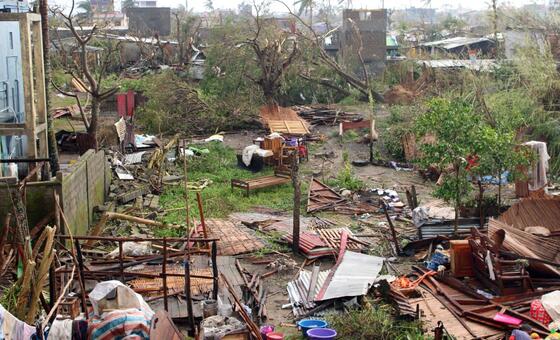
Ms. Goossens recently returned from a mission to the port city Toamasina (also known as Tamatave), the country’s second largest urban centre, where Gezani made landfall on Tuesday evening with wind gusts of up to 250 kilometres per hour.

“The scale of the destruction is really overwhelming,” Ms. Goossens insisted.

Nearly 40 deaths

She said that according to the authorities, 80 per cent of the city has suffered damage and that it is “running on roughly five per cent electricity at the moment.”

“There’s no water and one of WFP’s warehouses and our office was also completely destroyed during the cyclone,” she added.

Assessments are ongoing but to date the authorities report 38 deaths and 374 people injured.

Families left with nothing

The UN food agency official said that many families have left their homes and that there was “severe” damage to buildings, businesses, schools and the city’s hospital.

“During my visit, I saw families trying to recover the little that was left of their home,” she recounted. “Many are spending the night in homes where the roofs have been torn off.”

Uprooted trees and debris across the city are blocking streets, Ms. Goossens said, and fuel is difficult to come by.

“Families are telling us that they have lost everything,” she stressed. “Many are sheltering in damaged homes or temporary sites and uncertain about how they can access their next meal.”

Rising needs

In addition to the urgent need for food Ms. Goossens highlighted humanitarians’ concerns about water, sanitation and hygiene conditions, as a lack of clean water and damaged infrastructure raise the risk of disease outbreaks.

She also mentioned “rising protection concerns for vulnerable groups” such as women, children, the elderly and persons with disabilities.

Mobilising support

In anticipation of the shock WFP and partners have been providing cash assistance to the most vulnerable households allowing them to purchase some food and better prepare before the storm struck.

The UN food agency is now mobilising its “last food stocks,” which will be distributed in coordination with national disaster relief teams, Ms. Goossens explained.

However, the needs on the ground exceed WFP’s capacity and the agency is calling for urgent donor support.

The latest disaster “comes on top of an already very critical food security situation,” Ms. Goossens said, as already before the back-to-back cyclones 1.57 million people across the country were food insecure, including 84,000 facing emergency levels of hunger, according to the latest data from the IPC, a UN-backed global food security monitoring system.

“We’re also in the peak of the lean season here in Madagascar and funding shortfalls remain alarming… Our lean season response as well as cyclone response faces a $18 million gap over the next six months,” the WFP official warned.

“We will need… sustained support over the coming months to help people recover, to rebuild and strengthen their resilience against further shocks,” she added. “In fact, we are in at the start of the cyclone season. So, we are also concerned that this is only just the beginning.”

Source link

World News in Brief: Türk slams relentless Russian attacks, Gaza update, Cyclone Gezani hits Madagascar

His reaction followed overnight attacks on energy infrastructure in Kyiv, Dnipro and the key port city of Odesa.

Nearly 8,800 multistorey buildings in Kyiv, Kharkiv and Odesa are without heating.

In Kharkiv, temperatures are forecast to drop to minus 10°C or 14°F on Thursday evening, said Viktoriia Andrievska from the UN aid coordination office, OCHA.

“Without heating or electricity, homes will turn freezing, basic services will stop, for example, the lifts will stop working, and people, especially older residents and families with children, will struggle to stay warm and safe,” she said.

Illegal strikes

In his statement, the UN human rights chief emphasised the lasting impact of “large-scale” attacks by Russia on Ukrainian energy infrastructure, which he stressed are prohibited under international law.

“Millions of households struggle with only a few hours of electricity each day,” Mr. Türk said, noting that unheated schools have been forced to shut and medical care has been impacted too.

International efforts to end the war in Ukraine continue, meanwhile, with Moscow announcing on Thursday that it expected the “next round” of talks “to take place shortly”, according to a Kremlin spokesperson.

Gaza: Another UN worker is killed, says UNRWA

Another UN worker has been killed in Gaza, despite a ceasefire agreement between Hamas fighters and the Israeli military.

According to the UN agency for Palestine refugees, UNRWA, a staff member was killed during Israeli airstrikes on Tuesday, reportedly after an attack by Hamas militants in Rafah.

UNRWA said that the Israeli strikes in Gaza City and shelling in Khan Younis killed at least four Palestinians, including their colleague, as he was hit while out walking on Salah Eddin Street in central Gaza.

Nearly 400 staffers killed

Since the war began, 391 UNRWA staff and partners have been killed.

In other Gaza news, Israeli forces have demolished a United Nations school in Jabalia in northern Gaza, it has been confirmed.

According to UNRWA, the school was one of a number of facilities it has behind the so-called “Yellow Line” of concrete blocks that separates the Israel Defense Forces from the people of Gaza.

Between January and February, eight UNRWA schools in the militarised area have been reportedly demolished by Israeli forces, the UN agency said.

Cyclone Gezani displaces thousands in northeastern Madagascar

Tropical Cyclone Gezani has killed at least 31 people and displaced thousands after making landfall in Madagascar on 10 February, bringing winds exceeding 195 km/h, heavy flooding and widespread destruction across eastern and central regions.

According to local authorities, four people remain missing and 35 have been injured. Preliminary reports indicate that more than 250,000 people have been affected, with nearly 7,000 displaced. 

Over 65,000 homes have been flooded, damaged or destroyed, and around 600 classrooms have been partially or completely rendered unusable.

UN emergency teams deployed

The UN International Organization for Migration (IOM) has deployed emergency teams to Toamasina to support authorities as displaced families shelter in 28 evacuation centres across 16 districts. A national state of emergency has been declared.

“The scale of devastation…has left families struggling to cope with urgent needs and heavy losses,” said IOM Chief of Mission Roger Charles Evina.

The Government is leading search-and-rescue operations and delivering emergency shelter and food assistance, including the distribution of 800 metric tonnes of rice, with support from UN agencies and partners.

A $3 million allocation from the UN Central Emergency Response Fund will assist more than 90,000 people as additional donor funding supports early response efforts.

The UN aid coordination office, OCHA, warned that the cyclone could also affect central and southern Mozambique in the coming days.

Source link

Missing Malaysian Airlines MH370 ‘deliberately crashed’ in 2014, shows new evidence

The sudden disappearance of the Malaysian Airlines flight MH370 on March 8, 2014 was a deliberate attempt to crash the plane, said a report by The Independent, citing the discovery of a landing gear door of the ill-fated plane by a Madagascar fisherman. It further, suggested that the pilot “deliberately downed” the aircraft resulting in the loss of lives of all 239 passengers onboard.

The report said the gear door, found at the home of a fisherman named Tataly 25 days ago, was the material evidence that explains how the pilot “intended to destroy” the plane. It quoted British engineer Richard Godfrey and an American MH370 wreckage hunter Blaine Gibson to support the claim.

“The level of damage with fractures on all sides and the extreme force of the penetration right through the debris item lead to the conclusion that the end of the flight was in a high-speed dive designed to ensure the aircraft broke up into as many pieces as possible. The crash of MH370 was anything but a soft landing on the ocean,” Godfrey was quoted as saying.

File photo of MH370; A Madagascar fisherman found door gear of MH370, shows new evidence

In 2017, the fisherman found the landing gear door that washed ashore after the tropical storm Fernando and kept it with him for five years without knowing its significance, while his wife used it as a washing board.

“The combination of the high speed impact designed to break up the aircraft and the extended landing gear designed to sink the aircraft as fast as possible both show a clear intent to hide the evidence of the crash,” Independent quoted a report published by the experts as saying.

How MH370 disappeared on March 8, 2014?

The Beijing-bound MH370 disappeared off the radar about 40 minutes after take-off from Kuala Lumpur on the fateful night of March 8, 2014 when its communication systems were switched off and the flight changed the route into the southern Indian Ocean.

The probe concluded that the plane crashed in a remote area of about 232,000 kilometers off the sea bed. So far, some suspected fragments of the aircraft have been recovered from beaches in Reunion, Mozambique, Mauritius, South Africa, and Pemba Island (Zanzibar).

Malaysia, Australia, and China, who carried out the first search at a cost of over $151 million, suspended the probe in January 2017. even the US-based seabed exploration company Ocean Infinity, which conducted a second search, yielded no result.