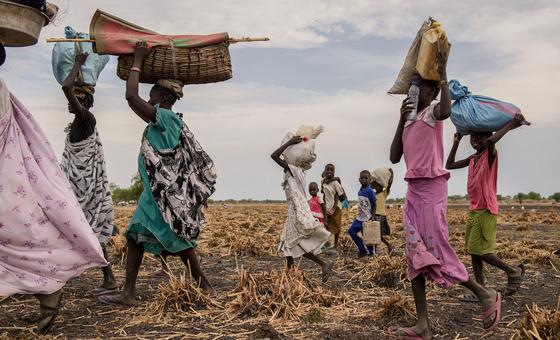
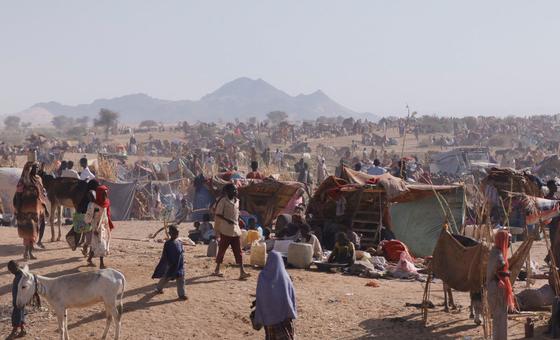
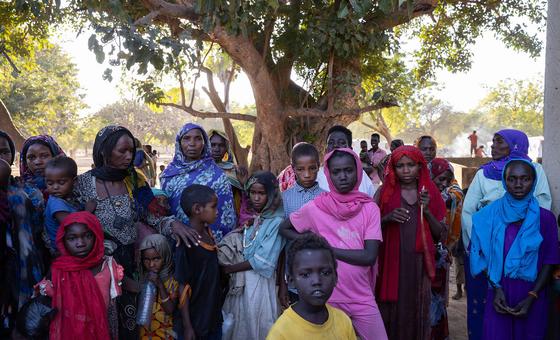
At least 75 civilians have been killed in hostilities between the national army (SSPDF) and the Sudan People’s Liberation Army-In Opposition (SPLA-IO) – which is both a political party and militia group loyal to First Vice President Riek Machar – and their respective allied armed groups, said UN human rights office, OHCHR, in a press release.
Thousands have been displaced from their homes.
South Sudan was plunged into civil war in 2013 between supporters of the President Salva Kiir and his rival Mr. Machar but a 2018 peace accord led to a fragile power-sharing agreement.
Escalating hostilities “portend a real risk of further exacerbating the already dire human rights and humanitarian situation,” said Volker Türk, head of the UN human rights office (OHCHR), urging all parties to the conflict to “urgently pull back from the brink.”
Intensifying hostilities
The latest armed violence erupted in February when a militia group identified as the White Army reportedly launched a series of attacks in Upper Nile State, OHCHR said.
Hostilities intensified between 3 May and 20 May with reports of indiscriminate aerial bombardments and river and ground offensives by the SSPDF on SPLA-IO positions in the states of Jonglei and Upper Nile.
Civilian displacement further increased on 21 May because of the SPLA-IO and allies’ counter-offensive in Jonglei State.
“I urge all parties to uphold the 2018 peace agreement,” said the UN human rights chief, calling for the warring parties to “ensure protection of civilians and civilian objects,” and facilitating “humanitarian access in line with their obligations under international law.”
Concern of arbitrary detention
Between 5 and 26 March, at least 55 high-ranking government officials affiliated with the SPLM-IP, among them civilians, have been arrested across the country. Notably, South Sudan’s first vice-president, ministers, members of parliament and military officers were among the dozens of politicians who have been detained.
“I am concerned that many of the detentions are arbitrary in nature,” Mr Türk said, as these arrests were conducted without warrant or due process.”
Mr Türk called for the immediate and unconditional release of those arbitrarily detained, as he urged for authorities to grant the UN Mission in South Sudan (UNMISS) access to National Security Service detention sites to assess the welfare of those detained there.
Finally, the UN also urged the authorities to take “prompt, effective and meaningful” steps to halt the spread of hate speech in the country.
“Biodiversity is the bedrock of life and a cornerstone of sustainable development,” Mr. Guterres said.
“Yet humanity is destroying biodiversity at lightening pace, the result of pollution, climate crisis, ecosystem destruction and – ultimately – short-term interests fuelling the unsustainable use of our natural world.”
He stressed that no country, “however rich or powerful,” can address the crisis in isolation, nor thrive without the ecological richness that defines life on Earth.
Alarm bells ringing
The International Day comes amid stark concern for the future: one million species are at risk of extinction, 75 per cent of land ecosystems and two-thirds of marine environments have been significantly altered by human activity.
Furthermore, if current trends continue, progress towards eight of the 17 Sustainable Development Goals (SDGs) could be jeopardized.
Mr. Guterres called for urgent implementation of the Kunming-Montreal Global Biodiversity Framework, the landmark agreement adopted to halt and reverse nature loss by 2030.
This includes delivering on national biodiversity action plans, scaling finance for conservation, shifting harmful subsidies, and supporting local communities, Indigenous Peoples, women and youth.
Live in harmony with nature
Biological diversity underpins food security, livelihoods, health and climate resilience.
Roughly three billion people eat fish for 20 a per cent of their animal protein intake, and 80 per cent of rural populations in developing countries rely on plant-based medicine.
Yet the destruction of natural habitats is also increasing the risk of zoonotic disease transmission, making biodiversity preservation a key factor in global health.
“Living in harmony with nature and sustainable development is humanity’s path to a better world for all,” Mr. Guterres said, echoing this year’s theme.
“Together, let us take it.”
The International Day
The UN officially designated 22 May as the International Day for Biological Diversity in 2000 to increase understanding and awareness of biodiversity issues.
The date marks the adoption of the Convention on Biological Diversity in 1992.
Tom Fletcher said in a statement on Monday that nine UN trucks were cleared to enter the southern Kerem Shalom crossing earlier in the day.
“But it is a drop in the ocean of what is urgently needed…We have been reassured that our work will be facilitated through existing, proven mechanisms. I am grateful for that reassurance, and Israel’s agreement to humanitarian notification measures that reduce the immense security threats of the operation.”
Alarm over Israeli bombardment: UN chief
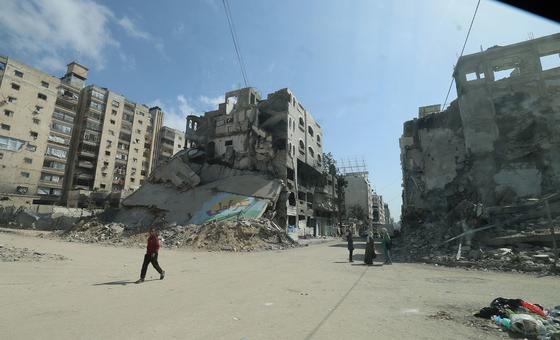
The UN Secretary-General on Monday expressed his alarm over the intensifying air strikes and ground operations in Gaza “which have resulted in the killing of hundreds of Palestinian civilians in recent days, including many women and children, and, of course, large-scale evacuation orders.”
António Guterres reiterated his call for the rapid, safe, and unimpeded delivery of humanitarian assistance at scale directly to civilians, in order to avert famine, alleviate widespread suffering, and prevent further loss of life.
Briefing reporters on Monday, UN Spokesperson Stéphane Dujarric said Mr. Guterres “welcomes the ongoing efforts by the mediators to reach a deal in Gaza. He has repeatedly warned that the continued violence and the destruction will only compound civilian suffering and heighten the risk of a broader regional conflict.”
He added that the Secretary-General “firmly rejects any forced displacement of the Palestinian population.”
Minimise risk of aid theft
Relief chief Fletcher said in his statement that he was determined to ensure UN aid reaches those in greatest need and make sure that any risk of theft by Hamas or other militants battling Israeli forces in the Strip amid a new offensive, would be minimised.
He said the UN aid coordination office, OCHA, had realistic expectations: “Given ongoing bombardment and acute hunger levels, the risks of looting and insecurity are significant.”
UN aid workers are committed to doing their jobs, “even against these odds,” he said, thanking humanitarian colleagues for their courage and determination.
Practical plan
“The limited quantities of aid now being allowed into Gaza are of course no substitute for unimpeded access to civilians in such dire need,” Mr. Fletcher continued.
“The UN has a clear, principled and practical plan to save lives at scale, as I set out last week.”
He called on Israeli authorities to:
Open at least two crossings into Gaza, in the north and south
Simplify and expedite procedures together with removing quotas limiting aid
Lift access impediments and cease military operations when and where aid is being delivered
Allow UN teams to cover the whole range of needs – food, water, hygiene, shelter, health, fuel and gas for cooking
Ready to respond
Mr. Fletcher said to reduce looting, there must be a regular flow of aid, and humanitarians must be permitted to use multiple routes.
“We are ready and determined to scale up our life-saving operation Gaza and respond to the needs of people, wherever they are,” he stressed – calling again for the protection of civilians, a resumption of the ceasefire and the immediate and unconditional release of all hostages.
He concluded saying the operation would be tough – “but the humanitarian community will take any opening we have.”
No aid has entered the enclave since Israel implemented a ban on 2 March and the entire population, more than two million people, is at risk of famine.
“As we demonstrated during the ceasefire this year – and every time we’ve been granted access – the United Nations and our humanitarian partners have the expertise, resolve and moral clarity to deliver aid at the scale necessary to save lives across Gaza,” said Mr. Fletcher.
Ready to move
Those proposing an alternative modality for aid distribution should not waste time, he added, as a plan already exists.
The document is “rooted in the non-negotiable principles of humanity, impartiality, neutrality and independence.” Furthermore, it is backed by a coalition of donors, as well as most of the international community, and ready to be activated if humanitarians are allowed to do their jobs.
“We have the people. We have the distribution networks. We have the trust of the communities on the ground. And we have the aid itself – 160,000 pallets of it – ready to move. Now,” he said.
‘Let us work’
Mr. Fletcher reiterated that the humanitarian community has done this before and can do it again.
“We know how to get our aid supplies registered, scanned, inspected, loaded, offloaded, inspected again, loaded again, transported, stored, protected from looting, tracked, trucked, monitored and delivered – without diversion, without delay, and with dignity. We know how to reach civilians in desperate need and stave off famine.”
He concluded the statement by saying “Enough. We demand rapid, safe, and unimpeded aid delivery for civilians in need. Let us work.”
António Guterres issued the warning in a video message to the inaugural Sagarmatha Sambaad, or “Everest Dialogue,” convened by the Government of Nepal in Kathmandu.
“Record temperatures have meant record glacier melt,” he said.
“Nepal today is on thin ice – losing close to one-third of its ice in just over thirty years. And your glaciers have melted 65 per cent faster in the last decade than in the one before.”
Named after Mount Everest (Sagarmatha in Nepali), the international platform convened ministers, parliamentarians, climate experts, and civil society to focus on climate change, mountain ecosystems, and sustainability.
Secretary-General’s video message.
Two billion futures at stake
Glaciers in the region have served for centuries as vital freshwater reservoirs. Their accelerated melt now threatens not only local communities but vast populations downstream who rely on Himalayan-fed rivers.
Reduced water flow in river systems such as the Ganges, Brahmaputra and Indus threatens not only water but also food production for nearly two billion people across South Asia.
Combined with saltwater intrusion, this could trigger collapsing deltas and mass displacement, the UN chief warned.
“We would see low-lying countries and communities erased forever,” he said.
Children raise their voices
Ahead of the summit, Nepal’s children and youth stepped into the spotlight with their own call to action.
In a declaration submitted to the dialogue, over 100 children and young people demanded urgent and inclusive climate action that recognizes them as rights-holders and climate actors – not just passive victims.
Among their key demands: ensuring child participation in climate decisions, supporting youth-led programmes, and promoting their innovations and climate action.
“The climate crisis is a child rights crisis – disproportionately impacting their health, nutrition, education and well-being,” said Alice Akunga, head of the UN Children’s Fund (UNICEF) in Nepal, which supported the deliberations.
“Listening to the voices of the ‘future of humanity’ is critical to designing and implementing meaningful and lasting solutions to address the adverse effects of climate change on children and youth.”
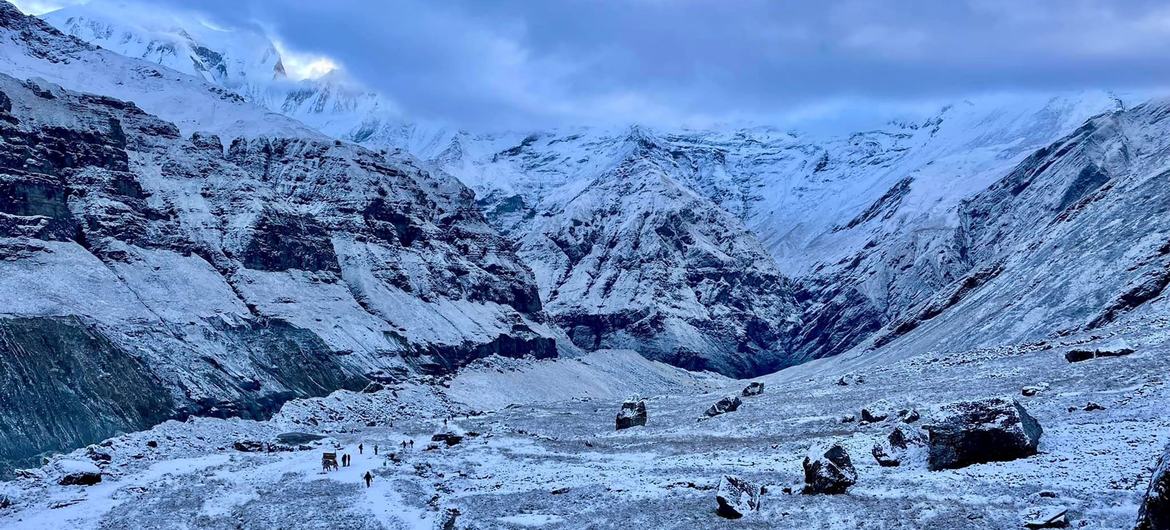
Glaciers in the high Himalayas, like those in Nepal’s Langtang region (pictured), feed major South Asian river systems sustaining tens of millions of lives and livelihoods downstream
At the time, he stood amid glacial basins in the Himalayas, warning that the “rooftops of the world” were rapidly vanishing.
“And that is why you are gathered together focused on Sambaad – dialogue,” the UN chief said on Friday, applauding Nepal’s climate leadership, including reforestation programmes, early warning systems and its goal to achieve net-zero emissions by 2045.
Act now
The world must act without delay to limit global temperature rise to 1.5°C, he continued – the target set by the Paris Agreement on climate change – with the biggest emitters leading the way.
This includes investing in renewable energy, fulfilling the $1.3 trillion climate finance goal agreed at COP29, doubling adaptation finance to at least $40 billion this year as pledged by developed countries, and providing robust, sustained support to the Loss and Damage Fund.
“Achieving these goals demands bold collaboration,” Mr. Guterres concluded. “The United Nations is your ally in this essential task.”
“There is no place for lethal autonomous weapon systems in our world,” Mr. Guterres said on Monday, during an informal UN meeting in New York focused on the use and impact of such weapons.
“Machines that have the power and discretion to take human lives without human control should be prohibited by international law.”
The two-day meeting in New York brought together Member States, academic experts and civil society representatives to examine the humanitarian and human rights risks posed by these systems.
The goal: to lay the groundwork for a legally binding agreement to regulate and ban their use.
Human control is vital
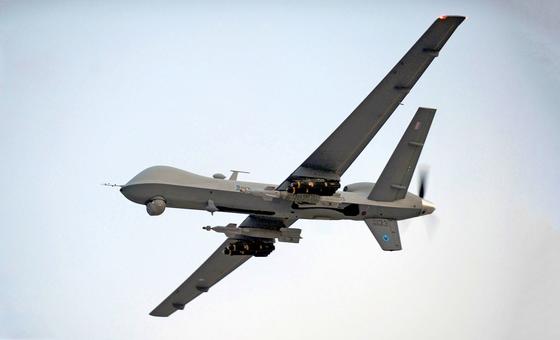
While there is no internationally accepted definition of autonomous weapon systems, they broadly refer to weapons such as advanced drones which select targets and apply force without human instruction.
The Secretary-General said in his message to the meeting that any regulations and prohibitions must make people accountable.
“Human control over the use of force is essential,” Mr. Guterres said. “We cannot delegate life-or-death decisions to machines.”
There are substantial concerns that autonomous weapon systems violate international humanitarian and human rights laws by removing human judgement from warfare.
The UN chief has called for Member States to set clear regulations and prohibitions on such systems by 2026.
Approaching a legally binding agreement
UN Member States have considered regulations for autonomous weapons systems since 2014 under the Convention on Certain Conventional Weapons (CCW) which deals with weapons that may violate humanitarian law.
Most recently, the Pact for the Future, adopted in September last year, included a call to avoid the weaponization and misuse of constantly evolving weapons technologies.
Stop Killer Robots – a coalition of approximately 270 civil society organizations – was one of the organizations speaking out during this week’s meeting.
Executive Director Nicole van Rooijen told UN News that consensus was beginning to emerge around a few key issues, something which she said was a “huge improvement.”
Specifically, there is consensus on what is known as a “two-tiered” approach, meaning that there should be both prohibitions on certain types of autonomous weapon systems and regulations on others.
However, there are still other sticking points. For example, it remains unclear what precisely characterizes an autonomous weapon system and what it would look like to legislate “meaningful human control.”
Talks so far have been consultations only and “we are not yet negotiating,” Ms. Rooijen told UN News: “That is a problem.”
‘Time is running out’
The Secretary-General has repeatedly called for a ban on autonomous weapon systems, saying that the fate of humanity cannot be left to a “black box.”
Recently, however, there has been increased urgency around this issue, in part due to the quickly evolving nature of artificial intelligence, algorithms and, therefore, autonomous systems overall.
“The cost of our inaction will be greater the longer we wait,” Ms. Rooijen told us.
Ms. Rooijen also noted that systems are becoming less expensive to develop, something which raises concerns about proliferation among both State and non-state actors.
The Secretary-General, in his comments Monday also underlined the “need for urgency” in establishing regulations around autonomous weapon systems.
“Time is running out to take preventative action,” Mr. Guterres said.
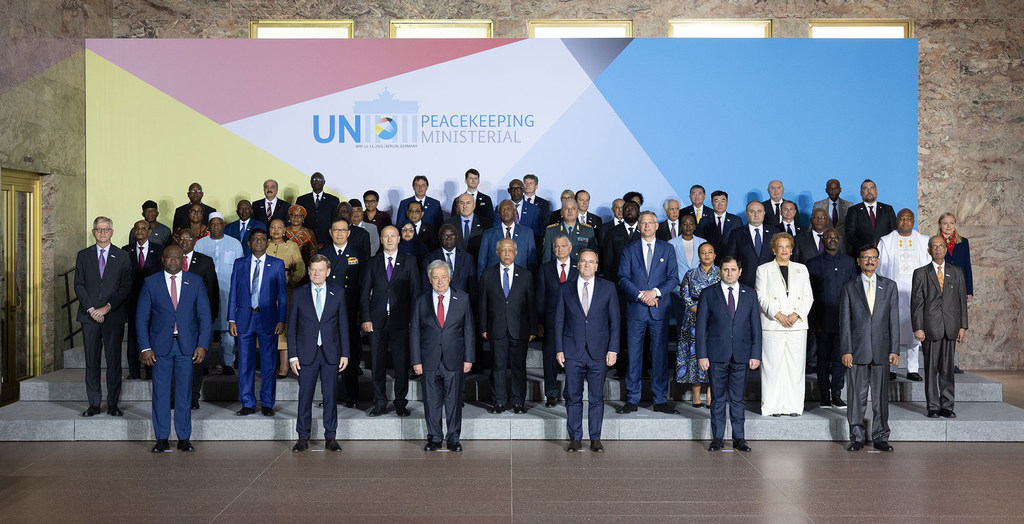
Addressing the UN Peacekeeping Ministerial 2025 in the German capital, the Secretary-General told dozens of ministers from more than 130 countries that peacekeepers remain key to “help countries move from conflict to peace.”
“In trouble spots around the world, blue helmets can mean the difference between life and death,” he insisted. “They are also a clear demonstration of the power of multilateral action to maintain, achieve and sustain peace.”
Despite the proven value of peacekeeping missions in ensuring a durable peace in countless countries from Cambodia to Liberia and Timor Leste, Mr. Guterres warned that today’s challenges have made this task much harder.
“We are now facing the highest number of conflicts since the founding of the United Nations and record numbers of people fleeing across borders in search of safety and refuge,” he said, before alluding to additional obstacles caused by an absence of political support for peacekeeping mandates.
The UN’s peacekeeping budget runs on a July-June cycle and has unpaid arrears of $2.7 billion.
Practical approach
To counter this and in the face of “dramatic financial constraints” now affecting the UN in its entirety, the Secretary-General announced an urgent review of operations to inspire a new peacekeeping model that is “fit for the future.”
In coming years, “a clear exit strategy” for peacekeepers will be key, Mr. Guterres said, as well as working with Member States and the Security Council “to ensure that any new mandates “are prioritized and achievable with the resources available.”
Other clues about what UN peacekeeping 2.0 could look like post-reform might be gleaned from the missions that the UN chief referred to in his speech in Germany.
Active missions such as UNIFIL in Lebanon have already shown that it is possible to adapt to today’s challenges while still ensuring peace and aid deliveries, Mr. Guterres noted.
And in a nod to MINUSCA in the Central African Republic, the Secretary-General highlighted its work in protecting civilians “and assisting the government to extend its reach beyond the capital where people are in desperate need.”
In the Democratic Republic of the Congo, too and despite ongoing fighting there, peacekeepers from MONUSCO also remain in the field and protect vulnerable populations, the UN chief maintained.
As Member States prepared to announce financial pledges for peacekeeping on Wednesday, Mr. Guterres stressed that the overall budget for missions represented only 0.5 per cent of global military spending.
Peacekeeping “is only as strong as Member States’ commitment to it,” stressed Mr. Guterres.
Amid massive cuts to UN funding by Member States, it remains to be seen if the upbeat mood in Berlin translates into desperately needed financial support for the global body’s peacekeeping operations.
“UN peacekeeping today is more vibrant than ever,” insisted Boris Pistorius, Minister of Defence of Germany. “It is and will remain a cornerstone of international stability. Let us commit to making it even more effective for the sake of those who depend on it.”
Cutbacks
The UN chief’s push to streamline the global body comes a day after his call to push ahead with major efficiency improvements and cost-cutting in response to the chronic liquidity crisis caused by Member States falling into arrears.
Important as these sweeping structural reforms are – with potential staff downsizing of up to 20 per cent – they are not the answer to the failure of some countries to pay the Organization to fulfil the mandates they have given it, Mr. Guterres insisted.
According to information provided by the UN Controller to the General Assembly’s Fifth Committee (Administrative and Budgetary), only $1.8 billion has been received against the $3.5 billion regular budget assessments for 2025 – a shortfall of around 50 per cent.
In the budget line for unpaid assessments these amounted to $2.4 billion on 30 April, with the United States owing about $1.5 billion, China $597 million, Russia $72 million, Saudi Arabia $42 million, Mexico $38 million and Venezuela $38 million. An additional $137 million has yet to be paid by other Member States.
For International Tribunals, total contributions outstanding totalled $79 million on 30 April.
At the 2025 UN Peacekeeping Ministerial in Berlin, Secretary General António Guterres underscored the vital role of UN peacekeeping and urged Member States to help shape peace operations fit for the future.
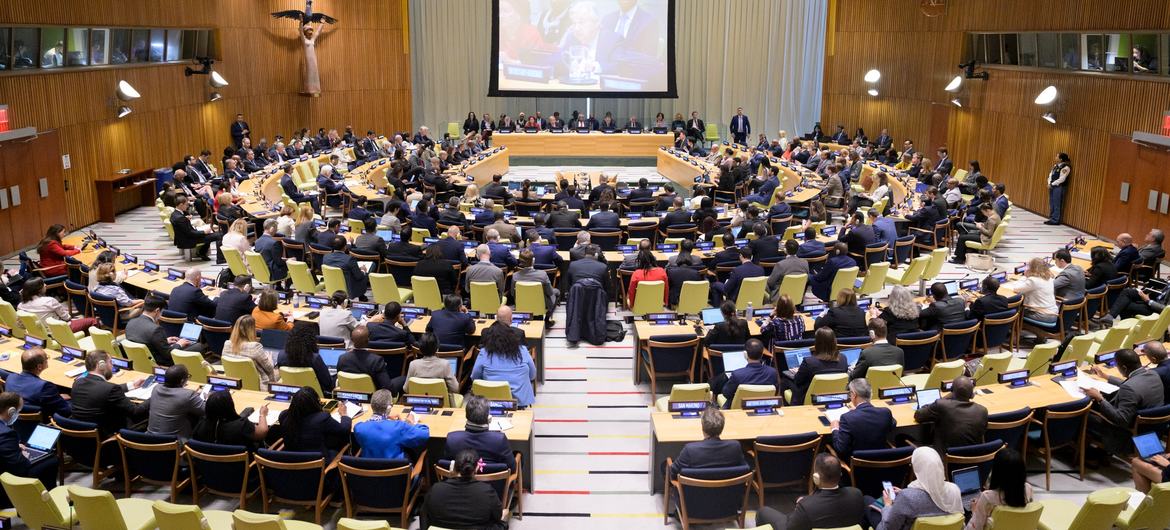
Briefing Member States in New York on Monday Mr. Guterres outlined wide-ranging effort to revamp how the UN system operates – cutting costs, streamlining operations, and modernizing its approach to peace and security, development and human rights.
“These are times of peril,” he said, “but they are also times of profound opportunity and obligation. The mission of the United Nations is more urgent than ever.”
Three main objectives
Launched in March, the UN80 Initiative centres on three priorities: enhancing operational efficiency, assessing how mandates – or key tasks – from Member States are implemented, and exploring structural reforms across the UN system.
The conclusions will be reflected in revised estimates for the 2026 budget in September this year, with additional changes that require more detailed analysis presented in 2027.
‘Meaningful’ budget reductions
Mr. Guterres said the changes are expected to yield “meaningful reductions” in the overall budget. For example, the departments for political and peacekeeping affairs could see a 20 per cent reduction in staff by eliminating duplication.
This level of reduction, he said, could serve as a benchmark across the UN system – while also considering unique factors for each department.
Additional examples include consolidating all counter-terrorism work within the main Office of Counter-Terrorism (UNOCT), ending building leases and relocating posts away from expensive “duty stations” where cost of living is high.
“There might be immediate, one-off costs involved in relocating staff and providing potential termination packages,” he said, “but by moving posts from high-cost locations, we can reduce our commercial footprint in those cities and reduce our post and non-post costs.”
UN Secretary-General António Guterres briefs on the UN80 Initiative.
Efficiencies and upgrades
The first workstream focuses on efficiencies and improvements, developing a new model that improves consolidation, looks at centralising services, relocating to cheaper locations, and expanding the use of automation and digital platforms.
Mr. Guterres said departments the UN’s headquarters in New York and Geneva have been asked to review whether some teams can be relocated to lower-cost duty stations, reduced or abolished.
Reviewing mandates
The second workstream involves a review of how existing mandates are being carried out – not the mandates themselves, which are the purview of Member States only.
A preliminary review identified more than 3,600 unique mandates for the Secretariat alone. A full and more detailed analysis is now underway.
Mr. Guterres emphasised that the sheer number of mandates – and the bureaucracy needed to implement them – places a particular burden on smaller Member States with limited resources.
“Based on this work, Member States may wish to consider the opportunity to conduct themselves a review of the mandates,” he added.
Structural change
The third workstream – focused on structural reform – is already underway, Mr. Guterres said.
Nearly 50 initial submissions have already been received from senior UN officials, reflecting what Mr. Guterres described as “a high level of ambition and creativity.”
Key work areas have been identified for review. These include peace and security, development, human rights, humanitarian, training and research and specialised agencies.
A wide view of the informal meeting of the General Assembly plenary that heard a briefing by the Secretary-General on the UN80 Initiative.
Not an answer to liquidity crisis
Mr. Guterres also touched on the UN dire cashflow situation, noting that the initiative “is not an answer” to the months-long liquidity crisis but by being more cost effective, it should help limit the impact.
“The liquidity crisis is caused by one simple fact – the arrears,” he said, adding that structural reform is not the answer to a fundamental failure by some Member States to pay what they owe on time to meet running costs.
Unpaid dues
According to information provided by the UN Controller to the General Assembly’s Fifth Committee (Administrative and Budgetary), only $1.8 billion has been received against the $3.5 billion regular budget assessments for 2025 – a shortfall of around 50 per cent.
As of 30 April, unpaid assessments stood at $2.4 billion, with the United States owing about $1.5 billion, China ($597 million), Russia ($72 million), Saudi Arabia ($42 million), Mexico ($38 million), and Venezuela ($38 million). An additional $137 million is yet to be paid by other Member States.
For the peacekeeping budget (which runs on a July-June cycle), including prior-period arrears, the unpaid amount totals $2.7 billion. For the International Tribunals, total contribution outstanding was $79 million as of 30 April.
Close consultation
The Secretary-General told Member States he would be consulting with them closely and regularly on the cash crisis and needed reforms, seeking guidance and presenting concrete proposals for countries to act on.
UN staff members and their representatives are being consulted and listened to, he added: “Our concern is to be humane and professional in dealing with any aspect of the required restructuring.”
In conclusion, he highlighted that the UN80 Initiative is a “significant opportunity” to strengthen the UN system and deliver for those who depend on it.
In response to the suggestion that the UN should focus on just the one key pillar of peace and security, he said it would be wrong to ditch development and human rights – all three are essential he underscored.
“Let us seize this momentum with urgency and determination, and work together to build the strongest and most effective United Nations for today and tomorrow.”
The UN chief warned that any further escalation of the conflict could result in massive civilian casualties and worsen the already catastrophic humanitarian situation across the country.
“The expansion of the conflict into an area that has served as a place of refuge for a large number of displaced people is alarming,” he said in a statement issued by his Spokesperson’s office.
Mr. Guterres’s appeal follows days of drone strikes on key infrastructure in Port Sudan that have opened a new front in the fighting between forces of the military government and heavily armed paramilitaries.
The city is a main entry point for relief supplies, hosting airports and direct access to the Red Sea. It is also a shelter for hundreds of thousands of displaced people and the seat of government after generals lost control of the capital Khartoum to the Rapid Support Forces (RSF).
Aid flights suspended
In response to the drone attacks, flights of the UN Humanitarian Air Service (UNHAS) to and from Port Sudan have been suspended since 4 May.
The UN World Food Programme (WFP) which manages the airline said that operations will resume as soon as conditions allow. For the moment, amid reported gun and weapons fire overnight, the insecurity has impacted the movement of aid workers into Sudan and across the country.
A country in flux
Drone strikes have also been reported elsewhere in Sudan, including the states of Kassala and River Nile. In Kassala, strikes near the airport displaced about 2,900 people and led to the temporary suspension or relocation of some aid activities, according to the UN aid coordination office, OCHA.
As of Wednesday evening, River Nile State was still without power following a drone strike on the transformer station in Atbara on 25 April. The outage has contributed to growing fuel and bread shortages and long queues at petrol stations and bakeries.
The situation remains dire across Sudan, the UN chief continued, citing intense attacks on critical infrastructure since January that have hampered people’s access to essential services and left them without food, clean water, healthcare and electricity.
“All parties to the conflict must comply with their obligations under international humanitarian law,” Mr. Guterres insisted. “They must not direct attacks against civilians and civilian objects; must take all feasible precautions to avoid, and in any event to minimize, incidental civilian casualties; and must allow and facilitate rapid and unimpeded passage of humanitarian relief for civilians in need.”
Sudan’s war stems from the breakdown in the transition to civilian rule following the overthrow in April 2019 of Omar al-Bashir, who had been president for 30 years.
Mr. Guterres decried a “lack of political will” by the warring parties to engage in constructive dialogue as they pursued their military goals.
“Dialogue is the only way to achieve the peace that the people of Sudan demand,” the Secretary-General insisted.
A hunger catastrophe
The turmoil caused by relentless heavy fighting across Sudan has reportedly killed more than 18,800 civilians and injured tens of thousands more. UN aid agencies say that the country’s people are in the grip of the largest hunger catastrophe on the planet.
Today, more than half of Sudan’s population – 30.4 million people – need humanitarian assistance, including more than 15 million children. They lack access to food, water, shelter, electricity, education and healthcare, aid veterans have warned repeatedly.
“Across Sudan, 25 million people face acute hunger,” WFP spokesperson Leni Kinzli told UN News. “And people are displaced across the country, nearly 13 million people forced from their homes. We are seeing waves of displacement in North Darfur,where around 450,000 people have fled horrific levels of violence.”
Reaching those in need
Despite the dangers, UN agencies and partners are doing everything they can to reach the most vulnerable uprooted by intensifying attacks on government-controlled El Fasher town and Zamzam displacement camp.
“We’ve distributed assistance food assistance and emergency food packages to 335,000 people who recently fled that violence in and around El Fasher,” Ms. Kinzli explained. “We are also ramping up assistance in Khartoum, aiming to support one million people across the coming month.”
Distributions are ongoing in Jabalia, in the South of Khartoum, which is one of the risk of famine areas, as well as the central Khartoum neighbourhood of Burri, “where we finally reached the centre of the city…just last week”, the WFP officer noted.
To reach 21 million people in desperate need this year the UN needs $4.2 billion which is only seven per cent funded.
And over the next six months, WFP requires around $700 million to ramp up assistance and expand assistance to seven million people per month.
“We are living through the greatest disruption to global health financing in memory,” said WHO Director-General Dr Tedros Adhanom Ghebreyesus.
He cautioned that abrupt withdrawals of funding are jeopardising hard-won medical progress, including efforts to combat tropical diseases, which are now re-emerging in some regions.
“This is just the tip of the iceberg,” he told journalists at WHO headquarters in Geneva.
Outbreaks intensify
Since January, Angola has been facing its worst cholera outbreaks in 20 years, with over 17,000 cases and more than 550 deaths recorded so far.
Inadequate access to safe water, hygiene and sanitation is fuelling the outbreak.
As WHO and partners carry out a large-scale vaccination campaign on the ground, one of their priorities is to bring the death rate down, said Tedros.
Amid funding cuts, advances in tackling neglected tropical diseases affecting over one billion people, are disproportionately impacting the poorest and most marginalized communities.
Reduced access
In many countries where insecurity is rife and hospitals are being targeted, access to healthcare has been severely reduced, Tedros continued.
On April 22, one of Haiti’s largest public hospitals, Hôpital Universitaire de Mirebalais, was forced to shut down due to violence. In the capital Port-au-Prince, more than 40 per cent of health facilities remain closed, he said.
Needless deaths
Turning to the Gaza blockade, he said the situation there was “catastrophically bad,” with the violence “driving an influx of casualties to a health system that is already on its knees.”
While essential medicines, and trauma and medical supplies, are running out, “people are dying from preventable diseases while medicines wait at the border,” said Tedros.
Reiterating the UN’s call for a ceasefire, Tedros added that “peace is the best medicine.”
“The horror unfolding in Sudan knows no bounds,” Volker Türk said in a statement calling for an end to the war between the Sudanese Armed Forces (SAF) and former ally the Rapid Support Forces (RSF), now in its third year.
He noted that three days ago, the RSF launched coordinated attacks from multiple directions on the North Darfur capital El Fasher and nearby Abu Shouk camp, killing at least 40 civilians.
Fear of more bloodshed
This brings the confirmed number of civilians killed in the region to at least 542 in just the last three weeks, he said, although the actual death toll is likely much higher.
“My fears are all the greater given the ominous warning by the RSF of ‘bloodshed’ ahead of imminent battles with the Sudanese Armed Forces (SAF) and their associated armed movements,” Mr. Türk said.
“Everything must be done to protect civilians trapped amid dire conditions in and around El Fasher.”
Stop the fighting
Furthermore, reports of extrajudicial executions in Khartoum state are also extremely disturbing, he added.
The High Commissioner said he has personally alerted both leaders of the RSF and SAF to the catastrophic human rights consequences of the war.
“These harrowing consequences are a daily, lived reality for millions of Sudanese. It is well past time for this conflict to stop,” he said.
Diplomatic efforts continue
Meanwhile, the UN Secretary-General’s Personal Envoy for Sudan, Ramtane Lamamra, was in Cairo this week where he met with senior Egyptian officials, including Foreign Minister Badr Abdelatty, to discuss the Sudan crisis.
“They shared the view that an inclusive Sudanese-led political path is needed to restore peace in the country, preserving the unity of Sudan, its sovereignty and territorial integrity,” said UN Spokesperson Stéphane Dujarric, speaking on Thursday in New York.
Mr. Lamamra also exchanged views with Ahmed Aboul Gheit, the Secretary General of the League of Arab States, on coordinating efforts between the UN, the Arab League and concerned multilateral organizations to advance a lasting peace in Sudan.
In a powerful statement on Thursday, Tom Fletcher, the UN Emergency Relief Coordinator, condemned Israel’s decision to halt humanitarian assistance as a “cruel collective punishment” of the Palestinian population.
“Two months ago, the Israeli authorities took a deliberate decision to block all aid to Gaza and halt our efforts to save survivors of their military offensive,” said Mr Fletcher. “They have been bracingly honest that this policy is to pressurise Hamas.”
‘Blocking aid kills’
While reaffirming the urgent need for the release of hostages taken by Hamas on 7 October 2023 – who “should never have been taken from their families,” – the UN relief chief stressed that “international law is unequivocal: As the occupying power, Israel must allow humanitarian support in.”
“Aid, and the civilian lives it saves, should never be a bargaining chip,” he added. “Blocking aid kills.”
Mr Fletcher warned that the aid blockade “starves civilians”, denies them basic medical services, and “strips them of dignity and hope.”
He underscored the neutrality and impartiality of humanitarian efforts, adding: “We believe that all civilians are equally worthy of protection. We remain ready to save as many lives as we can, despite the risks.”
Let us save lives
However, the latest delivery mechanism proposed by Israel, he said, “does not meet the minimum bar for principled humanitarian support.”
“To the Israeli authorities, and those who can still reason with them, we say again: lift this brutal blockade. Let humanitarians save lives,” he pleaded.
Addressing civilians in Gaza, Mr Fletcher said: “No apology can suffice… But I am truly sorry that we are unable to move the international community to prevent this injustice. We won’t give up.”
“Cutting funding for those in greatest need is not something to boast about…the impact of aid cuts is that millions die,” warned Emergency Relief Coordinator Tom Fletcher.
Speaking from an overcrowded hospital in Kandahar in southern Afghanistan where three or four patients have to share a bed, Mr. Fletcher warned that the financial crisis has already forced UN aid teams to close 400 primary health centres across the country so far.
His warning echoes dire announcements of drastic cost-cutting measures in response to chronic – and now acute – funding shortfalls, including an end to selected aid programmes by numerous UN relief agencies. These include the World Food Programme (WFP), the World Health Organization (WHO), the UN Children’s Fund (UNICEF), the UN aid coordination office (OCHA), the UN refugee agency (UNHCR) and UNAIDS.
Life-or-death call
Back in Afghanistan, the reality of funding cuts continues to play out in its hospitals “where you can see doctors making the most horrific decisions about which lives to save and which lives not to save”, Mr. Fletcher said at Mirwais Regional Hospital.
The lack of investment in aid relief has also affected female Afghan health workers whose salaries are being cut by up to two-thirds, Mr. Fletcher continued. The plight of women in the country is well documented and has been condemned by the international community, having deteriorated following numerous prohibitive edicts issued by the de facto authorities who overran Kabul in 2021.
As part of his official visit to Afghanistan, Mr. Fletcher met de facto provincial governor Mullah Shirin Akhund to discuss the need to address Afghanistan’s humanitarian crisis. It comes after more than four decades of conflict that have left almost half the population – some 22.9 million people – needing humanitarian assistance to survive.
Women’s key role
In earlier talks during his official visit, Mr. Fletcher stressed that development was not possible without girls’ education and their full participation in the country’s economy.
Amid soaring malnutrition, a lack of basic services and dire economic forecasts, Afghanistan has few resources to cope with the arrival of a growing number of Afghan refugees sent back by neighbouring countries including Pakistan and Iran.
The scale of the pushbacks is enormous, with more than 250,000 Afghans returned in April alone, including 96,000 who were forcibly deported. On Tuesday, the UN refugee agency, UNHCR, voiced particular alarm over the fate of women and girls, who face increasing repression under Taliban rule.
While in Kandahar, Mr. Fletcher also visited a reception centre where the UN and humanitarian partners provide support, including health check-ups and cash. He said that the closure of hundreds of health facilities in the region had denied more than three million people access to primary care.
“The promise of a two-State solution is at risk of vanishing altogether,” he said. “Political will to achieve that goal feels more distant than ever.”
He stressed that this erosion undermines the rights of both Palestinians and Israelis to live in peace and security, while denying Palestinians their legitimate national aspirations.
Gaza crisis ‘beyond imagination’
Mr. Guterres expressed deep concern over the worsening crisis in Gaza, where nearly 2,000 Palestinians have been killed since the March ceasefire collapsed.
He condemned the ongoing blockade of aid – including food, fuel and medicine – which has pushed over two million people into a humanitarian emergency he called “beyond imagination.”
“I am alarmed by statements from Israeli officials suggesting aid is being used as leverage for military gain,” he said. “Aid is not a bargaining chip. It is non-negotiable.”
He renewed calls for an immediate and lasting ceasefire, the unconditional release of all hostages, and full humanitarian access. He also underscored the need to uphold international law, protect UN personnel and facilities, and ensure accountability for attacks on aid workers.
Tensions in the West Bank
Turning to the West Bank including East Jerusalem, the Secretary-General described a worsening situation marked by Palestinian displacement, home demolitions, restricted movement and expanding Israeli settlements that are reshaping the territory in violation of international law.
“Palestinians are being contained and coerced,” he said – contained in areas under growing military pressure and coerced out of others where settlements are expanding.
Settler violence continues to rise amid impunity, while Palestinian attacks on Israelis also persist in both Israel and the occupied West Bank.
Secretary-General Guterres briefs the Security Council.
A pivotal moment for peace
With the region in turmoil, Mr. Guterres urged countries to move beyond statements and outline specific steps to revive the two-State solution.
“This is not a time for box-ticking,” he said. “The clock is ticking – and time is running out.”
He called on the international community to prevent a future of endless occupation and violence through sustained and serious action.
Leaders must deliver
The Secretary-General highlighted the upcoming high-level conference co-chaired by France and Saudi Arabia as a key chance to reenergise international support.
“I urge Member States to go beyond declarations and consider concrete steps to save the two-State solution – before it disappears altogether,” he said.
“At this hinge point in history, leaders must show courage, act with resolve, and deliver peace for Palestinians, Israelis, the region, and the world.”
Speaking in the UN Security Council, Filippo Grandi said in conflicts across the world in places like Sudan, Ukraine, Myanmar, the Democratic Republic of the Congo and Haiti, “violence has become the currency of our age.”
Forcibly displaced people are among the first victims of war. Worldwide, some 123 million people have had to flee due to conflict.
Since the beginning of the war in Sudan, one-third of Sudan’s population has been displaced by indiscriminate violence, disease, starvation, flooding, droughts and sexual violence, “a situation that frankly defies description,” said Mr. Grandi.
In Ukraine, 10 million people have been displaced by the war, experiencing what he described as “terrible toll.” Seven million of them are now refugees, living outside the country.
“Stagnation has defined the response in Myanmar,” said the UN refugee chief. As a result, Rohingya refugees in Bangladesh have been living in camps entirely dependent on humanitarian aid for the past eight years.
Security and self-reliance
Refugees and displaced people will not return to their communities “unless they are confident that the terms of peace are durable, for them and for their country,” he added.
Promoting security and self-reliance is essential to ending humanitarian crises.
However, a return to peace requires compromise and commitment; peace cannot be made passively, said Mr. Grandi.
Reminding the 15 Members of the Security Council that preventing and stopping wars is their primary responsibility, he noted that it was one that “this body has chronically failed to live up to.”
Seizing opportunities
To achieve durable peace, the UN must be ready both to seize unexpected opportunities, and to take calculated risks, High Commissioner Grandi said adding that “there is now an opportunity to break this dangerous inertia.”
As over one million people have already returned to Syria since December 8, with many more expected to follow, the refugee chief urged the Security Council to ease sanctions to support early recovery efforts and spur investment.
“To minimise the risk that the returning Syrians are taking, I am asking you to take some risks yourselves,” he said.
Retrenchment away from aid
Despite the positive signs coming out of Syria, as well as Burundi and the Central African Republic, Mr. Grandi told the Council that “we see a retrenchment away from aid, away from multilateralism, even away from life-saving assistance,” adding that “we hear of prioritizing national interests, of boosting defense spending — all valid concerns of course, and legitimate state pursuits. But these are not incompatible with aid, quite the contrary.”
One way or another, forced displacement has concerned every member of the Security Council, Mr. Grandi pointed out.
“You have been the refugee. You have welcomed those who sought refuge,” he said reminding its members of their collective responsibility “to end war, to bring peace.”