UN summit confronts AI’s dawn of wonders and warnings

The AI for Good Global Summit 2025 brings together governments, tech leaders, academics, civil society and young people to explore how artificial intelligence can be directed toward Sustainable Development Goals (SDGs) – and away from growing risks of inequality, disinformation and environmental strain.

We are the AI generation,” said Doreen Bogdan-Martin, chief of the International Telecommunications Union (ITU) – UN’s specialized agency for information and communications technology – in a keynote address.

But being part of this generation means more than just using these technologies.

It means contributing to this whole-of-society upskilling effort, from early schooling to lifelong learning,” she added.

Warnings on AI risks

Ms. Bogdan-Martin warned of mounting dangers in deploying AI without sufficient public understanding or policy oversight.

The biggest risk we face is not AI eliminating the human race. It is the race to embed AI everywhere, without sufficient understanding of what that means for people and our planet,” she said.

Her remarks reflected a growing sense of urgency among policymakers and technologists, as new “agentic AI” systems capable of autonomous reasoning and action emerge at unprecedented speed.

With some experts predicting human-level AI within the next three years, concerns about safety, bias, energy consumption and regulatory capacity have intensified.

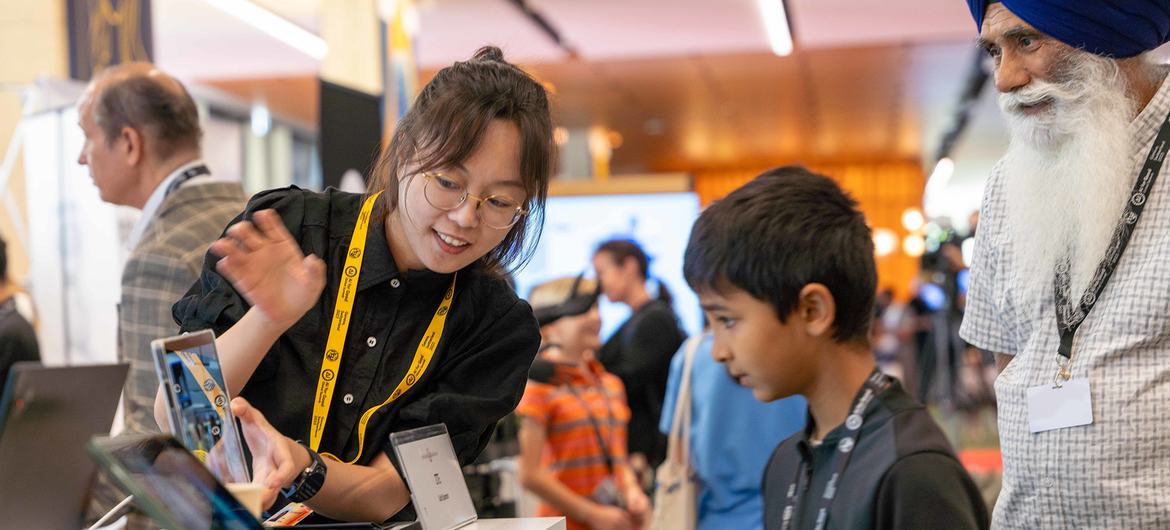
Tech on display at the AI for Good Global Summit.

Tech on display

The summit’s agenda reflects these tensions.

Over 20,000 square meters of exhibit space at Geneva’s Palexpo now hosts more than 200 demonstrations, including a flying car, a fish-inspired water quality monitor, brain-computer interfaces and AI-driven disaster response tools.

Workshops throughout the week will tackle topics ranging from AI in healthcare and education to ethics, gender inclusion and global governance.

One highlight will be the AI Governance Day on Thursday, where national regulators and international organizations will address the gap in global oversight. An ITU survey found that 85 per cent of countries lack an AI-specific policy or strategy, raising alarms about uneven development and growing digital divides.

Focus on health

Health is a prominent theme this year.

On Wednesday, the UN World Health Organization (WHO) will lead a session titled “Enabling AI for Health Innovation and Access,” bringing together technologists, regulators, clinicians and humanitarian leaders to address how AI can improve healthcare delivery – especially in low-resource settings.

Real-world applications – from AI-powered triage in emergency care to diagnostic tools for rural clinics – will be spotlighted, alongside a preview of WHO’s forthcoming Technical Brief on AI in Traditional Medicine.

Experts will also examine the challenges of interoperability, regulatory harmonisation and intellectual property rights at the intersection of AI and global health. The summit will feature the AI for Good Awards, recognising groundbreaking projects that harness AI for public benefit, with categories spanning people, planet and prosperity.
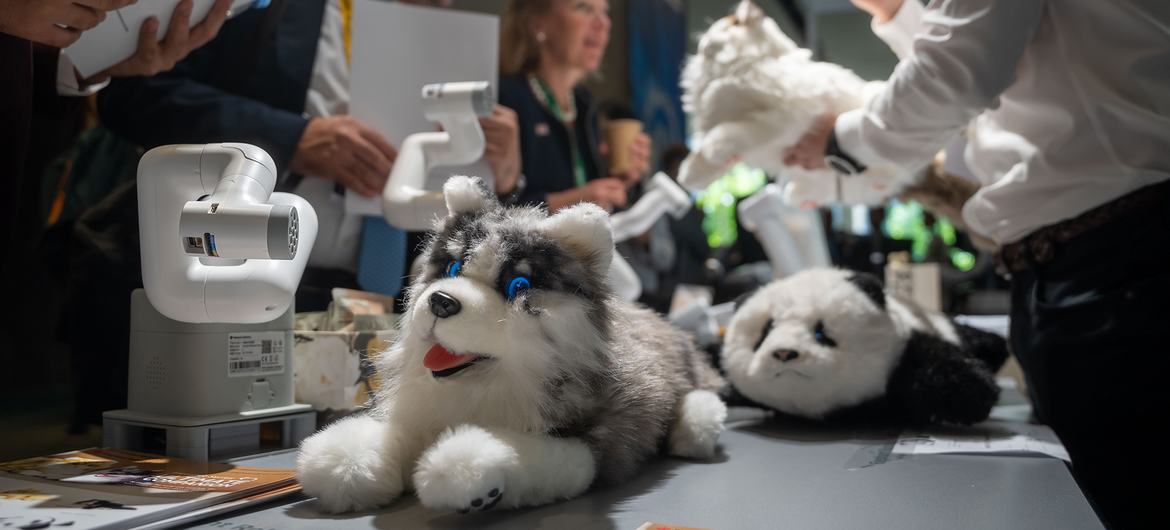
Tech on display at the AI for Good Global Summit in Geneva.

Launchpad for action

The health track exemplifies the summit’s core goal: ensuring AI serves the public good, especially in areas of greatest need.

Youth-led robotics teams from underserved communities will present solutions for disaster recovery and waste management, while startups compete in the Innovation Factory to showcase AI tools for education and climate resilience.

Live demonstrations include an autonomous orchard robot, a self-sanitising mobile toilet and a drone-eDNA system for scalable biodiversity and pest monitoring.

Closing her keynote, Ms. Bogdan-Martin reminded participants that the future of AI is a shared responsibility.

Let’s never stop putting AI at the service of all people and our planet,” she said.

Source link

As funding cuts bite, UN chief announces new dawn for peacekeeping

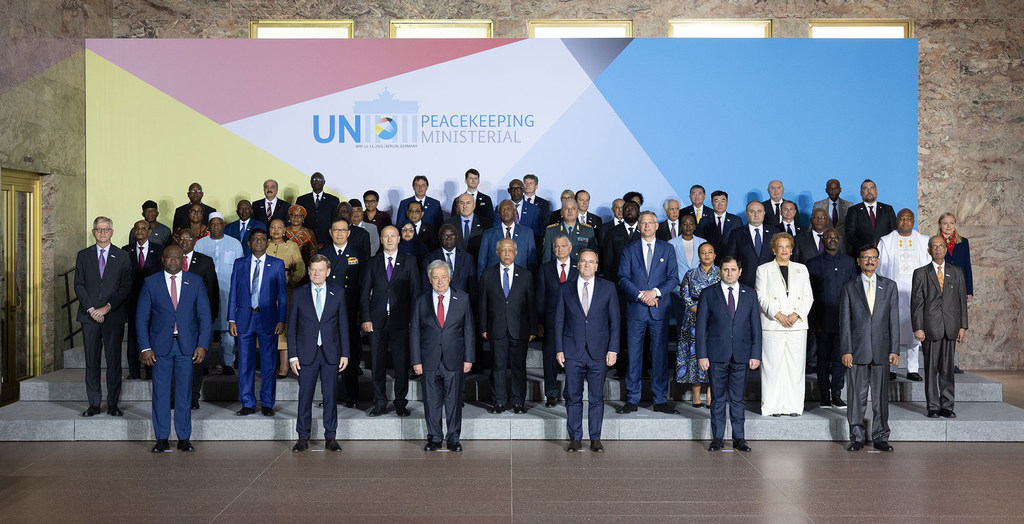
Addressing the UN Peacekeeping Ministerial 2025 in the German capital, the Secretary-General told dozens of ministers from more than 130 countries that peacekeepers remain key to “help countries move from conflict to peace.”

“In trouble spots around the world, blue helmets can mean the difference between life and death,” he insisted. “They are also a clear demonstration of the power of multilateral action to maintain, achieve and sustain peace.”

Despite the proven value of peacekeeping missions in ensuring a durable peace in countless countries from Cambodia to Liberia and Timor Leste, Mr. Guterres warned that today’s challenges have made this task much harder.

“We are now facing the highest number of conflicts since the founding of the United Nations and record numbers of people fleeing across borders in search of safety and refuge,” he said, before alluding to additional obstacles caused by an absence of political support for peacekeeping mandates.

The UN’s peacekeeping budget runs on a July-June cycle and has unpaid arrears of $2.7 billion.

Practical approach

To counter this and in the face of “dramatic financial constraints” now affecting the UN in its entirety, the Secretary-General announced an urgent review of operations to inspire a new peacekeeping model that is “fit for the future.”

In coming years, “a clear exit strategy” for peacekeepers will be key, Mr. Guterres said, as well as working with Member States and the Security Council “to ensure that any new mandates “are prioritized and achievable with the resources available.”

Other clues about what UN peacekeeping 2.0 could look like post-reform might be gleaned from the missions that the UN chief referred to in his speech in Germany.

Active missions such as UNIFIL in Lebanon have already shown that it is possible to adapt to today’s challenges while still ensuring peace and aid deliveries, Mr. Guterres noted.

And in a nod to MINUSCA in the Central African Republic, the Secretary-General highlighted its work in protecting civilians “and assisting the government to extend its reach beyond the capital where people are in desperate need.”

In the Democratic Republic of the Congo, too and despite ongoing fighting there, peacekeepers from MONUSCO also remain in the field and protect vulnerable populations, the UN chief maintained.

As Member States prepared to announce financial pledges for peacekeeping on Wednesday, Mr. Guterres stressed that the overall budget for missions represented only 0.5 per cent of global military spending.

Peacekeeping “is only as strong as Member States’ commitment to it,” stressed Mr. Guterres.

Amid massive cuts to UN funding by Member States, it remains to be seen if the upbeat mood in Berlin translates into desperately needed financial support for the global body’s peacekeeping operations.

“UN peacekeeping today is more vibrant than ever,” insisted Boris Pistorius, Minister of Defence of Germany. “It is and will remain a cornerstone of international stability. Let us commit to making it even more effective for the sake of those who depend on it.”

Cutbacks

The UN chief’s push to streamline the global body comes a day after his call to push ahead with major efficiency improvements and cost-cutting in response to the chronic liquidity crisis caused by Member States falling into arrears.

Important as these sweeping structural reforms are – with potential staff downsizing of up to 20 per cent – they are not the answer to the failure of some countries to pay the Organization to fulfil the mandates they have given it, Mr. Guterres insisted.

According to information provided by the UN Controller to the General Assembly’s Fifth Committee (Administrative and Budgetary), only $1.8 billion has been received against the $3.5 billion regular budget assessments for 2025 – a shortfall of around 50 per cent.

In the budget line for unpaid assessments these amounted to $2.4 billion on 30 April, with the United States owing about $1.5 billion, China $597 million, Russia $72 million, Saudi Arabia $42 million, Mexico $38 million and Venezuela $38 million. An additional $137 million has yet to be paid by other Member States.

For International Tribunals, total contributions outstanding totalled $79 million on 30 April.

© Bundeswehr/Jana Neumann

At the 2025 UN Peacekeeping Ministerial in Berlin, Secretary General António Guterres underscored the vital role of UN peacekeeping and urged Member States to help shape peace operations fit for the future.

Source link