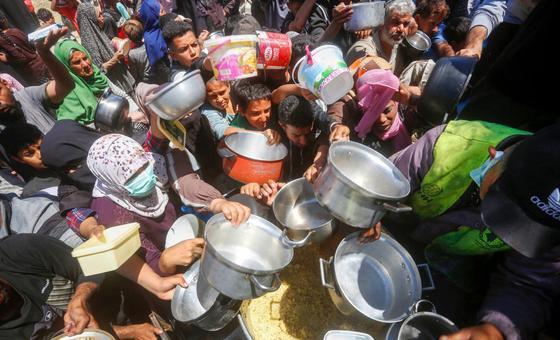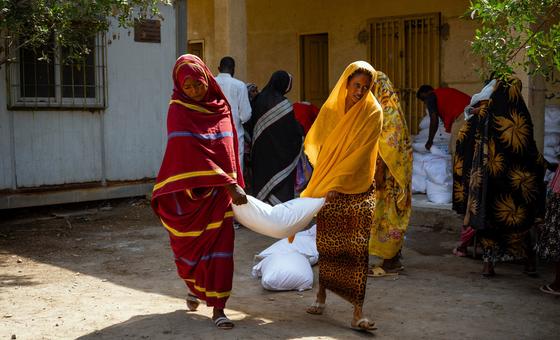
UN relief chief welcomes limited Gaza aid resumption – but it’s a ‘drop in the ocean’

Tom Fletcher said in a statement on Monday that nine UN trucks were cleared to enter the southern Kerem Shalom crossing earlier in the day.

“But it is a drop in the ocean of what is urgently needed…We have been reassured that our work will be facilitated through existing, proven mechanisms. I am grateful for that reassurance, and Israel’s agreement to humanitarian notification measures that reduce the immense security threats of the operation.”

Alarm over Israeli bombardment: UN chief

The UN Secretary-General on Monday expressed his alarm over the intensifying air strikes and ground operations in Gaza “which have resulted in the killing of hundreds of Palestinian civilians in recent days, including many women and children, and, of course, large-scale evacuation orders.”

António Guterres reiterated his call for the rapid, safe, and unimpeded delivery of humanitarian assistance at scale directly to civilians, in order to avert famine, alleviate widespread suffering, and prevent further loss of life.

Briefing reporters on Monday, UN Spokesperson Stéphane Dujarric said Mr. Guterres “welcomes the ongoing efforts by the mediators to reach a deal in Gaza. He has repeatedly warned that the continued violence and the destruction will only compound civilian suffering and heighten the risk of a broader regional conflict.”

He added that the Secretary-General “firmly rejects any forced displacement of the Palestinian population.”

Minimise risk of aid theft

Relief chief Fletcher said in his statement that he was determined to ensure UN aid reaches those in greatest need and make sure that any risk of theft by Hamas or other militants battling Israeli forces in the Strip amid a new offensive, would be minimised.

He said the UN aid coordination office, OCHA, had realistic expectations: “Given ongoing bombardment and acute hunger levels, the risks of looting and insecurity are significant.”

UN aid workers are committed to doing their jobs, “even against these odds,” he said, thanking humanitarian colleagues for their courage and determination.

Practical plan

“The limited quantities of aid now being allowed into Gaza are of course no substitute for unimpeded access to civilians in such dire need,” Mr. Fletcher continued.

The UN has a clear, principled and practical plan to save lives at scale, as I set out last week.”

He called on Israeli authorities to:

  • Open at least two crossings into Gaza, in the north and south
  • Simplify and expedite procedures together with removing quotas limiting aid
  • Lift access impediments and cease military operations when and where aid is being delivered
  • Allow UN teams to cover the whole range of needs – food, water, hygiene, shelter, health, fuel and gas for cooking

Ready to respond

Mr. Fletcher said to reduce looting, there must be a regular flow of aid, and humanitarians must be permitted to use multiple routes.

“We are ready and determined to scale up our life-saving operation Gaza and respond to the needs of people, wherever they are,” he stressed – calling again for the protection of civilians, a resumption of the ceasefire and the immediate and unconditional release of all hostages.

He concluded saying the operation would be tough – “but the humanitarian community will take any opening we have.”

Source link

Gaza: Israel ‘approaches UN’ to resume limited aid deliveries, says aid agency

“We have been approached by Israeli authorities to resume limited aid delivery, and we are in discussions with them now on how this would take place given the conditions on the ground,” OCHA said in a statement.

It is now 11 weeks since the Israeli authorities closed off all food, fuel and medicines to Gaza.

The decision has been widely condemned by the international community – including the UN Secretary-General – who on Sunday insisted that Israel’s “siege and starvation” of Gazans “makes a mockery of international law”.

According to news reports the Israel Government has taken the decision to resume “basic” levels of aid delivery to ensure against starvation, on the recommendation of the Israeli Defense Forces and in support of a renewed Gaza offensive.

“The situation for Palestinians in Gaza is beyond description, beyond atrocious and beyond inhumane,” António Guterres wrote online. “The blockade against humanitarian aid must end immediately.”

The aid blockade has created life-threatening hunger across Gaza – something that humanitarians have pointed out did not exist before the war started on 7 October 2023, sparked by Hamas-led terror attacks on Israel.

Basic principles

“I emphasize that the United Nations will not participate in any operation that does not adhere to international law and humanitarian principles of humanity, impartiality, independence and neutrality,” Mr. Guterres insisted, before underlining his “full support” for UNRWA, the largest aid agency in Gaza.

In an update on Monday, UNRWA reported that more than nine in 10 homes in Gaza have been damaged or destroyed. On Sunday the agency’s Commissioner-General, Philippe Lazzarini announced that more than 300 staff have been killed in the Gaza war. “The vast majority of staff were killed by the Israeli army with their children and loved ones: whole families wiped out,” he noted.

“Several were killed in the line of duty while serving their communities. Those killed were mostly UN health workers and teachers, supporting their communities.”

Ahead of unconfirmed reports on Monday that 20 aid trucks were expected to enter Gaza on Monday, UN agencies OCHA and the World Health Organization (WHO) warned that hungry and sick Gazans continue to live in terror because of ongoing bombardment.

In a new call to lift the blockade, both agencies rejected allegations of aid diversion to Hamas and highlighted the humanitarian nature of the goods being denied entry into Gaza, everything from children’s shoes to eggs, pasta, baby formula and tents.

How much war can you wage with this? asked OCHA spokesperson Jens Laerke.

Briefing Member States in Geneva, WHO Director-General Tedros Adhanom Ghebreyesus warned on Monday that the risk of famine “is increasing” as aid continues to be withheld deliberately by Israel.

Health system destroyed

The enclave’s health system is “already on its knees”, he insisted.

“Two million people are starving, while 116 000 tonnes of food is blocked at the border just minutes away,” he told the World Health Assembly.

In response to a resurgence of polio in Gaza, WHO negotiated a humanitarian pause for a vaccination campaign that reached more than 560,000 children, Tedros continued.

“We stopped polio, but the people of Gaza continue to face multiple other threats,” he said. “People are dying from preventable diseases as medicines wait at the border, while attacks on hospitals deny people care, and deter them from seeking it.”

At the same time, the WHO chief called out “increasing hostilities, evacuation orders, [the] shrinking humanitarian space and the aid blockade [that] are driving an influx of casualties”.

Tedros’s comments come as UN aid teams who remain committed to helping all Gazans confirmed intensifying bombing across the devastated Strip. “It has increased, of course,” said one worker, who wished to remain anonymous. They added that in the last 72 hours around 63,000 people have been uprooted.

Source link

UN humanitarian chief demands resumption of aid in Gaza

No aid has entered the enclave since Israel implemented a ban on 2 March and the entire population, more than two million people, is at risk of famine.

“As we demonstrated during the ceasefire this year – and every time we’ve been granted access – the United Nations and our humanitarian partners have the expertise, resolve and moral clarity to deliver aid at the scale necessary to save lives across Gaza,” said Mr. Fletcher.

Ready to move

Those proposing an alternative modality for aid distribution should not waste time, he added, as a plan already exists.

The document is “rooted in the non-negotiable principles of humanity, impartiality, neutrality and independence.” Furthermore, it is backed by a coalition of donors, as well as most of the international community, and ready to be activated if humanitarians are allowed to do their jobs.

“We have the people. We have the distribution networks. We have the trust of the communities on the ground. And we have the aid itself – 160,000 pallets of it – ready to move. Now,” he said.

‘Let us work’

Mr. Fletcher reiterated that the humanitarian community has done this before and can do it again.

“We know how to get our aid supplies registered, scanned, inspected, loaded, offloaded, inspected again, loaded again, transported, stored, protected from looting, tracked, trucked, monitored and delivered – without diversion, without delay, and with dignity. We know how to reach civilians in desperate need and stave off famine.”

He concluded the statement by saying “Enough. We demand rapid, safe, and unimpeded aid delivery for civilians in need. Let us work.”

UN aid office denounces attacks on Gaza hospital

OCHA reported that hostilities intensified overnight, with an attack by Israeli forces on the European Gaza Hospital in Khan Younis which killed and injured several people. 

A team from the World Health Organization (WHO) was also inside the hospital at the time.

The hospital premises were hit again on Wednesday morning, reportedly leading to additional casualties.

A ‘decimated’ health system

“These attacks not only further degrade Gaza’s already decimated healthcare system, but also further traumatize patients and medical staff at these facilities,” OCHA said.

The UN Office has documented at least 686 attacks impacting healthcare in the Gaza Strip since war erupted in October 2023, following the deadly Hamas-led attacks on Israel.

OCHA said escalating military activities and increasing explosive ordnance contamination are heightening safety risks for civilians, including aid workers, before stressing once again that civilians and healthcare facilities must always be protected.

First responders in northern Gaza reported that at least 80 people had been killed in the past day following Israeli strikes, including around 50 who died when homes were struck in northern Jabalia.

More displacement orders

Meanwhile, Israel has issued two new displacement orders in North Gaza since Tuesday night, following Palestinian rocket fire.  

Eight neighbourhoods have been affected and humanitarians have already observed some fleeing in search of relative safety.

More than 436,000 people are estimated to have been displaced to various areas of Gaza since 18 March.

Whether they leave or stay, civilians must be able to access the essentials for their survival,” OCHA said.

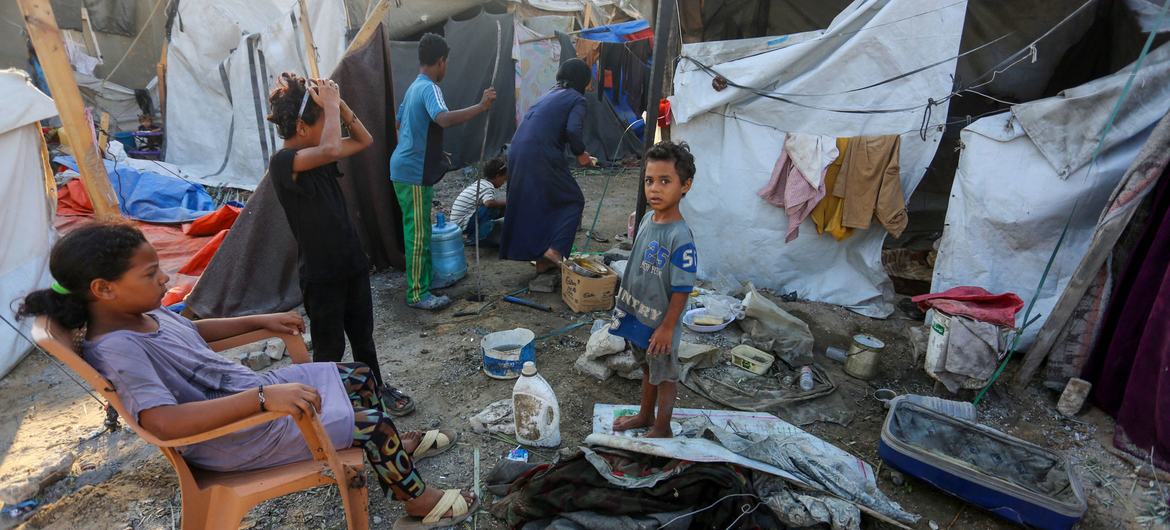
© UNICEF/Mohammed Nateel

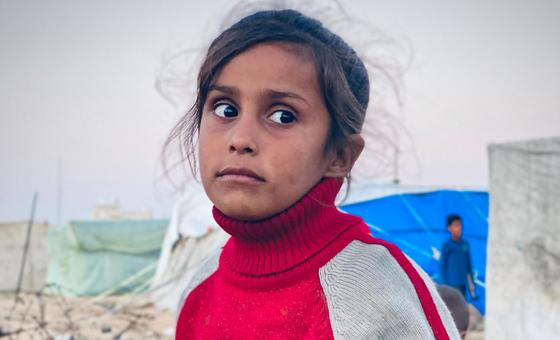
Displaced child in Gaza City

End aid blockade

The agency also continues to call for the immediate lifting of the blockade of Gaza. No cargo, including aid, has entered for more than 70 days.

The humanitarian situation is deteriorating, which has led to dwindling stocks in local markets and rising prices of the few supplies that remain available.

For example, during the first week of May, a single 25-kilogramme bag of wheat flour was being sold in Gaza City for the equivalent of more than $415 – a more than 3,000 per cent increase when compared with the last week of February.

“The blockade is also hampering the provision of hot meals in Gaza, with only about 250,000 individual meals now being provided each day through some 65 community kitchens,” OCHA said.

“This is compared to 25 April – less than three weeks ago – when 180 community kitchens were producing nearly 1.1 million meals on a daily basis.” 

Humanitarian partners have more than 171,000 metric tonnes of food in the region, ready for whenever the blockade is lifted.

This is enough to sustain Gaza’s entire population, roughly 2.1 million people, for up to four months.  

World News in Brief: Sudan refugees, aid for Syrian returnees, MERS alert in Saudi Arabia, Venezuela urged to end secret detentions

The UN refugee agency, UNHCR, reported on Wednesday that most of the new arrivals are women and children.

Many have come from Zamzam camp and the city of El Fasher, locations targeted by paramilitary Rapid Support Forces, who’ve been fighting forces of the military government for more than two years.

In Chad, the high numbers of those arriving are putting significant strain on overwhelmed resources.

Exhausted and victimised

Aid teams say that many refugees arrive exhausted after walking for days because they are unable to afford transport.

They report being victims of targeted attacks, looting and sexual violence.

Numerous children have been injured, families separated, and others remain missing, the refugee agency said.

Immediate needs in Chad include shelter, food, medical care and psychological support but the $409 million refugee response appeal is only 20 per cent funded.

Syria’s returnees desperately need help to start over

Syrians trying to rebuild their lives in their war-torn country urgently need the support of the rest of the world to help them start again, UN aid agencies said on Wednesday.

Hopes rose this week in Damascus following Donald Trump’s move to end punitive sanctions – but after more than 13 years of civil war that ended with the fall of the Assad regime last December, many communities today face a range of basic problems.

These include unreliable access to electricity, clean water and healthcare.

Records destroyed

The destruction of public records is also preventing returnees from accessing essential services or claiming housing and land rights, according to the UN migration agency, IOM.

Its Director-General, Amy Pope, insisted Syrians were resilient and innovative but that they needed help, now. “Enabling (them) to return to a country that is on the path to stability and progress is critical for the country’s future,” she insisted.

A new IOM report from more than 1,100 communities across Syria found that work is scarce, partly because farming and markets are still struggling to recover.

Shelter reconstruction is also needed urgently, while unresolved property issues continue to prevent people from rejoining their communities.

Since January 2024, the UN agency has recorded more than 1.3 million returnees previously displaced within Syria, in addition to nearly 730,000 arrivals from abroad.

WHO issues warning over deadly MERS outbreak in Saudi Arabia

A recent outbreak of Middle East Respiratory Syndrome coronavirus (MERS-CoV) in Saudi Arabia has raised concerns after two people died from the disease between March and April.

The World Health Organization (WHO) has released updated guidelines to help contain the outbreak, which has seen nine confirmed cases – seven of them in the capital, Riyadh. Several of those infected were healthcare workers who caught the virus from a patient.

MERS is caused by a zoonotic coronavirus, from the same family of viruses as COVID-19. While WHO estimates the fatality rate to be around 36 per cent, the true figure may be lower, as mild cases often go undiagnosed.

Despite the recent cases, the risk of wider spread remains moderate at both the regional and global levels, according to WHO.

MERS is primarily carried by dromedary camels and can be passed to humans through direct or indirect contact with infected animals.

Human-to-human transmission usually happens in healthcare settings, through respiratory droplets or close contact.

No vaccine, no cure

Much like COVID-19, MERS can range from no symptoms at all to severe respiratory illness, including acute respiratory distress — and in some cases, death. There’s currently no vaccine or specific treatment.

To stop the virus from spreading, WHO urges hospitals and clinics to step up infection prevention and control measures, especially where suspected cases are being treated.

Since MERS was first identified in 2012, it has caused 858 deaths across 27 countries in the Middle East, Africa and South Asia.

Call for Venezuela to end secret detention of political opponents

Top independent human rights experts have urged the Venezuelan authorities to stop the reported practice of holding political opponents incommunicado.

In an alert on Wednesday, they insisted that these “targeted detentions” were illegal and amounted to enforced disappearance, a major human rights violation if proved and potentially an international crime.

They maintained that using secret detention was a deliberate strategy by the State “to silence opposition figures…and to instill fear among the population”.

Lack of legal protection

The mission pointed to a widespread lack of “effective judicial protection” for civil society in Venezuela and accused State security forces of colluding with the Public Prosecutor’s Office.

The services allegedly responsible for detentions include the national intelligence service, the national guard and military counterintelligence.

The mission’s independent rights experts also maintained that criminal courts and the Constitutional Chamber of the Supreme Tribunal of Justice were also “complicit” by ensuring that the alleged crimes went unpunished.

The Fact-Finding Mission on Venezuela was created by the Human Rights Council in 2019; its members are not UN staff and they work in an independent capacity.

GAZA LIVE: Security Council to meet on aid crisis amid ‘critical risk of famine’ due to Israeli blockade

The Security Council is set to meet this afternoon at 3 PM in New York to discuss the deepening crisis in Gaza, where humanitarians warn of “a critical risk of famine” and aid shipments have been blocked for over 70 days. UN relief chief Tom Fletcher is expected to brief ambassadors. Follow live for key updates from UN Headquarters and reports from the region. App users can follow coverage here.

World News in Brief: Sudan aid update, child migrant deaths at sea, nursing shortages, invasive pest scourge

Port Sudan – the main entry point for humanitarian supplies and personnel into the country – came under attack for the ninth consecutive day. As the UN’s main humanitarian hub in Sudan, drone strikes on the coastal city have gravely impacted aid delivery.

Nonetheless, UN Humanitarian Air Service (UNHAS) flights were able to resume on 8 May, providing a continuation of a key humanitarian lifeline as the war between rival militaries for control of Sudan continues, UN Spokesperson Stéphane Dujarric confirmed.

Targeting of civilian infrastructure has sparked panic and displacement. The International Organization for Migration (IOM) reported last week that 600 people were displaced within Port Sudan alone because of the attacks.

Catastrophic situation in North Darfur

The UN Humanitarian Coordinator for Sudan, Clementine Nkweta-Salami, warned on Sunday that the situation in the North Darfur camps of Abou Shouk “is catastrophic.”

Although the UN and its partners continue to scale up their humanitarian response, both camps remain, in effect, cut off from aid.

Ms Nkweta-Salami issued an urgent call for a ceasefire and humanitarian pauses to allow life-saving deliveries to resume.

Call for action after deaths of migrant children at sea

Two young children, aged 3 and 4, have died from dehydration aboard a rubber dinghy found adrift in the central Mediterranean, the UN Children’s Fund (UNICEF) said on Monday.

The vessel, which departed Libya carrying 62 migrants including several children, had reportedly been stranded for days after its engine failed.

Refugees and migrants in a wooden boat are rescued near the Italian island of Lampedusa in the Mediterranean Sea.

According to survivors, the children had died nearly a day before rescuers arrived.

One additional passenger is believed to have drowned earlier in the journey. Many others onboard suffered severe chemical burns caused by contact with a mixture of seawater and spilled fuel – injuries which require urgent medical attention.

All surviving passengers were eventually rescued and transferred to Lampedusa by the Italian coast guard.

‘Devastating reminder’

Regina De Dominicis, UNICEF Regional Director for Europe and Central Asia, called the incident “another devastating reminder” of the deadly risks migrants face.

She stressed the need for coordinated search and rescue missions, and greater investment in support services for migrant families.

“The central Mediterranean remains one of the most dangerous migration routes in the world,” Ms. De Dominicis said. “Without immediate action, more lives will continue to be lost.”

UNICEF continues to call on governments to meet their obligations under international law and protect vulnerable children seeking safety.

Nursing workforce grows, but deep inequalities persist worldwide

The number of nurses around the world has increased in recent years, but a new UN report published on Monday shows that many countries and regions still face serious shortages, highlighting ongoing inequalities in access to nursing care.

Low-income countries are particularly affected, struggling with too few nurses to meet the needs of their growing populations, said the UN World Health Organization (WHO) which crunched the data.

Poor prospects at home

While these countries are training new nurses at a faster rate than wealthier nations, challenges such as rapid population growth and limited job opportunities are making it hard to close the gap, WHO added.

These imbalances in where nurses are working mean that millions still don’t have access to basic health services.

This is holding back efforts to achieve universal health coverage, protect global health, and meet international development goals linked to health.

“We cannot ignore the inequalities that mark the global nursing landscape,” said WHO Director-General Tedros Adhanom Ghebreyesus.

WHO is urging governments to create more nursing jobs and ensure they are fairly distributed, especially in communities where healthcare services are lacking.

Plant pests continue to threaten global food supplies

Protecting crops from pests is key to ensuring everyone has enough to eat, said the head of the UN Food and Agriculture Organization (FAO) on Monday, who stressed that access to food is a basic human right.

Each year, around 40 per cent of the world’s crops are lost to plant pests and diseases, causing over $220 billion in economic damage.

Invasive pests turn up the heat

Migratory pests like locusts and armyworms are among the biggest threats, especially in regions already hit hard by conflict and climate change.

Countries in the Near East and North Africa – including Algeria, Libya and Tunisia – are currently dealing with a serious outbreak of desert locusts that began in the Sahel.

These insects destroy crops and pastureland, putting food supplies for both people and animals at risk, and threatening the survival of farming communities.

“No country can face these challenges alone,” said FAO Director-General QU Dongyu, at a high-level conference in Italy marking the International Day of Plant Health.

He called for greater international cooperation and more funding to tackle cross-border pests and diseases.

Source link

World News in Brief: ‘Massive’ needs in Sudan, DR Congo aid shortfall, support for Congolese refugees and Angola cholera relief

The UN estimates that in the past few weeks, over 330,000 people have fled into Tawila after the Rapid Support Forces (RSF) launched violent attacks in the Zamzam and Abu Shouk displacement camps and in El Fasher, the regional capital. 

Over 100,000 people also remain trapped in El Fasher. 

‘Massive’ humanitarian needs

Since the beginning of the civil war in Sudan in April 2023, over 18,000 civilians have been killed and over 13 million have been forced from their homes. 

According to UN estimates, over 30.4 million Sudanese are in desperate need of humanitarian aid. 

The World Food Programme (WFP) has provided food assistance to over 300,000 people from the Zamzam displacement camp. Yet, UN Humanitarian Affairs Coordinator Tom Fletcher noted on Thursday that needs remain “massive” in the region. 

“Our humanitarian colleagues also underscore the urgent need for stepped-up, flexible funding to sustain and expand life-saving support for people in need in North Darfur and elsewhere in Sudan,” said UN Deputy Spokesperson Farhan Haq, briefing reporters on Friday. 

However, with ongoing drone strikes in Port Sudan, the main entry point for humanitarian supplies, and increasing violence in North Darfur, providing life-saving assistance has become increasingly difficult. 

“We call once again on all parties to facilitate safe, unhindered and sustained access to the area, via all necessary routes,” Mr. Haq said. 

© UNICEF/Jospin Benekire

A displaced family sit in front of their makeshift shelter in Goma, North Kivu province, DR Congo.

DR Congo: Dire impact of funding cuts amidst cholera outbreak   

Funding shortfalls have forced the humanitarian community to re-prioritise its response plan to alleviate the crisis in the Democratic Republic of the Congo (DRC), the UN aid coordination office OCHA said on Friday. 

Nearly seven million people have already been forcibly displaced by violence since advances by M23 rebels earlier this year.

While the 2025 UN humanitarian plan aims to provide life-saving interventions to 11 million people across the DRC at a cost of $2.5 billion, only $233 million has been received so far. 

Despite escalating needs in the wake of the crisis in the east of the country, “that’s only half the amount we had secured by this time last year,” Farhan Haq told journalists in New York.

Congolese health authorities are facing shortages of medical supplies as the DRC is now facing a cholera outbreak in six provinces.

OCHA is calling for greater protection of civilians in conflict-affected areas, and more support to prevent the collapse of essential services and address the root causes of the crisis.

UN fund allocates over $4 million to support Congolese refugees, Angola cholera outbreak

Two new allocations from the UN Central Emergency Response Fund (CERF) will support Congolese refugees in Uganda and efforts to combat a deadly cholera outbreak in Angola. 

UN Emergency Relief Coordinator Tom Fletcher released the funding on Friday.

More than 60,000 people have fled violence in the Democratic Republic of the Congo (DRC) for neighbouring Uganda since January.

The first allocation, for $2.5 million, will allow the UN and partners to provide life-saving assistance to over 40,000 refugees, including clean drinking water, food, healthcare and nutrition support.

The $1.8 million CERF contribution in Angola will support the urgent response to the country’s worst cholera outbreak in two decades.

Since the beginning of the year, the outbreak has spread to 17 out of 21 provinces, with more than 18,000 cases and 586 deaths reported as of 7 May. 

The funding will go towards scaling up the response and helping to prevent further spread of the disease. 

Source link

Gaza: UN agencies reject Israeli plan to use aid as ‘bait’

UN Children’s Fund (UNICEF) spokesperson James Elder insisted that the Israeli proposal to create a handful of aid hubs exclusively in the south of the Strip would create an “impossible choice between displacement and death”.

The plan “contravenes basic humanitarian principles” and appears designed to “reinforce control over life-sustaining items as a pressure tactic”, he told journalists in Geneva. “It’s dangerous to ask civilians to go into militarized zones to collect rations…humanitarian aid should never be used as a bargaining chip”.

The Gaza Strip has been under a complete aid blockade for more than two months and humanitarians have warned repeatedly that food, water, medicines and fuel have been running out.

Kids and elderly at risk

If the Israeli plan were to happen, Gaza’s most vulnerable individuals – the elderly, children with disabilities, the sick and the wounded who cannot travel to designated distribution zones – would face “horrendous challenges” retrieving aid, the UNICEF spokesperson maintained.

The Israeli aid distribution blueprint presented to UN humanitarians envisages only 60 aid trucks per day entering Gaza – “one-tenth of what was being delivered during the ceasefire” between Israel and Hamas which held from 19 January to 18 March.

“It’s not nearly enough to meet the needs of 1.1 million children, 2.1 million people,” Mr. Elder insisted. “There is a simple alternative: lift the blockade, let humanitarian aid in, save lives.”

Thousands of trucks in limbo

Stressing the success of the UN-led aid scale up during the ceasefire, humanitarian affairs coordination office spokesperson Jens Laerke urged the Israeli authorities to “facilitate the aid that we and our partners have available just a few kilometres away” just outside Gaza.

UNRWA, the largest aid provider in the Strip, said that the UN agency has “over 3,000 trucks of aid” that are stuck outside Gaza.

Juliette Touma, Director of Communications, deplored the fact that such a “big dollar figure” was going to waste, when the food could be reaching hungry children and when medicine could be used to treat people with chronic diseases.

“The clock is ticking. The gates must reopen, the siege must be lifted as soon as possible,” she insisted, while calling for the release of Israeli hostages and a return to a standard flow of humanitarian supplies.

Inside Gaza, aid teams warn that the situation is desperate. “Even those [food] lines are now gone because food is running out,” said UNRWA’s Ms. Touma.

Nothing left to queue for

In an update on Thursday, OCHA said that more than 80 community kitchens have been forced to shut since late April, owing to the lack of supplies. This number is rising “by the day”, fuelling “widespread” hunger in Gaza, the UN aid coordination office said.

Rebutting Israeli allegations that aid reaching Gaza has been diverted by militant groups, both Ms. Touma and UN World Health Organization (WHO) spokesperson Dr. Margaret Harris described “end-to-end” systems put in place to counter this risk.

“Our supplies are reaching the health facilities they’re meant to serve,” said Dr. Harris, adding that the UN health agency had not witnessed any aid diversion within the health care system.

“It is not about failure of aid delivery within Gaza. It is about not being allowed to bring it in,” Dr. Harris concluded.

In a further note of caution about the Israeli plan, UNICEF’s Mr. Elder insisted that the proposed use of facial recognition as a precondition to access aid ran against all humanitarian principles to “screen and monitor beneficiaries for intelligence and military purposes”.

He recalled that the ceasefire earlier this year had resulted in a “huge” improvement in children’s nutrition.

“It meant food in the markets, repaired water systems…It meant people could access health care safely. It meant health care facilitators had medicines that they need.”

‘Boastful’ denials of aid

Fast forward to today and food, water, medicines – “everything for a child to survive” – is being blocked, Mr. Elder said — “and in many ways, boastfully blocked”.

The UNICEF spokesperson also expressed concern that the Israeli plan risks separating family members “while they move back and forth to try and get aid” from the designated locations in a territory that “lacks any safety” amid ongoing bombardments.
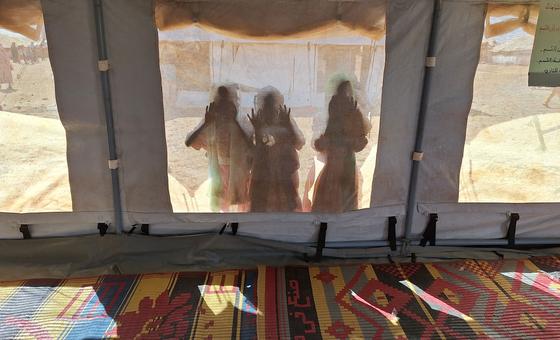
Source link

Port Sudan: Aid officials call for greater protection as drone attacks continue

The escalation is occurring as war grinds on between the Sudanese Armed Forces (SAF) and the paramilitary Rapid Support Forces (RSF), who appear to be targeting airports in each other’s areas of control.

“Very concerned by ongoing drone strikes on Port Sudan,” UN Emergency Relief Coordinator Tom Fletcher tweeted on Wednesday. 

“International humanitarian law must be respected. Constant care must be taken to spare civilians and civilian infrastructure.”

Suffering will worsen

The latest strikes in Port Sudan took place early on Tuesday morning, reportedly targeting the international airport and other infrastructure, including a fuel storage facility and a power transformer. 

The UN Resident and Humanitarian Coordinator in Sudan, Clementine Nkweta-Salami, issued a statement that day, saying the attacks “will deepen humanitarian suffering and needs, as well as exacerbate the already severe access and logistical challenges that humanitarian actors face in the delivery of urgently needed aid to the rest of the country.” 

She underlined that the airport is a “lifeline for humanitarian operations” as it is the primary entry point for aid personnel, medical supplies and other life-saving relief. 

“Moreover, the availability of fuel in Port Sudan is critical to the dispatch of humanitarian supplies to areas across Sudan in dire need of assistance,” she added.

She stressed that damage to critical infrastructure could also disrupt supply chains and increase the price of basic goods, thus worsening what is already the world’s largest humanitarian crisis.

Displacement and aid suspension

Drone attacks have also affected Kassala and River Nile states, according to the UN humanitarian affairs office OCHA.

Earlier this week, strikes near the airport in Kassala displaced about 2,900 people and led to the temporary suspension or relocation of some aid activities.

Meanwhile, River Nile state is still facing a power blackout following a drone strike on the transformer station in Atbara on 25 April. The outage is contributing to growing fuel and bread shortages and long lines at gas stations and bakeries.

Cease hostilities now

Ms. Nkweta-Salami noted that since January, attacks on infrastructure across Sudan, such as power stations, water sub-stations, and oil refineries, have caused widespread electricity outages and disrupted access to essential services, including safe drinking water, healthcare and food supplies. 

These are serious violations of international humanitarian law and “reflect a consistent failure to comply with the principles of distinction, proportionality and precaution,” she said. 

“Every measure must be taken to spare civilians and civilian objects,” she said. “Once again, I call on all those involved in this conflict to cease hostilities.”

Source link

DR Congo aid operation reaches Beni with food supplies for thousands

The UN World Food Programme (WFP) said that trucks packed with cereals, beans and cooking oil reached the city of Beni in North Kivu province from neighbouring Uganda, amid clashes between Rwanda-backed M23 rebel fighters and Congolese forces.

Aid for 140,000

WFP said that it intends to use the thousands of tonnes of relief supplies transported to warehouses in Beni to help around 140,000 people living in Lubero territory, south of the city of Butembo.

Violence escalated on 2 May across Lubero territory, uprooting some 30,000 people, according to the UN aid coordination office, OCHA.

The development comes amid ongoing peace talks in Qatar between the DRC Government and the M23 rebels. At previous talks in April, both sides pledged to work towards peace.

Amid rampant insecurity caused by proliferating armed groups, the Rwandan-backed M23 rebels have been at war for years with the Congolese army and allied forces in the mineral-rich region. In 2021, negotiations between the group and Kinshasa collapsed.

January offensive

Hostilities ramped up in January this year when M23 fighters captured Goma, the capital of North Kivu Province. A month later they seized Bukavu, the capital of South Kivu and threatened to take Kinshasa, on the other side of the huge country.

Since then, ongoing fighting has caused mass displacement, killed more than 7,000 people and fuelled fears of regional conflict.

A total of 21 million people need humanitarian assistance in DRC today. UN aid teams and partners remain on the ground to help and have condemned the looting of aid warehouses by armed groups which have destroyed food and medicine.

Source link

Gaza: UN aid teams reject Israel’s ‘deliberate attempt to weaponize aid’

It appears to be a deliberate attempt to weaponize the aid and we have warned against that for a very long time. Aid should be provided based on humanitarian need to whomever needs it,” said Jens Laerke, spokesperson for UN aid coordination office, OCHA.

Speaking in Geneva, Mr. Laerke referred to a verbal brief delivered by Israeli authorities on Monday, in which they offered to deliver supplies through Israeli hubs under conditions set by the military, once the Government reopens crossings into Gaza.

The proposal came as part of Israel’s plans to expand its military offensive against Hamas, including the “capture” of the Gaza Strip and a reported comment by Israeli Finance Minister Bezalel Smotrich that Palestinian territory will be “entirely destroyed”.

Attempted ‘shut down’ of UN aid system

Israeli officials have sought to shut down the existing aid system run by 15 UN agencies and 200 NGOs and partners,” Mr. Laerke maintained.

The Israeli cabinet’s vow to escalate the war will force Gaza’s more than two million people to move to the south of the Strip once again.

After 19 months of conflict, the entire enclave has suffered the impact of the months-long border blockade.

The Israeli decision to cut off the entry of humanitarian supplies to the enclave is reportedly to pressure Hamas to release the remaining hostages taken in Hamas-led terror attacks on 7 October 2023 that sparked the war.

Humanitarians have condemned the border closures stating the policy violates international law and risks fuelling famine.

Today in Gaza, UN partners working in the food sectors have distributed all they had and have no more to give. Mr. Laerke reported testimonies of colleagues on the ground who observed “people rummaging through garbage, trying to find something edible. That is the harsh, brutal, inhuman reality of the situation.”

Grave health impact

Since the beginning of 2025, nearly 10,000 children with global acute malnutrition have been admitted for outpatient and inpatient treatment, according to the UN World Health Organization (WHO). That number includes 1,397 with severe acute malnutrition.

Once you get to that stage, without treatment, you will die,” warned Dr. Margaret Harris, spokesperson for the UN health agency.

The WHO official noted that fewer children are being treated in partially functioning hospitals than expected, most probably because they cannot access care.

According to WHO data, one in five children does not complete their treatment because of the displacement and chaotic situation they face.

The lack of water and sewage infrastructure is also causing a worrying spike in acute watery diarrhoea. Skin diseases are also on the rise because people simply do not have enough water to wash themselves.

Meanwhile, Mr. Laerke continued to call on all combatants and those involved in mediation to continue pushing for a permanent ceasefire and the immediate and unconditional release of hostages.

“It is a horrible crime of war to take hostages and use them as some kind of bargaining chip,” he said. “On the other hand, you [cannot also] withhold aid to civilians as a bargaining chip on the other side of the board game.”

World News in Brief: Deadly attacks in South Sudan and Ukraine, World Court rejects Sudan case, lifesaving aid in Yemen

According to the UN relief coordination office (OCHA), the hospital in Old Fangak was struck early Saturday, killing seven civilians and injuring at least 20 more. The attack also destroyed vital supplies and forced the withdrawal of aid workers, leaving the town’s population without access to critical care.

“People in these areas are already battling flooding, food shortages and disease,” said Marie-Helene Verney, the UN’s acting Humanitarian Coordinator in South Sudan.

Too many lives at risk

“The destruction of critical health infrastructure and continued fighting puts innocent South Sudanese lives at risk.”

The bombing follows a wave of similar attacks in Upper Nile state, where health facilities in Ulang and Nasir have been targeted in recent months. The latest strike has heightened fears of renewed conflict as political and ethnic tensions rise nationwide.

The UN is now airlifting essential supplies to the area, but access remains limited. The violence has displaced over 130,000 people in the past two months, and aid agencies warn that South Sudan’s broader $1.7 billion humanitarian plan remains only 16 per cent funded.

Large scale attacks on densely populated cities across Ukraine

The UN’s top humanitarian official in Ukraine on Monday condemned a series of Russian strikes this weekend on densely populated towns and cities.

Between Friday and Monday, at least 12 people were killed and more than 100 others injured in attacks thar targeted Kharkiv, Kyiv and Cherkasy, and other regions in Ukraine.

These attacks also damaged homes, schools, a hospital and other civilian infrastructure, according to local authorities and partners, UN Deputy Spokesperson Farhan Haq told journalists in New York.

In the aftermath of the strikes, “humanitarian organizations provided first aid, psychosocial support, emergency shelter kits, repair materials, meals and drinks,” Mr. Haq said.

In the Kharkiv region, a fire triggered by a strike near the city of Izium on Sunday, burned 85 hectares of land and damaged over a dozen buildings. There were no casualties reported, Mr. Haq added.

Meanwhile, UN agencies alongside partners reached 600,000 people so far this year with first aid, medical transport, primary care and mental health support, including at transit centres for displaced people.

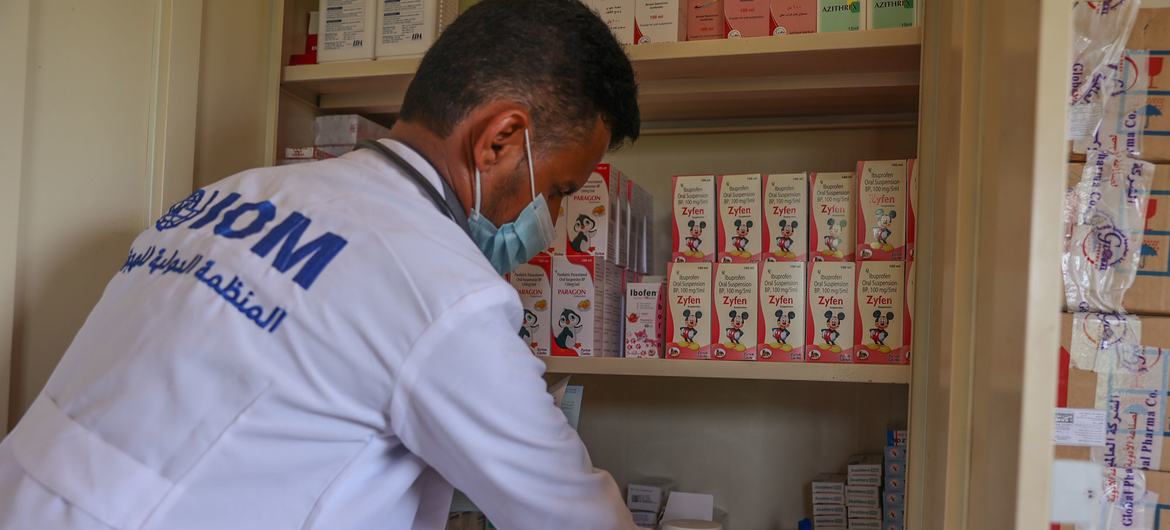
An IOM-supported health worker in Yemen accesses medical supplies.

Yemen: UN delivers lifesaving medical supplies

The UN International Organization for Migration (IOM) on Monday delivered critical medical supplies to seven health facilities in Yemen, where a collapsing health system and chronic shortages continue to endanger millions.

With support from the Government of the United Kingdom, IOM shipments are reaching hospitals and clinics in Aden, Lahj, Shabwah, Al Bayda and Sana’a – facilities serving both migrants and local communities.

“Every day, our teams see the impact of empty medicine shelves and overwhelmed clinics, on families and entire communities,” said Abdusattor Esoev, head of IOM in Yemen.

“By delivering essential supplies and supporting frontline staff, we are not just responding to urgent needs – we are keeping health services running for those who have nowhere else to turn.”

Crisis on crisis

The intervention comes amid an alarming health crisis.

Nearly 20 million people in Yemen require medical assistance in 2025, but over half of the country’s health facilities are only partially functioning or have shut down altogether. Funding gaps have left 382 facilities unsupported, forcing many to close or drastically cut services.

IOM’s assistance includes essential medicines, surgical equipment and infection prevention tools, as well as infrastructure repairs and support for health workers.

For many in the strife-torn country, IOM-supported clinics remain the only source of free medical care.

ICJ rejects Sudan’s genocide case against UAE

The International Court of Justice (ICJ) has rejected Sudan’s case accusing the United Arab Emirates (UAE) of complicity in genocide in Darfur, citing a lack of jurisdiction.

In the decision, the UN’s top judicial body ruled on Monday by a vote of 14 to two that it could not proceed with the case brought by Sudan under the Convention on the Prevention and Punishment of the Crime of Genocide (Genocide Convention) and declined to impose any provisional measures, as Sudan had requested.

The Court also removed the case from its general list by a vote of nine to seven.

“Having come to the conclusion that it manifestly lacks jurisdiction, the Court is precluded from taking any position on the merits of the claims made by Sudan,” the ruling stated.

Complicity charge

Sudan had accused the UAE of backing the paramilitary Rapid Support Forces (RSF), alleging its support amounted to complicity in genocidal acts against the non-Arab Masalit population in West Darfur.

The conflict between the RSF and the Sudanese army has claimed thousands of lives and displaced over 12.7 million people since April 2023.

The Court noted that while it could not hear the case, all States remain bound by their obligations under the Genocide Convention.

Source link

Sudan drone attacks raise fears for civilian safety and aid efforts

These attacks appear to be the latest in a series of retaliatory military operations, conducted by the Rapid Support Forces and the Sudanese Armed Forces, targeting airports in each other’s areas of control,” UN Deputy Spokesperson Farhan Haq told reporters in New York on Monday.

The fighting between troops of the military Government and former allies-turned-rivals for power, the RSF, began in April 2023. The war has devastated much of the country, killing thousands and displacing over 8.6 million people, according to UN agencies.

As conflict rages in Khartoum, Darfur, and other areas, Port Sudan on the Red Sea coast has remained a relative safe haven and a key hub for UN and international relief efforts.

Multiple drone strikes

The RSF carried out drone attacks on a military base and other targets on Sunday near the airport – and on Monday, there was a second series of attacks targeting fuel depots in the eastern part of Port Sudan, according to latest news reports.

© UNICEF/Ahmed Mohamdeen Elfatih

Mothers tend to their children suffering from severe acute malnutrition at a hospital in Port Sudan.

The RSF has not so far claimed responsibility for Monday’s strikes which left fuel storage facilities ablaze in what the army characterised as an attack on civilian infrastructure.

The Secretary-General is “concerned with the recent reports of drone attacks on military and civilian infrastructure” in the area, which until now had largely been spared from the devastation of the year-long war.

Call for urgent dialogue

Mr. Haq stressed that the attack on Port Sudan was a “worrying development threatening the protection of civilians and humanitarian operations” in the city, which has become a lifeline for humanitarian aid across the country.

The Secretary-General “renews his call for urgent dialogue between the warring parties towards an immediate cessation of hostilities and an inclusive political process,” Mr. Haq said. “This is essential to prevent further escalation, protect civilians, and put Sudan back on a path towards peace and stability.”

On the humanitarian front, the UN’s aid coordination office OCHA said the drone strikes have not directly affected its operations in Port Sudan.

UN aid operations continuing

“None of our offices, premises or warehouses have been impacted, and we continue to carry out our regular operations,” Mr. Haq confirmed.

However, he added that the situation is being closely monitored, and that UN Humanitarian Air Service flights in and out of the city have been temporarily paused.

Beyond Port Sudan, recent strikes on power stations across Sudan have disrupted electricity and clean water supplies – worsening conditions for displaced families and returnees.

We call on all parties to this conflict to ensure that civilians and civilian infrastructure are not targeted,” the Deputy Spokesperson said. “Wars have rules, and international humanitarian law must be respected.”

© UNICEF/Ahmed Mohamdeen Elfatih

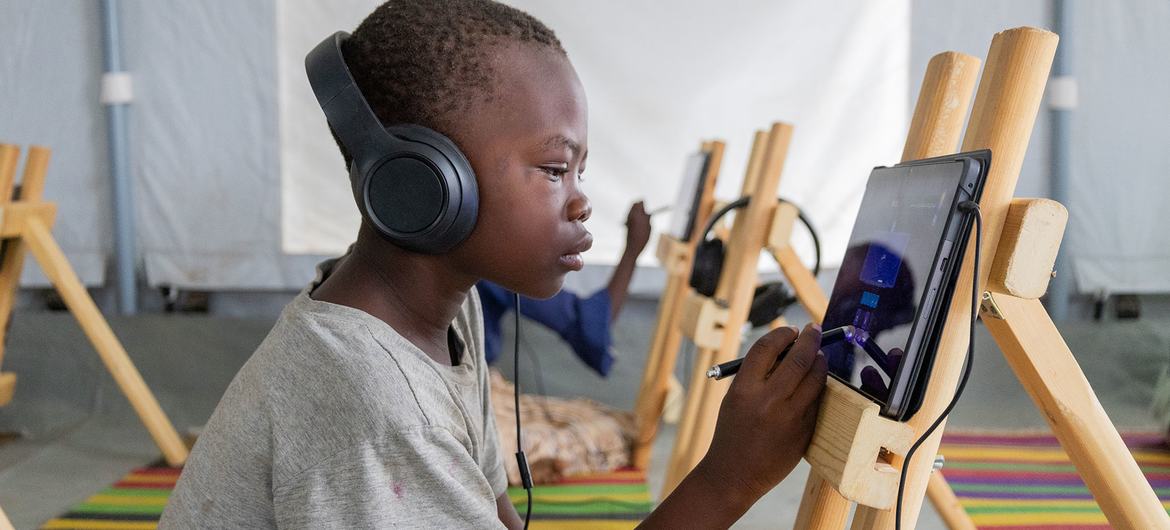
Children participate in an e-learning session at the Al Seniyaa internally displaced people’s gathering site in Port Sudan.

Gaza: ‘Worst-case scenario’ unfolds as brutal aid blockade threatens mass starvation

Speaking from Gaza City OCHA spokesperson Olga Cherevko told journalists in Geneva that a friend of hers “saw people burning a few days ago from the explosions – and there was no water to save them.”

Since all entry points into the war-torn enclave were “sealed by the Israeli authorities for the entry of cargo” in March, the “worst-case scenario” was triggered, Ms. Cherevko said: supplies are depleting while the conflict rages on.

Food stocks have now mainly run out, water access has become impossible,” she told journalists in Geneva.

As the veteran aid worker spoke, she noted that a “very violent fight” for access to water was taking place downstairs from her, with people throwing rocks and firing shots at a water truck which was pulling away.

No childhood

The OCHA spokesperson said that every day she was seeing children “who have been deprived of their childhood for many months,” and elderly people “rummaging through piles of trash” in search of food and combustible material for cooking, in the absence of fuel.

During a visit on Thursday to Patient Friends Hospital, a paediatric hospital in Gaza City which had been attacked several times during the war, she heard reports of rising malnutrition rates.

Hospitals report running out of blood units, as mass casualties continue to arrive,” Ms. Cherevko stressed, while precious fuel is being rationed.

Malnutrition cases among children in Gaza are increasing due to a lack of food.

Running on empty

“Gaza is inching closer to running on empty,” she added.

Ms. Cherevko said that UN humanitarians are “in constant contact” with the Israeli authorities and are advocating for border crossings to reopen. “We have mechanisms that mitigate diversion [and] ensure that aid reaches the people it’s intended to reach,” she said.

“We are ready to resume delivery at scale as soon as the crossings reopen, Ms. Cherevko insisted. “We stand by our pledge to remain principled and continue relieving people’s suffering, wherever they may be.”

In an appeal to the Israeli authorities on Thursday, the UN’s top humanitarian official and OCHA chief Tom Fletcher said, “Lift this brutal blockade. Let humanitarians save lives”.

Mr. Fletcher reaffirmed the urgent need for the release of hostages taken by Hamas on 7 October 2023, who “should never have been taken from their families” and stressed that “aid, and the civilian lives it saves, should never be a bargaining chip”.

Gazans queue for food in January 2025 when it was more widely available in the enclave.

Generational horror

Ms. Cherevko said that over the past one and a half months, 420,000 people have been “once again forced to flee, many of them with only the clothes on their backs, shot at along the way, arriving in overcrowded shelters, as tents and other facilities where people seek safety, are being bombed”.

“I worry that five, 10, 20 years from now, we will look at our children and grandchildren in shame and we will not be able to explain to them why we could not stop this horror,” she concluded.

How much more blood must be spilled before enough becomes enough?”

Source link

International aid: ‘The money isn’t coming back anytime soon’, Fletcher warns

UN News: You have said that that policymakers who signed off on aid cuts should come to Afghanistan to see the effect they’re having on the population. You said the effect of aid cuts is that millions die. Do you use this kind of blunt language when you’re talking to these policymakers in private?

Tom Fletcher: Yes, I do. Of course, there is a bit of a time lag before you really see the impact of the cuts, but here, 400 clinics closed in the last few weeks. That has a real-world impact and it’s become much more real for me on this trip.

I’ve just come from a meeting with NGOs, and they’re laying off half their staff. The local NGO’s that we’re keen to protect in the midst of all this, have been the hardest hit.

We try and find different ways to communicate this in slightly gentler terms, but ultimately, of course, people will die as a result of these cuts.

That’s the great tragedy at the heart of it now.

UN News: How do the politicians respond?

I think there are broadly two camps here. You’ve got politicians who are doing this really reluctantly, forced to make really tough decisions because their economies are struggling and because of pressures from taxpayers to do things differently. They know the importance of humanitarian efforts and they’re very sad about the choices they’re having to make.

Then there is another group of politicians who, I fear, celebrate, certainly in their public messages. They seem to boast about – and take credit for – aid cuts. That’s the group that I would love to bring to sit with a mother who has lost her child because she was forced to cycle pregnant to a hospital three hours away.

You show leadership on the world stage by being out there helping countries to deal with these challenges at source. I don’t know which of those arguments work with which constituencies, so we have to adapt and be creative in how we make the case.

We also have to be firm in defending what we do and take pride in the fact that the humanitarian community has taken millions out of poverty and saved hundreds of millions of lives.

UN News: You’ve become the UN emergency relief chief at a particularly tough time, in terms of ensuring the UN’s ability to help the most vulnerable. In February you announced 20 per cent cuts to your department. How will you make those cuts in a way that doesn’t make the job even harder?

Tom Fletcher: It’s rough. Really brutal choices are being made and the sector will probably shrink by one third. The money that’s been cut isn’t going to come back anytime soon, and there may be more funding cuts ahead.

We will be looking for new partners, and trying to convince the sceptics to bring the private sector in and change the public conversation around solidarity. We have to work with the money that we have, not the money that we need or the money that we wish we had.

I’m really positive about the way that Marco Rubio, the US Secretary of State, has talked about the need to protect life-saving aid. 

Dialogue is going on, I’m not giving up and I’m really positive about the way that Marco Rubio, the US Secretary of State, has talked about the need to protect life-saving aid. I really want to get into that conversation with him and see what his vision is for America’s role in saving lives around the world.

UN News: Given the current situation, are we going to have to completely rethink what aid entails and how it’s funded?

Tom Fletcher: We’re going to have to change. We have to preserve the best of what we’ve learnt and have confidence in what we’ve delivered so far, but we’re going through a process now that we call the “humanitarian reset”.

First of all, we’re becoming smaller and we’re trying to do that in a way that does as little damage as possible and minimises the hit to the essential life-saving work we do.

Alongside that, we’re becoming more efficient and smarter. I launched on my first day in office, a big efficiency drive across the sector.

The IASC, the body that coordinates our sector, has backed that up and actually taken it to the next level in terms of taking the layers out of the system and making sure we end the turf wars and focus on what we each do well, the extra value we bring, and ensure that we do much more at a local level, close to the communities we serve.

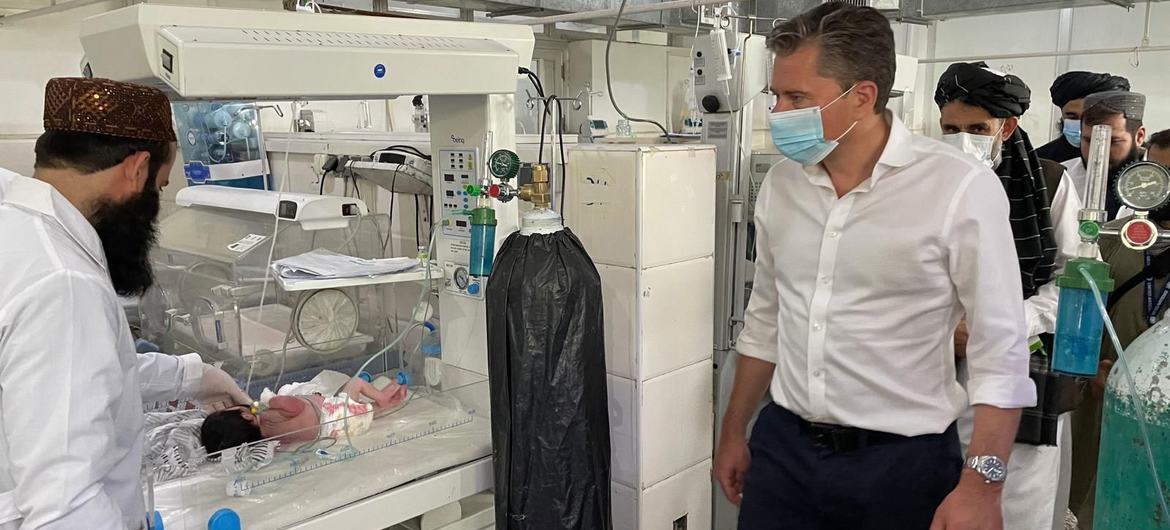
The UN relief chief Tom Fletcher, visits a hospital in Kandahar, Afghanistan.

UN News: Do many Member States still believe in the importance of international aid?

Tom Fletcher: Absolutely. A number of donors are staying solid despite the funding crises that they’re all facing. We’ve got new donors emerging and growing. I’ve been in The Gulf, and I was in China last week, and engagement there is deepening.

We’ve got new donors emerging, and engagement is deepening

We’ve got more innovative ideas about how to bring in the private sector and also I believe really strongly in the role of individuals in finding ways to ensure that we’re reaching wider movement beyond governments and Member States.

UN News: Returning to Afghanistan, the de facto authorities [The Taliban] have severely reduced access to education and employment prospects for women and girls. Are you able to have a constructive discussion about this with the regime?

Tom Fletcher: Yes, we are. There are two really core issues here for us. One is the role of women in humanitarian work: we simply cannot deliver without them. They are brilliant, brilliant colleagues, we rely on them completely and we couldn’t be here without them.

And the second is the wider issue around rights for women and girls, including education and the fact that millions of girls have had that right stolen from them over the last three years.

These are difficult conversations, but I come at this as a former diplomat, as someone who believes in dialogue, who believes in respect and trust and listening, and in recognizing that we have different cultures, different traditions, different heritages and different beliefs that I don’t hold.

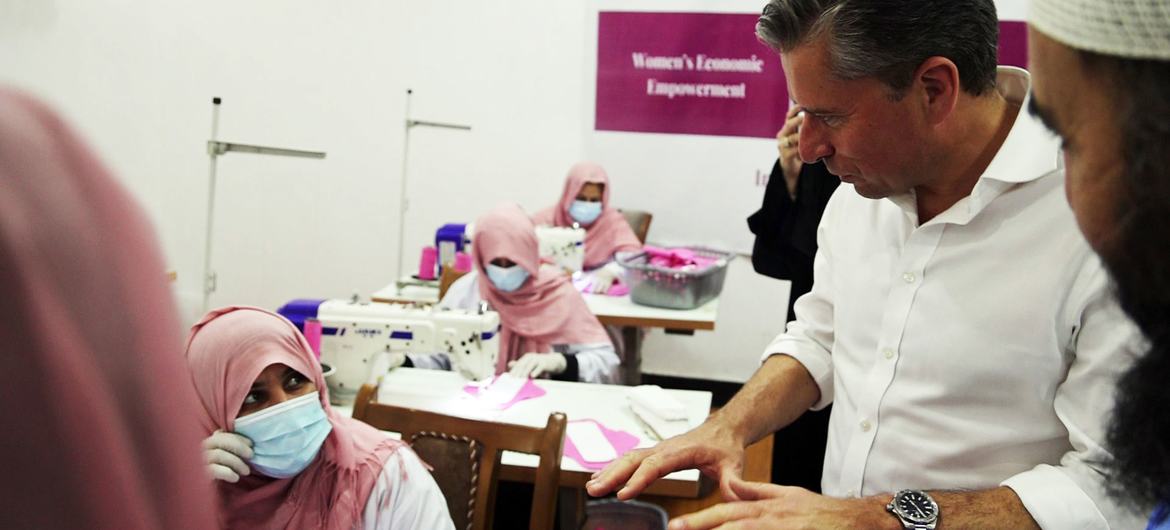
Tom Fletcher, the UN humanitarian meets women at an economic development programme in Afghanistan.

UN News: Before you began this job, did you have a goal in mind, that you want to achieve before the end of your mandate as the head of humanitarian affairs?

Tom Fletcher: The average head of OCHA lasts about three years, they burn through us pretty quickly. The travel schedule is very hectic and you’re dealing with the world’s worst crises so there’s a bit of wear and tear along the way.

It’s our job to save hundreds of millions of lives and to define everything we do against that yardstick.

So, my number one objective was to survive as long as possible, because I think it’s traumatic for an organization to get new people in, train them and have them up and running. Being around for a period of time, learning from the organization and from those we serve, and then putting that into action is a serious objective in itself.

I did come into it with an objective around the reform of the humanitarian sector, well before Donald Trump, Elon Musk and others started talking about efficiency and prioritization and cuts. I do believe that we can do this much more effectively and much closer to those we serve and so I was already determined to deliver that.

And then thirdly, the big one is ultimately about saving lives. I believe it’s our job to save hundreds of millions of lives and to define everything we do against that yardstick. 

Source link

First Person: Myanmar aid workers brave conflict and harsh conditions to bring aid to earthquake victims

Thein Zaw Win, Communications and Advocacy Analyst in the Yangon Office of the UN sexual and reproductive health agency (UNFPA) saw the devastating consequences of the quake during a week-long visit to the Mandalay region, one of the regions most severely affected by the disaster.

Thein Zaw Win, Communications and Advocacy Analy​st at UNFPA’s Yangon Office, speaks with​ a woman impacted by the recent earthquake in Mandalay, Myanmar.

“I was in Yangon when the earthquake struck. In the aftermath, news reports gradually began indicating that many cities had suffered significant casualties. Buildings, roads, homes, schools, and hospitals were reduced to rubble and people were trapped beneath the debris.

Communication systems were down, so I decided to travel to the affected areas and support the relief efforts.

Women and girls needed lifesaving support, including sexual and reproductive health services and maternal care, dignity kits, hygiene items, and other essential supplies as soon as possible.

Within 72 hours, the UNFPA country office had deployed a Rapid Response Team to deliver essential services to the affected population, working with partners on the ground.

The journey from Yangon to Mandalay usually takes about eight hours, but we struggled to get through, due to damaged roads and collapsed bridges. We had to find alternate routes and, at times, even navigate through the rugged fields beside the main road.

Now that the rainy season has started, the roads are even worse, and travelling has become increasingly difficult. It took us more than 10 hours to reach Mandalay.

A woman affected by earthquake receives relief items including UNFPA’s dignity kits during UN joint distribution in Sagaing, Myanmar.

In some areas of the city, debris blocked the roads. Tower blocks had collapsed and many areas had been reduced to complete rubble. Desperate families sought refuge in temporary shelters, on the streets, or in front of their damaged homes.

Tremors continued for several days. Frequent power outages during the night mean that some affected areas were plunged into darkness, making it unsafe to go anywhere. Reaching those affected and delivering aid under these conditions remains a considerable challenge.

My responsibility is to engage with communities affected by the disaster, and share their stories to a broader audience. It is also vital to raise awareness of the realities and needs on the ground so that we can secure support for emergency assistance. This is my mission.

I met a woman in Mandalay who visited our mobile clinic. She had lived in the city all her life but had never seen such devastation. Everything collapsed in a matter of seconds. She was deeply worried about the damage to healthcare facilities, as well as her ability to access medical care.

© UNOCHA/Myaa Aung Thein Kyaw

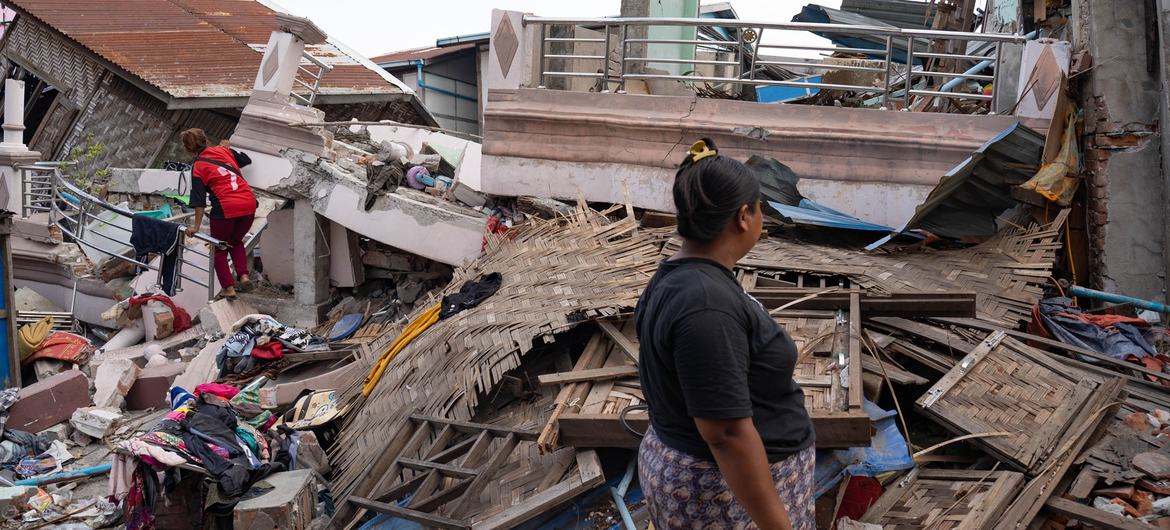
A woman in Mandalay, Myanmar, looks on at the devastation caused by the earthquake.

Amidst this crisis, the UNFPA team has provided services ranging from hygiene supplies, protection from gender-based violence, and mental health support for women and girls. They also support maternal and newborn care services. I saw for myself the unwavering resilience of humanitarian workers, and the way that UN agencies, civil society organizations, and NGOs work together.

Myanmar was already suffering from political instability and now it has been further devastated by this destructive earthquake. It is extremely difficult to deliver aid to communities in Sagaing and Mandalay, where armed conflict is ongoing.

In the present context, with monsoon conditions imminent, people are terrified of what this season may bring.

The country is also experiencing the impact of the decline in global aid funding.

UNFPA, like other UN agencies and humanitarian organizations, is dealing with constraints on resources, and we have issued an appeal for emergency assistance to support populations in critical need.

The suffering of women and children affected by the earthquake is profoundly distressing, and we need all of our strength and resilience to help them.

It is a heartbreaking experience to witness the despair in people’s eyes and to listen to their stories of loss, but we are trying to give them the dignity and hope they rightfully deserve in these difficult times.”

‘Recovery must move ahead’ in southern Lebanon, top aid official says

Imran Riza made the appeal following a visit to Bint Jbeil and Tyre districts on Tuesday.

What I saw in South Lebanon was both depressing and inspiring. The scale of destruction – to villages, health facilities, and water systems – is disturbing,” he said in a statement.

Fighting, ceasefire and escalation

The crisis stems from fighting that erupted between Hezbollah militants in Lebanon and Israeli forces following the 7 October 2023 Hamas-led attacks on Israel, which killed some 1,200 people.

Israel launched an incursion into southern Lebanon in late September 2024 and carried out airstrikes across the country that killed thousands and displaced nearly a million people. 

Last November, Lebanon and Israel signed a ceasefire agreement to end the fighting. 

It called for Israeli forces and Hezbollah militants to withdraw from the south, while the Lebanese military would redeploy to the region to guarantee the peace alongside troops from UN peacekeeping mission UNIFIL, who monitor the Blue Line of separation between the two countries. 

Since then, ceasefire violations have occurred and violence has escalated, including recent Israeli strikes on areas of Lebanon’s capital, Beirut, reportedly targeting Hezbollah.

‘No time to lose’

Mr. Riza described the people he met in the south as truly inspiring. 

It’s clear they want to return home, rebuild, and restart their productive lives,” he said.

“Everyone continues to feel a palpable sense of insecurity. Many still lack basics like water and electricity. Too many are still displaced, their homes flattened.”

He said people spoke of their need for peace, safe movement, basic services, and support to rebuild.

“They also shared the trauma they and their children have endured, and the importance of addressing mental health in the wake of what they have lived through,” he added.

The Humanitarian Coordinator stressed the critical need for sustained funding to restore water, electricity, healthcare, and education, and to assist people eager to get on with their lives.

“There is no time to lose – recovery must move ahead,” he said.

Diplomats reinforce support for UN mission

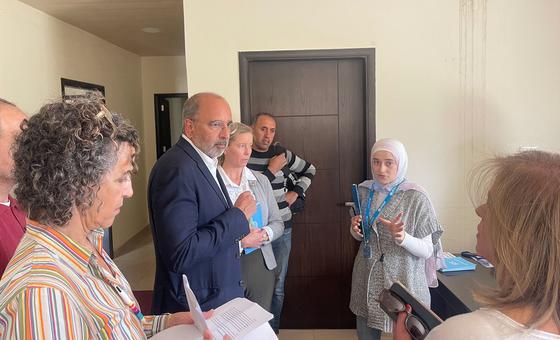
Meanwhile, diplomats from dozens of countries showed their solidarity with UNIFIL’s work in south Lebanon in a visit to the mission’s headquarters in Naqoura on Tuesday.

The diplomatic visit included representatives of 38 countries, including all five permanent members of the UN Security Council

Peacekeepers from 47 countries currently serve with UNIFIL, which was established in March 1978 to confirm Israel’s withdrawal from Lebanon. 

Its mandate was most recently defined in Security Council resolution 1701 (2006), which called for a full cessation of hostilities between Hezbollah and Israel following their 34-day war on Lebanese territory that year. 

An encouraging sign

UNIFIL Head and Force Commander, Lt. Gen. Aroldo Lázaro, welcomed the delegation and noted it would have been impossible to host the diplomats just a few months ago. 

Your presence here is an encouraging indication of the increased stability in the south and the progress made since the understanding on a cessation of hostilities came into effect on 27 November 2024,” he said. 

“The support of UNIFIL’s troop-contributing countries – and the countries who contribute in other ways – is essential to restoring stability to south Lebanon and along the Blue Line. I thank them and their peacekeepers serving on the ground for their continued contributions.”

The delegation also visited two UNIFIL positions along the Blue Line, near Marwahin and in Labbouneh. 

Ambassadors expressed their appreciation for the mission’s important work. 

Source link

Millions will die from funding cuts, says UN aid chief

“Cutting funding for those in greatest need is not something to boast about…the impact of aid cuts is that millions die,” warned Emergency Relief Coordinator Tom Fletcher.

Speaking from an overcrowded hospital in Kandahar in southern Afghanistan where three or four patients have to share a bed, Mr. Fletcher warned that the financial crisis has already forced UN aid teams to close 400 primary health centres across the country so far.

His warning echoes dire announcements of drastic cost-cutting measures in response to chronic – and now acute – funding shortfalls, including an end to selected aid programmes by numerous UN relief agencies. These include the World Food Programme (WFP), the World Health Organization (WHO), the UN Children’s Fund (UNICEF), the UN aid coordination office (OCHA), the UN refugee agency (UNHCR) and UNAIDS.

Life-or-death call

Back in Afghanistan, the reality of funding cuts continues to play out in its hospitals “where you can see doctors making the most horrific decisions about which lives to save and which lives not to save”, Mr. Fletcher said at Mirwais Regional Hospital.

The lack of investment in aid relief has also affected female Afghan health workers whose salaries are being cut by up to two-thirds, Mr. Fletcher continued. The plight of women in the country is well documented and has been condemned by the international community, having deteriorated following numerous prohibitive edicts issued by the de facto authorities who overran Kabul in 2021.

As part of his official visit to Afghanistan, Mr. Fletcher met de facto provincial governor Mullah Shirin Akhund to discuss the need to address Afghanistan’s humanitarian crisis. It comes after more than four decades of conflict that have left almost half the population – some 22.9 million people – needing humanitarian assistance to survive.

Women’s key role

In earlier talks during his official visit, Mr. Fletcher stressed that development was not possible without girls’ education and their full participation in the country’s economy.

Amid soaring malnutrition, a lack of basic services and dire economic forecasts, Afghanistan has few resources to cope with the arrival of a growing number of Afghan refugees sent back by neighbouring countries including Pakistan and Iran.

The scale of the pushbacks is enormous, with more than 250,000 Afghans returned in April alone, including 96,000 who were forcibly deported. On Tuesday, the UN refugee agency, UNHCR, voiced particular alarm over the fate of women and girls, who face increasing repression under Taliban rule.

While in Kandahar, Mr. Fletcher also visited a reception centre where the UN and humanitarian partners provide support, including health check-ups and cash. He said that the closure of hundreds of health facilities in the region had denied more than three million people access to primary care.

Gazans face hunger crisis as aid blockade nears two months

Both the UN agency that assists Palestine refugees, UNRWA, and the World Food Programme (WFP) report that food stocks are now exhausted, even as supplies of lifesaving assistance pile up at border crossings waiting to be brought in.

Humanitarians continue to warn that hunger is spreading and deepening in the enclave, amid the blockage, access constraints, ongoing Israeli military operations and a rise in looting.

Scarcity, sharing and shame

UNRWA shared the testimony of a woman called Um Muhammad who is staying at a shelter in Gaza City and prepares food for 11 family members daily. Although she still has some flour, most families nearby have already run out.

“When I knead and bake, I feel very ashamed of myself, so I distribute some bread to the children who come asking for a piece of bread,” she said.

“We eat one meal a day, dividing bread among each person daily. We eat canned goods, lentils, and rice. When this stock runs out, I don’t know what we will do because what is available in the market is scarce.”

Longest blockade

Gaza has a population of more than two million people who mostly depend on aid, but no humanitarian or commercial supplies have entered since 2 March when Israel imposed a full blockade on the territory.  

This is by far the longest ban on aid moving into the Strip since the start of the war in October 2023, following the deadly Hamas-led terror attacks on Israel.

The situation has led to shortages – not just of food, but other items including medicine, shelter supplies and safe water.  WFP recently noted a 1,400 per cent increase in food prices when compared to the ceasefire period, which lasted from 19 January to 18 March of this year.

Malnutrition and looting

On Friday, the UN agency delivered its last remaining stocks to hot meals kitchens, which have been a lifeline in recent weeks. The kitchens are expected to fully run out of food within days, and another 16 closed over the weekend.  Furthermore, all 25 WFP-supported bakeries are now shuttered.

There has been an increase in reports of looting incidents, the UN humanitarian affairs office OCHA said on Monday. Over the weekend, armed individuals reportedly ransacked a truck in Deir Al-Balah and a warehouse in Gaza City.

Meanwhile, the latest famine review analysis by the Integrated Food Security Phase Classification (IPC) got underway this week.

Humanitarian partners warn that the nutrition situation across Gaza is worsening. Since January, about 10,000 cases of acute malnutrition among children have been identified, including 1,600 cases of severe acute malnutrition

Although treatment supplies remain available in the south, accessing them continues to be extremely challenging due to operational and security restrictions.

Healthcare also affected

OCHA stressed that the depletion of critical stocks in Gaza goes far beyond food. For example, trauma-related medical supplies are running out at a time when the number of people injured in mass casualty incidents continues to increase. 

Gaza also lacks surgical supplies, including gowns, drapes and gloves.  The World Health Organization (WHO) informed that their warehouse has run out of therapeutic milk, intravenous antibiotics and painkillers, as well as spare parts for ambulances and oxygen stations. 

Partners working in health add that an increasing number of critical staff are being denied access to Gaza, with a rise in the denial of entry for emergency medical teams, particularly highly specialized professionals – including orthopedic and plastic surgeons – and a recent restriction of movement across the enclave.  

Aid awaiting entry

As the aid ban continues, humanitarians are doing everything possible to reach people with whatever supplies remain available.

They also have stocks of food and other lifesaving items ready and waiting to enter the Gaza Strip as soon as border crossings re-open.

This includes nearly 3,000 UNRWA trucks of aid, while WFP has more than 116,000 metric tonnes of food assistance – enough to feed one million people for up to four months. 

Source link