Security Council rejects creation of rival government in Sudan

In a statement issued on Wednesday, Council members said the step posed “a direct threat to Sudan’s territorial integrity” and could fragment the country, fuel the fighting, and deepen an already dire humanitarian crisis.

Ambassadors reaffirmed “unwavering” support for Sudan’s sovereignty, independence and unity, stressing that unilateral actions that undermine these principles jeopardise not only Sudan’s future but also peace and stability across the wider region.

The Council called on the RSF and Sudanese Armed Forces to return to talks aimed at reaching a lasting ceasefire and creating the conditions for a political settlement involving all political and social groups.

The goal, they said, is a credible, inclusive transition to a civilian-led government that can lead the country towards democratic elections and deliver “a peaceful, stable and prosperous future” in line with the Sudanese people’s aspirations.

Flashpoints in Darfur and Kordofan

The statement recalled the Council’s resolution 2736 (2024), which demands the RSF lift its siege of El Fasher, halt the fighting, and de-escalate tensions in and around the North Darfur capital.

Famine and extreme food insecurity are at risk of spreading in the city, which has been under siege since April 2024.

Members voiced alarm over reports of a renewed RSF offensive this week in El Fasher and urged the group to allow “unhindered humanitarian access” to the city.

The Council also expressed grave concern over reported attacks in Sudan’s Kordofan region in recent weeks, reportedly carried out by both sides, which have caused large numbers of civilian deaths. They also voiced deep concern about the impact of the conflict on humanitarian operations.

Demands for access

Council members pressed all parties to allow safe and unhindered humanitarian access in line with international law, to protect civilians, and to abide by their obligations under both resolution 2736 and the 2023 Jeddah Declaration.

They stressed that perpetrators of serious violations must be held to account. 
They also urged all UN Member States to avoid any external interference that fuels conflict and instability, support efforts for durable peace, and comply with relevant international law and Council resolutions, including resolution 2750.

Backing for UN envoy

The Council reiterated its commitment to supporting the people of Sudan in their quest for peace, security, stability and prosperity.

It also voiced full support for the Secretary-General’s Personal Envoy, Ramtane Lamamra, and his work with the warring sides and civil society to secure a sustainable settlement through dialogue. 

Source link

World News in Brief: Deadly attacks in South Sudan and Ukraine, World Court rejects Sudan case, lifesaving aid in Yemen

According to the UN relief coordination office (OCHA), the hospital in Old Fangak was struck early Saturday, killing seven civilians and injuring at least 20 more. The attack also destroyed vital supplies and forced the withdrawal of aid workers, leaving the town’s population without access to critical care.

“People in these areas are already battling flooding, food shortages and disease,” said Marie-Helene Verney, the UN’s acting Humanitarian Coordinator in South Sudan.

Too many lives at risk

“The destruction of critical health infrastructure and continued fighting puts innocent South Sudanese lives at risk.”

The bombing follows a wave of similar attacks in Upper Nile state, where health facilities in Ulang and Nasir have been targeted in recent months. The latest strike has heightened fears of renewed conflict as political and ethnic tensions rise nationwide.

The UN is now airlifting essential supplies to the area, but access remains limited. The violence has displaced over 130,000 people in the past two months, and aid agencies warn that South Sudan’s broader $1.7 billion humanitarian plan remains only 16 per cent funded.

Large scale attacks on densely populated cities across Ukraine

The UN’s top humanitarian official in Ukraine on Monday condemned a series of Russian strikes this weekend on densely populated towns and cities.

Between Friday and Monday, at least 12 people were killed and more than 100 others injured in attacks thar targeted Kharkiv, Kyiv and Cherkasy, and other regions in Ukraine.

These attacks also damaged homes, schools, a hospital and other civilian infrastructure, according to local authorities and partners, UN Deputy Spokesperson Farhan Haq told journalists in New York.

In the aftermath of the strikes, “humanitarian organizations provided first aid, psychosocial support, emergency shelter kits, repair materials, meals and drinks,” Mr. Haq said.

In the Kharkiv region, a fire triggered by a strike near the city of Izium on Sunday, burned 85 hectares of land and damaged over a dozen buildings. There were no casualties reported, Mr. Haq added.

Meanwhile, UN agencies alongside partners reached 600,000 people so far this year with first aid, medical transport, primary care and mental health support, including at transit centres for displaced people.

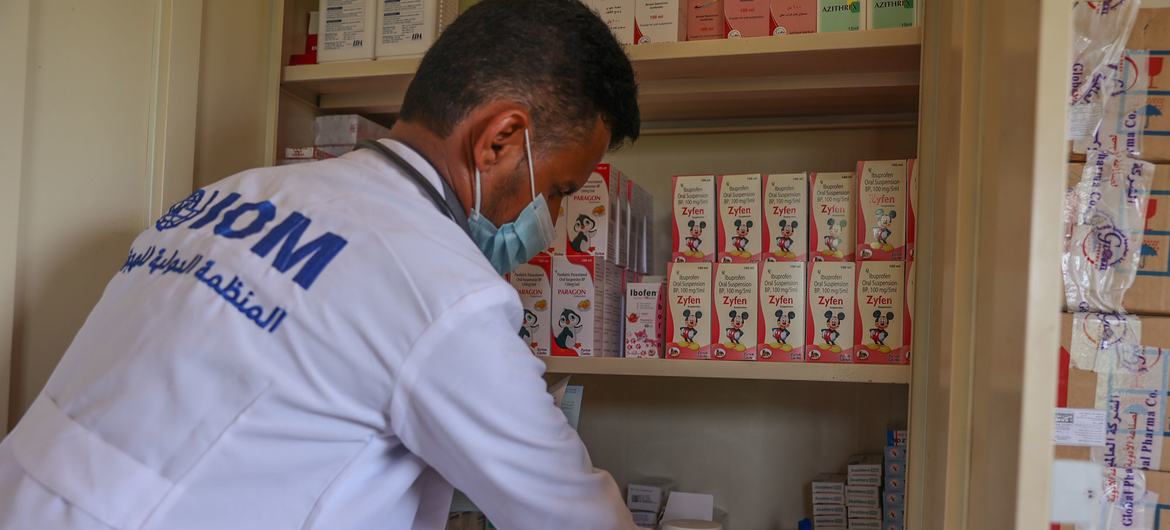
An IOM-supported health worker in Yemen accesses medical supplies.

Yemen: UN delivers lifesaving medical supplies

The UN International Organization for Migration (IOM) on Monday delivered critical medical supplies to seven health facilities in Yemen, where a collapsing health system and chronic shortages continue to endanger millions.

With support from the Government of the United Kingdom, IOM shipments are reaching hospitals and clinics in Aden, Lahj, Shabwah, Al Bayda and Sana’a – facilities serving both migrants and local communities.

“Every day, our teams see the impact of empty medicine shelves and overwhelmed clinics, on families and entire communities,” said Abdusattor Esoev, head of IOM in Yemen.

“By delivering essential supplies and supporting frontline staff, we are not just responding to urgent needs – we are keeping health services running for those who have nowhere else to turn.”

Crisis on crisis

The intervention comes amid an alarming health crisis.

Nearly 20 million people in Yemen require medical assistance in 2025, but over half of the country’s health facilities are only partially functioning or have shut down altogether. Funding gaps have left 382 facilities unsupported, forcing many to close or drastically cut services.

IOM’s assistance includes essential medicines, surgical equipment and infection prevention tools, as well as infrastructure repairs and support for health workers.

For many in the strife-torn country, IOM-supported clinics remain the only source of free medical care.

ICJ rejects Sudan’s genocide case against UAE

The International Court of Justice (ICJ) has rejected Sudan’s case accusing the United Arab Emirates (UAE) of complicity in genocide in Darfur, citing a lack of jurisdiction.

In the decision, the UN’s top judicial body ruled on Monday by a vote of 14 to two that it could not proceed with the case brought by Sudan under the Convention on the Prevention and Punishment of the Crime of Genocide (Genocide Convention) and declined to impose any provisional measures, as Sudan had requested.

The Court also removed the case from its general list by a vote of nine to seven.

“Having come to the conclusion that it manifestly lacks jurisdiction, the Court is precluded from taking any position on the merits of the claims made by Sudan,” the ruling stated.

Complicity charge

Sudan had accused the UAE of backing the paramilitary Rapid Support Forces (RSF), alleging its support amounted to complicity in genocidal acts against the non-Arab Masalit population in West Darfur.

The conflict between the RSF and the Sudanese army has claimed thousands of lives and displaced over 12.7 million people since April 2023.

The Court noted that while it could not hear the case, all States remain bound by their obligations under the Genocide Convention.

Source link