“Africa is a continent of boundless energy and possibility. But for too long, the colossal injustices inflicted by enslavement, the transatlantic slave trade and colonialism have been left unacknowledged and unaddressed,” he said.
The United Nations has repeatedly said that slavery and the transatlantic slave trade constituted crimes against humanity, and the Secretary-General has repeatedly called for redress for these injustices.
Speaking to the Africa Dialogue Series — which is focused on the theme of justice through reparations — the Secretary-General noted that the movement for reparatory justice is gaining momentum around the world as reflected by the declaration of the Second Decade for People of African Descent, which runs through 2035.
The last decade, which ended in 2024, yielded tangible results, with over 30 Member States revising laws to better tackle racial discrimination. However, the Secretary-General noted that much work remains.
“We point to the poisoned legacies of enslavement and colonialism, not to sow division but to heal them,” he said.
‘Long shadow of colonialism’
Mr. Guterres underlined the entrenched nature of racism and exploitative systems, saying that these systems have disadvantaged African countries and people of African descent beyond the end of colonialism and enslavement.
“Decolonization did not free African countries, or people of African descent, from the structures and prejudices that made those projects possible,” he said.
In fact, when the United Nations was founded and many of the global structures established, some African countries were still colonies.
“When African countries gained their independence, they inherited a system built to serve others — not them,” the Secretary-General said.
“Knowledge of our true history can serve as a powerful compass in our onward march towards progress,” he said.
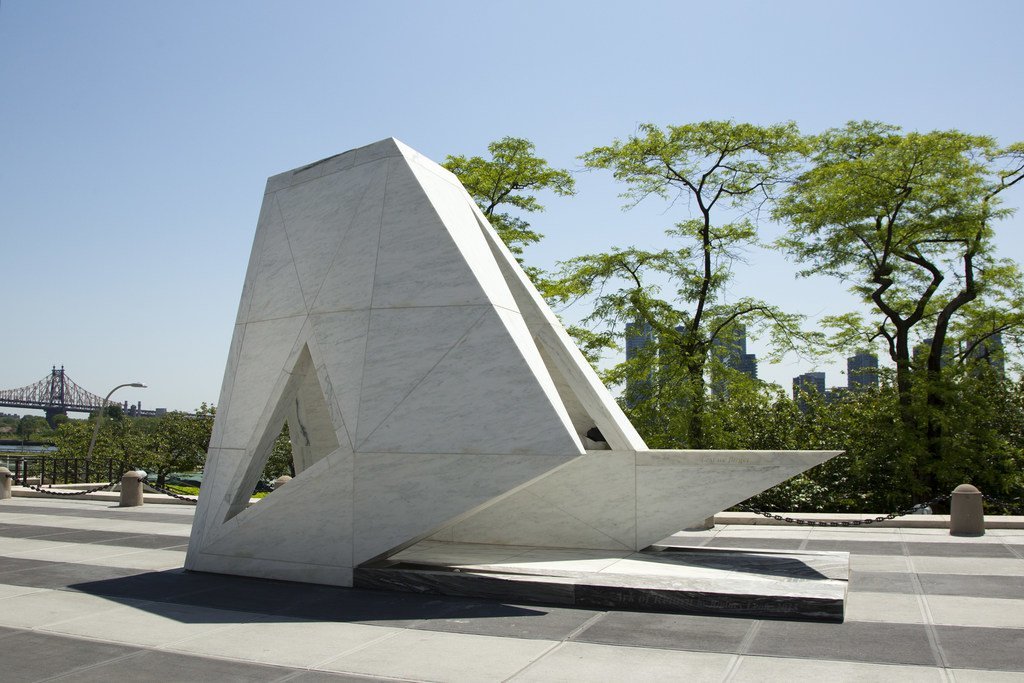
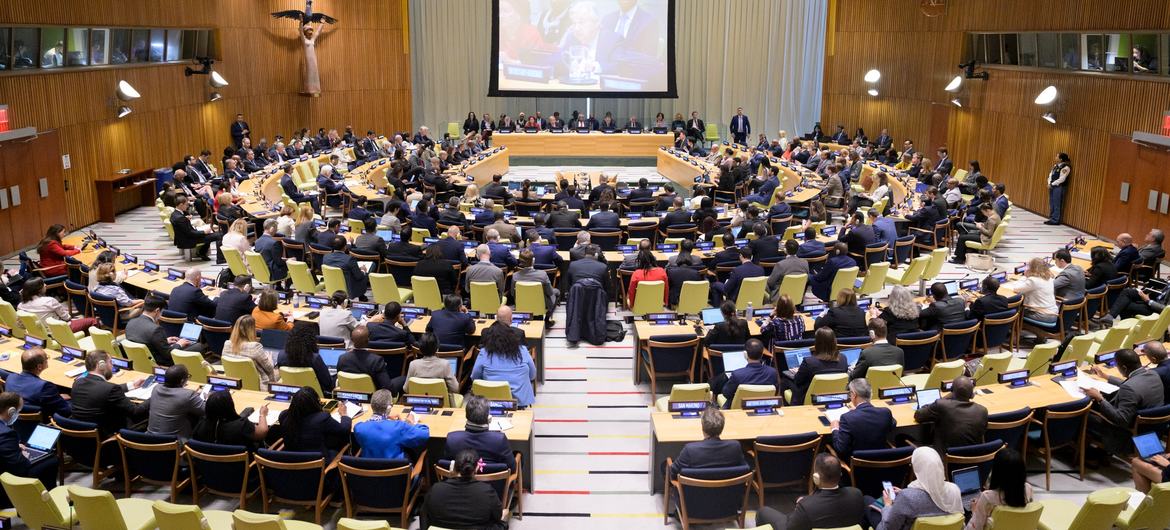
The Ark of Return, the Permanent Memorial to Honour the Victims of Slavery and the Transatlantic Slave Trade, located at the Visitors’ Plaza of UN Headquarters in New York.
Transforming ‘poisoned legacies’
To address the inequities of this system, the Secretary-General called upon the global community to take action on international financial systems which are burdening developing economies in Africa and the Caribbean. Specifically, he emphasized the importance of restructuring debt systems which are “suffocating” these countries’ economies.
Previous UN reports have noted that some poor countries spend more on debt repayments than they do on health, education and infrastructure combined
Mr. Guterres also called for massive investments into clean energy infrastructure in Africa which has been deeply impacted by climate change.
“African countries did not cause the climate crisis. Yet the effects of our heating planet are wreaking havoc across the continent,” he said.
He also reiterated his call for the establishment of a permanent Security Council position for an African Member State.
Mr. Yang, the General Assembly President, underlined the urgency of the Secretary-General’s remarks, urging member states to act imminently.
“Now is the moment to turn recommendations into rights, apologies into action and aspirations into accountability.”
On Wednesday, Israel launched airstrikes on Yemen’s main airport in the capital, Sana’a, destroying the last operational Yemenia Airways plane, according to media reports.
The attack came a day after the Houthis, also known as Ansar Allah, fired missiles at Israel.
Fragile situation worsening
In Yemen, the rebels have been fighting with Government troops, backed by a Saudi-led coalition, for over a decade. But since the start of the war in Gaza they have been targeting Israel as well as commercial ships in the Red Sea, as an act of solidarity with Palestinians.
“The ongoing military confrontation between the Houthis and Israel is exacerbating an already very fragile situation in Yemen and the broader region,” said UN Spokesperson Stéphane Dujarric.
“Attacks on civilian infrastructure, including Sana’a airport in Yemen and Ben Gurion Airport in Israel, are unacceptable.”
He said the strike on Sana’a airport and the destruction of the civilian aircraft “deprives many Yemenis of a critical means to leave the country for medical, educational, family or religious regions, especially at a time when thousands of pilgrims are preparing for the Hajj.”
De-escalation and dialogue
The Spokesman called on all stakeholders, including the Houthis, to de-escalate and exercise restraint, uphold their obligations under international law, and protect civilian infrastructure.
He also urged the warring parties to return to the intra-Yemeni dialogue, with the support of the region, as the only viable path toward lasting peace and security.
In related developments, the UN Special Envoy for Yemen concluded a visit to Oman’s capital Muscat on Wednesday, his office said in a statement.
Hans Grundberg met senior Omani officials, members of Ansar Allah leadership and representatives of the diplomatic community, including senior Iranian officials.
“Discussions focused on the cessation of hostilities between the United States and Ansar Allah and the need to translate this into sustainable progress that benefits all Yemenis and includes guarantees for the region and international community,” the statement said.
The ceasefire agreement was brokered by Oman and came into effect on 6 May following the resumption of deadly US airstrikes on Houthi-controlled areas in Yemen.
Free detained personnel
Mr. Grundberg further addressed regional dynamics and the shared responsibility of all to support de-escalation and a UN-led political process for a durable and comprehensive resolution to the conflict in Yemen.
As the Houthis continue to arbitrarily detain scores of personnel from the UN, non-governmental organizations, civil society and diplomatic missions, the Special Envoy called for their immediate and unconditional release in all his engagements.
“He stressed that their prolonged detention is not only unjustifiable but undermines the UN’s and international community’s ability to provide humanitarian support to millions of Yemenis,” the statement said.
“Since the collapse of the ceasefire in March, civilians have constantly come under fire, confined to ever-shrinking spaces, and deprived of lifesaving relief,” she said.
“Israel must halt its devastating strikes on civilian life and infrastructure.”
Risk of famine
With families cut off from aid for weeks on end, and only a fraction of the needed relief now entering the enclave, starvation looms.
“The entire population of Gaza is facing the risk of famine,” Ms. Kaag warned, adding that the limited aid permitted into the enclave is “comparable to a lifeboat after the ship has sunk.”
“Ms. Kaag emphasized that humanitarian aid must not depend on political negotiations, noting that the UN aid operation is prepared to deliver assistance immediately, in accordance with international law.
“Aid cannot be negotiable,” she said.
Full aid access imperative
Ms. Kaag called on Israel to halt its devastating strikes and allow full access for humanitarian aid and commercial goods.
At the same time, she stressed that Israel has the right to live in peace and security.
“This was undeniably shaken by the horrific terror attacks and taking of hostages on 7 October by Hamas and other Palestinian armed groups,” she said, reiterating the call on Hamas and other armed groups to stop rocket attacks against Israel and release all hostages unconditionally.
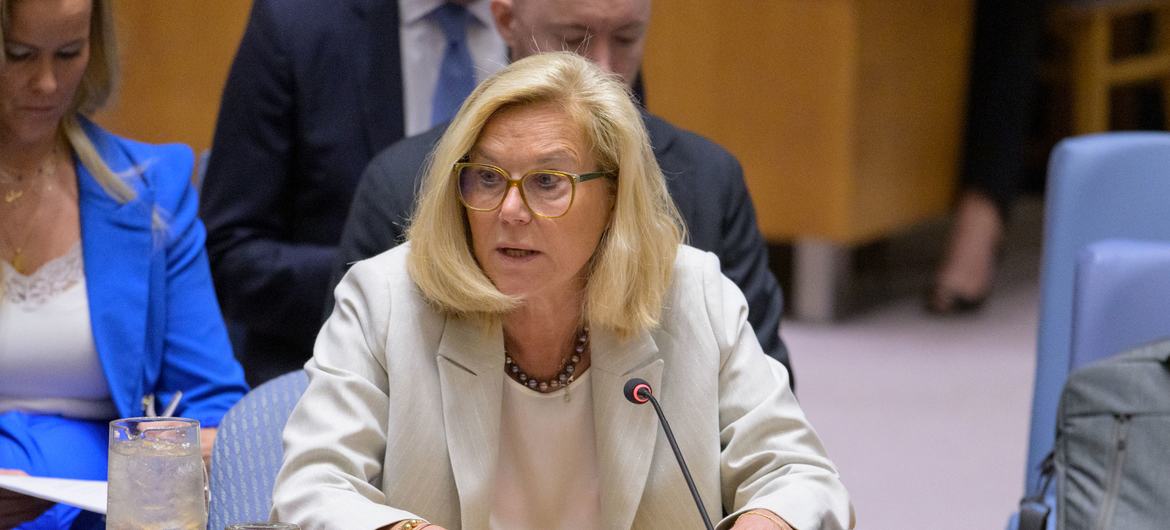
Sigrid Kaag, UN Special Coordinator for the Middle East Peace Process Ad Interim, briefs the Security Council on the situation in the Middle East.
Two-State solution
Ms. Kaag emphasised that durable security “cannot be achieved solely through force”, it must be built on mutual recognition, justice, and rights for all.
“A better path exists that resolves this conflict, de-escalates regional tensions and achieves a shared vision for peace,” she said.
The upcoming high-level international conference in June, co-chaired by France and Saudi Arabia, presents a critical opportunity to relaunch a path toward ending the occupation and realising the two-State solution based on international law, UN resolutions and previous agreements.
“It must not be another rhetorical exercise,” she said.
“We need to pivot ourselves from declarations to decisions. We need to implement rather than adopt new texts.”
‘See you in heaven’
In her briefing, Ms. Kaag described the deep despair of civilians in Gaza, where families now bid farewell not with a “goodbye, see you tomorrow”, but with the words “see you in heaven.”
“Death is their companion. It’s not life, it’s not hope,” she continued, stressing that Gazans deserve more than survival – they deserve a future.
Urging bold political action, she called for adherence to international law, and support for a reformed Palestinian Government that can govern both Gaza and the West Bank.
“Statehood is a right, not a reward,” Ms. Kaag said.
“Let us not be remembered as the generation that let the two-State solution disappear. Let us be the generation that chose courage over caution, justice over inertia and peace over politics. Let us be part of a generation that can make this happen.”
Special Coordinator a.i. Kaag’s briefing to the Security Council.
US ‘fully stands’ with Israel
Speaking for the United States, John Kelley, Political Coordinator at the US Mission to the UN, said that his country has been working tirelessly to free the hostages and bring the war to an end – “one that Hamas brutally started”.
“Hamas continues to reject proposals from the US, Qatar and Egypt that would release the 58 remaining hostages, who have now been cruelly held for 600 days, and bring calm to Gaza,” he said.
“Every day Hamas demonstrates its lack of regard for the Palestinians it claims to represent, all while it violently suppresses protests against its barbaric rule and diverts aid meant for civilians.”
He underscored that the US “fully stands” behind Israel and its right to defend itself, stating that to move forward, “Hamas must be defeated.”
“As Secretary [Marco] Rubio has said – if an ember survives, it will spark again into a fire. There can no peaceful and prosperous Gaza as long as Hamas governs it by force,” Mr. Kelley said.
The horrors must end: Algeria
Algerian Ambassador Amar Bendjama described the deadly impact of the ongoing war in Gaza on children, citing the specific case of the nine children of a Gazan doctor, all killed in an airstrike, while her sole remaining child and husband remain in a critical condition.
“They were not members of a centre for command and control of Hamas,” he said, adding, “the Israeli army killed them, they killed them deliberately.”
He noted that today, no one in Gaza is spared – and three decades after the optimism surrounding the Oslo peace accords between Israel and Palestinian leadership, “the dream of a Palestinian state is vanishing under the boots of the Israeli occupation and the silence of the international community.”
Stating that the “time for indecision” was over, he called for action – “not words of condemnation”.
“These horrors must end,” he said.
Gaza needs a ceasefire, not more bloodshed: United Kingdom
James Kariuki, Deputy Permanent Representative of the UK, said his country has “always supported” Israel’s right to defend itself but cautioned that it “strongly opposes” Israel’s escalating military action in Gaza, “which is wholly disproportionate.”
“An immediate ceasefire, not more bloodshed is the way to secure the release of the hostages and stop the end cycle of violence,” he said.
The level of human suffering in Gaza is intolerable, he continued, stating that the United Nations had warned of the risks of the Israeli Government’s aid delivery plan.
“In Rafah yesterday, we saw this warning become a reality. The Gaza Humanitarian Foundation lost control of its distribution centre, with multiple casualties reported and great distress for those desperately seeking aid,” he said.
“In contrast, the UN has a clear plan to deliver lifesaving aid at scale. It contains robust mitigations against aid diversion. Brave humanitarians stand ready to do their jobs,” he added. “Let aid in and enable the UN to operate now.”
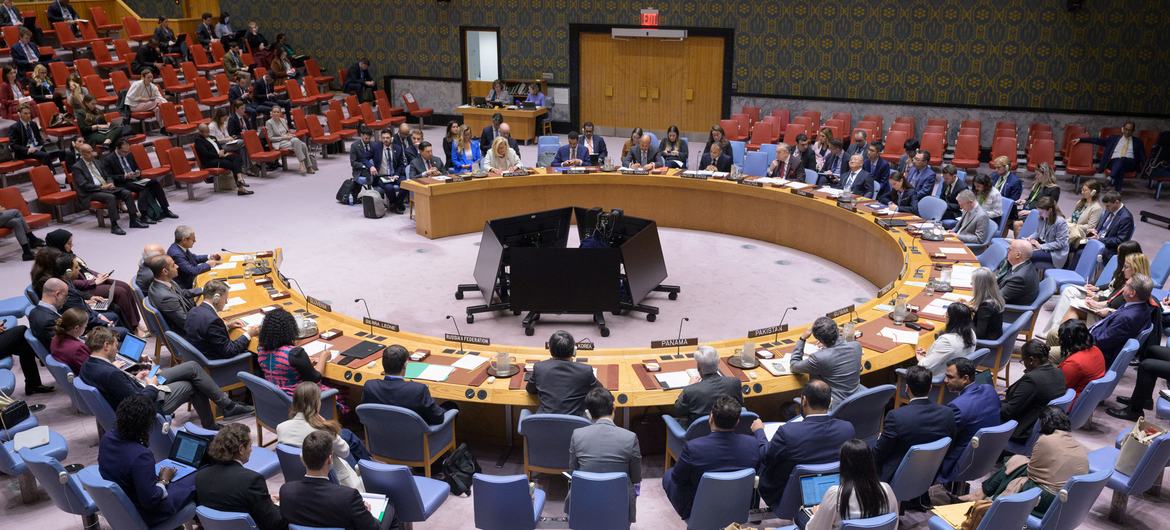
A wide view of the UN Security Council meeting on the situation in the Middle East.
Images of hungry, desperate people ‘gut-wrenching’: Palestine
Riyad Mansour, Permanent Observer of the State of Palestine, said the images of hungry and desperate people trying to get aid supplies in are “gut-wrenching” and “heart breaking.”
“These are people, human beings, deprived of water, food, medicine for so long and hanging to life by a thread,” he said, adding that this is “outraging the Palestinian people – all of them, including me.”
“It is outrageous to see this situation, and still you are not acting,” he said, pointing to Security Council members: “how much more do you want?”
He added that the UN plan for aid, with its proven capacity on the ground remains the only viable plan to deliver relief supplies and it has all necessary safeguards – “if that is the true concern.”
“But the true concern is how to get rid of the Palestinians by killing them, starving them, and destroying Gaza so they have no choice but to leave if they want to live,” Mr. Mansour said.
Israel is facilitating aid into Gaza: Ambassador
Israeli Ambassador Danny Danon said that while the UN “spreads panic and makes declarations detached from reality, the State of Israel is steadily facilitating the entry of aid into Gaza.”
This, he said, is being done via two methods.
“First, under the old framework, via trucks and, second, under the new distribution mechanism developed in coordination with the US and key international partners,” he continued, noting that both mechanisms are “working simultaneously” and will continue to do so for the immediate future.
“We are not only allowing aid in, but we are ensuring that it reaches the people who need it most,” he added.
Aid is already being distributed in Gaza, Ambassador Danon said, despite efforts by Hamas to obstruct people from reaching it by setting up checkpoints and roadblocks.
“Because Hamas knows if it loses control over the aid, it loses control over the people of Gaza,” he said.
The majority of those killed and injured were in major cities such as Kyiv, Kharkiv, and Mykolaiv, or in populated areas in other regions.
Meanwhile, large numbers of long-range drones launched into Russia by Ukrainian armed forces injured at least 11 civilians over the weekend, according to Russian authorities.
“It is time to put an end to Russia’s invasion of Ukraine, to commit to – and implement – a comprehensive ceasefire that stops the daily killing and destruction, and to start genuine peace negotiations, built on respect for international law,” he said.
He highlighted that – even amid ongoing hostilities – people deprived of their liberty must be protected. Summary executions, torture and all forms of inhumane and degrading treatment of prisoners are always prohibited, in any circumstances, and must stop immediately.
In addition, civilian detainees should be released as soon as the lawful reason for their detention ceases to exist and their protection against refoulement must be ensured, he said.
Relief, but also loss
High Commissioner Türk welcomed the recent exchange of prisoners of war and civilian detainees.
Nearly 900 prisoners of war and 120 civilians from each side were exchanged. Most of the civilians appeared to have been detainees, but details on individuals included in the exchange are not yet available, according to his office, OHCHR.
“Many families can now breathe a sigh of relief because their loved ones have finally returned home,” Mr. Türk said.
“But at the same time, other families have lost relatives and their homes, as their communities across Ukraine came under attack.”
Impact on children
In a separate statement, the UN Children’s Fund (UNICEF) expressed deep concern for the impact of the latest attacks on Ukraine’s children.
Munir Mammadzade, UNICEF Representative in Ukraine, said that in the past three days, at least three children were reportedly killed in Zhytomyr, and at least 13 children were injured in several regions across the country.
“Ukraine’s children have suffered for far too long. How many more futures must be stolen? The senseless violence and loss of young lives must stop,” Mr. Mammadzade said.
According to UNICEF, more than 220 children were killed or injured between January and April 2025 – a 40 per cent increase compared to the same period last year.
“Attacks on civilian areas must end, and children must always be protected,” Mr. Mammadzade emphasised. “Above all, children need an end to this war.”
After nearly three months of complete blockade by Israel, a “vastly insufficient” amount of aid was finally allowed into the war-ravaged enclave in the last week, insisted Jens Laerke, spokesperson for the UN aid coordination office, OCHA.
“We have not stopped operating,” he said, referring to staff still inside Gaza, who are tasked with liaising with the Israeli authorities to retrieve supplies allowed into Gaza from Israel, via the Kerem Shalom crossing.
Mr. Laerke insisted that the UN is not participating in the Israeli aid plan known as the Gaza Humanitarian Fund: “It is a distraction from what is actually needed, which is a reopening of all the crossings into Gaza, a secure environment within Gaza and faster facilitation of permissions and final approvals of all the emergency supplies that we have just outside the border; [aid] needs to get in.”
The veteran humanitarian stressed the ongoing dangers and obstacles that have prevented aid teams from picking up and dispatching lifesaving supplies via the UN’s existing delivery network in Gaza.
“We are not always able to collect what is being dropped off on the other side because of the insecure routes that are being assigned to us by the Israeli authorities to use,” he told journalists in Geneva.
‘Cherry-picking’ warning
All types of aid must be allowed through and not “cherry-picked”, Mr. Laerke stressed: “The bottom line again is that we are talking about a vastly insufficient amount of aid that eventually enters Gaza at the moment. That’s why we need [the] opening of more crossings, we need all types of aid – not that aid that is cherry-picked by the Israeli side that we are allowed to get in.”
In an update, the UN World Food Programme (WFP) said that as of Monday, 294 trucks have reached Kerem Shalom from Port Ashdod. On Tuesday, media reports indicated that protesters attempted to block lorries loaded with aid from leaving the Israeli port.
“While desperately needed aid is finally trickling into Gaza, the pace is far too slow to meet the overwhelming needs,” WFP said. “Gaza families are at a breaking point, amid intensified fighting, waves of evacuation orders and population displacement.”
Crossing the line
The UN agency noted that it has “more than 130,000 metric tonnes of food in the pipeline as well as a functioning delivery network ready to provide assistance. An immediate surge in daily aid trucks and unrestricted access to safely collect and distribute food inside Gaza are critical before it is too late.”
The UN agency for Palestinian refugees, UNRWA, meanwhile, explained that “no supplies whatsoever” prepared by the agency have reached Gaza since the Israeli siege began on 2 March.
This is despite UNRWA having readied more than 3,000 trucks carrying food and medicines in Jordan and Egypt which will perish soon.
“We have clinics, we have pharmacies that the agency runs and there we normally would distribute medicines against chronic diseases…but also basic medicines, things like paracetamol and then childhood diseases and these are the medicines that we’re running out of,” said Juliette Touma, UNRWA Director of Communications.
Evidence call to Israel
The development comes as UNRWA Commissioner-General Philippe Lazzarini urged the Israeli Government to provide proof to back up its unsubstantiated allegations that the UN agency’s staff were involved in the Hamas-led terror attacks in Israel that sparked the war in October 2023.
Investigations carried out internally by the UN last year found sufficient evidence that nine active UNRWA staff had been involved.
A separate independent probe commissioned by the UN Secretary-General found that the agency’s rules, mechanisms and procedures were the most “elaborate” within the UN, reflecting the complex and sensitive demands associated with working in the Occupied Palestinian Territories.
“It’s been over 20 months of these claims coming our way, harming the agency’s reputation of course, but more importantly, putting the lives of our staff, especially those working in the Occupied Palestinian Territory, at risk,” said Ms. Touma.
Despite numerous requests by UNRWA to the Israeli Government for evidence to substantiate “numerous accusations”, no evidence has been shared to back up the claims against the agency and its personnel, Ms. Touma continued.
At least 75 civilians have been killed in hostilities between the national army (SSPDF) and the Sudan People’s Liberation Army-In Opposition (SPLA-IO) – which is both a political party and militia group loyal to First Vice President Riek Machar – and their respective allied armed groups, said UN human rights office, OHCHR, in a press release.
Thousands have been displaced from their homes.
South Sudan was plunged into civil war in 2013 between supporters of the President Salva Kiir and his rival Mr. Machar but a 2018 peace accord led to a fragile power-sharing agreement.
Escalating hostilities “portend a real risk of further exacerbating the already dire human rights and humanitarian situation,” said Volker Türk, head of the UN human rights office (OHCHR), urging all parties to the conflict to “urgently pull back from the brink.”
Intensifying hostilities
The latest armed violence erupted in February when a militia group identified as the White Army reportedly launched a series of attacks in Upper Nile State, OHCHR said.
Hostilities intensified between 3 May and 20 May with reports of indiscriminate aerial bombardments and river and ground offensives by the SSPDF on SPLA-IO positions in the states of Jonglei and Upper Nile.
Civilian displacement further increased on 21 May because of the SPLA-IO and allies’ counter-offensive in Jonglei State.
“I urge all parties to uphold the 2018 peace agreement,” said the UN human rights chief, calling for the warring parties to “ensure protection of civilians and civilian objects,” and facilitating “humanitarian access in line with their obligations under international law.”
Concern of arbitrary detention
Between 5 and 26 March, at least 55 high-ranking government officials affiliated with the SPLM-IP, among them civilians, have been arrested across the country. Notably, South Sudan’s first vice-president, ministers, members of parliament and military officers were among the dozens of politicians who have been detained.
“I am concerned that many of the detentions are arbitrary in nature,” Mr Türk said, as these arrests were conducted without warrant or due process.”
Mr Türk called for the immediate and unconditional release of those arbitrarily detained, as he urged for authorities to grant the UN Mission in South Sudan (UNMISS) access to National Security Service detention sites to assess the welfare of those detained there.
Finally, the UN also urged the authorities to take “prompt, effective and meaningful” steps to halt the spread of hate speech in the country.
Addressing reporters outside the Security Council, António Guterres called once again for a permanent ceasefire to end the fighting between Israeli forces and Hamas militants, the immediate and unconditional release of all hostages and full humanitarian access so aid can flow in following nearly 80 days of Israeli blockade.
‘Cruellest phase’
He said Palestinians in the enclave are now “enduring what may be the cruellest phase of this cruel conflict,” with families being “starved and denied the very basics,” as Israel intensifies its offensive and promotes a new privatised aid distribution network reportedly due to begin on Sunday which would bypass the UN and partner organizations’ aid operation.
Israel has clear obligations under international humanitarian law to treat civilians in Gaza humanely, Mr. Guterres added, and “must not forcibly transport, deport or displace the civilian population of an occupied territory.”
He noted that despite authorising a “trickle of aid” to enter in recent days, supplies from only 115 out of 400 trucks have been cleared for collection and distribution – while nothing has reached the besieged north.
UN ‘working round the clock’
“We are working around the clock to get whatever aid we can to people in need,” the UN chief said, but “needs are massive – and the obstacles are staggering.”
Israel is causing unnecessary delays, imposing quotas on distribution and barring essentials such as fuel, shelter, cooking gas, and water purification supplies – are prohibited.
Furthermore, the lives of UN and other humanitarian staffers are being placed at risk if they continue to be prevented from distributing food parcels and flour to those in desperate need, the UN chief continued.
He said absent rapid, reliable, safe and sustained aid access, more Gazans will die – with profound long-term consequences.
Without making direct reference to the US-backed Israeli plan to create new distribution sites overseen by private contractors in coordination with the military, Mr. Guterres said the UN had been clear: “We will not take part in any scheme that fails to respect international law and the humanitarian principles of humanity, impartiality, independence and neutrality.”
5-point aid plan
Instead, he said the UN and partners had “a detailed, principled, operationally-sound 5-stage plan” – supported by UN Member States.
Ensure the delivery of aid to Gaza
Inspect and scan aid at crossing points
Transport aid from crossing points to humanitarian facilities
Prepare aid for onward distribution
And transport aid to people in need
“We have the personnel, the distribution networks, the systems and community relationships in place to act,” said the UN chief. “The supplies – 160,000 pallets, enough to fill nearly 9,000 trucks – are waiting.
“This is my appeal for life-saving aid for the long-suffering people of Gaza: Let’s do it right. And let’s do it right away.”
“There is no place for lethal autonomous weapon systems in our world,” Mr. Guterres said on Monday, during an informal UN meeting in New York focused on the use and impact of such weapons.
“Machines that have the power and discretion to take human lives without human control should be prohibited by international law.”
The two-day meeting in New York brought together Member States, academic experts and civil society representatives to examine the humanitarian and human rights risks posed by these systems.
The goal: to lay the groundwork for a legally binding agreement to regulate and ban their use.
Human control is vital
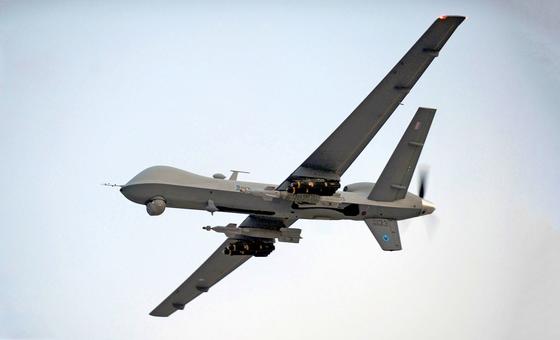
While there is no internationally accepted definition of autonomous weapon systems, they broadly refer to weapons such as advanced drones which select targets and apply force without human instruction.
The Secretary-General said in his message to the meeting that any regulations and prohibitions must make people accountable.
“Human control over the use of force is essential,” Mr. Guterres said. “We cannot delegate life-or-death decisions to machines.”
There are substantial concerns that autonomous weapon systems violate international humanitarian and human rights laws by removing human judgement from warfare.
The UN chief has called for Member States to set clear regulations and prohibitions on such systems by 2026.
Approaching a legally binding agreement
UN Member States have considered regulations for autonomous weapons systems since 2014 under the Convention on Certain Conventional Weapons (CCW) which deals with weapons that may violate humanitarian law.
Most recently, the Pact for the Future, adopted in September last year, included a call to avoid the weaponization and misuse of constantly evolving weapons technologies.
Stop Killer Robots – a coalition of approximately 270 civil society organizations – was one of the organizations speaking out during this week’s meeting.
Executive Director Nicole van Rooijen told UN News that consensus was beginning to emerge around a few key issues, something which she said was a “huge improvement.”
Specifically, there is consensus on what is known as a “two-tiered” approach, meaning that there should be both prohibitions on certain types of autonomous weapon systems and regulations on others.
However, there are still other sticking points. For example, it remains unclear what precisely characterizes an autonomous weapon system and what it would look like to legislate “meaningful human control.”
Talks so far have been consultations only and “we are not yet negotiating,” Ms. Rooijen told UN News: “That is a problem.”
‘Time is running out’
The Secretary-General has repeatedly called for a ban on autonomous weapon systems, saying that the fate of humanity cannot be left to a “black box.”
Recently, however, there has been increased urgency around this issue, in part due to the quickly evolving nature of artificial intelligence, algorithms and, therefore, autonomous systems overall.
“The cost of our inaction will be greater the longer we wait,” Ms. Rooijen told us.
Ms. Rooijen also noted that systems are becoming less expensive to develop, something which raises concerns about proliferation among both State and non-state actors.
The Secretary-General, in his comments Monday also underlined the “need for urgency” in establishing regulations around autonomous weapon systems.
“Time is running out to take preventative action,” Mr. Guterres said.
Briefing Member States in New York on Monday Mr. Guterres outlined wide-ranging effort to revamp how the UN system operates – cutting costs, streamlining operations, and modernizing its approach to peace and security, development and human rights.
“These are times of peril,” he said, “but they are also times of profound opportunity and obligation. The mission of the United Nations is more urgent than ever.”
Three main objectives
Launched in March, the UN80 Initiative centres on three priorities: enhancing operational efficiency, assessing how mandates – or key tasks – from Member States are implemented, and exploring structural reforms across the UN system.
The conclusions will be reflected in revised estimates for the 2026 budget in September this year, with additional changes that require more detailed analysis presented in 2027.
‘Meaningful’ budget reductions
Mr. Guterres said the changes are expected to yield “meaningful reductions” in the overall budget. For example, the departments for political and peacekeeping affairs could see a 20 per cent reduction in staff by eliminating duplication.
This level of reduction, he said, could serve as a benchmark across the UN system – while also considering unique factors for each department.
Additional examples include consolidating all counter-terrorism work within the main Office of Counter-Terrorism (UNOCT), ending building leases and relocating posts away from expensive “duty stations” where cost of living is high.
“There might be immediate, one-off costs involved in relocating staff and providing potential termination packages,” he said, “but by moving posts from high-cost locations, we can reduce our commercial footprint in those cities and reduce our post and non-post costs.”
UN Secretary-General António Guterres briefs on the UN80 Initiative.
Efficiencies and upgrades
The first workstream focuses on efficiencies and improvements, developing a new model that improves consolidation, looks at centralising services, relocating to cheaper locations, and expanding the use of automation and digital platforms.
Mr. Guterres said departments the UN’s headquarters in New York and Geneva have been asked to review whether some teams can be relocated to lower-cost duty stations, reduced or abolished.
Reviewing mandates
The second workstream involves a review of how existing mandates are being carried out – not the mandates themselves, which are the purview of Member States only.
A preliminary review identified more than 3,600 unique mandates for the Secretariat alone. A full and more detailed analysis is now underway.
Mr. Guterres emphasised that the sheer number of mandates – and the bureaucracy needed to implement them – places a particular burden on smaller Member States with limited resources.
“Based on this work, Member States may wish to consider the opportunity to conduct themselves a review of the mandates,” he added.
Structural change
The third workstream – focused on structural reform – is already underway, Mr. Guterres said.
Nearly 50 initial submissions have already been received from senior UN officials, reflecting what Mr. Guterres described as “a high level of ambition and creativity.”
Key work areas have been identified for review. These include peace and security, development, human rights, humanitarian, training and research and specialised agencies.
A wide view of the informal meeting of the General Assembly plenary that heard a briefing by the Secretary-General on the UN80 Initiative.
Not an answer to liquidity crisis
Mr. Guterres also touched on the UN dire cashflow situation, noting that the initiative “is not an answer” to the months-long liquidity crisis but by being more cost effective, it should help limit the impact.
“The liquidity crisis is caused by one simple fact – the arrears,” he said, adding that structural reform is not the answer to a fundamental failure by some Member States to pay what they owe on time to meet running costs.
Unpaid dues
According to information provided by the UN Controller to the General Assembly’s Fifth Committee (Administrative and Budgetary), only $1.8 billion has been received against the $3.5 billion regular budget assessments for 2025 – a shortfall of around 50 per cent.
As of 30 April, unpaid assessments stood at $2.4 billion, with the United States owing about $1.5 billion, China ($597 million), Russia ($72 million), Saudi Arabia ($42 million), Mexico ($38 million), and Venezuela ($38 million). An additional $137 million is yet to be paid by other Member States.
For the peacekeeping budget (which runs on a July-June cycle), including prior-period arrears, the unpaid amount totals $2.7 billion. For the International Tribunals, total contribution outstanding was $79 million as of 30 April.
Close consultation
The Secretary-General told Member States he would be consulting with them closely and regularly on the cash crisis and needed reforms, seeking guidance and presenting concrete proposals for countries to act on.
UN staff members and their representatives are being consulted and listened to, he added: “Our concern is to be humane and professional in dealing with any aspect of the required restructuring.”
In conclusion, he highlighted that the UN80 Initiative is a “significant opportunity” to strengthen the UN system and deliver for those who depend on it.
In response to the suggestion that the UN should focus on just the one key pillar of peace and security, he said it would be wrong to ditch development and human rights – all three are essential he underscored.
“Let us seize this momentum with urgency and determination, and work together to build the strongest and most effective United Nations for today and tomorrow.”
In a statement, UNFPA said the move – which invokes a 1985 legal provision known as the Kemp-Kasten Amendment – is based on “unfounded claims” about the agency’s work in China. These allegations, it noted, have “long been disproven”, including by the US Government itself.
The Kemp-Kasten amendment states that no funds can go to any organization or programme which support any “coercive abortion or involuntary sterilization,” as determined by the US president.
The funding cut now in effect is in addition to termination notices already issued for more than 40 existing humanitarian projects, representing roughly $335 million in support.
Impact on the most vulnerable
UNFPA – formally the UN Population Fund – said the loss of US support will significantly undermine efforts to prevent maternal deaths, especially in conflict-affected and crisis-hit regions.
“It will cut essential support for millions of people living in humanitarian crises and for midwives preventing mothers from dying in childbirth – work that is a ‘best-buy’ in development, a cost-effective investment that generates positive returns over generations,” the agency stated.
The US, a founding and long-standing partner, has over the decades helped strengthen global health systems and save countless lives, UNFPA said.
“Over the past four years alone, with the US Government’s life-saving investments, we prevented more than 17,000 maternal deaths, nine million unintended pregnancies and nearly three million unsafe abortions by expanding access to voluntary family planning,” the agency added.
Call to reconsider
UNFPA urged Washington to reconsider its position and “reclaim its position as a leader in global public health, saving millions of lives.”
“Funding UNFPA – the only United Nations agency dedicated to reproductive health and rights – is the surest way of reducing the risk of coercive practices around the world,” the agency said.
It also emphasised its continued commitment to dialogue with the US Government through the UNFPA Executive Board, where the United States has been an active member for over 50 years.
The agency also vowed to continue to work tirelessly under its mandate to uphold the health, safety, and dignity of women and girls worldwide.
The Quartet is calling on the country’s leaders to end hostilities and return to dialogue to fully implement the 2018 peace agreement known as the Revitalized Agreement on the Resolution of the Conflict in the Republic of South Sudan (R-ARCSS).
South Sudan, the world’s youngest nation, gained independence in 2011 but soon descended into a brutal civil war. A 2018 peace agreement has held together but now threatens to fully unwind between the president and his vice presidential rival.
Regional pressure
In recent weeks, the Quartet has observed air and ground attacks that have led to loss of life, the destruction of homes, and the displacement of civilians. Humanitarian facilities have also been targeted, while hate speech and ethnic tensions are on the rise.
The Quartet welcomed a recent joint visit by the African Union and IGAD to South Sudan as a sign of regional support for peace. It also called on all sides to cooperate with ceasefire monitors investigating recent violence.
South Sudan’s leaders must commit to inclusive dialogue, the release of political detainees, and renewed efforts to carry out the peace deal, the Quartet stressed.
A return to war would betray the people’s hope for peace and stability, they warned. Only a political solution can ensure free and fair elections at the end of the current transitional period.
UN rights chief urges EU not to weaken landmark corporate responsibility law
UN human rights chief Volker Türk has called on the European Union to protect a key law that holds large companies accountable for human rights and environmental harm.
The EU’s Corporate Sustainability Due Diligence Directive (CSDDD), adopted last year, requires businesses to identify and address any negative impact their activities may have on people or the planet.
But changes now being discussed in Brussels as part of a broader reform package could weaken the law, Mr. Türk warned on Wednesday.
“The CSDDD, by far the most ambitious business and human rights regulatory initiative anywhere in the world, has rightly been welcomed by companies, policy makers, civil society, and national human rights institutions alike,” he said.
“A large number of businesses have already taken steps to ensure they comply with it.”
Detailed review
UN human rights office, OHCHR, has published a detailed review of the EU proposal, pointing to ways it could undermine this groundbreaking directive.
“While some streamlining… could be advantageous, it would be counterproductive to water down its alignment with international standards,” he said.
April deadliest month for civilians in Ukraine since September
April was the deadliest month for civilians in Ukraine since September 2024, with at least 209 people killed and 1,146 injured, the UN Human Rights Monitoring Mission in Ukraine (HRMMU) reported on Wednesday.
In its monthly update, the Mission said that 97 per cent of casualties occurred in areas controlled by Ukraine, with nearly half caused by missile and loitering munitions attacks by Russian forces.
“Kryvyi Rih, Sumy, Dnipro, Zaporizhzhia, Kyiv, and Kharkiv all endured devastating attacks,” said Danielle Bell, Head of HRMMU. “The sharp rise in casualties was mainly due to the intensified use of ballistic missiles in major cities.”
Among the deadliest incidents:
On 4 April, a missile strike on Kryvyi Rih killed 20 civilians and injured 63.
On Palm Sunday (13 April), two missiles hit Sumy, killing at least 31 and injuring 105.
A 24 April attack on Kyiv killed 11 and injured 81.
Children were especially affected. At least 19 were killed and 78 injured in April – the highest monthly total since June 2022.
The wave of attacks continued into May, with cities including Kharkiv, Odesa and Kyiv again coming under fire.
UN experts raise alarm over Mali’s suspension of political parties
Independent UN human rights experts have strongly criticised Mali’s military authorities for suspending all political parties and activities, calling the move a clear violation of basic rights.
The decision, announced on 7 May via state television, halts political activity “until further notice.” The junta, which took power following coups in 2020 and 2021, said the suspension was necessary to maintain public order.
The three UN Human Rights Council-appointed experts described it as a direct violation of human rights and called for the order’s immediate repeal.
They also called on the National Transitional Council to strike down a bill introduced on 30 April, which repealed legislation governing how political parties operate.
“If passed into law, the 30 April bill will place Mali in contravention of its human rights obligations, notably on freedoms of association and expression,” the experts stressed.”
Protests
In response to the 30 April bill, opposition parties organised a pro-democracy rally in the capital Bamako on 3 May which drew hundreds of demonstrators. The parties reportedly demanded a timeline to end military rule and a return to constitutional order.
Another protest is planned for Friday to oppose the decree against political parties.
The experts said Malian authorities must work to counteract “the current climate of suppression of the civic space”.
“The right to peacefully assembly is essential to the health of a vibrant political community,” the experts said. “The Malian Transitional authorities must scrupulously respect it and abstain from acts of intimidation and repression that risk the physical integrity and the rights of demonstrators.”
Special Rapporteurs and Independent Experts are appointed by the Geneva-based Human Rights Council. They serve in their individual capacity, independent of the UN system and national governments. They are not UN staff and draw no salary
FMD is a highly contagious viral disease affecting cloven-hoofed animals, including cattle, pigs, sheep, goats, and various wild species.
Europe is currently facing its worst outbreak so far this century at the same time as an exotic viral strain has been introduced in Iraq and other countries in the Near East.
Concern for potential spread
“FAO is recommending urgent biosecurity measures and enhanced surveillance following the recent detection of foot-and-mouth disease (FMD) serotype SAT1 in Iraq and Bahrain,” the agency said in an alert.
“This serotype is exotic to the Near East and West Eurasia regions,” the agency continued – meaning the strain is not normally found there – which raises “serious concerns” about its potential spread.
FMD is typically characterized by fever and blisters in the mouth and on the feet of affected livestock, accompanied by lameness. Although few adult animals succumb to disease, young ones may die from sudden heart failure.
The virus spreads rapidly and can affect large numbers of animals, especially in countries or regions that are usually free of the disease or do not regularly use vaccination.
Although FMD is not a public health threat, it severely impacts animal health and welfare, food security and incomes by reducing agricultural productivity, including through decreased milk and meat yields.
The economic impact is also substantial, with global direct production losses and vaccination costs in endemic regions estimated to be $21 billion annually. FAO noted that the true economic burden is likely much higher when disruptions to both international and local trade are taken into consideration.
A major outbreak in the United Kingdom in 2001 led to the culling of more than six million animals and cost the economy billions, devastating the livestock industry and tourism. A series of new measures in response have reportedly reduced the risk and improved resilience, including local and national contingency plans for outbreaks.
Outbreaks and response
The FMD virus was recently detected in parts of Europe normally free of the disease and the continent is now experiencing its worst outbreak since 2001.
Germany detected an outbreak this past January but has since been declared FMD-free, however subsequent outbreaks in Hungary and Slovakia have persisted.
In response, the UK recently announced that it has banned imports of meat or dairy products from European countries where the virus has been detected, as well as Austria due to the outbreak in neighbouring Hungary.
FMD is endemic in the Near East, but the recent upsurge is due to an exotic serotype likely introduced from East Africa. Cases have been reported in Bahrain, Iraq and Kuwait, although other countries are at high risk.
Many strains of the FMD virus continue to circulate in different parts of the world, and the recent outbreaks in both Europe and the Near East highlight the ongoing risk the disease poses to livelihoods, food security and safe trade, said FAO.
Raising awareness
While all governments are urged to be vigilant, the agency said affected and high-risk countries should consider awareness-raising measures among farmers and communities to protect livestock.
Other recommendations include biosecurity measures such as separating sick animals from other livestock and having them examined by professionals, alongside checking vaccination records and verifying FMD contingency plans.
FAO said that by implementing these measures, countries can significantly reduce risks.