Malnutrition crisis deepens for Sudan’s children as war rages on

Across the five states that make up Darfur, UNICEF data revealed a 46 per cent increase in the number of children treated for SAM in January to May 2025 compared to the same period last year.

The rate of acute malnutrition has surpassed emergency levels set by the World Health Organization (WHO) in 9 of the 13 localities across Darfur.

In North Darfur alone, over 40,000 children were admitted for SAM treatment in the first five months of the year – double the number from the same period last year.

Besieged and starved

This malnutrition surge comes amid intensifying conflict in North Darfur since April. Entire neighborhoods have been besieged, hospitals targeted by airstrikes, roads rendered impassable while aid convoys have faced looting and violent attacks.

The situation is particularly catastrophic in El Fasher, where humanitarian access has been nearly completely severed since the RSF militia besieged the city – the last held by Government forces in the region – and cut off assistance in April of 2023.

UNICEF successfully delivered a batch of supplies to El Fasher earlier this year, but efforts to send additional aid have been blocked.

Children in Darfur are being starved by conflict and cut off from the very aid that could save them,” said Sheldon Yett, UNICEF Representative for Sudan. “This is a moment of truth; children’s lives depend on whether the world chooses to act or look away.”

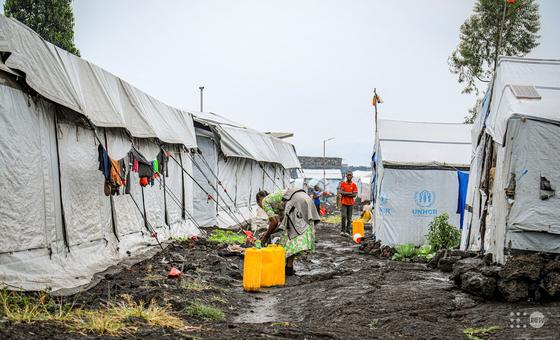
The crisis has triggered mass displacement in the area: in April, nearly 400,000 people fled the Zamzam camp near El Fasher. Many walked up to 70 kilometres to reach Tawila, where more than 500,000 displaced people survive with little access to food, water, or adequate shelter.

Nationwide crisis

SAM is the deadliest form of malnutrition, and children suffering from it are highly vulnerable to life-threatening complications and face a high risk of death without proper treatment.

And the crisis isn’t limited to the Darfur states – SAM admissions rose by more than 70 per cent in North Kordofan, 174 per cent in Khartoum State and a staggering 683 per cent in Al Jazirah State.

However, the report noted that the rise in admissions in Al Jazirah and Khartoum is partially due to improved security and humanitarian access, enabling more families to reach health centres.

Compounding the crisis is Sudan’s lean season – a period of food scarcity between harvests – which is rapidly increasing the risk of mass child mortality, particularly in areas already nearing famine thresholds.

Cholera outbreaks, measles cases and collapsing health services are further aggravating the crisis, putting vulnerable children at even greater risk.

UNICEF response

UNICEF and its partners are saving lives by treating the wounded and malnourished, drilling wells and distributing food. But despite their best efforts, the violence is driving needs faster than they can be met.

UNICEF is calling on all parties to allow unimpeded humanitarian access to affected populations and urges renewed diplomatic pressure on all sides for a cessation of hostilities.

The agency is also appealing to the international community for more lifesaving funds. An additional $200 million is needed this year to sustain and expand essential nutrition services, including treatment for acute malnutrition.

Source link

‘A moral failure’: Security Council hears about grave violations against children caught in war

“From that day on, our home became a travel bag and our path became that of displacement … My childhood was filled with fear and anxiety and people I was deprived of,” she said, speaking via videoconference from Syria.  

Seema Sen Gupta, director of child protection and migration at UNICEF, briefs the Security Council. 

Sila, now 17, described her experiences during the Syrian Civil War to a meeting of the UN Security Council held on Wednesday to discuss the findings of the Secretary-General’s latest report on Children and Armed Conflict.

The report documented a 25 per cent increase in grave violations against children in 2024, the largest number ever recorded in its 20-year history. 

This year’s report from the Secretary-General once again confirms what too many children already know — that the world is failing to protect them from the horrors of war,” said Sheema Sen Gupta, director of child protection at the UN Children’s Fund (UNICEF).

“Each violation against children in every country around the globe represents a moral failure.”

The real scale of the harm

The report presented to the Security Council is published annually to document grave violations against children affected by war. It relies entirely on data compiled and verified by the UN, meaning that the real numbers are likely much higher than reported.  

In 2024, the report documented a record 41,370 grave violations — including killing and maiming, rape, abduction and the targeting of infrastructure such as schools which supports children.  

“Each child struck by these attacks carries a story, a stolen life, a dream interrupted, a future obscured by senseless violence and protracted conflict,” said Virginia Gamba, the Secretary-General’s Special Representative for Children and Armed Conflict, whose office produced the report.  

Virginia Gamba, the Secretary-General’s Special Representative for Children and Armed Conflict, briefs the Security Council. 

While many of these violations occurred during times of conflict — especially as urban warfare is on the rise — grave violations can persist even after a conflict ends. 

They persist in the unexploded ordinances which still pepper the ground.  

“Every unexploded shell left in a field, schoolyard, or alley is a death sentence waiting to be triggered,” said Ms. Sen Gupta.  

They persist in the spaces which remain destroyed, impeding children from accessing healthcare and education.  

And they persist in the trauma and injuries which never fully leave a child.  

Scars that never heal

Children who survive the grave violations do not escape unscathed — if they suffered violence, the injuries will stay with them for a lifetime. And even if they were not injured, the trauma remains.

“The physical and psychological scars borne by survivors last a lifetime, affecting families, communities and the very fabric of societies,” said Ms. Gamba.  

This is why UNICEF and its partners have worked to provide reintegration programmes and psychosocial support for children who are victims of grave violations.

Sila said that the trauma of her childhood is still with her, and has pushed her to become an advocate for children in conflicts.  

“From that moment on, nothing has felt normal in my life. I’ve developed a phobia of any sound that resembles a plane, of the dark, and even of silence,” she said.  

‘This cannot be the new normal’

Ms. Gamba called for “unwavering condemnation and urgent action” from the international community in order to reverse the worrying trends which the report details.  

We cannot afford to return to the dark ages where children were invisible and voiceless victims of armed conflict… Please do not allow them to slip back into the shadows of despair,” she said. 

Current funding cuts to humanitarian aid are impeding the work of UN agencies and partners to document and respond to grave violations against children.

In light of this, Ms. Sen Gupta’s call for the Security Council was simple: “Fund this agenda.”

She said that the international community cannot allow this to become “a new normal,” and reminded the members of the Security Council that children are not and should never be “collateral damage.”

Despite the devastation which the report detailed, there were “glimmers of hope” according to Ms. Sen Gupta. For example, the Syrian National Army signed an action plan which will prevent the recruitment, killing and maiming of children.  

Sila also spoke of hope — she hopes that hers is the last generation to suffer these grave violations.  

“I am from a generation that survived. Physically,” she said. “Our bodies survived but our hearts are still living in fear. Please help us replace the word displacement with return, the word rubble with home, the word war with life.” 

Source link

Iran-Israel war: IAEA chief stresses need for strong new nuclear deal

“I welcome announcements on Iran situation. Resuming cooperation with [the International Atomic Energy Agency (IAEA)] is key to a successful agreement,” said Rafael Grossi, Director General of the (IAEA).

In a short online post on X, Mr. Grossi added that he had offered to meet Iranian Foreign Minister Abbas Araghchi on working together, “stressing this step can lead to a diplomatic solution to the long-standing controversy” over Iran’s nuclear programme.

Tehran prison concern

Meanwhile, the UN human rights office, OHCHR, insisted that a notorious Tehran prison known for holding dissidents should not be a target, a day after a reported Israeli strike on the complex.

OHCHR spokesperson Thameen Al-Kheetan told media in Geneva that Evin prison is not a military objective, according to the laws of war.

“Targeting it constitutes a grave breach of international humanitarian law”, he said.

OHCHR does not have specific details about what the alleged attack, Mr. Al- Kheetan said, but there have reportedly been fires inside the prison and a number of injuries.

Casualty count

An updated casualty count from the Iranian authorities on Tuesday indicated that 610 people have been killed including 49 women and 13 children since 13 June. That number includes two pregnant women and one infant along with 4,746 injured, including 185 women and 65 minors.

Seven hospitals, four health units and six emergency bases and nine ambulances have been damaged, the Iranian health authorities said.

Some 28 Israeli citizens have reportedly been killed by Iranian missile strikes to date.

Civilians must be protected

Political prisoners including journalists are held at Evin prison, but whether they are detained “arbitrarily” or in connection with “crimes they’ve actually committed”, the inmates must be protected, Mr Al-Kheetan insisted.

According to media reports on Tuesday, Iran said that it transferred all the inmates out of the prison after it was hit by an Israeli strike, moving them to other prisons around the capital in order to repair damage.

A fragile ceasefire proposed by the United States seemed to take hold briefly on Tuesday morning, before reports of further Iranian missile strikes on Israel, disputed by Tehran.

The conflict began with Israeli air attacks on 13 June and escalated over the weekend with US forces striking Iranian nuclear facilities. Hundreds of civilians have reportedly been killed in the Israeli airstrikes, while Iran’s retaliatory strikes killed close to 30 people in Israel.

Asked about signs of a crackdown on dissent by the Iranian authorities in the context of the Israeli and US military campaign against the country, the OHCHR spokesperson stressed that it was “difficult to verify information” coming from Iran, given the lack of access.

He confirmed seeing reports about Iranians being “arrested for cyber activities and publishing content related to the Israeli attacks on Iran, according to NGOs”.

Mr. Al-Kheetan also spoke of reports that nine men have been executed in Iran since Israel attacked the country on 13 June.

He called on the Iranian authorities to “completely respect the rights to freedom of expression and information, at all times”, insisting that journalists “must be able to do their work without any obstacles”.

Iranian citizens reportedly arrested and accused of espionage or collaboration with Israel “must have their full rights in terms of legal procedures and a fair trial”, he said.

“If these arrests are arbitrary, those persons must be freed immediately and unconditionally,” he concluded.

Human Rights Council concerns

On Monday, independent human rights experts reiterated their concerns about Iran’s “use of broadly defined national security offences, some of which are punishable by death”, in the context of recent reported executions on espionage charges.

Last week, the UN deputy human rights chief, Nada Al-Nashif, told the Human Rights Council that at least 975 people were executed in Iran last year – the highest number of reported executions since 2015.

She also briefed the Council on the use of torture in Iranian prisons and the ongoing targeting of minorities, journalists and human rights defenders.

Source link

Bearing the brunt of war: UNICEF chief meets some of Sudan’s 700,000 child refugees crossing into Chad

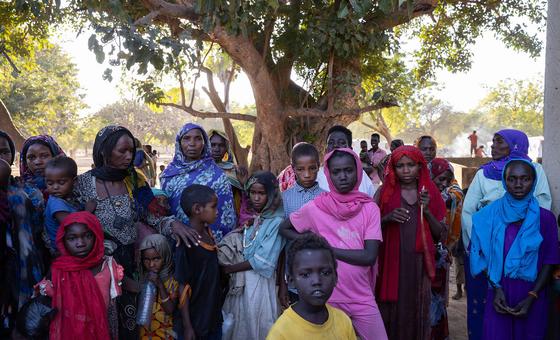
In neighbouring Chad, children make up 61 per cent of the 860,000 Sudanese refugees and a staggering 68 per cent of the 274,000 Chadian returnees – that’s over 700,000 young lives uprooted by violence.

Chad, already one of the world’s poorest countries, has the fourth-highest child mortality rate in the world, despite significant progress in recent years.

The Government of Chad and humanitarian partners have been providing support, but the migration crisis remains overwhelming: measles and malnutrition are spreading, the risk of Sudan’s cholera outbreak spilling into Chad remains high.

Only one in three children are enrolled in school and essential services are stretched to the brink.

Horrific memories 

UN Children’s Fund (UNICEF) Executive Director Catherine Russell concluded a three-day visit to Chad on Monday, where she met with refugee children and families displaced by the fighting and chaos across the Sudanese border.

Hundreds of thousands of the most vulnerable children are bearing the brunt of both the war in Sudan and the lack of essential services for those who have fled to Chad,” Russell said.

In eastern Chad, Ms. Russell “met women and children who arrived with little but the horrific memories they carry” and heard their stories of killings, mass rapes and homes burned to the ground.

She visited families newly arrived in Adré, an overwhelmed border town now hosting six refugees for every resident.

Russell also met President Mahamat Idriss Déby Itno to reaffirm UNICEF’s long-term commitment to Chad and discuss support for the country’s newly launched National Development Plan 2030.

The people of Chad have shown extraordinary generosity,” she said. “But they cannot face this crisis alone. We must stand in solidarity with them – and with the children of Sudan – by strengthening national systems and communities on the frontlines.”

Ramping up response

In Adré and surrounding areas, UNICEF-supported teams have vaccinated thousands of children, provided safe drinking water to tens of thousands, established child-friendly spaces and set up services for survivors of gender-based violence.

The agency is also working closely with Chadian authorities to scale up system-wide investments in health, including polio vaccination campaigns, as well as education and social protection.

But urgent funding gaps remain. Of the $114 million required for UNICEF’s 2025 humanitarian response in Chad, only 34 per cent has been secured.

Source link

‘A fire no one can control’: UN warns of spiralling Iran-Israel war

In an address to the UN Security Council on Friday, Mr. Guterres made an urgent plea for de-escalation, calling the spiralling confrontation a defining moment for the future of global security.

We are not drifting toward crisis – we are racing toward it,” he said.

“This is a moment that could shape the fate of nations…the expansion of this conflict could ignite a fire no one can control,” he warned.

Widespread panic, destruction

The Secretary-General’s remarks came amid a mounting civilian toll in both Israel and Iran, and as several nuclear sites in Iran have come under direct military assault.

Over 100 targets have been struck across Iran, including military and nuclear infrastructure such as the Natanz and Isfahan nuclear facilities and the Khondab heavy water reactor.

Iranian officials report over 224 civilian deaths, with some estimates twice as high. More than 2,500 have been injured reportedly – while major cities like Tehran have seen mass displacements, fuel shortages and widespread panic.

Iran has responded with its own barrage of missile strikes on Israel, hitting cities such as Tel Aviv, Haifa and Beersheba. Critical civilian sites, including the Soroka Medical Center and the Weizmann research institute, have been damaged. Twenty-four Israelis are confirmed dead, with more than 900 injured.

Give peace a chance

Mr. Guterres urged both parties to give diplomacy a chance, reiterating the need for full Iranian cooperation with the UN nuclear energy watchdog, IAEA, and warning that the “only thing predictable about this conflict is its unpredictability.”

He also called for unity within the Security Council and adherence to the UN Charter.

“The Non-Proliferation Treaty is a cornerstone of international security,” he said. “Iran must respect it. But the only way to bridge the trust gap is through diplomacy – not destruction.”

A wide view of the Security Council meeting on the Israel-Iran crisis.

Regional fallout expanding

Rosemary DiCarlo, UN Under-Secretary-General for political affairs, echoed those concerns, providing a grim overview of the violence and rising human toll.

“The vast majority are civilians,” she said, warning of a “humanitarian crisis in real time.”

The regional fallout is expanding, with airspace restrictions now spanning Lebanon to Iraq. Missiles from Yemen’s Houthi forces have targeted Israel and occupied Palestinian territory, while armed groups in Iraq are reportedly mobilizing.

“Any further expansion of the conflict could have enormous consequences for international peace and security,” Ms. DiCarlo cautioned.

She also highlighted global economic implications, noting that trade through the vital Strait of Hormuz has fallen 15 per cent amid rising tensions.

Grave warnings on nuclear safety

The most alarming update, however, came from IAEA Director General Rafael Grossi, who warned the Council that Israeli attacks on Iranian nuclear facilities are degrading critical safety systems and placing millions at potential radiological risk.

At Natanz, the destruction of electricity infrastructure and direct strikes on enrichment halls have led to internal contamination. While no radiological release has been detected outside the facility, Mr. Grossi warned that uranium compounds now pose significant health hazards within.

At Isfahan, multiple buildings – including a uranium conversion plant and a metal processing facility – were hit. At Arak’s Khondab reactor site, damage was sustained, though the facility was not operational.

The greatest risk, however, is the Bushehr Nuclear Power Plant, which remains operational.

A direct strike, Mr. Grossi warned, “could result in a high release of radioactivity to the environment.”

Millions at risk

Even disruption of its external power supply could lead to a core meltdown. In the worst-case scenario, radiation would affect populations hundreds of kilometres away and require mass evacuations.

Mr. Grossi also warned against any attack on the Tehran Nuclear Research Reactor, which could endanger millions in the capital.

Nuclear facilities and material must not be shrouded by the fog of war,” he said. “We must maintain communication, transparency and restraint.

Pledge to stay

Concluding his briefing, Mr. Grossi pledged that the IAEA would continue to monitor and report on nuclear safety conditions in Iran and reiterated his readiness to mediate.

He stressed the agency “can guarantee, through a watertight inspections system,” that nuclear weapons will not be developed in Iran, urging dialogue.

“The alternative is a protracted conflict – and a looming nuclear threat that would erode the global non-proliferation regime.”

Israeli actions in Palestinian territories constitute war crimes, Human Rights Council hears

“The goal of the Israeli government is abundantly clear: the destruction of life in Gaza.”

That’s how Navi Pillay, Chair of the Commission of Inquiry on the Occupied Palestinian Territory, opened her statement to the 59th session of the Council on Tuesday.

Calling the war in Gaza “the most ruthless, prolonged and widespread attack against the Palestinian people since 1948,” Ms. Pillay addressed the findings of the Commission’s report, released to the HRC on 6 May.

Attacks on educational facilities in Gaza

It found that 90 per cent of Gaza’s schools and universities have been damaged or destroyed by Israeli attacks – including airstrikes, shelling, burning and controlled demolitions.

“With the loss of education, Palestinians are also losing their source of stability, hope and possibility of a future,” said Ms. Pillay.

By not issuing adequate warnings to civilians sheltering inside, these attacks caused extensive casualties, amounting to war crimes, including knowingly launching attacks that caused excessive and disproportionate civilian harm, and the crime against humanity of extermination.

The Commission found no military necessity to justify the destruction of schools, concluding that the intent was to restrict long-term Palestinian access to education.

Notably, while Israeli forces often claimed they were targeting Hamas operatives allegedly based in schools, the Commission verified only one instance of Hamas using a school for military purposes, compared to the systematic Israeli use of schools as military bases.

Education restrictions in the West Bank

Ms. Pillay also warned that education in the West Bank remains under threat. Demolition orders, military raids, restrictions, and operations have significantly reduced school days, while settler violence has endangered students and teachers. The Israeli government has either incited or failed to prevent such violence, she said.

Attacks on religious and cultural sites

In Gaza, Israeli forces have damaged 53 per cent of religious and cultural sites.

Many were being used for refuge or worship, causing further civilian casualties, constituting war crimes and, in some cases, the crime against humanity of extermination.

This completely avoidable damage “has a cascading effect and deeply affects intangible cultural elements, such as religious and cultural practices, memories and history, undermining the identity of Palestinians as a people,” said Ms. Pillay.

Because Israeli forces should have known where these sites were and planned their assaults accordingly, the Commission found these acts constituted war crimes including intentionally targeting historic and religious sites and widespread destruction without military necessity.

Seizure of cultural heritage sites in the West Bank

In the West Bank and East Jerusalem, the Commission documented repeated cases of Israeli authorities or settlers seizing cultural heritage sites, displacing Palestinians, excluding non-Jewish history and restricting Palestinian access.

The report highlights increasing restrictions and assaults on Palestinians at Haram al-Sharif/Temple Mount, a long-standing flashpoint in East Jerusalem.

Ms. Pillay argued that through these actions, “Israel has been using cultural heritage and settlements as leverage for its unlawful territorial claims in the occupied West Bank, in flagrant defiance of multiple United Nations resolutions and the 2024 advisory opinion of the International Court of Justice (ICJ).”

These actions violate international law, including the right to cultural life, freedom of religion, and protection of cultural heritage.

Recommendations

Ms. Pillay concluded her speech by underscoring that Israel’s attacks on education, infrastructure and heritage sites aim to “erode Palestinians’ historical ties to the land and weaken their collective identity, thereby hindering their right to self-determination” and the possibility of a peaceful, sustainable two-State solution.

Accordingly, the Commission calls for Israel to end the unlawful occupation and enable Palestinian self-determination; stop attacks and seizures of educational, religious and cultural sites; end the systematic erasure of Palestinian history; and comply fully with international law, including the 2024 ICJ ruling.

Sudan’s war intensifies amid starvation, rights probe warns

Meanwhile in Sudan, heavy fighting continues to escalate as a “direct result” of the continued flow of arms into the country meaning that the war is far from over, top independent human rights investigators said on Tuesday, ahead of briefing the Human Rights Council.

In an update on the emergency in the northeast African nation, the Independent International Fact-Finding Mission for the Sudan highlighted the increased use of heavy weaponry in populated areas – and a sharp rise in sexual violence.

“Many Sudanese are dying from hunger and especially those who have been detained and in detention – they are dying and millions affected,” said Joy Ngozi Ezeilo, Expert Member of the Fact-Finding Mission.

“In terms of international responsibility, we urge all States to respect and enforce the arms embargo of the United Nations Security Council Resolution 1556,” she added.

Humanitarian relief continues to be weaponized and hospitals and medical facilities remain under siege, warned the investigators, whose mandate was established by the Council in October 2023.

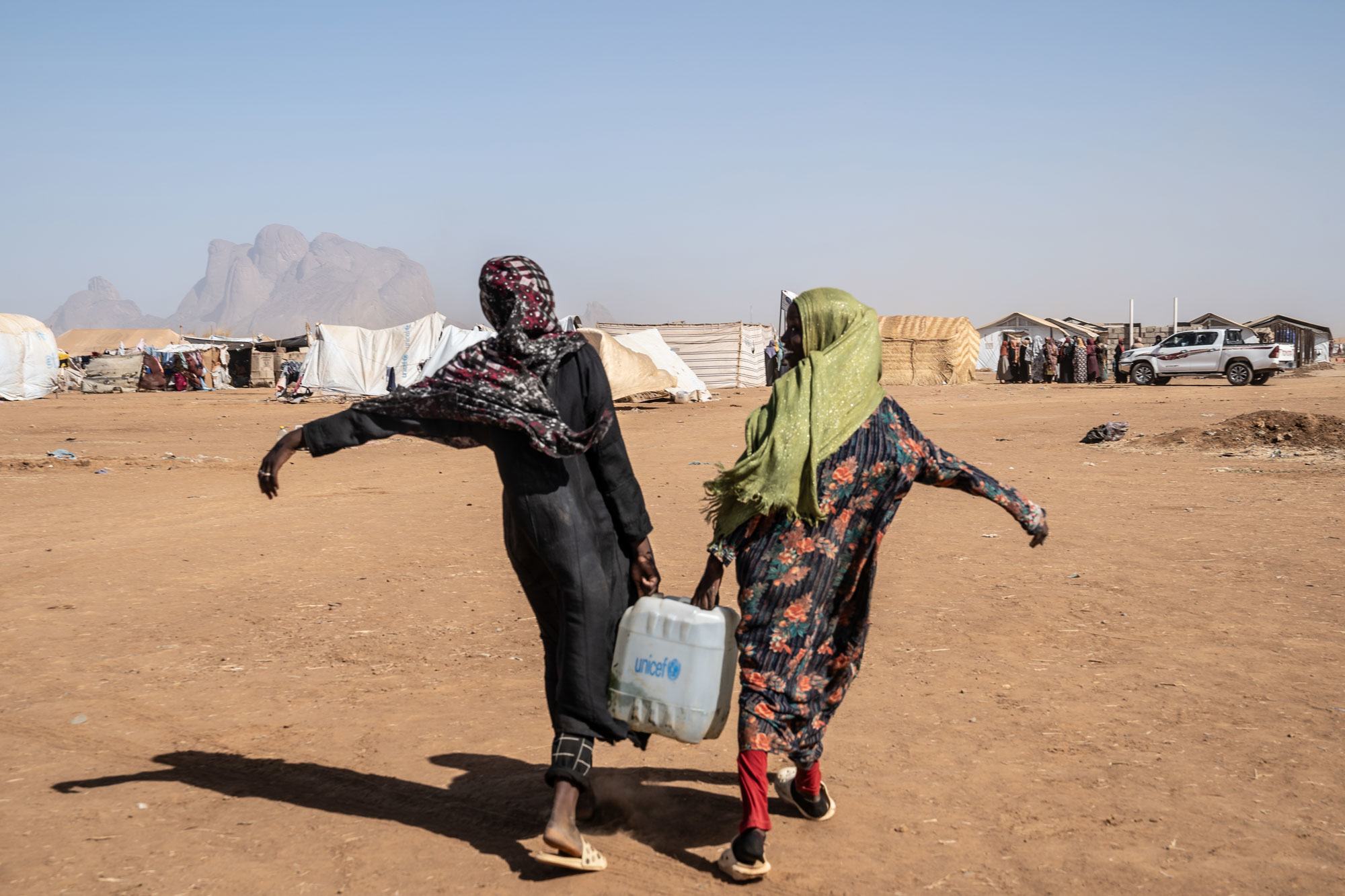
Two young women carry water at a site for displaced people in eastern Sudan.

Direct link

There is a direct link between the flow of arms in Sudan, armed hostilities and the resulting violence amounting to violations of international humanitarian law and human rights violations,” said Mohamed Chande Othman, Chair of the Fact-Finding Mission.

We know the kind of arms that are being used: heavy artillery, modern warfare, drones and in fact, they have escalated.”

Fellow investigator Mona Rishmawi insisted that testimonies gathered pointed to “both sides” continuing to commit war crimes – a reference to the Sudanese Armed Forces (SAF) and the Rapid Support Forces (RSF) which turned on each other in April 2023, following a breakdown in transition to civilian rule.

Around El Fasher, for instance, civilians have been “assaulted, detained and killed while villages have been attacked, burned and looted” by the RSF. During one RSF attack from 10 to 13 April, more than 100 civilians were reportedly killed, while a SAF bombing in Al Koma killed at least 15 civilians.

Now into its third year, the war has killed tens of thousands of civilians so far, displacing over 13 million Sudanese and subjecting many more to sexual violence, looting and the destruction of homes, health facilities, markets and other infrastructure. 

Crimes against humanity continue, “particularly in the context of persecution of certain ethnic groups”, Ms. Rishmawi insisted.

The result of restrictions to aid relief has been to drive famine, “especially in Darfur”, said the investigators, who are respected human rights experts and not UN staff.

In their latest update to the Human Rights Council, the investigators documented a sharp rise in sexual and gender-based violence, with women and girls subjected to rape, gang rape, abduction, sexual slavery and forced marriage, mostly in RSF-controlled displacement camps.

About UN experts

The members of both the Commission of Inquiry on the Occupied Palestinian Territory and the Fact-Finding Mission for the Sudan receive their mandates from the UN Human Rights Council.

They are not UN staff and do not receive payment for their work. 

Source link

DR Congo: Human rights violations could amount to war crimes, UN experts say

Volker Türk told the Human Rights Council that the investigation and analysis undertaken by his office, OHCHR, had revealed “an apparent total disregard for the protection of civilians during and after military operations.”

The OHCHR’s Fact-Finding Mission in the eastern DRC is also investigating other alleged violations of international humanitarian law, “many of which may amount to war crimes,” he said.  

Arbitrary Arrests

After capturing cities and villages in early 2025, the M23 Rwanda-backed rebels arbitrarily arrested police officers and large numbers of other civilians, including children, the UN human rights office reported.  

According to witnesses, those captured were, and are, still being held in “inhumane conditions,” and many were forcibly recruited into the ranks of the M23.  

The Mission is also investigating alleged arbitrary arrests and enforced disappearances of suspected M23 supporters by the military intelligence arm of the DRC armed forces.  

Extrajudicial Killings

OHCHR also reported that members of the M23 carried out summary and extrajudicial executions, which likely amount to war crimes, said Mr. Türk.  

The Mission is also investigating alleged summary executions by members of the DRC armed forces and DRC-backed Wazalendo militias.  

UN human rights is also investigating reports of death threats, detention and other reprisals against human rights defenders, journalists, and members of civil society perceived as critical of the M23; including the alleged killings of at least two activists.  

Sexual Violence

The Mission received reports of “horrific” use of sexual violence by all parties as a means of reprisal against communities, relatives of perceived opponents, and people from other ethnic groups, said Mr. Türk.  

In North and South Kivu, nearly 40 per cent of survivors of sexual and gender-based violence are children. The UN International Children’s Emergency Fund (UNICEF) estimated that during the most intense phase of the conflict, a child was raped every 30 minutes.  

Mr. Türk called on “all parties to the conflict to commit immediately to a ceasefire and resume negotiations, and to respect international humanitarian and human rights law.” 

Source link

World News in Brief: Rights abuses in Haiti, Sudan war sees exodus to Chad, food trade optimism

Between 1 January and 30 May, at least 2,680 people – including 54 children – were killed, 957 injured, 316 kidnapped for ransom, and many more subjected to sexual violence and child gang recruitment.

“Alarming as they are, numbers cannot express the horrors Haitians are being forced to endure daily,” said Mr. Türk.

Conflicts on all sides

In recent months, gangs have attacked Mirebalais in the centre of the country, looting police stations, destroying property and freeing over 500 inmates from the local prison.

Meanwhile, so-called self-defence groups have targeted individuals they suspect of gang affiliation. On 20 May, at least 25 people were killed and 10 injured by a group accusing them of supporting gangs.

Law enforcement has ramped up operations against them. Since January, police have killed at least 1,448 people, including 65 during extrajudicial executions.

Mr. Türk called on the international community to take decisive action to end the violence, including renewed support for the Security Council-backed Multinational Security Support (MSS) mission and full enforcement of the council’s arms embargo.

He also reiterated his call for States to not forcibly return anyone to Haiti.  

“The coming months will be crucial and will test the international community’s ability to take stronger, more coordinated action – action that will help determine the future stability of Haiti and the wider region,” Mr. Türk added.

Outlook for food trade ‘relatively optimistic’, FAO says

The Food and Agriculture Organization (FAO) released their annual Food Outlook report Thursday which provides a “relatively optimistic” look at international food markets.  

According to the report, production is expected to increase across almost all categories, with grain production expected to reach record levels. And while prices do remain higher this year than last, between April and May there was an overall decrease of almost one per cent. 

The report noted, however, that global trends — including rising geopolitical tensions, climate shocks and trade uncertainties — may still negatively impact production.  

“While agricultural production trends appear solid, drivers that could negatively impact global food security are increasing,” said FAO Chief Economist Máximo Torero.

Fowl, fish fraud and fertilizer flows

The report noted that outbreaks of avian influenza have become more persistent and constitute “one of the most significant biological threats to the global poultry sector.” Nevertheless, poultry exports have largely remained largely resilient so far.  

The issue of fish fraud – the misrepresentation of the location or manner of the catch – was also discussed, with FAO warning that risks are growing.  

Additionally, the report examined fertilizer flows, noting Russia’s growing exports and the decrease in fertilizer prices since the COVID pandemic.  

Overall, the report noted, the cost of imports worldwide has increased by 3.6 percent or nearly $2.1 trillion.  

Eastern Chad ‘reaching a breaking point’ as Sudan war refugees continue to arrive  

Aid teams in eastern Chad warn on Friday that host communities are reaching breaking point because of climate shocks and the pressure of hosting war refugees from neighbouring Sudan.

In an alert, the UN’s top aid official in Chad, François Batalingaya, warned that a humanitarian catastrophe is unfolding almost unnoticed by the world’s media.

“Right now, nearly 300,000 people are stranded at the border, waiting to be relocated inland,” he noted.  

“Tens of thousands, mostly women and children, are sleeping in the open without shelter, clean water and health care. These are survivors of war. They arrive traumatized, hungry, and with nothing. They recount stories of mass killings, sexual violence and entire communities destroyed.” 

Major exodus

Since the outbreak of war in Sudan in April 2023, more than 850,000 Sudanese refugees have crossed into Chad. They’ve joined the 400,000 existing Sudanese refugees who have arrived over the last 15 years.

The UN aid official explained that even before the latest Sudanese arrivals, nearly one million people in eastern Chad were in urgent need of help.  

Today, “they are sharing what little they have – food, water, and space – with those fleeing the war,” Mr. Batalingaya said.

In an appeal for international assistance, he warned that clinics are overwhelmed, malnutrition is rising and basic services are buckling.  

Sudan war exacerbates risk of cholera and malaria: UNICEF

In a report released Wednesday, UNICEF highlighted the growing threat of cholera in the war-torn country, with more than 7,700 cases and 185 associated deaths reported in Khartoum State alone since January 2025. Alarmingly, over 1,000 cases have affected children under the age of five.

Since the onset of conflict in April 2023, three million people have been forced to flee their homes, displaced internally and across the region.

Returning to homes without water

While improved access to parts of Khartoum State has enabled more than 34,000 people to return since January, many are coming back to homes that have been severely damaged and lack access to basic water and sanitation services.

Recent attacks on power infrastructure in Khartoum State have compounded the crisis, disrupting water supplies and forcing families to collect water from unsafe, contaminated sources.

This significantly increases the risk of cholera, particularly in densely populated areas such as displacement camps.

UNICEF has implemented a multi-pronged approach to the crisis, including distributing household water treatment chemicals, delivering over 1.6 million oral cholera vaccines, supplying cholera treatment kits, and more.

“Each day, more children are exposed to this double threat of cholera and malnutrition, but both are preventable and treatable, if we can reach children in time,” said Sheldon Yett, UNICEF Representative for Sudan.

Malaria and new prevention efforts

Also on Wednesday, UNICEF launched a partnership with the Sudanese government’s health ministry and The Global Fund to Fight AIDS, Tuberculosis and Malaria to distribute nearly 15.6 million insecticide-treated bed nets to prevent the spread of malaria among vulnerable families across Sudan, along with 500,000 additional nets for antenatal and immunization facilities.

The campaign aims to protect 28 million Sudanese across 14 states.

As with cholera, ongoing conflict and displacement have created conditions conducive to the spread of malaria. Overcrowded and unsanitary living conditions, coupled with the approaching rainy season, present a serious health risk to millions, particularly those returning to damaged communities.

In addition, the initiative aims to bolster the availability of anti-malarial medications, rapid diagnostic tests, and investments in strengthening the healthcare system.

Critical medical supplies reach West Darfur

In a more positive development, the World Health Organization (WHOannounced Tuesday that El Geneina Hospital in West Darfur has received eight tonnes of medical supplies for nutrition, non-communicable diseases and mental health.

The delivery, supported by the World Bank Africa, the Share Project, and the European Union, is expected to sustain the hospital’s operations for six months, providing vital support to one of the regions hardest hit by the multiple escalating crises.

Journalists being forgotten on the frontline, warns injured war reporter

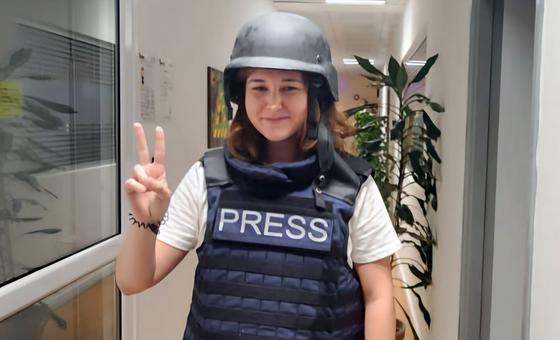
“I believe in nothing right now. Our press vests are turning us into targets and it’s becoming a death sentence for us,” Christina Assi told UN News recently.

On 13 October 2023, Ms. Assi – who was working as a photojournalist for Agence France Presse (AFP) – lost her right leg after two Israeli air strikes targeted the exposed hillside where she and other colleagues were observing the ongoing conflict between Israeli forces and Hezbollah militants.

This year’s commemoration of World Press Freedom Day on 3 May was marked with sorrow as nearly 300 journalists have been killed in recent conflicts. 

Ms. Assi stands among the few survivors, and she never imagined that she would be targeted simply for doing her job.

The day of the attack

She recounted the harrowing events of that day – one of her first major assignments, which quickly became the most traumatic experience of her life.

“It was starting to get dark and that’s when we were about to leave and then suddenly, out of nowhere, we were targeted,” she said.

“The first time I was on the ground, I couldn’t really understand what was happening, and I was screaming for help. So, my colleague Dylan rushed to help me and put a tourniquet on me. But then, like 40 to 47 seconds later, we were targeted again.”

After the second strike, Ms. Assi found herself alone beside a burning car. Bleeding and gravely injured, she had no choice but to crawl away to save her life.

“My press vest was too heavy, and the camera belt was suffocating,” she recalled. In that moment, she began to lose faith in international laws and conventions.

“As journalists, we are left alone,” she said. “Our press vests are turning us into targets—it’s becoming a death sentence for us.”

The silence of the international community

For Ms. Assi, the international community’s response to the attack – including condemnations and UN calls for investigation – has been utterly ineffective.

“I do believe that we need more than words. We need concrete action and something to happen where that should lead to justice in one way or another. If it’s not now, then later,” she said.

She strongly condemns the impunity with which attacks on journalists continue. “Our cases are being dismissed as collateral damage when, in fact, they are not. These are war crimes, and there should be a real investigation.”

The forgotten journalists of Gaza

Ms. Assi also emphasized that the same impunity applies to Palestinian journalists in Gaza, who have been documenting the war there since day one.

“They’ve been silenced, targeted in every possible way. It’s all over social media and in the news—and yet nothing has been done. No action has been taken to protect these journalists,” she said.

She pointed out that the lack of international presence hasn’t stopped the violence. “Even with the limited footage we’ve received, it’s clear how horrific everything is. But the world hasn’t reacted the way it should have. No one has even tried to stop it.”

Carrying the flame

Nearly a year after losing her leg, Ms. Assi carried the Olympic torch in the French city of Vincennes, ahead of the Paris Games in July 2024.

It was more than a symbolic gesture but a powerful opportunity to pay tribute to her colleague, Reuters journalist Issam Abdallah, who was killed in the same attack. 

“It was a great opportunity for us to honour all the fallen journalists and let the world and the international community and the Europeans and all those who didn’t know about what happened to us, let them know about what happened,” she said.  

Source link

World News in Brief: South Sudan urged to avoid slide to war, Türk calls on EU not to weaken landmark law, Ukraine and Mali updates

The Quartet is calling on the country’s leaders to end hostilities and return to dialogue to fully implement the 2018 peace agreement known as the Revitalized Agreement on the Resolution of the Conflict in the Republic of South Sudan (R-ARCSS).

South Sudan, the world’s youngest nation, gained independence in 2011 but soon descended into a brutal civil war. A 2018 peace agreement has held together but now threatens to fully unwind between the president and his vice presidential rival.

Regional pressure

In recent weeks, the Quartet has observed air and ground attacks that have led to loss of life, the destruction of homes, and the displacement of civilians. Humanitarian facilities have also been targeted, while hate speech and ethnic tensions are on the rise.

The Quartet welcomed a recent joint visit by the African Union and IGAD to South Sudan as a sign of regional support for peace. It also called on all sides to cooperate with ceasefire monitors investigating recent violence.

South Sudan’s leaders must commit to inclusive dialogue, the release of political detainees, and renewed efforts to carry out the peace deal, the Quartet stressed.

A return to war would betray the people’s hope for peace and stability, they warned. Only a political solution can ensure free and fair elections at the end of the current transitional period.

UN rights chief urges EU not to weaken landmark corporate responsibility law

UN human rights chief Volker Türk has called on the European Union to protect a key law that holds large companies accountable for human rights and environmental harm.

The EU’s Corporate Sustainability Due Diligence Directive (CSDDD), adopted last year, requires businesses to identify and address any negative impact their activities may have on people or the planet.

But changes now being discussed in Brussels as part of a broader reform package could weaken the law, Mr. Türk warned on Wednesday.

“The CSDDD, by far the most ambitious business and human rights regulatory initiative anywhere in the world, has rightly been welcomed by companies, policy makers, civil society, and national human rights institutions alike,” he said.

“A large number of businesses have already taken steps to ensure they comply with it.”

Detailed review

UN human rights office, OHCHR, has published a detailed review of the EU proposal, pointing to ways it could undermine this groundbreaking directive.

Mr. Türk urged lawmakers to keep the law in line with global standards, such as the UN Guiding Principles on Business and Human Rights.

“While some streamlining… could be advantageous, it would be counterproductive to water down its alignment with international standards,” he said.

April deadliest month for civilians in Ukraine since September

April was the deadliest month for civilians in Ukraine since September 2024, with at least 209 people killed and 1,146 injured, the UN Human Rights Monitoring Mission in Ukraine (HRMMU) reported on Wednesday.

In its monthly update, the Mission said that 97 per cent of casualties occurred in areas controlled by Ukraine, with nearly half caused by missile and loitering munitions attacks by Russian forces.

“Kryvyi Rih, Sumy, Dnipro, Zaporizhzhia, Kyiv, and Kharkiv all endured devastating attacks,” said Danielle Bell, Head of HRMMU. “The sharp rise in casualties was mainly due to the intensified use of ballistic missiles in major cities.”

Among the deadliest incidents:

  • On 4 April, a missile strike on Kryvyi Rih killed 20 civilians and injured 63.
  • On Palm Sunday (13 April), two missiles hit Sumy, killing at least 31 and injuring 105.
  • A 24 April attack on Kyiv killed 11 and injured 81.

Children were especially affected. At least 19 were killed and 78 injured in April – the highest monthly total since June 2022.

The wave of attacks continued into May, with cities including Kharkiv, Odesa and Kyiv again coming under fire.

UN experts raise alarm over Mali’s suspension of political parties

Independent UN human rights experts have strongly criticised Mali’s military authorities for suspending all political parties and activities, calling the move a clear violation of basic rights.

© MINUSMA/Harandane Dicko

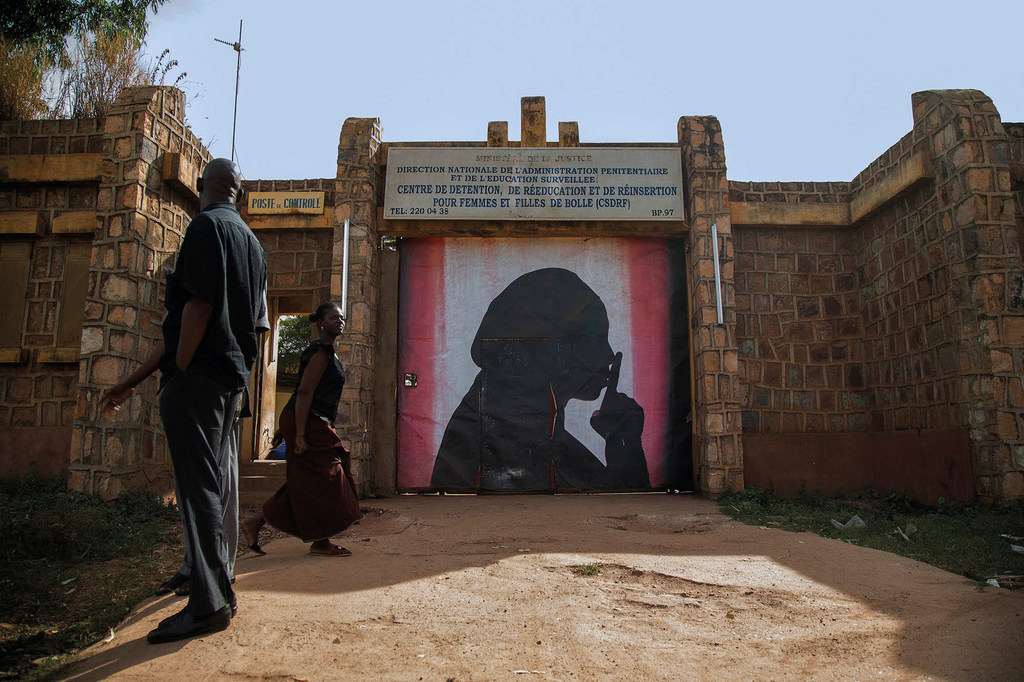
A detention centre in Bamako, Mali. (file)

The decision, announced on 7 May via state television, halts political activity “until further notice.” The junta, which took power following coups in 2020 and 2021, said the suspension was necessary to maintain public order.

The three UN Human Rights Council-appointed experts described it as a direct violation of human rights and called for the order’s immediate repeal.

They also called on the National Transitional Council to strike down a bill introduced on 30 April, which repealed legislation governing how political parties operate.

“If passed into law, the 30 April bill will place Mali in contravention of its human rights obligations, notably on freedoms of association and expression,” the experts stressed.”

Protests

In response to the 30 April bill, opposition parties organised a pro-democracy rally in the capital Bamako on 3 May which drew hundreds of demonstrators. The parties reportedly demanded a timeline to end military rule and a return to constitutional order.

Another protest is planned for Friday to oppose the decree against political parties.

The experts said Malian authorities must work to counteract “the current climate of suppression of the civic space”.

“The right to peacefully assembly is essential to the health of a vibrant political community,” the experts said. “The Malian Transitional authorities must scrupulously respect it and abstain from acts of intimidation and repression that risk the physical integrity and the rights of demonstrators.”

Special Rapporteurs and Independent Experts are appointed by the Geneva-based Human Rights Council. They serve in their individual capacity, independent of the UN system and national governments. They are not UN staff and draw no salary

Source link

‘Season of war,’ as norms of humanitarian law ‘cast aside’ UN refugee chief

Speaking in the UN Security Council, Filippo Grandi said in conflicts across the world in places like Sudan, Ukraine, Myanmar, the Democratic Republic of the Congo and Haiti, “violence has become the currency of our age.”

Forcibly displaced people are among the first victims of war. Worldwide, some 123 million people have had to flee due to conflict.

Since the beginning of the war in Sudan, one-third of Sudan’s population has been displaced by indiscriminate violence, disease, starvation, flooding, droughts and sexual violence, “a situation that frankly defies description,” said Mr. Grandi.

In Ukraine, 10 million people have been displaced by the war, experiencing what he described as “terrible toll.” Seven million of them are now refugees, living outside the country.

“Stagnation has defined the response in Myanmar,” said the UN refugee chief. As a result, Rohingya refugees in Bangladesh have been living in camps entirely dependent on humanitarian aid for the past eight years.

Security and self-reliance

Refugees and displaced people will not return to their communities “unless they are confident that the terms of peace are durable, for them and for their country,” he added.

Promoting security and self-reliance is essential to ending humanitarian crises.

However, a return to peace requires compromise and commitment; peace cannot be made passively, said Mr. Grandi.

Reminding the 15 Members of the Security Council that preventing and stopping wars is their primary responsibility, he noted that it was one that “this body has chronically failed to live up to.”

Seizing opportunities

To achieve durable peace, the UN must be ready both to seize unexpected opportunities, and to take calculated risks, High Commissioner Grandi said adding that “there is now an opportunity to break this dangerous inertia.”

As over one million people have already returned to Syria since December 8, with many more expected to follow, the refugee chief urged the Security Council to ease sanctions to support early recovery efforts and spur investment.

“To minimise the risk that the returning Syrians are taking, I am asking you to take some risks yourselves,” he said.

Retrenchment away from aid

Despite the positive signs coming out of Syria, as well as Burundi and the Central African Republic, Mr. Grandi told the Council that “we see a retrenchment away from aid, away from multilateralism, even away from life-saving assistance,” adding that “we hear of prioritizing national interests, of boosting defense spending — all valid concerns of course, and legitimate state pursuits. But these are not incompatible with aid, quite the contrary.”

One way or another, forced displacement has concerned every member of the Security Council, Mr. Grandi pointed out.

“You have been the refugee. You have welcomed those who sought refuge,” he said reminding its members of their collective responsibility “to end war, to bring peace.”

Source link

Japanese protesters oppose expensive state funeral to Shinzo Abe

For a pacifist nation like Japan, the assassination of Shinzo Abe would have been painful but the public outrage during the funeral is astounding in view of the state funeral at a cost of 1.7 billion yen ($12 million) at a time when the government is heavily indebted.

Former Japanese Prime Minister Shinzo Abe was assassinated during the campaign trail in July and the government’s plans to a state funeral have been opposed by many since then owing to the country’s fragile economy.

Japan’s prime minister Fumio Kishida has been unable to assuage public concerns as the controversy undermines his proposed record defense spending, which began with Shinzo Abe, whose legacy is left behind with the revision of the country’s post-war Pacifist Constitution and sending Japanese armed forces abroad.

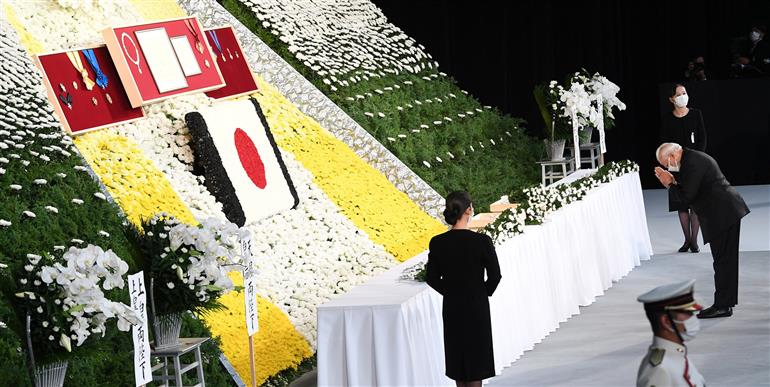
PM Modi paying homage at the State Funeral Ceremony of the Former Prime Minister of Japan, Late Mr. Shinzo Abe, in Tokyo, Japan on September 27, 2022 / PIB

PM Kishida’s approval ratings have reached the lowest level since he became the country’s Prime Minister in October. Last week, a man has allegedly set himself on fire near the office of Japanese Prime Minister protesting against the expensive state funeral.

The funeral on Tuesday kept the capital under maximum security due to protests which began just before the funeral. About 4,300 attendees gathered in Tokyo to pay their respects at the funeral.

U.S. Vice President Kamala Harris, Australian Prime Minister Anthony Albanese, Indian Prime Minister Narendra Modi and South Korean Prime Minister Han Duck-soo were among 700 foreign dignitaries from 218 countries, regions and international organizations who attended the funeral.