London Underground polluted with metallic particles small enough to enter human bloodstream

The London Underground is polluted with ultrafine metallic particles small enough to end up in the human bloodstream, according to University of Cambridge researchers. These particles are so small that they are likely being underestimated in surveys of pollution in the world’s oldest metro system.

The researchers carried out a new type of pollution analysis, using magnetism to study dust samples from Underground ticket halls, platforms and operator cabins.

The team found that the samples contained high levels of a type of iron oxide called maghemite. Since it takes time for iron to oxidise into maghemite, the results suggest that pollution particles are suspended for long periods, due to poor ventilation throughout the Underground, particularly on station platforms.

Some of the particles are as small as five nanometres in diameter: small enough to be inhaled and end up in the bloodstream, but too small to be captured by typical methods of pollution monitoring. However, it is not clear whether these particles pose a health risk.

Other studies have looked at overall pollution levels on the Underground and the associated health risks, but this is the first time that the size and type of particles has been analysed in detail. The researchers suggest that periodic removal of dust from Underground tunnels, as well as magnetic monitoring of pollution levels, could improve air quality throughout the network. Their results are reported in the journal Scientific Reports.

The London Underground carries five million passengers per day. Multiple studies have shown that air pollution levels on the Underground are higher than those in London more broadly, and beyond the World Health Organization’s (WHO) defined limits. Earlier studies have also suggested that most of the particulate matter on the Underground is generated as the wheels, tracks and brakes grind against one another, throwing up tiny, iron-rich particles.

“Since most of these air pollution particles are metallic, the Underground is an ideal place to test whether magnetism can be an effective way to monitor pollution,” said Professor Richard Harrison from Cambridge’s Department of Earth Sciences, the paper’s senior author. “Normally, we study magnetism as it relates to planets, but we decided to explore how those techniques could be applied to different areas, including air pollution.”

Pollution levels are normally monitored using standard air filters, but these cannot capture ultrafine particles, and they do not detect what kinds of particles are contained within the particulate matter.

“I started studying environmental magnetism as part of my PhD, looking at whether low-cost monitoring techniques could be used to characterise pollution levels and sources,” said lead author Hassan Sheikh from Cambridge’s Department of Earth Sciences. “The Underground is a well-defined micro-environment, so it’s an ideal place to do this type of study.”

Working with colleagues from Cambridge’s Department of Materials Science and Metallurgy, Sheikh and Harrison analysed 39 dust samples from the London Underground, provided by Transport for London (TfL). The samples were collected in 2019 and 2021 from platforms, ticket halls, and train operator cabins on the Piccadilly, Northern, Central, Bakerloo, Victoria, Northern, District and Jubilee lines. The sampling included major stations such as King’s Cross St Pancras, Paddington, and Oxford Circus.

The researchers used magnetic fingerprinting, 3D imaging and nanoscale microscopy to characterise the structure, size, shape, composition and magnetic properties of particles contained in the samples. Earlier studies have shown that 50% of the pollution particles in the Underground are iron-rich, but the Cambridge team were able to look in much closer detail. They found a high abundance of maghemite particles, ranging in diameter from five to 500 nanometres, and with an average diameter of 10 nanometres. Some particles formed larger clusters with diameters between 100 and 2,000 nanometres.

“The abundance of these very fine particles was surprising,” said Sheikh. “The magnetic properties of iron oxides fundamentally change as the particle size changes. In addition, the size range where those changes happen is the same as where air pollution becomes a health risk.”

While the researchers did not look at whether these maghemite particles pose a direct health risk, they say that their characterisation methods could be useful in future studies.

“If you’re going to answer the question of whether these particles are bad for your health, you first need to know what the particles are made of and what their properties are,” said Sheikh.

“Our techniques give a much more refined picture of pollution in the Underground,” said Harrison. “We can measure particles that are small enough to be inhaled and enter the bloodstream. Typical pollution monitoring doesn’t give you a good picture of the very small stuff.”

The researchers say that due to poor ventilation in the Underground, iron-rich dust can be resuspended in the air when trains arrive at platforms, making the air quality on platforms worse than in ticket halls or in operator cabins.

Given the magnetic nature of the resuspended dust, the researchers suggest that an efficient removal system might be magnetic filters in ventilation, cleaning of the tracks and tunnel walls, or placing screen doors between platforms and trains.

Also Read:

Nasal irrigation twice a day reduces COVID-related illness, death

Exposure to air pollution in infancy alters gut microorganisms, may boost disease risk [Preventive Steps]

Soon new material to replace rogue plastic; It biodegrades in ocean water within 4 weeks

Two fungi work together to kill fig trees; leads to fig-wilting disease

In many countries, the number of fig trees have been declining. While there are numerous explanations, one key problem is fig-wilting disease. A recognized cause of this disease is a fungus, Ceratocystis ficicola, which is transmitted by an ambrosia beetle, Euwallacea interjectus. Now, a group from Nagoya University in central Japan has identified another fungus, Fusarium kuroshium, which is harmless by itself, but ravages fig trees when found together with C. ficicola.

Along with known agents, such as C. ficicola, many other fungi are believed to be important in fig-wilting disease. These include F. kuroshium, a well-known infective agent of fig and avocado trees. As these fungi are frequently found on the heads, including a special organ for storing fungi, of wild and reared E. interjectus adult females, it has long been suspected that they are responsible for the spread of disease.

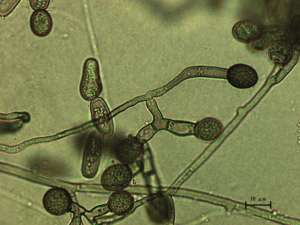
Ceratocystis ficicola/CREDIT:Zi-Ru Jiang and Hisashi Kajimura

To determine whether the fungi are related to the damage of the fig trees, Dr. Zi-Ru Jiang and Associate Professor Hisashi Kajimura of the Graduate School of Bioagricultural Sciences, Nagoya University, in partnership with the Hiroshima Prefectural Institute of Technology, Kobe University, and the Forestry and Forest Products Research Institute, inoculated fig saplings with various combinations of fungi collected from E. interjectus. As a control, they also included Neocosmospora metavorans, which is found in a wide range of plant hosts, including avocado and Robusta coffee. Some saplings received only one of the three fungi, and one group received a combination of F. kuroshium and C. ficicola.

As expected, the saplings infected with C. ficicola wilted, whereas the other two groups infected with only N. metavorans or only F. kuroshium did not, suggestingthat these two fungi are not harmful to fig trees. However, in the combination group, the saplings wilted less than two weeks after infection and had a larger area of dead wood. It seems that F. kuroshium and C. ficicola worked together in a symbiotic way that accelerated wilting in the saplings.

“A combination of the ambrosia beetle and its fungi may lead to symptoms of fig-wilting disease in the case of mass beetle attacks and decreased resistance in host trees. Therefore, understanding the relationship between C. ficicola and its symbionts may be useful in developing suitable disease control strategies,” explains Kajimura. “This study suggests that symbiotic fungi do not kill fig trees by themselves, but that synergistic effects are driven by their coexistence with companion fungi, and that they have a more detrimental effect on fig trees than the companion fungi alone. This fact leads to additional targets for control and provides important clues to improve integrated pest management methods in the future.”

Also Read:

Giraffes, parrots, oak trees, cacti among many species facing extinction

Medieval friars were ‘riddled with parasites’, new findings reveal

Hidden black diamond: Delicious, aromatic, rare ‘Appalachian truffle’

NASA Sensors to Help Detect Methane Emitted by Landfills

A nonprofit group, Carbon Mapper, will use data from NASA’s EMIT mission, plus current airborne and future satellite instruments, to survey waste sites for methane emissions.

Observations from the Earth Surface Mineral Dust Source Investigation (EMIT) and other NASA science instruments will be part of a global survey of point-source emissions of methane from solid waste sites such as landfills. The multiyear effort is being developed and conducted by the nonprofit Carbon Mapper organization.

Methane is a potent greenhouse gas, the source of roughly a quarter to a third of global warming caused by humans. The aim of the new initiative is to establish a baseline assessment of global waste sites that emit methane at high rates. This information can support decision-makers as they work to reduce the concentration of the gas in the atmosphere and limit climate change.

NASA Sensors to Help Detect Methane Emitted by Landfills

Methane produced by the waste sector contributes an estimated 20% of human-caused methane emissions. Ton for ton, methane is more than 80 times more potent than carbon dioxide in trapping heat in the atmosphere. But where carbon dioxide remains in the air for centuries, methane has an atmospheric lifetime of only about a decade or two. That means some immediate slowing of atmospheric warming could be achieved if methane emissions were significantly reduced.

“Currently, there is limited actionable information about methane emissions from the global waste sector. A comprehensive understanding of high-emission point sources from waste sites is a critical step to mitigating them,” said Carbon Mapper CEO Riley Duren. “New technological capabilities that are making these emissions visible – and therefore actionable – have the potential to change the game, elevating our collective understanding of near-term opportunities in this often overlooked sector.”

NASA/Photo: Nasa.gov

Carbon Mapper received a grant from the Grantham Foundation for the Protection of the Environment to support its operations related to the waste-site initiative, including potential funding to cover airborne methane surveys using NASA airborne assets. The project will entail conducting an initial remote-sensing survey in 2023 of more than 1,000 managed landfills across the United States and Canada, and in key locations in Latin America, Africa, and Asia.

To collect data from these regions, researchers will use aircraft-based sensors, including the Airborne Visible/Infrared Imaging Spectrometer-Next Generation (AVIRIS-NG), which was developed at NASA’s Jet Propulsion Laboratory in Southern California. In addition, they will use Arizona State University’s Global Airborne Observatory from the Center of Global Discovery and Conservation Science, which uses another JPL-built imaging spectrometer.

Also Read:

NASA’s Webb Detects Carbon Dioxide in Exoplanet Atmosphere

Webb space Telescope Captures Clearest View of Neptune’s Rings, Unusual Moon ‘Triton’

NASA Successfully Tests Mini Methane Sensor for Future Mars Exploration

NASA’s Perseverance Rover Gets the Dirt on Mars

The mission’s first two samples of regolith – broken rock and dust – could help scientists better understand the Red Planet and engineers prepare for future missions there.

NASA’s Perseverance rover snagged two new samples from the Martian surface on Dec. 2 and 6. But unlike the 15 rock cores collected to date, these newest samples came from a pile of wind-blown sand and dust similar to but smaller than a dune. Now contained in special metal collection tubes, one of these two samples will be considered for deposit on the Martian surface sometime this month as part of the Mars Sample Return campaign.

Scientists want to study Martian samples with powerful lab equipment on Earth to search for signs of ancient microbial life and to better understand the processes that have shaped the surface of Mars. Most of the samples will be rock; however, researchers also want to examine regolith – broken rock and dust – not only because of what it can teach us about geological processes and the environment on Mars, but also to mitigate some of the challenges astronauts will face on the Red Planet. Regolith can affect everything from spacesuits to solar panels, so it’s just as interesting to engineers as it is to scientists.

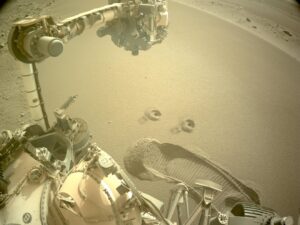
Two holes are left in the Martian surface after NASA’s Perseverance rover used a specialized drill bit to collect the mission’s first samples of regolith on Dec. 2 and 6, 2022. Credit: NASA/JPL-Caltech

As with rock cores, these latest samples were collected using a drill on the end of the rover’s robotic arm. But for the regolith samples, Perseverance used a drill bit that looks like a spike with small holes on one end to gather loose material.

Engineers designed the special drill bit after extensive testing with simulated regolith developed by JPL. Called Mojave Mars Simulant, it’s made of volcanic rock crushed into a variety of particle sizes, from fine dust to coarse pebbles, based on images of regolith and data collected by previous Mars missions.

NASA’s Perseverance Mars rover took this image of regolith – broken rock and dust – on Dec. 2, 2022. This regolith will be considered for deposit on the Martian surface as part of the Mars Sample Return campaign. Credit: NASA/JPL-Caltech

“Everything we learn about the size, shape, and chemistry of regolith grains helps us design and test better tools for future missions,” said Iona Tirona of NASA’s Jet Propulsion Laboratory in Southern California, which leads the Perseverance mission. Tirona was the activity lead for operations to collect the recent regolith sample. “The more data we have, the more realistic our simulants can be.”

The Challenge of Dust

Studying regolith up close could help engineers design future Mars missions – as well as the equipment used by future Martian astronauts. Dust and regolith can damage spacecraft and science instruments alike. Regolith can jam sensitive parts and slow down rovers on the surface. The grains could also pose unique challenges to astronauts: Lunar regolith was discovered to be sharp enough to tear microscopic holes in spacesuits during the Apollo missions to the Moon.

Regolith could be helpful if packed against a habitat to shield astronauts from radiation, but it also contains risks: The Martian surface contains perchlorate, a toxic chemical that could threaten the health of astronauts if large amounts were accidentally inhaled or ingested.

“If we have a more permanent presence on Mars, we need to know how the dust and regolith will interact with our spacecraft and habitats,” said Perseverance team member Erin Gibbons, a McGill University doctoral candidate who uses Mars regolith simulants as part of her work with the rover’s rock-vaporizing laser, called SuperCam.

“Some of those dust grains could be as fine as cigarette smoke, and could get into an astronaut’s breathing apparatus,” added Gibbons, who was previously part of a NASA program studying human-robot exploration of Mars. “We want a fuller picture of which materials would be harmful to our explorers, whether they’re human or robotic.”

Besides answering questions about health and safety hazards, a tube of Martian regolith could inspire scientific wonder. Looking at it under a microscope would reveal a kaleidoscope of grains in different shapes and colors. Each one would be like a jigsaw puzzle piece, all of them joined together by wind and water over billions of years.

“There are so many different materials mixed into Martian regolith,” said Libby Hausrath of University of Nevada, Las Vegas, one of Perseverance’s sample return scientists. “Each sample represents an integrated history of the planet’s surface.”

As an expert on Earth’s soils, Hausrath is most interested in finding signs of interaction between water and rock. On Earth, life is found practically everywhere there’s water. The same could have been true for Mars billions of years ago, when the planet’s climate was much more like Earth’s.

Also Read:

Wind blows, ground moves on Mars, says study after INSIGHT lander findings

Mars cracks show water dried up 3.5 billion years ago on Red Planet

Are we alone in the universe? JPL’s OWLS, other tools to help search for life in deep space

Viral Videos Today: Trump to MS Dhoni videos

Here are today’s viral videos and the one-year-old video of faceoff between Indian and Chinese troops along the Tawang border is trending. See them here:


https://youtube.com/shorts/6gE–usZAKY?feature=share


https://youtube.com/shorts/S5M8UVX4VOg?feature=share


https://youtube.com/shorts/5YWxh6oa8Xc?feature=share

Researchers uncover factors linked to optimal aging

What are the keys to “successful” or optimal aging? A new study followed more than 7000 middle aged and older Canadians for approximately three years to identify the factors linked to well-being as we age.

They found that those who were female, married, physically active and not obese and those who had never smoked, had higher incomes, and who did not have insomnia, heart disease or arthritis, were more likely to maintain excellent health across the study period and less likely to develop disabling cognitive, physical, or emotional problems.

As a baseline, the researchers selected participants who were in excellent health at the start of the approximately three-year period of study. This included the absence of memory problems or chronic disabling pain, freedom from any serious mental illness and absence of physical disabilities that limit daily activities — as well as the presence of adequate social support and high levels of happiness and life satisfaction.

Japan’s oldest woman Misao Owasa receiving Huinness Record for longest living person (http://www.guinnessworldrecords.com)

“We were surprised and delighted to learn that more than 70% of our sample maintained their excellent state of health across the study period,” says the first author, Mabel Ho, a doctoral candidate at the University of Toronto’s Factor-Inwentash Faculty of Social Work (FIFSW) and the Institute of Life Course and Aging. “Our findings underline the importance of a strength-based rather than a deficit-based focus on aging and older adults. The media and research tend to ignore the positive and just focus on the problems.”

There was considerable variation in the prevalence of successful aging based on the respondents’ age at the beginning of the study. Three quarters of the respondents who were aged 55 to 64 at the start of the study period maintained excellent health throughout the study. Among those aged 80 and older, approximately half remained in excellent health.

“It is remarkable that half of those aged 80 and older maintained this extremely high bar of cognitive, physical, and emotional well-being across the three years of the study. This is wonderful news for older adults and their families who may anticipate that precipitous decline is inevitable for those aged 80 and older.”  says Mabel Ho. “By understanding factors associated with successful aging, we can work with older adults, families, practitioners, policymakers, and researchers to create an environment that supports a vibrant and healthy later life.”

Sleep/en.wikipedia.org

Older adults who were obese were less likely to maintain good health in later life. Compared to older adults who were obese, those who had a normal weight were 24% more likely to age optimally.

“Our findings are in keeping with other studies which have found that obesity was related to a range of physical symptoms and cognitive problems and that physical activity also plays a key role in optimal aging,” says co-author David Burnes, Associate Professor at the University of Toronto’s FIFSW and a Canada Research Chair in Older Adult Mistreatment Prevention. “These findings highlight the importance of maintaining an appropriate weight and engaging in an active lifestyle throughout the life course”.

Income was also as an important factor. Only about half of those below the poverty line aged optimally compared to three-quarters of those living above the poverty line.

“Although our study does not provide information on why low income is important, it is possible that inadequate income causes stress and also restricts healthy choices such as optimal nutrition. Future research is needed to further explore this relationship,” says senior author Esme Fuller-Thomson, Director of the Institute for Life Course & Aging and Professor at the University of Toronto’s Factor-Inwentash Faculty of Social Work.


Lifestyle factors are associated with optimal health in later life. Older adults who never smoked were 46% more likely to maintain an excellent state of health compared to current smokers. Previous studies showed that quitting smoking in later life could improve survival statistics, pulmonary function, and quality of life; lower rates of coronary events, and reduce respiratory symptoms. The study found that former smokers did as well as those who had never smoked, underscoring that it is never too late to quit.

The study also found that engaging in physical activity was important in maintaining good health in later life. Older adults who engaged in moderate to strenuous physical activity were 35% to 45% more likely to age well, respectively.

The findings indicated that respondents who never or rarely experienced sleep problems at baseline were 29% more likely to maintain excellent health across the study.

“Clearly, good sleep is an important factor as we age. Sleep problems undermine cognitive, mental, and physical health. There is strong evidence that an intervention called cognitive-behavioral therapy for insomnia (CBT-I) is very helpful for people living with insomnia,” says Esme Fuller-Thomson.

Also Read:

New Algorithm Can Read Your Mind, Shows Study Using Brain Imaging Technology

VMC is biomarker of ageing for nematode; what is its role in Humans?

b-type procyanidin-rich foods consumed in right amounts have multiple health benefits

Earth’s inner core may be oxygen-rich

Oxygen is the key substance for life and one of the most abundant elements in the Earth. However, it’s still unknown whether oxygen is present and in which form in the inner core with extreme high pressure and temperature conditions, and almost composed of pure iron. Scientists co-led by Dr. Jin Liu from HPSTAR (the Center for High Pressure Science &Technology Advanced Research) and Dr. Yang Sun from Columbia University reveal that Fe-rich Fe-O alloys are stable at extreme pressures of nearly 300 GPa and high temperatures of more than 3,000 K.

The results published in the journal of The Innovation prove that oxygen can exist in the solid inner core, which provides key constraints for further understanding of the formation process and evolution history of the Earth’s core.

The Earth’s solid inner core, as one of the most mysterious places on the planet, is in the most extreme temperature and pressure environment on Earth, with a pressure of more than 3 million atmospheres and a temperature close to the surface of the Sun, about 6000 K. Because the inner core is far beyond the reach of humans, we can only infer its density and chemical composition from the seismic signals generated by earthquakes.


Iron-rich Fe–O compounds at Earth’s core pressures/CREDIT:Jin Liu

At present, it is believed that light elements exist in the inner core, but the type and content are still debated. Cosmochemical and geochemical evidence suggests that it should contain sulfur, silicon, carbon, and hydrogen. Experiments and calculations also confirmed that these elements mix with pure iron to form various Fe alloys under high temperatures and high-pressure conditions of the deep Earth.

However, oxygen, which is closely related to us, is usually excluded from the inner core. This is mainly because Fe-O alloys with iron-rich compositions have never been found in the surface or mantle environments. The oxygen content in all known iron oxides is greater than or equal to 50 atomic percent. Although people have been trying to synthesize iron oxide compounds with iron-rich compositions, such substances have never been found yet. Is the Earth’s inner core so “anoxic”? To answer this question, a series of experiments and theoretical calculations were carried out in this study.

To be close to the temperature and pressure of Earth’s core, pure iron and iron oxide were placed on the tips of two diamond anvils and heated with a high-energy laser beam. After many attempts, it was found that a chemical reaction between iron and iron oxide occurs above 220-260 GPa and 3000 K. The XRD results reveal that the reaction product is different from the common high-temperature and high-pressure structure of pure iron and iron oxide.

Theoretical crystal structure search using a genetic algorithm proved that the iron-rich Fe-O alloy could exist stably at approximately 200 GPa. Under such conditions, the new Fe-rich Fe-O alloys form a hexagonal close-packed structure, where the oxygen layers are arranged in between Fe layers to stabilize the structure. Such a mechanism produces many close-packed arrangements forming a large family of Fe-rich Fe-O compounds with large configurational entropy.

Based on this theoretical information, an atomic configuration of Fe28O14 was found to match the experimentally measured XRD pattern. Further calculations showed that Fe-rich Fe-O phases are metallic, in contrast with common iron oxides at low pressures. The electronic structure depends on O concentration and the Fe and O layer arrangements. The mechanical properties and thermal properties of the alloy need to be further studied in the future.

Also Read:

What happens when weakening magnetic field creates 3 poles, instead of 2 on Earth?

2 billion years ago, Earth had higher oxygen levels, finds new study of ancient rocks in Russia

Christmas Day sees 61 earthquakes, more than six above average, USGS explains why


Watching water droplets merge on the International Space Station

Understanding how water droplets spread and coalesce is essential for scenarios in everyday life, such as raindrops falling off cars, planes, and roofs, and for applications in energy generation, aerospace engineering, and microscale cell adhesion. However, these phenomena are difficult to model and challenging to observe experimentally.

In Physics of Fluids, by AIP Publishing, researchers from Cornell University and Clemson University designed and analyzed droplet experiments that were done on the International Space Station.

Droplets usually appear as small spherical caps of water because their surface tension exceeds gravity.

“If the drops get much larger, they begin to lose their spherical shape, and gravity squishes them into something more like puddles,” said author Josh McCraney of Cornell University. “If we want to analyze drops on Earth, we need to do it at a very small scale.”

Droplets (on the centimeter scale) merge during an experiment on the International Space Station./CREDIT:Josh McCraney

But at small scales, droplets dynamics are too fast to observe. Hence, the ISS. The lower gravity in space means the team could investigate larger droplets, moving from a couple millimeters in diameter to 10 times that length.

The researchers sent four different surfaces with various roughness properties to the ISS, where they were mounted to a lab table. Cameras recorded the droplets as they spread and merged.

“NASA astronauts Kathleen Rubins and Michael Hopkins would deposit a single drop of desired size at a central location on the surface. This drop is near, but not touching, a small porthole pre-drilled into the surface,” said McCraney. “The astronaut then injected water through the porthole, which collects and essentially grows an adjacent drop. Injection continues until the two drops touch, at which point they coalesce.”

NASA/Photo: Nasa.gov

The experiments aimed to test the Davis-Hocking model, a simple way to simulate droplets. If a droplet of water sits on a surface, part of it touches the air and creates an interface, while the section in contact with the surface forms an edge or contact line. The Davis-Hocking model describes the equation for the contact line. The experimental results confirmed and expanded the parameter space of the Davis-Hocking model.

As the original principal investigator of the project, the late professor Paul Steen of Cornell University had written grants, traveled to collaborators worldwide, trained doctoral students, and meticulously analyzed related terrestrial studies, all with the desire to see his work successfully conducted aboard the ISS. Tragically, Steen died only months before his experiments launched.

“While it’s tragic he isn’t here to see the results, we hope this work makes him and his family proud,” said McCraney.

Also Read:

NASA-Built ‘Weather Sensors’ Capture Vital Data on Hurricane Ian

NASA’s Hubble finds spiraling stars ‘NGC 346’, providing window into early universe

US Postal Service Celebrates NASA’s Webb Telescope With New Postal Stamp

Bharat Jodo Yatra: Why Raghuram Rajan singled out for joining Yatra

Former RBI Governor Raghuram Rajan joined the Bharat Jodo Yatra of Rahul Gandhi in Rajasthan on Wednesday as many celebrities have joined the 3,500-km long Yatra in the course of last 98 days. But Rajan was singled out first time when BJP’s IT Cell chief Amit Malviya said the former RBI governor “fancies” himself as the next Manmohan Singh.

Raghuram Rajan was the 23rd Governor of the RBI and served his term between 2013 and 2016. He joined Congress leader Rahul Gandhi during the Yatra on Wednesday, December 14. He was shown having a discussion with Rahul Gandhi while marching as the Congress’ yatra resumed from Bhadoti of Sawai Madhopur in Rajasthan this morning.

Soon after Congress tweeted about his participation stating, “BharatJodoYatra Shri Raghuram Rajan, former Governor of RBI, shaking steps with @RahulGandhi ji… The increasing number of people standing up to unite the country against hatred shows that we will be successful,” the debate on social media kicked off as he was known for his opposition to Demonetisation and other economic policies of the country.

Otherwise, several personalities ranging from joined the Bharat Jodo Yatra from activist Medha Patkar to actor Swara Bhaskar but did not evoke reaction the way Rajan’s participation did.

“Just that his commentary on India’s economy should be discarded with disdain. It is coloured and opportunistic,” Malviya tweeted. He was soon joined by BJP national general secretary CT Ravi who said Raghuram Rajan joined Rahul Gandhi’s yatra to “repay his debt” to the “dynasty” that had made him the RBI governor. “Raghu Ram Rajan was glorified as a great economist by the Liberals. But he turns out to be just another jewel in the court of the Fake Gandhis,” CT Ravi tweeted.

Rajan, with Lionel Barber (left) and Lloyd Blankfein (right), at the FT and Goldman Sachs Business Book of the Year Award ceremony in 2010.

As an internationally renowned economist, Rajan was averse to the risks of both unnecessary government intervention as well as unregulated financial markets. He advocated more freedom for financial markets in the economy. In his book, Saving Capitalism from the Capitalists: Unleashing the Power of Financial Markets to Create Wealth and Spread Opportunity, he argued that deregulated financial markets facilitate access of the poor to finance and he was known for making the first move as RBI Governor who provided microfinance institutions become minibanks in the country for a greater financial inclusion.

He hols the view that “healthy and competitive financial markets are an extraordinarily effective tool in spreading opportunity and fighting poverty. ”

Known for his research work on banking and at IMF, Rajan early this year said even sanctions work as strongly as weapons of mass destruction. “When fully unleashed, sanctions, too, are weapons of mass destruction. They may not topple buildings or collapse bridges, but they destroy firms, financial institutions, livelihoods, and even lives. Like military WMDs, they inflict pain indiscriminately, striking both the culpable and the innocent,” he wrote in his article titled  “Economic Weapons of Mass Destruction“, Project Syndicate.

Otherwie, the yatra will enter its 100th day on December 16 and move to Haryana next. The yatra started from Kanniyakumari on September 7 and has so far covered Tamil Nadu, Kerala, AP, Karnataka, Telangana, Maharashtra and Madhya Pradesh. It will conclude in Jammu and Kashmir in early February 2023.

College girls clash to bully getting it back: Today’s Viral videos [Watch]

Here’s a video that is going viral today on Twitter by Bahar Ke Kalesh that has garnered over 4.7 million views with over hundreds of likes. It shows how a girl in a white t-shirt is seen interacting with another and the second girl blows a punch on her face.

Annoyed, the girl turned violent and started hitting the other girl and brings her down to the ground. While the two are engaged in their fight, a third girl enters in between and gets hurt.

them and joins to take down the attacking girl. However, with her strength, the violent girl took down both of them and keeps on hitting them. It ended when a college authority interrupted them. Watch it:

Here’s another video going viral. It shows how a school bully gets back finally. See the video:


Missing Malaysian Airlines MH370 ‘deliberately crashed’ in 2014, shows new evidence

The sudden disappearance of the Malaysian Airlines flight MH370 on March 8, 2014 was a deliberate attempt to crash the plane, said a report by The Independent, citing the discovery of a landing gear door of the ill-fated plane by a Madagascar fisherman. It further, suggested that the pilot “deliberately downed” the aircraft resulting in the loss of lives of all 239 passengers onboard.

The report said the gear door, found at the home of a fisherman named Tataly 25 days ago, was the material evidence that explains how the pilot “intended to destroy” the plane. It quoted British engineer Richard Godfrey and an American MH370 wreckage hunter Blaine Gibson to support the claim.

“The level of damage with fractures on all sides and the extreme force of the penetration right through the debris item lead to the conclusion that the end of the flight was in a high-speed dive designed to ensure the aircraft broke up into as many pieces as possible. The crash of MH370 was anything but a soft landing on the ocean,” Godfrey was quoted as saying.

File photo of MH370; A Madagascar fisherman found door gear of MH370, shows new evidence

In 2017, the fisherman found the landing gear door that washed ashore after the tropical storm Fernando and kept it with him for five years without knowing its significance, while his wife used it as a washing board.

“The combination of the high speed impact designed to break up the aircraft and the extended landing gear designed to sink the aircraft as fast as possible both show a clear intent to hide the evidence of the crash,” Independent quoted a report published by the experts as saying.

How MH370 disappeared on March 8, 2014?

The Beijing-bound MH370 disappeared off the radar about 40 minutes after take-off from Kuala Lumpur on the fateful night of March 8, 2014 when its communication systems were switched off and the flight changed the route into the southern Indian Ocean.

The probe concluded that the plane crashed in a remote area of about 232,000 kilometers off the sea bed. So far, some suspected fragments of the aircraft have been recovered from beaches in Reunion, Mozambique, Mauritius, South Africa, and Pemba Island (Zanzibar).

Malaysia, Australia, and China, who carried out the first search at a cost of over $151 million, suspended the probe in January 2017. even the US-based seabed exploration company Ocean Infinity, which conducted a second search, yielded no result.

UN chief calls for de-escalation of India-China border tensions

UN Secretary General Antonio Guterres on Tuesday called for de-escalating the India-China border tensions after reports of army clashes in Arunachal Pradesh.

His spokesperson Stephane Guterres said: “We call for de-escalation to ensure that the tensions along the border in that area do not grow.”

India’s Defence Minister Rajnath Singh said that on Friday a physical scuffle took place between the armies of the two countries in the Yangtse area of the Tawang sector in Arunachal Pradesh.

Both sides suffered minor injuries and Indian troops turned back China’s incursion, he said.

The two nations’ troops commanders in the region met on Sunday and the matter has also been taken up with China through diplomatic channels, he said.

Tawang Border Clash with China: US says closely monitoring situation

Following border clashes between India and China at Tawang in Arunachal Pradesh, the US said that it “strongly opposes” any unilateral attempt to advance territorial claims.

US State Department spokesperson Ned Price told reporters at the daily briefing that the US is “closely” monitoring the situation along the Line of Actual Control (LAC) in the aftermath of clashes and is in “close contact” with its Indian “partners”.

Price declined to detail conversations with India but stated, “We are glad to hear that both sides appear to have quickly disengaged from the clashes,” Price said and went on to appeal to the two countries to discuss their boundary disputes utilising the existing bilateral channels.

White House press secretary Karine Jean-Pierre also expressed similar sentiments. “We are glad to hear that both sides appear to have quickly disengaged from the clashes. We are closely monitoring the situation. We encourage India and China to utilise existing bilateral channels to discuss disputed boundaries,” she said.

Price was responding to questions about clashes between contingents of the Indian Army and the People’s Liberation Army (PLA) in the Tawang sector last week.

The Chinese soldiers, numbering about 300, came armed with tasers, knuckle dusters and other weapons – but not guns as per a bilateral pact not to use arms in the border. The Indian side deployed reinforcements and “compelled” them to return to their posts, said the Indian defence minister.

The largely unmarked LAC has seen several such clashes, of late with Galwan in Ladakh region in 2020 when 20 Indian soldiers were injured at the time and many Chinese soldiers too killed or injured.

Raja Krishnamoorthi, an Indian American member of the House of Representatives, expressed concern over the clashes and said, “I’m disturbed to learn of the latest show of aggression by the Chinese Communist Party through its violation of Indian territory with its armed forces.”

He said the clashes are a reminder of the growing belligerence of the Chinese Communist Party and the need for the United States to continue to work with India in the region to counter Beijing’s aggression.

The incident on Dec 9, 2022 happened when Chinese troops in Yangtse in the Tawang sector in Arunachal Pradesh clashed with three different battalions — Jammu and Kashmir Rifles, Jat regiment and Sikh Light Infantry — were present at the location in a bid to change the status quo in the border territory.

Update on MBBS & PG seats in Indian Medical Colleges

The update shows that there is 67% increase in Medical Colleges from 387 to 648 or 87% increase in MBBS seats from 51,348 to 96,077 and 105% increase in PG seats from 31,185 to 64,059. Currently, there are 22 AIIMS approved with 19 AIIMS of them having undergraduate courses.

A total of 96,077 MBBS seats are available in the country out of which 51,712 in Government Medical Colleges and 44365 in Private Medical Colleges. There are 49,790 PG seats of National Medical Commission (NMC) available in the country, out of which 30,384 in Government Medical Colleges and 19,406 in Private Medical Colleges.

There are also 12,648 Diplomate of National Board (DNB) / Fellowship of National Board (FNB) PG seats out of which 4185 in Government institutions and 8463 in Private institutions. In addition, 1621 PG seats are in College of Physicians and Surgeons (CPS), said a statement.

There is an increase of 67% in Medical Colleges from 387 before 2014 to 648 as of now. Further, there is an increase of 87% in MBBS seats from 51,348 before 2014 to 96,077 as of now and increase of 105% in PG seats from 31,185 before 2014 to 64,059 as of now. The measures/steps taken by the Government to increase the opportunities for medical studies and expansion of medical education in the Country include: –

  1. Central Sector Scheme for establishment of new medical college by upgrading district/ referral hospital under which 94 new medical colleges are already functional out of 157 approved.
  2. Central Sector Scheme for strengthening/ upgradation of existing State Government/Central Government Medical Colleges to increase MBBS and PG seats.
  3. Central Sector Scheme for “Upgradation of Government Medical Colleges by construction of Super Specialty Blocks”. A total of 60 projects are complete out of 75 approved.
  4. Under the Central Sector Scheme for setting up of new AIIMS, 22 AIIMS have been approved. Undergraduate courses have started in 19 of these.
  5. Relaxation in the norms for setting up of Medical College in terms of requirement for faculty, staff, bed strength and other infrastructure.
  6. DNB qualification has been recognized for appointment as faculty to take care of shortage of faculty.
  7. Enhancement of age limit for appointment/ extension/ re-employment against posts of teachers/Dean/Principal/ Director in medical colleges upto 70 years.

As per information received from the State Government of Madhya Pradesh, the State in order to promote education in regional languages has taken a decision to impart medical education in Hindi as a pilot project.

The Union Minister of State for Health and Family Welfare, Dr. Bharati Pravin Pawar stated this in a written reply in the Rajya Sabha today.

Also Read:

Indian, US, Spain surgeons win global robotic surgery innovation awards

Life Style Diseases

Government enhances superannuation age of doctors to 65 years

China building towns along Arunachal border, show satellite images

Amid border incursions with the Chinese soldiers coming with barbed sticks near the LAC on December 9, satellite images show that China has built villages on their side. As per a bilateral pact, weapons are not to be borne by soldiers on the border.
Along the India-China border abutting Arunachal Pradesh’s Tawang, the PLA army has also constructed a road, Indian Army sources told media on Tuesday, a day after a clash between troops of both sides last week became public.

On the clash, sources said that as many as 300 Chinese troops had arrived near the LAC on December 9 to gain control over the peak of a 17,000-feet-high mountain but the Indian troops foiled their attempt, the source said.

Meanwhile, China’s first statement on the clash has come, with its Foreign Ministry said that the situation on its border with India is “stable”. Responding to reports of clash between Indian and Chinese soldiers on the Line of Actual Control (LAC) near Tawang, China maintained that the situation on the border is stable.

Chinese Foreign Ministry spokesman Wang Wenbin said: “As far as we understand, the situation on the China-India border is overall stable. Continuous talks are going on, on the border issue through diplomatic and military channels.”

Union Defence Minister Rajnath Singh on Tuesday told Parliament that Indian troops successfully thwarted an attempt by Chinese soldiers to transgress the LAC in Arunachal Pradesh’s Tawang sector.

In a statement which the Defence Minister read out in both Houses of Parliament, he said that Indian troops in a brave and resolute manner pushed back the Chinese troops back to their positions after a physical scuffle, in which minor injuries were suffered by both sides in Yangtse area of Tawang sector.

However no fatalities were reported on the Indian side during the incident, Rajnath Singh informed the House. He said that subsequently a flag meeting between Indian and Chinese commanders was held on December 11, where the Chinese side was told to refrain from such actions and maintain peace and tranquility along the border.

The matter has also been taken up through diplomatic channels with China. Rajnath Singh expressed confidence that the House stands united in supporting Indian soldiers in their efforts as the Lok Sabha witnessed a pandemonium when he read out the statement.

Earlier in the day, Rajnath Singh had chaired a high-level emergency meeting with CDS Lieutenant General Anil Chauhan, Army chief General Manoj Pande and NSA Ajit Doval.

Congress leader Shashi Tharoor said, “No doubt that China has its eyes on Tawang. We’ve to be very alert there. I think what our Army did yesterday had the support of entire country.”
The clash between Indian and Chinese troops on December 9 took place at the 17,000 feet at Yangtse, some 35 km north-east of Tawang in western Arunachal Pradesh.

A source informed that there have been injuries to both Indian and Chinese soldiers and six of the injured Indian soldiers had been admitted to the military hospital at Guwahati, but here is no reports of any serious injury or death.

China has been repeatedly trying to take control of the 17,000-feet-high peak but Indian Army sources said that India has a firm control of the peak, which provides a commanding view on both sides of the border. Currently, Indian Air Force aircraft are patrolling the skies of Arunachal.


Delhi Govt kicks off ‘Rain Basera’ for homeless and poor people as harsh winter sets in

As the winter is setting in, the Delhi government is taking up the Winter Action Plan to rescue the homeless from the chill and provide them accommodation and food in ‘Rain Baseras’.

Delhi Deputy Chief Minister Manish Sisodia on Tuesday reviewed the plan with senior officials of various departments concerned. The Delhi Urban Shelter Improvement Board (DSUIB) has set up 15 rescue teams, each equipped with a vehicle, for surveillance and rescuing homeless people.

The Delhi government has also set up a 24×7 centralised control room and issued helpline numbers to join Rain Basera or night shelter.

To ensure that no one is left out in the cold during the peak winter season, the government has established food and lodging facilities for homeless people across 195 shelter homes which have the capacity of accommodating over 17,000 people, said Sisodia.

An official said that people can inform the DUSIB about the homeless through this helpline and DUSIB’s rescue team will reach the location to take the homeless to the nearest shelter.

About the night shelter facility, Sisodia said: “The Delhi government is determined to provide a dignified life to every person residing in the capital, including homeless people.

He also said that the government is planning to increase the capacity of these shelters, if needed, in the winter.

The DUSIB officials are responsible for managing the night shelter facility across the capital primarily, along with the existing facilities of food, lodging and medical care at the ‘Rain Baseras’.

So far, over 1,500 homeless people have been rescued by these teams in the past few weeks. Out of total 195 night shelters for homeless people in Delhi, 19 are for families, 17 for women, four for drug addicts, and three are recovery shelters.


Bengaluru to miss spectacular view of Geminid meteor shower tonight

Sky watchers can witness a meteor shower peaking between Tuesday night and well into the early hours of Wednesday, Dec 12-13 night as the Geminid meteor shower comes around this time of the year when several meteoroids, left behind by ‘rock comet’ 3200 Phaethon, enter the earth’s atmosphere.

While Bengaluru-based Jawaharlal Nehru Planetarium is organising an event to watch the night sky with naked eye between 10pm tonight till 4:30am Wednesday under expert advice and supervision after paying Rs. 500 per head, the winter night has become suddenly cloudy by evening that many may be left disappointed.

Following the Cyclone Mandous in Chennai and Andhra Pradesh coast, Bengaluru is under constant spell of rain in the last four days and the morning Sun soon disappeared on Wednesday.

However, people in other ares with clear sky can see meteors unless hindered by pollution and a cloudy sky, with a bright moon to add to that. However, if you are in luck, you will be able to observe around 30 to 40 meteors lighting up the night sky each hour, especially between 2am and 3am. Telescopes are not necessary for this event as they limit the view of the sky.


Pune up in arms, holds protests over slurs on Chhatrapati Shivaji

In a massive show of anger, more than 80 political parties and social organisations staged a silent march in Pune on Tuesday to protest the repeated slurs on Chhatrapati Shivaji Maharaj.

Several major areas of the city, including wholesale markets observed a shutdown and more than two lakh protesters joined the march sporting saffron flags, black banners and posts, demanding the removal of Governor Bhagat Singh Koshyari for his recent utterances vilifying great icons of the state.

Maha Vikas Aghadi members Congress, Shiv Sena-UBT, Nationalist Congress Party, around three dozen Maratha, Shiv Premi and Muslim organisations, the royal descendent Chhatrapati Udayanraje Bhosale and a large number of women walked in the silent march from Deccan to Lal Mahal areas of the city.

However, the ruling Balasahebanchi Shiv Sena-Bharatiya Janata Party and Raj Thackeray’s Maharashtra Navnirman Sena kept off the protest demonstration, where a massive police contingent of over 7,500 personnel was deployed to ward off any untoward incidents.

Bhosale questions 

Shivaji’s descendent Bhosale asked the media that when Nupur Sharma (who made derogatory remarks on the Prophet Mohammed in May) was removed by the party, what prevented it from ousting the Governor for his utterances against the Chhatrapati, and initiating action against all others who keep making derogatory comments on icons which hurt public sentiments.

MVA’s leaders in the procession included Shiv Sena-UBT Deputy Leader Dr. Raghunath Kuchik, Sushma Andhare, Sena-UBT city chief Sanjay More, NCP’s city President Prashant Jagtap, office-bearers Rupali Patil, Deepak Mankar and Ankush Kakde, Ajinkya Palkar, Congress city chief Ramesh Bagwe, office-bearers Arvind Shinde, Sangeeta Tiwari, Mohan Joshi, Balasaheb Dabhekar, and the Sambhaji Brigade was represented by Santosh Shinde, Vikas Pasalkar, and Prashant Dhumal.

Other major groups which joined were the CPI, Maratha Mahasangh, Dalit Panthers, RPI, Aam Aadmi Party, Vanchit Bahujan Aghadi, over two dozen non-political, social, business organisations, youths, women and Muslim front groups.

Bhagat Singh Koshiyari

The MVA leaders have rejected the Governor’s letter (December 6) clarifying his position to Union Home Minister Amit Shah, and insisted that he had not apologised for his remarks against Chhatrapati Shivaji Maharaj or Mahatma Jyotirao Phule, hence he has lost the moral right to continue in his post.

Among other things in his letter, Koshyari said that he “cannot even dream” of insulting the great personalities as contended and sought Shah’s “guidance” in the matter.

The state has been rocked by a series of agitations and protests against the Governor for his recent utterances that have irked the state polity and top leaders also objected to him sharing the stage with Prime Minister Narendra Modi in Nagpur on Sunday.

Besides the Governor, other BJP leaders like state ministers Chandrakant Patil, Mangal Prabhat Lodha, Union Minister Raosaheb Danve, have been accused of making objectionable statements against the state’s icons.

A big step toward producing rhino gametes

To save the northern white rhinoceros from extinction, the BioRescue team is racing to create lab-grown egg and sperm cells of the critically endangered subspecies. The team has now reported a milestone in Science Advances: they have generated primordial germ cells from stem cells – a world’s first.

Thirty-three-year-old Najin and her daughter Fatu are the last surviving northern white rhinos on the planet. They live together in a wildlife conservancy in Kenya. With just two females left, this white rhino subspecies is no longer capable of reproduction – at least not on its own. But all hope is not lost: according to a paper published in the journal Science Advances, an international team of researchers has successfully cultivated primordial germ cells (PGCs) – the precursors of rhino eggs and sperm – from embryonic stem cells (ESCs) and induced pluripotent stem cells (iPSCs).


The last two surviving females live in the Ol Pejeta Conservancy in Kenya./CREDIT:Jan Stejskal, Safari Park Dvůr Králové

This represents a major milestone in an ambitious plan. The BioRescue project, which is coordinated by the Leibniz Institute for Zoo and Wildlife Research (Leibniz-IZW) and has been funded by the German Federal Ministry of Education and Research (BMBF) since 2019, wants to save the northern white rhino from extinction. To this end, the scientists are pursuing two strategies – one of them trying to generate viable sperm and eggs from the skin cells of deceased rhinos. The idea is to implant the resulting embryos into closely related southern white rhino females, who will then carry the surrogate offspring to term. And so the northern white rhino subspecies, which humans have already effectively wiped out through poaching, may yet be saved thanks to state-of-the-art stem cell and reproductive technologies.

First success with an endangered species

To get from a piece of skin to a living rhinoceros may be a true feat of cellular engineering, but the process itself is not unprecedented: the study’s co-last author Professor Katsuhiko Hayashi leads research labs at the Japanese universities of Osaka and Kyushu in Fukuoka, where his teams have already accomplished this feat using mice. But for each new species, the individual steps are uncharted territory. In the case of the northern white rhinoceros, Hayashi is working in close cooperation with Dr. Sebastian Diecke’s Pluripotent Stem Cells Technology Platform at the Max Delbrück Center and with reproduction expert Professor Thomas Hildebrandt from Leibniz-IZW. The two Berlin-based scientists are also co-last authors of the current study.

“This is the first time that primordial germ cells of a large, endangered mammalian species have been successfully generated from stem cells,” explains the study’s first author, Masafumi Hayashi of Osaka University. Previously, it has only been achieved in rodents and primates. Unlike in rodents, the researchers have identified the SOX17 gene as a key player in rhinoceros PGC induction. SOX17 also plays an essential role in the development of human germ cells – and thus possibly in those of many mammalian species.

The southern white rhino embryonic stem cells being used in Japan come from the Avantea laboratory in Cremona, Italy, where they were grown by Professor Cesare Galli’s team. The newly derived northern white rhino PGCs, meanwhile, originated from the skin cells of Fatu’s aunt, Nabire, who died in 2015 at Safari Park Dvůr Králové in the Czech Republic. Diecke’s team at the Max Delbrück Center was responsible for converting them into induced pluripotent stem cells.

Next step: cell maturation

Masafumi Hayashi says that they are hoping to use the cutting-edge stem cell technology from Katsuhiko Hayashi’s lab to save other endangered rhino species: “There are five species of rhino, and almost all of them are classified as threatened on the IUCN Red List.” The international team also used stem cells to grow PGCs of the southern white rhino, which has a global population of around 20,000 individuals. In addition, the researchers were able to identify two specific markers, CD9 and ITGA6, that were expressed on the surface of the progenitor cells of both white rhino subspecies. “Going forward, these markers will help us detect and isolate PGCs that have already emerged in a group of pluripotent stem cells,” Hayashi explains.

The BioRescue scientists must now move on to the next difficult task: maturing the PGCs in the laboratory to turn them into functional egg and sperm cells. “The primordial cells are relatively small compared to matured germ cells and, most importantly, still have a double set of chromosomes,” explains Dr. Vera Zywitza from Diecke’s research group, who was also involved in the study. “We therefore have to find suitable conditions under which the cells will grow and divide their chromosome set in half.”

Genetic variation is key for conservation

Leibniz-IZW researcher Hildebrandt is also pursuing a complementary strategy. He wants to obtain egg cells from 22-year-old Fatu and fertilize them in Galli’s lab in Italy using frozen sperm collected from four now deceased northern white rhino bulls. This sperm is thawed and injected into the egg in a process known as intracytoplasmic sperm injection (ICSI). However, Hildebrandt explains that Fatu is not able to bear her own offspring, as she has problems with her Achilles tendons and cannot carry any additional weight. Her mother Najin, meanwhile, is past child-bearing age and also suffers from ovarian tumors. “And in any case, since we only have one donor of natural eggs left, the genetic variation of any resulting offspring would be too small to create a viable population,” he adds.

The team’s top priority, therefore, is turning the PGCs they now have at their disposal into egg cells. “In mice, we found that the presence of ovarian tissue was important in this crucial step,” Zywitza explains. “Since we cannot simply extract this tissue from the two female rhinos, we will probably have to grow this from stem cells as well.” The scientist is hopeful, however, that ovarian tissue from horses could come in useful, as horses are among the rhinos’ closest living relatives from an evolutionary standpoint. If only humans had taken as good care of the wild rhino as they had of the domesticated horse, the immense challenge now facing the BioRescue scientists could perhaps have been avoided altogether.

Also Read:

VMC is biomarker of ageing for nematode; what is its role in Humans?

Clarifying the chaos of narwhals behavior; what are narwhals, how they help [Details]

Sound reveals ‘Ocean giants’ dance with wind to find food

No more blood tests, now life-saving light beam to detect malaria

A fast, needle-free malaria detection tool developed by a University of Queensland-led team could help save hundreds of thousands of lives annually.

Malaria is usually detected by a blood test, but scientists have devised a method using a device that shines a beam of harmless infrared light on a person’s ear or finger for five-to-10 seconds, it collects an infrared signature that is processed by a computer algorithm.

International team leader, Dr Maggy Lord from UQ’s School of Biological Sciences, said the technology would revolutionise how malaria is fought globally.

The malaria detection tool collects an infrared signature for a mobile phone to process./CREDIT:The University of Queensland

“Currently it’s incredibly challenging to test large groups of people, such as the population of a village or town – you have to take blood from everyone and mix it with a reagent to get a result,” Dr Lord said.

“But with this tool we can find out very quickly whether a whole village or town is suffering from, or carrying, malaria.

“The technique is chemical-free, needle-free and detects malaria through the skin using infrared-light – it’s literally just a flash on a person’s skin and it’s done.

“The device is smart-phone operated, so results are acquired in real time.”

The researchers believe the technology is the first step to eliminating malaria.

Tiger Mosquito of Asia is adaing to survive the state of Illinois’s harsh winters / CREDIT: JAMES GATHANY/CDC

“According to the World Health Organisation malaria report, in 2020 there were an estimated 241 million cases worldwide and more than 600,000 died from malaria,” Dr Lord said.

“Most of the cases are in sub-Saharan Africa, where 90 per cent of deaths are children under five years old.

“The biggest challenge in eliminating the disease is the presence of asymptomatic people in a population who act as a reservoir for transmission by mosquitos.

“The World Health Organisation has proposed large-scale surveillance in endemic areas and this non-invasive, affordable and rapid tool offers a way to achieve that.”

The technology could also help tackle other diseases.

“We’ve successfully used this technology on mosquitoes to non-invasively detect infections such as malaria, Zika and dengue,” Dr Lord said.

“In our post-COVID world, it could be used to better tackle diseases as people move around the globe.

“We hope the tool could be used at ports of entry to screen travellers, minimising the re-introduction of diseases and reducing global outbreaks.

“It’s still early days, but this proof-of-concept is exciting.”

UQ collaborated with the Instituto Oswaldo Cruz, Brazil, led by Dr Rafael Maciel de Freitas, who applied the tool to detect malaria in patients in the Amazon region.

The work was funded by Fiocruz INOVA Ideias Inovadoras, Conselho Nacional de Pesquisa e Desenvolvimento Científico e Tecnológico, Fundação Carlos Chagas Filho de Amparo a Pesquisa do Estado do Rio de Janeiro and by Advance Queensland Industry Research Fellowship and the National Health and Medical Research Council.

Also Read:

New ecology tools predict disease transmission among wildlife, humans

Japan, India scientists develop new approach to lessen severity of malaria

Scent, sweat from human skin attract disease-spreading mosquitoes