
Watching water droplets merge on the International Space Station

Understanding how water droplets spread and coalesce is essential for scenarios in everyday life, such as raindrops falling off cars, planes, and roofs, and for applications in energy generation, aerospace engineering, and microscale cell adhesion. However, these phenomena are difficult to model and challenging to observe experimentally.

In Physics of Fluids, by AIP Publishing, researchers from Cornell University and Clemson University designed and analyzed droplet experiments that were done on the International Space Station.

Droplets usually appear as small spherical caps of water because their surface tension exceeds gravity.

“If the drops get much larger, they begin to lose their spherical shape, and gravity squishes them into something more like puddles,” said author Josh McCraney of Cornell University. “If we want to analyze drops on Earth, we need to do it at a very small scale.”

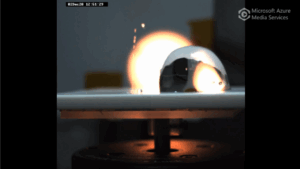
Droplets (on the centimeter scale) merge during an experiment on the International Space Station./CREDIT:Josh McCraney

But at small scales, droplets dynamics are too fast to observe. Hence, the ISS. The lower gravity in space means the team could investigate larger droplets, moving from a couple millimeters in diameter to 10 times that length.

The researchers sent four different surfaces with various roughness properties to the ISS, where they were mounted to a lab table. Cameras recorded the droplets as they spread and merged.

“NASA astronauts Kathleen Rubins and Michael Hopkins would deposit a single drop of desired size at a central location on the surface. This drop is near, but not touching, a small porthole pre-drilled into the surface,” said McCraney. “The astronaut then injected water through the porthole, which collects and essentially grows an adjacent drop. Injection continues until the two drops touch, at which point they coalesce.”

NASA/Photo: Nasa.gov

The experiments aimed to test the Davis-Hocking model, a simple way to simulate droplets. If a droplet of water sits on a surface, part of it touches the air and creates an interface, while the section in contact with the surface forms an edge or contact line. The Davis-Hocking model describes the equation for the contact line. The experimental results confirmed and expanded the parameter space of the Davis-Hocking model.

As the original principal investigator of the project, the late professor Paul Steen of Cornell University had written grants, traveled to collaborators worldwide, trained doctoral students, and meticulously analyzed related terrestrial studies, all with the desire to see his work successfully conducted aboard the ISS. Tragically, Steen died only months before his experiments launched.

“While it’s tragic he isn’t here to see the results, we hope this work makes him and his family proud,” said McCraney.

Also Read:

NASA-Built ‘Weather Sensors’ Capture Vital Data on Hurricane Ian

NASA’s Hubble finds spiraling stars ‘NGC 346’, providing window into early universe

US Postal Service Celebrates NASA’s Webb Telescope With New Postal Stamp

US Postal Service Celebrates NASA’s Webb Telescope With New Postal Stamp
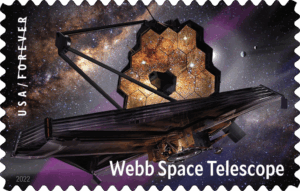
The U.S. Postal Service will issue a stamp celebrating NASA’s new James Webb Space Telescope, the largest, most powerful, and most complex science telescope ever put in space. The stamp, which features an illustration of the observatory, will be dedicated in a ceremony Thursday, Sept. 8, at the Smithsonian’s National Postal Museum in Washington.

“When anyone who uses these stamps looks at this telescope, I want them to see what I see: its incredible potential to reveal new and unexpected discoveries that help us understand the origins of the universe, and our place in it,” said NASA Associate Administrator Bob Cabana. “This telescope is the largest international space science program in U.S. history, and I can’t wait to see the scientific breakthroughs it will enable in astronomy.”

Webb, a mission led by NASA in partnership with ESA (European Space Agency) and CSA (Canadian Space Agency), launched Dec. 25, 2021, from Europe’s Spaceport in French Guiana. Over the following months, Webb traveled to its destination nearly one million miles (1.5 million kilometers) away from Earth, underwent weeks of complex deployments to unfold into its final configuration, and prepared its mirrors and science instruments to capture never-before-seen views of the universe.

The U.S. Postal Service will issue a stamp highlighting NASA’s James Webb Space Telescope on Sept. 8, 2022. U.S. Postal Service Art Director Derry Noyes designed the stamp using existing art by James Vaughan and an image provided by NASA and the Space Telescope Science Institute.
Credits: U.S. Postal Service

NASA released Webb’s first full-color images and spectra July 12 – providing a first look at the observatory’s powerful capabilities. The U.S. Postal Service stamp honors these achievements as Webb continues its mission to explore the unknown in our universe and study every phase in cosmic history.

“I am excited to add this beautiful stamp to our collection, as we watch from the ground as humanity’s newest and most capable telescope unlocks the greatest secrets of our cosmos that have been waiting to be revealed since the beginning of time,” said Thomas Zurbuchen, associate administrator for NASA’s Science Mission Directorate. “The Webb Telescope represents the start to a new era of what we can accomplish for the benefit of all.”

The stamp features an artist’s digital illustration of Webb against a background of stars. The selvage around each set of stamps showcases a sharp image of a star, captured while setting up the telescope in space to confirm precise alignment of Webb’s 18 hexagonal mirror segments.

The U.S. Postal Service’s first day of issue event is free and open to the public on Thursday, Sept. 8, at 11 a.m. EDT at the National Postal Museum. NASA Associate Administrator Bob Cabana; Lee Feinberg, Webb optical telescope element manager at NASA’s Goddard Space Flight Center; and Erin Smith, Webb deputy observatory project scientist at NASA Goddard will be among the speakers providing remarks.

NASA/Photo: Nasa.gov

To follow along with NASA’s Webb Telescope as it begins its mission to unfold the infrared universe, visit:

https://www.nasa.gov/webb

The James Webb Space Telescope is the world’s premier infrared space science observatory. Webb will solve mysteries in our solar system, look beyond to distant worlds around other stars, and probe the mysterious structures and origins of our universe and our place in it. Webb is an international program led by NASA with its partners, ESA (European Space Agency) and CSA (Canadian Space Agency).