US Postal Service Celebrates NASA’s Webb Telescope With New Postal Stamp

The U.S. Postal Service will issue a stamp celebrating NASA’s new James Webb Space Telescope, the largest, most powerful, and most complex science telescope ever put in space. The stamp, which features an illustration of the observatory, will be dedicated in a ceremony Thursday, Sept. 8, at the Smithsonian’s National Postal Museum in Washington.

“When anyone who uses these stamps looks at this telescope, I want them to see what I see: its incredible potential to reveal new and unexpected discoveries that help us understand the origins of the universe, and our place in it,” said NASA Associate Administrator Bob Cabana. “This telescope is the largest international space science program in U.S. history, and I can’t wait to see the scientific breakthroughs it will enable in astronomy.”

Webb, a mission led by NASA in partnership with ESA (European Space Agency) and CSA (Canadian Space Agency), launched Dec. 25, 2021, from Europe’s Spaceport in French Guiana. Over the following months, Webb traveled to its destination nearly one million miles (1.5 million kilometers) away from Earth, underwent weeks of complex deployments to unfold into its final configuration, and prepared its mirrors and science instruments to capture never-before-seen views of the universe.

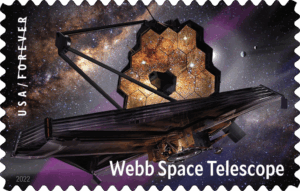
The U.S. Postal Service will issue a stamp highlighting NASA’s James Webb Space Telescope on Sept. 8, 2022. U.S. Postal Service Art Director Derry Noyes designed the stamp using existing art by James Vaughan and an image provided by NASA and the Space Telescope Science Institute.
Credits: U.S. Postal Service

NASA released Webb’s first full-color images and spectra July 12 – providing a first look at the observatory’s powerful capabilities. The U.S. Postal Service stamp honors these achievements as Webb continues its mission to explore the unknown in our universe and study every phase in cosmic history.

“I am excited to add this beautiful stamp to our collection, as we watch from the ground as humanity’s newest and most capable telescope unlocks the greatest secrets of our cosmos that have been waiting to be revealed since the beginning of time,” said Thomas Zurbuchen, associate administrator for NASA’s Science Mission Directorate. “The Webb Telescope represents the start to a new era of what we can accomplish for the benefit of all.”

The stamp features an artist’s digital illustration of Webb against a background of stars. The selvage around each set of stamps showcases a sharp image of a star, captured while setting up the telescope in space to confirm precise alignment of Webb’s 18 hexagonal mirror segments.

The U.S. Postal Service’s first day of issue event is free and open to the public on Thursday, Sept. 8, at 11 a.m. EDT at the National Postal Museum. NASA Associate Administrator Bob Cabana; Lee Feinberg, Webb optical telescope element manager at NASA’s Goddard Space Flight Center; and Erin Smith, Webb deputy observatory project scientist at NASA Goddard will be among the speakers providing remarks.

NASA/Photo: Nasa.gov

To follow along with NASA’s Webb Telescope as it begins its mission to unfold the infrared universe, visit:

https://www.nasa.gov/webb

The James Webb Space Telescope is the world’s premier infrared space science observatory. Webb will solve mysteries in our solar system, look beyond to distant worlds around other stars, and probe the mysterious structures and origins of our universe and our place in it. Webb is an international program led by NASA with its partners, ESA (European Space Agency) and CSA (Canadian Space Agency).

30 Doradus: Thousands of stunning young stars in “cosmic tarantula”captured by James Webb telescope

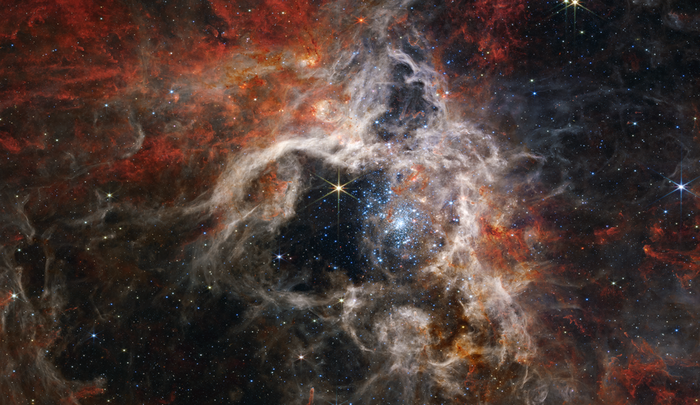
Thousands of never-before-seen young stars spotted in a stellar nursery called 30 Doradus, captured by NASA’s James Webb Space Telescope, called Tarantula Nebula owing to its appearance in dusty filaments.

The nebula has long been a favorite for astronomers studying star formation and the  Webb has been revealing beautiful distant background galaxies, as well as the detailed structure and composition of the nebula’s gas and dust ever since it’s started capturing the deep space.

At only 161,000 light-years away in the Large Magellanic Cloud galaxy, the Tarantula Nebula is the largest and brightest star-forming region in the Local Group, the galaxies nearest our Milky Way. It is home to the hottest, most massive stars known. Astronomers focused three of Webb’s high-resolution infrared instruments on the Tarantula. Under the lens of Webb’s Near-Infrared Camera (NIRCam), the region resembles a burrowing tarantula’s home, lined with its silk.

The nebula’s cavity centered in the image above has been hollowed out by blistering radiation from a cluster of massive young stars, which sparkle pale blue in the image. Only the densest surrounding areas of the nebula resist erosion by these stars’ powerful stellar winds, forming pillars that appear to point back toward the cluster. These pillars contain forming protostars, which will eventually emerge from their dusty cocoons and take their turn shaping the nebula.

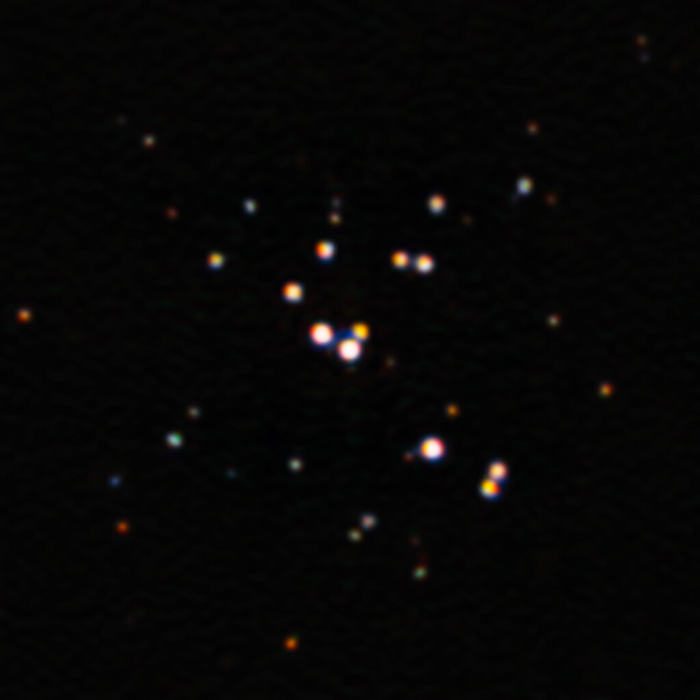
Caption: Nestled in the center of the Tarantula Nebula in the Large Magellanic Cloud is the largest star yet discovered, astronomers have produced the sharpest image ever of this star.  Photo:Observatory/NOIRLab/NSF/AURA Acknowledgment

Webb’s Near-Infrared Spectrograph (NIRSpec) caught one very young star doing precisely emerging out of the dust. Astronomers previously thought this star might be a bit older and already in the process of clearing out a bubble around itself. However, NIRSpec showed that the star was only just beginning to emerge from its pillar and still maintained an insulating cloud of dust around itself. Without Webb’s high-resolution spectra at infrared wavelengths, this episode of star formation-in-action could not have been revealed.

The region takes on a different appearance when viewed in the longer infrared wavelengths detected by Webb’s Mid-infrared Instrument (MIRI). The hot stars fade, and the cooler gas and dust glow. Within the stellar nursery clouds, points of light indicate embedded protostars, still gaining mass.

While shorter wavelengths of light are absorbed or scattered by dust grains in the nebula, and therefore never reach Webb to be detected, longer mid-infrared wavelengths penetrate that dust, ultimately revealing a previously unseen cosmic environment.

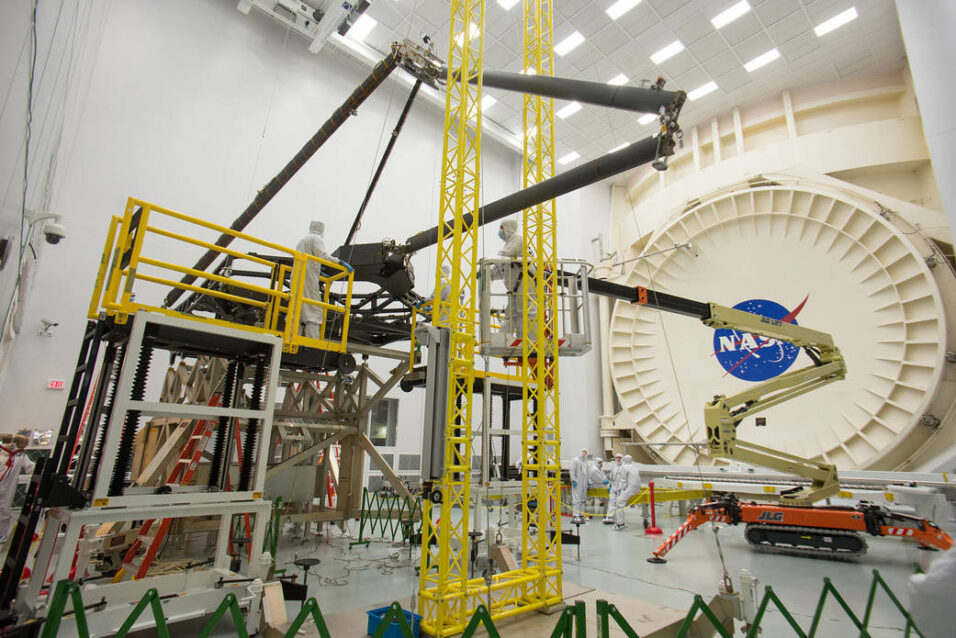
Caption: NASA’s James Webb Space Telescope

One of the reasons the Tarantula Nebula is interesting to astronomers is that the nebula has a similar type of chemical composition as the gigantic star-forming regions observed at the universe’s “cosmic noon,” when the cosmos was only a few billion years old and star formation was at its peak. Star-forming regions in our Milky Way galaxy are not producing stars at the same furious rate as the Tarantula Nebula, and have a different chemical composition.

Caption: In this mosaic image displays the Tarantula Nebula star, including tens of thousands of never-before-seen young stars that were previously shrouded in cosmic dust. The most active region appears to sparkle with massive young stars, appearing pale blue./Photo:NASA

This makes the Tarantula the closest (i.e., easiest to see in detail) example of what was happening in the universe as it reached its brilliant high noon. Webb will provide astronomers the opportunity to compare and contrast observations of star formation in the Tarantula Nebula with the telescope’s deep observations of distant galaxies from the actual era of cosmic noon.