Ukraine: Security Council hears of escalating attacks, diplomatic developments

“As we are facing renewed escalation on the ground and crisis elsewhere, it is critical to maintain focused attention on the urgent need for peace in Ukraine,” said UN Assistant Secretary-General Miroslav Jenča – one of two senior officials briefing the ambassadors.

In the three weeks since the Council last met on Ukraine, Russia has carried out unrelenting large-scale attacks on cities and towns, resulting in a significant rise in civilian casualties.

Deadly Kyiv attack 

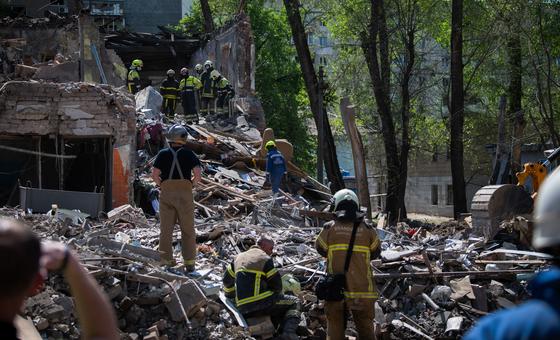
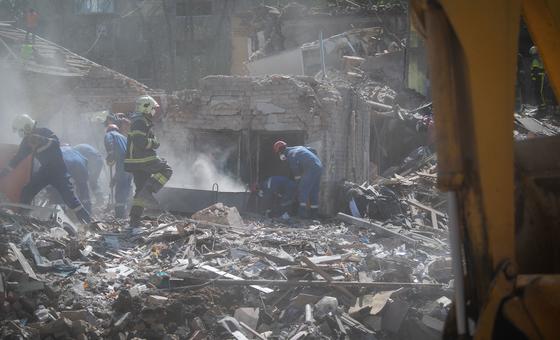
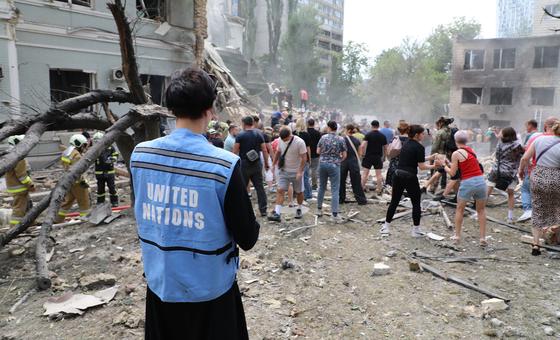
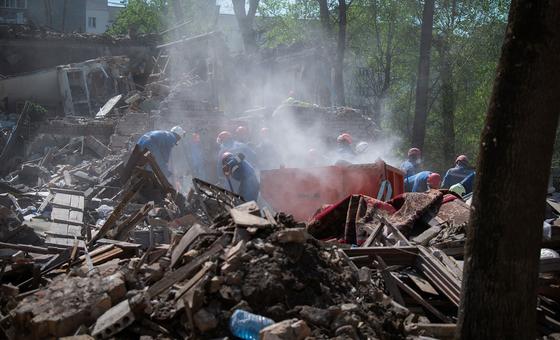
A combined drone and missile attack on the capital Kyiv overnight on 16-17 June was one of the deadliest there in a year. At least 28 civilians were killed and more than 130 injured. Many others are still reported missing under the rubble of the 35 apartments destroyed that night.

Attacks also reportedly occurred in Odesa, Zaporizhzhia, Chernihiv, Zhytomyr, Kirovohrad, Mykolaiv and Kyiv provinces that same night, with two civilians reportedly killed and scores injured in Odesa. 

“These levels of death and destruction risk dimming hope for an immediate ceasefire and threaten to undermine prospects for a lasting peace,” he said. 

‘Dramatic increase’ in casualties

Data from the UN human rights office, OHCHR, reveals that at least 13,438 civilians, including 713 children, have been killed since Russia launched its full-scale invasion of Ukraine in February 2022. Another 33,270 civilians have been injured, including over 2,000 children.

The number of civilian casualties in the first five months of this year alone totaled 5,144 – nearly 50 per cent higher than in the same period in 2024. Of this number, 859 were killed and 4,285 injured. 

“This dramatic increase is a result of intensified use of long-range weapons, both missiles and loitering munitions, against cities across Ukraine,” said Mr. Jenča. 

Ukrainian authorities report that between 1 and 17 June, Russian forces launched at least 3,340 long-range drones, including loitering munitions and decoy drones, and 135 missiles into the country. This compares to 544 long-range munitions launched during the whole of June 2024.

Attacks reported in Russia 

Escalating violence also continues to be reported in Russian regions that border Ukraine, though at a far lower level.  

In the Kursk region, a woman died in hospital a day after being injured in a Ukrainian drone attack while a man was killed, and five others injured, in a strike on a recreational centre. The UN was not able to verify these reports. 

“Let me once again unequivocally state – attacks against civilians and civilian infrastructure are strictly prohibited under international humanitarian law, wherever they occur,” said Mr. Jenča, reiterating the UN’s condemnation.

Diplomatic developments welcomed 

Meanwhile, “important diplomatic developments have taken place on the challenging path towards a lasting peace in Ukraine.”  

Ukrainian and Russian delegations held their second face-to-face meeting in Istanbul on 2 June.  They reportedly exchanged written memoranda outlining their respective visions for a ceasefire and parameters for a future peace settlement. 

The sides also reached agreement for the large-scale exchange of prisoners of war, mortal remains and civilian detainees. Swaps have been carried out since then, with the latest round taking place earlier on Friday. The mortal remains of 6,057 Ukrainian and 78 Russian servicepersons also have been returned as of 16 June.

“We welcome the continuation of all meaningful diplomatic efforts, including the recent talks in Istanbul. We urge the sides to make tangible progress towards a ceasefire and a lasting settlement through continued talks,” said Mr. Jenča.

In the face of escalation, he called for redoubling efforts “to ensure that the fragile diplomatic process is not only sustained but becomes irreversible.”

Civilians bear the brunt

In the meantime, civilians continue to bear the severe consequences of the war, said Edem Wosornu, Director of Operations at the UN Office for the Coordination of Humanitarian Affairs (OCHA).

“As the war continues, millions of lives are impacted every day. Essential  services are disrupted, and vulnerabilities are deepening for nearly 13 million people in need of assistance,” she said.

Roughly 3.7 million people are displaced inside Ukraine, including 60,000 newly displaced from frontline regions since January alone. Almost six million citizens are now refugees, mainly in Europe.

Amid the intensifying hostilities, the Government continues to order the mandatory evacuation of families with children from front-line villages, she said.  However, for some people in these locations “attacks are so frequent  that evacuations themselves become a risky prospect.”

Humanitarians at risk

Ms. Wosornu noted that humanitarians also face growing threats. This year, two aid workers have been killed and 24 injured while delivering assistance, and some 68 incidents of violence impacting relief personnel, assets and facilities have been recorded. 

She said that “despite an operating environment beset by multiple risks and challenges,” humanitarians remain committed and engaged, and their operations continue. Between January and May, they reached some 3.4 million people with life-saving aid, including food, water, medicines, health services and livelihood support.

Humanitarians are seeking $2.6 billion for Ukraine this year, and $816 million, has been secured, she said, stressing the importance importance of “timely financial support”.

End the war

Ms. Wosornu concluded her remarks by renewing earlier calls for the Council to take urgent, collective action in three areas, including protecting civilians and ensuring safe humanitarian access to all in need.  

Ambassadors were also urged to ensure sustained financial support as “declining funding trends” threaten aid efforts.

Her final request was an appeal to “end this war, and until then, ensure that humanitarian concerns are a central part of discussions on a pause in fighting or longer-term agreement.” 

Source link

World News in Brief: Global growth slows, deadly Ukraine attacks, Haiti hurricane hunger risk, legal migration for refugees

Growth is projected to weaken to 2.3 per cent, or nearly half a percentage point lower than expected at the start of the year, according to the Global Economic Prospects report.

“The global outlook is predicated on tariff rates close to those of late May prevailing,” it said.

“Accordingly, pauses to previously announced tariff hikes between the United States and its trading partners are assumed to persist.”

Although a global recession is not expected, average global growth is on track to be the slowest of any decade since the 1960s.

Poor countries suffer

Growth forecasts are being slashed in nearly 70 per cent of all economies, with the poorest countries most affected.

In most developing countries, nearly 60 per cent, growth should average 3.8 per cent in 2025 before reaching an average 3.9 per cent in the following two years – more than a percentage lower than the average in the 2010s.

The slowdown will impact efforts by developing countries in areas such as job creation, poverty reduction and closing income gaps with richer economies.

“The world economy today is once more running into turbulence. Without a swift course correction, the harm to living standards could be deep,” said Indermit Gill, Senior Vice President and Chief Economist.

The report calls for rebuilding trade relations as “economic cooperation is better than any of the alternatives – for all parties,” he said.

Countries are also urged to improve business climates and to promote employment by ensuring workers are equipped with necessary skills.

At least three dead in new Russian drone assault on Ukrainian cities 

A massive new wave of Russian drone attacks has killed at least three civilians and left Kyiv, Odesa and Zaporizhzhia engulfed in clouds of thick smoke, aid teams said on Tuesday. 

The attack was reportedly one of the largest since Russia’s full-scale invasion more than three years ago.

In an online update, the UN aid coordinating office, OCHA, said that a maternity ward in Odesa had come under fire, causing injuries and widespread damage to homes. 

Another terrible night

The UN Children’s Fund, UNICEF, underscored the impact of the violence on civilians, citing 16-year-old Sonya from Kyiv in an online post. “It was a terrible night,” she said. “The sounds were so frightening – a buzzing sound that was getting closer and explosions every five minutes.”

Russia has intensified its airstrikes on Ukraine in recent days. 

According to Moscow, it stepped up its bombing campaign in retaliation for Ukraine’s suprise drone attacks deep inside Russian territory last week codenamed operation spiderweb.

Amid the ongoing conflict, UN humanitarian teams and partners continue to work to help civilians in cities across Ukraine.

They provide first aid, protection services, food, construction materials and other support including counselling and legal advice.

Haiti: Hurricane season is here, but there are no food supplies

The World Food Programme (WFP) has reported that for the first time ever, it has no prepositioned food supplies in Haiti for the hurricane season, which lasts from June to November. 

WFP also said staffers do not have the financial resources to respond quickly to an emergency weather event in the country. 

Other UN agencies have prepositioned water and sanitation kits for 100,000 and health supplies for 20,000 people. However, these are not sufficient, especially in the absence of food, to meet needs during an emergency. 

“The current lack of contingency stocks and operational funds leaves Haiti’s most at-risk communities dangerously unprotected at a time of heightened vulnerability,” Deputy Spokesperson Farhan Haq said in a briefing Tuesday. 

Famine-like conditions

Food insecurity and malnutrition are already rampant, with over half the population facing acute hunger. Haiti is one of five countries worldwide which is experiencing famine-like conditions. 

Continuing armed violence by gangs in the capital and in other regions has displaced over one million people, compounding the hunger crisis and limiting access to other basic services such as clean water and health care. 

UN agencies in the country estimate that they will need $908 million to continue providing life-saving resources in Haiti, but currently, they have only received $78 million in emergency support. 

Refugees find hope through legal migration

Nearly one million refugees from eight countries with high asylum recognition rates were granted entry permits to 38 destination countries between 2019 and 2023, according to a new report from UN refugee agency, UNHCR, and the Organisation for Economic Co-operation and Development (OECD), Safe Pathways for Refugees

These permits were issued through existing systems for work, study, or family reunification.

“Refugees are using the same legal channels that millions rely on every day,” said Ruven Menikdiwela, UNHCR’s Assistant High Commissioner for Protection. 

“We don’t need new systems – just safer access to the ones already in place.”

In 2023 alone, nearly 255,000 permits were issued, marking a 14 per cent increase from 2022 and the highest number recorded since tracking began in 2010. 

Countries such as Germany, Canada, the United States, the United Kingdom and Sweden have played a leading role. 

UNHCR is urging States to remove obstacles for refugees and integrate them into regular migration systems. It also calls for stronger partnerships to expand access to legal pathways amid growing displacement and strained asylum systems. 

Source link

World News in Brief: Guterres condemns antisemitic attacks, ILO to debate pros and cons of working online, Sudan, Ukraine updates

A man was arrested in Boulder after reportedly using a flamethrower and Molotov cocktails to set people on fire at an event in support of Israeli hostages in Gaza on Sunday.

The suspect reportedly yelled “Free Palestine” during the attack and now faces federal hate crime charges along with multiple felonies.

The attack injured at least eight people, ranging in age from 52 to 88. The injuries have been described by local police as ranging from minor to “very serious”.

Holocaust memorial targeted

In a further antisemitic act in Paris, vandals targeted the Shoah Memorial, three synagogues and the Jewish restaurant Chez Marianne on Saturday morning, according to news reports.

Photos show green paint splashed on the Le Mur Des Justes wall, which lists names of French men and women who helped Jews during the World War II.

No suspects have been arrested so far and no group has claimed responsibility, news reports noted.

UN Spokesperson Stéphane Dujarric told correspondents at the Noon Briefing in New York that “The Secretary-General condemns these acts.”

“The United Nations firmly stands against all forms of antisemitism, as well as all other manifestations of extremism and any incitement to religious hatred and violence, and he calls for swift action to hold those responsible accountable,” 
Mr. Dujarric said.

UN labour agency sheds light on potential risks of online work

Governments, employers, and workers from the 187 UN ILO Member States are currently meeting in Geneva for the International Labour Organization’s annual conference.

The potential pitfalls of online platforms will be one key area for debate, as countries mull reforms to protect workers and promote development.

Digital platforms have grown rapidly in recent decades in line with the gig economy, boosting online education, tourism and transport, for example.

Lack of protections

But although businesses that use digital platforms offer flexibility for workers, there’s concern that they don’t offer enough social protection or decent conditions.

According to senior ILO official Angelika Muller many online workers lack protections as part of the informal economy.

As such, many face poor working conditions while many employers turn to  algorithms to evaluate worker performance.

Member States are also expected to agree on new ways to help countries transition from the informal to the formal economy and address the issue of health dangers from exposure to biological hazards at work.

Attacks on Sudanese civilians continue

On May 29, the World Food Programme’s facility in Al Fasher was repeatedly shelled, resulting in extensive damage, according to a report on Monday from UN aid coordination office, OCHA.

The next day, Eldaman International Hospital in Al Obeid was struck by a drone attack, killing at least six health workers and injuring more than 15 others.

Both attacks were reportedly carried out by the Rapid Support Forces (RSF) militia which has been fighting the Sudanese Armed Forces (SAF) for control of the country since April 2023.

Acting Resident and Humanitarian Coordinator for Sudan, Kristine Hambrouck, released a statement on Sunday calling the attacks a “blatant violation of international humanitarian law,” calling on all sides to protect civilian lives.

UN relief chief Tom Fletcher, also expressed concern over these attacks in a social media post Monday: “These attacks must stop.”

Continued cholera threats

Meanwhile, in Khartoum state, strikes on electricity infrastructure have aggravated water shortages, forcing many residents to rely on unsafe water sources and endangering over one million children with waterborne diseases, as cholera continues to spread across Sudan.

Thanks to the efforts of health workers and community volunteers, daily cholera cases in the capital region have fallen compared to previous weeks.

There have been more than 16,500 cases and over 340 reported deaths in Khartoum since the outbreak began.

Dozens of cases are also emerging in the South Darfur state, prompting officials to declare a health emergency and appeal for urgent support to contain the outbreak.

With UN support, local health authorities have established treatment centers and initiated surveillance and community health efforts. 

is urging the international community to act now to ensure that aid reaches those most in need, to halt the spread of cholera, and to protect the millions of civilians at risk.

Recent attacks on Ukrainian civilians 

The UN on Monday reported that attacks in Ukraine over the weekend and Monday left more than 20 civilians dead, including one child, and injured over 100 others.

Civilian infrastructure – including homes, medical and educational facilities and power and gas lines – was also affected.

Notably, the attacks occurred just hours before Ukrainian and Russian delegations met for a second round of preliminary peace talks in Türkiye on Monday.

Humanitarian response

Humanitarian organizations are providing critical support to affected families, including emergency repair materials, legal and psychological assistance, and evacuations from areas where heavy fighting is continuing.

On 30 May, an inter-agency convoy delivered essential aid – including solar lamps, charging stations, kitchen sets, diapers, food, hygiene items and first aid kits – to over 700 residents in the frontline Mylivska community of Kherson.

Source link

Ukraine: Hopes for peace on life support, Security Council hears

The longer the war continues, the longer its regional and global impacts will be felt, and the more difficult it will be to find a peaceful resolution,” said Rosemary DiCarlo, UN Under-Secretary-General for Political and Peacebuilding Affairs.

She recalled the adoption of Security Council resolution 2774 in February – the first since Russia’s full-scale invasion of Ukraine in 2022 – which sparked a sense of optimism for a diplomatic solution.  

That has since been replaced by a sense of international frustration – and more suffering in Ukraine following the surge in attacks.

The hope that the parties will be able to sit down and negotiate is still alive, but just barely,” Ms. DiCarlo warned.

Rising civilian toll

Under-Secretary-General DiCarlo briefing the Security Council.

The weekend’s escalation has been described as the largest wave of attacks, with record numbers of long-range missiles and drones killing and injuring dozens of civilians and damaging homes and infrastructure in Kyiv, Kharkiv, Odesa, Mykolaiv, and other cities.

Russian regions bordering Ukraine also reported civilian casualties and infrastructure damage. According to the Russian Ministry of Foreign Affairs, nine civilians were killed and 117 injured by Ukrainian strikes between 19 and 25 May, with a further 17 civilians killed and over 100 injured the week before.

“The United Nations is not able to verify these reports. However, if confirmed, these figures serve as a vivid reminder of the rising civilian toll of Russia’s full-scale invasion of Ukraine, most egregiously in Ukraine, but also increasingly in the Russian Federation itself,” Ms. DiCarlo said.

International humanitarian law strictly prohibits attacks against civilians and civilian infrastructure, she stressed.

“They are unacceptable and indefensible – wherever they occur – and must stop immediately.”

‘Every delay costs lives’

OCHA Director Doughten briefing the Security Council.

Lisa Doughten, Director for Financing at the UN Office for the Coordination of Humanitarian Affairs (OCHA), painted a dire picture on the ground.  

Over 5,000 people – mostly from Kherson, Donetsk and Sumy regions – were newly displaced in the past week alone, adding to the 3.7 million already displaced across Ukraine. An estimated 1.5 million civilians in Russian-occupied areas remain largely cut off from humanitarian assistance.

Despite escalating challenges, humanitarian organizations – many of them local NGOs – continue to deliver food, water, hygiene kits and protection services.  

However, only a quarter of the $2.6 billion needed for the 2025 humanitarian response plan has been funded, leaving aid workers struggling to meet rising needs.

Every delay costs lives. Every dollar helps us reach the next family under fire with aid, educate the next child out of school, help evacuate people with disabilities, and sustain water in front-line communities,” Ms. Doughten said.

“The needs do not shrink. And so, our resolve cannot falter.”

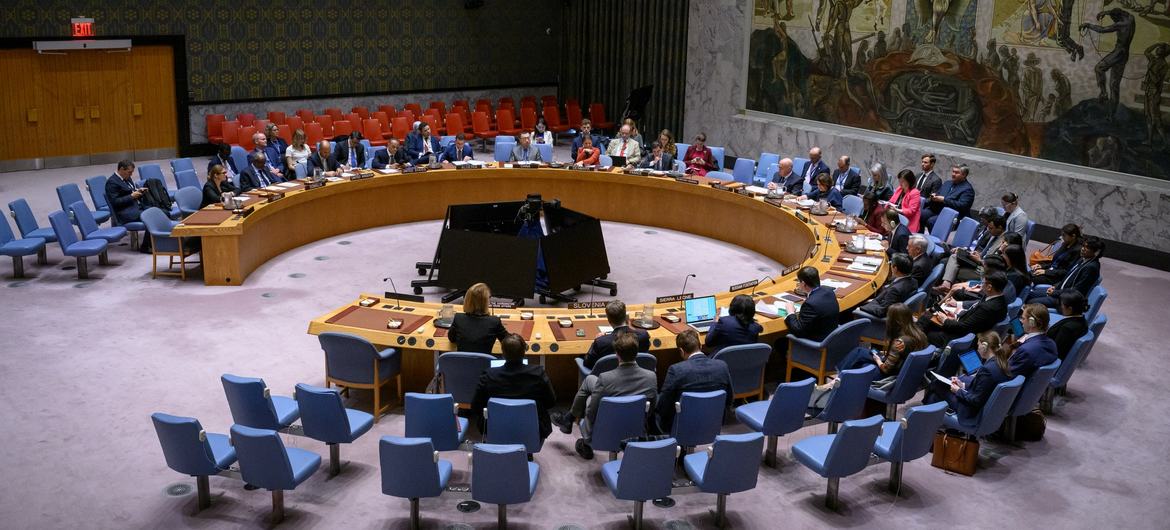
A wideview of the Security Council meeting as members discuss the situation in Ukraine

The war is a strategic mistake: US

Sanctions for Russia are “still on the table” if they make the “wrong decision” to continue the catastrophic war against Ukraine, the representative of the United States, John Kelley, told ambassadors.

“President [Donald] Trump has emphasised from the beginning that this war was a strategic mistake and should never have happened; time is not on the side of any who would prolong it,” Mr. Kelley said.

The US also condemned Russia’s decision to launch record numbers of long-range missiles and drones against civilians and civilian infrastructure in Ukraine this past weekend.

Mr. Kelley noted that if Russia makes the “wrong decision to continue this catastrophic war,” the United States may be forced to end their negotiation efforts.

“To be clear, in doing so, we would not be ‘abandoning’ our principles or our friends. Rather, we would be recognising Russia’s refusal to work with us toward a desirable outcome,” he said.

Mr. Kelley also referenced President Trump’s conversation with Russian President Vladimir Putin on 21 May, saying that the US is expecting a “term sheet” which will outline a Russian ceasefire proposal.

“We will judge Russia’s seriousness towards ending the war not only by the contents of that term sheet, but more importantly, by Russia’s actions,” Mr. Kelley said.

Ukraine trying to derail peace: Russia

Russia’s Ambassador Vasily Nebenzya accused the Ukrainian Government of attempting to “deceive and mislead” President Donald Trump in order to push the US away from its central role brokering negotiations.

“As long as the spectre of the ‘Russian threat’ persists, [Volodymyr] Zelensky’s clique can avoid accountability for embezzled budget funds and Western – primarily American – aid, which now totals tens if not hundreds of billions of dollars,” Mr. Nebenzya said.

“Even their partners in Europe and the [Joe] Biden administration, who have also profited greatly from the conflict in Ukraine, are starting to grow weary of this.”

Regarding allegations that Russia is targeting civilians in Ukraine, he claimed the casualties are the result of Ukrainian air defense systems being “positioned near residential buildings and public infrastructure in violation of basic international humanitarian law.”

He stated that the true targets of Russian strikes are military-industrial sites, citing the destruction of ammunition depots and other weapons facilities in various Ukrainian regions.

Ukraine open to talks that ‘yield tangible results’

Khrystyna Hayovyshyn, Deputy Permanent Representative of Ukraine to the UN, said that the international community must increase pressure on Russia, including through sanctions, to end the “diplomatic stalemate” for which she squarely blamed Russia.

“Ukraine did not initiate this war, nor do we desire its continuation,” Ms. Hayovyshyn said.

She noted that President Volodymyr Zelensky remains willing to meet President Vladimir Putin at any point for direct talks, but that the Russian President has not made himself available – including failing to attend the negotiations in Türkiye where Mr. Zelensky was present.

“We are not afraid of talks,” she said. “We are for constructive talks.”

Ms. Hayovyshyn said that “only positive result” of the meeting in Türikye was the agreement from both Russia and Ukraine to each release 1,000 prisoners of war.

But she reiterated that Ukraine would not compromise on its territorial integrity or sovereignty when negotiating for peace.

“Achieving peace at any cost will not end the war. A comprehensive, just and lasting peace must rest on a fundamental respect towards non-negotiable principles,” she said.

Source link

UN rights chief calls for end to daily killings in Ukraine after deadly weekend attacks

The majority of those killed and injured were in major cities such as Kyiv, Kharkiv, and Mykolaiv, or in populated areas in other regions.

Meanwhile, large numbers of long-range drones launched into Russia by Ukrainian armed forces injured at least 11 civilians over the weekend, according to Russian authorities.

Silence the guns

High Commissioner Volker Türk underscored the urgency for an end to hostilities.

“It is time to put an end to Russia’s invasion of Ukraine, to commit to – and implement – a comprehensive ceasefire that stops the daily killing and destruction, and to start genuine peace negotiations, built on respect for international law,” he said.

He highlighted that – even amid ongoing hostilities – people deprived of their liberty must be protected. Summary executions, torture and all forms of inhumane and degrading treatment of prisoners are always prohibited, in any circumstances, and must stop immediately.

In addition, civilian detainees should be released as soon as the lawful reason for their detention ceases to exist and their protection against refoulement must be ensured, he said.

Relief, but also loss

High Commissioner Türk welcomed the recent exchange of prisoners of war and civilian detainees.

Nearly 900 prisoners of war and 120 civilians from each side were exchanged. Most of the civilians appeared to have been detainees, but details on individuals included in the exchange are not yet available, according to his office, OHCHR.

“Many families can now breathe a sigh of relief because their loved ones have finally returned home,” Mr. Türk said.

“But at the same time, other families have lost relatives and their homes, as their communities across Ukraine came under attack.”

Impact on children

In a separate statement, the UN Children’s Fund (UNICEF) expressed deep concern for the impact of the latest attacks on Ukraine’s children.

Munir Mammadzade, UNICEF Representative in Ukraine, said that in the past three days, at least three children were reportedly killed in Zhytomyr, and at least 13 children were injured in several regions across the country.

“Ukraine’s children have suffered for far too long. How many more futures must be stolen? The senseless violence and loss of young lives must stop,” Mr. Mammadzade said.

According to UNICEF, more than 220 children were killed or injured between January and April 2025 – a 40 per cent increase compared to the same period last year.

“Attacks on civilian areas must end, and children must always be protected,” Mr. Mammadzade emphasised. “Above all, children need an end to this war.”

Source link

UN rights mission deplores deadly Russian strikes in Ukraine

According to the UN mission, the overnight assault from Saturday into Sunday – one of the largest of its kind since Russia’s full-scale invasion in February 2022 – resulted in civilian casualties and damage to homes and infrastructure across 10 regions of Ukraine, including the capital, Kyiv.

At least three children were among those killed and nine children were reported injured. The mission is currently working to verify the full extent of the casualties and the broader impact of the attack.

“With at least 78 people reported killed or injured across the country, last night’s attack tragically demonstrates the persistent deadly risk to civilians of using powerful weapons in urban areas, including those far away from the frontline,” Danielle Bell, HRMMU Head, said in a news release on Sunday.

“It is yet another addition to the staggering human toll this war continues to inflict on civilians, with more families across the country now grieving their losses.”

No place is safe

Matthias Schmale, the UN Humanitarian Coordinator for Ukraine, also voiced deep concern over the civilian suffering.

“I am horrified that yet again civilians – among them children – were killed in last night’s massive attacks,” he said in a statement posted on the social media platform X.

“Across Ukraine, no place is safe. Homes and civilian infrastructure were hit. Grateful to humanitarian NGOs and state services who are immediately supporting affected people. Civilians must never be a target.”

Use of long-range weapons

Ukrainian authorities reported that the Russian armed forces launched at least 367 missiles and loitering munitions during the night, in a coordinated attack with air, sea and land-based systems.

The strike followed a similar assault the previous night, which had mainly targeted the Kyiv region.

HRMMU noted that the use of long-range weapons in urban areas has been a major driver of civilian casualties in March and April. While the number of casualties in May had been somewhat lower than April before the latest attack, the toll from this weekend’s strikes will add to the monthly figures.

Source link

Civilians killed in drone strike in eastern Ukraine: UN rights monitors

At least nine people were killed and seven injured when a Russian drone struck a minibus near the town of Bilopillia in the Sumy region, according to local authorities.

HRMMU monitors are in the process of gathering additional information on the circumstances of the attack and its victims.

Preliminary reports suggest that the minibus was carrying civilian evacuees from an area close to the frontline, the majority of whom were women.

‘A stark reminder’

“With nine civilians reported killed, this would be the deadliest attack in weeks,” said Danielle Bell, Head of HRMMU.

“This is a stark reminder that civilians continue to be killed and injured on a daily basis across Ukraine.”

If confirmed, the strike would represent the deadliest attack since 24 April, when at least 11 civilians were killed and 81 injured in the capital, Kyiv.

HRMMU said that while the number of civilian casualties in May has been somewhat lower than in April, it continues to document daily civilian casualties, particularly along the frontline.

Source link

World News in Brief: South Sudan urged to avoid slide to war, Türk calls on EU not to weaken landmark law, Ukraine and Mali updates

The Quartet is calling on the country’s leaders to end hostilities and return to dialogue to fully implement the 2018 peace agreement known as the Revitalized Agreement on the Resolution of the Conflict in the Republic of South Sudan (R-ARCSS).

South Sudan, the world’s youngest nation, gained independence in 2011 but soon descended into a brutal civil war. A 2018 peace agreement has held together but now threatens to fully unwind between the president and his vice presidential rival.

Regional pressure

In recent weeks, the Quartet has observed air and ground attacks that have led to loss of life, the destruction of homes, and the displacement of civilians. Humanitarian facilities have also been targeted, while hate speech and ethnic tensions are on the rise.

The Quartet welcomed a recent joint visit by the African Union and IGAD to South Sudan as a sign of regional support for peace. It also called on all sides to cooperate with ceasefire monitors investigating recent violence.

South Sudan’s leaders must commit to inclusive dialogue, the release of political detainees, and renewed efforts to carry out the peace deal, the Quartet stressed.

A return to war would betray the people’s hope for peace and stability, they warned. Only a political solution can ensure free and fair elections at the end of the current transitional period.

UN rights chief urges EU not to weaken landmark corporate responsibility law

UN human rights chief Volker Türk has called on the European Union to protect a key law that holds large companies accountable for human rights and environmental harm.

The EU’s Corporate Sustainability Due Diligence Directive (CSDDD), adopted last year, requires businesses to identify and address any negative impact their activities may have on people or the planet.

But changes now being discussed in Brussels as part of a broader reform package could weaken the law, Mr. Türk warned on Wednesday.

“The CSDDD, by far the most ambitious business and human rights regulatory initiative anywhere in the world, has rightly been welcomed by companies, policy makers, civil society, and national human rights institutions alike,” he said.

“A large number of businesses have already taken steps to ensure they comply with it.”

Detailed review

UN human rights office, OHCHR, has published a detailed review of the EU proposal, pointing to ways it could undermine this groundbreaking directive.

Mr. Türk urged lawmakers to keep the law in line with global standards, such as the UN Guiding Principles on Business and Human Rights.

“While some streamlining… could be advantageous, it would be counterproductive to water down its alignment with international standards,” he said.

April deadliest month for civilians in Ukraine since September

April was the deadliest month for civilians in Ukraine since September 2024, with at least 209 people killed and 1,146 injured, the UN Human Rights Monitoring Mission in Ukraine (HRMMU) reported on Wednesday.

In its monthly update, the Mission said that 97 per cent of casualties occurred in areas controlled by Ukraine, with nearly half caused by missile and loitering munitions attacks by Russian forces.

“Kryvyi Rih, Sumy, Dnipro, Zaporizhzhia, Kyiv, and Kharkiv all endured devastating attacks,” said Danielle Bell, Head of HRMMU. “The sharp rise in casualties was mainly due to the intensified use of ballistic missiles in major cities.”

Among the deadliest incidents:

  • On 4 April, a missile strike on Kryvyi Rih killed 20 civilians and injured 63.
  • On Palm Sunday (13 April), two missiles hit Sumy, killing at least 31 and injuring 105.
  • A 24 April attack on Kyiv killed 11 and injured 81.

Children were especially affected. At least 19 were killed and 78 injured in April – the highest monthly total since June 2022.

The wave of attacks continued into May, with cities including Kharkiv, Odesa and Kyiv again coming under fire.

UN experts raise alarm over Mali’s suspension of political parties

Independent UN human rights experts have strongly criticised Mali’s military authorities for suspending all political parties and activities, calling the move a clear violation of basic rights.

© MINUSMA/Harandane Dicko

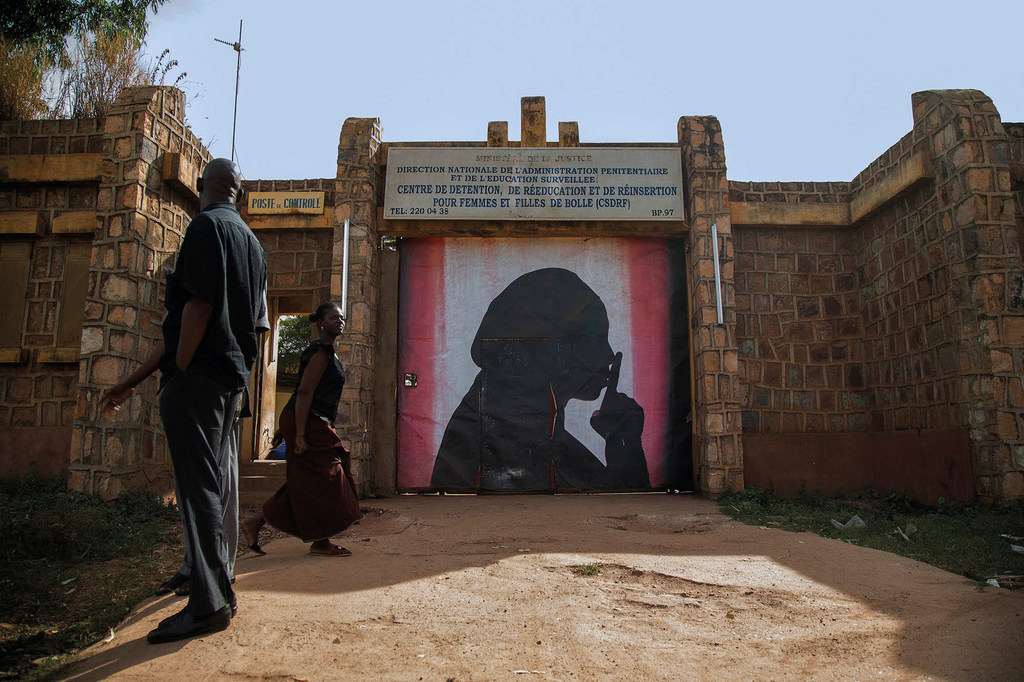
A detention centre in Bamako, Mali. (file)

The decision, announced on 7 May via state television, halts political activity “until further notice.” The junta, which took power following coups in 2020 and 2021, said the suspension was necessary to maintain public order.

The three UN Human Rights Council-appointed experts described it as a direct violation of human rights and called for the order’s immediate repeal.

They also called on the National Transitional Council to strike down a bill introduced on 30 April, which repealed legislation governing how political parties operate.

“If passed into law, the 30 April bill will place Mali in contravention of its human rights obligations, notably on freedoms of association and expression,” the experts stressed.”

Protests

In response to the 30 April bill, opposition parties organised a pro-democracy rally in the capital Bamako on 3 May which drew hundreds of demonstrators. The parties reportedly demanded a timeline to end military rule and a return to constitutional order.

Another protest is planned for Friday to oppose the decree against political parties.

The experts said Malian authorities must work to counteract “the current climate of suppression of the civic space”.

“The right to peacefully assembly is essential to the health of a vibrant political community,” the experts said. “The Malian Transitional authorities must scrupulously respect it and abstain from acts of intimidation and repression that risk the physical integrity and the rights of demonstrators.”

Special Rapporteurs and Independent Experts are appointed by the Geneva-based Human Rights Council. They serve in their individual capacity, independent of the UN system and national governments. They are not UN staff and draw no salary

Source link

World News in Brief: Deadly attacks in South Sudan and Ukraine, World Court rejects Sudan case, lifesaving aid in Yemen

According to the UN relief coordination office (OCHA), the hospital in Old Fangak was struck early Saturday, killing seven civilians and injuring at least 20 more. The attack also destroyed vital supplies and forced the withdrawal of aid workers, leaving the town’s population without access to critical care.

“People in these areas are already battling flooding, food shortages and disease,” said Marie-Helene Verney, the UN’s acting Humanitarian Coordinator in South Sudan.

Too many lives at risk

“The destruction of critical health infrastructure and continued fighting puts innocent South Sudanese lives at risk.”

The bombing follows a wave of similar attacks in Upper Nile state, where health facilities in Ulang and Nasir have been targeted in recent months. The latest strike has heightened fears of renewed conflict as political and ethnic tensions rise nationwide.

The UN is now airlifting essential supplies to the area, but access remains limited. The violence has displaced over 130,000 people in the past two months, and aid agencies warn that South Sudan’s broader $1.7 billion humanitarian plan remains only 16 per cent funded.

Large scale attacks on densely populated cities across Ukraine

The UN’s top humanitarian official in Ukraine on Monday condemned a series of Russian strikes this weekend on densely populated towns and cities.

Between Friday and Monday, at least 12 people were killed and more than 100 others injured in attacks thar targeted Kharkiv, Kyiv and Cherkasy, and other regions in Ukraine.

These attacks also damaged homes, schools, a hospital and other civilian infrastructure, according to local authorities and partners, UN Deputy Spokesperson Farhan Haq told journalists in New York.

In the aftermath of the strikes, “humanitarian organizations provided first aid, psychosocial support, emergency shelter kits, repair materials, meals and drinks,” Mr. Haq said.

In the Kharkiv region, a fire triggered by a strike near the city of Izium on Sunday, burned 85 hectares of land and damaged over a dozen buildings. There were no casualties reported, Mr. Haq added.

Meanwhile, UN agencies alongside partners reached 600,000 people so far this year with first aid, medical transport, primary care and mental health support, including at transit centres for displaced people.

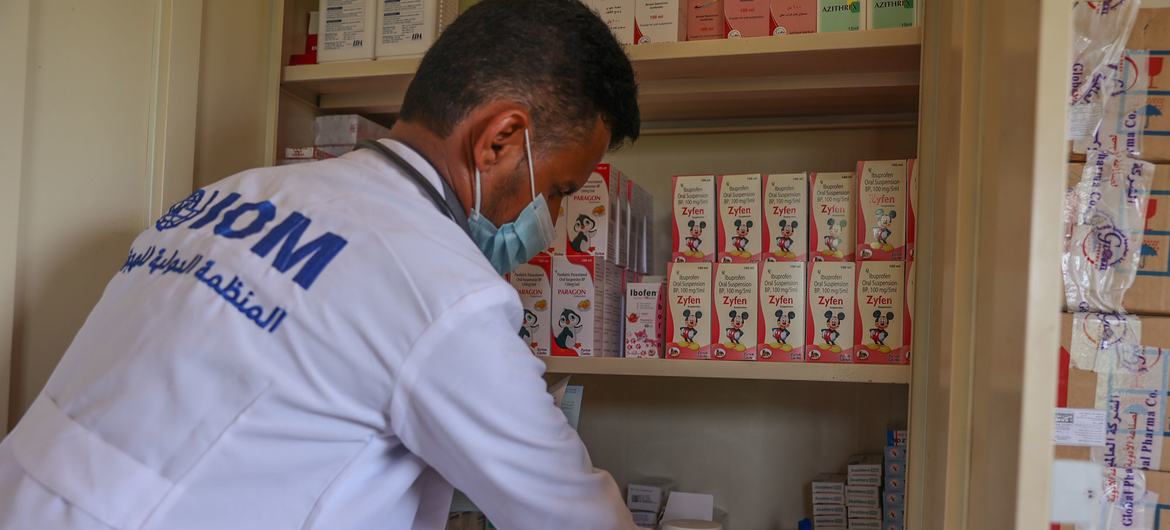
An IOM-supported health worker in Yemen accesses medical supplies.

Yemen: UN delivers lifesaving medical supplies

The UN International Organization for Migration (IOM) on Monday delivered critical medical supplies to seven health facilities in Yemen, where a collapsing health system and chronic shortages continue to endanger millions.

With support from the Government of the United Kingdom, IOM shipments are reaching hospitals and clinics in Aden, Lahj, Shabwah, Al Bayda and Sana’a – facilities serving both migrants and local communities.

“Every day, our teams see the impact of empty medicine shelves and overwhelmed clinics, on families and entire communities,” said Abdusattor Esoev, head of IOM in Yemen.

“By delivering essential supplies and supporting frontline staff, we are not just responding to urgent needs – we are keeping health services running for those who have nowhere else to turn.”

Crisis on crisis

The intervention comes amid an alarming health crisis.

Nearly 20 million people in Yemen require medical assistance in 2025, but over half of the country’s health facilities are only partially functioning or have shut down altogether. Funding gaps have left 382 facilities unsupported, forcing many to close or drastically cut services.

IOM’s assistance includes essential medicines, surgical equipment and infection prevention tools, as well as infrastructure repairs and support for health workers.

For many in the strife-torn country, IOM-supported clinics remain the only source of free medical care.

ICJ rejects Sudan’s genocide case against UAE

The International Court of Justice (ICJ) has rejected Sudan’s case accusing the United Arab Emirates (UAE) of complicity in genocide in Darfur, citing a lack of jurisdiction.

In the decision, the UN’s top judicial body ruled on Monday by a vote of 14 to two that it could not proceed with the case brought by Sudan under the Convention on the Prevention and Punishment of the Crime of Genocide (Genocide Convention) and declined to impose any provisional measures, as Sudan had requested.

The Court also removed the case from its general list by a vote of nine to seven.

“Having come to the conclusion that it manifestly lacks jurisdiction, the Court is precluded from taking any position on the merits of the claims made by Sudan,” the ruling stated.

Complicity charge

Sudan had accused the UAE of backing the paramilitary Rapid Support Forces (RSF), alleging its support amounted to complicity in genocidal acts against the non-Arab Masalit population in West Darfur.

The conflict between the RSF and the Sudanese army has claimed thousands of lives and displaced over 12.7 million people since April 2023.

The Court noted that while it could not hear the case, all States remain bound by their obligations under the Genocide Convention.

Source link

Ukraine: Ceasefire a critical first step on the road to durable peace

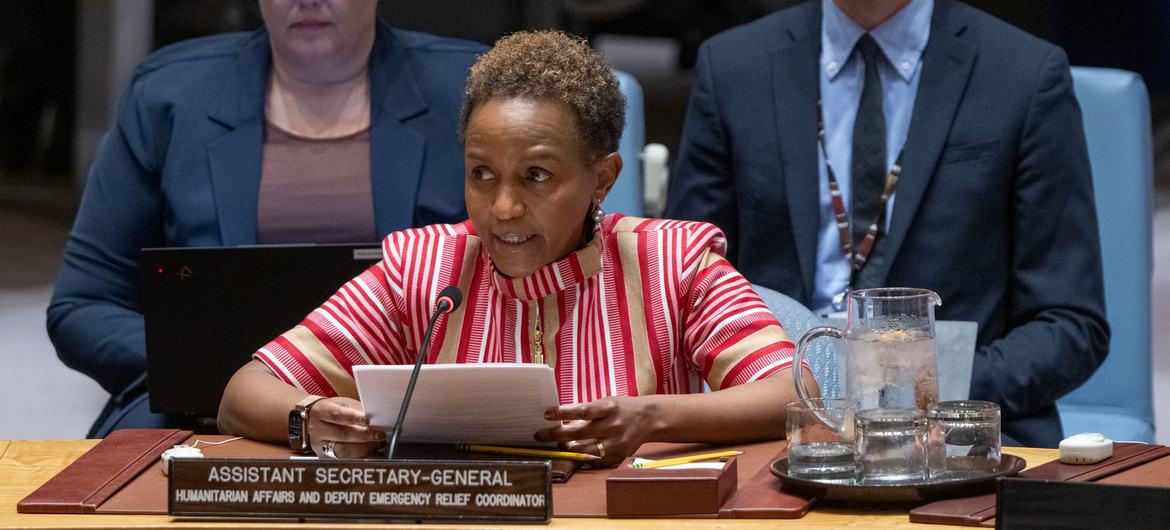
Under-Secretary-General Rosemary DiCarlo addressed ambassadors alongside UN deputy relief chief, Joyce Msuya, who updated on the dire humanitarian situation in the country amid ongoing Russian attacks.

Ms. DiCarlo said the meeting was taking place at a potential inflection point in the three-year war, as the past few weeks have seen intensified shuttle diplomacy towards a possible peace deal. 

‘Glimmer of hope’

These initiatives offer a glimmer of hope for progress towards a ceasefire and an eventual peaceful settlement,” she said.

“At the same time, we continue to witness relentless attacks on Ukrainian cities and towns.”

Russian forces have carried out recent deadly strikes, such as the massive, combined missile and drone attack last week on several regions, including the capital Kyiv.  

Multiple residential buildings in the city were hit. At least 12 people were reported killed and more than 70 others injured, including children, making it the deadliest attack on the capital in nine months. 

This followed several other deadly strikes, including one in Sumy city on Palm Sunday that reportedly killed 35 people.  Another in Kryvyi Rih killed 18, including nine children – the deadliest single strike against children since the start of the full-scale Russian invasion.

The UN human rights office, OHCHR, verified that as of 24 April, 151 civilians have been killed, and 697, injured so far this month in Ukraine. 

Verification is ongoing, but numbers are expected to surpass the March figures, which were already 50 per cent higher than in February.

She also noted recent media reports quoting local Russian authorities that indicate civilian casualties in the Kursk, Bryansk and Belgorod regions in Russia, including alleged Ukrainian strikes on 23 and 24 April that reportedly killed three people in the Belgorod region.

“We condemn all attacks against civilians and civilian infrastructure, wherever they occur,” she said.

Diplomatic efforts encouraged

Ms. DiCarlo noted that the UN Secretary-General has repeatedly called for de-escalation and a durable ceasefire in Ukraine.

“In this regard, we are encouraged by the diplomatic efforts underway,” she said.

“We take note of yesterday’s announcement by the Russian Federation of a 72-hour truce planned for the period from 8 to 10 May.”

It follows a similar Russian announcement on 19 April of a 30-hour Easter truce, “and Ukrainian authorities reportedly agreed to mirror any such steps, reiterating their earlier support for a 30-day ceasefire proposed by the United States,” she said.

“Regrettably, hostilities continued during Holy Week, with both sides accusing each other of violations.”

She recalled that a month earlier, the Secretary-General welcomed separate announcements by the US, Russia and Ukraine regarding a 30-day moratorium on strikes against energy infrastructure and the resumption of negotiations on the safety of navigation in the Black Sea.

Despite these commitments, however, attacks against energy infrastructure persisted,” she said. 

Political will valuable

Ms. DiCarlo said the continued exchange of prisoner of war by both sides – including the largest to date, when 500 people were swapped on 20 April – “shows that with political will, diplomacy can yield tangible results even in the most difficult circumstances.”

She concluded her remarks by pointing to the forthcoming 80th anniversary of the Second World War, which serves as a reminder “with even greater urgency” of the centrality of the UN Charter and international law in safeguarding peace and security.

“The Russian Federation’s full-scale invasion of Ukraine stands as an egregious challenge to these fundamental principles, jeopardizing stability in Europe and threatening the broader international order,” she said.

“What is needed now is a full, immediate and unconditional ceasefire as a critical first step towards ending the violence and creating the conditions for a just, comprehensive and sustainable peace.”

Joyce Msuya, UN Deputy Emergency Relief Coordinator, briefs the Security Council meeting on maintenance of peace and security of Ukraine.

Millions in need

Ms. Msuya reported that the humanitarian situation in Ukraine has worsened despite ceasefire opportunities. Overall, nearly 13 million people need assistance.

“So far this year, not a single day has passed without civilians being killed or injured in attacks,” she said. 

The operating environment also remains highly dangerous for humanitarians. 

Aid workers under attack

“From 1 January to 23 April, there were 38 verified security incidents impacting humanitarian staff within 20 kilometers of the frontline. This has left three aid workers dead and 21 injured while delivering life-saving assistance,” she said.

Ms. Msuya reiterated earlier calls for the Council to take urgent, collective action on Ukraine in three areas.

She urged ambassadors to ensure the protection of civilians – including humanitarian and health workers – and critical infrastructure. 

Her second point stressed the need to increase financial support for humanitarian operations as underfunding is forcing critical programmes to scale down. 

Finally, she called for a just peace: “Every effort, whether aimed at a temporary pause or a lasting agreement, must prioritize the protection and needs of civilians.” 

Source link

Ukraine: Continued Russian assaults drive civilians from frontline communities

Attacks on frontline regions (are) increasing and it’s always civilians that are bearing the highest cost of the war,” said UNHCR Representative Karolina Lindholm Billing.

Since January, more than 3,500 newly displaced people have transited through a centre in Pavlohrad towards central Ukraine; in total, more than 200,000 people have been evacuated or displaced from frontline areas between August last year and the start of 2025.

Last to leave

Last month, more than 4,200 evacuees arrived at a transit centre in the northeastern city of Sumy where UNHCR and partners provide humanitarian support. These numbers are only a fraction of all those made homeless by the violence and mandatory evacuation orders issued by Kyiv in the face of ongoing Russian aggression.

The majority of those being moved are the elderly with low mobility or disabilities, families with few resources and children. In many cases, they stayed until the end because they didn’t want to leave everything they had behind, UNHCR said.

Cities and civilians targeted

On Thursday, UN aid agencies led condemnation of Russian missile-and-drone attack on Kyiv that killed 12 people and injured 84, one of a wave of attacks across the country that point to an intensification of the conflict since the start of the year – and growing humanitarian needs for refugees.

“Those deadly Russian attacks have intensified alarmingly since January,” said Ms. Billing, speaking to journalists in Geneva via videolink from Kyiv.

“More than 1,000 people have been directly affected as their homes have been damaged or completely destroyed. Civilian infrastructure were also hit in several other regions yesterday, including in Kharkiv, where I myself woke up around 2 am in the morning to the loud sound of explosions.”

According to the UN Human Rights Monitoring Mission in Ukraine, civilian casualties in Ukraine were 70 per cent higher in March this year compared to 12 months earlier.

Supporting lives and livelihoods

The war has left four million internally displaced since 24 February 2022 when Russian tanks rolled into Ukraine. Many of those uprooted have yet to find affordable housing and a new job – which is why support from humanitarian organizations is so crucial, the UNHCR official continued.

“One of the main things we deliver as part of the emergency response are emergency shelter materials that help people cover broken windows, roofs and doors,” Ms. Billing said.

Since 2022, UNHCR has supported around 450,000 people making repairs on their homes. The UN agency also provides psychological first aid and legal support to those who have lost their identity documents and emergency cash assistance to help people cover most basic needs.   

Funding impacts

But more support is needed to sustain a timely and predictable response to the many calls for assistance the agency receives from the affected people and the authorities.

Last year, US funding for UNHCR accounted for around 40 per cent of its overall contributions. For 2025, UNHCR has appealed for $803.5 million to address the emergency situation in Ukraine. Today, that appeal is just 25 per cent funded. During the winter period, the agency had to put some of its programmes partially on hold, impacting psychosocial support, emergency shelter material and cash assistance. 

Source link

Outrage as Russian overnight attacks on Ukraine cities kill at least nine civilians

Reports indicate that the latest Russian strikes damaged 12 buildings in the capital, causing widespread damage to homes, businesses and key services, while phones have been heard ringing from the rubble.

Other Ukrainian cities targeted included Zhytomyr – due west of Kyiv – and the northeastern cities of Sumy –  where a daytime missile strike killed at least 34 people on 13 April – and Kharkiv – where the authorities reported 24 drone and missile strikes in total.

“The casualty count is expected to rise as emergency teams continue search-and-rescue operations amid,” said the UN aid coordination office, OCHA.

The development follows Ukrainian President Volodymyr Zelensky’s reported decision on Wednesday to reject a US-led proposal to seek a peace deal with Russia that would have involved ceding territory lost during the war. In theory, this would include the eastern Ukrainian regions of Donetsk, Luhansk, Kherson and Zaporizhzhia, in addition to Crimea, which Russia annexed illegally in 2014.

“Last night’s large-scale attack by the armed forces of the Russian Federation on residential areas in Kyiv and surrounding regions is yet another appalling violation of international humanitarian law,” said the UN’s top aid official in Ukraine, Matthias Schmale.

Children and a pregnant woman were among the more than 70 people injured by Wednesday night’s reported missile and drone strikes. “This senseless use of force must stop… Civilians must never be targets”, insisted Mr. Schmale, UN Humanitarian Coordinator for Ukraine.

Echoing that message, the UN Children’s Fund, UNICEF, appealed for an end to the use of explosive weapons in civilian areas.

Source link

Trump Warns Zelensky: Ukraine War Could End Without Him

NEW YORK, Feb. 20 — The war of words between U.S. President Donald Trump and Ukrainian President Volodymyr Zelensky escalated Wednesday as Trump suggested Ukraine could be sidelined in negotiations to end the war with Russia.

“Zelensky better move fast or he’s not going to have a country left,” Trump wrote on Truth Social, claiming that only his administration could successfully broker peace with Russia.

The warning came after Zelensky criticized the U.S. and Russia for holding negotiations in Riyadh without Ukrainian representation. He insisted that Ukraine would not accept a peace deal reached without its direct involvement.

Zelensky fired back, accusing Trump of “living in a web of disinformation.” Trump, in turn, labeled Zelensky a “dictator without elections.”

With Russia occupying roughly 20% of Ukraine’s territory and Ukraine making only minor territorial gains, a negotiated peace deal is unlikely to restore all of Ukraine’s pre-war borders.

U.S. Defense Secretary Pete Hegseth suggested that reverting to Ukraine’s pre-2014 borders—including Crimea—was unrealistic and ruled out NATO membership for Ukraine in any foreseeable peace agreement.

Trump previously suggested Ukraine provoked the war—despite Russia’s 2022 invasion. His “dictator” remark references Ukraine’s decision to postpone elections due to the war, extending Zelensky’s term beyond its scheduled end.

As the primary financier of Ukraine’s defense, Trump appears to believe he could unilaterally pressure Kyiv into accepting peace terms negotiated with Russian President Vladimir Putin.

On Tuesday, U.S. Secretary of State Marco Rubio and Russian Foreign Minister Sergey Lavrov met in Riyadh for more than four hours to discuss an end to the war. Both sides reported progress, with Lavrov calling the talks “useful” and Rubio indicating Russia was open to serious negotiations.

One key development was an agreement to restore U.S. and Russian embassies to full operational status after years of reduced diplomatic presence.

Trump also lashed out at European nations for not matching U.S. financial support for Ukraine. “Zelensky talked the United States into spending $350 billion on a war that couldn’t be won,” he wrote, arguing that European nations should contribute equally.


‘One Step Short of World War’, Warns Putin on France’s Idea of Deploying NATO Troops in Ukraine

Russian President Vladimir Putin cautioned the US-led NATO military alliance against deploying troops in Ukraine, stating that such action would bring the world “one step closer to a full-scale World War III.”

During a speech to his supporters and the media following his decisive presidential election victory, Putin hinted at the presence of fighters from NATO countries on Ukrainian soil.

“We hear both French and English speech there. There is nothing good in this, first of all for them, because they die there and in large numbers,” he was quoted by Russian media as saying. “Anything is possible in the modern world… But everyone knows that this would be one step shy of a full-scale World War III. I don’t think that anyone is interested in that.”

Putin emphasized that Moscow is well aware of NATO’s efforts to send troops to Ukraine, noting the presence of French and English speakers in the region. He expressed concerns about the consequences, particularly the loss of lives.

In response to French President Emmanuel Macron’s suggestion that the West might consider sending soldiers to assist Ukraine, Putin urged France to focus on de-escalating the conflict and aiding in finding a peaceful resolution.

In response to Macron’s stance, French politicians criticized his interview expressing support for Ukraine. Elina Valtonen, Finland’s Minister of Foreign Affairs said that Western nations, including the US, should not completely dismiss the possibility of deploying troops to Ukraine if the situation deteriorates.

Even Antonio Tajani, Italian Foreign Minister and Deputy Prime Minister, rebuffed French President Emmanuel Macron’s suggestion of deploying Western troops to Ukraine, stating, as reported by media outlets.

He asserted that it “would be a mistake” for NATO to send troops to Ukraine, emphasizing that it is a nation “we must help defend,” as cited by a report from Ukrainska Pravda.

“To enter into war with Russia would mean the threat of World War III,” Tajani remarked. “Our military is effectively fulfilling their duties in the Red Sea to protect our ships; they are also operating efficiently in Lebanon, Africa, and Iraq. Our armed forces uphold peace, security, and freedom. We are not at war with Russia.”


Zelensky involved in car accident: President’s spokesman briefs

Kiev, Sep 15 (IANS) Ukrainian President Volodymyr Zelensky was involved in a car accident, his spokesman said on Thursday, adding that he was not seriously injured.

In a brief social media post, the President’s spokesman Serhii Nykyforov said that a passenger car collided with Zelensky’s vehicle and his escort in capital Kiev.

Nykyforov said that the driver of the car that collided with the motorcade was provided with “emergency aid and transferred him to an ambulance”

“The President was examined by a doctor, no serious injuries were found,” the spokesman said, adding that law enforcement officials will “find out all the circumstances of the accident”.


Nykyforov, however, did not provide any other details of the accident, including the day.

The development comes after Zelensky visit the recaptured city of Izyum, a key logistics hub in north-eastern Ukraine, on Wednesday, the BBC reported.

During his visit, he thanked troops who took part in a swift counter-attack against Russian occupiers, and oversaw a flag-raising ceremony.

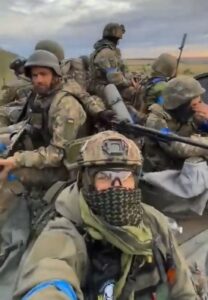
Ukraine soldiers speaking in British accent?

Soldiers with British accents have been filmed fighting in Ukrainian borders going by the footage at a time when the country is making stunning advances against Russian forces, Daily Mail reported.

The footage taken on GoPro cameras reportedly shows foreign legionaries fighting during Ukraine’s Kharkiv Oblast counter-offensive, which have made Krelim forces retreat, with intelligence experts hailing a ‘major turning point’ in the six-month war, the report said.

It has led to the recapture of several key towns in the east as Vladimir Putin’s forces fled in disarray. In a compilation of footage uploaded on social media, soldiers with British accents can be heard speaking to one another while wearing blue armbands to identify themselves as Ukrainian forces.

One clip appears to show soldiers moving POWs through a compound, while others show soldiers hurling grenades, running to take cover, and climbing through windows. Ukraine said that its forces had recaptured more than 1,158 square miles (3,000 square kilometres) this month from Russian troops.

Soldiers with British accents filmed fighting in Ukrainian colours

The counter-offensive centred on the country’s northeast is being led by Ukrainian general Valeriy Zaluzhny who said, “Since the beginning of September, more than 3,000 square kilometres have been returned to Ukrainian control… Around Kharkiv, we have begun to advance not only in the south and east, but also to the north. We are 50 kilometres (31 miles) from the border.”

The speed of Ukraine‘s advance, with photographs shared by Kyiv show them raising the Ukrainian flag in liberated towns after advancing more than 30 miles, has sparked Moscow fire the top general who was appointed just 16 days ago, Daily Mail reported.

Republic Day Celebrated in Kyiv, Ukraine; Tunis, Tunisia

Indian Republic Day function was celebrated with traditional fervor and gaiety at the Embassy of India, Kyiv on Thursday morning.

Flag hoisting ceremony was performed by Indian Ambassador Manoj K. Bharti, which was followed by singing of the Indian National Anthem. Mr Bharti later read out speech of Indian President on the occasion, which was well attended by the Indian community in Kyiv.

Another report from Tunis said the Republic Day was observed by the Indian mission with hoisting of the tricolour in the embassy premises on Thursday. Here is a photo of the event:

Indian embassy in Tunis, Tunisia hoisted tricolour on the occasion of Indian Republic Day on Thursday. (Photo: Indian mission, Tunis)