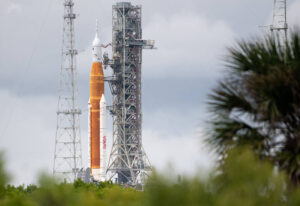
NASA will target Saturday, Sept. 3 at 2:17 p.m. EDT, the beginning of a two-hour window, for the launch of Artemis I, the first integrated test of NASA’s Orion spacecraft, Space Launch System (SLS) rocket, and the ground systems at the agency’s Kennedy Space Center in Florida.
Mission managers met Tuesday to discuss data and develop a forward plan to address issues that arose during an Aug. 29 launch attempt for the flight test. During that launch attempt, teams were not able to chill down the four RS-25 engines to approximately minus 420 degrees F, with engine 3 showing higher temperatures than the other engines. Teams also saw a hydrogen leak on a component of the tail service mast umbilical quick disconnect, called the purge can, and managed the leak by manually adjusting propellant flow rates.
Artemis I launch on Aug 27, 2022 / NASA
In the coming days, teams will modify and practice propellant loading procedures to follow a procedure similar to what was successfully performed during the Green Run at NASA’s Stennis Space Center in Mississippi. The updated procedures would perform the chilldown test of the engines, also called the kick start bleed test, about 30 to 45 minutes earlier in the countdown during the liquid hydrogen fast fill liquid phase for the core stage.
Teams also are configuring platforms at Launch Pad 39B to enable engineers access to the purge can on the tail service mast umbilical. Once access is established, technicians will perform assessments and torque connection points where necessary.
Meteorologists with the U.S. Space Force Space Launch Delta 45 predict favorable weather conditions for Saturday. While rain showers are expected, they are predicted to be sporadic during the launch window.
The mission management team will reconvene Thursday to review data and overall readiness.
Finding water on the Moon could be easier with a Goddard technology that uses an effect called quantum tunneling to generate a high-powered terahertz laser, filling a gap in existing laser technology.
Locating water and other resources is a NASA priority crucial to exploring Earth’s natural satellite and other objects in the solar system and beyond. Previous experiments inferred, then confirmed the existence of small amounts of water across the Moon. However, most technologies do not distinguish among water, free hydrogen ions, and hydroxyl, as the broadband detectors used cannot distinguish between the different volatiles.
Goddard engineer Dr. Berhanu Bulcha said a type of instrument called a heterodyne spectrometer could zoom in on particular frequencies to definitively identify and locate water sources on the Moon. It would need a stable, high-powered, terahertz laser, which was prototyped in collaboration with Longwave Photonics through NASA’s Small Business Innovation Research (SBIR) program.
“This laser allows us to open a new window to study this frequency spectrum,” he said. “Other missions found hydration on the Moon, but that could indicate hydroxyl or water. If it’s water, where did it come from? Is it indigenous to the formation of the Moon, or did it arrive later by comet impacts? How much water is there? We need to answer these questions because water is critical for survival and can be used to make fuel for further exploration.”
As the name implies, spectrometers detect spectra or wavelengths of light in order to reveal the chemical properties of matter that light has touched. Most spectrometers tend to operate across broad sections of the spectrum. Heterodyne instruments dial in to very specific light frequencies such as infrared or terahertz. Hydrogen-containing compounds like water emit photons in the terahertz frequency range — 2 trillion to 10 trillion cycles per second — between microwave and infrared.
Like a microscope for subtle differences within a bandwidth like terahertz, heterodyne spectrometers combine a local laser source with incoming light. Measuring the difference between the laser source and the combined wavelength provides accurate readings between sub-bandwidths of the spectrum.
Traditional lasers generate light by exciting an electron within an atom’s outer shell, which then emits a single photon as it transitions, or returns to its resting energy level. Different atoms produce different frequencies of light based on the fixed amount of energy it takes to excite one electron. However, lasers fall short in a particular portion of the spectrum between infrared and microwave known as the terahertz gap.
“The problem with existing laser technology,” Dr. Bulcha said, “is that no materials have the right properties to produce a terahertz wave.”
This tiny laser capitalizes on quantum-scale effects of materials just tens of atoms across to generate a high-powered beam in a portion of the spectrum where traditional lasers fade in strength/NASA/Michael Giunto
Electromagnetic oscillators like those that generate radio or microwave frequencies produce low-powered terahertz pulses by using a series of amplifiers and frequency multipliers to extend the signal into the terahertz range. However, this process consumes a lot of voltage, and the materials used to amplify and multiply the pulse have limited efficiency. This means they lose power as they approach the terahertz frequencies.
From the other side of the terahertz gap, optical lasers pump energy into a gas to generate photons. However, high-powered, terahertz-band lasers are large, power hungry, and not suitable for space exploration purposes where mass and power are limited, particularly hand-held or Small Satellite applications. The power of the pulse also drops as optical lasers push towards the terahertz bandwidths.
To fill that gap, Dr. Bulcha’s team is developing quantum cascade lasers that produce photons from each electron transition event by taking advantage of some unique, quantum-scale physics of materials layered just a few atoms thick.
In these materials, a laser emits photons in a specific frequency determined by the thickness of alternating layers of semiconductors rather than the elements in the material. In quantum physics, the thin layers increase the chance that a photon can then tunnel through to the next layer instead of bouncing off the barrier. Once there, it excites additional photons. Using a generator material with 80 to 100 layers, totaling less than 10 to 15 microns thick, the team’s source creates a cascade of terahertz-energy photons.
This cascade consumes less voltage to generate a stable, high-powered light. One drawback of this technology is its beam spreads out in a large angle, dissipating quickly over short distances. Using innovative technology supported by Goddard’s Internal Research and Development (IRAD) funding, Dr. Bulcha and his team integrated the laser on a waveguide with a thin optical antenna to tighten the beam. The integrated laser and waveguide unit reduces this dissipation by 50% in a package smaller than a quarter.
He hopes to continue the work to make a flight-ready laser for NASA’s Artemis program.
The laser’s low size and power consumption allow it to fit in a 1U CubeSat, about the size of a teapot, along with the spectrometer hardware, processor, and power supply. It could also power a handheld device for use by future explorers on the Moon, Mars, and beyond.
By harnessing the capabilities of the 8.1-meter Gemini South telescope in Chile, which is part of the International Gemini Observatory operated by NSF’s NOIRLab, astronomers have obtained the sharpest image ever of the star R136a1, the most massive known star in the Universe. Their research, led by NOIRLab astronomer Venu M. Kalari, challenges our understanding of the most massive stars and suggests that they may not be as massive as previously thought.
Astronomers have yet to fully understand how the most massive stars — those more than 100 times the mass of the Sun — are formed. One particularly challenging piece of this puzzle is obtaining observations of these giants, which typically dwell in the densely populated hearts of dust-shrouded star clusters. Giant stars also live fast and die young, burning through their fuel reserves in only a few million years. In comparison, our Sun is less than halfway through its 10 billion year lifespan. The combination of densely packed stars, relatively short lifetimes, and vast astronomical distances makes distinguishing individual massive stars in clusters a daunting technical challenge.
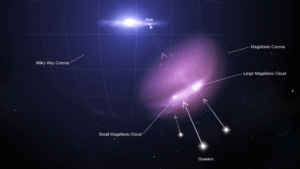
By pushing the capabilities of the Zorro instrument on the Gemini South telescope of the International Gemini Observatory, operated by NSF’s NOIRLab, astronomers have obtained the sharpest-ever image of R136a1 — the most massive known star. This colossal star is a member of the R136 star cluster, which lies about 160,000 light-years from Earth in the center of the Tarantula Nebula in the Large Magellanic Cloud, a dwarf companion galaxy of the Milky Way.
Previous observations suggested that R136a1 had a mass somewhere between 250 to 320 times the mass of the Sun. The new Zorro observations, however, indicate that this giant star may be only 170 to 230 times the mass of the Sun. Even with this lower estimate, R136a1 still qualifies as the most massive known star.
Astronomers are able to estimate a star’s mass by comparing its observed brightness and temperature with theoretical predictions. The sharper Zorro image allowed NSF’s NOIRLab astronomer Venu M. Kalari and his colleagues to more accurately separated the brightness of R136a1 from its nearby stellar companions, which led to a lower estimate of its brightness and therefore its mass.
“Our results show us that the most massive star we currently know is not as massive as we had previously thought,” explained Kalari, lead author of the paper announcing this result. “This suggests that the upper limit on stellar masses may also be smaller than previously thought.”
This result also has implications for the origin of elements heavier than helium in the Universe. These elements are created during the cataclysmicly explosive death of stars more than 150 times the mass of the Sun in events that astronomers refer to as pair-instability supernovae. If R136a1 is less massive than previously thought, the same could be true of other massive stars and consequently pair instability supernovae may be rarer than expected.
The star cluster hosting R136a1 has previously been observed by astronomers using the NASA/ESA Hubble Space Telescope and a variety of ground-based telescopes, but none of these telescopes could obtain images sharp enough to pick out all the individual stellar members of the nearby cluster.
Gemini South’s Zorro instrument was able to surpass the resolution of previous observations by using a technique known as speckle imaging, which enables ground-based telescopes to overcome much of the blurring effect of Earth’s atmosphere [1]. By taking many thousands of short-exposure images of a bright object and carefully processing the data, it is possible to cancel out almost all this blurring [2]. This approach, as well as the use of adaptive optics, can dramatically increase the resolution of ground-based telescopes, as shown by the team’s sharp new Zorro observations of R136a1 [3].
“This result shows that given the right conditions an 8.1-meter telescope pushed to its limits can rival not only the Hubble Space Telescope when it comes to angular resolution, but also the James Webb Space Telescope,” commented Ricardo Salinas, a co-author of this paper and the instrument scientist for Zorro. “This observation pushes the boundary of what is considered possible using speckle imaging.”
“We began this work as an exploratory observation to see how well Zorro could observe this type of object,” concluded Kalari. “While we urge caution when interpreting our results, our observations indicate that the most massive stars may not be as massive as once thought.”
Zorro and its twin instrument `Alopeke are identical imagers mounted on the Gemini South and Gemini North telescopes, respectively. Their names are the Hawaiian and Spanish words for “fox” and represent the telescopes’ respective locations on Maunakea in Hawai‘i and on Cerro Pachón in Chile. These instruments are part of the Gemini Observatory’s Visiting Instrument Program, which enables new science by accommodating innovative instruments and enabling exciting research. Steve B. Howell, current chair of the Gemini Observatory Board and senior research scientist at the NASA Ames Research Center in Mountain View, California, is the principal investigator on both instruments.
“Gemini South continues to enhance our understanding of the Universe, transforming astronomy as we know it. This discovery is yet another example of the scientific feats we can accomplish when we combine international collaboration, world-class infrastructure, and a stellar team,” said NSF Gemini Program Officer Martin Still.
Remember when you first learned about reproduction process in health class at school? Well, NASA biologists are wondering how some of those basics of how fertilization would work if sperm and egg were to unite in space. In other words, having sex aboard on ISS and examine how the sperm squirm in weightlessness — is their plan.
A cargo mission is launching to the International Space Station in April 2018 to study how weightlessness affects sperm. NASA’s Ames Research Center in California’s Silicon Valley manages the investigation, called Micro-11, aboard SpaceX’s 14th cargo resupply services mission to the International Space Station for NASA.
Little is currently known about the biology of reproduction in space, and this experiment will begin to address that gap by measuring, for the first time, how well bull and human sperm functions in space, said NASA in a statement. Studying reproductive biology in space is useful because the unique environment of microgravity can reveal processes and connections not visible in gravity on Earth, it explained the rationale behind such step.
In mammals, including humans, fertilization occurs when a sperm cell swims toward an egg and fuses with it. Before this can happen, the sperm cell must be activated to start moving. Next, to prepare it for fusing with the egg, the sperm needs to move faster, and its cell membrane must become more fluid.
Previous experiments with sea urchin and bull sperm suggest that activating movement happens more quickly in microgravity, while the steps leading up to fusion happen more slowly, or not at all. Delays or problems at this stage could prevent fertilization from happening in space.
For this experiment, two types of mammalian sperm, human and bull, will be sent to the space station as frozen samples. Bull sperm show similar changes in movement and other markers of fertility as human sperm. However, human sperm are inherently more varied in motion and appearance. So, the measurements of bull sperm will provide quality control to ensure the researchers can detect subtle differences in sperm from both species.
The astronaut crew will thaw the samples and add chemical mixtures that trigger activation of sperm movement and preparation for fusing with an egg. Researchers will use video to assess how well the space sperm move. Finally, the samples will be mixed with preservatives and returned to Earth, where they’ll be analyzed to see whether the steps necessary for fusion occurred and whether the samples from space differ from sperm samples activated on the ground.

We don’t know yet how long-duration spaceflight affects human reproductive health, and this investigation would be the first step in understanding the potential viability of reproduction in reduced-gravity conditions.
Managed by NASA’s Ames Research Center in California’s Silicon Valley, the Micro-11’s principal investigator for the fertilization in space experiment is Joseph S. Tash of the University of Kansas Medical Center in Kansas City. The experimental hardware for Micro-11 was developed by BioServe Space Technologies at the University of Colorado Boulder, and will launch aboard SpaceX’s 14th cargo resupply services mission to the International Space Station for NASA.
Japanese astronomer team led by Teruyuki Hirano of Tokyo Institute of Technology has validated 15 exoplanets orbiting red dwarf systems and found one of them highly akin to Earth and habitable. It could be of particular interest as researchers describe it as a ‘super-Earth’, which could harbour liquid water, and potential alien life.
One of them, K2-155 located around 200 light years away from Earth, has three transiting super-Earths, which are slightly bigger than ours and interestingly the outermost planet, K2-155d, with a radius 1.6 times that of Earth, could be within the host star’s habitable zone, they said.
The findings, published in The Astronomical Journal, are based on data from NASA Kepler spacecraft’s second mission, K2, and other data from the ground-based telescopes, including the Subaru Telescope in Hawaii and the Nordic Optical Telescope (NOT) in Spain.
The Japanese researchers found that K2-155d could potentially have liquid water on its surface based on 3D climate simulations. Hirano said: “In our simulations, the atmosphere and the composition of the planet were assumed to be Earth-like, and there’s no guarantee that this is the case.”
A key outcome from the current studies was that planets orbiting red dwarfs may have remarkably similar characteristics to planets orbiting solar-type stars.
“It’s important to note that the number of planets around red dwarfs is much smaller than the number around solar-type stars,” says Hirano. “Red dwarf systems, especially coolest red dwarfs, are just beginning to be investigated, so they are very exciting targets for future exoplanet research.”
While the radius gap of planets around solar-type stars has been reported previously, this is the first time that researchers have shown a similar gap in planets around red dwarfs. “This is a unique finding, and many theoretical astronomers are now investigating what causes this gap,” says Hirano.
He adds that the most likely explanation for the lack of large planets in the proximity of host stars is photoevaporation, which can strip away the envelope of the planetary atmosphere.
The researchers also investigated the relationship between planet radius and metallicity of the host star. “Large planets are only discovered around metal-rich stars,” Hirano says, “and what we found was consistent with our predictions. The few planets with a radius about three times that of Earth were found orbiting the most metal-rich red dwarfs.”
The studies were conducted as part of the KESPRINT collaboration, a group formed by the merger of KEST (Kepler Exoplanet Science Team) and ESPRINT (Equipo de Seguimiento de Planetas Rocosos Intepretando sus Transitos) in 2016.
With the planned launch of NASA’s Transiting Exoplanet Survey Satellite (TESS) in April 2018, Hirano is hopeful that even more planets will be discovered. “TESS is expected to find many candidate planets around bright stars closer to Earth,” he says. “This will greatly facilitate follow-up observations, including investigation of planetary atmospheres and determining the precise orbit of the planets,” he said.
Figure 1. Results of 3D global climate simulations for K2-155d
Surface temperatures were plotted as a function of insolation flux (the amount of incoming stellar radiation) estimated at 1.67±0.38. When the insolation exceeds 1.5, a so-called runaway greenhouse effect occurs, signaling a cut-off point for life-friendly temperatures. If the insolation is under 1.5, the surface temperature is more likely to be moderate.
Figure 2. Distribution of planet sizes
Histogram of planet radius for the validated and well-characterized transiting planets around red dwarfs: The number counts for mid-to-late red dwarfs (those with a surface temperature of under 3,500 K) are shown above those for early red dwarfs (those with a surface temperature of around 3,500–4,000 K). The results show a “radius gap”, or a dip in the number of stars with a radius between 1.5–2.0 times that of Earth.
US space agency NASA has denied global hackers group Anonymous claim that it is going make announcement on the discovery of alien life, said a spokesman.
Last week, the hacking group Anonymous posted a video on YouTube that said NASA is about to announce the discovery of life in our galaxy but NASA scientist beyond Earth.
“Contrary to some reports, there’s no pending announcement from NASA regarding extraterrestrial life,” said NASA science chief Thomas Zurbuchen in a tweet.
“Are we alone in the universe? While we do not know yet, we have missions moving forward that may help answer that fundamental question,” Zurbuchen said.
In fact, Anonymous has put out its video based on Zurbuchen’s testimony to the House of Representatives’ Committee on Science and Space in April this year. However, NASA has always maintained that there is no discovery of alien life and Anonymous video (see below) has surprised many.
Anonymous on their website said, “NASA says aliens are coming!” and uploaded the above video citing alien-friendly comments made by NASA astronauts and space scientists.
Anonymous quoted Zurbuchen’s rendering before a Congressional hearing in April titled “Advances in the Search for Life” that said: “NASA`s recent advances, such as the discovery of hydrogen in Saturn`s moon Enceladus and the Hubble team’s promising results from the oceans of Jupiter`s moon Europa, are promising signs that we’re closer than ever to discovering evidence of alien life.”
“Taking into account all of the different activities and missions that are specifically searching for evidence of alien life, we are on the verge of making one of the most profound, unprecedented, discoveries in history,” Zurbuchen said. Perhaps the second part of the quote has made Anonymous see NASA forthcoming with an announcement.