US Postal Service Celebrates NASA’s Webb Telescope With New Postal Stamp

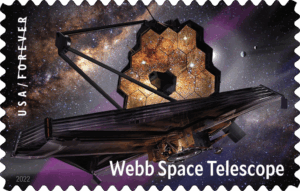
The U.S. Postal Service will issue a stamp celebrating NASA’s new James Webb Space Telescope, the largest, most powerful, and most complex science telescope ever put in space. The stamp, which features an illustration of the observatory, will be dedicated in a ceremony Thursday, Sept. 8, at the Smithsonian’s National Postal Museum in Washington.
“When anyone who uses these stamps looks at this telescope, I want them to see what I see: its incredible potential to reveal new and unexpected discoveries that help us understand the origins of the universe, and our place in it,” said NASA Associate Administrator Bob Cabana. “This telescope is the largest international space science program in U.S. history, and I can’t wait to see the scientific breakthroughs it will enable in astronomy.”

Webb, a mission led by NASA in partnership with ESA (European Space Agency) and CSA (Canadian Space Agency), launched Dec. 25, 2021, from Europe’s Spaceport in French Guiana. Over the following months, Webb traveled to its destination nearly one million miles (1.5 million kilometers) away from Earth, underwent weeks of complex deployments to unfold into its final configuration, and prepared its mirrors and science instruments to capture never-before-seen views of the universe.

The U.S. Postal Service will issue a stamp highlighting NASA’s James Webb Space Telescope on Sept. 8, 2022. U.S. Postal Service Art Director Derry Noyes designed the stamp using existing art by James Vaughan and an image provided by NASA and the Space Telescope Science Institute.
Credits: U.S. Postal Service

NASA released Webb’s first full-color images and spectra July 12 – providing a first look at the observatory’s powerful capabilities. The U.S. Postal Service stamp honors these achievements as Webb continues its mission to explore the unknown in our universe and study every phase in cosmic history.

“I am excited to add this beautiful stamp to our collection, as we watch from the ground as humanity’s newest and most capable telescope unlocks the greatest secrets of our cosmos that have been waiting to be revealed since the beginning of time,” said Thomas Zurbuchen, associate administrator for NASA’s Science Mission Directorate. “The Webb Telescope represents the start to a new era of what we can accomplish for the benefit of all.”

The stamp features an artist’s digital illustration of Webb against a background of stars. The selvage around each set of stamps showcases a sharp image of a star, captured while setting up the telescope in space to confirm precise alignment of Webb’s 18 hexagonal mirror segments.

The U.S. Postal Service’s first day of issue event is free and open to the public on Thursday, Sept. 8, at 11 a.m. EDT at the National Postal Museum. NASA Associate Administrator Bob Cabana; Lee Feinberg, Webb optical telescope element manager at NASA’s Goddard Space Flight Center; and Erin Smith, Webb deputy observatory project scientist at NASA Goddard will be among the speakers providing remarks.

NASA/Photo: Nasa.gov

To follow along with NASA’s Webb Telescope as it begins its mission to unfold the infrared universe, visit:

https://www.nasa.gov/webb

The James Webb Space Telescope is the world’s premier infrared space science observatory. Webb will solve mysteries in our solar system, look beyond to distant worlds around other stars, and probe the mysterious structures and origins of our universe and our place in it. Webb is an international program led by NASA with its partners, ESA (European Space Agency) and CSA (Canadian Space Agency).

Queen Elizabeth II Visits Goddard Space Flight Center in 2007: NASA

Queen Elizabeth II, Britain’s longest-reigning monarch, died on Sept. 8, 2022 at age 96. Her reign spanned all of spaceflight, predating both Sputnik and Explorer 1.

As NASA joins the planet in marking her passing, we are moved by the curiosity The Queen showed our explorers over the years.

Queen Elizabeth II passed away, Charles III becomes UK’s new King

In this photo, Queen Elizabeth II greets employees on her walk from NASA’s Goddard Space Flight Center mission control to a reception in the center’s main auditorium, Tuesday, May 8, 2007, in Greenbelt, Md. Queen Elizabeth II and her husband, Prince Philip, Duke of Edinburgh, visited the NASA Goddard Space Flight Center as one of the last stops on their six-day United States visit.


30 Doradus: Thousands of stunning young stars in “cosmic tarantula”captured by James Webb telescope

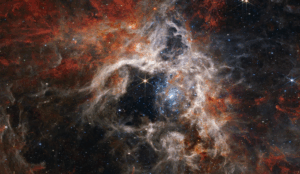
Thousands of never-before-seen young stars spotted in a stellar nursery called 30 Doradus, captured by NASA’s James Webb Space Telescope, called Tarantula Nebula owing to its appearance in dusty filaments.

The nebula has long been a favorite for astronomers studying star formation and the  Webb has been revealing beautiful distant background galaxies, as well as the detailed structure and composition of the nebula’s gas and dust ever since it’s started capturing the deep space.

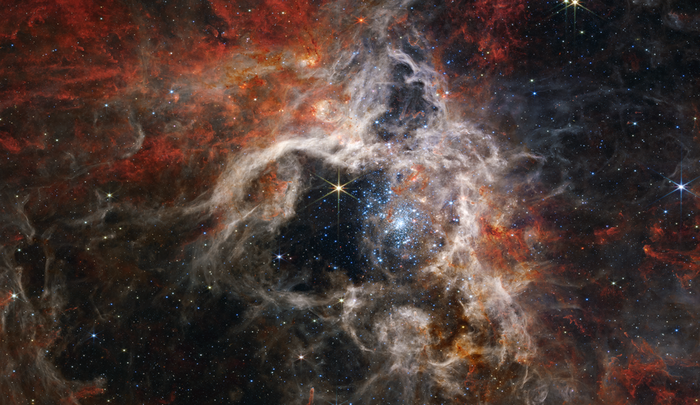
At only 161,000 light-years away in the Large Magellanic Cloud galaxy, the Tarantula Nebula is the largest and brightest star-forming region in the Local Group, the galaxies nearest our Milky Way. It is home to the hottest, most massive stars known. Astronomers focused three of Webb’s high-resolution infrared instruments on the Tarantula. Under the lens of Webb’s Near-Infrared Camera (NIRCam), the region resembles a burrowing tarantula’s home, lined with its silk.

The nebula’s cavity centered in the image above has been hollowed out by blistering radiation from a cluster of massive young stars, which sparkle pale blue in the image. Only the densest surrounding areas of the nebula resist erosion by these stars’ powerful stellar winds, forming pillars that appear to point back toward the cluster. These pillars contain forming protostars, which will eventually emerge from their dusty cocoons and take their turn shaping the nebula.

Caption: Nestled in the center of the Tarantula Nebula in the Large Magellanic Cloud is the largest star yet discovered, astronomers have produced the sharpest image ever of this star.  Photo:Observatory/NOIRLab/NSF/AURA Acknowledgment

Webb’s Near-Infrared Spectrograph (NIRSpec) caught one very young star doing precisely emerging out of the dust. Astronomers previously thought this star might be a bit older and already in the process of clearing out a bubble around itself. However, NIRSpec showed that the star was only just beginning to emerge from its pillar and still maintained an insulating cloud of dust around itself. Without Webb’s high-resolution spectra at infrared wavelengths, this episode of star formation-in-action could not have been revealed.

The region takes on a different appearance when viewed in the longer infrared wavelengths detected by Webb’s Mid-infrared Instrument (MIRI). The hot stars fade, and the cooler gas and dust glow. Within the stellar nursery clouds, points of light indicate embedded protostars, still gaining mass.

While shorter wavelengths of light are absorbed or scattered by dust grains in the nebula, and therefore never reach Webb to be detected, longer mid-infrared wavelengths penetrate that dust, ultimately revealing a previously unseen cosmic environment.

Caption: NASA’s James Webb Space Telescope

One of the reasons the Tarantula Nebula is interesting to astronomers is that the nebula has a similar type of chemical composition as the gigantic star-forming regions observed at the universe’s “cosmic noon,” when the cosmos was only a few billion years old and star formation was at its peak. Star-forming regions in our Milky Way galaxy are not producing stars at the same furious rate as the Tarantula Nebula, and have a different chemical composition.

Caption: In this mosaic image displays the Tarantula Nebula star, including tens of thousands of never-before-seen young stars that were previously shrouded in cosmic dust. The most active region appears to sparkle with massive young stars, appearing pale blue./Photo:NASA

This makes the Tarantula the closest (i.e., easiest to see in detail) example of what was happening in the universe as it reached its brilliant high noon. Webb will provide astronomers the opportunity to compare and contrast observations of star formation in the Tarantula Nebula with the telescope’s deep observations of distant galaxies from the actual era of cosmic noon.


First underground radar images from Mars Perseverance rover reveal some surprises

Key takeaways:

  • Roving the Red Planet. Perseverance landed on Mars in February 2021 and has been gathering data on the planet’s geology and climate and searching for signs of ancient life.​​​​​​
  • What lies beneath. The rover’s subsurface radar experiment, co-led by UCLA’s David Paige, has returned images showing unexpected variations in rock layers beneath the Jezero crater.
  • Probing the past. The variations could indicate past lava flows or possibly a river delta even older than the one currently being explored on the crater floor.

After a tantalizing year-and-a-half wait since NASA’s Mars Perseverance rover touched down on our nearest planetary neighbor, new data is arriving — and bringing with it a few surprises.

The rover, which is about the size of car and carries seven scientific instruments, has been probing Mars’ 30-mile-wide Jezero crater, once the site of a lake and an ideal spot to search for evidence of ancient life and information about the planet’s geological and climatic past.

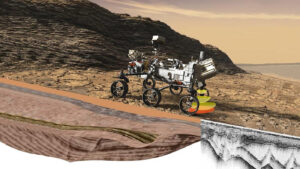
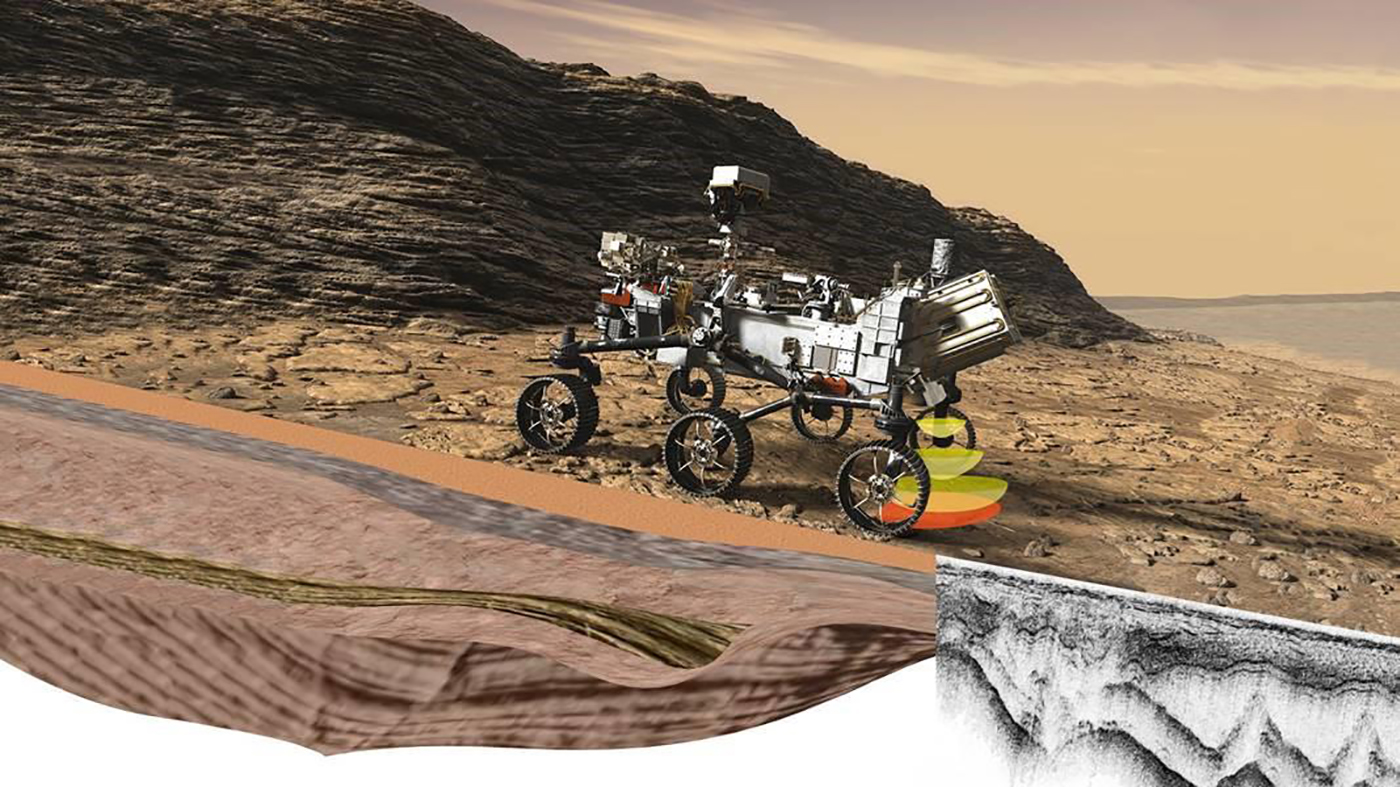
Rendering of Perseverance, whose RIMFAX technology is exploring what lies beneath the Martian surface. Photo: NASA/JPL/Caltech/FFI

In a paper published today in the journal Science Advances, a research team led by UCLA and the University of Oslo reveals that rock layers beneath the crater’s floor, observed by the rover’s ground-penetrating radar instrument, are unexpectedly inclined. The slopes, thicknesses and shapes of the inclined sections suggest they were either formed by slowly cooling lava or deposited as sediments in the former lake.

Perseverance is currently exploring a delta on the western edge of the crater, where a river once fed the lake, leaving behind a large deposit of dirt and rocks it picked up along its course. As the rover gathers more data, the researchers hope to clear up the complex history of this part of the Red Planet.

“We were quite surprised to find rocks stacked up at an inclined angle,” said David Paige, a UCLA professor of Earth, planetary and space sciences and one of the lead researchers on the Radar Imager for Mars Subsurface Experiment, or RIMFAX. “We were expecting to see horizontal rocks on the crater floor. The fact that they are tilted like this requires a more complex geologic history. They could have been formed when molten rock rose up towards the surface, or, alternatively, they could represent an older delta deposit buried in the crater floor.”

Paige said that most of the evidence gathered by the rover so far points to an igneous, or molten, origin, but based on the RIMFAX data, he and the team can’t yet say for certain how the inclined layers formed. RIMFAX obtains a picture of underground features by sending bursts of radar waves below the surface, which are reflected by rock layers and other obstacles. The shapes, densities, thicknesses, angles and compositions of underground objects affect how the radar waves bounce back, creating a visual image of what lies beneath.

During Perseverance’s initial 3-kilometer traverse, the instrument has obtained a continuous radar image that reveals the electromagnetic properties and bedrock stratigraphy — the arrangement of rock layers — of Jezero’s floor to depths of 15 meters, or about 49 feet. The image reveals the presence of ubiquitous layered rock strata, including those that are inclined at up to 15 degrees. Compounding the mystery, within those inclined areas are some perplexing highly reflective rock layers that in fact tilt in multiple directions.

“RIMFAX is giving us a view of Mars stratigraphy similar to what you can see on Earth in highway road cuts, where tall stacks of rock layers are sometimes visible in a mountainside as you drive by,” Paige explained. “Before Perseverance landed, there were many hypotheses about the exact nature and origin of the crater floor materials. We’ve now been able to narrow down the range of possibilities, but the data we’ve acquired so far suggest that the history of the crater floor may be quite a bit more complicated than we had anticipated.”

The data collected by RIMFAX will provide valuable context to rock samples Perseverance is collecting, which will eventually be brought back to Earth.

“RIMFAX is giving us the backstory of the samples we’re going to analyze. It’s exciting that the rover’s instruments are producing data and we’re starting to learn, but there’s a lot more to come,” Paige said. “We landed on the crater floor, but now we’re driving up on the actual delta, which is the main target of the mission. This is just the beginning of what we’ll hopefully soon know about Mars.”

The paper, “Ground penetrating radar observations of subsurface structures in the floor of Jezero crater, Mars,” is one of three simultaneously published papers discussing some of the first data from Perseverance.

Explore the Solar System With NASA’s New, Improved 3D ‘Eyes’

The agency’s newly upgraded “Eyes on the Solar System” visualization tool includes Artemis I’s trajectory along with a host of other new features.

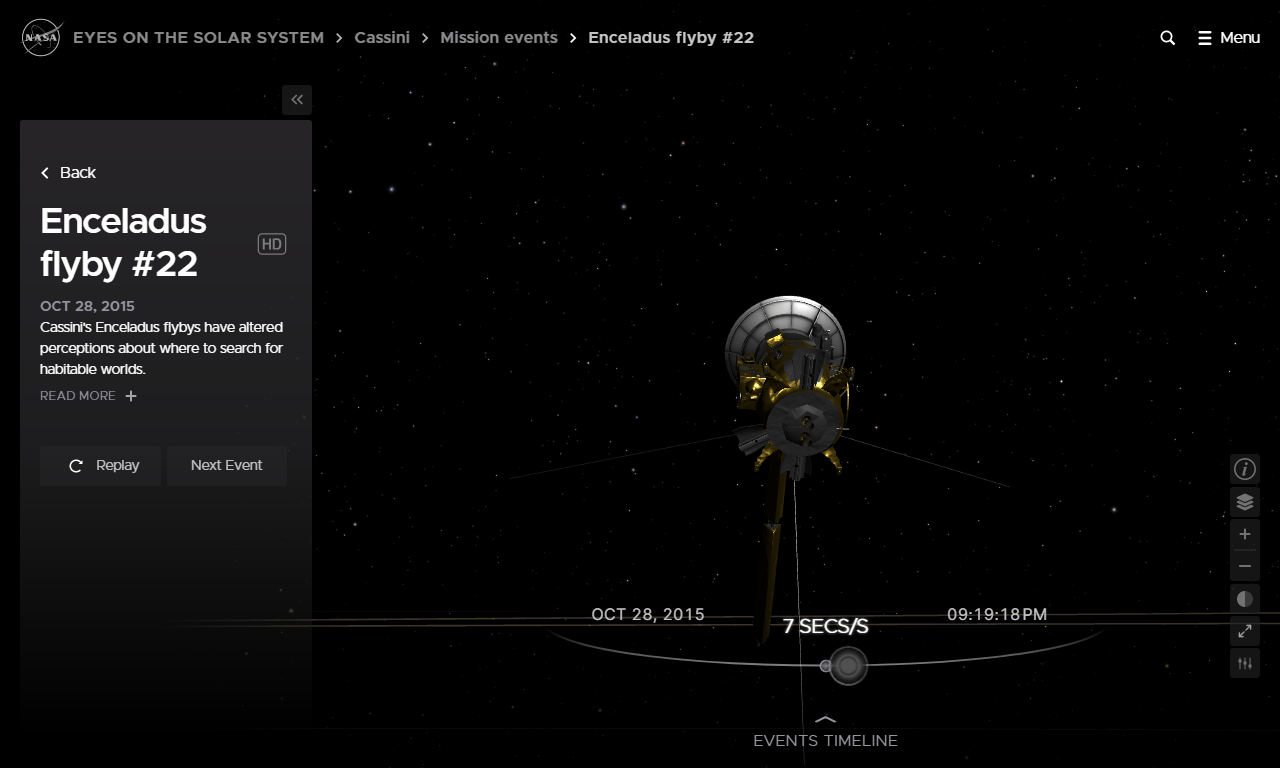
NASA has revamped its “Eyes on the Solar System” 3D visualization tool, making interplanetary travel easier and more interactive than ever. More than two years in the making, the update delivers better controls, improved navigation, and a host of new opportunities to learn about our incredible corner of the cosmos – no spacesuit required. All you need is a device with an internet connection.

 Trace the course Artemis I will take to lunar orbit, or touch down with Perseverance during its harrowing entry, descent, and landing on the Red Planet. Learn the basics about dwarf planets or the finer points of gas giants, and ride alongside no fewer than 126 space missions past and present. You can even follow the paths of spacecraft and celestial bodies as far back as 1949 and as far into the future as 2049.

While you’re at it, you can rotate objects, compare them side by side, and even modulate the perspective as well as the lighting. The visuals are striking. This latest version of “Eyes” also lets you scroll through rich interactive journeys, including Voyager’s Grand Tour of Jupiter, Saturn, Uranus, and Neptune.

“The beauty of the new browser-based ‘Eyes on the Solar System’ is that it really invites exploration. You just need an internet connection, a device that has a web browser, and some curiosity,” said Jason Craig, the producer of the “Eyes” software at NASA’s Jet Propulsion Laboratory.

Apply now to experience the Launch of NASA’s SpaceX Crew-5 Mission[Full details]

Digital content creators are invited to register to attend the launch of the fifth SpaceX Crew Dragon spacecraft and Falcon 9 rocket that will carry astronauts to the International Space Station for a science expedition mission. This mission is part of NASA’s Commercial Crew Program.

The earliest targeted launch date for the agency’s SpaceX Crew-5 mission is Oct. 3, from Kennedy’s Launch Complex 39A. The launch will carry NASA astronauts Nicole Mann, commander; Josh Cassada, pilot; and mission specialists Koichi Wakata, of JAXA (Japan Aerospace Exploration Agency), and Roscosmos cosmonaut Anna Kikina.

If your passion is to communicate and engage the world online, then this is the event for you! Seize the opportunity to be on the front line to see and share the #Crew5 mission launch.

A maximum of 35 social media users will be selected to attend this two-day event and will be given access similar to news media.

NASA Social participants will have the opportunity to:

  • View a launch of the SpaceX Falcon 9 rocket
  • Tour NASA facilities at Kennedy Space Center
  • Meet and interact with Crew-5 subject matter experts
  • Meet fellow space enthusiasts who are active on social media

NASA Social registration for the Crew-5 launch opens on August 31 and the deadline to apply is September 6 at 3 p.m. EDT. All social applications will be considered on a case-by-case basis.


APPLY NOW


Do I need to have a social media account to register?
Yes. This event is designed for people who:

  • Actively use multiple social networking platforms and tools to disseminate information to a unique audience.
  • Regularly produce new content that features multimedia elements.
  • Have the potential to reach a large number of people using digital platforms.
  • Reach a unique audience, separate and distinctive from traditional news media and/or NASA audiences.
  • Must have an established history of posting content on social media platforms.
  • Have previous postings that are highly visible, respected and widely recognized.

Users on all social networks are encouraged to use the hashtag #NASASocial, and #Crew5.  Updates and information about the event will be shared on Twitter via @NASASocial and @NASAKennedy, and via posts to Facebook and Instagram.

How do I register?
Registration for this event opens August 31 and closes at 3 p.m. EDT on September 6. Registration is for one person only (you) and is non-transferable. Each individual wishing to attend must register separately. Each application will be considered on a case-by-case basis.

Can I register if I am not a U.S. citizen?
Because of the security deadlines, registration is limited to U.S. citizens. If you have a valid permanent resident card you will be processed as a U.S. citizen.

When will I know if I am selected?
After registrations have been received and processed, an email with confirmation information and additional instructions will be sent to those selected. We expect to send the first notifications on September 13 and waitlist notifications on September 14.

What are NASA Social credentials?
All social applications will be considered on a case-by-case basis. Those chosen must prove through the registration process they meet specific engagement criteria.

If you do not make the registration list for this NASA Social, you still can attend the launch offsite and participate in the conversation online. Find out about ways to experience a launch here.

What are the registration requirements?
Registration indicates your intent to travel to NASA’s Kennedy Space Center in Florida and attend the two-day event in person. You are responsible for your own expenses for travel, accommodation, food, and other amenities.

Some events and participants scheduled to appear at the event are subject to change without notice. NASA is not responsible for loss or damage incurred as a result of attending. NASA, moreover, is not responsible for loss or damage incurred if the event is cancelled with limited or no notice. Please plan accordingly.

Kennedy is a government facility. Those who are selected will need to complete an additional registration step to receive clearance to enter the secure areas.

IMPORTANT: To be admitted, you will need to provide two forms of unexpired government-issued identification; one must be a photo ID and match the name provided on the registration. Those without proper identification cannot be admitted. For a complete list of acceptable forms of ID, please visit: NASA Credentialing Identification Requirements.

All registrants must be at least 18 years old.

Photo: Nasa.gov

What if the launch date changes?
Hundreds of different factors can cause a scheduled launch date to change multiple times. The launch date will not be official until after the Flight Readiness Review. If the launch date changes prior to then, NASA may adjust the date of the NASA Social accordingly to coincide with the new target launch date. NASA will notify registrants of any changes by email.

If the launch is postponed, attendees will be invited to attend a later launch date. NASA cannot accommodate attendees for delays beyond 72 hours.

NASA Social attendees are responsible for any additional costs they incur related to any launch delay. We strongly encourage participants to make travel arrangements that are refundable and/or flexible.

What if I cannot come to the Kennedy Space Center?
If you cannot come to the Kennedy Space Center and attend in person, you should not register for the NASA Social. You can follow the conversation using the #NASASocial hashtag on Twitter. You can watch the launch on NASA Television or www.nasa.gov/live. NASA will provide regular launch and mission updates on @NASA@NASAKennedy, and @Commercial_Crew.

What are the safety protocols for this event?
COVID-19 safety protocols for this event will be communicated closer to the date of the event.

If you cannot make this NASA Social, don’t worry; NASA is planning many other Socials in the near future at various locations! Check back here for updates.

NASA’s Webb Detects Carbon Dioxide in Exoplanet Atmosphere

NASA’s James Webb Space Telescope has captured the first clear evidence for carbon dioxide in the atmosphere of a planet outside the solar system. This observation of a gas giant planet orbiting a Sun-like star 700 light-years away provides important insights into the composition and formation of the planet. The finding, accepted for publication in Nature, offers evidence that in the future Webb may be able to detect and measure carbon dioxide in the thinner atmospheres of smaller rocky planets.

WASP-39 b is a hot gas giant with a mass roughly one-quarter that of Jupiter (about the same as Saturn) and a diameter 1.3 times greater than Jupiter. Its extreme puffiness is related in part to its high temperature (about 1,600 degrees Fahrenheit or 900 degrees Celsius). Unlike the cooler, more compact gas giants in our solar system, WASP-39 b orbits very close to its star – only about one-eighth the distance between the Sun and Mercury – completing one circuit in just over four Earth-days. The planet’s discovery, reported in 2011, was made based on ground-based detections of the subtle, periodic dimming of light from its host star as the planet transits, or passes in front of the star.

Previous observations from other telescopes, including NASA’s Hubble and Spitzer space telescopes, revealed the presence of water vapor, sodium, and potassium in the planet’s atmosphere. Webb’s unmatched infrared sensitivity has now confirmed the presence of carbon dioxide on this planet as well.

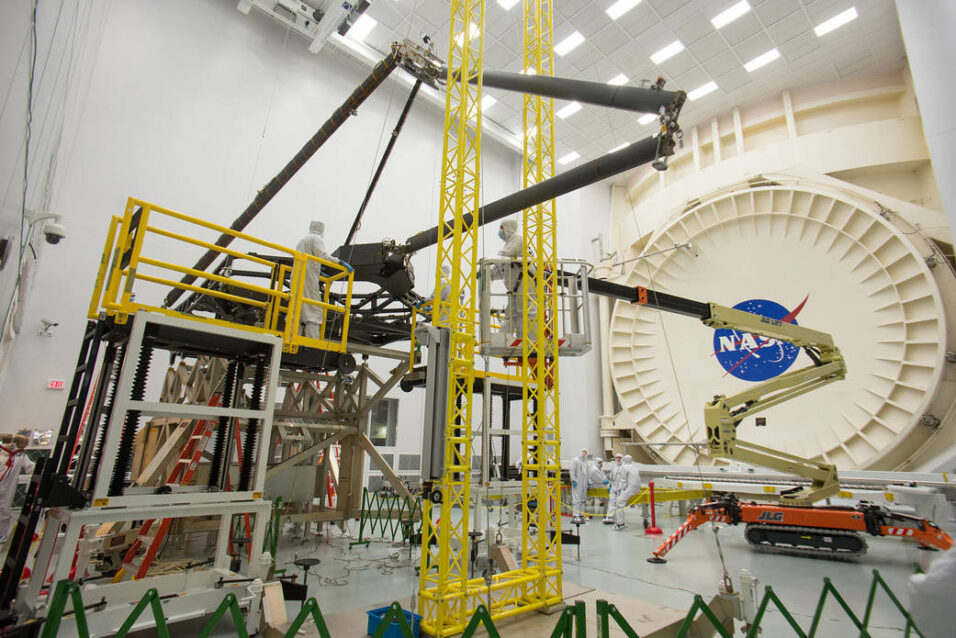
NASA Prepares Webb Telescope /NASA

Filtered Starlight

Transiting planets like WASP-39 b, whose orbits we observe edge-on rather than from above, can provide researchers with ideal opportunities to probe planetary atmospheres.

During a transit, some of the starlight is eclipsed by the planet completely (causing the overall dimming) and some is transmitted through the planet’s atmosphere.

Because different gases absorb different combinations of colors, researchers can analyze small differences in brightness of the transmitted light across a spectrum of wavelengths to determine exactly what an atmosphere is made of. With its combination of inflated atmosphere and frequent transits, WASP-39 b is an ideal target for transmission spectroscopy.

First Clear Detection of Carbon Dioxide

The research team used Webb’s Near-Infrared Spectrograph (NIRSpec) for its observations of WASP-39b. In the resulting spectrum of the exoplanet’s atmosphere, a small hill between 4.1 and 4.6 microns presents the first clear, detailed evidence for carbon dioxide ever detected in a planet outside the solar system.

“As soon as the data appeared on my screen, the whopping carbon dioxide feature grabbed me,” said Zafar Rustamkulov, a graduate student at Johns Hopkins University and member of the JWST Transiting Exoplanet Community Early Release Science team, which undertook this investigation. “It was a special moment, crossing an important threshold in exoplanet sciences.”

No observatory has ever measured such subtle differences in brightness of so many individual colors across the 3 to 5.5-micron range in an exoplanet transmission spectrum before. Access to this part of the spectrum is crucial for measuring abundances of gases like water and methane, as well as carbon dioxide, which are thought to exist in many different types of exoplanets.

“Detecting such a clear signal of carbon dioxide on WASP-39 b bodes well for the detection of atmospheres on smaller, terrestrial-sized planets,” said Natalie Batalha of the University of California at Santa Cruz, who leads the team.

Understanding the composition of a planet’s atmosphere is important because it tells us something about the origin of the planet and how it evolved. “Carbon dioxide molecules are sensitive tracers of the story of planet formation,” said Mike Line of Arizona State University, another member of this research team. “By measuring this carbon dioxide feature, we can determine how much solid versus how much gaseous material was used to form this gas giant planet. In the coming decade, JWST will make this measurement for a variety of planets, providing insight into the details of how planets form and the uniqueness of our own solar system.”

NASA hopes to Launch Artemis I Moon Mission on Sept 3

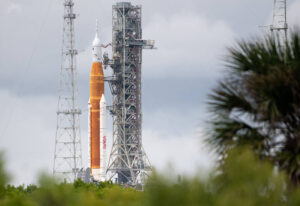
NASA will target Saturday, Sept. 3 at 2:17 p.m. EDT, the beginning of a two-hour window, for the launch of Artemis I, the first integrated test of NASA’s Orion spacecraft, Space Launch System (SLS) rocket, and the ground systems at the agency’s Kennedy Space Center in Florida.

Mission managers met Tuesday to discuss data and develop a forward plan to address issues that arose during an Aug. 29 launch attempt for the flight test. During that launch attempt, teams were not able to chill down the four RS-25 engines to approximately minus 420 degrees F, with engine 3 showing higher temperatures than the other engines. Teams also saw a hydrogen leak on a component of the tail service mast umbilical quick disconnect, called the purge can, and managed the leak by manually adjusting propellant flow rates.

Artemis I launch on Aug 27, 2022 / NASA

In the coming days, teams will modify and practice propellant loading procedures to follow a procedure similar to what was successfully performed during the Green Run at NASA’s Stennis Space Center in Mississippi. The updated procedures would perform the chilldown test of the engines, also called the kick start bleed test, about 30 to 45 minutes earlier in the countdown during the liquid hydrogen fast fill liquid phase for the core stage.

Teams also are configuring platforms at Launch Pad 39B to enable engineers access to the purge can on the tail service mast umbilical. Once access is established, technicians will perform assessments and torque connection points where necessary.

Meteorologists with the U.S. Space Force Space Launch Delta 45 predict favorable weather conditions for Saturday. While rain showers are expected, they are predicted to be sporadic during the launch window.

The mission management team will reconvene Thursday to review data and overall readiness.

NASA Engineer Develops Tiny, High-Powered terahertz Laser to Find Water on the Moon

Finding water on the Moon could be easier with a Goddard technology that uses an effect called quantum tunneling to generate a high-powered terahertz laser, filling a gap in existing laser technology.

Locating water and other resources is a NASA priority crucial to exploring Earth’s natural satellite and other objects in the solar system and beyond. Previous experiments inferred, then confirmed the existence of small amounts of water across the Moon. However, most technologies do not distinguish among water, free hydrogen ions, and hydroxyl, as the broadband detectors used cannot distinguish between the different volatiles.

Goddard engineer Dr. Berhanu Bulcha said a type of instrument called a heterodyne spectrometer could zoom in on particular frequencies to definitively identify and locate water sources on the Moon. It would need a stable, high-powered, terahertz laser, which was prototyped in collaboration with Longwave Photonics through NASA’s Small Business Innovation Research (SBIR) program.

“This laser allows us to open a new window to study this frequency spectrum,” he said. “Other missions found hydration on the Moon, but that could indicate hydroxyl or water. If it’s water, where did it come from? Is it indigenous to the formation of the Moon, or did it arrive later by comet impacts? How much water is there? We need to answer these questions because water is critical for survival and can be used to make fuel for further exploration.”

As the name implies, spectrometers detect spectra or wavelengths of light in order to reveal the chemical properties of matter that light has touched. Most spectrometers tend to operate across broad sections of the spectrum. Heterodyne instruments dial in to very specific light frequencies such as infrared or terahertz. Hydrogen-containing compounds like water emit photons in the terahertz frequency range — 2 trillion to 10 trillion cycles per second — between microwave and infrared.

Like a microscope for subtle differences within a bandwidth like terahertz, heterodyne spectrometers combine a local laser source with incoming light. Measuring the difference between the laser source and the combined wavelength provides accurate readings between sub-bandwidths of the spectrum.

Traditional lasers generate light by exciting an electron within an atom’s outer shell, which then emits a single photon as it transitions, or returns to its resting energy level. Different atoms produce different frequencies of light based on the fixed amount of energy it takes to excite one electron. However, lasers fall short in a particular portion of the spectrum between infrared and microwave known as the terahertz gap.

“The problem with existing laser technology,” Dr. Bulcha said, “is that no materials have the right properties to produce a terahertz wave.”

This tiny laser capitalizes on quantum-scale effects of materials just tens of atoms across to generate a high-powered beam in a portion of the spectrum where traditional lasers fade in strength/NASA/Michael Giunto

Electromagnetic oscillators like those that generate radio or microwave frequencies produce low-powered terahertz pulses by using a series of amplifiers and frequency multipliers to extend the signal into the terahertz range. However, this process consumes a lot of voltage, and the materials used to amplify and multiply the pulse have limited efficiency. This means they lose power as they approach the terahertz frequencies.

From the other side of the terahertz gap, optical lasers pump energy into a gas to generate photons. However, high-powered, terahertz-band lasers are large, power hungry, and not suitable for space exploration purposes where mass and power are limited, particularly hand-held or Small Satellite applications. The power of the pulse also drops as optical lasers push towards the terahertz bandwidths.

To fill that gap, Dr. Bulcha’s team is developing quantum cascade lasers that produce photons from each electron transition event by taking advantage of some unique, quantum-scale physics of materials layered just a few atoms thick.

In these materials, a laser emits photons in a specific frequency determined by the thickness of alternating layers of semiconductors rather than the elements in the material. In quantum physics, the thin layers increase the chance that a photon can then tunnel through to the next layer instead of bouncing off the barrier. Once there, it excites additional photons. Using a generator material with 80 to 100 layers, totaling less than 10 to 15 microns thick, the team’s source creates a cascade of terahertz-energy photons.

This cascade consumes less voltage to generate a stable, high-powered light. One drawback of this technology is its beam spreads out in a large angle, dissipating quickly over short distances. Using innovative technology supported by Goddard’s Internal Research and Development (IRAD) funding, Dr. Bulcha and his team integrated the laser on a waveguide with a thin optical antenna to tighten the beam. The integrated laser and waveguide unit reduces this dissipation by 50% in a package smaller than a quarter.

He hopes to continue the work to make a flight-ready laser for NASA’s Artemis program.

The laser’s low size and power consumption allow it to fit in a 1U CubeSat, about the size of a teapot, along with the spectrometer hardware, processor, and power supply. It could also power a handheld device for use by future explorers on the Moon, Mars, and beyond.

Sharpest image ever of universe’s most massive known star

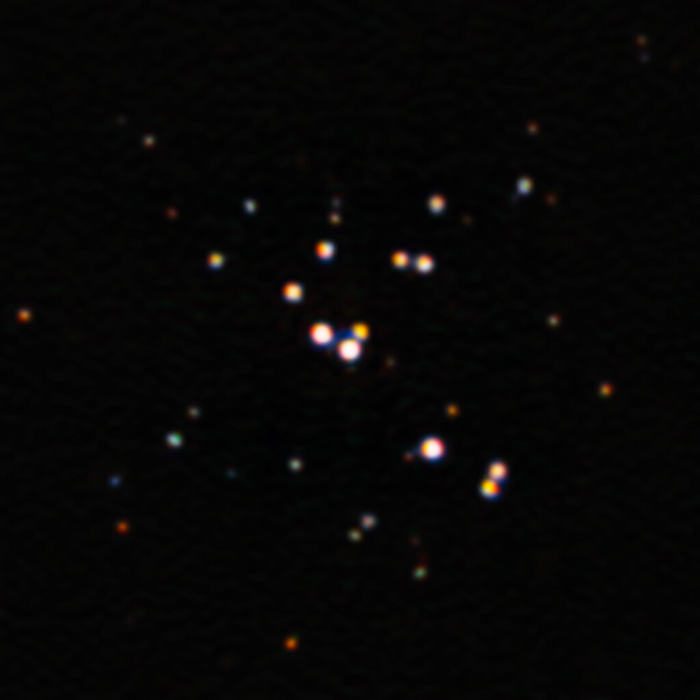
By harnessing the capabilities of the 8.1-meter Gemini South telescope in Chile, which is part of the International Gemini Observatory operated by NSF’s NOIRLab, astronomers have obtained the sharpest image ever of the star R136a1, the most massive known star in the Universe. Their research, led by NOIRLab astronomer Venu M. Kalari, challenges our understanding of the most massive stars and suggests that they may not be as massive as previously thought.

Astronomers have yet to fully understand how the most massive stars — those more than 100 times the mass of the Sun — are formed. One particularly challenging piece of this puzzle is obtaining observations of these giants, which typically dwell in the densely populated hearts of dust-shrouded star clusters. Giant stars also live fast and die young, burning through their fuel reserves in only a few million years. In comparison, our Sun is less than halfway through its 10 billion year lifespan. The combination of densely packed stars, relatively short lifetimes, and vast astronomical distances makes distinguishing individual massive stars in clusters a daunting technical challenge.

By pushing the capabilities of the Zorro instrument on the Gemini South telescope of the International Gemini Observatory, operated by NSF’s NOIRLab, astronomers have obtained the sharpest-ever image of R136a1 — the most massive known star. This colossal star is a member of the R136 star cluster, which lies about 160,000 light-years from Earth in the center of the Tarantula Nebula in the Large Magellanic Cloud, a dwarf companion galaxy of the Milky Way.

Previous observations suggested that R136a1 had a mass somewhere between 250 to 320 times the mass of the Sun. The new Zorro observations, however, indicate that this giant star may be only 170 to 230 times the mass of the Sun. Even with this lower estimate, R136a1 still qualifies as the most massive known star.

Astronomers are able to estimate a star’s mass by comparing its observed brightness and temperature with theoretical predictions. The sharper Zorro image allowed NSF’s NOIRLab astronomer Venu M. Kalari and his colleagues to more accurately separated the brightness of R136a1 from its nearby stellar companions, which led to a lower estimate of its brightness and therefore its mass.

Our results show us that the most massive star we currently know is not as massive as we had previously thought,” explained Kalari, lead author of the paper announcing this result. “This suggests that the upper limit on stellar masses may also be smaller than previously thought.

This result also has implications for the origin of elements heavier than helium in the Universe. These elements are created during the cataclysmicly explosive death of stars more than 150 times the mass of the Sun in events that astronomers refer to as pair-instability supernovae. If R136a1 is less massive than previously thought, the same could be true of other massive stars and consequently pair instability supernovae may be rarer than expected.

The star cluster hosting R136a1 has previously been observed by astronomers using the NASA/ESA Hubble Space Telescope and a variety of ground-based telescopes, but none of these telescopes could obtain images sharp enough to pick out all the individual stellar members of the nearby cluster.

Gemini South’s Zorro instrument was able to surpass the resolution of previous observations by using a technique known as speckle imaging, which enables ground-based telescopes to overcome much of the blurring effect of Earth’s atmosphere [1]. By taking many thousands of short-exposure images of a bright object and carefully processing the data, it is possible to cancel out almost all this blurring [2]. This approach, as well as the use of adaptive optics, can dramatically increase the resolution of ground-based telescopes, as shown by the team’s sharp new Zorro observations of R136a1 [3].

This result shows that given the right conditions an 8.1-meter telescope pushed to its limits can rival not only the Hubble Space Telescope when it comes to angular resolution, but also the James Webb Space Telescope,” commented Ricardo Salinas, a co-author of this paper and the instrument scientist for Zorro. “This observation pushes the boundary of what is considered possible using speckle imaging.

We began this work as an exploratory observation to see how well Zorro could observe this type of object,” concluded Kalari. “While we urge caution when interpreting our results, our observations indicate that the most massive stars may not be as massive as once thought.

Zorro and its twin instrument `Alopeke are identical imagers mounted on the Gemini South and Gemini North telescopes, respectively. Their names are the Hawaiian and Spanish words for “fox” and represent the telescopes’ respective locations on Maunakea in Hawai‘i and on Cerro Pachón in Chile. These instruments are part of the Gemini Observatory’s Visiting Instrument Program, which enables new science by accommodating innovative instruments and enabling exciting research. Steve B. Howell, current chair of the Gemini Observatory Board and senior research scientist at the NASA Ames Research Center in Mountain View, California, is the principal investigator on both instruments.

Gemini South continues to enhance our understanding of the Universe, transforming astronomy as we know it. This discovery is yet another example of the scientific feats we can accomplish when we combine international collaboration, world-class infrastructure, and a stellar team,” said NSF Gemini Program Officer Martin Still.

NASA gears up for livestreaming mega event of Artemis I launch

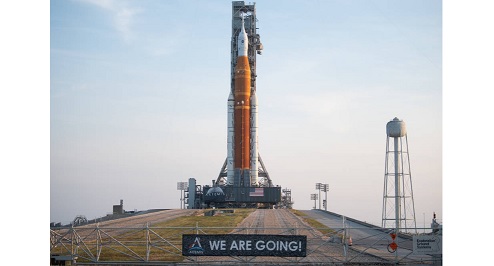
As the SLS rocket is scheduled for launch during a two-hour window that opens at 8:33 a.m. EDT Monday, Aug. 29, from Launch Pad 39B at Kennedy Space Center, NASA is planning to provide a wide coverage of prelaunch, launch, and postlaunch activities for Artemis I.

Artemis I will be the first integrated test of NASA’s Orion spacecraft, Space Launch System (SLS) rocket, and the ground systems at the launch center in Florida, heralding future crewed flight test and future human lunar exploration.

The rocket and spacecraft have already reached the launch pad last week after the nearly 10-hour, four-mile trek from the Vehicle Assembly Building and a livestream of the rocket and spacecraft at the launch pad has been made available on the NASA Kennedy YouTube channel.

Live coverage of events will air on NASA Television, the NASA app, and the agency’s website, with prelaunch events starting Monday, Aug. 22. The launch countdown will begin Saturday, Aug. 27, at 10:23 a.m.


Artemis I set for launch / NASA

A live broadcast of the launch includes celebrity appearances by Jack Black, Chris Evans, and Keke Palmer, as well as a special performance of “The Star-Spangled Banner” by Josh Grobin and Herbie Hancock. It also will feature a performance of “America the Beautiful” by The Philadelphia Orchestra and cellist Yo-Yo Ma, conducted by Yannick Nézet-Séguin.

The first in a series of complex missions, Artemis I is an uncrewed flight test that will provide a foundation to extend human presence to the Moon and beyond. The mission will test the performance of the SLS rocket and test Orion’s capabilities over a period of about six weeks while on its travel that covers about 40,000 miles beyond the Moon and back to Earth.

Lightweight Crane Technology to be Tested on the Moon [ARTEMIS PROJECT]

Like a Swiss Army knife, NASA’s Lightweight Surface Manipulation System (LSMS) technology is likely to find many ways of usage on the surface of Moon as part of its Artemis moon program.

This lightweight robotic crane with a structurally efficient truss frame and cable actuation mimics the movement of a human arm, but with a much longer reach as seen in the visual provided by NASA. It is scalable to fit any sized lander, vehicle, or surface application and can use a toolbox of quick-interchange end-effectors, or tools, that allow it to act as a hoist, forklift, regolith scoop, welder, said the US space agency.

“The unique thing about the LSMS is its dexterity and multi-functionality,” said Barmac Taleghani, project manager at NASA’s Langley Research Center in Hampton, Virginia.

The LSMS tested at Langley more than a decade ago to demonstrate the concept for offloading large payloads, such as habitats and rovers, from landers on human exploration missions. Once it is used on the moon’s surface, it’s likely to be sent to Mars too in future NASSA programs.

“We started thinking about additional tools that could be useful so that when you land the LSMS it could be used for multiple tasks,” said Tom Jones.“You’ve already carried that mass there; why not reuse it?”

Meanwhile, LSMS has been upgraded to include a suite of new tools, such as a bucket truck end-effector for digging and maneuvering regolith, a forklift tine tool for lifting cargo pallets, and a welding tool, in addition to greater autonomous functionality. The next design is on a larger for a large cargo to lunar lander under the artemis project.

Although similar in structural design to a terrestrial crane, the LSMS uses a cable-driven actuation system to articulate its arm links and precisely maneuver payloads.
Credits: NASA

“As we establish a sustainable presence on the Moon under the Artemis missions, we will need to start setting up multiple elements, and there will be a wide range of tasks that could leverage the versatility and functionality of the LSMS,” Jones said.

The new LSMS will be similar in size to the original prototype with about a 25-foot reach and will be able to lift payloads weighing around one metric ton on the Moon, equal to approximately 2,200 pounds, or the size of an elephant.

Jones further said, “LSMS is designed to operate either on the Moon or Mars or really any kind of planetary body. There may be different environmental concerns depending on the destination, but the hardware would be very similar.”


Planet Nine or Exoplanet? Scientists find startling resemblance in star 336 light years away

As astronomers are looking for a hypothetical “Planet Nine” in our solar system, an exoplanet 336 light years from Earth is looking more like the Planet Nine of its star system.

Planet Nine, potentially 10 times the size of Earth and orbiting far beyond Neptune in a highly eccentric orbit around the sun, was proposed in 2012 to explain perturbations in the orbits of dwarf planets beyond Neptune’s orbit, so-called detached Kuiper Belt objects. However, it has yet to be found, if ever it exists.

A similarly weird extrasolar planet was discovered far from the star HD 106906 in 2013 was much heavier than the predicted mass of Planet Nine at probably 11 times the mass of Jupiter, or 3,500 times the mass of Earth. And it was located in an unexpected location, far above the dust plane of the planetary system and tilted at an angle of about 21 degrees.

It is not known whether the planet, HD 106906 b, is in an orbit perpetually bound to the binary star — which is 15 million years old compared to the 4.5 billion-year age of our sun or on its way out of the planetary system, never to return.

In a paper published on Dec. 10, 2020, in the Astronomical Journal, astronomers answer that question. By precisely tracking the planet’s position over 14 years, they determined that it is likely bound to the star in a 15,000-year, highly eccentric orbit, making it a distant cousin of Planet Nine.

If it is in a highly eccentric orbit around the binary, “This raises the question of how did these planets get out there to such large separations,” said Meiji Nguyen, a recent UC Berkeley graduate and first author of the paper. “Were they scattered from the inner solar system? Or, did they form out there?”

According to senior author Paul Kalas, University of California, Berkeley, the resemblance to the orbit of the proposed Planet Nine shows that such distant planets can really exist and that they may form within the first tens of millions of years of a star’s life. “Something happens very early that starts kicking planets and comets outward, and then you have passing stars that stabilize their orbits,” he said.

What makes HD 106906 unique is that it is the only exoplanet that we know that is directly imaged, surrounded by a debris disk, misaligned, and widely separated, Nguyen said. “This is what makes it the sole candidate we have found thus far whose orbit is analogous to the hypothetical Planet Nine.”

Internet for All? SpaceX just launched 60 satellites into space orbit, as part of its Starlink fleet

On Wednesday, June 3 at 9:25 p.m. EDT, SpaceX launched its eighth Starlink mission aboard Falcon 9, which lifted off from Space Launch Complex 40 (SLC-40) at Cape Canaveral Air Force Station, just days after SpaceX and NASA made history amid coronavirus pandemic last weekend, launching two astronauts into space on board a Falcon 9 rocket to join the International Space Station (ISS).

Astronauts Robert Behnken and Douglas Hurley were launched into space on board a SpaceX Falcon 9 rocket, marking the first time humans have been launched from the US since 2011.

Falcon 9’s first stage previously supported the Telstar 18 VANTAGE mission in September 2018, the Iridium-8 mission in January 2019, and two separate Starlink missions in May 2019 and in January 2020. Following stage separation, SpaceX landed Falcon 9’s first stage on the “Just Read the Instructions” droneship, which was stationed in the Atlantic Ocean.

On this mission, SpaceX launched the first Starlink satellite with a deployable visor to block sunlight from hitting the brightest spots of the spacecraft. NASA’s Kennedy Space Centre said: “The goal of Starlink is to create a network that will help provide internet services to those who are not yet connected, and to provide reliable and affordable internet across the globe.”

Starlink Satellite

Explaining the Starlink satellite design, SpaceX said on its website that it was driven by the fact that they fly at a very low altitude compared to other commmunication satellites. “We do this to prioritize space traffic safety and to minimize the latency of the signal between the satellite and the users who are getting internet service from it. Because of the low altitude, drag is a major factor in the design.”

During orbit raise, the satellites must minimize their cross-sectional area relative to the wind, otherwise drag will cause them to fall out of orbit. High drag is a double-edged sword—it means that flying the satellites is tricky, but it also means that any satellites that are experiencing problems will de-orbit quickly and safely burn up in the atmosphere. This reduces the amount of orbital debris or “space junk” in orbit.

This low-drag and thrusting flight configuration resembles an open book, where the solar array is laid out flat in front of the vehicle. When Starlink satellites are orbit raising, they roll to a limited extent about the velocity vector for power generation, always keeping the cross sectional area minimized while keeping the antennas facing Earth enough to stay in contact with the ground stations, said SpaceX.

Shark-Fin orientation

When the satellites reach their operational orbit of 550 km, drag is still a factor—so any inoperable satellite will quickly decay—but the altitude control system is able to overcome this drag with the solar array raised above the satellite in a vertical orientation that we call “shark-fin.” This is the orientation in which the satellite spends the majority of its operational life.

A recent study, published in arXiv, researchers led by Stefano Gallozzi, wrote: “Depending on their altitude and surface reflectivity, their contribution to the sky brightness is not negligible for professional ground based observations. With the huge amount of about 50,000 new artificial satellites for telecommunications planned to be launched in Medium and Low Earth Orbit, the mean density of artificial objects will be of >1 satellite for square sky degree; this will inevitably harm professional astronomical images.”

NASA’s Aqua satellite catches Tropical Cyclone Gaja’s landfall

Caught in the act of landfall, Tropical Cyclone Gaja was seen by NASA’s Aqua satellite as it passed overhead and collected temperature information.

The Atmospheric Infrared Sounder or AIRS instrument aboard NASA’s Aqua satellite passed over Tropical Cyclone Gaja on Nov. 15 at 3:29 p.m. EDT (2029 UTC) and analyzed the storm in infrared light. Infrared light provides temperature data and that’s important when trying to understand how strong storms can be. The higher the cloud tops, the colder and the stronger they are.

When Aqua passed over the Indian Ocean, Gaja’s center was making landfall along the coast of southeastern India. The AIRS instrument found coldest cloud top temperatures in thunderstorms around the center, where temperatures were as cold as minus 63 degrees Fahrenheit (minus 53 degrees Celsius). Storms with cloud top temperatures that cold have the capability to produce heavy rainfall.

At 10 a.m. EST (1500 UTC), the center of Tropical Cyclone Gaja was located near latitude 9.7 degrees north and longitude 75.9 degrees west. Gaja was moving toward west-southwest. Maximum sustained winds are near 46 mph (40 knots/74 kph) with higher gusts.

Gaja was exiting the southwestern coast of India on Nov. 16 at 7 a.m. EST (1200 UTC) and was moving into the Arabian Sea where it is expected to maintain strength and travel in a westerly direction over the next several days.

Sunday May 6: Solar Storm to cause Mobile, TV, Tech Blackout on Earth?

US space agency NASA has informed that a solar storm brewing on Sun is flaring up splitting huge sun storms which may reach earth on Sunday, May 6. It said a coronal hole or sun spot has opened up releasing huge swarm of cosmic rays which may take 8 minutes to reach earth.

The space weather watching unit of National Oceanic and Atmospheric Administration (NOAA) said the solar tsunami can create an aurora or polar lights when it hits earth. Astronomers have estimated that three such solar storms are likely to reach earth on May 6, to be precise, the Indian Ocean and India is very much within the target area.

The storm classified as G-1 or ‘minor’ is the biggest since 2004 and it could trigger sparks and melt soil on Moon, while its impact on Earth is still not comprehended by astronomers but similar storms had apparently given birth to origin of life on earth.

A section of scientists warned that the solar storms on Sunday could be severe enough to disrupt communications, satellite-based GPS, flaring up magnetic field around electricity power stations or transmitters. A partial tech blackout is likely to disrupt the Internet-based communications, they added.

Effects on Earth?

Since the severity has been classified as low by NOAA, it may cause voltage fluctuations in electricity supply or even cause power failures for now. However, the US Space Weather Prediction Center (SWPC) has issued a storm alert on Sunday and Monday stating that the solar storm could cause a “high stream of activity” that is characteristic to any G1-class storm. The gigantic coronal hole in the sun’s surface was captured today by NASA’s Solar Dynamics Observatory (SDO), said SWPC.

G1 (Minor) geomagnetic storm watches have been issued for 06 and 07 May 2018 due to the anticipated effects of a negative polarity coronal hole high speed stream… Aurora may be visible at high latitudes, that is, northern tier of the US such as northern Michigan and Maine,” said SWPC in a statement.

Meanwhile, conspiracy theorists woke up to the situation to claim that these disruptions are due to the effect of an approaching Nibiru planet which is lurking in the vicinity of our solar system. David Meade, its proponent, has repeated that the next seven years will witness tribulation with many more calamities. NASA has denied these claims as Internet Hoax, though.

50-Year-Cycle?


Researchers have long announced that a storm is likely to come and the most intense solar flare may reach earth in maximum fifty years. It is not sure whether the Sunday storm was the one or not.

Mausumi Dikpati of the National Center for Atmospheric Research (NCAR), who’s been working on these storms for decades, predicted that the next solar storm will be a stronger one. “The next sunspot cycle will be 30% to 50% stronger than the previous one,” she said a few years ago. It can produce a burst of solar activity second only to the historic Solar Max of 1958.

Earlier, such intense solar storms had been observed in 1805 and 1958 but with no mobiles and magnetic power lines, the disruption was not detectable as clearly as it would today when auroras and cell technology will showcase the real impact.

According to solar physicist David Hathaway of the National Space Science and Technology Center (NSSTC), a typical sunspot exists for just a few weeks. When it decays, it leaves behind a ‘corpse’ of weak magnetic fields.

Whether the big Doomsday is Sunday or not will be known sooner. For now, a storm is coming and how big will it be remains a major question.

Sperm being sent to ISS to see whether they squirm the same way in Space

Remember when you first learned about reproduction process in health class at school? Well, NASA biologists are wondering how some of those basics of how fertilization would work if sperm and egg were to unite in space. In other words, having sex aboard on ISS and examine how the sperm squirm in weightlessness — is their plan.

A cargo mission is launching to the International Space Station in April 2018 to study how weightlessness affects sperm. NASA’s Ames Research Center in California’s Silicon Valley manages the investigation, called Micro-11, aboard SpaceX’s 14th cargo resupply services mission to the International Space Station for NASA.

Little is currently known about the biology of reproduction in space, and this experiment will begin to address that gap by measuring, for the first time, how well bull and human sperm functions in space, said NASA in a statement. Studying reproductive biology in space is useful because the unique environment of microgravity can reveal processes and connections not visible in gravity on Earth, it explained the rationale behind such step.

In mammals, including humans, fertilization occurs when a sperm cell swims toward an egg and fuses with it. Before this can happen, the sperm cell must be activated to start moving. Next, to prepare it for fusing with the egg, the sperm needs to move faster, and its cell membrane must become more fluid.

Previous experiments with sea urchin and bull sperm suggest that activating movement happens more quickly in microgravity, while the steps leading up to fusion happen more slowly, or not at all. Delays or problems at this stage could prevent fertilization from happening in space.

For this experiment, two types of mammalian sperm, human and bull, will be sent to the space station as frozen samples. Bull sperm show similar changes in movement and other markers of fertility as human sperm. However, human sperm are inherently more varied in motion and appearance. So, the measurements of bull sperm will provide quality control to ensure the researchers can detect subtle differences in sperm from both species.

The astronaut crew will thaw the samples and add chemical mixtures that trigger activation of sperm movement and preparation for fusing with an egg. Researchers will use video to assess how well the space sperm move. Finally, the samples will be mixed with preservatives and returned to Earth, where they’ll be analyzed to see whether the steps necessary for fusion occurred and whether the samples from space differ from sperm samples activated on the ground.

We don’t know yet how long-duration spaceflight affects human reproductive health, and this investigation would be the first step in understanding the potential viability of reproduction in reduced-gravity conditions.

Managed by NASA’s Ames Research Center in California’s Silicon Valley, the Micro-11’s principal investigator for the fertilization in space experiment is Joseph S. Tash of the University of Kansas Medical Center in Kansas City. The experimental hardware for Micro-11 was developed by BioServe Space Technologies at the University of Colorado Boulder, and will launch aboard SpaceX’s 14th cargo resupply services mission to the International Space Station for NASA.

Hubble finds first galaxy without dark matter; Stunned scientists in dark for scientific explanation

How can a galaxy be there without dark matter? The galaxy NGC 1052-DF2 challenges currently-known theories of galaxy formation as it negates everything we know about nature of dark matter.

First identified with the Dragonfly Telephoto Array (DFA) and later observed by the Sloan Digital Sky Survey (SDSS), the NASA/ESA Hubble Space Telescope, the Gemini Observatory and the Keck Observatory, the galaxy without dark matter stunned scientists.

Since 1884 astronomers have invoked dark matter to explain why galaxies do not fly apart, given the speed at which they move within galaxies. From Kepler’s Second Law it is expected that the rotation velocities of stars will decrease with distance from the centre of a galaxy. This is not observed in NGC 1052-DF2, which resides about 65 million light-years away in the NGC 1052 Group, which is dominated by a massive elliptical galaxy called NGC 1052.

This large, fuzzy-looking galaxy is so diffuse that astronomers can clearly see distant galaxies behind it. This ghostly galaxy is not well-formed. It does not look like a typical spiral galaxy, but it does not look like an elliptical galaxy either. Based on the colours of its globular clusters, the galaxy is about 10 billion years old. However, even the globular clusters are strange: they are twice as large as typical groups of stars.

All of these oddities pale in comparison to the weirdest aspect of this galaxy: NGC 1052-DF2 is missing most, if not all, of its dark matter. The galaxy contains only a tiny fraction of dark matter that astronomers would expect for a galaxy this size. But how it formed is a complete mystery.

"I spent an hour just staring at this image," said lead researcher Pieter van Dokkum of Yale University. "This thing is astonishing: a gigantic blob so sparse that you see the galaxies behind it. It is literally a see-through galaxy."

This discovery makes all the current theories on the distribution of dark matter and its influence on galaxy formation redundant or partly false. "There is no theory that predicts these types of galaxies — how you actually go about forming one of these things is completely unknown," says co-author Allison Merritt from Yale University.

The MOND theory — Modified Newtonian Dynamics — suggests that the phenomena usually attributed to dark matter can be explained by modifying the laws of gravity. The result of this would be that a signature usually attributed to dark matter should always be detected, and is an unavoidable consequence of the presence of ordinary matter.

However, the discovery of NGC 1052-DF2 demonstrates that dark matter is somehow separable from galaxies. This is only expected if dark matter is bound to ordinary matter through nothing but gravity. Now researchers are pondering possible explanations for this missing dark matter in NGC 1052-DF2.

Did a cataclysmic event such as the birth of a multitude of massive stars sweep out all the gas and dark matter? Or did the growth of the nearby massive elliptical galaxy NGC 1052 billions of years ago play a role in NGC 1052-DF2’s dark matter deficiency? These ideas, however, still do not explain how this galaxy formed.


NGC 1052-DF2 is missing its dark matter. The galaxy contains only a tiny fraction of dark matter that astronomers would expect for a galaxy this size. But how it formed is a complete mystery.
Credit: NASA, ESA, and P. van Dokkum (Yale University)

NASA sees wide-eyed Typhoon Noru headed for landfall in Kyushu, Japan

Typhoon Noru was churning just south of the southwestern-most island of Japan when NASA’s Terra satellite captured an image of the storm with an eye over 35 miles wide. The Joint Typhoon Warning Center expects Noru to make landfall in Kyushu by August 6.

On August 4, 2017 at 0220 UTC (Aug. 3 at 10:20 p.m. EDT), NASA’s Terra satellite passed over the Northwestern Pacific Ocean and the Moderate Resolution Imaging Spectroradiometer or MODIS instrument captured a visible-light image of the storm. The image revealed that Noru’s eye had become more apparent since the previous day. The western quadrant of the storm was affecting Japan’s Tokara Islands, which lie to the south of Japan’s large island of Kyushu. The Tokara Islands is an archipelago in the Nansei Islands, part of the Ryukyu Archipelago. The chain of islands consists of twelve small islands between Yakushima and Amami-Oshima.

Animated enhanced infrared satellite imagery and radar imagery indicate that Noru was re-intensifying with improved deep convective thunderstorm banding and a 37-nautical-mile-wide eye.

On August 4, 2017 at 11 a.m. EDT (1500 UTC), Noru’s maximum sustained winds were near 86 mph (75 knots/139 kph). Noru’s eye was centered near 29.3 degrees north latitude and 130.3 degrees east longitude, about 218 nautical miles northeast of Kadena Air Base, Okinawa, Japan. Noru has tracked to the west-northwestward at 5.7 mph (5 knots/9.2 kph).

Warnings are already in effect for the sub-prefecture regions of Kyushu including: Satsuma Chiho, Osumi Chiho, Tanegashima-Yakushima Chiho, Amami Chiho, Nambu Heiyabu, Hokubu Heiyabu, Nambu Yamazoi and Hokubu Yamazoi.

For watches and warnings from the Japan Meteorological Agency on Noru, visit: http://www.jma.go.jp/jma/indexe.html

Noru is forecast to turn north-northeast and make landfall in Kyushu on August 6. The Joint Typhoon Warning Center forecasts the storm will then move in a northeasterly direction and move west of Kyoto on the big island of Japan before moving into the Sea of Japan.

NASA’s Juno to Fly Directly Over Jupiter’s Mysterious Red Spot Now

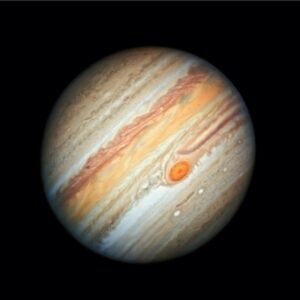
NASA’s Juno spacecraft is all set for another manoeuvre on July 10, flying directly over Jupiter’s Great Red Spot, the gas giant’s iconic, 10,000-mile-wide (16,000-kilometer-wide) storm.

This meanoeuvre will be humanity’s first close-up view of the gigantic storm being monitored since 1830 and possibly existing for more than 350 years on Jupiter, making it mysterious and puzzling.

“Jupiter’s mysterious Great Red Spot is probably the best-known feature of Jupiter,” said Scott Bolton, principal investigator of Juno from the Southwest Research Institute in San Antonio. “This monumental storm has raged on the solar system’s biggest planet for centuries. Now, Juno and her cloud-penetrating science instruments will dive in to see how deep the roots of this storm go, and help us understand how this giant storm works and what makes it so special,” said a NASA report.

The July 10 flyby will Juno’s sixth on to the gas giant’s mysterious cloud tops. Since Juno’s perijove is on Monday, July 10, at 6:55 pm PDT (9:55 pm EDT), Juno will be about 2,200 miles (3,500 kilometers) above the planet’s cloud tops.

In its closest reach lasting for 11 minutes and 33 seconds, Juno will cover another 24,713 miles (39,771 kilometers) and will be directly above the coiling crimson cloud tops of Jupiter’s Great Red Spot, said NASA. The spacecraft will bee about 5,600 miles (9,000 kilometers) above the Giant Red Spot clouds and all its 8 instruments and its camera JunoCam, will be directly on the storm during the flyby.

“The success of science collection at Jupiter is a testament to the dedication, creativity and technical abilities of the NASA-Juno team,” said Rick Nybakken, project manager for Juno from NASA’s Jet Propulsion Laboratory in Pasadena, California. “Each new orbit brings us closer to the heart of Jupiter’s radiation belt, but so far the spacecraft has weathered the storm of electrons surrounding Jupiter better than we could have ever imagined.”

As US is celebrating its Independence Day on July 4, Juno will have logged exactly one year in Jupiter orbit.