Cold virus ‘hides’ and multiplies in tonsils and adenoids, even in people without symptoms

A new study has found that the virus responsible for the common cold can quietly persist in the human body, even in individuals who show no symptoms.

Researchers from the University of São Paulo in Brazil discovered that the rhinovirus can reside deep within the tonsils and adenoids—tissues located at the back of the throat—effectively using them as reservoirs. The study, based on samples from 293 children undergoing surgical removal of these tissues, revealed that the virus can infect key immune cells and remain there undetected for extended periods.

Unlike its typical behaviour—where it infects the surface lining of the nose and throat, multiplies rapidly, and is cleared by the immune system within a week—the virus was found to penetrate deeper layers of tissue. There, it infects long-lived immune cells such as B lymphocytes and CD4 T cells, allowing it to persist without destroying them.

This hidden presence may help explain why cold outbreaks often occur shortly after schools reopen. Children carrying the virus without symptoms can unknowingly transmit it to others in close, indoor environments, triggering wider infections.

The study further found that nearly half of the children tested carried the virus in at least one site—tonsils, adenoids, or nasal secretions—even though they were symptom-free at the time of surgery. Evidence also suggested that the virus remained active and capable of spreading.

Researchers say these lymphoid tissues may act as a “virus reservoir,” potentially supporting long-term immune memory. However, this persistence could also have downsides. In children with asthma, for instance, lingering viruses may trigger inflammation and worsen symptoms.

The findings also raise concerns about diagnostic accuracy. Detecting rhinovirus in throat swabs may not always indicate an active infection, as the virus could be lingering from a previous illness. This could complicate treatment decisions, particularly in respiratory cases.

Scientists are now exploring whether such dormant viruses could reactivate in patients with weakened immune systems, potentially leading to complications without any new external exposure.

Also Read:

Newer ground water is linked with increased risk of Parkinson disease

Why Millions Of Americans Turn To AI For Medical Advice—Before, After, And Instead Of Doctor Visits

Why Millions Of Americans Turn To AI For Medical Advice—Before, After, And Instead Of Doctor Visits

One in four U.S. adults — the equivalent of over 66 million Americans — report having used artificial intelligence tools or chatbots for physical or mental healthcare information or advice, according to new research released today from the West Health-Gallup Center on Healthcare in America. Rather than replacing traditional care, more than half say they turn to AI to supplement their healthcare experiences, using the technology before or after seeing a doctor.

The findings are based on a nationally representative survey of more than 5,500 U.S. adults conducted from October through December 2025.

In the past 30 days, did you use an AI tool or chatbot for health-related information or advice for any of the following reasons?

% Yes, among adults who have used AI tools or chatbots for health-related information or advice in the past 30 days.

Note. Categories are for descriptive purposes only and were not shown on the survey.

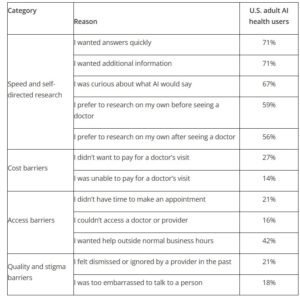
Among Americans who have used AI for health-related information or advice in the past 30 days, the most frequently cited motivations are wanting answers quickly (71%) and wanting additional information (71%). Nearly seven in 10 (67%) say they were curious about what AI would say, and roughly six in 10 report using AI to do research on their own before (59%) or after (56%) seeing a doctor.

Regardless of the reason, almost half (46%) of Americans who used AI for healthcare information say the AI tool or chatbot made them feel more confident talking with or asking questions of a provider. Others say it helped them identify issues earlier (22%) or avoid unnecessary medical tests or procedures (19%).

“Artificial intelligence is already reshaping how Americans seek health information, make decisions and engage with providers, and health systems must keep pace,” said Tim Lash, President, West Health Policy Center, a nonprofit and nonpartisan organization focused on aging and healthcare affordability. “The risk isn’t that AI is moving too fast — it’s that health systems may move too slowly to guide its use in healthcare responsibly.”

A Smaller Share Turn to AI in Place of a Provider

While self-directed research is the primary driver of AI health use, a smaller but notable share of recent users report turning to AI instead of seeing a healthcare provider, particularly when faced with cost, access or quality barriers. Among recent AI health users, 27% say they didn’t want to pay for a doctor’s visit and 14% say they were unable to pay. One in five (21%) say they didn’t have time to make an appointment, and 16% say they couldn’t access a doctor or provider. Another 21% say they felt dismissed or ignored by a provider in the past, and 18% say they were too embarrassed to talk to a person.

In the past 30 days, did you use an AI tool or chatbot for health-related information or advice for any of the following reasons?

% Yes, among adults who have used AI for health-related information and advice in the past 30 days

I was unable to pay for a doctor’s visit
Household Income  % Yes, Among adults who have used AI for health-related
information and advice in the past 30 days
<$24k 32%
$24k – <$48k 21%
$48k – <$90k 14%
$90k – <$120k 9%
$120k – <$180k 8%
$180k+ 2%


Among recent AI health users, 84% still saw a healthcare provider, but 14% report not seeing a provider they otherwise would have seen because of information or advice they received from AI. When projected to the full U.S. adult population, this represents roughly 14 million Americans who did not see a provider after receiving AI-generated health information.

Trust in that AI-generated health information, however, remains divided. Among those who consulted it in the past 30 days, roughly one-third say they trust it (33%), one-third neither trust nor distrust it (33%), and about one-third distrust it (34%). However, only 4% say they strongly trust the accuracy, indicating that many Americans are making healthcare decisions based on AI-generated information without full confidence in its accuracy.

About one in 10 (11%) who report using AI for health information or advice in the past 30 days say that AI recommended healthcare information or advice they believed was unsafe.

“This data indicates that while some Americans may be using artificial intelligence as a substitute for going to the doctor’s office, many see it as a tool to complement their healthcare, helping them understand symptoms they might be feeling and clarify any diagnosis they receive from their doctors,” said Joe Daly, Global Managing Partner at Gallup.

Motivations Vary by Age and Income

While information-seeking is the dominant reason Americans turn to AI for health purposes, use patterns differ by demographics. Younger adults are more likely than older adults to use AI for self-directed research — 69% of adults aged 18 to 29 say they do research before seeing a doctor, compared with 43% of those 65 and older.

Income differences are most visible in barrier-driven motivations. Among adults earning less than $24,000 annually, 32% say they used AI because they could not pay for a doctor’s visit, compared with just 2% among those earning $180,000 or more.

Everyday Health Questions Top the List of AI Use Cases

Americans who used AI for health information or advice in the past 30 days most often report using it to gather information about everyday health concerns, including physical symptoms (58%) and nutrition or exercise (59%). But AI use extends beyond symptom-checking — Americans who used AI in the past 30 days also report using AI to understand medication side effects (46%), interpret medical information (44%), or research a diagnosis or medical condition (38%). Nearly one in four (24%) report using AI to explore mental health or emotional concerns.

Also Read:

Doctors Say Start Screening Cholesterol Earlier. Here’s What Changed

A Heart Test Could Reveal Hidden Fracture Risk in Women After Menopause: Study


Mukta Arts Invites Writers To Submit Story Ideas For Films, Animation, OTT Projects

Mukta Arts Film Studios has issued an open call inviting writers to submit original story plots and character ideas for potential production. The studio is seeking concise two-page concepts across formats, including small-budget high-concept films, Hindi OTT series in music, drama, or suspense genres, animated features of about an hour, and mid-budget commercial films.

Submissions must be registered with the Screenwriters Association (SWA), and interested creators can pitch their ideas via email to pitch@muktaarts.com. The initiative signals Mukta Arts’ continued push to discover fresh storytelling talent across diverse formats.

Also Read:

Subhash Ghai’s Mukta arts enters into partnership with Green Gold to produce animation films

Legendary Singer Asha Bhosle Dies After Brief Illness, Leaves Behind Timeless Musical Legacy

India–Austria Relations Get Boost: Major Agreements And Outcomes From Austrian Chancellor Stocker’s India Visit

Christian Stocker, Federal Chancellor of Austria, is on a four-day official visit to India from April 14–17, 2026—his first trip to the country and also his first visit outside Europe since taking office.

During the visit, Stocker held bilateral talks with Prime Minister Narendra Modi in New Delhi, focusing on expanding cooperation in trade, investment, green technology, and strategic sectors.

The two sides signed multiple agreements, including cooperation in food safety, counter-terrorism, and broader economic engagement, signalling a renewed push in India–Austria ties.

The visit is being seen as a milestone, marking the first visit by an Austrian Chancellor to India in over four decades and reflecting growing momentum in bilateral relations.

Sl. No MoU / Agreement/LoI Description
1 Agreement on Audiovisual Co production between India and Austria The agreement will provide a framework for enhanced cooperation between the film industries of the two countries and facilitate joint film production, creative exchanges and greater cultural engagement.
2 Joint Announcement on setting up a Fast Track Mechanism for Indian and Austrian companies The Fast Track mechanism will identify and solve problems faced by Indian and Austrian companies and investors in each other’s economies. The FAST- TRACK mechanism will also serve as a platform for discussing general suggestions from the point of view of investors regarding ease of doing business.
3 Letter of Intent on Cooperation in Military Matters The LOI will provide an institutional framework for promoting cooperation in military matters, defence industrial and technology partnership, building on the momentum of the India-EU Defence and Security Partnership signed on 27 January 2026, as well as facilitate defence policy dialogue, training and capacity building.
4 Letter of Intent on Joint Working Group on Counter Terrorism The LoI will advance counter terrorism cooperation between India and Austria including the goal of both sides to work together to establish a Joint Working Group on Counter Terrorism for exploring areas of strategic cooperation on issues relating to the fight against terrorism.
5 MoU on Food Safety between AGES, Austria and FSSAI, India The MoU will promote cooperation in food safety standards, scientific exchange, capacity building and sharing of best practices in food regulation and risk assessment thereby promoting trade in agricultural and food products, while ensuring highest priority for safety standards.
6 Joint Letter of Intent regarding dual vocational training, skills development and the recognition of vocational qualifications Joint Letter of Intent will help to expand exchanges and knowledge sharing in the fields of dual vocational training (apprenticeship) and skills development as well as the promotion of recognition of Indian vocational qualifications according to Austrian Standards.

Announcements

Sl. No Title
1 Renewal of the MoU on technical cooperation in the road infrastructure sector.

(The MoU will help to strengthen technical cooperation in Intelligent Transport Systems (ITS), road safety, electronic toll collection and traffic management.)

2 Increased cooperation of startup ecosystems under India-Austria Startup Bridge.

(continued collaboration between the startups, unicorns, innovation ecosystems and venture capital networks of the two countries)

3 Launch of Institutional Cybersecurity Dialogue.
4 Partnership between India’s Centre for UN Peacekeeping and Austrian Armed Forces International Centre (AUTINT).
5 Agreement to jointly organise a bilateral space industry seminar in Vienna in Autumn 2026; included in the Joint Statement.
6 Operationalization of Working Holiday Programme.
7 High-technology cooperation as a central pillar of the Enhanced India–Austria partnership.

(Identification of several collaborative R&D projects including in the areas of material science and technology, quantum technology, wastewater treatment, machine learning, lasers, etc under the joint Committee of Science and Technology)

8 Launch a structured bilateral Dialogue on Cooperation in Education.

(Aimed at enhancing skills development, promote curricula development, facilitate the mutual recognition of qualifications, and support institutional collaboration in higher education and the development of vocational education and training systems.)

9 Focus India initiative of Austria’s leading technical Universities to systematically deepen educational cooperation and research cooperation with India.

(Launch by the three public technical universities in Austria (Technische Universität Wien, Technische Universität Graz und Montanuniversität Leoben) of a dedicated portal to facilitate admissions for Indian students to pursue engineering and technical masters programmes in Austria)

Viksit Bharat vision: “Nari Shakti Vandan Run” to be Held on 17–18 April 2026 Across Seven Cities

The Ministry of Youth Affairs and Sports will organise a nationwide Nari Shakti Vandan Run on April 17 and 18, 2026, spanning seven major cities as part of its push to promote women-led development and citizen engagement under the Viksit Bharat vision.

The event, themed #NariShaktiVandan, will be held in Delhi, Cuttack, Patna, Mumbai, Indore, Bengaluru and Jaipur. While Patna and Jaipur will host the run on April 17, the remaining cities—Delhi, Cuttack, Mumbai, Indore and Bengaluru—are scheduled for April 18.

The programme will begin early in the morning with participant registrations, followed by an inaugural session featuring the felicitation of dignitaries, an address by the chief guest, and the administration of the Nari Shakti pledge. The run itself, covering a distance of around 2 to 3 kilometres, will take place at prominent public venues in each city and conclude with certificate distribution.

The initiative seeks to draw wide participation from women across sectors, including students, professionals, entrepreneurs, athletes and civil society members. Participation is being facilitated through platforms and institutions such as MY Bharat, the National Service Scheme (NSS), and the Sports Authority of India (SAI), along with other partner organisations.

The event coincides with the ongoing Parliament session from April 16 to 18, during which discussions around women’s representation and delimitation are underway. It is aimed at deepening public awareness and encouraging greater engagement in democratic processes, particularly in the context of inclusive representation.

The ‘Nari Shakti Vandan Run’ underscores the government’s continued emphasis on women’s empowerment, positioning women as central stakeholders in India’s journey towards becoming a developed nation.

Also Read:

Election Commission Schedules 2026 Assembly Polls And By-Elections; Voter Slip Distribution Begins

Vice President Urges Embrace Of ‘AI For Good Governance’ At IIPA Lecture

Election Commission Schedules 2026 Assembly Polls And By-Elections; Voter Slip Distribution Begins

Distribution of Voter Information Slips begins

  1. Election Commission of India (ECI) has commenced the distribution of Voter Information Slips (VIS) for the general elections to the legislative assemblies of Tamil Nadu and West Bengal (Phase-I) which go to polls on 23rd April, 2026 (Thursday).
  2. VIS contains voter’s details, Polling Station location, date and time of poll and a snapshot of the polling station map along with a list of Do’s and Don’ts to guide the voters on poll day. A QR code also helps the voters in faster searching/matching of elector details. VIS also helps in reducing crowding at polling stations and helps in faster polling.
  3. It may be recalled that the Commission had, in one of its initiatives, issued instructions to make VIS more readable and accessible for the convenience of voters. Accordingly, the part number and the serial number of the voter has been made clearly legible on the VIS for ease of identification and use.
  4. VIS are being distributed by the BLOs concerned personally to the voters by visiting door to door. The process is to be completed at least 5 days before the day of poll to all enrolled electors.
  5. To make the VIS accessible and voter-friendly, the Commission has also issued instructions that they should only be in the languages in which Electoral Roll is published for the assembly constituency.
  6. To ensure wholesome constructive participation and active engagement of Persons with Disabilities (PwDs) in the election process, it has been directed to issue Accessible Voter Information Slips (AVIS) with Braille Features to Persons with Visual Impairment or Blind, over and above the regular VIS.
  7. BLA/Candidate or their agents may accompany the BLOs during distribution of VIS.
  8. Any unauthorized distribution/ possession of VIS (election material) shall be considered as violation of the relevant provisions of the RP Act, 1951 and the BNS and is punishable with imprisonment or fine or both.
  9. Voter Information Slip shall not be accepted as a stand-alone identification document by a voter for the purpose of casting one’s vote in the poll. Electors can use any one of the 12 authorised ID proofs apart from the EPIC to cast their votes.


Also Read:

West Bengal Elections 2026: 2,926 Candidates Enter Fray Across Polls

ECI Mandates Enhanced Voter Facilities Ahead of Assembly Polls in Five States

Vice President Urges Embrace Of ‘AI For Good Governance’ At IIPA Lecture

The Vice President of India, C. P. Radhakrishnan, on Wednesday called for a proactive embrace of Artificial Intelligence as a transformative force for governance, while delivering the 5th Dr. Rajendra Prasad Memorial Lecture at the Indian Institute of Public Administration.

Speaking at the institute’s Founders’ Day celebrations, he described the current era as the “Age of AI,” noting that emerging technologies are redefining how governments function and interact with citizens. He emphasised that governance must go beyond systems and regulations, focusing instead on empowering people and ensuring inclusivity.

Paying tribute to Rajendra Prasad, the Vice President highlighted his legacy of integrity, simplicity, and commitment to public service, calling the lecture series a fitting homage to the Chairman of the Constituent Assembly.

Radhakrishnan underlined that AI is playing a pivotal role in advancing India’s vision of becoming a developed nation by 2047. He said the technology is enabling faster, smarter, and more transparent governance, improving service delivery and ensuring targeted welfare distribution with minimal leakages.

He also pointed to India’s growing leadership in the AI space under Prime Minister Narendra Modi, citing initiatives such as the national language platform BHASHINI, which is helping bridge linguistic divides. AI applications in healthcare, including telemedicine services like eSanjeevani, were highlighted as examples of how technology is expanding access to essential services.

Beyond healthcare, he noted AI’s expanding footprint across agriculture, MSMEs, cybersecurity, judiciary, and administrative systems, reinforcing its role as a cross-sectoral enabler.

Highlighting India’s strong global standing in AI innovation, the Vice President referenced key initiatives such as the India AI Mission and the Anusandhan National Research Foundation, aimed at strengthening the country’s technological ecosystem.

He also urged young professionals to adapt to emerging technologies, drawing parallels with the early scepticism around computers, and emphasised the need to build an AI-ready workforce through initiatives like Skill India and the National Education Policy.

At the same time, Radhakrishnan cautioned against the unregulated use of AI, stressing that technological advancement must be guided by ethical principles, fairness, and accountability.

Concluding his address, he described Artificial Intelligence as not merely a technological shift but a broader human transformation, calling on stakeholders to harness its potential responsibly to build an inclusive and compassionate society.

Also Read:

West Bengal Elections 2026: 2,926 Candidates Enter Fray Across Polls

Final farewell to Asha Bhosle: Music icon to be cremated in Mumbai with state honours

Kirk Jones’ ‘I Swear’ To Hit US Theatres On April 24, 2026 Via Sony Pictures Classics

Sony Pictures Classics has announced that I Swear, written and directed by BAFTA nominee Kirk Jones, will open in theatres across the United States on April 24, 2026.

The film, which had its world premiere at the Toronto International Film Festival 2025, received strong critical acclaim and currently holds a 100% rating on Rotten Tomatoes. It has also delivered a solid run at the UK box office, alongside major awards recognition. Lead actor Robert Aramayo secured the Best Lead Performance honour at the British Independent Film Awards, where the film also won for Best Casting. It has further earned multiple BAFTA nominations, including Outstanding British Film and Best Original Screenplay.

Inspired by the life of Tourette’s Syndrome campaigner John Davidson, the film stars Aramayo alongside a strong supporting cast featuring Maxine Peake, Shirley Henderson and Peter Mullan.

imdb

Spanning five decades from the 1980s to present-day Britain, the story traces Davidson’s diagnosis at the age of 15 and follows his journey through adolescence and adulthood, highlighting the challenges of living with a widely misunderstood condition. The film also worked closely with the Tourette’s community, incorporating individuals with lived experience and consulting relevant charities to ensure authenticity.

I Swear is produced by Kirk Jones, Georgia Bayliff and Piers Tempest under One Story High and Tempo Productions, with Cindy Jones and John Davidson serving as executive producers.

Also Read:

Sony Pictures Classics Acquires Worldwide Rights of ‘Gail Daughtry and the Celebrity Sex Pass’

‘We’re Not Alone’ Spielberg’s UFO Remarks At SXSW Reflect Growing Focus on Alien Life

Sony Pictures Classics Acquires Worldwide Rights of ‘Gail Daughtry and the Celebrity Sex Pass’

Sony Pictures Classics has acquired worldwide rights to Gail Daughtry and the Celebrity Sex Pass, a comedy directed by David Wain. The film premiered at the Sundance Film Festival 2026 and features an ensemble cast led by Zoey Deutch and Jon Hamm. The acquisition marks one of Sony Pictures Classics’ key deals from this year’s festival.


West Bengal Elections 2026: 2,926 Candidates Enter Fray Across Polls

The Election Commission of India (ECI) announced the schedule for the General Election to Legislative Assemblies of Assam, Kerala, Puducherry, Tamil Nadu and West Bengal and bye-elections in 6 states on March 15,2026.

  1. The last date of filing of nominations for the State of West Bengal (Phase-II), which goes to polls on April 29, 2026 was April 9, 2026, while the date of scrutiny of nominations for West Bengal (Phase-II), was April 10, 2026 and the last date of withdrawal of nominations was April 13, 2026 by 3:00 PM.
  2. After the last date of withdrawal of nominations, details of the total number of candidates for West Bengal are as under:
Sl.

No.

Name of State/UT No. of ACs Total No. of candidates

after Withdrawals

1. West Bengal (Phase-I) 152 1,478
2. West Bengal (Phase-II) 142 1,448


  1. The Returning Officers (ROs) shall publish the list of contesting candidates in the Official Gazette as per the Conduct of Election Rules, 1961.
  2. ROs shall place all the election papers and proceedings relating to nominations, scrutiny and withdrawal of candidatures in each constituency together in his/her custody in a sealed packet/envelope with the seal.
  3. Citizens can view the details of their candidates including their educational qualifications, criminal antecedents, assets and liabilities and download their affidavits from the “Know Your Candidate” tab on the ECINet App.
  4. Moreover, in line with ECI’s initiative, the EVM Ballot papers will bear the coloured photographs of the candidates and their details including serial number, name and symbol in large font for the ease and convenience of the voters.

Also Read:

ECI Mandates Enhanced Voter Facilities Ahead of Assembly Polls in Five States

ECI mandates all political Parties to get pre-certification of all political advertisements on electronic media


NFDC Announces Nationwide Release of its Malayalam Film Achappa’s Album on 24th April 2026; Cast, Story details

The National Film Development Corporation Ltd. has announced the nationwide release of Malayalam feature film Achappa’s Album on April 24, 2026. Directed by Deepti Pillay Sivan, the film blends family drama, fantasy, and comedy through a time-travel narrative. The project, backed by the Ministry of Information and Broadcasting, explores generational relationships through a father-son role reversal.


Study Finds Teens Concerned Over Emotional Dependence on AI Companion Chatbots; Becoming Hard to Quit

A study from Drexel University finds that U.S. teens are increasingly worried about their growing attachment to AI companion chatbots. The research, based on hundreds of Reddit posts and set to be presented at the ACM Conference on Human Factors in Computing Systems in April, highlights patterns resembling behavioral addiction. Researchers say features like emotional responsiveness and personalization may be deepening these attachments and affecting teens’ offline lives.

Key Takeaways

  • Teens report growing emotional dependence on AI companion chatbots.
  • Usage patterns in the study show signs similar to behavioral addiction.0
  • Chatbot design features may intensify attachment and make disengagement difficult.
  • Researchers call for safer, more responsible AI design to protect young users.

For some teenagers, conversations with artificial intelligence are beginning to feel less like a tool and more like a relationship.

A new study from Drexel University examines how teens are using AI-powered companion chatbots and what happens when those interactions deepen over time. The findings suggest a growing unease among young users who say their reliance on these systems is becoming difficult to manage.

The research focused on platforms such as Character.AI, Replika, and Kindroid, which are designed to simulate conversation and provide companionship. More than half of U.S. teens are estimated to use such tools regularly, according to the study.

Teen AI chatbot usage patterns and emotional dependence

The study analyzed more than 300 Reddit posts written by users who identified themselves as between 13 and 17 years old. These posts described personal experiences with chatbot use, often beginning as entertainment or emotional support.

About a quarter of the users said they turned to chatbots to cope with loneliness, distress, or mental health struggles. A smaller portion reported using them for creative tasks or casual interaction.

Over time, many described a shift.

  • Teens reported using chatbots for emotional support and companionship.
  • Some said usage began as harmless or helpful.
  • Many described growing difficulty in limiting or stopping use.

“This study provides one of the first teen-centered accounts of overreliance on AI companions,” said Afsaneh Razi, an assistant professor in Drexel’s College of Computing and Informatics.

Researchers found that what began as occasional engagement often evolved into persistent, habitual use that extended into daily routines.

Signs of behavioral addiction in chatbot interactions

The research identified patterns that align with established components of behavioral addiction. Within the 318 posts reviewed, teens described experiences that matched all six major indicators.

  • Conflict: feeling torn between continued use and negative feelings about it
  • Salience: prioritizing chatbot interaction over real-world relationships
  • Withdrawal: experiencing anxiety or sadness when not using the chatbot
  • Tolerance: increasing usage to maintain satisfaction
  • Relapse: attempting to quit but returning to use
  • Mood modification: using chatbots to cope with stress or loneliness

“Many teens described starting with something that felt helpful or harmless, but over time it became something they struggled to step away from,” said Matt Namvarpour, the study’s lead author.

The interactive nature of these systems may intensify attachment. Unlike earlier digital tools, chatbots respond conversationally and can simulate empathy, which may blur the line between software and social connection.

“What makes this especially tricky is that chatbots are interactive and emotionally responsive, so the experience can feel more like a relationship than a tool,” Namvarpour said.

Why AI companion design may increase attachment

Researchers point to specific design features that may contribute to stronger emotional bonds.

Personalization allows chatbots to adapt responses based on user preferences. Memory features enable them to recall past conversations. Multimodal capabilities can simulate more human-like interaction.

These elements, the study suggests, make it harder for users to disengage.

“Personalization, multimodality and memory set AI companions apart from earlier technologies and make overreliance harder to disentangle from authentic-feeling relationships,” the researchers wrote.

The study highlights how these characteristics may increase susceptibility to overuse, especially among younger users still developing social and emotional frameworks.

Recommendations for safer chatbot design

The research team proposes a framework aimed at reducing harmful patterns while maintaining the benefits of AI tools.

  • Include usage tracking features to help users monitor time spent
  • Add emotional check-in prompts to encourage reflection
  • Provide customizable limits on interaction
  • Design clear and gradual exit options for disengagement

“It’s important for designers to ensure that chatbots are offering guidance that helps users build confidence in their abilities to form relationships offline,” Razi said.

The researchers also recommend involving mental health professionals and users in the design process to better address risks.

Expanding research on AI and youth behavior

The study is based on self-reported experiences from Reddit users, which researchers acknowledge as a starting point rather than a complete picture. They suggest future work should include broader demographics and multiple platforms.

Further research may also explore how different chatbot designs influence user behavior and whether certain features increase or reduce dependency.

Also Read:

Insufficient sleep in teenagers leads to obesity: Study

Deny teenagers any screen, they’ll soon go to sleep: Study

New Dark Matter Theory May Solve Three Cosmic Puzzles

A study led by University of California Riverside physicist Hai-Bo Yu suggests a new form of dark matter could explain three long-standing astrophysical anomalies. Published in Physical Review Letters, the research shows how dense clumps of self-interacting dark matter may shape structures across galaxies. The findings connect observations from distant gravitational lenses to stellar streams and nearby satellite galaxies through a single theoretical framework.

Key Takeaways

  • Self-interacting dark matter offers a new explanation for dense cosmic structures.
  • A single mechanism may explain anomalies in lenses, stellar streams, and dwarf galaxies.
  • The theory challenges the long-standing cold dark matter model.
  • Future observations could provide stronger evidence for or against SIDM.

Dark matter remains one of the most elusive components of the universe. It cannot be seen directly, yet it accounts for roughly 85 percent of all matter, shaping galaxies through its gravitational pull.

For decades, physicists have relied on the standard “cold dark matter” model, which assumes particles pass through one another without interaction. That framework explains large-scale cosmic structure but struggles with certain dense, small-scale phenomena observed in space.

New research from UC Riverside proposes an alternative. Instead of behaving like non-interacting particles, dark matter may collide with itself, exchanging energy and forming dense cores.

Yu and his team focus on what is known as self-interacting dark matter, or SIDM. In this model, particle collisions trigger a process called gravothermal collapse, leading to the formation of compact, high-density regions.

“The difference is like a crowd of people who ignore each other versus one where everyone is constantly bumping into one another,” Yu said. “In SIDM, these interactions can dramatically reshape the internal structure of dark matter halos.”

Self-interacting dark matter theory and gravothermal collapse explained

In the SIDM framework, dark matter halos do not remain diffuse. Repeated interactions allow energy to redistribute, causing matter to concentrate toward the center.

Over time, this produces clumps with extreme density, sometimes reaching masses equivalent to about a million suns. These compact structures can exert strong gravitational effects, even though they remain invisible.

Such behavior offers a possible explanation for anomalies that have puzzled astronomers. Many observed systems show signs of dense, unseen objects that do not align with predictions from standard models.

Yu’s study suggests these structures arise naturally in SIDM, without requiring additional exotic physics.

Astrophysical anomalies explained by SIDM clumps

The research identifies three distinct observations that may share the same underlying cause.

  • JVAS B1938+666 gravitational lens system:
    An ultra-dense object appears to distort light from distant galaxies more strongly than expected, indicating a compact mass concentration.
  • GD-1 stellar stream disruption:
    A spur-and-gap feature suggests that an unseen object passed through the stream, leaving a gravitational imprint that altered its structure.
  • Fornax 6 in the Fornax dwarf galaxy:
    A tightly bound cluster of stars may have formed around a dense dark matter clump acting as a gravitational trap.

Each case involves a different cosmic environment, from distant galaxies to structures within the Milky Way. Yet all show evidence of unusually dense, compact objects.

“What’s striking is that the same mechanism works in three completely different settings, across the distant universe, within our galaxy, and in a neighboring satellite galaxy,” Yu said. “All show densities that are difficult to reconcile with standard model dark matter but arise naturally in SIDM.”

Implications for cosmology and future observations

The study provides a unified explanation for phenomena that previously required separate interpretations. By linking them to a single mechanism, it strengthens the case for SIDM as a viable alternative to the standard model.

Researchers say the findings could guide future observations. If dense dark matter clumps are common, astronomers may detect more indirect signatures through gravitational effects.

The work also highlights the importance of studying small-scale structures, where differences between competing dark matter models become most apparent.

Further research will be needed to test the theory across additional systems and refine predictions. Observations from next-generation telescopes may offer more precise data to confirm or challenge the SIDM framework.

Also Read:

Artemis II Mission Launch: NASA Sends Crew on First Moon Flyby in 50 Years

RRI scientists trace mysterious X-ray bursts to wobbling disk in distant galaxy

Too many cooks, or too many robots?

Researchers at Harvard University found that adding controlled randomness to robot movement improves efficiency in crowded environments. The study, published in the Proceedings of the National Academy of Sciences, shows how swarm systems can avoid congestion by balancing order and unpredictability. Conducted through simulations and lab experiments in the Netherlands, the work outlines how simple local rules can optimize performance in tasks like disaster cleanup and manufacturing.

Key Takeaways:

  • Harvard SEAS researchers show mathematically that when many robots share a space, adding a certain amount of randomness in their paths improves their efficiency.
  • Their study exemplifies how simple local rules can lead to the emergence of complex, self-organized task completion.
  • Their formulas could guide the design of robot swarms or crowded public spaces.

In a crowded workspace, more hands do not always mean faster results. That tension sits at the center of a new study from Harvard researchers, who examined how swarms of robots behave when tasked with completing jobs in confined areas.


Final farewell to Asha Bhosle: Music icon to be cremated in Mumbai with state honours

Veteran playback singer Asha Bhosle passed away on April 12, 2026, following a brief illness, marking the end of an era in Indian music. She was 92.

Her last rites will be held at Shivaji Park on Monday afternoon with full state honours, reflecting her immense contribution to Indian cinema and music. Family members, close associates from the film and music industry, and admirers gathering to pay their final respects.

Several leading personalities, including members of the Mangeshkar family and prominent figures from Bollywood, attended the ceremony, while fans across the country mourned her loss and remembered her timeless voice.

Family Background:

Ashalata Dinanath Mangeshkar was born in the small hamlet of Goar in Sangli, then part of the princely state of Sangli (now in Maharashtra), into a musically rich family. Her father, Pandit Deenanath Mangeshkar, of Marathi and Konkani heritage, was a noted classical singer and stage actor, while her mother Shevanti was of Gujarati origin. Tragedy struck early when her father passed away while she was just nine years old. Following his death, the family relocated from Pune to Kolhapur and eventually to Mumbai in search of livelihood. Alongside her elder sister Lata Mangeshkar, she began singing and acting in films to support the family. Her first recorded film song, “Chala Chala Nav Bala,” was for the Marathi film Majha Bal (1943).

Career

During the late 1940s and early 1950s, playback singing for leading actresses in Hindi cinema was largely dominated by voices like Geeta Dutt, Shamshad Begum, and Lata Mangeshkar. Despite this, Asha Bhosle steadily carved her own space and, by the 1950s, was recording more songs than many of her contemporaries.

Composer O. P. Nayyar played a pivotal role in shaping her early career between 1952 and 1956. However, her major breakthrough came with B. R. Chopra’s Naya Daur (1957), with music composed by Nayyar. Her duets with Mohammed Rafi—such as “Maang Ke Saath Tumhara,” “Saathi Haath Badhana,” and “Uden Jab Jab Zulfein Teri,” written by Sahir Ludhianvi—brought her widespread acclaim and recognition.

Over the years, she delivered numerous iconic songs, including “Piya Tu Ab To Aaja” from Caravan and “Yeh Mera Dil” from Don, among many others that remain timeless classics.

In 2013, at the age of 79, Bhosle made her acting debut in the film Mai, playing the titular role. She portrayed a 65-year-old mother suffering from Alzheimer’s disease who is abandoned by her children, earning praise from critics for her performance.

In May 2020, she expanded her digital presence by launching her YouTube channel, “Asha Bhosle Official.”

Personal Life:

At the age of 16, Asha married Ganpatrao Bhosle against her family’s wishes. The marriage, however, ended in separation in 1960, after which she returned to her maternal home with her children.

She later married music composer Rahul Dev Burman in 1980.

Awards:

Asha Bhosle won numerous awards. Some of them are :

Filmfare Best Female Playback Award

  • 1967: “Garibon ki Suno” (Dus Lakh, 1966)
  • 1969: “Parde Mein Rehne Do” (Shikar, 1968)
  • 1972: “Piya Tu Ab To Aaja” (Caravan, 1971)
  • 1973: “Dum Maro Dum” (Hare Rama Hare Krishna, (1971)
  • 1974: “Hone Lagi Hai Raat” (Naina, 1973)
  • 1975: “Chain Se Humko Kabhi” (Pran Jaye Par Vachan Na Jaye, 1974)
  • 1979: “Yeh Mera Dil” (Don, 1978)

National Film Awards

Bhosle won the National Film Award for Best Female Playback Singer twice:

  • 1981: Dil Cheez Kya Hai (Umrao Jaan)
  • 1986: Mera Kuch Samaan (Ijaazat)

IIFA Awards

IIFA Award for Best Female Playback

  • 2002: “Radha Kaisa Na Jale” (Lagaan)

Grammys

Bhosle is one of the very few Indian artists who have been nominated at the Grammy Awards.

  • 39th Grammy Awards – 1997

– Grammy Award for Best Global Music Album – Ali Akbar Khan’s Legacy (nominated)

  • 48th Grammy Awards – 2006

– Grammy Award for Best Contemporary World Music Album – You’ve Stolen My Heart (nominated)

Honours and recognitions

  • In 1997, Bhosle became the first Indian singer to be nominated for the Grammy Award, for Legacy, an album with Ustad Ali Akbar Khan.
  • She received seventeen Maharashtra State Awards.
  • She received the Dadasaheb Phalke Award in 2000 for her outstanding contribution to Indian cinema.
  • In 2011 the Guinness Book of World Records officially acknowledged Bhosle, at The Asian Awards, as the most recorded artist in the history of music. She was awarded a certificate for “the most studio recordings (singles) from Sebastian Coe for recording up to 11,000 solo, duet and chorus-backed songs and in over 20 Indian languages since 1947”. At the event she was also awarded the Lifetime Achievement Award.

(Courtesy:Wikipedia)

Also Read:

Legendary Singer Asha Bhosle Dies After Brief Illness, Leaves Behind Timeless Musical Legacy


Legendary Singer Asha Bhosle Dies After Brief Illness, Leaves Behind Timeless Musical Legacy

Asha Bhosle, popular bollywood singer passed away today at the age of 92 in Mumbai. She died at Breach Candy Hospital following a chest infection, extreme exhaustion, multiple organ failure and a cardiac arrest. Her funeral is scheduled to take place at Shivaji Park.

Asha Bhosle, born Ashalata Dinanath Mangeshkar on September 8, 1933, was a towering figure in Indian music whose career spanned singing, acting, business, and television. Widely associated with Indian cinema, she earned acclaim for her remarkable versatility across genres and styles. Over the decades, she came to be regarded as one of the most influential and celebrated voices in the history of Hindi film music.

She is one of India’s most versatile and celebrated playback singers, with a career spanning over seven decades. She has recorded thousands of songs across multiple languages, becoming especially known for her wide range—from classical and ghazals to pop and cabaret numbers.

The younger sister of legendary singer Lata Mangeshkar, Asha carved her own identity through iconic songs in Bollywood and collaborations with composers like R. D. Burman.

She has received numerous honours, including the Dadasaheb Phalke Award, and remains an enduring symbol of adaptability and excellence in Indian music.

Her passing marks the end of an era in Indian music, with tributes pouring in across the country and globally.

Also Read: 

Breaking: Indian Business Titan Ratan Tata Passes Away at 86

S P Balasubrahmanyam, the legendary singer, passes away after battling Covid-19


Artemis II Mission Accomplished: Crew Re-Entry Updates, Splash down and Safe return home [Watch Videos]

  • Artemis II launched aboard NASA’s Space Launch System, carrying four astronauts in the Orion spacecraft on a deep-space mission beyond low Earth orbit.
  • The crew conducted system checks and performed a historic lunar flyby, travelling thousands of kilometres beyond the Moon before beginning their return journey.
  • After completing a roughly 10-day mission, Orion safely re-entered Earth’s atmosphere and splashed down in the Pacific Ocean, marking the first crewed lunar mission since Apollo.

Watch as the Artemis II crew returns to Earth, splashing down.

See visualization of plasma build up around the space craft, repelling of that heat on Integrity seat shield To splash down in pacific ocean( from timestamp 1:26:15)  in below  video posted by NASA on X.

NASA’s Artemis II mission return home details:

6:25 p.m.

NASA’s Artemis II mission is scheduled to splash down at about 8:07 p.m. EDT (5:07 p.m. PDT) off the coast of San Diego. After splashdown, a combined NASA and U.S. military team, will retrieve the crew and transport them by helicopter to the USS John P. Murtha. Once aboard the ship, the astronauts will undergo post-mission medical evaluations before returning to shore to board an aircraft bound for NASA’s Johnson Space Center in Houston.

Watch live return coverage on NASA+, Amazon PrimeApple TVNetflixHBO MaxDiscovery+Peacock and Roku. Learn how to stream NASA content through a variety of online platforms, including social media.

7:15 p.m.

The Artemis II Crew – NASA astronauts Reid Wiseman, Victor Glover, Christina Koch and CSA (Canadian Space Agency) astronaut Jeremy Hansen are preparing for re-entry aboard the Orion spacecraft/NASA

7:33 p.m.

Orion’s crew and service module have separated. The crew module continues on its path towards Earth while the service module will harmlessly burn up in Earth’s atmosphere over the Pacific Ocean. The Artemis II return trajectory is designed to ensure any remaining debris does not pose a hazard to land, people, or shipping lanes.

7:37 p.m.

Orion performed the crew module raise burn, adjusting the spacecraft’s orientation to align its heat shield for re-entry.

7:53 p.m.

At 7:53 p.m. EDT,  The Orion spacecraft reached Earth’s atmosphere 400,000 feet above the planet’s surface, traveling 35 times the speed of sound and about 1,956 statute miles from the splashdown site. This is where the spacecraft first encounters the upper atmosphere and begins its guided descent. Shortly after, Orion is in a planned communications blackout expected to last about six minutes as plasma built around the crew capsule during heating.

8:00 p.m.

NASA has reestablished communications contact with the Artemis II crew aboard the Orion spacecraft as it returns to Earth.

8:03 p.m.

At 23,400 feet, the drogue parachutes on Orion deployed to slow and stabilize the spacecraft. Orion’s velocity drops to 479 feet per second and is .8 miles from splashdown.

8:04 p.m.

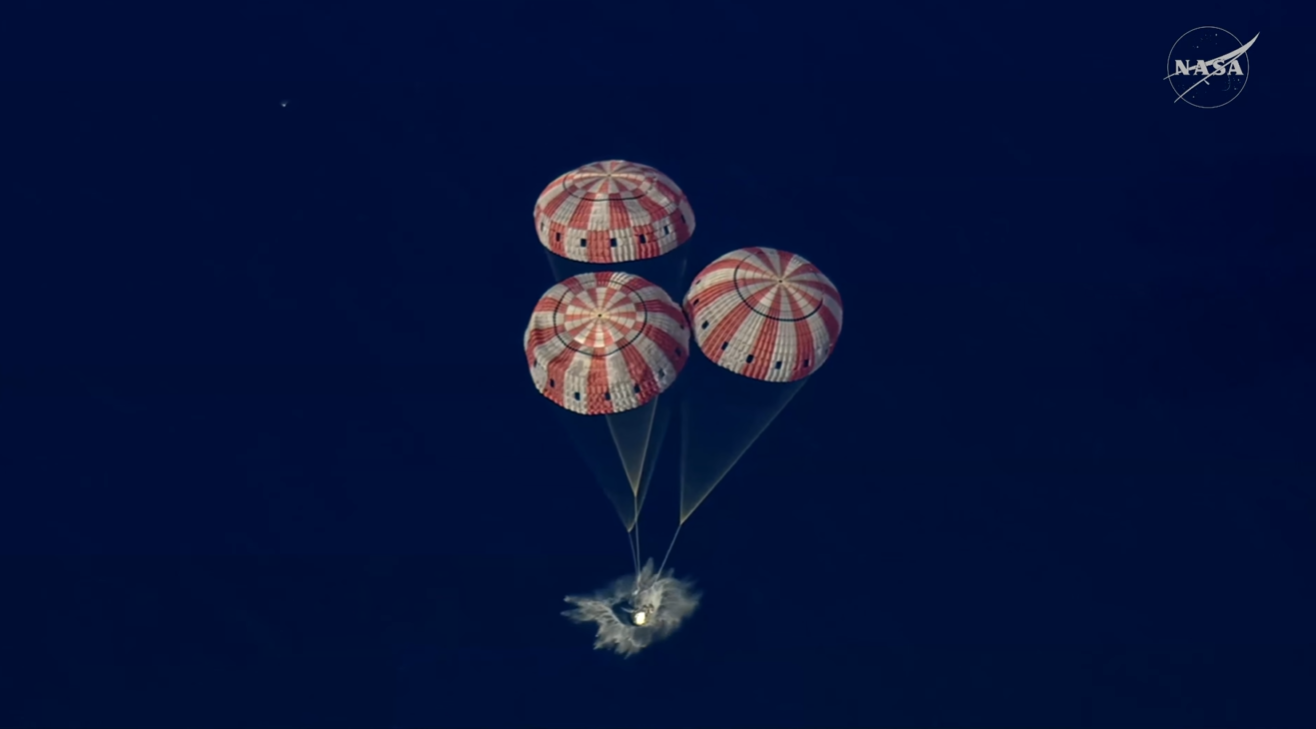
At 5,400 feet, Orion’s drogue parachutes were cut and the three main parachutes deployed, reducing velocity to less than 200 feet per second and guiding Orion on its final descent and splashdown.

8:07 p.m.

SPLASHDOWN!

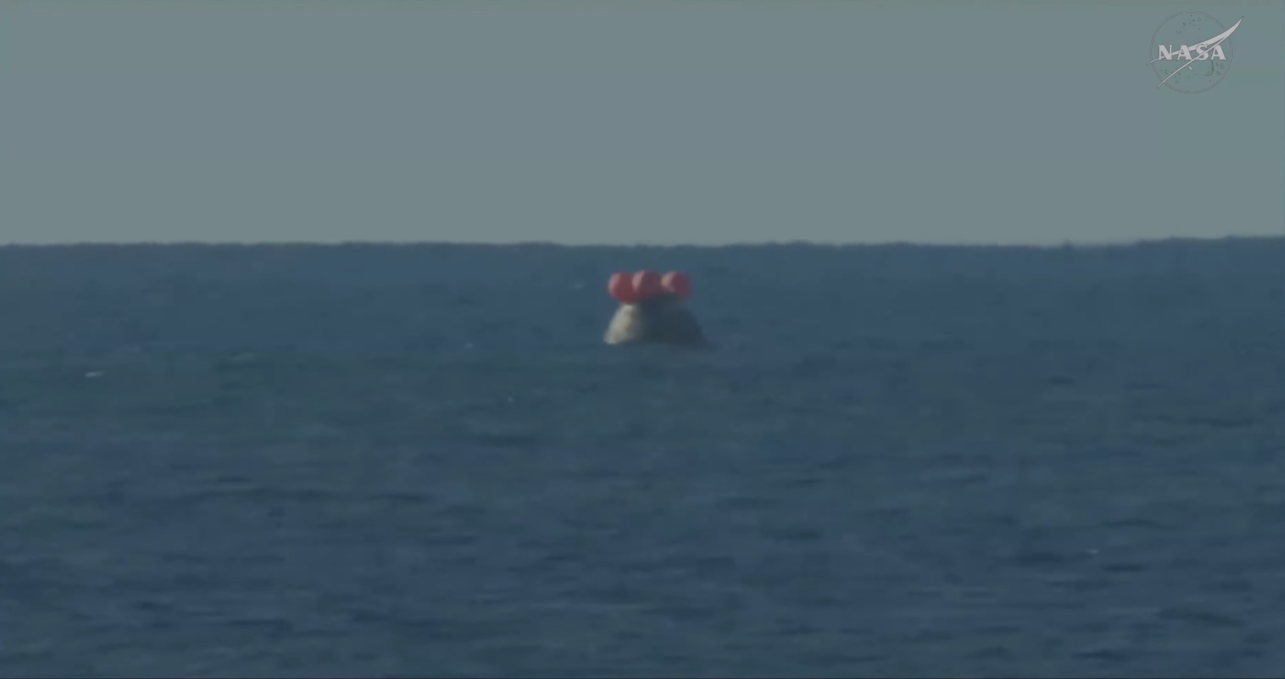
NASA’s Artemis II crew in their Orion spacecraft is back on Earth. They successfully completed a parachute-assisted splashdown in the Pacific Ocean off the coast of San Diego at 8:07 p.m. EDT (5:07 p.m. PDT).
NASA

NASA’s Artemis II crew in their Orion spacecraft is back on Earth. They successfully completed a parachute-assisted splashdown in the Pacific Ocean off the coast of San Diego at 8:07 p.m. EDT (5:07 p.m. PDT).

Engineers will conduct several additional tests while Orion is in the water before powering down the spacecraft and handing it over to the recovery team aboard the USS John P. Murtha. The recovery team is on site and headed to the capsule to begin assisting the crew out of Orion.

The Orion spacecraft with the Artemis II crew inside is seen floating in the Pacific Ocean after splashing down at 8:07 p.m. EDT on April 10, 2026.
NASA

Orion has begun crew module power down, a planned post-splashdown step in which flight controllers shut down nonessential systems and transition the capsule into its recovery configuration. This reduces power demand and prepares the spacecraft for crew extraction as recovery teams move in.

8:12 p.m.

At the direction of the NASA recovery director, team members from the agency and the U.S. military now are approaching the spacecraft in inflatable boats.

Approximately an hour after splashdown, the crew will be extracted from Orion and then flown to the USS John P. Murtha. U.S. Navy helicopters will then transport them to the ship. Once aboard, the astronauts will undergo post-mission medical evaluations before returning to shore to board an aircraft bound for NASA’s Johnson Space Center in Houston.

When ready, Navy divers will attach a cable, called the winch line, to Orion to pull the spacecraft into a specially designed cradle inside the ship’s well deck. Four additional tending lines will be secured to attachment points on the crew module while under tow.

Once Orion is positioned above the cradle assembly, technicians will drain the well deck and secure the capsule.

After it is secure aboard the ship, teams will return Orion to U.S. Naval Base San Diego before returning it to NASA’s Kennedy Space Center in Florida for inspection. Once there, technicians will thoroughly examine the spacecraft, retrieve onboard data, remove payloads, and conduct additional post-flight checks.

9:34 p.m.

The Artemis II crew – NASA astronauts Reid WisemanVictor Glover, and Christina Koch, and CSA (Canadian Space Agency) astronaut Jeremy Hansen — have been safely extracted from the Orion spacecraft.

The Artemis II crew is seen on an inflatable raft, called the front porch, after exiting the spacecraft. The Artemis II mission successfully splashed down in the Pacific Ocean at 8:07 p.m. EDT on April 10, 2026.
9:56 p.m.

The Artemis II crew has been hoisted into U.S. helicopters and are being flown to the USS John P. Murtha.

Artemis II Commander and NASA astronaut Reid Wiseman is being hoisted into a U.S. military helicopter before being transported to the USS John P. Murtha.
Artemis II mission specialist and NASA astronaut Christina Koch is being hosted into a U.S. military helicopter before being flown to the USS John P. Murtha. NASA

9:58 p.m.

The Artemis II crew is safely aboard the USS John P. Murtha, where they will undergo post-mission medical evaluations in the ship’s medical bay before traveling back to shore to board a NASA aircraft bound for the agency’s Johnson Space Center in Houston.

NASA will hold a post-splashdown news conference at 10:35 p.m. EDT from the agency’s Johnson Space Center in Houston. Participants include:

  • NASA Associate Administrator Amit Kshatriya
  • Lori Glaze, acting associate administrator, Exploration Systems Development Mission Directorate
  • Rick Henfling, entry flight director, Artemis II
  • Howard Hu, manager, Orion Program
  • Shawn Quinn, manager, Exploration Ground Systems Program

Also Read:

Artemis II Update-25, Day 10: Crew Sets for Final Burn, Splashdown

What’s the longstanding tradition at JPL before any launch and other major space mission events


Artemis II Update-26, Day 10: Crew Completes Final Burn Before Splashdown

At 2:53 p.m. EDT, the Orion spacecraft ignited its thrusters for 8 seconds, producing a change in velocity of 4.2 feet-per-second and pushing Artemis II toward Earth. NASA astronauts Reid Wiseman, Victor Glover, Christina Koch and CSA (Canadian Space Agency) astronaut Jeremy Hansen reviewed procedures and monitored the spacecraft’s configuration and navigation data.

The crew continues to wrap up cabin configuration for re-entry and move into their entry checklist.

Splashdown is targeted for 8:07 p.m. EDT (5:07 p.m. PDT) off the coast of San Diego, where NASA’s recovery team will be standing by to welcome the Artemis II crew home.

Watch live return coverage on NASA+, Amazon PrimeApple TVNetflix, HBO Max, Discovery+, Peacock and Roku, starting at 6:30 p.m. Learn how to stream NASA content through a variety of online platforms, including social media. Coverage will continue until NASA and Department of War personnel safely assist the crew out of Orion and transport them to the USS John P. Murtha.


Also Read:

Deep Space Network Establishes Contact With Artemis II Spacecraft

JPL’s Mission Control Steps Up For Artemis II Deep Space Operations


Artemis II Update-25, Day 10: Crew Sets for Final Burn, Splashdown

The Artemis II crew — NASA astronauts Reid Wiseman, Victor Glover, Christina Koch and CSA (Canadian Space Agency) astronaut Jeremy Hansen — began the final phase of their journey home to the songs “Run to the Water” by Live, selected by the crew, and “Free” by Zac Brown Band, as they prepared for their third return trajectory correction burn and shifted into full re-entry and splashdown preparations. When they woke up, they were 61,326 miles from Earth.

Splashdown is targeted for 8:07 p.m. EDT (5:07 p.m. PDT) off the coast of San Diego, where a combined NASA and U.S. military recovery team will be standing by to welcome the Artemis II crew home.

Watch live return coverage on NASA+, Amazon PrimeApple TVNetflixHBO MaxDiscovery+Peacock and Roku starting at 6:30 p.m. Learn how to stream NASA content through a variety of online platforms, including social media.

Final return burn sets Orion for home

The third return burn will occur at 2:53 p.m., refining Orion’s path for atmospheric entry and splashdown. During the maneuver, the spacecraft will make precise adjustments to stay on its targeted course home.

NASA’s Artemis II re-entry and splashdown timeline and streaming coverage. Splashdown is targeted for 8:07 p.m. EDT (5:07 p.m. PDT) off the coast of San Diego, where NASA’s recovery team will be standing by to welcome the Artemis II crew home.NASA

Artemis II splashdown timeline

A carefully timed sequence will guide Orion through the final stages of descent:

  • 7:33 p.m.: Orion’s crew module will separate from the service module, exposing its heat shield for the spacecraft’s return through Earth’s atmosphere, where it will encounter temperatures of about 3,000 degrees Fahrenheit.
  • 7:37 p.m.: Following separation, Orion will perform an 18 second crew module raise burn beginning to set the proper entry angle and align the heat shield for atmospheric interface.
  • 7:53 p.m.: When Orion reaches 400,000 feet above Earth’s surface while traveling nearly 35 times the speed of sound. The crew is expected to experience up to 3.9 Gs in the planned entry profile. This moment marks the spacecraft’s first contact with the upper atmosphere and the start of a planned six-minute communications blackout as plasma builds around the capsule.
  • 8:03 p.m.: Around 22,000 feet in altitude, the drogue parachutes will deploy, slowing and stabilizing the capsule as Orion nears splashdown.
  • 8:04 p.m.: At around 6,000 feet, the drogues will release, and the three main parachutes will deploy, reducing Orion’s speed to less than 136 mph.
  • 8:07 p.m.: Slowing to 20 mph, Orion will splash down in the Pacific Ocean off the coast of San Diego, completing the Artemis II crew’s return to Earth and a 694,481-mile journey.
  • From there, teams from NASA and the U.S. military will extract the crew from Orion and fly them via helicopter to the USS John P. Murtha.
  • Within two hours after splashdown, the crew will be extracted from Orion and flown to the USS Murtha. Recovery teams will retrieve the crew, assist them onto an inflatable raft, and then use helicopters to deliver them to the ship. Once aboard, the astronauts will undergo post‑mission medical evaluations before returning to shore where awaiting aircraft will take them to NASA’s Johnson Space Center in Houston.

The Artemis II mission began with the successful liftoff of NASA’s SLS (Space Launch System) rocket on April 1 at 6:35 p.m. from Launch Pad 39B at Kennedy Space Center in Florida, sending the first humans toward the Moon since 1972.

During the mission, the astronauts completed a historic lunar flyby, marking humanity’s return to the vicinity of the Moon for the first time in more than 50 years. Throughout the flight, the crew and teams on the ground have evaluated Orion’s systems in the deep‑space environment, including a series of tests in which astronauts directly operated and interacted with the spacecraft.

Also Read:

Artemis II Update-24, Day 9: Second Return Correction Burn Complete

What’s the longstanding tradition at JPL before any launch and other major space mission events


Subhash Ghai’s Mukta arts enters into partnership with Green Gold to produce animation films

Mukta Arts Enters Global Animation Space With SGM  Studios

Mukta Arts Ltd has announced its foray into the animation feature film segment for global cinema audiences, marking a strategic expansion into a rapidly growing entertainment vertical.

The company will operate through its newly formed division, SGM Animation Studios, and has partnered with Green Gold Animation—a well-established Hyderabad-based Indian animation company known for delivering successful animated content, founded by  Rajiv Chilaka.

Green Gold Animation is widely recognised for producing popular titles such as Chhota Bheem, among other commercially successful projects.

Wikipedia

The collaboration is expected to position Mukta Arts in the global animation market, leveraging creative expertise and proven storytelling capabilities to develop feature films for worldwide audiences.

See the instagram post from Subhash Ghai:

Also Read:

Netflix’s Black Mirror Expands Universe with Launch of Interactive Game ‘Thronglets’