India Maps Rare Earth Reserves, Pushes Magnet Manufacturing With ₹7,280 Cr Plan

India has identified over 8.5 million tonnes of rare earth oxide resources across coastal and inland regions, the government said on April 2, 2026, in Parliament. While the country holds domestic reserves, it remains dependent on imports for rare earth magnets due to processing and industrial gaps. A ₹7,280 crore incentive scheme aims to build local magnet manufacturing capacity and reduce reliance on foreign supply chains.

A mineral buried in coastal sands and inland deposits has quietly become central to India’s industrial ambitions. Rare earth elements, essential for everything from electric vehicles to defence systems, are now at the center of a policy push to turn geological potential into manufacturing strength.

The Atomic Minerals Directorate for Exploration and Research (AMD), a unit under the Department of Atomic Energy (DAE), has identified significant rare earth reserves across the country, according to a statement presented in the Rajya Sabha on April 2, 2026.

India holds approximately 7.23 million tonnes of in-situ total rare earth oxide equivalent embedded in 13.15 million tonnes of monazite, a mineral rich in thorium and rare earths. These deposits are spread across coastal “teri” sands, beach sands, and inland alluvial regions in states including Andhra Pradesh, Odisha, Tamil Nadu, Kerala, and West Bengal, among others.

In addition, about 1.29 million tonnes of rare earth oxide resources have been identified in hard rock terrains in parts of Gujarat and Rajasthan.

Why India Still Imports Rare Earth Magnets

Despite these reserves, the government acknowledged a critical gap. India is not dependent on other countries for rare earth minerals themselves, but it continues to rely on imports for rare earth magnets and related high-value products.

The reasons are structural and technical.

The ore grade of Indian deposits is relatively low, ranging between 0.056% and 0.058%, which makes extraction economically challenging. The presence of radioactive elements further complicates processing, requiring stricter handling protocols and increasing costs.

Environmental and regulatory constraints also limit mining. Coastal Regulation Zone (CRZ) rules, mangrove protections, forest cover, and habitation patterns have restricted large-scale extraction, effectively capping production volumes.

Equally significant is the absence of a strong midstream industry. India has limited capacity to convert refined rare earth oxides into metals, alloys, and finished magnets. This lack of downstream demand has historically dampened incentives to scale up extraction.

₹7,280 Crore Scheme Targets Full Supply Chain

To address these gaps, the Union Cabinet approved a scheme in November 2025 to promote the domestic manufacturing of sintered rare earth permanent magnets. The policy was formally notified in December 2025.

The scheme aims to establish 6,000 metric tonnes per annum of rare earth permanent magnet production capacity in India.

The total financial outlay stands at ₹7,280 crore. This includes ₹6,450 crore in sales-linked incentives over five years and ₹730 crore as capital subsidy to support the creation of manufacturing facilities.

Rare earth permanent magnets are among the strongest magnets available and are critical components in electric mobility, renewable energy systems such as wind turbines, advanced electronics, aerospace applications, and defence technologies.

The government’s objective is to build an end-to-end ecosystem. This includes processing rare earth oxides, producing metals and alloys, and manufacturing finished magnets within the country.

Strategic Push Includes Corridors and Pilot Plants

Alongside the incentive scheme, the government has initiated supporting infrastructure and pilot manufacturing efforts.

The Department of Atomic Energy has established a rare earth permanent magnet plant in Visakhapatnam, Andhra Pradesh. The facility produces about three tonnes of Samarium Cobalt magnets annually, a category of high-performance magnets used in strategic sectors such as defence and atomic energy.

The Union Budget for 2026–27 has also proposed dedicated Rare Earth Corridors in Odisha, Kerala, Andhra Pradesh, and Tamil Nadu. These corridors are expected to cluster mining, processing, and manufacturing activities to improve efficiency and attract investment.

The policy direction signals a shift from resource identification to industrial scaling.

Global Context and Domestic Stakes

Rare earth magnets sit at the heart of global supply chains for clean energy and advanced manufacturing. Countries with control over processing and magnet production hold significant leverage in sectors such as electric vehicles and defence systems.

India’s approach, as outlined in Parliament, reflects an attempt to bridge the gap between resource availability and industrial capability.

The statement was delivered by Jitendra Singh, Union Minister of State (Independent Charge) for Earth Sciences and Science and Technology, in the Rajya Sabha.

As the government moves to operationalize incentives and infrastructure, the focus now shifts to execution, industry participation, and the pace at which domestic manufacturing capacity can be built.


Also Read:

Artemis II Update-3: Apogee Raise burn complete, Crew prepares critical Proximity Test

NASA confirmed the Artemis II crew completed the apogee raise burn on April 2, increasing Orion’s orbital high point. The mission now transitions toward a proximity operations demonstration that will test manual spacecraft control near another object. Engineers continue to monitor a minor onboard system issue as the crew prepares for the next phase.


Artemis II Update-2 : Perigee Raise Burn Completed with brief Communications Loss, NASA Probes

NASA confirmed the Artemis II crew completed a perigee raise maneuver on April 2, refining Orion’s orbit around Earth. A brief communications loss occurred shortly after the burn but was quickly resolved with no reported impact on crew safety. The agency will hold a press conference from Kennedy Space Center as the mission prepares for its next orbital milestone.


Artemis II Update-1: Orion Completes Proximity Operations, Perigee Burn Next

Astronauts aboard NASA’s Artemis II mission completed a key proximity operations test on April 2 while orbiting Earth. The maneuver involved controlled movements around a detached rocket stage to evaluate spacecraft handling. With CubeSat deployments ahead and a minor onboard system issue under review, the crew is now preparing for a perigee raise burn to refine Orion’s orbit.


Artemis II Mission Launch: NASA Sends Crew on First Moon Flyby in 50 Years

The National Aeronautics and Space Administration launched four astronauts on April 2 from Kennedy Space Center in Florida aboard the Artemis II mission. The crew is set for a 10-day test flight around the Moon, marking the first human lunar flyby since the Apollo era. The mission aims to validate spacecraft systems and pave the way for future Moon landings and Mars exploration.


Indian scientists convert discarded battery waste into high-value material for cleaner fuel cells

Scientists in India have developed a method to reuse graphite from discarded lithium-ion batteries to improve fuel cell efficiency, according to a recent study. The research, conducted by the International Advanced Research Centre for Powder Metallurgy and New Materials, shows that recycled graphite can enhance catalyst performance and durability in fuel cells. The findings, published in ACS Sustainable Resource Management, point to a dual solution for battery waste and clean energy challenges.

A used lithium-ion battery, often discarded after years of service, may hold more value than previously thought.

Scientists have found a way to extract graphite from spent batteries and transform it into a high-performance material that improves how fuel cells operate, offering a potential bridge between waste management and clean energy systems.

The work was carried out by researchers at the International Advanced Research Centre for Powder Metallurgy and New Materials, an autonomous institute under the Department of Science and Technology.

Recycled graphite and the challenge of fuel cell efficiency

Fuel cells, particularly those used in clean energy applications, rely on catalysts to drive chemical reactions that generate electricity. One of the most critical reactions is the oxygen reduction reaction, or ORR, which directly affects efficiency.

Platinum-based catalysts are widely used for this purpose but face two major limitations. They are expensive, and their performance can degrade over time due to poisoning by carbon monoxide and interference from methanol in certain fuel cell systems.

At the same time, the rapid rise in lithium-ion battery usage has created a growing stream of waste, with graphite being a major component of discarded batteries.

Researchers have been exploring whether this waste material could be repurposed to address bottlenecks in fuel cell technology.

How the material was developed and tested

The research team recovered graphite from end-of-life lithium-ion batteries and chemically exfoliated it, a process that increases its surface area and introduces more active sites for chemical interaction.

They then carried out detailed characterization and electrochemical testing to evaluate how the material performed in ORR conditions, including its tolerance to methanol.

Unlike earlier studies that focused mainly on alkaline environments, this work demonstrated effective performance in acidic conditions, which are relevant for many commercial fuel cell systems.

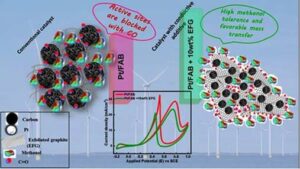
The exfoliated graphite was combined with platinum catalysts to form a conductive network that improved both electron flow and oxygen transport within the system.

Fig: Graphical illustration of the Pt–exfoliated graphite catalyst, with exfoliated graphite forming a conductive network that suppresses methanol crossover and CO poisoning, leading to improved oxygen reduction performance and durability PIB

Performance gains and durability improvements

The study identified an optimal composition of 10 percent exfoliated graphite by weight, which delivered improved performance and stability compared with conventional setups.

The material showed an ability to selectively adsorb methanol molecules, acting as a barrier that prevents unwanted reactions. This reduces methanol oxidation and limits carbon monoxide poisoning of the platinum catalyst.

As a result, the system maintained higher efficiency over longer operating periods.

Researchers said the improvement in methanol tolerance and catalyst protection could address a key challenge in Direct Methanol Fuel Cells, a technology considered promising for portable and stationary energy applications.

Linking battery recycling with clean energy goals

The findings highlight a potential pathway to address two growing concerns: battery waste and the cost and durability of fuel cell technologies.

By converting discarded graphite into a functional material, the approach reduces reliance on expensive catalyst components while creating value from waste.

The work also supports broader efforts to build sustainable energy systems by improving the performance of fuel cells, which produce electricity with lower emissions compared with conventional combustion-based technologies.

Scientists say further research and scaling efforts will be needed to translate laboratory results into commercial applications, but the study establishes a proof of concept for integrating recycling and energy innovation.

The approach reflects a shift toward circular material use, where components from one technology lifecycle are repurposed to enhance another, reducing environmental impact while advancing clean energy solutions.

Also Read:

Almost every Indian village now has a banking outlet within 5 km radius. What changed?

RRI scientists trace mysterious X-ray bursts to wobbling disk in distant galaxy

India expands water sports training and funding for all other states; Why Karnataka is missing

India is strengthening water sports training and safety systems through national institutions and funding schemes, the government told Parliament on March 30, 2026. While several states have sought support for infrastructure and training, Karnataka has not submitted a proposal for coastal or district-level development. The effort includes training programs, safety standards and a national festival aimed at expanding participation in water sports.


A stretch of coastline can become a tourism hub with the right infrastructure. In Karnataka, that transformation has yet to begin on paper.

The Union government said no formal proposal has been submitted for developing water sports infrastructure in Coastal Karnataka or Dakshina Kannada district, even as other regions move to expand capacity.

Union Minister for Tourism and Culture Gajendra Singh Shekhawat disclosed the status in a written reply in the Lok Sabha on March 30, 2026, outlining how India is building its water sports ecosystem through training, funding and safety regulation.

NIWS training programs and India’s water sports capacity building

The National Institute of Water Sports, operating under the Indian Institute of Tourism and Travel Management, serves as the country’s nodal body for training and certification in water sports.

The institute conducts courses in scuba diving, surfing, parasailing, canoeing and related activities, focusing on skill development and safety compliance. Officials describe the training ecosystem as the foundation for scaling water-based tourism across India’s coastline and inland waterways.

Several states and union territories, including Andaman and Nicobar Islands, Gujarat and Odisha, have approached the institute to establish satellite centres aimed at building local capacity and ensuring safety standards.

These centres are expected to support both tourism growth and workforce development, particularly in regions already seeing demand for water-based recreational activities.

A Reddit user, posting under the handle “coastalsportsfan” in a discussion on adventure tourism with more than 800 upvotes, said trained operators “make or break the experience,” pointing to safety and certification as key factors in attracting international tourists.

Khelo India funding and sports infrastructure support

Parallel to training initiatives, the government is funding sports infrastructure through schemes such as the Khelo India Scheme and the National Sports Development Fund.

Under these programs, financial assistance has been provided for facilities including swimming pools, synthetic tracks, hockey fields and multipurpose halls across the country.

Karnataka has received approval for one swimming pool project under these schemes, according to the minister’s statement. The broader infrastructure pipeline spans multiple states, with project details available on official dashboards maintained by the Ministry of Youth Affairs and Sports.

While these projects are not limited to water sports, they contribute to the broader ecosystem needed to support aquatic training and competitive events.

PIB

Khelo India Water Sports Festival and participation push

The government has also begun promoting water sports through national-level events.

The first edition of the Khelo India Water Sports Festival was held in Srinagar, in the union territory of Jammu and Kashmir, from August 21 to August 23, 2025.

The event featured two competitive sports and three demonstration sports, drawing participation from 409 athletes along with support staff, technical officials and volunteers.

Officials said the festival was designed to increase visibility and participation in water sports, particularly among younger athletes and emerging talent pools.

The key features of the Khelo India Water Sports Festival (KIWSF) 2025 are as follows:

Sports Discipline:

  • Competitive: Kayaking & Canoeing, Rowing (2 Sports)
  • Demo: Water Skiing, Shikara Race & Dragon Boat (3 Sports)

Age Category: Open Age Category. Top three States in the Medal Tally: –

State Gold Silver Bronze Total
Madhya Pradesh 10 3 5 18
Odisha 4 5 1 10
Kerala 3 1 3 7

National waterways and untapped potential

India has declared 111 national waterways, many of which are already being used for water sports activities by state governments.

These include major rivers such as the Ganga, Godavari, Krishna and Narmada, as well as regional systems like the Mandovi and canal networks in Kerala.

Despite this existing activity, the Ministry of Tourism said no formal proposal has been received to develop water sports infrastructure specifically linked to these waterways at a national level.

Development in these areas largely depends on state-led initiatives, with central support contingent on project proposals meeting technical feasibility, risk assessment and environmental carrying capacity criteria.

Safety standards and state-level enforcement mechanisms

Safety remains a central component of the government’s approach.

The National Institute of Water Sports has developed standard operating procedures and safety guidelines for various activities. These have been adopted by several states and union territories in their adventure tourism policies.

Technical support has been extended to regions including Goa, Gujarat, Odisha and Puducherry.

Enforcement, however, is handled at the state level. Mechanisms vary by region and include tourist police units in Goa, dedicated enforcement teams in Andaman and Nicobar Islands and state-level adventure tourism committees in Gujarat and Odisha.

Compliance is monitored through inspections, audits and regulatory oversight by local authorities.

Proposal-driven expansion leaves gaps

The government’s approach to water sports infrastructure remains proposal-driven, with funding tied to submissions from states and other eligible entities.

Projects are evaluated based on completeness, technical feasibility and environmental considerations, including risk assessments for coastal zones, rivers, reservoirs and lakes.

In the absence of proposals, regions such as Coastal Karnataka remain outside the current expansion pipeline, even as other states move ahead with training centres and infrastructure planning.

The gap highlights the uneven pace of development in India’s water sports sector, where institutional support exists but implementation depends on state-level initiative.

As the government continues to build training systems, safety frameworks and funding channels, the next phase of growth may hinge less on policy and more on participation from states yet to enter the pipeline.

Also Read:

Rs.50K Stipend for Sports Persons Going for Olympic, Asian Games

National Sports Museum to be established in New Delhi

Centre Outlines Budget Allocation for Indian Museum Expansion

The details of funds allocated and utilised by the Indian Museum, since 2014, year-wise is attached at Annexure-I.

The details of sanctioned strength, filled positions and current vacancies at the Indian Museum are as below:

Sanctioned Strength Total filled posts Total vacant posts
138 58 80


The details of visitors footfall along with revenue generated by the Indian Museum, since 2014, year-wise is attached at Annexure-II.

Salar Jung Museum ,Hyderabad

Annexure- ‘I’

The details of funds allocated and utilised by Indian Museum since 2014


Financial Year 2014 – 2015
Sl. No. GIA-Head Fund Allocated (in Lakhs) Fund Utilised (in Lakhs)
1 Plan 1288.75 1017.82
2 Non-Plan 813.92 1028.11
Total 2102.67 2045.93
 

Financial Year 2015 – 2016

Sl. No. GIA-Head Fund Allocated (in Lakhs) Fund Utilised (in Lakhs)
1 Plan 632.64 477.77
2 Non-Plan 872.52 1146.53
Total 1505.16 1624.30
 

Financial Year 2016 – 2017

Sl. No. GIA-Head Fund Allocated (in Lakhs) Fund Utilised (in Lakhs)
1 Plan 406.62 546.97
2 Non-Plan 583.86 1183.59
Total 990.48 1730.56
Financial Year 2017 – 2018


Sl. No. GIA-Head Fund Allocated (in Lakhs) Fund Utilised (in Lakhs)
1 GIA-General 525.00 525.00
2 GIA-Salary 742.59 742.59
3 GIA-CCA 0.00 0.00
4 GIA-SAP 0.00 0.00
Total 1267.59 1267.59
 

Financial Year 2018 – 2019

Sl. No. GIA-Head Fund Allocated (in Lakhs) Fund Utilised (in Lakhs)
1 GIA-General 700.00 700.00
2 GIA-Salary 1327.16 1327.16
3 GIA-CCA 48.76 48.76
4 GIA-SAP 2.25 2.25
5 GIA-NER 24.21 24.21
Total 2102.80 2102.80
 

Financial Year 2019 – 2020

Sl. No. GIA-Head Fund Allocated (in Lakhs) Fund Utilised (in Lakhs)
1 GIA-General 1600.00 1600.00
2 GIA-Salary 1227.15 758.80
3 GIA-CCA 1100.00 1027.92
4 GIA-SAP 2.25 0.22
Total 3929.40 3386.94
 

Financial Year 2020 – 2021

Sl. No. GIA-Head Fund Allocated (in Lakhs) Fund Utilised (in Lakhs)
1 GIA-General 910.55 910.55
2 GIA-Salary 1014.90 1465.03
3 GIA-CCA 127.92 188.58
4 GIA-SAP 0.00 1.66
Total 2053.37 2565.82
 

Financial Year 2021 – 2022

Sl. No. GIA-Head Fund Allocated (in Lakhs) Fund Utilised (in Lakhs)
1 GIA-General 1402.00 1402.00
2 GIA-Salary 871.78 871.78
3 GIA-CCA 188.58 180.40
4 GIA-SAP 1.63 2.00
Total 2463.99 2456.18
 

Financial Year 2022 – 2023

Sl. No. GIA-Head Fund Allocated (in Lakhs) Fund Utilised (in Lakhs)
1 GIA-General 2100.00 2100.00
2 GIA-Salaries 880.00 810.71
3 GIA-CCA 300.00 50.33
4 GIA-SAP 2.00 2.00
Total 3282.00 2963.04
 

Financial Year 2023 – 2024

Sl. No. GIA-Head Fund Allocated (in Lakhs) Fund Utilised (in Lakhs)
1 GIA-General 2250.00 2250.00
2 GIA-Salaries 900.00 915.30
3 GIA-CCA 690.00 112.02
4 GIA-SAP 2.49 2.49
Total 3842.49 3279.81
 

Financial Year 2024 – 2025

Sl. No. GIA-Head Fund Allocated (in Lakhs) Fund Utilised (in Lakhs)
1 GIA-General 2100.00 2100.00
2 GIA-Salaries 866.01 866.01
3 GIA-CCA 400.00 398.31
4 GIA-SAP 2.00 2.00
Total 3368.01 3366.32
 

Financial Year 2025 – 2026 (Upto March 25, 2026)

Sl. No. GIA-Head Fund Allocated (in Lakhs) Fund Utilised (in Lakhs)
1 GIA-General 2400.00 2331.90
2 GIA-Salaries 875.00 708.12
3 GIA-CCA 0.00 233.31
4 GIA-SAP 2.00 2.00
Total 3277.00 3275.33

Annexure-‘II’

The annual footfall at the Indian Museum since 2014 along with the information on total revenue generation is furnished below.

Financial Year Total Visitors Revenue Generated by Indian Museum(in Lakhs)
2014 – 2015 6,96,148 140.59
2015 – 2016 7,20,997 190.24
2016 – 2017 7,16,020 211.70
2017 – 2018 7,05,065 210.92
2018 – 2019 6,87,262 236.51
2019 – 2020 5,99,465 384.56
2020 – 2021 1,22,962 79.66
2021 – 2022 2,39,552 162.96
2022 – 2023 6,60,381 452.60
2023 – 2024 6,71,287 641.32
2024 – 2025 6,30,307 631.79
2025 – 2026

(Till February 2026)

6,29,322 538.07

This information was given by Union Minister for Culture and Tourism Shri Gajendra Singh Shekhawat in a written reply in Lok Sabha today.

Also Read:

India cultural diplomacy initiatives: ICCR, Gyan Bharatam, global partnerships

Akashvani to Broadcast Full Version of “Vande Mataram” from 26th March


India cultural diplomacy initiatives: ICCR, Gyan Bharatam, global partnerships

IPL 2026: Phase 2 Schedule Announced With 50 Matches Across 12 Cities

The Board of Control for Cricket in India has announced the second phase schedule for the TATA IPL 2026, with 50 matches set from April 13 to May 24 across 12 Indian cities. The league resumes with Sunrisers Hyderabad facing Rajasthan Royals in Hyderabad. The phase includes eight double-headers and will determine playoff contenders, with venues for knockout matches yet to be confirmed.

The race to the IPL playoffs is about to enter its decisive stretch.

The Board of Control for Cricket in India on Saturday released the schedule for the second phase of the TATA Indian Premier League 2026, outlining the remaining 50 league matches to be played between April 13 and May 24 [1].

The fixtures span 12 venues across India, setting up a packed calendar as teams push for playoff qualification in the final weeks of the league stage.

IPL 2026 second phase schedule dates venues and opening match

The tournament resumes on April 13 with Sunrisers Hyderabad taking on Rajasthan Royals in Hyderabad, marking the start of a crucial run of matches [1].

Games in this phase will be hosted in Bengaluru, Mumbai, Chennai, Kolkata, Delhi, Ahmedabad, Hyderabad, Lucknow, Jaipur, Dharamshala, Raipur and New Chandigarh.

The wide spread of venues reflects the league’s pan-India footprint as teams travel extensively during the closing stretch of the season.

Double headers timings and team home venues in IPL 2026

The second phase includes eight double-headers, with afternoon matches scheduled at 3:30 PM IST and evening games at 7:30 PM IST [1].

Several franchises will split their home fixtures across multiple venues.

Punjab Kings will host matches in New Chandigarh and Dharamshala, including three games in the hill venue. Rajasthan Royals are set to play four home matches in Jaipur.

Royal Challengers Bengaluru will stage three home games in Bengaluru while also hosting two matches in Raipur, adding a neutral venue dynamic to their schedule.

Playoff race intensifies as league stage enters final stretch

With only league matches remaining before the playoffs, the second phase is expected to shape the final standings.

Teams will compete across cities in quick succession, with limited turnaround time between matches, increasing the importance of squad depth and travel management.

The playoff venues have not yet been announced, the BCCI said, with details expected at a later stage [1].

For fans, the coming weeks promise a dense schedule and high-stakes encounters as franchises jostle for position in the points table.

The second phase will ultimately determine which teams advance to the knockout rounds and remain in contention for the IPL 2026 title.

Also Read:

IPL 2026: You feel different as Google’s AI is factored in

India Clinches Thrilling Victory Over Pakistan in T20 World Cup Clash

IPL 2026: You feel different as Google’s AI is factored in

Google India and the Board of Control for Cricket in India have partnered to integrate AI-powered insights into the TATA IPL 2026, both in live broadcasts and Google Search. Announced ahead of the new season, the move will allow fans to access real-time analysis, historical comparisons and interactive queries during matches. The collaboration reflects a broader shift toward data-driven, conversational sports viewing.

Cricket fans watching the Indian Premier League this season may find themselves asking questions mid-match and getting answers instantly.

Google India and the Board of Control for Cricket in India have announced a partnership that will bring AI-powered analysis into the TATA Indian Premier League 2026, marking a new phase in how fans interact with the game.

Under the agreement, Google Search’s AI Mode has been named an official premier partner for the tournament, with features designed to deliver conversational insights during live matches and beyond.

AI Mode integration in IPL 2026 broadcast and Google Search

For the first time, AI-driven analysis will be integrated directly into the IPL’s live broadcast, alongside traditional commentary and visuals.

Fans will also be able to access the same insights through Google Search, asking detailed questions about gameplay, strategy and player performance as matches unfold.

The system is designed to go beyond basic score updates, offering tactical breakdowns and contextual explanations in real time.

Supporters could, for example, ask why Jasprit Bumrah is effective in high-pressure overs or how Abhishek Sharma approaches aggressive opening batting, with AI-generated responses drawing on match data and historical patterns.

Deeper fan engagement through historical and tactical analysis

The partnership also opens up access to past matches and long-term performance comparisons.

Fans can explore historical rivalries, revisit key moments and analyze strategies used by leading captains such as Rohit Sharma and MS Dhoni.

AI Mode enables follow-up queries, allowing users to drill into specific aspects such as captaincy decisions, player mentorship or match-turning moments.

It can also generate curated summaries of recent games, highlighting key plays like decisive catches or momentum shifts in closely contested matches.

Officials say AI reflects changing fan behavior

Devajit Saikia said the integration reflects how fans increasingly seek deeper engagement with the sport.

“IPL has always been the heartbeat of Indian cricket, and this collaboration with Google India to integrate AI Mode into Search will fundamentally transform the fan experience,” he said.

From Google’s side, Shekar Khosla pointed to the sustained popularity of cricket-related searches.

“Cricket fans are not just passive viewers but are active experts,” he said, adding that AI tools can help them explore the game beyond traditional formats.

Beyond matches: AI for planning, fitness and fan culture

The partnership extends beyond match analysis.

Google Search will continue to serve as a hub for match-day planning, allowing users to find venues such as sports cafés for group viewing or explore player fitness routines and training methods.

This broader integration reflects how the IPL experience increasingly spans digital, social and real-world interactions.

A shift toward conversational sports viewing

The collaboration signals a wider transformation in sports consumption, where fans move from passive viewing to interactive participation.

By combining live data, historical context and conversational AI, the IPL 2026 experience aims to create a more immersive connection between fans and the game.

As the season unfolds, the effectiveness of these tools will likely shape how similar technologies are adopted across other major sporting events.

Also Read:

Sports Minister felicitates Badminton stars and their coaches

Empty Stands Mar India – Pakistan Asia Cup Clash As Politics Overshadow Cricket

A Heart Test Could Reveal Hidden Fracture Risk in Women After Menopause: Study

A new study from Tulane University finds that postmenopausal women with higher cardiovascular risk face significantly greater odds of fractures, especially hip fractures. Using the American Heart Association’s PREVENT score, researchers tracked more than 21,000 women and found risk nearly doubled in high-risk groups. The findings suggest heart health metrics could help flag fracture risk earlier, though more research is needed.


Doctors Say Start Screening Cholesterol Earlier. Here’s What Changed

U.S. cardiology groups have released updated cholesterol guidelines for the first time since 2018, urging earlier screening and more aggressive LDL reduction. The recommendations, published in leading medical journals and presented March 28 in New Orleans, aim to curb cardiovascular disease by identifying risk sooner and tailoring treatment. Doctors say the changes could shift prevention strategies toward younger adults and high-risk groups.

A routine cholesterol test may soon come earlier in life for millions of Americans.

The American College of Cardiology and the American Heart Association have updated their joint clinical guideline on cholesterol management, marking the first revision since 2018 [1]. The guidance was published in the Journal of the American College of Cardiology and Circulation, with a formal presentation scheduled for March 28 at the cardiology group’s annual scientific session in New Orleans

At its core, the update pushes for earlier screening, lower targets for low-density lipoprotein cholesterol, and a more individualized approach to assessing cardiovascular risk.

Early cholesterol screening recommendations and family risk focus

The new guideline emphasizes screening people sooner, especially those with a family history of heart disease or inherited lipid disorders.

For individuals with familial hypercholesterolemia, a genetic condition that causes very high LDL cholesterol, screening is now recommended as early as age 9 or younger [1]. The shift reflects growing evidence that cardiovascular risk can begin decades before symptoms appear.

“We know that lower LDL cholesterol levels are better when it comes to reducing the risk of heart attacks, strokes and congestive heart failure,” said Roger S. Blumenthal, who chaired the guideline writing committee [1].

The update also calls for a one-time measurement of lipoprotein(a), or Lp(a), a genetically influenced lipid linked to elevated heart disease risk. Levels above 125 nanomoles per liter are associated with about a 40 percent higher risk, with risk doubling at higher concentrations, according to the guideline

PREVENT risk calculator replaces older model for long-term prediction

A major change in the guideline is the introduction of a new risk assessment tool called Predicting Risk of Cardiovascular Disease Events, known as PREVENT.

The calculator estimates both 10-year and 30-year risks for heart attack and stroke, expanding on the previous pooled cohort equation that focused mainly on 10-year outcomes in adults over 40.

PREVENT incorporates additional health indicators, including blood sugar and kidney function, offering a broader picture of cardiovascular risk. It draws on data from 6.6 million individuals, compared with about 26,000 used in the earlier model

The tool is recommended for use starting at age 30, signaling a shift toward earlier intervention.

“Shifting the paradigm toward proactive prevention strategies earlier in life can meaningfully change the trajectory of cardiovascular disease,” said Seth Martin, a member of the writing committee [1].

Lower LDL cholesterol targets and expanded treatment options

The guideline sets more aggressive LDL cholesterol targets depending on a patient’s risk level.

For people without cardiovascular disease, optimal LDL levels remain below 100 milligrams per deciliter. Those at intermediate risk are advised to aim below 70 milligrams per deciliter, while high-risk individuals should target levels under 55 milligrams per deciliter.

These thresholds reflect a growing consensus that “lower is better” when it comes to LDL cholesterol.

The recommendations also expand treatment options beyond statins, the longstanding first-line therapy. Additional medications include ezetimibe, bempedoic acid and PCSK9 inhibitors, injectable drugs used when statins alone are insufficient

Clinicians are encouraged to tailor treatment plans based on individual risk profiles, rather than relying on a one-size-fits-all approach.

Broader definition of cardiovascular risk and “risk enhancers”

The updated guideline introduces a wider set of “risk enhancers” to refine decision-making.

These include chronic inflammatory conditions such as rheumatoid arthritis, pregnancy-related complications like preeclampsia, and early menopause. Family history and ancestry also factor into risk calculations.

Doctors may use additional tests to guide treatment decisions for patients with borderline or intermediate risk. These include measuring high-sensitivity C-reactive protein, a marker of inflammation, and coronary artery calcium scans to detect plaque buildup in arteries

The guidance also addresses specific populations, including pregnant or lactating women, older adults over 75, and patients with conditions such as diabetes, chronic kidney disease, HIV infection or cancer.

Lifestyle remains central to prevention strategy

Despite advances in testing and treatment, the guideline reinforces longstanding advice on lifestyle.

Healthy eating, regular physical activity, avoiding tobacco, maintaining a healthy weight and getting enough sleep remain foundational to managing cholesterol levels.

Blumenthal noted that 80 percent to 90 percent of cardiovascular disease is linked, at least in part, to modifiable risk factors

That statistic underscores the continued importance of prevention strategies that begin outside the clinic.

A shift toward earlier intervention in cardiovascular disease

The update arrives as cardiovascular disease remains the leading cause of death in the United States. About one in four U.S. adults has elevated LDL cholesterol, a major contributor to atherosclerosis, the buildup of plaque in arteries that can lead to heart attack or stroke

By focusing on earlier screening and long-term risk, the guideline signals a shift in how clinicians approach prevention.

Instead of reacting to disease in midlife or later, the new approach aims to identify risk earlier and intervene sooner.

For patients, that may mean discussing cholesterol levels and heart health well before symptoms appear.

Als0 Read:

Fatty fish, camelina oil good for HDL, IDL cholesterol: study

High salt intake associated with doubled risk of heart failure

Scientists Find Hidden Critical Point in Water That Explains Strange Behavior

Researchers at Stockholm University have identified a long-theorized critical point in supercooled water at about minus 63 degrees Celsius and 1,000 atmospheres, using advanced X-ray laser experiments. The discovery, published in Science, helps explain why water behaves differently from other liquids, including why ice floats and why water expands as it cools. Scientists say the finding could reshape understanding of water’s role in climate, biology and planetary systems.


INS Trikand Concludes Seychelles Port Call, Participates in First Tri-Services Exercise Lamitiye

Indian Naval Ship Trikand, a stealth frigate of the Indian Navy, departed from Port Victoria, Seychelles, on March 20, 2026, following an enriching port call that underscored India’s deepening defence cooperation with the island nation.

During the visit, Captain Sachin Kulkarni, Commanding Officer of the ship, called on senior government functionaries and the High Commissioner of India to Seychelles. In a gesture of collaborative partnership, the ship also handed over critical spares and essential stores to the Government of Seychelles.

The port call coincided with INS Trikand’s participation in the first tri-services edition of Exercise Lamitiye 2026, alongside contingents from the Indian Army and Indian Air Force, as well as the Seychelles Defence Forces (SDF). The exercise marked the maiden participation of the Indian Navy in Lamitiye, reflecting a significant milestone in joint military engagement between the two nations.

During the harbour phase, Visit, Board, Search and Seizure (VBSS) training was conducted onboard the ship, which included joint boarding drills. The sea phase that followed saw the ship exercise with SCGS Le Vigilant, with joint boarding operations at sea carried out by a team comprising Indian Navy Marine Commandos and Special Forces of the SDF. Subsequently, Army troops from the Indian Army and the Seychelles Defence Forces conducted landing operations on Praslin Island.

Maj Gen Michael Rosette, Chief of Defence Forces, SDF, along with Brig Jean Attala, Deputy Chief of Defence Forces, SDF, and other senior officers embarked INS Trikand during the sea phase to witness the conduct of the exercise.

Exercise Lamitiye, which means ‘friendship’ in Creole, provided a valuable opportunity to enhance interoperability and strengthen maritime cooperation between India and Seychelles, reaffirming the historic ties between the two nations.

The port call aligns with India’s vision of MAHASAGAR or Mutual and Holistic Advancement for Security and Growth Across Regions. It also reinforces the Indian Navy’s commitment to remain the Preferred Security Partner and First Responder in the Indian Ocean Region.

Centre to Launch 7th Tranche of Critical Mineral Auctions on March 23

Union Minister of Coal & Mines, G. Kishan Reddy, alongside Minister of State for Coal & Mines, Satish Chandra Dubey, will launch the 7th Tranche of Auction of Critical and Strategic Mineral Blocks on March 23, 2026.

The initiative underscores the growing strategic importance of critical minerals, which are vital to the country’s economic development and mineral security. With the global shift toward clean energy and advanced technologies, demand for minerals such as lithium, graphite, rare earth elements (REE), tungsten, vanadium, and titanium has surged. Given their limited availability and concentrated geographical distribution, securing a resilient supply chain has become a national priority.

In a landmark move to address these challenges, the Government of India amended the Mines and Minerals (Development and Regulation) Act, 1957 (MMDR Act) on August 17, 2023, notifying 24 minerals as critical and strategic. The amendment empowers the Central Government to conduct auctions for Mining Leases and Composite Licences for these resources, with all revenue generated accruing to the respective State Governments.

To date, the Ministry of Mines has successfully concluded six tranches of auctions, resulting in 46 critical and strategic mineral blocks being auctioned—a testament to robust industry participation and growing investor confidence in India’s mineral sector.

The upcoming seventh tranche will offer 19 blocks across multiple states under both Mining Lease and Composite Licence categories. The blocks feature a diverse range of minerals essential for clean energy, advanced technologies, fertilizers, and strategic industries.

The auction framework has been progressively strengthened to enhance transparency, efficiency, and speedy operationalisation of mineral blocks. Recent regulatory reforms, including the Mineral (Auction) Second Amendment Rules, 2025, have streamlined post-auction processes such as the submission of performance security, upfront payments, and issuance of Letters of Intent. Further, the Mineral (Auction) Amendment Rules, 2026 have introduced the provision of Insurance Surety Bonds as an alternative to bank guarantees, offering greater flexibility to bidders.

The auction will be conducted online through a transparent two-stage ascending forward auction process, with the successful bidder selected on the basis of the highest percentage of the value of mineral dispatched quoted.

Also Read:

Japan Launches High-Seas Gamble to Break China’s Grip on Critical Minerals

India’s Wholesale Price Inflation Rises to 1.84% in September

Priyanka Chopra Faces Online Scrutiny Over Oscars Moment After Javier Bardem’s Statement

Priyanka Chopra Jonas returned to the Academy Awards stage for the first time in a decade on Sunday, only to find herself at the center of a social media debate, not for anything she said, but for how she appeared to react when her co-presenter said it.

At the 98th Academy Awards, Priyanka Chopra Jonas took the stage alongside Spanish actor Javier Bardem to present the Best International Feature Film award, which went to Norway’s Sentimental Value, directed by Joachim Trier. Before announcing the nominees, Bardem said, “No to war and Free Palestine,” while wearing a “No to War” pin on his tuxedo. His statement drew loud applause from inside the Dolby Theatre. Chopra Jonas stood beside him, nodded, and proceeded with the presentation. She has not publicly commented on the moment.

Clips of the exchange circulated rapidly across platforms, with users fixating on Priyanka Chopra Jonas’ expression during Bardem’s remarks. Interpretations ranged widely — some read discomfort into her body language, others pushed back against that characterization entirely. The disagreement itself became the story.

Indian content creator and political commentator Dhruv Rathee escalated the conversation days later when he posted a video on Instagram publicly criticizing Chopra Jonas, accusing her of maintaining “privileged neutrality” and suggesting that Bollywood figures are broadly reluctant to take moral stands on international human rights issues. Rathee also directed criticism at the wider Bollywood community, contrasting Indian celebrities with Hollywood stars who have more openly addressed the Gaza conflict. As of the time of publication, neither Chopra Jonas nor her representatives had issued a public response.

Attends Major Hollywood Events

The controversy arrived at a moment otherwise meant to mark a career milestone. Her 2026 appearance was her first time presenting at the Oscars since 2016, when she shared the stage with Liev Schreiber to present the Best Film Editing award. Over the years, Priyanka  Chopra Jonas has established herself as one of the few Indian actors with a consistent presence at major Hollywood industry events. On the professional front, she was most recently seen in The Bluff, currently streaming on Prime Video, and is attached to SS Rajamouli’s upcoming production Varanasi, opposite Mahesh Babu.

The evening brought a separate wave of headlines as well. Reports emerged that Priyanka  Chopra Jonas and husband Nick Jonas were forced to switch to a golf cart after their vehicle was denied clearance near the venue, and that the cart nearly tipped over on a sharp corner while they were en route to make her presentation slot on time.

A separate controversy resurfaced in the days following the ceremony when a 2017 video began recirculating online appearing to show the same two individuals approaching Priyanka  Chopra Jonas for autographs on two separate occasions at LAX, prompting accusations that the encounters were staged for publicity. Neither Chopra Jonas nor her team addressed the claim.

Further noise was added when a fabricated tweet, falsely attributed to Indian actress Swara Bhasker, began spreading in connection with the Oscars moment. Bhasker denied authorship of the post on X, calling it fake and attributing it to politically motivated bad actors.

The backlash directed at Priyanka Chopra Jonas reflects a recurring tension in global celebrity culture, the expectation that high-profile figures take explicit positions on geopolitical conflicts, weighed against the professional and personal consequences of doing so. For South Asian stars navigating both Bollywood and Hollywood simultaneously, that calculus is often more complicated than the discourse around it tends to acknowledge.

The Gulf Is on Fire, Gas Fields Up In Flames, Arab Nations Wary: Fallout of Diplomacy Failure

A single Israeli airstrike on the world’s largest gas field has ignited a chain of retaliatory attacks across the Middle East, crippling energy infrastructure from Tehran to Doha and sending shockwaves to petrol pumps from Mumbai to Minneapolis.

The flames that erupted over Iran’s Bushehr Province on the night of March 18 were visible from fishing boats miles out in the Gulf. On shore, they signalled something far more consequential than a military strike: the opening of a new and terrifying chapter in the Middle East’s long war over energy.

Israeli jets had struck the South Pars gas field (the world’s largest, shared between Iran and Qatar) and the sprawling Asaluyeh processing hub on Iran’s southern coast. Within hours, Tehran’s military commanders promised not merely retaliation but systemic destruction. They kept that promise.

In the days that followed, drones and missiles rained down on refineries, liquefied natural gas plants, and export terminals across Saudi Arabia, Kuwait, Qatar, the United Arab Emirates and Bahrain. The Gulf, the artery through which nearly a third of the world’s traded oil flows, was effectively at war with itself. “If strikes on Iran’s energy facilities happen again, further attacks on your energy infrastructure and that of your allies will not stop until it is completely destroyed,” said Ebrahim Zolfaqari, Iranian Military Spokesman.

KEY FIGURES AT A GLANCE

Gul oil and gas field up in flames / AI Generated

The Strike That Started It All

South Pars is not merely a gas field. Shared with Qatar, which calls its half the North Field, the reservoir holds enough natural gas to power civilisations for generations. Disrupting it was not simply a military calculation. It was an economic declaration of war.

Israel’s stated rationale was to sever a critical revenue artery for the Islamic Revolutionary Guard Corps. According to Israeli officials, the strike was coordinated with Washington, a claim that put the White House in a diplomatically delicate position. President Donald Trump subsequently said the United States “knew nothing” about the strikes, even as an Israeli official told CNN the two governments had acted in concert. Trump later ruled out further American-sanctioned attacks on Iranian energy sites, though the damage was already done.

The Asaluyeh processing hub took offline approximately 100 million cubic metres per day of gas processing capacity, roughly 14 per cent of South Pars output and close to 12 per cent of Iran’s total national gas production. Eyewitness videos showed the field ablaze in the night sky, an orange glow reflected in the waters of the Persian Gulf.

Iran’s response was swift, coordinated, and designed to demonstrate that the Islamic Republic could exact a symmetrical price. The Iranian military announced it had entered “a new stage in the war,” one in which energy facilities linked to the United States were legitimate targets.

Drone and missile strikes hit refineries in Riyadh, LNG plants in Kuwait and Qatar, and export terminals along the UAE coast. Missile debris alone, intercepted by air defences, forced the shutdown of Abu Dhabi’s massive Habshan gas complex. The Fujairah export terminal, through which significant volumes of oil bypass the Strait of Hormuz entirely, was struck repeatedly.

Bahrain declared force majeure after its Sitra refinery was hit. Iraq sharply curtailed output from its southern oilfields as a precautionary measure, even though no direct strikes landed on Iraqi soil.

Perhaps most significantly for the global energy market, an Iranian strike hit Qatar’s Ras Laffan industrial city, the nerve centre of its LNG export operations.

“The attacks have knocked out a sixth of Qatar’s LNG export capacity, worth $20 billion a year. Repairs will take three to five years.” CEO, QatarEnergy, speaking to Reuters

Qatar accounts for roughly 20 per cent of global LNG supply. A sixth of that capacity gone overnight means dozens of energy-hungry nations, from Japan and South Korea to India and Germany, scrambling for alternative supply in a market with none readily available.

The violence did not spare Israel. Iranian forces struck oil facilities at the port of Haifa, Israel’s largest commercial harbour and a key energy terminal. Israeli media confirmed structural damage, though authorities reported no casualties. The symbolism was unmistakable: in this new phase of the conflict, no energy installation on either side is sacred.

Markets in Meltdown

Global energy markets reacted with a ferocity not seen since the early days of the Russia-Ukraine war. Middle East crude benchmarks hit record highs. In the United States, diesel crossed the $5-per-gallon mark, a politically charged threshold that sends inflationary pressure cascading through the entire economy. Gasoline reached its highest levels since late 2023.

In Asia, refiners from China to South Korea began cutting processing runs, unable to secure adequate feedstock at workable prices. Beijing and Seoul imposed export controls or price caps on refined products, prioritising domestic supply over export revenues. For India, which sources nearly 45 per cent of its crude from the Gulf, the disruption carries particular weight, both at the pump and at the policy table in New Delhi.

The insurance industry moved with unusual speed. Lloyd’s of London and major reinsurers imposed war-risk exclusions on Gulf energy infrastructure almost immediately. War-risk premiums for vessels transiting the Strait of Hormuz, the narrow chokepoint through which 21 million barrels of oil pass every day, multiplied tenfold within days.

The International Energy Agency took the extraordinary step of calling for the release of 400 million barrels from global strategic reserves, a scale of intervention that underscored just how severe the shock has been.

The strikes have laid bare two uncomfortable truths. First, that even the most sophisticated air defence systems, American, Israeli and Saudi alike, cannot fully protect the Gulf’s most critical and geographically exposed energy infrastructure. Second, that Iran retains a formidable capacity to impose costs on its adversaries and their regional allies, even as its own installations burn.

The world is watching a war fought not merely with missiles but with energy itself as both weapon and target. The question is no longer whether global supply chains will be disrupted. They already have been. The question is how long the disruption lasts, and whether diplomacy can find a foothold before another salvo makes that question moot.

(Disclaimer: The story has used AI assistance in images and online research but filed by reporter and vetted by human editor entirely.)