
Trump Targets ICC With Sanctions as Pillay’s Nobel Prize Puts Global Justice in Spotlight

US President Donald Trump’s administration has imposed sweeping sanctions on the International Criminal Court (ICC), potentially targeting companies that provide services to the tribunal, just hours after former ICC judge Navi Pillay won the 2026 Nobel Peace Prize for her work promoting international justice.

The move escalates Washington’s confrontation with the court, which has investigated alleged crimes involving US personnel and issued arrest warrants against Israeli Prime Minister Benjamin Netanyahu and other figures. It also puts the United States on a collision course with European allies that support the court’s work.

The ICC condemned the sanctions as an “assault on the rule of law and on the very foundations of the international legal order” and urged its 125 member states to defend the institution.

“The Court cannot stand alone. Its fate now rests also in the hands of the states that created it,” the court said in a statement, warning that the dispute concerned the future of an international order grounded in the rule of law.

The timing has sharpened the political significance of the confrontation. The Norwegian Nobel Committee awarded Pillay the Peace Prize on October 9, explicitly citing the political attacks faced by judges and international legal institutions.

Rubio Says US Will Cut Off ICC Resources

US Secretary of State Marco Rubio said the sanctions were intended to prevent the ICC from prosecuting Americans.

“President Trump will never allow the International Criminal Court to prosecute Americans,” Rubio said in a statement first reported by Reuters.

“That is why, today, the United States is sanctioning the International Criminal Court. We will ban transactions with this rogue court, cutting off their resources and crippling its ability to operate.”

The sanctions go beyond Washington’s earlier measures against individual ICC prosecutors and judges. They could affect banks, insurers, software providers and other companies that work with the court, potentially disrupting its access to financial services and essential technology.

The US Treasury announced an initial six-month grace period, alongside exemptions for certain transactions involving telecommunications, software, pension payments and detainees.

Rubio said the measures were structured to give the court and its member states an opportunity to address US concerns. Washington indicated that the sanctions could be adjusted if those demands were met.

The United States signed the Rome Statute that established the ICC but never ratified it. Washington has long argued that the court should not exercise jurisdiction over American citizens without US consent.

The ICC was established in 2002 to prosecute individuals accused of genocide, war crimes, crimes against humanity and the crime of aggression under the conditions set out in its founding treaty.

European Allies Rally Behind International Court

The sanctions have raised concerns among US allies in Europe, where governments fear that restrictions on the ICC could undermine international investigations and prosecutions.

European Union foreign policy chief Kaja Kallas said the six-month grace period offered an opportunity for dialogue but warned that the bloc had options to ensure the court could continue its work.

Belgium’s foreign minister called for the activation of an EU blocking statute designed to protect European entities from the effects of certain foreign sanctions.

The ICC’s deputy prosecutor, Nazhat Shameem Khan, said the measures were intended to undermine an independent judicial institution.

“The sanctions are intended to undermine the rule of law internationally and the work that an independent judicial institution is doing,” Khan told media. “Our work will continue across all our situations, our investigations and our prosecutions.”

The court has issued arrest warrants against more than 70 people, including Netanyahu and Russian President Vladimir Putin. It has also pursued cases involving figures linked to conflicts in Sudan, Libya and other regions.

Washington’s opposition has focused particularly on the court’s actions involving Israeli officials and its past investigation into alleged crimes by US personnel in Afghanistan. The ICC has said the Afghanistan investigation involving US personnel has been deprioritised.

Nobel Prize Puts International Justice at Centre of Dispute

Pillay, a South African jurist and former United Nations High Commissioner for Human Rights, served on the ICC’s Appeals Chamber from 2003 to 2008.

The Nobel Committee said her award was intended to reaffirm support for international justice at a time when judges and institutions of international law were facing political attacks.

“An international legal system in which war criminals are held to account and the victims of abuse see justice served is a precondition for a peaceful world,” the committee said.

The juxtaposition of the award and the US sanctions has turned a longstanding legal dispute into a wider diplomatic confrontation over the authority of international courts.

The ICC’s immediate challenge will be to maintain access to essential services and continue its investigations and prosecutions. Its longer-term position will depend partly on whether member states can shield the institution from the sanctions’ effects.

For Washington, the measures reflect the administration’s determination to resist ICC jurisdiction over Americans. For the court and its supporters, the confrontation raises a broader question: whether international judicial institutions can pursue accountability for grave crimes when powerful governments reject their authority.

Flydubai Flight Could Have Crashed Without Third Pilot, What to Learn?

A flydubai aircraft carrying 174 people could have crashed during a mid-air emergency if a third pilot had not intervened and landed the plane safely, Federation of Indian Pilots (FIP) president Captain C.S. Randhawa said on Thursday, highlighting serious concerns over cockpit safety following a violent confrontation between two pilots.

Indian pilot Captain Smit Machchhar was injured during an altercation with the co-pilot aboard Flight FZ1073, which was travelling from Dubai to Tel Aviv on Wednesday. The aircraft was subsequently diverted to Tabuk, Saudi Arabia, and landed safely, with all passengers and crew reported safe.

Randhawa, who has five decades of aviation experience, said he had never witnessed a similar episode of violence inside a cockpit. He stressed that investigators must establish how the confrontation began, what happened during the struggle and how the crew managed to regain control of the aircraft.

“If a third pilot was not present, the aircraft would have crashed,” Randhawa told IANS, warning that the incident could have ended in a major tragedy.

His assessment puts the spotlight on the role of the third pilot and raises questions about cockpit security, crew resource management and the procedures designed to prevent a single confrontation from escalating into a flight emergency.

Flight Recorders Crucial to Establish What Happened

Randhawa said the cockpit voice recorder and digital flight data recorder would be central to reconstructing the incident.

The cockpit voice recorder could help investigators establish when the confrontation began, identify conversations between crew members and capture sounds from inside the cockpit. The flight data recorder, meanwhile, would provide technical information on the aircraft’s altitude, descent profile and flight-control parameters.

He also referred to microphone recordings that could help establish which pilot was speaking and reconstruct the sequence of events, including possible exchanges involving people who entered the cockpit.

“So, I do not know what the investigation will reveal when officials take the statements of the crew members, the passengers, and the third pilot. This will be further substantiated by the cockpit voice recorder. It is a very important piece of evidence to establish when this whole thing started,” he said.

Randhawa cautioned against speculation that the confrontation was a terrorist act. He said investigators would first need to establish the co-pilot’s intentions and determine whether there was any evidence of a deliberate attempt to bring down the aircraft.

“There are also theories about terrorism… that it is a deliberate attempt. I think it is premature to say that there was an act of terror, because that has to be established,” he said.

If investigators establish that the confrontation involved a deliberate attempt to crash the aircraft, the inquiry would have to examine the co-pilot’s possible motives and any links to organisations, he added.

Randhawa also raised the possibility that the incident could have involved a suicide attempt, while praising Machchhar for resisting the attacker and the third pilot for bringing the aircraft to safety.

Cockpit Safety and Pilot Screening Under Scrutiny

Randhawa said the confrontation may have escalated through several stages, beginning with an argument before turning physical and potentially involving a weapon. However, he emphasised that this was a possible sequence rather than an established account of what happened aboard the aircraft.

He explained how a physical struggle inside a cockpit could interfere with flight controls. If a pilot became unstrapped and accidentally struck the control column during a fight, the aircraft could potentially disengage from autopilot and descend sharply.

“During the brawl in the cockpit. One of the pilots might have unstrapped himself, and if one of them had hit his leg on the control column, the autopilot mode would have dropped, and the aeroplane would have steeply descended,” he said.

The FIP chief identified a possible failure of crew resource management (CRM) as one area investigators should examine. CRM focuses on communication, coordination, decision-making and the management of human factors among flight crews.

He also called for regular psychometric assessments of pilots to identify stress and other psychological factors that could affect cockpit safety.

“Psychometric tests of pilots need to be carried out on a regular basis to know about their mental condition, whether they are under some kind of stress or not,” he said.

Randhawa argued that similar screening should be introduced in India’s aviation sector, describing the incident as a warning for the global aviation industry.

However, the proposal raises a broader policy question about how airlines and regulators can identify genuine safety risks while protecting medical confidentiality, preventing discrimination and ensuring that psychological assessments are scientifically validated.

The investigation into Flight FZ1073 will be crucial in determining whether the emergency exposed gaps in cockpit security, crew coordination or existing pilot fitness procedures. Until the findings are released, the precise cause of the confrontation and the extent to which existing safety measures failed remain unresolved.

The Gulf Is on Fire, Gas Fields Up In Flames, Arab Nations Wary: Fallout of Diplomacy Failure

A single Israeli airstrike on the world’s largest gas field has ignited a chain of retaliatory attacks across the Middle East, crippling energy infrastructure from Tehran to Doha and sending shockwaves to petrol pumps from Mumbai to Minneapolis.

The flames that erupted over Iran’s Bushehr Province on the night of March 18 were visible from fishing boats miles out in the Gulf. On shore, they signalled something far more consequential than a military strike: the opening of a new and terrifying chapter in the Middle East’s long war over energy.

Israeli jets had struck the South Pars gas field (the world’s largest, shared between Iran and Qatar) and the sprawling Asaluyeh processing hub on Iran’s southern coast. Within hours, Tehran’s military commanders promised not merely retaliation but systemic destruction. They kept that promise.

In the days that followed, drones and missiles rained down on refineries, liquefied natural gas plants, and export terminals across Saudi Arabia, Kuwait, Qatar, the United Arab Emirates and Bahrain. The Gulf, the artery through which nearly a third of the world’s traded oil flows, was effectively at war with itself. “If strikes on Iran’s energy facilities happen again, further attacks on your energy infrastructure and that of your allies will not stop until it is completely destroyed,” said Ebrahim Zolfaqari, Iranian Military Spokesman.

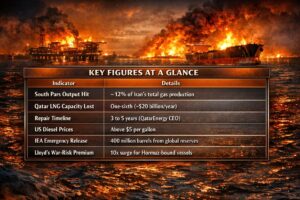
KEY FIGURES AT A GLANCE

Gul oil and gas field up in flames / AI Generated

The Strike That Started It All

South Pars is not merely a gas field. Shared with Qatar, which calls its half the North Field, the reservoir holds enough natural gas to power civilisations for generations. Disrupting it was not simply a military calculation. It was an economic declaration of war.

Israel’s stated rationale was to sever a critical revenue artery for the Islamic Revolutionary Guard Corps. According to Israeli officials, the strike was coordinated with Washington, a claim that put the White House in a diplomatically delicate position. President Donald Trump subsequently said the United States “knew nothing” about the strikes, even as an Israeli official told CNN the two governments had acted in concert. Trump later ruled out further American-sanctioned attacks on Iranian energy sites, though the damage was already done.

The Asaluyeh processing hub took offline approximately 100 million cubic metres per day of gas processing capacity, roughly 14 per cent of South Pars output and close to 12 per cent of Iran’s total national gas production. Eyewitness videos showed the field ablaze in the night sky, an orange glow reflected in the waters of the Persian Gulf.

Iran’s response was swift, coordinated, and designed to demonstrate that the Islamic Republic could exact a symmetrical price. The Iranian military announced it had entered “a new stage in the war,” one in which energy facilities linked to the United States were legitimate targets.

Drone and missile strikes hit refineries in Riyadh, LNG plants in Kuwait and Qatar, and export terminals along the UAE coast. Missile debris alone, intercepted by air defences, forced the shutdown of Abu Dhabi’s massive Habshan gas complex. The Fujairah export terminal, through which significant volumes of oil bypass the Strait of Hormuz entirely, was struck repeatedly.

Bahrain declared force majeure after its Sitra refinery was hit. Iraq sharply curtailed output from its southern oilfields as a precautionary measure, even though no direct strikes landed on Iraqi soil.

Perhaps most significantly for the global energy market, an Iranian strike hit Qatar’s Ras Laffan industrial city, the nerve centre of its LNG export operations.

“The attacks have knocked out a sixth of Qatar’s LNG export capacity, worth $20 billion a year. Repairs will take three to five years.” CEO, QatarEnergy, speaking to Reuters

Qatar accounts for roughly 20 per cent of global LNG supply. A sixth of that capacity gone overnight means dozens of energy-hungry nations, from Japan and South Korea to India and Germany, scrambling for alternative supply in a market with none readily available.

The violence did not spare Israel. Iranian forces struck oil facilities at the port of Haifa, Israel’s largest commercial harbour and a key energy terminal. Israeli media confirmed structural damage, though authorities reported no casualties. The symbolism was unmistakable: in this new phase of the conflict, no energy installation on either side is sacred.

Markets in Meltdown

Global energy markets reacted with a ferocity not seen since the early days of the Russia-Ukraine war. Middle East crude benchmarks hit record highs. In the United States, diesel crossed the $5-per-gallon mark, a politically charged threshold that sends inflationary pressure cascading through the entire economy. Gasoline reached its highest levels since late 2023.

In Asia, refiners from China to South Korea began cutting processing runs, unable to secure adequate feedstock at workable prices. Beijing and Seoul imposed export controls or price caps on refined products, prioritising domestic supply over export revenues. For India, which sources nearly 45 per cent of its crude from the Gulf, the disruption carries particular weight, both at the pump and at the policy table in New Delhi.

The insurance industry moved with unusual speed. Lloyd’s of London and major reinsurers imposed war-risk exclusions on Gulf energy infrastructure almost immediately. War-risk premiums for vessels transiting the Strait of Hormuz, the narrow chokepoint through which 21 million barrels of oil pass every day, multiplied tenfold within days.

The International Energy Agency took the extraordinary step of calling for the release of 400 million barrels from global strategic reserves, a scale of intervention that underscored just how severe the shock has been.

The strikes have laid bare two uncomfortable truths. First, that even the most sophisticated air defence systems, American, Israeli and Saudi alike, cannot fully protect the Gulf’s most critical and geographically exposed energy infrastructure. Second, that Iran retains a formidable capacity to impose costs on its adversaries and their regional allies, even as its own installations burn.

The world is watching a war fought not merely with missiles but with energy itself as both weapon and target. The question is no longer whether global supply chains will be disrupted. They already have been. The question is how long the disruption lasts, and whether diplomacy can find a foothold before another salvo makes that question moot.

(Disclaimer: The story has used AI assistance in images and online research but filed by reporter and vetted by human editor entirely.)