Ukraine: Increasing hostilities displace civilians, limit humanitarian access

Donetsk, Kherson and Sumy regions sustained the most damage, with several civilians reportedly killed, and many displaced, UN Spokesperson Stéphane Dujarric told reporters at a regular news briefing on Thursday.

“Our humanitarian colleagues tell us that food insecurity remains a concern in front-line and border regions,” he added.

According to a recent assessment by the UN World Food Programme (WFP) and the Food and Agriculture Organization (FAO), the conflict has devastated livelihoods and quadrupled poverty levels, leaving the most vulnerable – particularly displaced people – at greatest risk.

Food insecurity on the front-line

WFP Executive Director Cindy McCain described the challenges.

“This frontline stretches 700 miles and countless towns and villages are still without the basics for survival,” she said. 

This has made the work of humanitarians even more vital, with over 400,000 people in Donetsk and Kherson receiving food and agricultural support in addition to cash-based assistance.

In total, over 130 humanitarian organizations have distributed food and livelihood assistance to over 1.8 million people across the country.  

Aid challenges

But with hostilities becoming increasingly deadly, humanitarian access remains limited. Since the start of the year, there has been a 50 per cent increase in civilian deaths when compared to the same period last year.  

Authorities continue to urge the 10,000 people who remain in the front-line region to evacuate for their own safety.  

“For those who stayed or those who came back, there are no jobs, no income and no opportunity,” Ms. McCain said. 

Source link

‘Still reeling’: Myanmar quakes worsen humanitarian crisis in fractured country

The 28 March quake measuring 7.7 on the Richter scale, struck central regions with deadly force, killing some 3,800 people and injuring over 5,000, according to UN estimates.

The disaster devastated infrastructure and homes across Mandalay, Sagaing and Magway, displacing tens of thousands more in a country already grappling with over 3.2 million internally displaced persons (IDPs) since the 2021 military coup.

Communities are still reeling from the earthquakes – the strongest the country has experienced in a century,” said Jorge Moreira da Silva, Executive Director of the UN Office for Project Services (UNOPS), speaking to journalists at the UN Headquarters in New York via video from Beijing after a three-day visit to Myanmar.

The devastation caused by the quakes compounded the existing challenges of conflict, displacement and severe humanitarian needs.

Needs outpace resources

UNOPS, which maintains the largest UN presence in Myanmar with nearly 500 staff, mobilized $25 million within weeks of the disaster and has reached half a million people with lifesaving support.

“My colleagues worked swiftly with partners to deliver emergency shelters, clean water, and deploy infrastructure specialists for rapid assessments,” Mr. da Silva said.

However, he warned that far greater international support is needed to meet the scale of needs.

The World Bank estimates total damages at nearly $11 billion, with full reconstruction expected to cost two to three times more. Over 2.5 million tonnes of debris must also be cleared to enable recovery.

Mr. da Silva emphasized that reconstruction must be people-centred, inclusive, and linked to peacebuilding efforts.

“We echo calls from across the UN for an end to violence,” he said. “Recovery and reconstruction should support Myanmar’s journey to peace and reconciliation. Protection of civilians must be a priority.

Women and girls face disproportionate risks

The humanitarian fallout has hit women and girls particularly hard – many of whom were among those killed or injured – and now face growing protection risks.

According to the UN reproductive health agency, UNFPA, more than 4.6 million women of reproductive age – including over 220,000 currently pregnant – are at heightened risk.

Damage to health facilities, worsened by monsoon flooding and insecurity, has disrupted access to emergency obstetric care and menstrual hygiene. Gender-based violence meanwhile, is rising sharply in overcrowded, poorly lit shelters.

UNOPS Executive Director Jorge Moreira da Silva meets with a woman and her newborn child at a health clinic.

Health system under pressure

The risk of waterborne diseases such as cholera and vector-borne illnesses like dengue and malaria is also rising.

According to the World Health Organization (WHO) while no major outbreaks had been reported as of 31 May, cases of acute watery diarrhoea and skin infections are ticking up.

Monsoon rains have worsened conditions in temporary shelters, where overcrowding and poor sanitation raise serious health concerns. Mental health remains fragile, with 67 per cent of respondents in a recent survey reporting emotional distress linked to the quake and ongoing conflict.

WHO and its partners have delivered more than 300,000 vaccine doses – including tetanus and rabies – but access remains limited, and health services underfunded.

Protracted crisis

More than 3.25 million people remain displaced within Myanmar since the military coup of February 2021, with at least another 176,000 seeking refuge in neighbouring countries, according to refugee agency, UNHCR.

This excludes the hundreds of thousands of Rohingya refugees from earlier waves of violence.

Myanmar also remains one of the world’s deadliest countries for landmines and explosive remnants of war.

In the first nine months of 2024 alone, 889 casualties were reported – raising fears the toll could surpass the record 1,052 deaths and injuries documented in 2023.

UN warns of mounting humanitarian toll as Israel-Iran hostilities continue

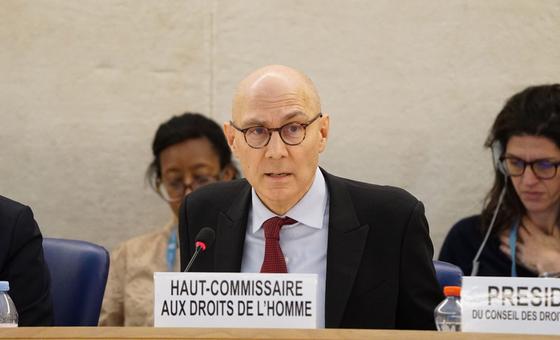
UN High Commissioner for Human Rights Volker Türk on Thursday called for “maximum restraint” and reiterated that both Israel and Iran are bound by international humanitarian law.

“The widescale, continuing attacks by Israel across Iran, and the missile and drone strikes launched in response by Iran, are inflicting severe human rights and humanitarian impacts on civilians, and risk setting the whole region ablaze,” he said in a statement.

The only way out of this spiralling illogic of escalation is maximum restraint, full respect for international law, and return in good faith to the negotiating table,” he stressed.

Appalling collateral damage

The UN rights chief also expressed deep concern over the impact on civilians.

It is appalling to see how civilians are treated as collateral damage in the conduct of hostilities,” he said, adding that threats and inflammatory rhetoric by senior officials on both sides suggest a “worrying intention” to inflict harm on civilians.

The airstrikes, missile and drone attacks – launched by both Israel and Iran since 13 June – have caused heavy damage to civilian infrastructure and claimed hundreds of lives.  

According to Iranian authorities, at least 224 people have been killed, while human rights groups report significantly higher figures. In Israel, officials report 24 deaths and more than 840 injuries so far.

Widespread panic

Warnings from both governments have also prompted widespread panic among civilians.

Israel’s call for civilians to evacuate on Tuesday triggered panic across Tehran, resulting in heavy traffic jams on highways. Movement has reportedly been hampered across the country by fuel shortages, leading to hours-long queues at petrol stations.

Concern for refugees

The Office of the UN High Commissioner for Refugees (UNHCR) expressed grave concern over the deteriorating humanitarian situation, adding that it is monitoring reports that people are on the move within Iran and that some are leaving for neighbouring countries.

UNHCR Spokesperson Babar Baloch cautioned that the situation remained fluid and hard to verify.

Iran has long hosted the largest Afghan refugee population in the world. Now, its own people are experiencing devastation and fear,” Mr. Baloch added.

He also emphasised the principle of non-refoulement, calling on neighbouring countries to grant protection to anyone fleeing violence, and not turn them back.

UNHCR Spokesperson Baloch on the crisis.

Iran hosts an estimated 3.5 million refugees and those in refugee-like situations, including some 750,000 registered Afghans and over 2.6 million undocumented individuals.

Regional worries

There is already regional fallout, with missile launches from Yemen towards Israel and the Occupied Palestinian Territory and heightened tensions reportedly involving armed groups in Iraq, according to OCHA.

This escalation takes place as the region already grapples with mounting humanitarian needs, sharply reduced funding, and constrained operational space for humanitarian action,” the Office said in a flash update issued on Wednesday.

“De-escalation is vital to preventing further suffering of civilians and population displacements,” OCHA underscored.
Source link

Haiti: WFP concerned over humanitarian situation as hurricane season begins

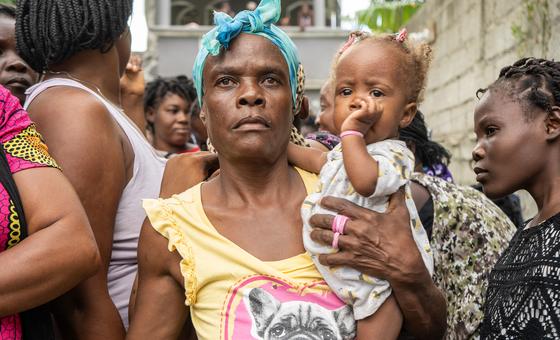
With roughly half the population, 5.7 million people, facing some sort of emergency level of hunger, Haiti is one of five countries in the world with catastrophic levels of hunger.  

“Despite all the violence, displacement and collapse”, WFP remains in Haiti, Lola Castro, Regional Director in Latin America and the Caribbean, said during a briefing on Tuesday, having recently returned from the country. 

More than one million people in Haiti are displaced due to ongoing gang violence and insecurity.

As the hostilities are disrupting the food systems and supply chains in the capital Port-au-Prince, WFP is facing a “quite dramatic” situation, Ms. Castro said. 

Displaced population 

Displaced populations, notably in and around Port-au-Prince, are faced with a “very problematic” situation, she said, as hostilities have recently uprooted around 14,000 people from the commune of Kenscoff.  

“Kenscoff is a commune where people used to come and sell their food,” she said, and the same people are now relying on food assistance after their houses were burned and their livelihoods “destroyed.” 

Gender-based violence  

With 6,000 cases of gender-based violence having been reported this year, the situation of women and girls in Port-au-Prince is dramatic, according to Ms. Castro.  

The city is probably “one of the most dangerous places in the world” for women and girls. “We need to provide them support to assure that they become less vulnerable and are not exposed to all this violence,” she said.  

Dwindling aid stocks  

The 2025 Humanitarian Response Plan for Haiti calls for just over $908 million but is only eight per cent funded. Ms. Castro said WFP alone needs $46.4 million over the next six months to sustain its emergency response and address the root causes of hunger and malnutrition. 

The hurricane season began on 1 June and runs through the end of November. She warned that at this moment when half of all Haitians are already going hungry, a single storm could push millions into a humanitarian catastrophe. 

While in past years, WFP had humanitarian stocks ready in the country and could assist between a quarter to half a million people in the immediate aftermath of a disaster, “this year, we start the hurricane season with an empty warehouse,” she said.  

Unless resources are made available, the agency will have no capacity to respond—there are no contingency supplies, no logistical buffer, and no lifeline for the most vulnerable. 

“We cannot forget the people of Haiti,” Ms. Castro said, calling on the humanitarian community to provide urgent support.  

Source link

As displacement surges in South Sudan, regional humanitarian crisis deepens

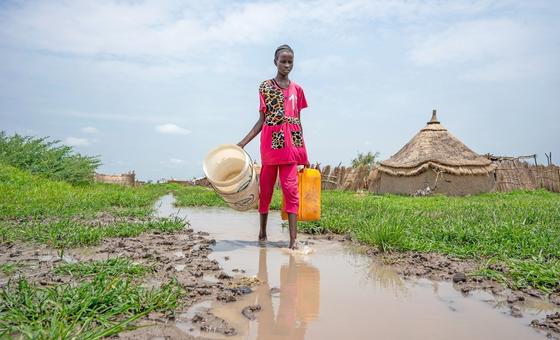
Violence between armed groups in Upper Nile state and other flashpoints has crippled essential services, triggered food insecurity and worsened disease outbreaks, including cholera – forcing some to be displaced repeatedly.

Roughly 65,000 have been internally displaced in Upper Nile state alone. 

Access to aid in conflict hotspots is limited, with fighting and movement restrictions cutting off assistance.

Lifesaving supplies, including medicine and healthcare to curb rising cholera cases, have halted, while rains threaten to worsen the crisis, flooding roads and driving up transport costs.

South Sudan has also absorbed over a million people fleeing conflict in Sudan.

Regional crisis

Another 103,000 South Sudanese have sought refuge in neighbouring countries, pushing the total number of South Sudanese refugees to 2.3 million.

“This emergency could not have come at a worse time,” said Mamadou Dian Balde, UNHCR’s Regional Director for the East, Horn of Africa and Great Lakes region.

“Many of the refugees are seeking safety in countries which have challenges of their own or are already dealing with emergencies amidst ongoing brutal funding cuts, straining our ability to provide even basic life-saving assistance.”

Despite the conflict in Sudan, 41,000 South Sudanese have sought refuge there – 26,000 in White Nile state, where over 410,000 South Sudanese already live, many repeatedly displaced due to ongoing violence in their host country.

The surge in arrivals in Sudan has created an urgent need for additional space, while essential services are overwhelmed due to cholera outbreaks and ongoing security challenges.

In the Democratic Republic of the Congo (DRC), 23,000 have arrived amid the country’s own insecurity.

Some 21,000 South Sudanese have sought refuge in Ethiopia. Previously living in makeshift shelters along riverbanks near the border, new arrivals are now receiving UNHCR aid further from the border; however, infrastructure and services in the area remain severely overstretched, worsened by a cholera outbreak.

Uganda, which hosts one million South Sudanese refugees, has taken in 18,000 since March – a 135 per cent year-on-year increase. Nearly 70 per cent are children; many forced to take longer and more hazardous routes to safety.

Call for support

UNHCR is providing refugees with critical relief items, documentation and specialised support to survivors of gender-based violence. 

But to provide necessary support for the next six months – including shelter, water, health and nutrition screening, as well as cash assistance – the agency requires $36 million. 

Calling for an immediate end to hostilities, UNHCR urged all parties to spare civilians further suffering. 

Unrest in Warrap state

In related developments, the UN Mission in South Sudan (UNMISS) voiced deep concern over escalating intercommunal violence in Tonj East county, Warrap state, urging the Government to intervene and deploy security services to address the situation. 

The violence has been driven by attempts to recover stolen cattle and revenge for the previous loss of lives, resulting in more than 80 casualties, although the numbers are yet to be verified. 

UNMISS is intensively engaging with state and local authorities to calm the situation, in addition to increasing patrols, however peacekeepers are experiencing significant challenges reaching some of the impacted areas due to a proliferation of checkpoints manned by armed youth.

Source link

UN humanitarian chief demands resumption of aid in Gaza

No aid has entered the enclave since Israel implemented a ban on 2 March and the entire population, more than two million people, is at risk of famine.

“As we demonstrated during the ceasefire this year – and every time we’ve been granted access – the United Nations and our humanitarian partners have the expertise, resolve and moral clarity to deliver aid at the scale necessary to save lives across Gaza,” said Mr. Fletcher.

Ready to move

Those proposing an alternative modality for aid distribution should not waste time, he added, as a plan already exists.

The document is “rooted in the non-negotiable principles of humanity, impartiality, neutrality and independence.” Furthermore, it is backed by a coalition of donors, as well as most of the international community, and ready to be activated if humanitarians are allowed to do their jobs.

“We have the people. We have the distribution networks. We have the trust of the communities on the ground. And we have the aid itself – 160,000 pallets of it – ready to move. Now,” he said.

‘Let us work’

Mr. Fletcher reiterated that the humanitarian community has done this before and can do it again.

“We know how to get our aid supplies registered, scanned, inspected, loaded, offloaded, inspected again, loaded again, transported, stored, protected from looting, tracked, trucked, monitored and delivered – without diversion, without delay, and with dignity. We know how to reach civilians in desperate need and stave off famine.”

He concluded the statement by saying “Enough. We demand rapid, safe, and unimpeded aid delivery for civilians in need. Let us work.”

UN warns of growing humanitarian catastrophe in Gaza

In a statement released by the UN Humanitarian Country Team – which leads coordinated relief efforts across the Occupied Palestinian Territory – officials condemned Israeli efforts to dismantle the current aid system.

The team led by the UN’s top aid official in the region representing UN and non-governmental organizations (NGOs) both international and Palestinian, said Israeli plans would “contravene fundamental humanitarian principles” and deepen the suffering of civilians already enduring severe shortages of food, water, and medical care.

“Bakeries have shut. Community kitchens have closed. Warehouses stand empty. Children have gone hungry,” the statement said, describing the dire conditions facing the population.

The UN said Israeli authorities were attempting to impose a new aid distribution system that would funnel humanitarian supplies through military-controlled hubs, rather than allowing UN agencies and NGOs to operate independently.

‘Dangerous’ Israeli proposal

The proposal, the UN said, would leave “large parts of Gaza, including the less mobile and most vulnerable people,” without aid and would force civilians to enter militarised areas to access basic necessities.

This is dangerous, driving civilians into militarised zones to collect rations, threatening lives, including those of humanitarian workers,” the UN said, warning it would also exacerbate forced displacement across the strip.

According to news reports, the Israeli government has defended the policy as a security measure. At the same time, Israeli forces are planning to ramp up operations in central and southern Gaza.

On Saturday, call up notices were reportedly issued to thousands of Israeli military reservists, indicating a likely escalation of the offensive inside the Strip.

Guiding principles

The UN statement reaffirmed that aid operations must remain guided by the principles of “humanity, impartiality, independence and neutrality” and said all 16 UN entities and major humanitarian partners working in Gaza had endorsed this unified position.

“Humanitarian action responds to people’s needs, wherever they are,” the team said.

UN teams remain on the ground, “ready to again scale up the delivery of critical supplies and services” once the blockade is lifted. They urged global leaders to intervene and pressure Israel to reopen border crossings immediately.

“The time is now,” the UN said.

In a social media post on Sunday, the UN aid agency for Palestine refugees, UNRWA, pointed out that nearly a third of essential supplies for civilians in the Gaza Strip are out of stock while another third are projected to run out in under two months.

Source link

‘Season of war,’ as norms of humanitarian law ‘cast aside’ UN refugee chief

Speaking in the UN Security Council, Filippo Grandi said in conflicts across the world in places like Sudan, Ukraine, Myanmar, the Democratic Republic of the Congo and Haiti, “violence has become the currency of our age.”

Forcibly displaced people are among the first victims of war. Worldwide, some 123 million people have had to flee due to conflict.

Since the beginning of the war in Sudan, one-third of Sudan’s population has been displaced by indiscriminate violence, disease, starvation, flooding, droughts and sexual violence, “a situation that frankly defies description,” said Mr. Grandi.

In Ukraine, 10 million people have been displaced by the war, experiencing what he described as “terrible toll.” Seven million of them are now refugees, living outside the country.

“Stagnation has defined the response in Myanmar,” said the UN refugee chief. As a result, Rohingya refugees in Bangladesh have been living in camps entirely dependent on humanitarian aid for the past eight years.

Security and self-reliance

Refugees and displaced people will not return to their communities “unless they are confident that the terms of peace are durable, for them and for their country,” he added.

Promoting security and self-reliance is essential to ending humanitarian crises.

However, a return to peace requires compromise and commitment; peace cannot be made passively, said Mr. Grandi.

Reminding the 15 Members of the Security Council that preventing and stopping wars is their primary responsibility, he noted that it was one that “this body has chronically failed to live up to.”

Seizing opportunities

To achieve durable peace, the UN must be ready both to seize unexpected opportunities, and to take calculated risks, High Commissioner Grandi said adding that “there is now an opportunity to break this dangerous inertia.”

As over one million people have already returned to Syria since December 8, with many more expected to follow, the refugee chief urged the Security Council to ease sanctions to support early recovery efforts and spur investment.

“To minimise the risk that the returning Syrians are taking, I am asking you to take some risks yourselves,” he said.

Retrenchment away from aid

Despite the positive signs coming out of Syria, as well as Burundi and the Central African Republic, Mr. Grandi told the Council that “we see a retrenchment away from aid, away from multilateralism, even away from life-saving assistance,” adding that “we hear of prioritizing national interests, of boosting defense spending — all valid concerns of course, and legitimate state pursuits. But these are not incompatible with aid, quite the contrary.”

One way or another, forced displacement has concerned every member of the Security Council, Mr. Grandi pointed out.

“You have been the refugee. You have welcomed those who sought refuge,” he said reminding its members of their collective responsibility “to end war, to bring peace.”

Source link

Gaza: UN official warns of ‘assault on dignity’ as blockade cripples humanitarian response

Speaking to journalists in Gaza City, Jonathan Whittall, OCHA‘s local Head of Office, painted a dire picture of life under what he called a “total and complete blockade” now approaching its third month.

“The coming days in Gaza are going to be critical. Today people are not surviving in Gaza, those that aren’t being killed with bombs and bullets are slowly dying,” he said.

Whittall stressed that humanitarian agencies are unable to meet the soaring needs of civilians due to the collapse of supply lines. Hospitals are overwhelmed, but medicines and equipment are running out. People are going hungry, but food warehouses are empty and bakeries are closing. Clean water is desperately needed, but water wells are inaccessible.

He noted that solid waste is piling up in the streets with no equipment to remove it, and that rescue efforts after airstrikes are impossible without fuel and machinery. Displaced families are forced to live in rubble without shelter materials, and fishermen are being shot at sea, while humanitarian organisations lack the resources to assist them. “Nowhere in Gaza today is safe”, he said.

He added that children need to learn, but schools have been destroyed or are inaccessible, and that education supplies are not available. Prices of the remaining goods in Gaza continue to rise, but there is no cash available. There is no cooking gas or fuel, forcing families to burn trash to generate some energy.

“This is not only about humanitarian needs, but it’s about dignity. There is an assault on people’s dignity in Gaza today,” he warned.

“We also know that humanitarian workers, first responders, you as journalists, should be protected, like all civilians, but we’re being killed in a war that appears to be fought without any limits,” he added.

Whittall emphasised that the situation in Gaza does not even resemble a war. “People in Gaza are telling me that they feel like it’s the deliberate dismantling of Palestinian life in plain sight, for all to see, documented every day by you as journalists,” he said.

He described the devastation witnessed daily — including children’s bodies thrown by explosions, families burnt alive, and colleagues killed — as part of what he termed “everyday atrocities.”

“As humanitarians we can see that aid is being weaponised through its denial,” he warned. “There’s no justification for the denial of humanitarian assistance. And humanitarian aid should never be weaponised.”

Despite the catastrophic conditions, he stressed that humanitarian organisations are continuing to operate where possible, but “we have less and less and less supplies and less and less capacity to be able to meet the growing and growing needs that are intensifying across Gaza.”

“Lives depend on the blockade being lifted, on aid being allowed to enter into Gaza, on the ceasefire being reinstated,” he said, calling for real accountability rather than waiting for history to judge the international community’s response.

Hunger and malnutrition surging

In a separate statement, OCHA warned of a “severe decline” in food availability across Gaza, as malnutrition rates escalate rapidly, particularly among children.

A UN partner organisation recently screened around 1,300 children in northern Gaza and identified over 80 cases of acute malnutrition, representing more than double the rate recorded in previous weeks.

“Nutrition partners report a critical shortage of supplies due to the obstruction of aid entry and challenges in transporting essential materials within Gaza,” OCHA said. Access to key facilities, including UNICEF’s main warehouse in Rafah, remains heavily restricted.

Journalists who visited the United Nations Relief and Works Agency for Palestine Refugees (UNRWA) main warehouses this week found them largely empty of food supplies, including flour.

Call for accountability and action

“Nothing can justify the collective punishment of the Palestinian people,” UNRWA said in a separate statement, stressing that international law prohibits indiscriminate attacks, the obstruction of humanitarian assistance, and the destruction of vital civilian infrastructure.

The agency reiterated its call for a renewed ceasefire, the dignified release of all hostages, and the immediate, unhindered flow of humanitarian aid and commercial goods into Gaza.

Source link