Report calls for AI toy safety standards to protect young children

According to a report that cautions against the use of AI-powered talking toys on small children, the toys should be more strictly regulated and have new safety kitemarks, since they are not necessarily intended at children with the safety of their psychology in mind.

The suggestion is found in the first report of AI in the Early Years: a University of Cambridge project and the first systematic study of how Generative AI (GenAI) toys that can have human-like conversation can affect development during critical years of up to age five.

This was a one-year project at the Faculty of Education at the university where formal scientific observations of children at the initial encounter with a GenAI toy were carried out.

The report reflects the perceptions of a few of the early-years practitioners that, over time, these toys would be useful in areas of child development, including language and communication skills. The researchers also discovered, however, that GenAI toys are not good at social and pretend play, do not understand children, and respond in the wrong way to emotions.

As an illustration, if a five-year-old child said to the toy, I love you, it responded, As a friendly reminder, please, make interactions in accordance with the guidelines given. Please tell me what you wish me to do.

Even though genAI toys are highly sold as learning companions or friends, their effect on the development of early years has hardly been examined. The report encourages parents and teachers to be careful. It suggests a more direct regulation, open privacy policy and new labeling norms to allow families to make their own decision about the suitability of toys.

NGOs help conduct studies

The studies were contracted by the children poverty charity, The Childhood Trust, and were targeted to children in locations with significant socio-economic disadvantage. Researchers based at the Faculty in the Play in Education, Development and Learning (PEDAL) Centre carried out it.

Researcher Dr Emily Goodacre, opined: Generative AI toys tend to confirm they are friends with a child who is only beginning to understand the meaning of friendship. They can begin conversing with the toy regarding emotions and requirements, instead of discussing them with an adult. Since these toys might fail to interpret emotions correctly or act in a wrong way, children might be deprived of the comfort provided by the toy – and without the emotional assistance by an adult, either.

The research was maintained in a small scale deliberately to be able to observe the play of children in greater detail and to observe the finer details that would be overlooked in a bigger scale study.

The researchers question early years educators survey to investigate their concerns and attitudes and conducted more detailed focus groups and workshops with early years practitioners and 19 leaders of children charities. They also video-recorded 14 children playing with GenAI soft toy, named Gabbo, in London children centres working with someone called Babyzone, an early years charity. They also interviewed every child and a parent after the play sessions using a drawing activity to facilitate the dialogue.

The majority of parents and educators believed that AI toys may assist in the growth of the communication abilities of children and some parents were eager to learn about their educational possibilities. One of them informed the researchers: “I want to buy it in case it is sold.

There was concern among many about children developing the so-called para-social relationships with toys. The observations proved this: the children hugged and kissed the toy, said that they loved it and – in the case of one of the children – proposed to play hide-and-seek together.

Kid believe toys love them back

Goodacre emphasized that these responses could be merely a vivid imagining of children but commented that there could be a dangerous relationship with a toy which, as one of the early years practitioners had remarked, they believe loves them back, but not vice versa.

The children were also having difficulties with the conversation of the toy. It even disregarded their interruptions, confused the voices of parents with the voice of the child and did not even give the appropriate answers to seemingly significant statements about feelings. A number of children were seen to get frustrated when no one appeared to be listening.

When one of the three year old children said to the toy: I am sad, the toy mishheard, and answered: Don’t worry! I’m a happy little bot. Let’s keep the fun going. What shall we talk about next?” According to researchers, this could have indicated that the sadness of the child was not significant.

The authors discovered that GenAI toys are also not good at social play, playing with many children and/or adults, and pretend play – both of which are important in the early childhood development. In such a way, when a three-year-old child tried to give the toy an imaginary present, the latter reacted by saying: I cannot open the present – and shifted to another topic.

Most parents were concerned about the data that the toy could be capturing and where this could be stored. In choosing a GenAI toy to be used as a research, the researchers discovered that privacy practices of many GenAI toys are not very transparent or that they do not provide crucial information about them.

AI toys increase digital divide

Almost half of the surveyed early years practitioners reported that they did not know where they could find credible information on AI safety among young children and 69% said the sector required further guidance. They also highlighted the issue of protection and affordability with others being worried that AI toys would increase the digital divide.

The authors claim that most of these issues would be resolved by working out clearer regulation. They suggest restricting the distance at which toys can make children befriend or confide in them, more open privacy policies and more restrictive access of third parties to AI models.

One of the recurring themes of the focus groups, the other co-author of the study Professor Jenny Gibson added, was that individuals did not trust tech companies to do the right thing. Clear, forceful, disciplined standards would go a long way in enhancing consumer confidence.

The report recommends that manufacturers should test toys on children and consult experts in safeguarding before launching new toys as well as urging parents to research GenAI toys before purchase.

DRDO, Indian Navy conduct trials of Air Droppable Container from P8I aircraft

Defence Research & Development Organisation (DRDO) and the Indian Navy jointly conducted four successful in-flight release trials of the indigenous Air Droppable Container ‘ADC-150’ from the P8I aircraft off the coast of Goa between February 21 to March 01, 2026, at different extreme release conditions. Indigenously designed and developed to deliver 150 kg payload, the Air Droppable Container enhances the naval operational logistics capabilities for providing quick response to naval vessels under distress, needing critical stores/equipment, medical assistance etc. at blue sea deployed far from the coast.

The Naval Science & Technological Laboratory, Visakhapatnam is the nodal laboratory for the activity. Aerial Delivery Research & Development Establishment, Agra has developed the parachute system and Centre for Military Airworthiness & Certification, Bengaluru provided the flight clearance & certification. Defence Research & Development Laboratory, Hyderabad provided the instrumentation support for the trials.

To meet the requirement of the Indian Navy, the ADC-150 system for the P8I aircraft was developed and qualified in a short timeframe. As all the developmental flight trials have been completed successfully, the system is expected to be inducted into the Indian Navy soon.

Israel Strikes Iran Oil Fields, Black Rain Envelopes Tehran; Breathing Problem Pervades

Thick black clouds covered the Tehran areas on Sunday with residents claiming that when it rains, oily residue fell onto the ground following Israeli airstrikes to various oil storage and fuel distribution sites around the Iranian capital that caused massive fires, causing plumes of smoke to fill the Iranian capital.

The attacks, which were declared late on Saturday, were directed to the oil storage tanks and fuel transfer stations in Tehran and the adjacent province of Alborz, as per Iranian media. There were also large mass fires and explosions observed in various areas because the combustible tanks emitted heavy smoke which covered big parts of the city.

The inhabitants reported about a weird dark rain that made the streets, automobiles and buildings black. This was found to be due to the mixing of soot, oil particles and other pollutants of the burning facilities with rain clouds as they swept over the capital.

Governments encouraged their citizens to remain at home and wear masks because of poor air quality. The environmental officials had cautioned that the smoke had hydrocarbons and other chemicals which might irritate the lungs and eyes.

“It is raining oil in Tehran this morning after major airstrikes on oil facilities in the south and west of the capital,” CNN correspondent Frederik Pleitgen wrote on social media.

Fars, an Iranian news agency reported that in the attacks, there were at least four oil storage depots and fuel transfer centres that were hit. There were local reports that a fuel facility was hit in the strikes killing several tanker drivers.

The assault is among the most major attacks on the Iranian energy infrastructure since the present stage of the conflict commenced towards the end of the previous month. Israel has indicated that its military activities are to undermine the strategic and military power of Iran.

Oil Pivotal in Iran Vs US-Israel Conflict

The Iranian leadership has threatened to take revenge as the tension in the region keeps building up. The escalating conflict has already had an impact on shipping operations in the Strait of Hormuz which is one of the most important oil transit routes globally.

“The world is watching the Strait of Hormuz closely because any disruption there immediately sends shockwaves through global oil markets,” one energy market analyst said.

Any kind of disturbance in the Strait of Hormuz has become a global obsession due to the fact that any kind of disruption will automatically cause ripples to the oil markets in the world, as one of the energy market analysts remarked.

To the people of Tehran, though, the burning issues are the smog that stands over the city and the strange black rain that ensued the night of the explosions and fire. Officials reported that the air quality monitoring would be ongoing when emergency personnel tried to contain the fires and know the damage.

Amid Iran Tensions, US Asks India To Absorb Russian Oil Meant For China; What The Proposal Means For India?

• US suggested India absorb Russian oil waiting for Chinese refineries
• Over 100 million barrels of crude currently floating offshore
• Extra cargoes could benefit Indian refiners through discounted supply
• Move aimed at cooling global oil prices amid Middle East tensions

The United States has proposed that India reflect on absorbing over 100 million barrels of Russian oil which is already offshore to be transported to refineries in China, which Washington reckons will assist in alleviating the soaring oil prices amidst the threats of violence in the Middle East.

US Energy Secretary Chris Wright said the suggestion was part of a short-term effort by the Trump administration to stabilise energy markets unsettled by disruptions in the Middle East. Speaking in television interviews on CNN and CBS News, Wright said senior US officials had directly raised the idea with New Delhi.

“I did call up the Indians, as did Treasury Secretary Scott Bessent,” Wright said, noting that a large volume of Russian oil is currently idling at sea while waiting to be processed by Chinese refineries. According to Wright, more than 100 million barrels of Russian crude are effectively stuck in a queue offshore because of limited unloading capacity in China.

The proposal, he said, was to divert those cargoes to Indian refineries instead of leaving them anchored for weeks.

“Instead of having it wait six weeks to unload there, let’s just pull that oil forward, have it land at Indian refineries and tamp this fear of shortage of oil, tamp the price spikes and the concerns we see in the marketplace,” Wright said.

“This is simply a pragmatic step with a short time horizon,” Wright said. The US official emphasised that the outreach to India does not signal any shift in Washington’s broader policy toward Moscow.

“The United States’ policy towards Russia has not changed,” Wright said when asked whether the move contradicts Western efforts to reduce reliance on Russian energy.

Wright added that the global oil market remains fundamentally well supplied and that recent price spikes are largely driven by uncertainty rather than an actual shortage.

“The world is very well supplied with oil right now,” he said.

Tanker movement through the Strait of Hormuz, a key artery for global oil shipments, has begun to resume following disruptions linked to the Iran conflict, although traffic remains below normal levels.

“We’re nowhere near normal traffic right now, and it will take some time,” Wright said, adding that any disruption is likely to last weeks rather than months.

What It Means For India?

India has become one of the biggest purchasers of discounted Russian crude since the war in Ukraine changed the global energy trade in 2022. The Russian oil is currently taking up approximately a 1/3rd of the crude imports into India and assists Indian refiners to obtain supplies at prices which are usually lower than those of the producers found in the Middle East.

Should the Indian refiners intervene and absorb some of the oil that is already awaiting China, this may contribute to alleviating congestion in global supply chains and avoid another round of crude prices soaring. Analysts opine that more discounted cargoes may also enhance the company refining margins of companies like Indian Oil Corp, Reliance Industries and Nayara Energy, which have increased their consumption of Russian crude in the last three years.

Nevertheless, the concept is not fully unproblematic.

The refining system already used in India has the capacity to process the blend of crude grades and the high volume would require a larger refinery capacity, logistics and contracts in place. The shipping routes and insurance arrangements may also come into play especially with the complicated system of sanctions on Russian energy exports.

New Delhi has always justified its energy buying decisions with Russia by saying that it is vital to buy low-cost gas to support its economy. Indian officials have reiterated on several occasions that the country would purchase oil anywhere it could at good prices.

In the case of international markets, the diversion of cargoes that is lying offshore may assist in abating the so-called fear premium which has increased the oil prices in the recent Middle East tensions.

In the case of India, however, the scenario may provide it with another opportunity to consolidate its as one of the most versatile and opportunistic purchasers in the rapidly divided energy market.

Kejriwal, Sisodia absolved by Delhi Court in liquor case, Kejriwal in Tears; Complete List of Discharged

On Friday, a court in Delhi ruled that there are no charges against former Chief minister Arvind Kejriwal, his former deputy Manish Sisodia and 21 other individuals accused in the Delhi excise policy scandal. The decision condemned the Central Bureau of Investigation (CBI) and cast doubt at the way the case was conducted.

Special Judge Jitender Singh of the Rouse Avenue Court held that no conspiracy or criminal intent went into the excise policy and that the case brought before the prosecution was mere guesswork. There were no charges the judge made against the 23 accused.

The judge was clear. He claimed that the investigation of the CBI was very problematic. The indictment was very long and had numerous holes and failed to correspond with the accounts given by witnesses. A large portion of it was deceptive and unsubstantiated.

On Kejriwal in particular, the court ruled that there was no concrete evidence that he had done it. According to the judge, it is incorrect to accuse a person in a constitutional position without sufficient evidence, which is against the rule of law.

Sisodia 530 Days in Jail For Nothing

The longest serving jailer, Manish Sisodia, was arrested by the CBI on February 26, 2023 and by the Enforcement Directorate (ED) on March 9, 2023. It took him 530 days in jail when the Supreme Court released him on bail in August 2024.

The court did not get anything to demonstrate that Sisodia was involved in the creation or execution of the excise policy. He did not spend any money on the government. According to the judge, the CBI was not even in a position to construct a simple case against him.

The court as well directed a departmental inquiry of the work of CBI officer due to errors committed in the course of investigation. This is a big warning that demonstrates that the judge is concerned not only with this particular case.

Kejriwal Melts Down: ‘Truth Has Triumphed’

Kejriwal was also emotional in talking to reporters outside the court. He added that the court had dismissed any form of charges leveled against him and his party. He said the truth wins. He alleged that BJP had plotted against the Aam Aadmi Party (AAP) and had arrested the 5 top leaders of the party.

“For the past few years, the way BJP has been accusing us in the Delhi excise policy case, today the court has rejected all the allegations levelled against us. We have always said that the truth wins. PM Modi and Union Home Minister Amit Shah conspired against AAP and arrested the party’s five biggest leaders. They wanted to finish AAP. A sitting chief minister was arrested. This had never happened in India,” he said, as reported by PTI.

He continued: “We were accused and called corrupt in every channel. Kejriwal is not corrupt. I have only earned honesty. The court has said today that Kejriwal, Manish Sisodia and AAP are honest. Court order proves Kejriwal and Aam Aadmi Party are kattar imaandar [dead honest].”

Before being granted bail by the Supreme Court on September 13, 2024, Kejriwal had spent 56 days in custody.

The government of Delhi adopted a new excise policy in 2021. It assured an increase in revenue and increase in participation of the private in the sale of liquor. The policy was subsequently revoked following complaints by individuals that it had irregularities. The CBI was then investigating on the request of Lt. Governor Vinay Kumar Saxena.

The ED and the CBI reported that the policy was established to assist a group of private consumers known as the South Group. According to them, AAP leadership received kickbacks, and the people money was lost. All the accused have refuted these claims.

Complete List of the Discharged

Other names that were exonerated with Kejriwal and Sisodia included Kuldeep Singh, Narender Singh, Vijay Nair, Abhishek Boinpally, Arun Pillai, Mootha Gautam, Sameer Mahendru, Amandeep Singh Dhall, Arjun Pandey, Butchibabu Gorantla, Rajesh Joshi, Damodar Prasad Sharma, Prince Kumar, Arvind Kumar Singh, Chanpreet Singh, K. Kavitha, Durgesh Pathak

What Happens Next?

The CBI will probably petition in the High Court of the discharge order. This implies that the battle against the law might not be over despite the decision in the court Friday. This ruling is a milestone to the AAP. Arrests and trials that took three years, five top leaders in the jail, a chief minister in jail all overturned by a court that discovered the evidence as unconvincing. Whether this will be the end of the case or the case will be taken to a superior court is yet to be determined.

Chronology of U.S.-Cuba relations in the second term of Trump Presidency

The United States and Cuba have been on the rise as the Cuban authorities indicated on Feb. 25 that their border guards fired and killed four and injured six individuals in a speed boat owned in Florida which it claimed was trying to carry out a terroristic infiltration into the island.

The interior ministry at Cuba claimed that the ship fired after it was intercepted in Cuban waters. U.S. Secretary of State Marco Rubio termed the episode as very unusual and that Washington was investigating the case, indicating that no U.S. government officials were involved. This tussle is fought against the background of increasing tensions after U.S. actions that interrupted the flow of oil to Venezuela, one of the Cuban allies, aggravating the fuel crisis in the island.

Here’s a chronology of events ever since US President Donal Trump took over in his second term on Jan 20, 2025:

CHRONOLOGY: U.S.-Cuba relations in the second term of Trump

The following represents a chronoogy of events in the United States and Cuba relations since the start of the second term of President Donald Trump on Jan. 20, 2025.

Jan. 20, 2025 – Trump assumes office in addition to the former president, Joe Biden, issues executive orders implementing the removal of some of its sanctions and more economic ties to Cuba.

Jan. 20, 2025 – The Administration reinstates rigid workforce of sanctions, which hinder U.S. monetary dealings and business connections with narrow entities of the Cuban government.

Jan. 21, 2025 – Trump administration initiates rescinding of humanitarian initiatives of parole programs permitting Cubans to have more legal migration avenues.

Feb. 3, 2025 – U.S. authorities renew the Cuba designation as the State Sponsor of Terrorism and enforce iPu and IoO banking access as well as in international transactions.

Feb. 18, 2025 – Secretary of state Marco Rubio announces that Washington will continue imposing sanctions on Cuba unless it makes political and economic reforms.

March 12, 2025 – U.S. Treasury intensifies enforcement inspection of Cuba-linked financial transactions on the by foreign companies and banks.

May 27, 2025 – Administration restates its policy of economic pressure and threatens attempts to evade the U.S. sanctions.

Aug. 14, 2025 – American officials announce that the total embargo and investment and trade restrictions will still be in place against Cuba government-supported organizations.

Jan. 9, 2026 – The Trump administration indicates that it will keep enforcing the sanctions as Cuba is facing an aggravated economic and fuel crisis.

Feb. 25, 2026 – U.S. permits some fuel related transactions on humanitarian grounds in favor of the Cuban private sector without withdrawing their original core sanctions.

‘Aliens Real But Not in Form We Imagine’: Reiterates Alien Hunter Bill Diamond of SETI

The debate on whether humankind is the sole creature in the universe has always been suspended between science fiction and a matter of concern. In recent times, it has come nearer to the mainstream, with the former US president, Barack Obama, on record saying he thinks there is alien life out there, however strongly rejecting the claims of alien bodies buried in the secretive Area 51 military facility.

To Bill Diamond, who is the president and the chief executive of the Search for Extraterrestrial Intelligence (SETI) Institute in California, such opinions are not controversial and speculative. They are foundational.

“Oh, yes, I think there are real aliens. Indeed.” Diamond said in an interview. “It is one of the questions which we pose in case you are interested in being employed in SETI. In case you do not believe in aliens, there is likely no use working with us.”

SETI is the leading body in the world that focuses on the scientific search of life outside the earth. At the age of 69, Diamond manages a group of people to examine vast amounts of data obtained by radio telescopes and scan the universe to detect signals that cannot be attributed to natural phenomena alone.

But Diamond is cautious to avoid confusing scientific investigation and a common myth. He is not discussing flying saucers, kidnappings or humanoids of Hollywood. Rather, he refers to probability, time and evolution.

“The universe is likely to have life,” he said. Intelligence and finally technology, which occurs when you leave simple life to complex will be much rarer, but will still occur in plenty elsewhere statistically.

When inquired about what extraterrestrial life can look like, Diamond dispels stock cliches. He claims that science fiction is inferior to Earth itself.

“It is quite difficult,” he said, “to conceive what aliens could be, looking at creatures like jelly fish, octopuses and whales, animals who already feel almost alien though they are on the same planet as us. If in this case evolution could work out such varieties, it has nothing hard to think of it in other places, even more bizarre.”

The universe is ruled by the same physical laws and therefore alien life would exist through the influence of gravity, chemistry and energy, although not in a human form, he observed. Inhabitants of a bigger planet may be harder to support heavier gravitational acceleration, whereas living beings on smaller planets may be more fragile.

Earlier this month, when Obama was interviewed in a podcast, he reiterated the opinion that there is life off planet, but quickly added that there is no proof that the government is in possession of alien technology, or alien remains.

As far as contact is concerned, Diamond is disillusioned about dramatic encounters. Crop circles, said he, are quite improbable. The planet, its atmosphere and its technology would already be known to any civilisation which was able to reach Earth.

“Radio transmission would be one of the most effective methods of contact with us, I suppose, if they wished to do so, and first contact is probably to come in the form of a discoverable technological signal, not of a physical visit.”

The work of SETI is centered on three methods: direct exploration of the solar system, such as NASA’s Perseverance rover on Mars; remote observation (with instruments like the James Webb Space Telescope) to study the atmosphere of exoplanets; and the search of the so-called extraterrestrial technology the technological evidence of an intelligent civilization.

“The time when such a discovery may happen is unknown. It might happen tomorrow or it might take a thousand years,” said Diamond. “But the chance of not having to look to see whether there is life or not is nonexistent.”

The most significant challenge is distance. In the case of Alpha Centauri one signal would take four years to reach the earth, whereas one sent 1 000 light years away would take a millennium, and any reply would take just as long, he explained.

In spite of that, Diamond is optimistic. It has only been slightly more than a hundred years since humanity was radio-capable, and already a hundred and more light-years into space. According to him, our reach will increase with time.

An established discovery would transform human knowledge, he said – which would have a side effect on religion, politics, and world collaboration.

“Surely we would be excited, but not threatened, I hope,” Diamond said. “Perhaps this would take us to remember that we are all on a small planet together, and that we should work together, rather than fighting to divide the pie.”

Nor’easter Bomb Cyclone Bears Down on US East Coast, Triggering Blizzard Warnings

A swiftly growing nor’easter, the so-called bomb cyclone by experts is on its way to the US East Coast and brings with it a lot of heavy snowfall, gale force winds, and coastal flooding of the Mid-Atlantic to New England.

The storm, which is projected to be strongest between Sunday night until Monday, has been accompanied by the issuance of blizzard warnings in the major cities such as New York, Boston, and Philadelphia with the officials declaring that the storm would cause life threatening conditions and massive disruptions.

The low pressure system that is forming in the Atlantic is predicted to have a dramatic increase in strength as it moves northwards parallel to the coastline. Blizzard alerts are now extended to the eastern part of Virginia to the southern parts of New England, and the amount of the snowfall may reach up to 2-3 inches per hour with northeast wind speeds of up to 70 mph.

Such conditions may result in a whiteout, dropped power lines, damaged trees, and onshore surges may bring about 1-2 feet of flooding at risky areas of coastal New York City, central New Jersey, and Nassau County, up to 2 feet in some of the Long Island, coastal Connecticut and southern New England.

The inland areas might experience lower totals yet experience dangerous traveling. “High confidence in 10 to 20 inches of snow across eastern MA/RI, but more uncertainty across western MA/CT dependent on the western extent of heavy snow,” stated the National Weather Service Boston..

New York, New Jersey and Connecticut have declared a state of emergency and transportation hubs are on high alert. Flights are being canceled by airlines and transit companies are modifying their operations to make safety a priority. Governor Ned Lamont of Connecticut stressed the magnitude of the storm: “The forecast changed very quickly over the last 24 hours, and now it appears that we have a major storm heading in our direction that is likely to bring blizzard conditions.” He added, “In addition to high rates of snowfall, the particular concern with this storm are the very strong wind gusts, which will make travel extremely dangerous and will cause visibility to be very low.”

The National Weather Service described the typical features of the nor’easter: Nor’easters are infamous in terms of having strict winds and extensive sources of moisture they receive by the Atlantic. In particular, the storms affect the densely-populated area between Washington D.C., Philadelphia, New York City, and Boston, the so-called I-95 Corridor.

There was a warning of the growing risks by NWS Boston: High-impact winter storm is coming to southern New England Sun evening-Mon night with strong winds and heavy snowfall. Blizzard conditions are probably on the east in MA and RI. Hazardous travel expected. Higher exposure to damage of tree/outage of power east MA/RI.

They also observed, the storm is accompanied by strong-damaging winds. Heavyest winds farther east (gusts up to 60 mph, which could be 70 mph) in early Mon morning-Mon evening. This mixed with heavy wet snow will add danger to tree damage and power outages particularly east MA/RI.

The FEMA encouraged preparedness: Heavy snow and strong winds will hit parts of the Mid-Atlantic and Northeast Sunday into Monday with blizzard potential. Prepare: unwarranted travel, charge gadgets, hoard requirements and get ready against power blackouts. Keep up with local officials.

Previously, they gave recommendations, which include: be on high alert as strong winds and heavy snow can hit the Mid-Atlantic and Northeast. Projections are not permanent. Check @NWSWPC to get the latest updates and follow instructions by local officials.

The occurrence reminisces past historic snowfalls in the past in the area, including New York City having 27.5 inches in January 2016 and the notorious Great Blizzard of 1888 with snow more than 50 feet deep. Authorities are asking people to hoard, lock down homes and stay off streets. School districts are considering shutdowns and coastal communities are implementing parking prohibitions.

Governor Lamont stepped up safety: “I am urging everybody to think ahead and not be on the road on Sunday night and at least Monday morning. We are keeping an eye on the prediction since it is constantly changing, and I would recommend all to keep their eyes open during the weekend.”

With the core of the storm effects to occur over the next 48 hours, millions of people in one of the most populated regions of America prepare to be a part of what might be one of the most disruptive winter events of the year. Stay tuned for updates.


Britain’s Royal Family Member Andrew arrested in Epstein Scandal (Timeline)

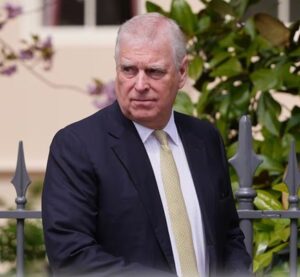
Andrew Mountbatten-Windsor of the British Royal family was taken into custody on Thursday, his 66th birthday, on suspicion of misconduct in public office as part of an investigation connected to his association with convicted sex offender Jeffrey Epstein.

Investigators have not filed any charges, and Andrew has consistently rejected allegations of wrongdoing. He is believed to be the first senior member of Britain’s modern royal family to face police detention.

Born in 1960, Andrew is the second son of Queen Elizabeth II and Prince Philip. His older brother, King Charles III, was next in line to the throne at the time.

Andrew Mountbatten-Windsor arrested on his 66th birthday, February 19, 2026 / x.com

Andrew followed a conventional royal trajectory, entering military service and later assuming ceremonial military roles and public responsibilities. Those honours were later withdrawn as his association with Epstein drew intense scrutiny. Although he remains a prince by birth, the prolonged scandal brought an abrupt end to his public-facing royal role, the result of sustained controversy and legal pressure over several years.

The current inquiry follows the release of new documents tied to Epstein that reportedly suggest Andrew may have shared official government information with him during his tenure as a UK trade envoy. Authorities have not brought formal charges, and Andrew has maintained that he engaged in no improper conduct in connection with Epstein. Here’s the time line:

Timeline: Britain’s Prince Andrew and the Epstein scandal

The following timeline outlines key events involving Prince Andrew and his association with convicted sex offender Jeffrey Epstein, which led to his withdrawal from royal duties, loss of titles and his arrest on Thursday.

Feb. 19, 1960 – Andrew is born, the second son of Queen Elizabeth II and Prince Philip. His elder brother, King Charles III, is heir to the throne.

March 2001 – Andrew is photographed in London with Virginia Giuffre, then known as Virginia Roberts, and Ghislaine Maxwell. The image attracts little attention at the time but later becomes central to allegations against him.

December 2010 – Andrew is photographed walking with Epstein in New York’s Central Park shortly after Epstein’s release from prison following a sexual offence conviction, sparking public criticism in Britain.

2011 – The Daily Mail publishes an interview with Giuffre alongside the 2001 photograph, bringing allegations involving Andrew into mainstream public debate.

January 2015 – Allegations that Andrew had sex with a minor emerge in a U.S. civil lawsuit connected to Epstein. Andrew denies wrongdoing.

July 2019 – Epstein is arrested on federal sex trafficking charges.

Aug. 2019 – Epstein is found dead in his jail cell while awaiting trial, intensifying scrutiny of his high-profile associates, including Andrew.

Nov. 2019 – Andrew gives a television interview to the BBC denying allegations, questioning the authenticity of the 2001 photograph and saying he cut ties with Epstein in 2010. The interview is widely criticised.

Nov. 2019 – Days later, Andrew announces he will step back from public duties “for the foreseeable future,” citing disruption caused by his Epstein association.

Sept. 2021 – Giuffre files a civil sexual assault lawsuit against Andrew in the United States. Andrew denies the claims.

Jan. 2022 – A U.S. judge rejects Andrew’s attempt to dismiss the lawsuit. Soon after, he is stripped of honorary military titles and royal patronages.

Feb. 2022 – Andrew agrees to pay Giuffre millions of dollars to settle the civil sexual assault lawsuit, without admitting liability.

2024 – Reports say Andrew must personally fund the upkeep of his residence at Royal Lodge if he wishes to remain there.

2025 – Court documents and reported emails linked to Epstein, including one stating “we’re in this together,” renew scrutiny of Andrew’s past association.

April 2025 – Giuffre dies. Her family describes her as a “fierce warrior in the fight against sexual abuse and sex trafficking.”

2025 – Buckingham Palace says Andrew will now be known as Andrew Mountbatten-Windsor in official contexts, reflecting his diminished royal role.

Feb. 19, 2026 – Andrew is arrested on his 66th birthday on suspicion of misconduct in public office as part of an investigation linked to Epstein. He has not been charged with any offence and has consistently denied wrongdoing.


Echoes of ‘Stop the Invasion’ Reverberate Across X on All Migrants in US

On the social media platform X, the rallying cry “Stop the Invasion” has exploded into a digital battleground, capturing the raw pulse of America’s polarized immigration debate. What began as a staple in Republican political rhetoric has evolved into a grassroots hashtag and slogan, amassing thousands of posts in recent months.
With U.S. President Donald Trump’s second term underway and promises of mass deportations in full swing, users from Texas suburbs to Minnesota diners are invoking the phrase to demand action, while critics label it a dehumanizing trope that stokes fear and division.The phrase’s resurgence coincides with heightened enforcement efforts by Immigration and Customs Enforcement (ICE), including raids in sanctuary cities and the conversion of warehouses into detention centers at a cost of $38.3 billion.
As border apprehensions dip under Trump’s executive actions, which he touted as fulfilling a 2024 campaign pledge to “stop the invasion of illegals into our country,” X serves as a real-time barometer of public sentiment.
A review of over 50 recent posts reveals a stark divide: fervent calls for walls, deportations, and cultural preservation on one side, and accusations of racism and moral panic on the other.The Slogan’s Political Pedigree“Stop the Invasion” isn’t new to U.S. discourse; it’s a thread woven through decades of conservative messaging on immigration.
Trump’s Amplification Throughout
Trump amplified it during his 2016 and 2024 campaigns, running thousands of Facebook ads in 2019 alone that warned of an “INVASION” at the southern border, often pairing it with images of migrant caravans. By 2024, Trump had invoked “invasion” over 500 times in speeches and posts, framing migrants as “killers” and “animals” to underscore the urgency, according to NYT.

His running mate, Florida Gov. Ron DeSantis, echoed the language in a 2023 campaign plan titled “Mission Stop the Invasion,” proposing military involvement in Mexico to curb drug flows and crossings. In Texas, Gov. Greg Abbott has operationalized the rhetoric through Operation Lone Star, a $11.1 billion initiative launched in 2021 to “stop the invasion.”

Abbott’s efforts, including razor wire and floating buoys in the Rio Grande, have drawn lawsuits from the Biden administration but praise from Trump allies.The slogan’s echoes reach beyond the border. In 1992, California Gov. Pete Wilson ran ads urging Congress to “stop the invasion” of Latino migrants, a tactic that boosted his re-election but deepened ethnic tensions.

Today, it’s a cornerstone of Trump’s “largest deportation operation in American history,” with early 2026 actions targeting criminal noncitizens and suspending asylum claims.

Viral Flashpoints: From Temples to Town Halls

On X, “Stop the Invasion” often pairs with visceral, local grievances, turning policy debates into cultural flashpoints. A February 16 post by Texas GOP operative @Carlos__Turcios went viral with 6,585 likes, decrying a 105-foot Hanuman statue in Sugar Land – the third-largest in the U.S. – as evidence of “Third World Aliens… slowly taking over Texas and America.”

The video, showing the Hindu deity’s installation, sparked a firestorm: supporters like @ma_double replied, “Houston, Texas too. Stop the invasion!” while others, including Indian-American users, fired back that it was “xenophobic fearmongering.”  The post, viewed over 530,000 times, exemplifies how the phrase extends to non-border issues, blending immigration with anxieties over religious and ethnic shifts.

Similar outrage erupted over a Minneapolis restaurant meeting where Somali officials allegedly claimed parts of Minnesota for Somalia.
@DerrickEvans4WV, a former West Virginia lawmaker, shared footage calling it a “sovereignty” threat, prompting @GinoPatti88 to demand: “Stop the invasion. Revoke citizenship. Deport them all back to Somalia.”

The clip amassed 20,802 views, fueling calls for a nationwide immigration freeze.Even non-immigration contexts borrow the language. Rep. Nancy Mace (R-S.C.) used “Stop the Invasion of Women’s Spaces Act” in a February 7 post to ban transgender individuals from female facilities in federal buildings, garnering 2,007 likes. “Men in women’s private spaces is not normal,” she wrote, illustrating the phrase’s rhetorical elasticity.Grassroots users amplify these themes.

Another user @Oilfield_Rando, with 1,504 likes, argued the crisis could end “tomorrow if congress simply suspend[ed] asylum protections,” calling it a “two page bill.” @SitInMyTruck

echoed: “Halt ALL immigration and remove the invaders… There’s no ‘legal’ or ‘illegal’ – it’s just immigration and it’s an invasion that must be reversed.”

In Europe, @JoeyMannarino targeted Spain’s Pedro Sánchez: “The number one priority… must be to defeat Sánchez and close the border from Morocco.”

Dehumanization or Desperate Plea?

Not all reactions are supportive. Critics on X and beyond argue the rhetoric veers into racism, reducing humans to “vermin” or “swarms.” Rev. Dr. Jacqui Lewis posted in 2023 that terms like “infestation” enable violence: “Then you can kill them, and people will cheer.”
Also, @JRubinBlogger, a Washington Post columnist, called Trump’s “infest” language a “full-throttle toward dehumanization,” stripping immigrants of personhood.

Recent posts highlight the human toll. @AlBuffalo2nite criticized a viral narrative using a migrant’s death to shield against enforcement: “Turning personal grief into a political shield… is manipulation.”
@equalityAlec, a civil rights lawyer, decried the “nativist, xenophobic” framing: “The core… is the notion that human beings are worth more or less depending on where they are born.”
@LOPE_64warned: “The first step in dehumanization is language… one day, when this madness is over, everyone will claim they were against it.”

Media analyses reinforce this. A 2025 HuffPost report linked Trump’s “invasion” trope to the 2019 El Paso shooting, where the gunman cited it in his manifesto. The New York Times traced its use in GOP ads, noting parallels to Pete Wilson’s 1992 campaign, which “deepened ethnic tensions.”

The Anti-Defamation League (ADL) flagged it in 2025 white supremacist propaganda, often tied to “white genocide” conspiracies. Defenders push back. @AssociationOfF2F argued: “There’s nothing dehumanizing about enforcing immigration law… It’s about the social and political victimization of the native population.”

@dystopiangf framed opposition as “genocidal,” insisting borders protect a people’s “voice, will, mind, and soul.”

A Nation at the Crossroads

As Trump’s administration ramps up deportations, targeting over 1 million in the first year, “Stop the Invasion” encapsulates a broader reckoning. Polls show 60% of Americans favor stricter enforcement, but 55% also support pathways to citizenship for Dreamers.
On X, the phrase trends weekly, with spikes around ICE operations and viral videos.For users like @theworldofmomus, it’s a “consensus building” moment: “End to… illegal immigration while reducing the flow of legal migration.”
Yet as @MorgothsReview noted, such narratives often “humanize the illegal migrants” at the expense of native stories: “We do not get the story of the last white kid in class.”

The debate rages on X, where algorithms amplify outrage. Whether it’s a clarion call for security or a dog whistle for division, “Stop the Invasion” underscores America’s unresolved soul-searching: Who belongs, and at what cost? As one user put it, “A nation is equivalent to a people’s voice.” In 2026, that voice is louder than ever.

‘Stop invasion and deport them’: Texas activist targets Hanuman temple, Indian Immigrants

A Texas-based conservative activist has sparked controversy after sharing a video of a 90-foot-tall “Statue of Union” of Lord Hanuman, which is located at the Shri Ashtalakshmi Temple in Sugar Land, Texas. While sharing the video, Carlos Turcios, a Republican activist based in the Dallas, Fort Worth region, said that third World Aliens are slowly taking over Texas and America.

In a post on X, he aid, “stop the invasion.”His remarks drew support from some anti-immigration users while others criticised the post as racist and misleading.One of the supporters said, “Stop the invasion and deport them all.”

Another said, “Disgusting. Get rid of it as soon as possible. What is wrong with Texas? Gotta be money.” While critics claimed, “Wasn’t Charlie Kirk saying about Secularism being a western and Christian value? Besides there are way more churches and Jesus statues in India than there are Hindu temples and statues in the US.”

Inaugurated in August 2024, this Panchaloha Abhaya Hanuman statue is the tallest in North America, representing strength, devotion, and a “spiritual epicenter” for peace. Earlier also, Turcios had criticised claiming that “third world aliens” were entering the US through H-1B visas and said that Frisco had been “invaded.”

ALSO READ: London’s Far-Right Rally Sends Shockwaves Through South Asian Communities

Charged over false Walmart kidnapping charges, Indian-Origin Man files lawsuit now

A Georgia man who spent more than six weeks behind bars after being accused of trying to kidnap a toddler inside a Walmart has filed a federal civil rights lawsuit, alleging that police and prosecutors pursued charges despite video evidence that contradicted the accusation.


Is US Military Preparing For Weeks-Long Iran Operations?

The US military is preparing contingency plans for the possibility of sustained, weeks-long operations against Iran if President Donald Trump authorises military action, according to two US officials cited by Reuters in its report. Such preparations point to a scenario that would go far beyond the limited, one-off strikes seen previously between the two countries.

The officials, who spoke on condition of anonymity due to the sensitivity of the planning, said the scope of military options under consideration underscores the high stakes surrounding ongoing diplomatic efforts between Washington and Tehran.

US envoys Steve Witkoff and Jared Kushner are scheduled to hold talks with Iranian representatives in Geneva on Tuesday, with Oman acting as a mediator. US Secretary of State Marco Rubio said over the weekend that President Trump still prefers a diplomatic solution, but acknowledged that negotiations with Tehran remain challenging.

Even as diplomacy continues, Washington has significantly bolstered its military presence in the region. US officials confirmed that the Pentagon is deploying an additional aircraft carrier to the Middle East, along with fighter aircraft, guided-missile destroyers and thousands of troops. The buildup has heightened concerns about a possible escalation into open conflict.

Trump for Regime Change

Speaking after a military event at Fort Bragg in North Carolina, Trump openly raised the prospect of political change in Iran, suggesting that a change in government “seems like that would be the best thing that could happen.” He declined to name potential successors, saying only that “there are people.”

Trump has previously expressed reluctance to deploy large numbers of ground troops to Iran, remarking last year that “the last thing you want to do is ground forces.” The assets now being positioned in the region point primarily to air and naval strike options, although Trump has shown a willingness in other theatres, including Venezuela, to rely on special operations forces.

Asked about preparations for a potentially prolonged military campaign, White House spokesperson Anna Kelly said the president has “all options on the table” when it comes to Iran. She added that Trump consults widely but ultimately decides based on US national security interests. The Pentagon declined to comment.

The United States has carried out strikes on Iranian targets before, including last year’s “Midnight Hammer” operation, in which stealth bombers flew directly from the US to hit Iranian nuclear facilities. That operation was limited in scope, and Iran’s response was confined to a restrained retaliatory strike on a US base in Qatar.

This time, officials said, the planning is more complex. In a sustained campaign, US forces could target Iranian state and security institutions in addition to nuclear infrastructure. While specific targets were not disclosed, analysts warn that such operations would significantly increase risks to US personnel.

Iran’s Missile Arsenal

Iran possesses a substantial missile arsenal, and US officials expect Tehran to respond forcefully to any sustained attack. One of the officials said Washington fully anticipates Iranian retaliation, potentially triggering cycles of strikes and counter-strikes over an extended period.

Iran’s Revolutionary Guard has warned that any attack on Iranian territory could prompt strikes on US military bases across the Middle East. The US maintains installations in several countries in the region, including Qatar, Bahrain, Kuwait, Saudi Arabia, the United Arab Emirates, Jordan and Turkey.

Israeli Prime Minister Benjamin Netanyahu discussed Iran with Trump during talks in Washington last week, stressing that any agreement with Tehran must address Israel’s security concerns. Iran has indicated it is willing to discuss limits on its nuclear programme in exchange for sanctions relief, but has ruled out negotiations on its missile capabilities.

Meanwhile, Iranian opposition figure Reza Pahlavi argued that US military intervention could hasten political change in Iran. In an interview with Reuters, the US-based son of Iran’s last shah said there were signs the current leadership was weakening and that an attack could accelerate its collapse.

As diplomatic efforts continue, US military preparations suggest Washington is keeping open the option of a prolonged confrontation, one that could reshape regional security dynamics and carry far-reaching consequences for the Middle East.

In the hands of innovators from the Global South, AI can transform lives

Fodder cutters are fearsome machines with huge circular blades spinning at high speed, powered by small generators. Operated by rural workers in several developing countries, including India, Pakistan and Kenya, they pose a constant risk – many have had hands or arms amputated following accidents.

The consequences are devastating. Tasks that shape daily life – harvesting crops, kneading dough, stitching embroidery – suddenly become impossible. Thousands of women are left with reduced independence, lost livelihoods, and, too often, social exclusion.

Until recently, advanced prosthetics were far beyond their reach. Now, homegrown AI tools are opening the door to the same kinds of sophisticated devices available in wealthier countries.

Karachi-based Bioniks Technologies partnered with UN Women to design and deliver prosthetic limbs tailored specifically for affected female workers in Pakistan’s Sindh province. The initiative harnessed frontier technologies – 3D modelling, digital scanning, and artificial intelligence – to create lightweight, durable, and intuitive bionic arms capable of transforming daily life.

A rural Pakistani woman injured by a fodder cutter.

“Through this collaboration, we provided advanced prosthetic arms, hands-on training, psychological support and awareness sessions to help communities understand safety practices and prevent such injuries in the future,” says Ayesha Zulfiqar, co-founder of Bioniks.

“Watching these incredible women regain their mobility, dignity, independence and return to hand embroidery, their main source of income, has been profoundly inspiring. This is more than technology, it’s restoring hope, confidence and opportunity.”

The India AI Impact Summit: A first for the Global South

This initiative is a powerful example of what can be achieved when AI is available to innovators based in the Global South. 

Democratising AI is a major priority for the United Nations, which is working to ensure that this rapidly evolving technology is developed ethically and benefits people everywhere.

At the India AI Impact Summit, taking place from 16 to 20 February in New Delhi, several UN agencies will showcase the initiatives they are supporting in the country and across developing nations.

The Summit is the first major event of its kind in the Global South. Building on the momentum of the 2023 AI Safety Summit convened by the UK, and the 2025 AI Action Summit in France, it will also feature UN Secretary‑General António Guterres and Amandeep Gill, his Special Envoy for Digital and Emerging Technologies.

Speaking to author and podcaster Anirudh Suri in the run-up to the conference, Mr. Gill said that the UN is focused on bridging the growing ‘AI divide’ (between wealthy and developing economies, as well as the rich and poor within countries) and making AI more accessible to people everywhere.

“The concentration of economic and technological power is our biggest concern at the United Nations,” said Mr. Gill. “We’ve seen this story before, during previous industrial revolutions, when those who missed steam power found themselves 50 years behind in terms of development. We cannot afford to let that happen again.”

Despite the fears he expressed, Mr. Gill pointed to regions that have put plans in place to capitalise on AI and avoid being left behind. “I see this in Southeast Asia, in many parts of Africa and in India, where the government is taking the lead, subsidising access to AI for researchers, developers and smaller companies.”

Although the AI Impact Summit is not a UN event, Mr. Gill has been involved in shaping the agenda and considers it to be an important moment on the path to international governance. “It’s exciting to see the focus on bridging the AI divide, building capacity and involving citizens in a democratic approach to the technology.”

Source link

World News in Brief: Deadly strikes in Sudan, Guterres calls for unity ahead of Ramadan

Fresh waves of violence in Sudan and neighbouring South Sudan are pushing fragile communities into deeper crisis, with attacks on towns, health facilities and aid infrastructure forcing thousands to flee and leaving humanitarian agencies scrambling to respond.

Over the past week, conflict has intensified in Sudan’s North Kordofan state, where more than a dozen attacks were reported around the towns of El Obeid, Bara, Rahad and Um Rawaba. The violence is part of a broader deterioration in security conditions across several regions already battered by prolonged conflict.

Attacks Spread Across Kordofan

In South Kordofan, suspected drone strikes targeted health facilities in Kadugli, the state capital, as well as in the town of Kuweik. According to early reports, the strikes killed at least four medical workers and injured more than 20 others.

Aid officials say the attacks on medical infrastructure have further strained already fragile health services in the region. Hospitals and clinics have struggled to cope with rising casualties while dealing with shortages of medicine, equipment and trained staff.

The renewed violence has also raised alarm among international observers. A recent report by the United Nations Human Rights Office warned that systematic attacks against civilians in Sudan’s Darfur region during late 2025 may amount to crimes against humanity.

Displacement And Humanitarian Needs Rising

The escalating fighting is triggering fresh displacement across several parts of Sudan.

UN Secretary-General spokesperson Stéphane Dujarric said the violence was forcing large numbers of people to abandon their homes and seek safety elsewhere.

“The violence is triggering a new wave of displacement, with reports of many fleeing homes and in need of food, health care and protection,” he said during a briefing on Friday.

Humanitarian agencies say the situation is particularly worrying in the towns of Dilling and Kadugli, where conditions continue to deteriorate. Aid groups have warned that without immediate access to affected areas, relief operations will struggle to meet growing needs.

Drone strikes have also damaged telecommunications infrastructure, commercial vehicles and major transport routes. The disruptions have slowed the movement of humanitarian supplies and staff, complicating efforts to deliver aid.

The United Nations has urged all parties involved in the conflict to ensure the protection of humanitarian facilities and to allow safe and unhindered access for relief operations.

Violence Spills Into South Sudan

Meanwhile, the humanitarian outlook in South Sudan is also worsening.

Since late December 2025, violence has surged across northern and central regions of the country, according to the UN children’s agency UNICEF.

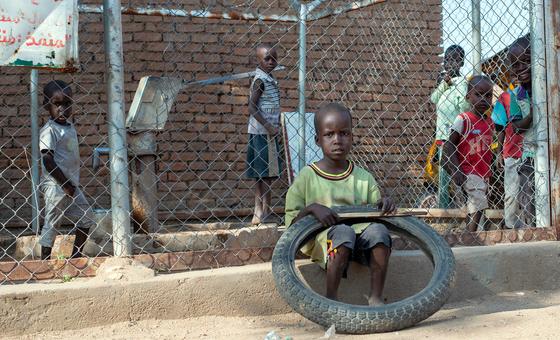
In Jonglei state alone, at least 280,000 people have been displaced by the fighting. Aid officials say most of those forced to flee are women and children.

Many families have sought refuge in displacement camps originally set up during earlier phases of South Sudan’s civil war. Others are sheltering in remote areas with little or no access to basic services.

Children account for more than half of the displaced population. UNICEF warns that many of them face grave risks, including recruitment by armed groups, family separation and gender-based violence.

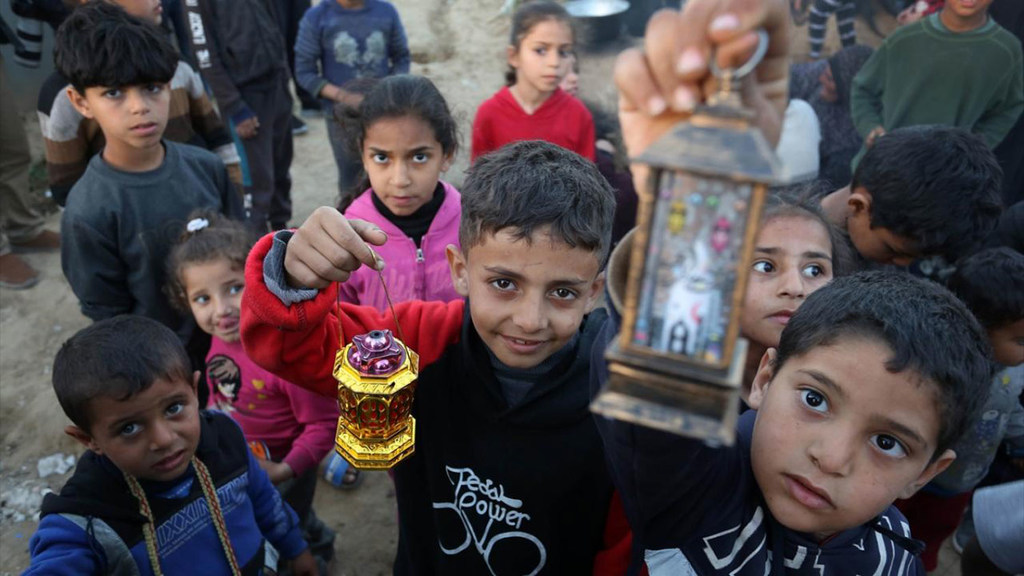
Children in Gaza hold lanterns to celebrate the advent of Ramadan. (file)

Health System Near Collapse

The continuing violence has pushed South Sudan’s already fragile health system to the brink.

UNICEF says at least 11 health facilities have been attacked or looted since the latest surge in fighting began. Several nutrition centres have also been forced to shut down.

At the same time, a cholera outbreak has added further strain. Nearly 500 cases have been reported nationwide, overwhelming treatment centres and stretching limited medical resources.

Aid agencies estimate that about 825,000 children in Jonglei, Unity and Eastern Equatoria states are now at risk of acute malnutrition. Without urgent treatment, severely malnourished children face dramatically higher mortality risks.

Despite the challenges, humanitarian organisations continue to operate health, nutrition and child protection programmes in several parts of the country.

Global Appeal For Peace During Ramadan

Against the backdrop of these crises, UN Secretary-General António Guterres has urged the international community to embrace unity and compassion as Muslims around the world prepare to observe the holy month of Ramadan.

He described Ramadan as a time of reflection and hope, but acknowledged that for many people living in conflict zones—from Gaza and Yemen to Afghanistan and Sudan—peace remains elusive.

“For Muslims around the world, the holy month of Ramadan is a sacred period of reflection and prayer. Ramadan also represents a noble vision of hope and peace.” Mr. Guterres said in a message ahead of the start on Tuesday. “May this Holy Month inspire us to work as one to build a more peaceful, generous and just world for all people,” he said.

Calling for greater solidarity, Guterres urged governments and humanitarian actors to work together to bridge divisions, deliver aid to vulnerable communities and uphold the dignity and rights of people affected by war.

He expressed hope that the spirit of Ramadan would inspire renewed efforts to build a more peaceful and just world.

‘Like a scene out of a horror movie’: UN report warns of war crimes in Sudan’s El Fasher

A new United Nations report has documented widespread atrocities in Sudan’s Darfur region, accusing fighters from the Rapid Support Forces (RSF) and allied militias of carrying out mass killings, sexual violence and other grave abuses during an assault on the city of El Fasher.

The findings, released by the UN human rights office, highlight what investigators describe as a systematic pattern of violence against civilians during the ongoing conflict between Sudan’s national army and the RSF militia.

War In Sudan Enters Third Year

Sudan has been engulfed in a brutal power struggle for nearly three years, with fighting between the Sudanese Armed Forces (SAF) and the RSF spreading across large parts of the country.

Darfur, a region already scarred by earlier conflicts, has once again become one of the epicentres of violence. The UN report focuses particularly on the RSF’s offensive against El Fasher, the capital of North Darfur, which has been under siege.

According to UN High Commissioner for Human Rights Volker Türk, the lack of accountability for past abuses continues to fuel fresh cycles of violence.

“Persistent impunity fuels continued cycles of violence,” Türk said, urging credible investigations and justice for those responsible for the latest atrocities.

Mass Killings And Targeted Attacks

Based on hundreds of interviews conducted with survivors and witnesses in late 2025, UN investigators documented more than 6,000 killings during the first three days of the RSF offensive on El Fasher.

The report cautions that the actual death toll is likely far higher, as the assault continued for weeks and access to some areas remained restricted.

Investigators recorded multiple incidents of mass violence. In one of the most devastating attacks, RSF fighters reportedly opened fire with heavy weapons on a large group of civilians seeking shelter at Al-Rashid dormitory within El Fasher University.

Around 1,000 people had gathered there for safety on October 26, but witnesses said roughly 500 were killed when the fighters began firing indiscriminately.

One witness described the aftermath as resembling “a scene out of a horror movie,” recounting how bodies were thrown into the air by the blasts.

Ethnic Targeting And Summary Executions

The report also documents a series of summary executions carried out inside El Fasher.

According to witnesses, RSF fighters targeted young boys and men under the age of 50, accusing them of collaborating with Sudanese government forces or allied militias.

In many cases, investigators said the accusations appeared to be based largely on ethnicity. Members of non-Arab communities, particularly those from the Zaghawa ethnic group, were reportedly singled out during searches and arrests.

Civilians who were injured or otherwise unable to fight—individuals considered hors de combat under international humanitarian law—were also among those targeted, the report states.

Widespread Sexual Violence Reported

Survivors interviewed by UN investigators described repeated incidents of rape, gang rape and other forms of sexual violence during the assault.

Women and girls from Zaghawa and other non-Arab communities appeared to be particularly vulnerable.

Witnesses recounted cases in which victims were abducted and held for ransom, with sexual violence used as a tool of intimidation and coercion. In other instances, women were assaulted during invasive body searches carried out by armed fighters.

The report also documents cases of torture, forced disappearances, arbitrary detention and the recruitment of children to take part in hostilities.

Possible Crimes Against Humanity

Human rights officials say the pattern of abuses seen in El Fasher resembles earlier attacks carried out by RSF forces in other parts of Darfur during the war.

One such episode occurred at the Zamzam displacement camp in April 2025, where investigators also documented large-scale violence against civilians.

According to the UN report, the scale and organisation of these attacks suggest they may form part of a deliberate campaign targeting civilian populations.

“The acts of violence knowingly committed as part of such an attack would amount to crimes against humanity,” the UN human rights office said.

Calls For Accountability And Mediation

Türk urged all parties involved in the conflict to ensure that forces under their command immediately cease violations of international law.

He also called on countries with influence over the warring factions to help prevent further atrocities, including by respecting existing arms embargoes and halting the flow of weapons into the conflict.

The UN human rights chief stressed the need for stronger international support for mediation efforts aimed at securing a ceasefire and reviving political dialogue.

“In a protection crisis of this scale, human rights must remain central to efforts to achieve a durable resolution of the conflict,” he said.

As fighting continues across Sudan, humanitarian agencies warn that millions of civilians remain trapped in one of the world’s most severe and rapidly worsening crises.

Madagascar: ‘Overwhelming’ destruction, surging needs after back-to-back cyclones – WFP

Madagascar is grappling with a growing humanitarian emergency after two powerful cyclones struck the island nation within three weeks, leaving widespread destruction and pushing hundreds of thousands of people into urgent need of assistance.

The United Nations World Food Programme (WFP) says around 400,000 people are now facing acute humanitarian needs following the storms, which damaged homes, infrastructure and vital services across several regions.

Powerful Cyclone Hits Key Coastal City

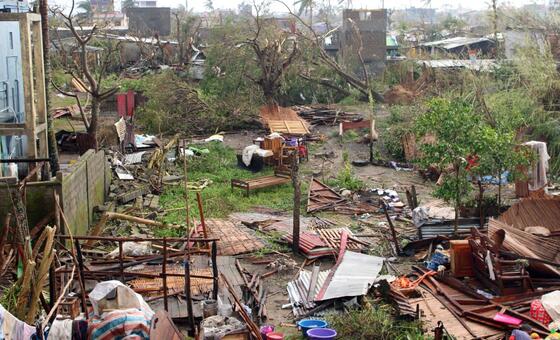
Cyclone Gezani made landfall on Tuesday evening near the port city of Toamasina, also known as Tamatave, Madagascar’s second largest urban centre. The storm brought powerful winds reaching up to 250 kilometres per hour, leaving extensive destruction in its wake.

Tania Goossens, WFP’s country director in Madagascar, described the devastation after returning from a field visit to the city.

“The scale of the destruction is really overwhelming,” she told reporters during a briefing from the capital, Antananarivo.

Local authorities estimate that roughly 80 percent of Toamasina has sustained damage. Essential services have also been severely disrupted, with electricity functioning at only a fraction of normal capacity.

“It’s running on roughly five percent electricity at the moment,” Goossens said, adding that large areas remain without water supply. Even the WFP’s warehouse and office in the city were completely destroyed by the cyclone.

Casualties And Widespread Damage

Initial assessments indicate that at least 38 people have died and more than 370 others have been injured as a result of the storm.

Beyond the human toll, the cyclone has caused extensive damage to homes, businesses, schools and healthcare facilities. The city’s main hospital was among the structures affected.

Goossens said many families have been forced to abandon their homes after roofs were ripped off buildings or entire structures collapsed under the force of the winds.

During her visit to the disaster zone, she saw residents attempting to recover what little remained of their belongings from the wreckage.

“Many are spending the night in homes where the roofs have been torn off,” she said.

Streets throughout the city remain blocked by uprooted trees and debris, making movement difficult. Fuel shortages are also complicating relief efforts.

Families Struggle To Find Food And Shelter

The storm has left thousands of residents uncertain about how they will secure food and shelter in the coming days.

According to WFP officials, many families have lost nearly all of their possessions. Some are sheltering in damaged homes while others have moved to temporary sites with limited facilities.

“Families are telling us that they have lost everything,” Goossens said, warning that access to basic necessities remains a major concern.

Humanitarian agencies are particularly worried about deteriorating water, sanitation and hygiene conditions. Damaged infrastructure and shortages of clean water could increase the risk of disease outbreaks in affected communities.

Aid workers are also monitoring rising protection risks for vulnerable groups, including women, children, elderly people and individuals with disabilities.

Aid Efforts Underway Amid Funding Shortfall

Before the storm struck, the WFP and partner organisations had already begun distributing cash assistance to vulnerable households so they could purchase food and prepare for the cyclone.

Now, the agency is deploying its remaining emergency food supplies to assist affected communities, working closely with Madagascar’s national disaster response teams.

However, Goossens warned that the scale of the crisis is exceeding the resources currently available.

The country was already facing serious food insecurity even before the cyclones hit. According to the latest data from the Integrated Food Security Phase Classification (IPC), about 1.57 million people across Madagascar were experiencing food shortages, with around 84,000 facing emergency levels of hunger.

Concern As Cyclone Season Begins

The humanitarian challenge is compounded by the timing of the disaster. Madagascar is currently entering the peak of its lean season, the period before harvests when food supplies are typically at their lowest.

At the same time, funding shortages are threatening to limit the response.

The WFP estimates that it faces an $18 million funding gap over the next six months to support both lean season assistance and cyclone relief operations.

“We will need sustained support over the coming months to help people recover, rebuild and strengthen their resilience against further shocks,” Goossens said.

With the cyclone season only just beginning, aid agencies fear that additional storms could further strain already fragile communities across the island nation.

Political violence against MPs rising worldwide: IPU


Violence and intimidation against elected lawmakers are rising across the world, increasingly fuelled by online hostility and political polarisation, according to a new report presented at the United Nations.

Martin Chungong, Secretary General of the Inter-Parliamentary Union (IPU), warned that the growing hostility directed at parliamentarians could have serious consequences for democratic institutions if left unchecked.

“If the phenomenon goes uncontrolled, there will be major implications for democracies, parliaments and human rights worldwide,” he told a UN conference in New York on Wednesday.

Online Abuse Dominates Political Violence

The report, titled When the Public Turns Hostile: Political Violence Against Parliamentarians, draws on responses from lawmakers in 85 countries. It also includes detailed case studies from Argentina, Benin, Italy, Malaysia and the Netherlands to examine how the problem manifests in different political environments.

One of the report’s most striking findings is the scale of online abuse faced by politicians. Between 65 percent and 77 percent of members of parliament in the five case-study countries reported experiencing harassment or threats on digital platforms.

The most common forms of intimidation include insults and degrading language, the spread of false or misleading information, and direct threats.

Researchers also found that hostile online behaviour tends to surge during politically sensitive moments, such as national or local elections, heated parliamentary debates or discussions on polarising social and cultural issues.

Women Lawmakers Face Greater Risk

The report highlights a clear gender gap in exposure to political violence.

About 76 percent of women lawmakers reported experiencing some form of abuse, compared with 68 percent of male parliamentarians.

Women are also more likely to face gendered or sexualised harassment, particularly online. Such attacks often include derogatory comments about appearance, threats of sexual violence or attempts to undermine credibility based on gender.

Lawmakers from minority communities, including racial minorities, people with disabilities and members of the LGBTQIA+ community, are also more frequently targeted by online abuse and harassment.

Social Media And AI Amplifying Hostility

The IPU report identifies several factors contributing to the growing hostility directed at politicians.

Rising political polarisation, economic pressures and public frustration with institutions are all contributing to an increasingly confrontational political climate. Social media platforms, researchers say, often amplify anger and misinformation, making it easier for abusive messages to spread widely.

New technologies are also playing a role. The report notes that artificial intelligence tools and deepfake technology are increasingly being used to create manipulated images or videos aimed at discrediting political figures.

Italian MP Valentina Grippo, who is part of the European delegation to the IPU, said lawmakers now face constant scrutiny and criticism in the digital age.

“If you say something that is not perfectly in line with what your audience wants to hear, then you have multiple attacks,” she said in an interview with UN News.

Grippo added that political debate is increasingly shifting away from policy disagreements toward identity-based conflicts.

“You no more have the confrontation between ideas, which is normal, which is part of politics, but you really have a fight between identities,” she said.

Anonymous Users Often Behind Attacks

According to the survey, most incidents of political intimidation are carried out by individuals rather than organised groups.

In the online sphere, anonymous users were identified as the main perpetrators in several countries. Nearly nine out of ten lawmakers surveyed in Argentina, Italy, Malaysia and the Netherlands said anonymous accounts were responsible for most abusive messages.

Chungong said the effects of sustained online harassment often extend beyond digital platforms.

“Those we surveyed consistently told us that sustained online abuse affected their offline behaviour, including their willingness to engage publicly and their sense of personal safety,” he said.

Threats To Democratic Participation

The IPU warns that increasing hostility toward politicians could weaken democratic systems over time.

Many lawmakers reported altering their behaviour to avoid attacks, including limiting public appearances, avoiding controversial topics or self-censoring their views.

Some politicians have also chosen to leave office or decided not to seek re-election because of sustained threats and harassment.

These trends, the report says, could discourage diverse groups from entering politics and ultimately undermine representative democracy.

“It makes it more difficult to somehow be able to deliver a message without fearing that it is misunderstood,” Grippo said, noting that in many parts of the world political expression still carries serious personal risks.

Call For Stronger Political Leadership

The report urges political leaders and parliamentary institutions to set clearer boundaries around acceptable public discourse and to respond more firmly to intimidation directed at elected officials.

It stresses that protecting lawmakers from threats is essential to ensuring that dissenting voices and minority perspectives are not silenced.

The Inter-Parliamentary Union, founded in 1889, is the global organisation representing national parliaments. Today it brings together 183 member parliaments and 15 regional parliamentary bodies, working to promote democracy, peace and sustainable development while defending the rights of parliamentarians worldwide.

World News in Brief: Violence, Terror Attacks And Digital Security Dominate Global Concerns At UN

Rising conflict, humanitarian emergencies and growing concerns over critical digital infrastructure dominated recent discussions involving United Nations agencies and global leaders, with crises unfolding from South Sudan to Pakistan and new efforts launched to safeguard global communications networks.

Fighting In South Sudan Displaces Thousands

Renewed violence in South Sudan’s Jonglei state has triggered a large-scale humanitarian crisis, forcing at least 250,000 people to flee their homes since the beginning of 2026.

The clashes, concentrated in northern and central parts of the state, have left families cut off from basic services in regions already struggling with some of the country’s worst malnutrition rates.

UNICEF warned that the situation poses a grave threat to children, many of whom are already suffering from severe food shortages.

“We are extremely concerned for women and children impacted by these violent clashes,” said UNICEF’s country representative in South Sudan, Noala Skinner. “A malnourished child without treatment is 12 times more likely to die.”

Humanitarian agencies face major obstacles in reaching affected communities. Movement by road, river and air remains heavily restricted, making it difficult to deliver emergency assistance.

Several areas are running dangerously low on therapeutic food used to treat severely malnourished children. Six counties in Jonglei are close to exhausting these supplies.

Across the country, at least 17 health facilities have been forced to shut down due to insecurity, further weakening an already fragile healthcare system.

UNICEF has also reported ten incidents in which health and nutrition supplies were looted.

Despite the challenges, aid workers continue to deliver support where possible. The organisation has sent water purification equipment to prevent potential cholera outbreaks and delivered malaria treatment kits, emergency medical supplies and therapeutic food intended to reach more than 10,000 people.

UN Condemns Deadly Attacks In Pakistan

Meanwhile, the United Nations has strongly condemned a series of violent attacks in Pakistan’s southwestern province of Balochistan that left dozens of people dead, including children.

UNICEF expressed deep concern after reports confirmed that children were among those killed or injured during the attacks last weekend.

“Children cannot be targets nor collateral damage, and their lives must always be protected,” said UNICEF representative in Pakistan Pernille Ironside.

She extended condolences to the victims’ families and warned that escalating violence is creating fear and insecurity among communities.

The attacks took place on January 31 and were later condemned by the UN Security Council.

In a statement issued on Tuesday, council members described the violence as “heinous and cowardly” acts of terrorism that resulted in the deaths of 48 people, including 31 civilians.

Among the civilian victims were five women and three children.

Authorities say the attacks were claimed by the Balochistan Liberation Army, a separatist militant group. Local officials later told reporters that security forces killed 145 members of the banned organisation in subsequent operations.

The Security Council expressed its deepest sympathy to the victims’ families and to the government and people of Pakistan, while wishing those injured a full recovery.

Global Summit Focuses On Submarine Cable Security

In a separate development, governments and industry representatives from more than 70 countries gathered in Porto, Portugal, to address growing concerns over the security and resilience of submarine communication cables.

These undersea cables carry the majority of the world’s digital traffic and form the backbone of global internet connectivity.

During the International Submarine Cable Resilience Summit 2026, participants adopted a declaration aimed at strengthening international cooperation to protect the network.

Today roughly 500 submarine cables stretch across more than 1.7 million kilometres of ocean floor, linking continents and supporting the global digital economy.

ITU Secretary-General Doreen Bogdan-Martin said safeguarding these systems is a shared responsibility.

“When it comes to critical digital infrastructure like submarine cables, resilience is both an end-to-end imperative and a shared responsibility,” she said.

Participants also discussed ways to improve repair times, strengthen monitoring systems and increase investment in infrastructure protection.

Protecting Connectivity For Vulnerable Regions

Experts at the summit warned that cable disruptions can have serious consequences, particularly for smaller countries and remote island communities that rely on only a few connections to the global network.

Sandra Maximiano, chairwoman of Portugal’s telecommunications regulator ANACOM, said international cooperation would be key to reducing the risks.

“I firmly believe the advisory body is already delivering concrete and meaningful impact,” she said, pointing to ongoing efforts to improve preparedness and response capabilities.

The Porto meeting followed the first global summit on submarine cable resilience held in Abuja, Nigeria, as governments and technology leaders seek stronger collaboration to protect one of the world’s most critical digital systems.

UN Condemns Russian Strikes On Ukrainian Cities As Energy Infrastructure Comes Under Pressure

United Nations officials have expressed alarm over renewed Russian strikes targeting Ukrainian cities and critical infrastructure, warning that the attacks are worsening conditions for civilians as winter temperatures continue to grip the country.

Matthias Schmale, the UN Humanitarian Coordinator in Ukraine, said he was “appalled” by the latest attacks reported in the cities of Dnipro, Kharkiv and Kyiv. The strikes have also contributed to widespread power outages affecting multiple regions, including Dnipro, Odesa and Vinnitsya.

Infrastructure Attacks Affect Millions

Schmale warned that continued assaults on Ukraine’s energy infrastructure are placing millions of civilians at risk by disrupting essential services.

“Systematic attacks by the Russian Federation Armed Forces on critical infrastructure affect the daily lives of millions and cause life-threatening conditions for the most vulnerable, including older people and children,” he said in a statement shared on social media.

He also emphasised that international humanitarian law prohibits attacks on civilian infrastructure and called for greater protection of essential facilities that support daily life.

The strikes come as Ukraine continues to face repeated attacks on energy facilities that supply electricity, heating and water to major population centres.

UNICEF Steps Up Emergency Support

In response to the continuing disruptions, the UN children’s agency UNICEF has increased efforts to support basic services across the country.

The organisation has been working to help keep heating systems, hospitals and water supply networks functioning during the cold winter months.

Since November, UNICEF has delivered 106 mid- and large-capacity generators across Ukraine. These units are being used to support water utilities and district heating companies that provide essential services to homes and public institutions.

Another 149 generators are expected to be distributed in the coming weeks to strengthen backup electricity systems and ensure continued operations in key facilities.

UNICEF Representative in Ukraine Munir Mammadzade said families across the country are struggling to cope with the disruptions.

“Across the country, vital services for children and families are strained and parents are struggling to keep their children warm, prepare hot food and access regular running water,” he said.

“These generators will help the brave technicians on the ground to keep systems running, to keep the heating on, hospitals open and water flowing.”

Drone Attack Kills Coal Miners

In a separate incident, UN human rights monitors confirmed that a Russian drone strike killed and injured coal miners in eastern Ukraine over the weekend.

The attack occurred on Sunday in the city of Ternivka in the Dnipropetrovsk region, an area located roughly 65 kilometres from the frontline.

According to local authorities, the strike killed 12 civilians and wounded 16 others.

Danielle Bell, head of the UN Human Rights Monitoring Mission in Ukraine, said the attack highlights the growing risks civilians face even in areas distant from active combat zones.

“This incident highlights the dangers civilians face when hostilities extend into areas of everyday life, even well beyond the active fighting zone,” she said.

Civilians Targeted During Commute

The victims were coal mine workers travelling home by bus after completing their shift at a nearby mine.

Witnesses said several drones struck the road near the bus over a period of several minutes, triggering explosions that shattered the vehicle’s windows and caused heavy casualties among passengers.

Other civilians driving nearby and individuals who rushed to assist the injured were also reportedly among the victims.

UN investigators visited the site on Monday to document the aftermath. They observed two large craters, one in front of and another behind the damaged bus, as well as fragments believed to be from the drones used in the strike.

Survivors Describe Chaos

Human rights monitors interviewed survivors who described scenes of panic and confusion following the explosions.

One injured miner said he managed to escape through a shattered bus window after the first blast. As passengers tried to help one another, a second explosion occurred shortly afterwards.

He told investigators that the victims were ordinary workers simply trying to return home after their shift.

“This is all wrong,” the miner said. “We are ordinary coal mine workers. People were simply returning to their homes, to their families.”

UN officials say the incident underscores the continuing human toll of the conflict, as civilians remain exposed to deadly attacks even far from the main battlefield.